LINES OF THE DAY

". . . But the past does not exist independently from the present. Indeed, the past is only past because there is a present, just as I can point to something over there only because I am here. But nothing is inherently over there or here. In that sense, the past has no content. The past -- or more accurately, pastness -- is a position. Thus, in no way can we identify the past as past." p. 15

". . . But we may want to keep in mind that deeds and words are not as distinguishable as often we presume. History does not belong only to its narrators, professional or amateur. While some of us debate what history is or was, others take it into their own hands." p. 153

Silencing the Past: Power and the Production of History (1995) by Michel-Rolph Trouillot

Showing posts with label capitalism. Show all posts

Tuesday, September 13, 2022

Not the Worst of Times: Covid, Slavery, Global Capitalism, Industrialization

      . . . . . Such thunderstorms last night, Thor level storms, as they woke me twice out of my Omicron vax reaction stupor.  Maybe our drought is over?

It took about 7 - 8 hours post the early AM jab more or less, around about 8 - 9 PM that the reaction to the new vax began to manifest, with the usual fatigue.  Even so, as I'd slept badly, and got in only about 5 hours of sleep the night before, I wasn't sure.  But at 10 I gave up resisting, took Tylenol and retired, while el V read me to sleep from Howard French's Born in Blackness: Africa, Africans, and the Making of the Modern World, 1471 to the Second World War (2021), a long historical study of what the European extraction economy of resources including population, meant for the


development of capitalism and European industrialization, particularly England's

Me had already started feeling a bit achy and chilled.  Woke about 3:30 very achy and chilled, took another Tylenol, drank a gallon of water, and lay there paralyzed for quite some time, mildly hallucinating. More quickly than in the past, the Tylenol did its job, and I only woke because my bladder woke me -- which meant I also drank then, another gallon of water (gallon is rather an exaggeration). About noon I woke feeling more like a person than a disassociated alien in the world.  Now drinking splendid tea and looking forward to breakfast and another Tylonel.  By about 3 PM I'll probably decree the reaction is finished with.

All in all this reaction was several degrees milder than the last two reactions, particularly the one before this. Been jabbed 5 times now for covid.  I suppose will do it again mid-December?  It's clearly worth it, being vaccinated, and I'll keep doing it, and masking.

I have books at the library, which I may attempt to pick up, but I probably won’t work out today, as feeling a little weak, and that electrical shock effect across my back, which has always manifested after the reaction is manifesting at the moment.  Plus have things to organize regarding the trip to New Orleans.  Then must return again to NO almost at once, to do a talk about the contributions of Caribbean slavery to the first globalization and world economy.

In many ways the last weeks have been rough, from the various anxieties around the Colombia trip to Cali and the Buenaventura Pacific Coast, then el V's staph eye infection manifesting in Bogóta, after the Travelers all flew home (nobody got covid -- the protocols were strict, except one, who acquired it, naturally on the plane when returning, but it was very mild).  Everyone had a the most splendid experiences, musical, people-to-people, and even natural -- whales among those -- sounding while on the boat to an island off the coast!  One of the young ladies then continued on alone on her explorations, heading off by bus to Cartegena.

But here at home the whole family in the Midwest got covid, from the baby to the elderly -- from a grandkid's preschool, where a teacher came down with it.  It wasn't  good for everybody.

Before that, our very dear friend, K, had to have sudden, RIGHT THIS MINUTE IF YOU WISH TO LIVE, brain surgery.  Thank all the lordessas the non-cancerous tumor was finally discovered, and discovered just in time -- the tumor was displacing the space in the cranium that the brain occupies.  The surgery was most successful, he's recovering well, but it's a long road, and it's been very painful. So They have him on opiates, which he, characteristically sniffs at, as "a most inelegant drug," and hates it.  But this is also good in a way, because he was determined to stop using the stuff as soon as possible. But the blinding headaches that come and go (the tumor was removed via the nasal passages, which means breaking his nose among other things) kept him from sleeping, so he still needs to resort to them at night sometimes during the week. But he's good, and he sounds wonderful!  The tumor's progress was insidious and going on so gradually that the changes in him he racked up to 'age' and so did we.  But all that aging is gone now, and he's as he's always been -- though in pain, etc. -- and that is WONDERFUL.

Then, our friend, the wonderful Gwendolyn Midlo Hall died, after a long and most important career, that changed how we see and do history (among other things, she created database historiography). 

All the names (107,000) recorded in Gwendolyn Midlo Hall’s Louisiana Slave Database were engraved on 216 granite slabs, mounted on 18 walls.

Her ashes will be buried at the Whitney Plantation Museum, at the Allées Gwendolyn Midlo Hall, that she contributed so much to bring into existence.

Hmm, it seems I'm still quite out of it, as They Say, meaning a little foggy and weak, and o that electrical shock pain across my back is really not what one wants to be feeling.

* What Dr. Deveraux completely missed in his overview on Unmitigated Pendantry recent entry, as to why England industrialized so quickly -- and WHEN IT DID -- is the African Atlantic slave trade, and slavery itself throughout its imperium from the first days.

French's book is just one of many, including ours, in the last decade, decade and a half -- and even before -- that goes into detail about the African-Atlantic slave trade, New World slavery and how this is the road to industrialization and global capitalism.  Never in the history of the world had so much wealth been produced so rapidly -- and all by extracting it from others, right down to the rights to their own bodies, and appropriating it for themselves.  Yet there are always that multitude of the smartest bros in the room who get very angry when this is pointed out, because industrialization only happened because we are such smart engineers and scientists, and, o ya, we have a superior of way of doing everything.  Never a thought given as to how any of this from the 16th through the 19th centuries was financed -- or even, that it had to be financed.

Lordessa are the Brits in their fairy tale rewriting their Royals' history pretending none of this went on, and went on under her reign too.


Sunday, June 13, 2021

Red Letter, Er, Red Number Days, They Are Here

      . . . . Am looking at my wall calendar, above the computer desk. 

O my, there are red reminder circles around quite a few dates!  Which hasn't been the case in nearly 16 months, generally speaking.  Additionally, there are the arrows running across a week of dates indicating when el V leaves for Miami, and when he returns. Holy Cow! He has a research residency at the Ayallah Archive at the Florida International University.  This will include giving a webinar while in residence at the Diaz Ayala Center of Florida International University's Cuban Research Institute on Thursday, July 1, at 2 pm Eastern: "Teaching the Cuban Discography: The Archive as Clave." As the title suggests, he's preparing a course in the Cuban discography.

~~~~~~~

. . . . The long persistent 'heat dome' disintegrated a couple of days ago.  My toes are confused. After such a nice time of sandal freedom, they are back in sox and boots, with long sleeves and / or light sweater outside. Which means that the coming week looks like 'normal' lovely June weather of earlier years.

Nevertheless, it's difficult to rejoyce too much. The They Sayers are saying covid's here for good. Why yes, just forget about that herd immunity fantasy.  Ain't happening, ain't gonna happen, folks. Why yes, this is no kind of surprise.

Due to Delta spread it does seem the UK isn't going to completely open this week, which is good.  But we're wide open here, so we know what to look forward to.

While the new surges in Southeast Asia are of course hitting hard the factory workers who make everything we USians use.  Again, not a surprise, is this? Along with this is the ever-increasing housing crisis in this nation.  Much of this is caused by capitalism, all right. The wide-spread, grinding, relentless poverty -- just starting with utterly unaffordable housing -- in the USA is a deliberate policy choice:

https://www.nytimes.com/2021/06/13/opinion/stimulus-unemployment-republicans-poverty.html?

And yet so many obscenely wealthy wonder why so many of us believe they are the greatest danger to family, community, society and security ever created.

~~~~~~~~~~

. . . .  WATCHING:  Lupin, Part 2, went up on Netflix this weekend. 


My goodness the writers, camera people and editors do tension in this show. It's breathtaking how many narrow escapes upon narrow escapes they can pile up in a single sequence of a single episode.  I've never seen anything quite like this. And while doing so they manage to create visual jokes that add commentary.

For a single sample, in one scene Our Protagonist, Assane Lupin, captured and handcuffed in a police vehicle, stops a station to refuel, naturally requests to use the bathroom -- and of course, hands cuffed behind him, requires assistance from the guardian cop. All through this sequence are people holding hoses and engaged in other activity, that with a restroom in the picture, provides comic, um, er, well ya, relief!  Only the French could have done this so elegantly, subtly, refusing to draw any attention to itself, lacking broad vulgarity (which broad vulgarity, of course the French do as much as every other culture on the planet), while containing wit.

Ya, this show is special in every way, because it is so French, making no gestures toward that blandness of deliberately trying for an international audience. Lupin was conceived from the gitgo for a French audience, not a global one.  The producers are fairly convinced that this is why the show became an unexpected  international blockbuster -- it is relaxed within its French context, from source material to culture to cast, to locations.

~~~~~~~~~~

 
. . . . READING: The Horde: How the Mongols Changed The World (2021) by Marie Favereau. 


Definitely in the top 5 of the books read this year.  I don't like it that I've only a few more pages left to read in this book. It was so pleasant to sink into Eurasia in the era given to us by Chinggis Khan, until the Bubonic Plague and other factors diminished the bloodlines of the Hordes, and the rise of the Ottomans.  Believe it: if you think you know about the Mongols and what they did, you very likely do not, as one learns by reading this book. A solitary sample: how many of us have even considered how much the Hansa trading consortium depended on, and was integrated into the Hordes' commercial system?

Having concluded Justinian's Flea as our bedtime together Read-Aloud, we have embarked on a very old book, recommended by the author of same, but published way back in 1971, Peter Brown's The World of Late Antiquity: AD 150-75. Thus in many ways, presenting a perspective that contemporary scholarship no longer supports. It's a slim book, during which one does frequently observe, "My! how late antiquity has changed in the 21st century!"

We will follow this as our Read-Aloud with The Inheritance of Rome: Illuminating the Dark Ages 400-1000 (The Penguin History of Europe - 2009), by Chris Wickham.  All our faves included -- Goths! Vandals! Mameluks! Mongols! Ottomans!  And most of all, Charlemagne!

I remain puzzled though: why does the Eastern Empire interest me so much less than either the old or new Western Empire, or the Mongols or the Turks?

~~~~~~~~~

* I do not need to be informed that French expression can and does resort to that kind of humor as much as does every other culture in the world. Ha!

Sunday, January 22, 2017

It's Official: Frontier is Awful. And Preposterous Too


     . . . .  Frontier (2016) season one. Canadian Discovery Channel – Netflix.  It's been renewed for a second season already.


It's unclear just when this period costume series is set.  It's evident that it is after the conclusion of the War of Independence, but not necessarily after the the Constitutional Convention and ratification (1788 - 1789).  The neighbors south of the Canadian territories are referred to as "Americans," and we didn't start doing that until about the time of we began the process of separation with Britain at the time of the tea parties, around 1773 and forward.  The series' opening title sequences include a manikin colonial soldier with a musket positioned in front of a red and white stars and bars with a circle of 13 stars on blue field in the corner. It's a cheap mock-up of such title sequences that have been done so brilliantly with visual and graphics and music as in Black Sails and Vikings great intro (though the series itself has turned to merde).


So we have a rough idea of chronology here, which matters considering there are competing 'companies' from ore than one place trying to break the Hudson's Bay fur monopoly for harvest, trade and employment of the Native groups to do the hardest work of the fur trade, which has a long colonial history both above and below the Canadian line, among the colonists / USians, the British companies, the French, the Spanish and the French.  We need to know these matter too in order to figure out who the characters are and why they are so mutually hostile.

But where are we, exactly?  That's even more vague.  Supposedly in The North -- The Wilderness, quite unpopulated by colonists at least, around Hudson Bay and the part of it called James Bay, north of the relatively civilized Montreal. (So we are definitely not in the 1760's, since until then it was French, you know! And supposedly there are now British banks there, as well as Hudson Bay offices and trans-shipment points.)  So when not trekking through seasonally incoherent and inconsistent northern wildernesses, we are trekking between Montreal and Fort St. James, which at this time is merely a rough trading station providing some supplies and sustenance to trappers and hunters, and is also a trans-shipment point for at least the Hudson's Bay Company.  However, people dash back and forth between the Wilderness and St. James with a rapidity that is only more astonishing than the rapidity they make the dashes back-and-forth between St. James and Montreal.

There are lot of good actors in this 6-episode series. But the writers are so awful, that the characters the actors play are probably the most mentally challenged people in North America in 1780's and 1790's -- even more stupid than King George III was about North America.

The stupid things they do, from pretending they are being sneaky and clandestine and hiding identities, to not killing their rivals any time they have a chance -- and instead they talk talk talk talk.


The villain instead of killing his nemesis, Declan Harp, a half Cree and half Irish fellow whose father was a Hudson's Bay employee, played by the rather splendid Jason Mamoa, who has no opportunity to redeem this stupid stuff, tries his best to talk him to death instead.  So Harp is rescued, but only to be so stupid as to go back and peer at his nemesis who had tortured his dead wife and child and tortured him too, and NOT KILL HIM every time he had the opportunity.

Everybody does this bs -- getting away, coming back, getting away, coming back.  While unimportant characters, many of them, are killed frequently in grisly manners.  Though there's always sexual threats against the women, they tend to avoid that -- on screen anyway, thank goodness.  It really makes one think that the writers are all believe they are channeling James Fennimore Cooper of the Leatherstocking Tales.  I pardon Cooper (for that at least) but not these jokers.

Many of the scenes are shot so darkly that no matter what one does, one can barely see what is going on.

Grace Emberly, who naturally owns the only tavern, "The Ale Tavern" in Fort Saint James.  She seems also to be the only woman in St. James, except for her bar maid, Mary, and The Villain's whore-spy, who he transported all the way from London to spy on Emberly.  But despite them all using their very feminine wiles and assets to beguile any and all men, they are not whores, no siree bhob!  Ms. Emberly also wears really nice spandex leggings and trousers and knee high leather boots.  Note, how dark everything is!  The viewer can hardly make out anything.

This was so poorly done that I spent a lot of time clicking away from the netflix screen where the episodes were running to researching the fur companies, the historical situation, checking that women really did not wear such stylishly tailored clothing in the Wilderness that one thought were actually in Montreal in 2017. Additionally -- there are too many parallels between Frontier's plot and characters and the latest great white tv hope, Taboo, to ignore. Whew!

In other words, I watched this so nobody else has to.  I feel so sorry for the actors.  They have all earned better -- well maybe not Katie McGrath, who was Morgana in Merlin and other equally silly productions?

Res police officer, Officer Mathias. played by Zahn McClarnon, whose character is in his own way is as smart as Henry Standing's Bear's character, played by Longmire co-star, Lou Diamond Phillips, and as admirable.

But certainly actors such as Zahn McClarnon, whom I first got to appreciate in the Longmire series. But he got only a single episode in Frontier. Then he was killed, which is what happens, you know, to good Native Americans.

This was Discovery Canada's first scripted drama.  They have a long, long, long way to go -- and they really need to give back the History Channel's Vikings' teleporter too. Worse, it is obvious all the places where the production is pretending, instead of spending money.  For instance there a couple of transition scenes that the viewer is supposed to see as real human beings dressed in red coat Hudson Bay -- or British army uniforms (which is which is n't always clear!). However anyone can see that it is a model of the so-called governor's house and those guys standing there are manikins, not human actors.  Good way to save money, of course.  They also tell us a geat deal instead of showing, and saving more money, by using long quotes on title cards -- one even from . . . Ice Cube!

It's all too bad, because there is so much going for such a series set in these landscapes, during these times, with all these conflicting forces.


Thursday, December 31, 2015

Boston Review Puts TASC in Sydney Mintz Orbit-Obit / Another Counterpunch TASC Review

It gives a funny feeling, on the day before we leave for Cuba that Sydney Mintz has died. And see The American Slave Coast mentioned in the obituary by  Sarah Hill.

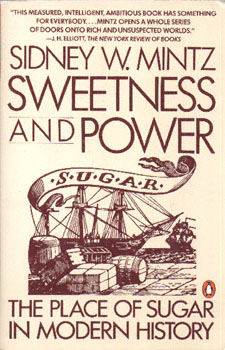
My copy of Sweetness and Power, which I still have.

I first read Sweetness and Power: The Place of Sugar in Modern History (1985) back in 1989-90, before el V's first trip to Cuba. It helped reshape my way of thinking, of seeing our past, along with Fernand Braudel, co-founder of the French school of history known as the Annales. I got el V to read it asap.

It's an honor to have TASC included in a list of like books, influential titles, that the obit writer clearly sees influenced to greater and lesser degree by the work of Mintz.

Alas the obituary writer left out the name of the other author of The American Slave Coast. This may be the first time this omission has happened.  However, the obit writer knew Prof. Mintz well, and surely is grief-stricken.

In the meantime, Ron Jacobs, author of a new Counterpunch review of The American Slave Coast is outraged. In his final paragraph Jacobs says:
Ned and Constance Sublette have provided the world with one of the best history books ever written about the United States. Nominally about the slave breeding industry in the US South, The American Slave Coast is actually a sweeping, in-depth survey of the nation known as the United States. The authors skilfully blend economics, politics, military history and personal narratives into a history volume that stands among the best ever published. Written with an eye on the present–a present where the case of Tamir Rice is but one of hundreds–it is a history with a weight that will never began to be thrown off until it is understood with the same honesty it is told in The American Slave Coast.

Sunday, June 7, 2015

The Edge of the World by Michael Pye

The NYT's Sunday Book Review includes a very good history I read last month, The Edge of the World, by Michael Pye.


This history has one of the best analysis of the other roots of European trade and capitalism in the centuries we used to call the dark ages and the middle ages, before the Age of Nation States. His thesis is the mercantile peoples around the North Sea are as essential to how this process played out as the merchants, traders and money lenders around the Braudelian Mediterranean coasts. Or, as he puts it, he's not denying or minimizing the process that took place in these post-latin empire locations, but that without examination of the Vikings, Frisians, Hansa, etc., the picture is missing essential pieces, particularly how Charlemagne's Empire operated on these foundations that eventually merges the north and south into, for a while, the European Christendom.


Pye, perhaps sensitized by being a gay man, instead of employing the default "he" tends to employ "she" which always caught my attention, proving how deeply run the gender assumptions in history, whether written history or history merely referred to.

He also gives women as traders and entrepreneurs adequate space in his text, drawing attention to how central women commonly were in the trade and financial history of Europe -- and which is hardly ever included in the landscape portrait in the histories of trade, finance and money, at least until recently, and then confined still mostly to monographs, dissertations and narrowly focused scholarly works. Pye includes the many significant contributions of women without exaggerating or special pleading.

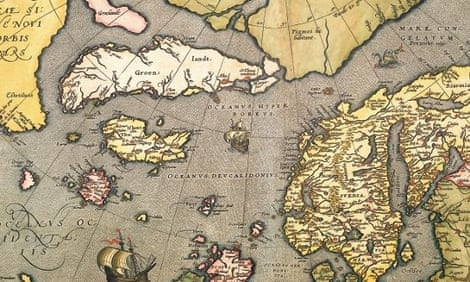
Map of the Hanseatic League
One of the two most fascinating revelations in The Edge of the World for this reader is his nuanced description of what the Hansa was and how it operated. In those days already, it was pure, unchecked capitalism. The Hansa existed for one thing, was concerned with one thing only -- making money. The Hansa

In het midden van de vijftiende eeuw beleefde de Hanze zijn hoogtepunt. Haar invloed strekte zich uit tot de mondingen van de Rijn en Maas, Engeland, Finland en Estland. De handelaren hadden in deze periode dankzij hun economische invloed en militaire kracht zoveel macht, dat ze zelfs het beleid van het Heilige Roomse (Duitse) Rijk wisten te beïnvloeden.
acknowledged no responsibilities, no obligations to humanity, community, even family, and certainly not to any lord, and not even to its own people. Its only concern was to make money and make more money. The destruction this unfettered, unregulated system caused is well described, again without exaggeration or dramatizataion. The reason the Hansa eventually fell apart was the rise of the monarchal nation-state, which was the only entity large enough, and powerful enough, to have a military arm that could check the Hansa operations because it was richer, i.e. had more resources and income streams via taxation than the Hanseatic League could muster.  In conflicts then, with monarchs, the Hansa lost its bases and resources, overpowered by monarch's armies.

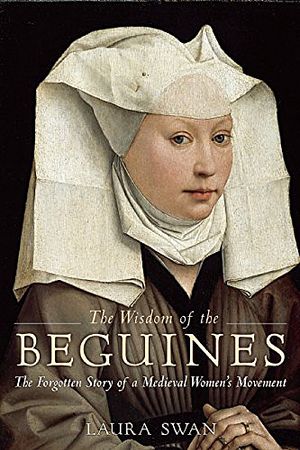
The second revelation were the Beguines, of whom I'd not heard of previously, as I'm not a medievalist.

How they dance beguine in the Caribbean

How Eleonar Powell and Fred Astaire tap-dance the beguine in "The Broadway Melody of 1940"

Cole Porter plays "Begin the Beguine"

The beguine I knew is a popular, social dance, with accompanying songs and rhythms. The beguine appeared in the French Antilles, back in the earlier decades of the 20th century, built, as are so many of the musics of the Caribbean on what we call the habanera.

In this case however, the Beguines were women who lived secular yet ascetic, scholarly yet entrepreneurial lives in compounds separate from men and heterosexual society in the 12th, 13th and 14th centuries in middle-northern Europe, particularly the Low Countries.  The compounds housed only women and their children. They were not affiliated with the Church. There were no vows. They could leave any time, and they could marry if they wished -- though with marriage they had to leave the béguinage community. Some of them


became very wealthy through trade and other mercantile activities. Most histories of the Beguines concentrate on the mystical aspects of some of the women, and the turn toward more overtly religious activity that happened in the 14th century. Pye, however, isn't interested in that aspect, but in what the histories hardly ever elaborate on or even mention: the forms of work and money-making the women of these communities practiced -- and their literacy.  Some of them were notable


scholars.  I kept thinking what a haven the Beguine communities must have been for so many different kinds of women, particularly in a day when there was really no language to even think about diverse orientations that we now group under the classification of  or gay. As a beguine you need not marry and you most certainly were about working.  You could exist as a single woman!  Though now mostly affiliated with the Church in some manner, beguine communities still exist.

Throughout The Edge of the World 's  prose is lively and fast-paced, yet packed with information in every sentence that will be new to many if not most readers who are not scholars of these centuries.

Friday, May 1, 2015

Capitalism and Slavery

 Check it out, here!

The opening paragraph:

Last week, Columbia University presented the Bancroft Award to two books that directly address the relationship of capitalism, slavery, expansion, and empire: my The Empire of Necessity: Slavery, Freedom, and Deception in the New World and Sven Beckert’s Empire of Cotton: A Global HistoryBoth are part of a renewed scholarly attention to capitalism and slavery, carried out by historians such Walter JohnsonEdward BaptistCalvin Schermerhorn,Bonnie MartinKathryn BoodrySeth RockmanAda FerrerAdam Rothman, and Caitlin Rosenthal (and keep an eye out for Ned Sublette’s and Constance Sublette’s forthcoming,The American Slave Coast: A History of the Slave Breeding Industry).
The American Slave Coast, btw, is now available for pre-orders, hereand here, andhere.  Also here.


This is the very first public/media mention of TASC. One couldn't have asked for a better first mention.

Tuesday, March 31, 2015

Bancroft History Prize + -- the Return of el V!

So many very fine history titles came out last year that the judges awarded the Bancroft Award to two titles. The Bancroft is one of the oldest and most prestigious history prizes given out in the U.S.  I don't think it is ever awarded to anyone who isn't an academic (which means TASC automatically wouldn't be considered, though the prize-winners are often published by non-academic, trade/commercial publishers. It is sponsored by Columbia University so that would make sense.

This year Greg Grandin's Empire of Necessity won along with Sven Beckert's Empire of Cotton. Both authors received a fair amount of media attention when their books came out -- at least here.  Grandin is well known already, and won other awards. We don't know Beckert but Greg's an amigo.


Both books deal with the global aspects of capitalism, cash crops, slavery and the slave trade. They're both "Big Picture" histories.  Both books are eminently readable though their authors are academics.

I mention the readability because I've been frequently seeing online this winter that academic histories cannot be big picture and cannot be written in accessible, readable prose, and thus are objects of derision. This appears to be repeated mostly by non-professionals and non-historians and by those who are uninterested in history, so uninterested in history, that they flat-out deny it's a discipline and profession at all. Academics do, of course, worry about readability and accessibility -- but many of them, like most people everywhere, aren't gifted writers, thus  we still have all these works that don't read well -- which is too bad, for them, but most of all, for us, as readers and scholars.  (Of course, a great deal else goes into the research of history beyond reading and writing, including math, archeology, statistical analysis, and other sorts of data mining.)

I've paid particular attention to this year's winners because both Grandin and Beckert deal with some of what TASC deals with (in fact, Cuba and Its Music is cited in Empire of Necessity). Another reason is I'm reading 


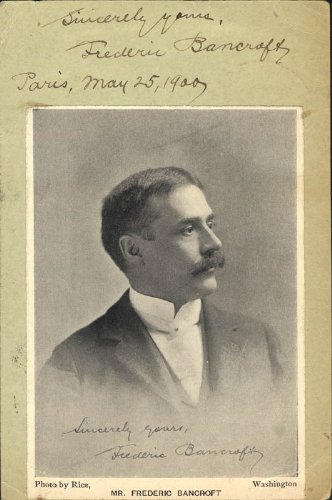
Foner's Gateway to Freedom: The Hidden History of the Underground Railroad (2015), for which much of his research took place in Columbia University's Butler Library's Rare Book collection (i.e. includes papers and archives). Two summers ago we did a great deal of research there in the papers of Frederic Bancroft. 


Not only did he establish and fund the Bancroft History Prize, but he's the founding father of the history of the U.S. domestic slave trade studies, with his self-published Slave-trading in the Old South (1931).


Slave-trading in the Old South was self-published because he could afford to pay for it (which was very expensive in those days). In this era the southern revisionist vision of the antebellum south and slavery dominated the current publishing industry as it did politics and history. Since he could afford to self-publish Bancroft chose to side-step embarrassing rejections from all those editors -- many of whom he knew well, as he, like they were, was among America's aristocratic class -- and thus avoid embarrassment all around.

Additionally, Bancroft was a contemporary of Henry Adams and other American aristocrats, within and without the discipline of history, whose works we've read thoroughly throughout the process of researching and writing The American Slave Coast.

Not that any of this matters to anyone but myself, but I like to keep track of these moments where I feel part of the mighty currents that make up the study of Matter of America and its history.

-----------------------

El V comes back tonight, late. The weather is not pleasant, so this time he won't be bringing nicer weather with him upon his return, as he so often when having been away.  I've missed him so much!


Sunday, December 21, 2014

Solstice Day

The week leading up to the winter solstice is one of the most beautiful weeks of the year, particularly when the daylight hours are tenebrous, filtererd through lowered, occluded skies.


The effect is that of the silver backing on glass, throwing mirrored images from earth to heaven and back down again, punctuated by the brilliant colors of the holiday lights lighting windows, buildings and streets with as much cheer as at night.

Yesterday the temperature was firmly set just at 32, so, no happy birds dancing about in the Nativity stable. A slight flurry of snow sparkled around me as I bustled along. Apartment mates were shopping together for the Christmas tree to be the centerpiece of their Christmas party. A pedestrian sauntered along wearing a wool hat with reindeer antlers. Young women carried shopping bags blazoned with the logos of expensive stores, filled, no doubt with what they wear to this weekend's parties. Raffetto's (est. 1906!) was packed with people. I felt alive-O! I also knew the snow flurry was just that and wouldn't last long.

Feeling so Christmassy, then the arrival of unexpected news (which can't be spoken yet) that is like a huge gift out of the blue, planning the preparation of the pork shoulder for the Christmas Eve pulled pork, looking forward to today's Solstice party.

Then we wake to learn of this.

A lone, mentally ill, black man shot someone in Baltimore and then came here and shot two cops sitting in their car in Brooklyn, then went a subway station platform and shot himself. The NYPD union heads, already furious with the Mayor, are screaming that de Blasio is the one who murdered these police, and started a twitter feed with #bluelivesmattertoo.  That hashtag is a declaration of war on the rest of us.  They are COPS and we, we are merely civilians.  That


language is militarized, not the language of policing.  This shooting is NOT the same issue as "Hands Up Don't Shoot", which is about being killed by police for being a person of color.  Most of all, what does de Blasio's actions have to do with this murder?  The man who is responsible didn't even live here, at least not at this time -- he seems to have some connection with Brooklyn in his earlier years.

OK. Why it is when a white guy does something awful, it's always just a lone deranged white guy, not a conspiracy, i.e. as with John Wilkes Booth, which was a conspiracy. Why is it that those who want to go back to the conditions of, at least, Jim Crow, always need to steal music and slogans from black people and progressives?

OTOH, my own sense is that the Black Lives Matter -- I Can't Breathe -- Hands Up Don't Shoot -- protests have focused rather too much on the cops per se rather than on the broken and delegitimated justice system, which is about feeding poor black bodies into privatized prisons, supported with tax dollars, which further are a pool of basically unpaid labor providing even products to the luxury market such as fine bed linens.  But that's too complex for a march, right? Nobody knows all that history or cares about it, right?

I am conflicted about pushing these thoughts away for a few days, and concentrating on feeling as good as I get to feel ....

Saturday, November 8, 2014

Egypt in 1862 -- Photographs

"Francis Bedford’s astonishing photographs of the 1862 royal tour" --.

These are photographs of the four-month tour of the Middle East in 1862 of the 20-year-old Prince of Wales -- sent off by Queen Victoria and Albert, as both punishment and cure for Bertie's discovery that he could have sex.  Before the Prince of Wales set off, Albert died, and Victoria disliked her son and heir even more.

Click the link for more photos of the from the trip in the Guardian photo gallery.

Talking about this article with a friend, her take away was that nobody in the royal family could even sneeze without the Royal Permission, and how stifling and suffocating this had to be.


1862. Alix and Minnie with their mother Queen Louise of Denmark.
Which led me to observe that the clothes alone, for both men and women, were stifling and suffocating, and the higher up the social scale, the more clothing was heaped upon the body, concealing its natural shape and form, making it the more difficult to move -- particularly for women.  Good thing that servants were cheap in those days and one could mistreat them pretty much at will ....

Thoughts about European clothing of 1862 are prompted naturally by an observation in the article about the Christian (Druze) and Muslim conflicts in Lebanon:
Even the cheapness of English cloth had sharpened resentments between the various groups, enriching the Christian agents of the Manchester houses and impoverishing Muslim weavers – unintended consequences of the Industrial Revolution and globalisation.
Now I'm curious as to what happened with the Muslim weavers in the next few years, as this was 1862, and the British factories were soon going to starve as the Union blockade of the Cotton Kingdom's product got more effective. This, in

Mehmet (Muhammad) Ali of Egypt, who began the large-scale cultivation of cotton in Egypt.

turn, set off in Egypt, what is still historically called the "cotton boom," to supply the English textile industry.  Note: the Egyptian cotton boom was accomplished by slave labor ....


Saturday, September 27, 2014

Why Banks Don't Worry About the Fed


A confidential report and a fired examiner’s hidden recorder penetrate the cloistered world of Wall Street’s top regulator—and its history of deference to banks.
by Jake Bernstein 

This American Life audio version can be heard here

It is essential reading / listening for every one who is affected by the boom and bust cycles, both of which tend to make the 99% poorer and the 1% richer, that the U.S. calls an economy.


As are the members of the Federal regulation investigators who do the job they are hired and paid to do -- when they do it they get fired.  Like Carmen Segarra.

Monday, September 15, 2014

The Economist's Anonymous Historians Mean To Slavers Whine Continues to Give

This time from Greg Grandin, whose latest book, Empire of Necessity, Freedom and Necessity in the New World, which looks at the relationship of slavery and the trade in all the Americas with 18th and 19th century global capitalism. It too got bitch-slapped in the Economist when it came out. *


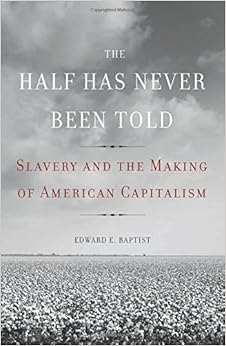
Edward Baptist, author of The Half Has Never Been Told, the study of U.S. Cotton Kingdom slavery and the global capitalist revolution. The snarky, ignorant review in The Economist ignited a fire storm so great the magazine pulled the review and apologized.  The firestorm, however, continues -- here, and many other sites.
From Greg's article in The Nation:
Quote:The Empire of Necessity tries to establish the dependent relationship of slavery to the capitalist revolution of the eighteenth and nineteenth centuries in all of the Americas, north and south, and presumes to use Herman Melville as embodying the moral complexities of that relationship. In other words, there’s a lot going on in the book. But the reviewer seemed only excited to find a few instances confirming that the trans-Atlantic slave system was not universally, 100 percent, absolutely, totally, categorically, “a matter of white villains and black victims.” “As is commonly supposed.” “Blacks,” he or she was happy to report, “profited from the Atlantic slave trade.”

The reviewer then complained about the book’s gloominess: “Unfortunately, the horrors in Mr Grandin’s history are unrelenting. His is a book without heroes. The brave battlers against the gruesome slave business hardly get a look in, although it was they who eventually prevailed.”One might think that “brave battlers” would be a good description of the group of West Africans who led the slave-ship revolt that is the book’s set piece. Having endured horrific captivity and transport, forced not just across the Atlantic but the whole American continent into the Pacific, the deception they managed to pull off under extremely hostile conditions was, I’d say, heroic. 
Slavery might not be black or white, but bravery and morality apparently are: whites possess those qualities, a possession that merits historical consideration; blacks don’t, at least according to The Economist. The Empire of Necessity didn’t “credit” William Wilberforce, the white reformist MP, or white abolitionist evangelicals and Quakers, for ending slavery. Nor, the reviewer points out, did I make mention of the British Royal Navy freeing “at least 150,000 west Africans from slave ships during the 19th century.” The book isn’t about abolition, or, for that matter, the British Royal Navy. No matter. “The British historians,” wrote the great historian of slavery, Eric Williams, “wrote as if Britain had introduced Negro slavery solely for the satisfaction of abolishing it.” So too, apparently, anonymous Economist reviewers.
This bit, quoting from The Atlantic Monthly's pundit, the British James Fallows, is fun:
Quote:
The review itself was written in that smarmy style that makes US corporate managers and hedge funders swoon, identified some time ago by James Fallows as “colonial cringe.” Readers on this side of the Atlantic assign an Oxbridge accent to the text, which “involves a stance so cocksure of its rightness and superiority that it would be a shame to freight it with mere fact.”
Greg further informs us how far back and how deep are the roots of The Economist's pro-slavery and racist biases. In the U.S. Civil War The Economist was just about the only British publication that bellowed in favor of British support of the CSA and slavery.  I recall Henry Adams and his father's profound disgust for this at the time, so much so they could barely bring themselves to mention the publication at all, even to criticize its lies. 

--------------------

* Full disclosure, el V's is referenced, and is among the acknowledgments for Empire of Necessity.

Friday, September 5, 2014

Economist Magazine's Reviewer's Feelings Hurt By Book About Slavery and Capitalism

White slave owners and traders are pictured as victimizers and enslaved people as victimized!  This is advocacy not history, shrills anonymous reviewer of The Half Has Never Been Told: Slavery and the Making of American Capitalism by Edward Baptist.


I have read the book. The title is perfect
because the whole story is still not told.
Though most of what is in his book is in
The American Slave Coast, there's a
great deal more in TASC -- but then
TASC is much longer and covers the
entire period of legal slavery in the U.S.
Each book focuses on different aspects of 
of slavery and capitalism in the U.S.

In the wake of Ta-Nehisi Coates tweets about it, The Economist felt it necessary to apologize and withdraw the review:

Apology: In our review of “The Half Has Never Been Told: Slavery and the Making of American Capitalism” by Edward Baptist, we said: “Mr Baptist has not written an objective history of slavery. Almost all the blacks in his book are victims, almost all the whites villains.” There has been widespread criticism of this, and rightly so. Slavery was an evil system, in which the great majority of victims were blacks, and the great majority of whites involved in slavery were willing participants and beneficiaries of that evil. We regret having published this and apologise for having done so. We have therefore withdrawn the review, but in the interests of transparency the text remains available only on this special page and appears below.

And here it is, and how typically ignorant it is. This anonymous person even drags up that very disproved "fact" that slaves were not badly treated because they were too valuable to be mistreated. That this is mendacious is proved with every account of slavery one reads.  More important than a slave's value were two other parts of a slave society: profit, and in the case of U.S. southern slavery in particular, white supremacy of the "black" body -- though as the generations rolled on the general lightening of the enslaved population became ever more noticeable.


[ " “FOR sale: a coloured girl, of very superior qualifications…a bright mulatto, fine figure, straight, black hair, and very black eyes; very neat and cleanly in her dress and person.” Such accounts of people being marketed like livestock punctuate Edward Baptist’s grim history of the business of slavery.

Although the import of African slaves into the United States was stopped in 1807, the country’s internal slave trade continued to prosper and expand for a long time afterwards. Right up until the outbreak of the civil war in 1861, the American-born children and grandchildren of enslaved Africans were bought cheap in Virginia and Maryland to be sold dear in private deals and public auctions to cotton planters in the deep South.

Tall men commanded higher prices than short ones. Women went for less than men. The best bids were for men aged 18 to 25 and for women aged 15 to 22. One slave recalled buyers passing up and down the lines at a Virginia slave auction, asking, “What can you do? Are you a good cook? Seamstress? Dairy maid?” and to the men, “Can you plough? Are you a blacksmith?” Slaves who gave surly answers risked a whipping from their masters

Raw cotton was America’s most valuable export. It was grown and picked by black slaves. So Mr Baptist, an historian at Cornell University, is not being especially contentious when he says that America owed much of its early growth to the foreign exchange, cheaper raw materials and expanding markets provided by a slave-produced commodity. But he overstates his case when he dismisses “the traditional explanations” for America’s success: its individualistic culture, Puritanism, the lure of open land and high wages, Yankee ingenuity and government policies. 

ake, for example, the astonishing increases he cites in both cotton productivity and cotton production. In 1860 a typical slave picked at least three times as much cotton a day as in 1800. In the 1850s cotton production in the southern states doubled to 4m bales and satisfied two-thirds of world consumption. By 1860 the four wealthiest states in the United States, ranked in terms of wealth per white person, were all southern: South Carolina, Mississippi, Louisiana and Georgia.

Mr Baptist cites the testimony of a few slaves to support his view that these rises in productivity were achieved by pickers being driven to work ever harder by a system of “calibrated pain”. The complication here was noted by Hugh Thomas in 1997 in his definitive history, “The Slave Trade”; an historian cannot know whether these few spokesmen adequately speak for all. 

Another unexamined factor may also have contributed to rises in productivity. Slaves were valuable property, and much harder and, thanks to the decline in supply from Africa, costlier to replace than, say, the Irish peasants that the iron-masters imported into south Wales in the 19th century. Slave owners surely had a vested interest in keeping their “hands” ever fitter and stronger to pick more cotton. Some of the rise in productivity could have come from better treatment. Unlike Mr Thomas, Mr Baptist has not written an objective history of slavery. Almost all the blacks in his book are victims, almost all the whites villains. This is not history; it is advocacy. " ]

By the way, Lord Thomas concentrates his studies on colonial Caribbean and South American slavery, which are his areas and eras of expertise.  He is by no means an expert on the history of the southern U.S. slave society, which differed so much in so many ways from that further south of us, and particularly from the colonies with French and Spanish imperiums' legal systems and codes.

What I can't figure out though, is why The Economist even allowed this review to run at all? Surely they're brighter than this and better informed than this? Except, surely, they knew something like this would appear in the review since they chose whoever-it-was to review it.  It's so convenient for The Economist and its writers to not have by-lines, and not to have ever allowed them, as far as I know.

Friday, August 15, 2014

Charlotte Bronte's Shirley -- End Of Summer Reading Historical Fiction

Last night I began to read Charlotte Bronte's second published novel, Shirley (1849).  It seems the perfect novel to carry me through the change of seasons from summer to autumn, both long enough while engaging enough, with several themes.  Not the least of Shirley's engagements is that it presents dilemmas and problems for all the readers -- and even scholars -- who are insistent upon presenting Charlotte Bronte and her protagonists as feminist and politically liberal.


Shirley, though classified as a social novel, is neither feminist nor liberal, particularly in its outlook of Yorkshire textile laborers particularly, or the lower classes in general.  This may explain why Shirley is so unpopular generally with not only Bronte-ists, but those who study the history of the novel in English -- so much so that a surprising number of those who are well educated in The Novel, are unaware that Charlotte Bronte wrote this novel.


The edition I chose to read was not my falling apart Penguin copy acquired a millennium ago while an undergrad, but a newer Penguin edition with an introductory essay (2006) by the excellent Bronte scholar, Lucasta Miller.

The other primary reason I chose Shirley is that as well as being classified as Bronte's only social novel, it is considered an historical novel.  The novel's chronological location is specifically told the reader on page 1 as, "eighteen-hundred-eleven-twelve." I.e., we're in my favorite war (speaking historically), the War of 1812.  Britain, like Napoleon, had levied an embargo upon trade with "America" (which included grabbing every U.S. ship they encountered -- if they could) thus the Yorkshire textile manufacturers, like so many other industrial employers, had closed their mills or greatly reduced activity and workforces.

The narrator so informs us, in a one-sided explanation, on page 25, second


chapter, as spoken by the half French-Antwerpian, Robert Moore, owner of the Hollow's mill:
"I am very rich in cloth, I cannot sell; you should step into my warehouse yonder, and observe how it is piled to the roof with pieces.  Roakes and Perason are in the same condition: America used to be their market, but the Orders in Council have cut that off."


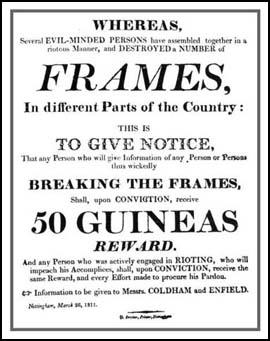
This is the period of the Luddite uprisings, as the manufacturers like Roger Moore, with the capital to do so, are installing more efficient machines that require fewer workers.

Bronte expands on the Orders in Council and unemployment on page 29-30:
"The 'Orders in Council,' provoked by Napoleon's Milan and Berlin decrees,* and the forbidding neutral powers to trade with France, had, by offending the Americans, cut off the principal market of the Yorkshire woollen trade, and brought it consequently to the verge of ruin. Minor foreign markets were glutted, and would receive no more: the Brazils, Portugal, Sicily,**were all overstocked by nearly two years' consumption. At this crisis, certain inventions of the north, which, greatly reducing the number of hands necessary to be employed, threw thousands out of work and left them without legitimate means of sustaining life.  A bad harvest supervened.  Distress reached its climax....
This is the first time I've undertaken a Shirley re-read since having lived in New Orleans and on the Chesapeake, major grounds and objectives for the Brits in the War of 1812.

As for the plan that was to be a reading transition from one season to another -- well, Climate Change evidently made another plan.  When I left for the libary before 10 AM the temperature was 64 degrees.  Big brown leaves were being blown off the plane trees in droves.  This is like no August I've experience here ever.  The long term weather forecasts are saying we're going to continue with temperatures generally lower than usual, November is going to be wet, and winter will began early and be close to the brutal thing is was last go-round.  I'm going to be extra-careful not to catch a sinus infection in November or break my elbow in January as I did last time.

----------------------

*  Napoleon's monstrous egomania and British arrogance were equally responsible for the embargo. All nations' trade was caught between the hammer and tongs of the British and French navies.  Indeed, when Denmark insisted on her right to continue trading as she wished, and an ally with Britain against the French, the British navy shelled Copenhagen, burning much of it to the ground, in 1807.

 ** Not to mention being under siege in one way or another, as with Sicily to where the King of Naples had fled, and Portugal, as part of the very long and brutal Peninsular campaign -- Bronte is frequently hazy, to put it generously, with her information about many aspects that she mentions regarding trade, the military and politics, despite her passion when younger for heroes such as Wellingon and Napoleon. Her forte is the personal, always.

Additionally she was writing this some decades after it took place; she was born when it was all over, in 1816.  Thus Shirley gets classified by some as an historical novel.  I'm not sure I agree, however, any more than I can think of Middlemarch as an historical novel.  Though set in the 1830's of the Reform Movement bills, Eliot, born in 1819, was more than old enough, particularly with her father profession and their common interest in public issues and politics, to remember the time well.  As well, the Reformist movement returned to the public stage in 1860.


Tuesday, August 12, 2014

Continuum - Season 3

As of last night's dinner-preparation hour I'm nearly half way through watching Continuum's third season.


Season 3's plot lines and the characters themselves are complicated.  Part of the complication involves Alec Sadler, one of the three principal characters, being present as two; i.e. one from the timeline (I think ...) we've been in since the beginning of the show, and the other from another timeline branch, and they're existing simultaneously in the same timeline -- though I'm not entirely clear whether this timeline is the series' original timeline.  I may have forgotten some essentials from watching seasosn 2 last year at this time.

This season also began with two of the protagonist-protector from 2077, Kiera Cameron, but immediately one of them is shot dead.  The killed Kiera was the "original" Kiera known from the series's start by her contemporary Vancouver


police force partner and friend, Carlos Fonnegra. That there are / were two Kieras is known to him almost immediately.  He sees this Kiera as different the first one, and isn't sure he either likes or trusts the second one.

Second Kiera doesn't like First Alec or trust him, but seems to like and trust the second one.  Further complications are created by First Alec learning that his first love, Emily, wasn't what he thought she was, while Second Alec, who was the first Alec, traveled back in time a week to save Emily's life, after she's killed in the first timeline. First, now Second Alec, still loves Emily, no matter what.

If others can follow all this with no difficulties they are much better viewers than I am.  In the meantime, as the two Alecs and the Second Kiera dash about, the timelines are getting ever more muddled and history in the past and the future is changing. This further complicates the plots because it's not always easy to distinguish what seem volte faces of characters and their relationships with each other as they seemed previously.

Further we're presented with Kiera's past -- which is still in our future --  beginning when she's still a young girl, and not yet a Protector.  But -- is her time traveling changing her past as well?

Tonight I'll watch the seventh episode (there are thirteen), and will perhaps understand things better.

As well, I am hoping that Alec Sadler, who the series isn't about --

Note: the captions says "the future is in her hands."
it's Kiera's show -- isn't edging the focus from her to himself.  The show couldn't handle two Kieras -- i.e. two supercompetent females leads --  but we have two Alecs, and the Alecs are supergenius-nerds, who are getting at least twice the amount of screen time than previously.

What I'm like most about Continuum, is how well the writers are connecting labor, capitalism, and the corporate state with the police state, in both our present and the future.  Indeed, in Kiera's future, the state has gone full circle in which every person owes a life debt to the state -- which is connected to one's economic status --  which debt gets adjusted in various ways  up and down, including execution when the debt is greater than one's economic value.  This value is assessed by many criteria: treason is of course a debt that merits execution. This sort of conceptualization seems to indicate the writers have carefully read at least the first


sections of David Graeber's Debt: The First 5,000 Years (2011).

So far though, Continuum's writers haven't overtly connected these conditions to so many jobs being performed by robots and other automation,* though it is implied, whenever there are scenes set in a college or university, and the many public protests included throughout the seasons' episodes.  It's this that makes the over-arching time lines of both "present" and future so plausible in Continuum.

Continuum does seem to be asking the important questions, and further inquires, what are the answers, and how can we get to them?

Alas, so far, there's been no hard announcement there's going to be a season 4 of Continuum, though it was scheduled to be made "early in August."

----------------

*  Just this week: room service and check-in desk will be robots:


the Aloft Hotel in Cupertino, Calif,  ... will begin using an R2D2-esque robot for such trips. Fittingly, Aloft’s parent company, Starwood Hotels, tests the latest technology at the Silicon Valley hotel. Guests can enter their rooms with a smartphone app and bypass the traditional check-in process at the front desk.

So very soon now, not even turning your city, your region into an extractive, toxic tourist playground will provide even the most menial of jobs, that are always touted as "jobs creation," and o so good for the economy.