LINES OF THE DAY

". . . But the past does not exist independently from the present. Indeed, the past is only past because there is a present, just as I can point to something over there only because I am here. But nothing is inherently over there or here. In that sense, the past has no content. The past -- or more accurately, pastness -- is a position. Thus, in no way can we identify the past as past." p. 15

". . . But we may want to keep in mind that deeds and words are not as distinguishable as often we presume. History does not belong only to its narrators, professional or amateur. While some of us debate what history is or was, others take it into their own hands." p. 153

Silencing the Past: Power and the Production of History (1995) by Michel-Rolph Trouillot

Showing posts with label European Culture. Show all posts

Thursday, March 9, 2023

You Can Drink the Tap Water in Spain

      . . . .  Madrid's tap water made all the difference for recovering from dehydration caused by jetlag, adjusting to the altitude, and thorough upset of usual metabolic routines.  I drank gallons and gallons.  Recall, high altitude also promotes dehydration, which dehydration in these circumstances makes jetlag, lack of sleep and metabolic interruptions so much worse.

Madrid's on a plateau surrounded by impressively jagged mountain chains.  It was spectacular as they appeared out of the clouds, snow-covered points and sides, as we were in that long descent to the airport. I recalled how moved and impressed I was waking to the view below of southwestern France, the vast forests, mountains, ravines and farmlands.  It was the same this time, except it wasn't Gaul, but Iberia, and it looked in terms color and soft shapes like all those paintings we know -- except this was real.  Then, suddenly these ominous mountains  . . . with steep ravines and foothills seemingly impassable except to those who know.  This is a Transhumance world.  There is even an upcoming festival in Madrid to celebrate the ancient Iberian Transhumance way of life.  El V recorded me, it turned out, face pushed against the window, eyes wide, repeating, "Wow," over and over.

It moved me, like that flight over southwestern France, this in my own eyes revaltion of what Spain is, it's history going back at least to the Phoenicians, the Romans and the Visigoths, particularly about Madrid, why it is here.  Recall, there is so little Islamic presence in the region as to only a single archeological artifact's survival of their barely there footprint, the antipodes of Southern Spain. Knocked me out, it did.

The observance of Women's International Day -- there is a lot to say about that, because we were right in it.

Can't believe we've been here just about 48 hours, as months of activity feel have happened.  However, jetlagged, needing to adjust to altitude, and the disruption of usual metabolic routine, while NO usual exercise, though a lot of walking is going on, up and down -- remember those mountains, hmmmm?  Plus eating so well, and o lordessa, in heaven, drinking wines made right here.

In the meantime too, when it comes to hotels, restaurants, art and entertainment, Madrid is so inexpensive, particularly compared to NYC.  Don't forget, that like the other European nations, i.e. the EU, Spain supports art and literature and entertainments.  We have nothing like this in the US.  In fact, in every way it feels like re-entering civilization from a long sojourn in a failed and toxic state, where we may all die any day from starvation, homelessness, disease, violence public and personal, climate catastrophe, and most of all plain all out stupidity.  In comparison to Madrid, even the avenues around the Met look grubby and shabby.

So much has happened already, including a whole day at the Prado, meetings with various people, drinking the best wine, and falling down unconscious -- not from the wine but from jetlag and altitude adjustment as well as arriving w/o sleep reasons.  Tomorrow is day trip to Toledo, which Spain took back from Islam in 1085, and which was the capital, as far as that would go, of Christian Spain, until Philip II decided to make this nothing place on this plateau his capital of his kingdom.

Gads, I love this!

I have some fotos, but am too tired to do the work to present them here now.

O lordessa it is wonderful to be here!

I could live here.  Easily. 


Monday, August 16, 2021

Vacation, Friends, Delta, Postmambo, NOLA Reconnect, Books, TV, But In The Beginning We EAT!

      . . . . It's been a long time, so much going on, but in the end, IT'S ALL ABOUT AUGUST, which is all about -- 


CORN ON THE COB & HERITAGE TOMATOES!  Am I right or am I right? Reveling and gorging, with the best pots of beans, salads and sausages.  What a month this has been for eating, which has all been done at home, or even the first week, spent  at our Saratoga's friend's house. Delta made sure of that. We were not then and are not not now though, in the least deprived staying away all together from restaurants again.  So much delight in getting our produce and other foods at the Green Markets (and O! the green markets up Saratoga way!), and then, cooking together, as B and S and I did each day, with much lubrication provided by Host S's wine cellar, B's brought-alongs, local beers from the Saratoga Minogue's Beverage Center, and any and all music anyone could possible desire or have a yen to hear.


     Every second of Saratoga was more than splendid, even while asleep. The nights dropped into the 50's.  We slept with windows open.  The air was fresh and good smelling, any time day or night. The weather was just what one wanted for an August NYC getaway.  Then we came home, to roaring surges of Delta, and fearing yet again They will steal Thanksgiving and the rest of the holidays from us.


Back in the City though, and back in our grooves. Every time we think, "Well, maybe we don't need any more Postmambo Movie Nights, or any more NOLA Reconnect events, because people will be going out now -- well, no.  Our Host S provided such a moving tribute to how important these Postmambo activities and events have been for him in the pandemic.  Postmambo and his dog -- his gf lives in another town, and has a full-time job, so he's alone mostly.  Imagine, being up there, snowed in, blizzards howling round these past two winters.  "Some very dark days," he said, and said nothing else.  It was kind of emotional for me to be watching Summer of Soul from Harlem, 1969 (film July 2021), and Leningrad Cowboys (1993, Helsinki) films in company with him, el V and Ben, people who have attended to many music events together over the years, and now doing it only by screen again, thanx to jerkwaddies who won't wear masks or get vaccinated, and watching in the same place Steve is when doing NOLA Reconnect and Postmambo.

~ ~ ~ ~ ~

READING

Non-fiction

El V and I continue bedtime read-aloud of Chris Wickham's The Inheritance of Rome: Illuminating the Dark Ages 400 – 1000 (2009); I continue for myself with Judith Herrin's Ravenna: Capital of Empire, Crucible of Europe (2021), 


both of which go so well with the content in the review of The Selected Letters of Cassiodorus: A Sixth-Century Sourcebook (2020) translated and edited by M. Shane Bjornlie, in the latest London Review of Books.  Cassiodorus -- bridge between Late Antiquity Rome and the following eras of murdrous kinglets, want-to-be emperors, etc.  Also the surviving literature, with emphasis on 'surviving', as it seems the 5th century is where everything changes and transmutes, assisted later by whatever literary focus Charlegmagne's scriptors possessed, thus what was lost. Reading this is far more interesting to me probably, than reading the book itself, as I'm not a Latin scholar.

Fiction

The Germans of antebellum New Orleans, how much have we thought about them?  Of course Germans arrived in New Orleans in the 1830's and 1840's as they did in so many cities here, such as St. Louis, progressive labor and political activists, bringing the information, messages and means of Revolution -- and then fleeing from the failure to overset the crowns and oppressions of Old Europe's old Empires and Kingdoms.  They also brought their arts and culture, as we see here in this astonishing work, The Mysteries of New Orleans by Baron Ludwig von Reizenstein, translated and edited by Steven Rowan (2002).  It was originally serially published in 1854 and 1855, and then unavailable until 'rediscovered' in 1990. Why did it disappear? From the opening paragraph of the "Preface and Acknowledgments":
This edition began as a whim and ended as an obsession.  The memory of Reizenstein and his notorious book was preserved primarily by J. Hanno Delier. [ftn.1] It has long been known that Ludwig von Reizenstein wrote a book about New Orleans which offended the taste of its time and was quickly withdrawn from circulation; more could not be said. It is safe to assume that the book, Die Geheimnisse von New Orleans, remained unread for more than a century until 1990, when I managed to reconstruct almost of it from the microform files of the Louisiana Staats-Zeitung . . . .
We learned of this work via last week's NOLA Reconnect session which focused on the Spanish language newspapers of New Orleans.  However, as the featured scholar of the non-English newspapers of New Orleans's history further informed us, there were others, not just French, which we expect, of course, and Spanish, which still too few people think about, as for some reason the deep Spanish history and roots of New Orleans remains overlooked by American History (particularly by those who have positioned themselves as gatekeepers as what the narrative of US history is supposed to be).  German and Italian were among those publications in other languages.


As this cover art for the 2002 translation informs us, among the culture and traditions the Germans gifted to Victorian USA, is the gothic manner and sensibility.  Not only did that map finely upon New England's (think, Hawthorne), but so obviously, once one's attention is caught, with that of the most 'gothic' city of the nation, New Orleans. Late nineteenth Century New Orleans author, Lafcadio Hearn, with a tessara of backgrounds, wasn't New Orleans's sui generis. 

Three times a week, I am most satisfactorily re-immersed in the first novel of Sharon Kay Penman I had ever read, When Christ and His Saint Slept (1994).  am not re-reading the novel though, I am listening to it.  Be assured, this is a wonderful book to accompany 2 1/2 hour workouts!


This is a lively novel, deeply researched, which makes understandable to a non-scholar how and why the nineteen-year bloody tragedy, known as the Anarchy, descended upon 12th C England and her people after the death of King Henry I. Since I first read When Christ and His Saints Slept, I have learned a very great deal about everything even remotely connected with these years, and not only in England. I confess this has allowed for an even greater pleasure in the narrative, and admiration for Penman.

As is Penman's manner, the women are half of the principal characters, starting with Empress Maud, also named Matilda, daughter of King Henry I, to whom he bequeathed his crown, and Matilda, the queen of the usurping successor, Stephen, Henry’s nephew, and Maud's cousin. In many ways, as Penman shows the succession of back-and-forth battles, the successes and failures on both sides, this is as much a women’s war as it is that of their lords.  As women, they have to fight on multiple fronts, not only battlefields.

The set pieces of terrible violence make the suffering of the average Englander clear, as, per usual, lords and their ladies are spared the worst, except on the battlefield, and even then they can often be ransomed instead of just killed. That this civil war indecisively juttered on for nineteen years, despite so many furious, grim and grisly military encounters, leads the reader to consider, perhaps, most of the protagonists lacked any talent for strategy or for building coalition.  All of the men appear to be more than competent warriors, but as war commanders and statesmen, maybe not?  This includes Empress Maud-Matilda too. We see at each turn that failures emerge out of character defects of all the protagonists. Medieval nobles and royals were the not trustworthy or faithful to anyone, much less their inferiors, despite chivalric pretense, which was viewed as weakness if / when a figure practiced such behavior outside romances.

The blood of William the Bastard runs fast and thick in the veins of all the protagonists, that wild, fierce, cruel, violent and stubborn heritage, that cannot brook any thwarting of their will from any quarter, that will never compromise or negotiate. With Henry II’s coronation, Henry I’s grandson, and an Angevin – Plantagenet as well, this was the blood that would rule England and remained convinced for centuries their divine right to rule France as well. The more I read along in this novel, the more I see the same kinds of arrogant treachery and punishment, such as a willingness to use starvation and destruction as weapons upon one’s own people England that the Normans wreaked upon the English in the years and decades after Hastings – the plundering, and the theft too. The English did the same in France in the 14th Century during the Hundred Years War. Plantagenets Edward III and his son, the Black Prince, are historically (in?)famous for what came to be called chevauchée, but that sort of warfare was not by any means a new addition to tactics and armaments. It took until the 15th century before that Plantagenet blood was replaced in England’s royalty – though the desire to rule France as well continued through the 16th Century, with or without blood heritage of the Bastard and the Angevins.

One inevitably considers: if in 1066, Harold and his army hadn’t been so exhausted at Hastings, having just fought and won a previous hard pressed bloody battle against the Danes hundreds of miles away, from which they force marched immediately back south to take on the Bastard, mayhap England might have remained firmly within the North Sea and Scandinavian sphere of influence, and not have gotten pulled into those of France and Europe. How much blood and treasure England would have been spared, perhaps, if that hadn't happened. Yes, that would be a big alternate history, That Penman did not write alternate history, but did her best to bring us in a readable narrative what we think we know, I am deeply grateful.


Sunday, June 13, 2021

Red Letter, Er, Red Number Days, They Are Here

      . . . . Am looking at my wall calendar, above the computer desk. 

O my, there are red reminder circles around quite a few dates!  Which hasn't been the case in nearly 16 months, generally speaking.  Additionally, there are the arrows running across a week of dates indicating when el V leaves for Miami, and when he returns. Holy Cow! He has a research residency at the Ayallah Archive at the Florida International University.  This will include giving a webinar while in residence at the Diaz Ayala Center of Florida International University's Cuban Research Institute on Thursday, July 1, at 2 pm Eastern: "Teaching the Cuban Discography: The Archive as Clave." As the title suggests, he's preparing a course in the Cuban discography.

~~~~~~~

. . . . The long persistent 'heat dome' disintegrated a couple of days ago.  My toes are confused. After such a nice time of sandal freedom, they are back in sox and boots, with long sleeves and / or light sweater outside. Which means that the coming week looks like 'normal' lovely June weather of earlier years.

Nevertheless, it's difficult to rejoyce too much. The They Sayers are saying covid's here for good. Why yes, just forget about that herd immunity fantasy.  Ain't happening, ain't gonna happen, folks. Why yes, this is no kind of surprise.

Due to Delta spread it does seem the UK isn't going to completely open this week, which is good.  But we're wide open here, so we know what to look forward to.

While the new surges in Southeast Asia are of course hitting hard the factory workers who make everything we USians use.  Again, not a surprise, is this? Along with this is the ever-increasing housing crisis in this nation.  Much of this is caused by capitalism, all right. The wide-spread, grinding, relentless poverty -- just starting with utterly unaffordable housing -- in the USA is a deliberate policy choice:

https://www.nytimes.com/2021/06/13/opinion/stimulus-unemployment-republicans-poverty.html?

And yet so many obscenely wealthy wonder why so many of us believe they are the greatest danger to family, community, society and security ever created.

~~~~~~~~~~

. . . .  WATCHING:  Lupin, Part 2, went up on Netflix this weekend. 


My goodness the writers, camera people and editors do tension in this show. It's breathtaking how many narrow escapes upon narrow escapes they can pile up in a single sequence of a single episode.  I've never seen anything quite like this. And while doing so they manage to create visual jokes that add commentary.

For a single sample, in one scene Our Protagonist, Assane Lupin, captured and handcuffed in a police vehicle, stops a station to refuel, naturally requests to use the bathroom -- and of course, hands cuffed behind him, requires assistance from the guardian cop. All through this sequence are people holding hoses and engaged in other activity, that with a restroom in the picture, provides comic, um, er, well ya, relief!  Only the French could have done this so elegantly, subtly, refusing to draw any attention to itself, lacking broad vulgarity (which broad vulgarity, of course the French do as much as every other culture on the planet), while containing wit.

Ya, this show is special in every way, because it is so French, making no gestures toward that blandness of deliberately trying for an international audience. Lupin was conceived from the gitgo for a French audience, not a global one.  The producers are fairly convinced that this is why the show became an unexpected  international blockbuster -- it is relaxed within its French context, from source material to culture to cast, to locations.

~~~~~~~~~~

 
. . . . READING: The Horde: How the Mongols Changed The World (2021) by Marie Favereau. 


Definitely in the top 5 of the books read this year.  I don't like it that I've only a few more pages left to read in this book. It was so pleasant to sink into Eurasia in the era given to us by Chinggis Khan, until the Bubonic Plague and other factors diminished the bloodlines of the Hordes, and the rise of the Ottomans.  Believe it: if you think you know about the Mongols and what they did, you very likely do not, as one learns by reading this book. A solitary sample: how many of us have even considered how much the Hansa trading consortium depended on, and was integrated into the Hordes' commercial system?

Having concluded Justinian's Flea as our bedtime together Read-Aloud, we have embarked on a very old book, recommended by the author of same, but published way back in 1971, Peter Brown's The World of Late Antiquity: AD 150-75. Thus in many ways, presenting a perspective that contemporary scholarship no longer supports. It's a slim book, during which one does frequently observe, "My! how late antiquity has changed in the 21st century!"

We will follow this as our Read-Aloud with The Inheritance of Rome: Illuminating the Dark Ages 400-1000 (The Penguin History of Europe - 2009), by Chris Wickham.  All our faves included -- Goths! Vandals! Mameluks! Mongols! Ottomans!  And most of all, Charlemagne!

I remain puzzled though: why does the Eastern Empire interest me so much less than either the old or new Western Empire, or the Mongols or the Turks?

~~~~~~~~~

* I do not need to be informed that French expression can and does resort to that kind of humor as much as does every other culture in the world. Ha!

Thursday, September 10, 2020

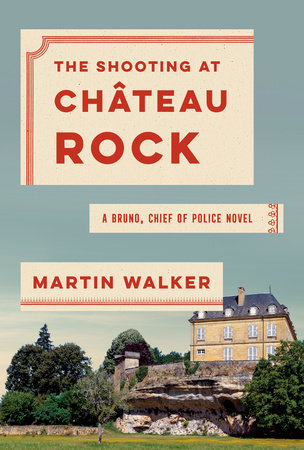
Martin Walker: The Shooting at Château Rock

     . . . . Thanks to the opening of the library branch's  Grab 'n Go program, I have received the very last published volume in Martin Walker's Bruno Chief of Police series, published in May (2020), #18, The Shooting at Château Rock. Chief Bruno and the fluctuating cast of St. Denis and the Périgord region have been an ongoing part of my life since the later part of June. There's no gift more desirable to reader, than the discovery of a multi-volume series in which all the titles have already been published.


I wonder if there will be any more Chief Brunos. I can see Walker successfully creating more titles in the series set plausibly in the covid-19 era. his might not be the case for every series going by any means, particularly one with as many titles and regular, established characters and relationships. In this series though, it’s not as if Europe, France and this region of France haven’t suffered dreadfully in pandemics in the past.

One of Chief Bruno's French Basset boys typical positions, requesting tummy rubs from humans they like -- especially women.  Supposedly this is the breed from which George Washington received his own pack of hunting hounds from Europe. Like the varieties of wine that pour through the Bruno novels, so dogs, horses, cows, sheep chickens, geese, donkeys,  even snakes. 


Bruno's Balzac, his second basset, at two years, should now begin his duty to continue the breed, something only Martin Walker would have thought of as part of a police tale's story? Particularly as it seems French Basset males can need some human help in getting 'er done, particularly the first time. (Which to my mind never bodes well for the endurance of a breed of anything when it needs humans to have sex.)

An earlier post brings up the large place in these books taken by agriculture at large, wine making and drinking, and the raising, cooking and eating of food in convivial circumstances.  just the châteaux of the the Loire Valley have very long been the fantasy ideal of fairy tale castles, Walker’s St. Denis of the Dordogne is a French fairyland world, in which a community retains traditional cultural ways practiced 


for centuries, where all its vastly long history exists on top, around and through the present, where so much daily life is good (not to mention delicious), a world that is carefully cared for and nourished by its officialdom top down, from mayor and wealthy residents, to, above all, its Chief of Police, who operates almost like St. Denis’s personal guardian angel. Even so, very bad things happen there.

The region is always in flux.  In past it suffered invasions since at least the days of the Phoenicians; these days it suffers -- and prospers -- by floods of outsiders, whether summer residents from England who come to stay, tourists from the entire world or day trippers from Paris. From this flood emerge an endless procession of bad guys, whether as legacy from France's colonial evils, its Nazi occupation, or new ones that have blossomed on their own, such as the Russian oligarchs. Yet, there's always a purely local connection that brings them to Bruno's St. Denis, as befits the pull of the region human beings have inhabited continuously longer than anywhere else in Europe -- and before them, and co-habiting with Neanderthals too.  Whether newly discovered Neanderthal grave sites, the Caves of Lascaux, to what is embedded in the thousands of years of eating and drinking, this is as much a cradle of civilization as Mesopotamia or the Ganges.

The EU almost functions as the highway for the very bad things' presence. I like so much that the EU is a constant reference in the book. Its rules, regulations, trade agreements. and evidently its power, at least as regarded by the residents of a rural community, is in the way of them making a living. It is almost always outsiders that are the actors for the bad events.

The series may not be the best writing or even the best series, perhaps? but it was reliably engaging, and unpredictably quirky through out. The quirks are what makes its formula feel awake, not tired.  Original, yet formulaic enough, new books could trace pathways within the pandemic as it was / is happening in France, to deepen the community's relationships, official and personal, and provide new interests and development in the characters. This isn't literature, but it is terrific story telling, keeping us coming back for more, always wanting to know more.  The reader quite becomes part of the community. If we are fortunate enough to enter into such a community, becomes a part of it, so we are always interested in our friends and neighbors of St. Denis.  That's quite a lot of accomplishment -- the author should be pleased and proud.


Thursday, May 10, 2018

Nîmes: Out of Chronological Order -- Spanish Southern France

     . . . .  Nîmes is the Spanish side of southern Gaul -- as Nice is the Italian side of southern Gaul and Avignon is in the middle and mostly medieval. Going through the photos again today, and I can't resist posting right now the photos that tell us so much about southern, Roman Gaul.  

Nîmes was where our travels concluded, as far as sight-seeing was concerned.  It was from Nîmes we took the train back to Cannes, where I picked us from the station and drove us back to hers and David's place in Bar-sur-loup.  The next morning David drove us to the Nice airport, and we flew home. 

That I can't resist putting up some of the Nîmes photos doesn't mean we loved it more than Avignon, or even Bar-sur-loup (though we did love all three of these places in a way that we didn't love Italy's Ventimiglia, and certainly did not in any way love Cannes! what a vulgar, ugly place filled with vulgar ugly people).

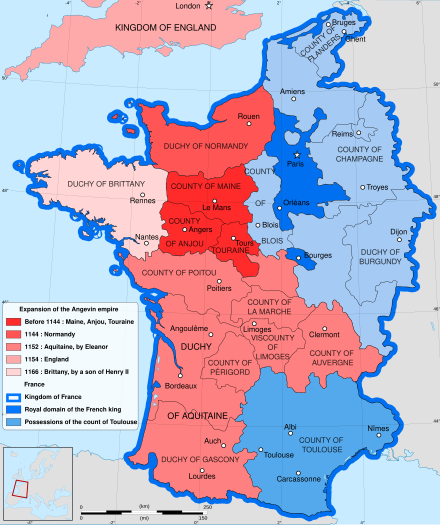
See where Nîmes is, on the far right side of the map. Provence is on the other side of that boundary.


Nîmes is on the other side of the boundary of Provence proper, i.e. just barely inside what used to be Aquitaine, the land of Queen Eleanor -- Provençal Occitan / Languedoc-Roussillon (Lang -- tongue / language of doc / Occitan -- this is in the beginning of el V's Cuba and Its Music). This is the very edge, yes, but I am / was in the land of Queen Eleanor of Aquitaine! You cannot imagine what this does / did to me

Recall how important Iberia was to the history of Rome.  Hannibal began his campaign against Rome from Carthegenian Iberia.  Pompey the Magnus won additional military glory in Iberia. The young Octavian, still only the young relative of ruling Julius Caesar, stationed with the Roman cavalry there.  The later Emperor Hadrian was born in Iberia, of an Hispano-Roman family.


Thus one is not surprised to see bulls and bullfighting still revered in Nîmes. 

Bulls are iconic throughout the Mediterranean coastal regions, it seems, from the most ancient days of Crete's bull dancers, Zeus's rape of Europa in the shape of a bull, bulls given sacrifices, which latter was continuously practiced in the western Roman empire at least, even deep into Rome's Christian eras.  We ate lunch in a restaurant called la Grande Bourse located by the Roman arena.  The heads of the most brave bulls of each feria are mounted high on the walls around the huge dining area, which one knows is packed during the fighting of the bulls.


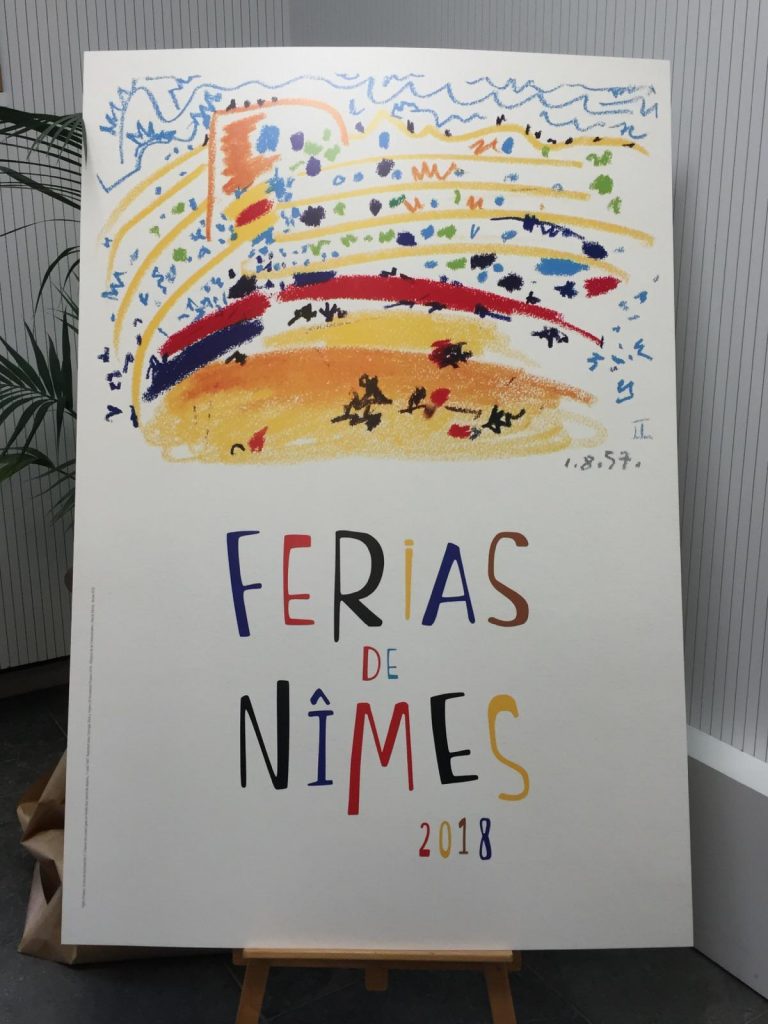
If one doesn't wish to believe that a love for the bull fight could exist in such a civilized, haute bourgeois spot as the south of France, so colonized by animal rights loving British, see the above image. This handsome specimen of bovine strength and beauty was lovingly stenciled all through the city.  It wasn't a part of the city's advertising for Ferias de Nîmes 2018, but a project of presumably an individual art student? from the University of Nîmes? Whom, presumably, marched in the May 1st parade of unions and students protesting the neo con policies of Macron and the drive to privatize so many of France's public agencies and institutions.

Thursday, November 16, 2017

Black Sails and Treasure Island + Outlander and Voyager

     . . . . Black Sails (2017) Season Four, final season was very good.  At this moment I'm still wondering this may be the most historically accurate action adventure period presentation dramatized on screen (and read in most historical fiction).  Cuba! Views of its bay and fortalezas and habana vieja that I too have seen and been to! Invasion of Nassau to put down the motley pre-era of Revolution crew of pirates, self-emancipated slaves, free blacks, indentures and the lower classes in general – as the greatest threat to civilization.

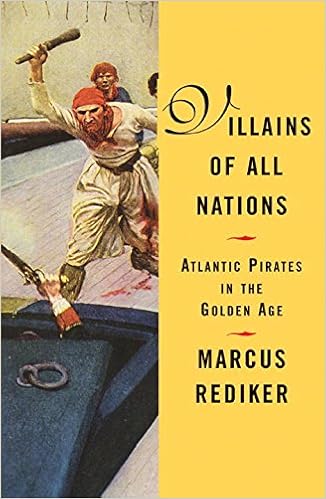
The Black Sails writers really read Marcus Rediker it looks like.

A deluxe 1886 edition of Robert Louis Stevenson's Treasure Island included a treasure map.


 This isn't to say that some liberties with historical facts have not been taken -- for instance the Peruvian shipment on the pirated Spanish vessel, Urca de Lima, was made of valuable commodities such as hides and chocolate,  but not that ever more powerful chimera of gold! gold! gold! which is the ever more enthralling, ever more unattainable source of the stories of  Robert Louis Stevenson's Treasure Island and Starz's Black Sails.  But, over all, throughout, Black Sails tacks remarkably close to what historical facts of Nassau's early history we know.


Guess who . . .  he didn't begin like this.


So it matters more for Spain and Britain to cooperate in putting them than the current war between their rulers. Their sheer outrage that anyone not of the ruling classes should attempt to change anything is brilliantly emoted.

These outsiders' ideals of anti-slavery, equality and fairness, have been bubbling along for the previous season, though sometimes submerged either by the imperious demands of survival, which means financing survival, and rivalries and conflicts of interests of all sorts.  In the final season both the ideal, inter-personal conflict and greed are at center of every action.  In the last episodes the audience begins to glimpse through the current action, the characters as we first got to know them in Stevenson's Treasure Island.


Professor Marcus Rediker


After watching the end of the series, I re-read Treasure Island, on Gutenberg since Black Sails is the prequel to the stories of all these characters long and long before Jim Hawkins enters the picture at his mother's inn, the Admiral Benbow, the black spot and all the rest.  Needless to say, in Black Sails, everybody was much much younger and very good looking, which they generally are not in Treasure Island, except perhaps that charming, enticing storyteller we meet as one-legged Long John Silver, with a parrot named Flint (Captain Flint is the central protagonist in Black Sails) -- and many of them had ideals of freedom, liberty and equality, escape from the real evils of the poor and powerless  attempting to create an alternative to Europe's ancien régime.

But in the end, as stolen treasure does, the Urca's fictional gold destroyed them all. And now they're old, so old, if not actually you know,  like Captain Flint, dead. Yet they're still chasing after that damned treasure for which  that hundreds if not thousands have already lost their honor,  blood and lives.

It had been a long time since I'd re-read Treasure Island.  What isn't different though -- and this is brilliant of Black Sails, considering its unique social and political concerns (also so much part of the age), which are seldom if ever found in adventure entertainments --  from the first pages already, the evil miasma of the Urca treasure contagion is in play.  Hawkins, the boy, of course, like we kids who are much of Stevenson's targeted audience, can't see it.  But the boy can see danger, far more quickly than the adults do.

This particularly struck me in terms of Starz's Outlander, both because I just finished re-reading Voyager, the third novel in Diana Gabaldon's historical romance series from which this current season is adapted, and the latest episode takes place at sea, sailing to Jamaica. The ships used in this episode are among those that had been constructed for Black Sails. 
Voyager's action is located in the spread of 1745 - 1765, only a few decades after Black Sails in 1715.  The African slave trade, slavery and indenture slavery were reaching their peak during this entire arc. This is something that the pirates of the era understood thoroughly.  The more oppressed the bottom, i.e. slaves, can be, the more oppressed are every class above them.

Voyager was the book in the series after which I quit, because none of it was working any more. The arbitrary artificiality of the obstacles being put int the way of the twenty years older Claire and Jamie, to have a life without running, and lots and lots of their happy, happy sex is preposterously obvious. This is the point where the series goes off the rails in the books, and probably does on television too.  It's all more likely due to the author's embarrassing caricatures of non-white characters and her ignorance of the cultures in the Caribbean in general.

The author's determination to keep this a romance, is, in the end, makes the effort only about the personal, and by extension to family and clan's well-being, which are still personal concerns.  In Black Sails, romance was not the point.  Sex wasn't even the point., though there was a lot of it, some, unwatchably violent and abusive, detailed and prolonged. Though lesbians were not punished for being lesbian,  gay men had to keep their love a terrible secret, which such demand by society and law at large, has effects on the development of character, thinking and action.

Loyalty and companionship matter of course, but most of all for some, at least, among the Black Sails' crews, there were those who had larger loyalties to ideals of social and political justice, for women and men, for black as well as white. Not only is Black Sails a prequel to Treasure Island, but it's a prequel to revolution, located as it is on the eve of the Era of Revolutions that set the whole world on fire (with help from that anti-revolutionary, Emperor  Napoleon) -- Washington, George Danton, Toussaint L'Ouverture, Símon Bolívar.  But the Outlander books, really about Claire and Jamie's ROMANCE, and  her family and their romance,s as more and younger members of her family arrive in the past from the future, are missing this dimension.

Perhaps that makes the contrast between Starz Outlander and Black Sails all the more stark: Outlander's Voyager turned us cranky and impatient; Black Sails got ever more compelling as the seasons and episodes rolled on.

Tuesday, March 7, 2017

Long-Haired Kings + Cuba

     . . . . I find myself missing writing here.  I've been too busy, on too many fronts simultaneously, to think of stringing together sentences that make minimal sense about my reading and watching. Too busy even to watch anything, for that matter.

For instance for the last 10 days I've spent just about every day between 12:30 PM and 5 PM shopping for all the people in Cuba who need things they can't get there, things for us that we or the Travelers may need and which are hard if not impossible to get there, especially when constantly on the move.

And I still haven't started packing for myself!  We leave here at the preposterous hour of 3 AM on Saturday in order to get to the airport, through security etc. and make a 6 AM flight.

I've watched very little television  All this walking in this topsy-turvy temperature winter, carrying so many heavy bags, standing in long, slow lines at check-out -- because the customers and / or the technology have massive melt-downs, all at the same time, all the time now, it seems --my back hurts so much, and I'm so so stiff and sore that after making dinner and getting things cleaned up, sitting with my feet up and reading about the Merovingians is about all I can manage.

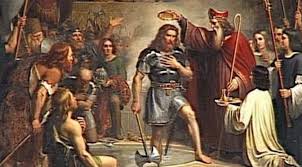
Depiction of Battle of the Catalaunian Fields (Chalons), where a coalition of "barbarians" defeated Attila the Hun's forces.


Yah, I'm still riding that hobby horse.  I have been keeping rather extensive notes, and we've been talking about this in Another Place with others who are as ignorant as I am, but have gotten interested from my notes and so now are reading books as well.   I do know more now than I did before beginning this project to educate myself at least a little in four centuries about which I knew little to nothing -- but I still know very little.  It doesn't help that every historian of the 5th, 6th, 7th and 8th century will say at some point -- at many points -- "this is doubtful . . . we don't know much, if anything about" whatever it is.

Warriors, and Long-haired Kings: 5TH Century Rome and Frankia 

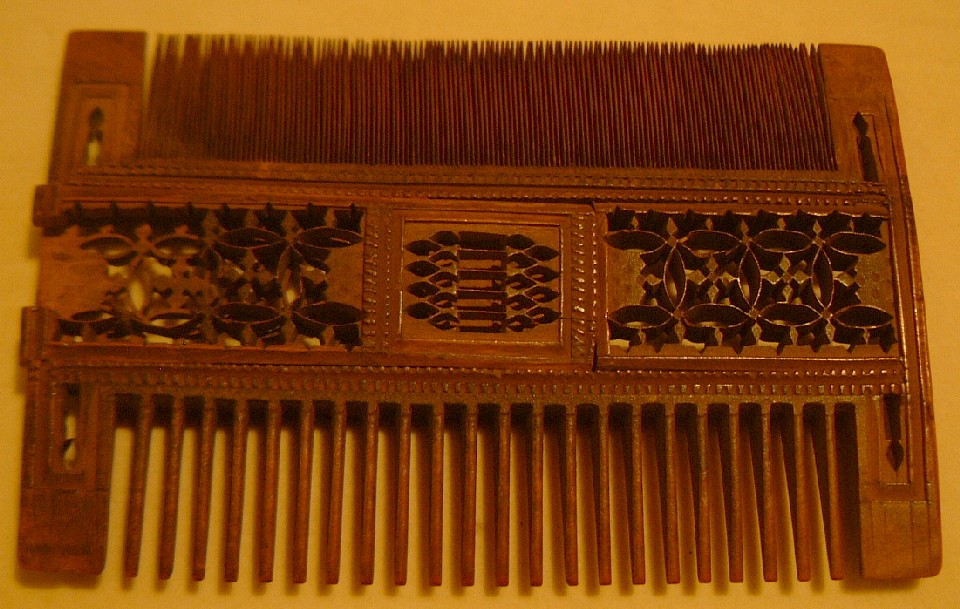
As long hair was the signifier of a Merovingian man of distinction, combs were valuable personal property, often found in grave sites of important men.  They were also important commercial goods, with manufacturies for combs (which took an average of 50 hours of skilled labor to make).
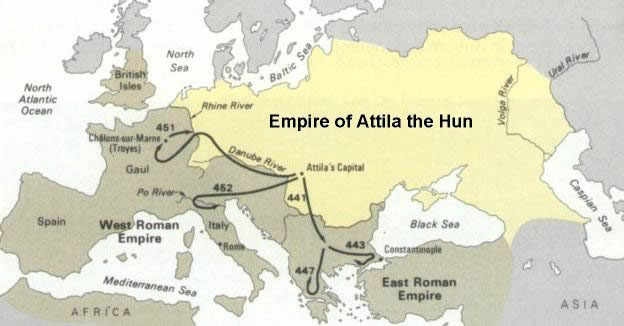
One of the things I've learned is that the the communities that study these centuries are as divided as historians are about our own history.  The primary dividing line is: the Western Roman Empire declined and fell sometime in the 5th century which ushered in four centuries of barbarian invasions, no taxation and no commerce, the end of cities and civilization which were replaced by endless warfare vs. the Western Roman Empire that transformed, regenerated and transitioned into something new, dynamic and vital, incorporating the forms and structures of the old western empire while creating new things that better suited itself.  Nor were there great barbarian invasions beyond, perhaps that of Attila's, which was defeated by a coalition of Other Barbarians who had transformed quite some time ago into Gallo-Romans -- and commerce and manufacture boomed particularly in the north, east and south to the Black Sea and Bosphorus, which brought luxury, expensive goods and coins (as well as mints) to all these cities that didn't lose their populations.

One of the players in this history field, James J. O'Donnell,  characterizes this division of the field of Late Antiquity - Early Medieval History as the Reformers vs. the Counter-Reformationists. * The Counter-Reformationists believe the Western Roman Empire fell and ushered in the Dark Ages.  The Reformers look hard at material history and what archeology has revealed in the last 50 years, particularly in the more northern reaches, including both the British Isles and the Nordic regions, and see a burgeoning of trade and commerce, and cities neither losing population and, in fact new cities founded to deal with their trade.

When it comes to American History I have positions on many figures and issues that have evolved out of  life-long, deeply researched work.  But in this history I am a novice, so I don't / can't  have a position on this matter, only a leaning. I lean toward the side of the Reformers.  We'd have guessed that would be the case as the Counter-Reformationists have accused the Reformers of shilling for the marxists and, more lately, now, catering to political correctness.


The books I've read or am reading about these centuries in Europe in the order I've read or am reading them:
Charlemagne by Derek Wilson -- this is outside the purview, but it was reading this biography last summer that put me onto the Merovingians in the first place;
The Ruin of the Roman Empire: A New History by James J O'Donnell;
The Long-Haired Kings by J.M. Wallace-Haddrill;
Late Merovingian France: History and Hagiography 640-720 by Paul Fouracer and Richard Al Gerberding;
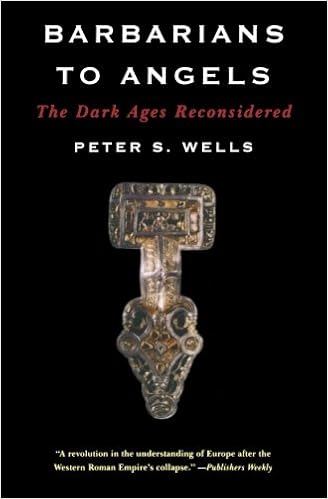
Barbarians to Angels: The Dark Ages Reconsidered by Peter S. Wells -- he's an archeologist and definitely a Reformer.
We're reading aloud to each other this one:
The Merovingian Kingdoms 450 - 751 by Ian Wood -- this has been the narrative political history of the subject for quite some time;
El V's reading this book himself, which focuses on the 'real' middle ages, with only a short summary of roughly 100 pages out of  the 526 of these previous centuries that concludes with the chapter, "Consolidation of the Kingdoms" post Charlemagne's coronation as "emperor"  (though he does partition it again among his sons!):
The Middle Ages by Johannes Fried (translated by Peter Lewis); Fried is a semi-Counter-Reformationist.
I am also reading assorted, occasional articles from journals online and JSTOR.


A friend in Another Place is reading these -- the second two are Counter-Reformationists, and the first is a firm believer in the Dark Ages, though he blames Mohammed and Islam rather more than northeastern barbarians. The author was a practicioner of philosophical / pattern history, which I intensely dislike.  Thus, the conversations there are quite lively:
Medieval Cities: Their Origins and the Revival of Trade; and,  Mohammed and Charlemagne by Henri Pirenne, in which exposits his famous Pirenne Thesis -- which, among many others, I too have a difficult time accepting as Pirenne's focus is the south and the Mediterranean.
The Fall of Rome and the End of Civilization by Bryan Ward-Perkins;
The Fall of the Roman Empire: A New History by Peter Heather. 
I am reading other books too, but those are mostly about female personages in the era of the War of the Rebellion and in the Age of Horrors, er, the Gilded Age / Age of Innocence,  and the history of the Ottomans, particularly in the 15th and 16th and 17th centuries. More about this later, probably a lot later, after returning from the Caribbean.

-----------------------

*   James O'Donnell himself lines up on the Reformers side of the division.

Wednesday, January 18, 2017

Booking Wednesday: The Ruin of the Roman Empire: A New History

      . . . . One of the best things about an audio book the listener just can't wait to get back to is how enthusiastically one clears all the other jobs so she can work out. My latest audio book enthusiasm is James O’Donnell's The Ruin of the Roman Empire: A New History (2008).


O'Donnell's style may be a bit too breezy for certain gatekeepers of Roman history. The sort of contemporary tone he often employs tends not to age well over the decades, particularly his choices for metaphors or similes for certain issues, behaviors or events between now and the 3rd, 4th, 5th, 6th and 7th centuries -- particularly the Middle East and the Dubya regime. Nevertheless, beyond that, for me, not a scholar or specialist of Roman history, O'Donnell has provided new knowledge and understanding  regarding what both he and Mary Beard would probably now call the 'fake news' of s-called barbarian invasions of Italy and Gaul. All parts of this history are enthralling history, whether connected to the histories of the schism of the Christian Churches into east and west and the proofs that the Roman empire definitively did not fall until the 15th century. His argument provides specific context and rebuttal to the long-standing dogma provided by Gibbon that Rome fell in the 3rd or 4th or 5th century, and nothing but chaos remained, i.e. the Dark Ages. He bases his own argument in the tax and trade bases that supported both Rome and Constantinople for centuries longer, because specifically taxes and customs supported the military on the edges of the empires.

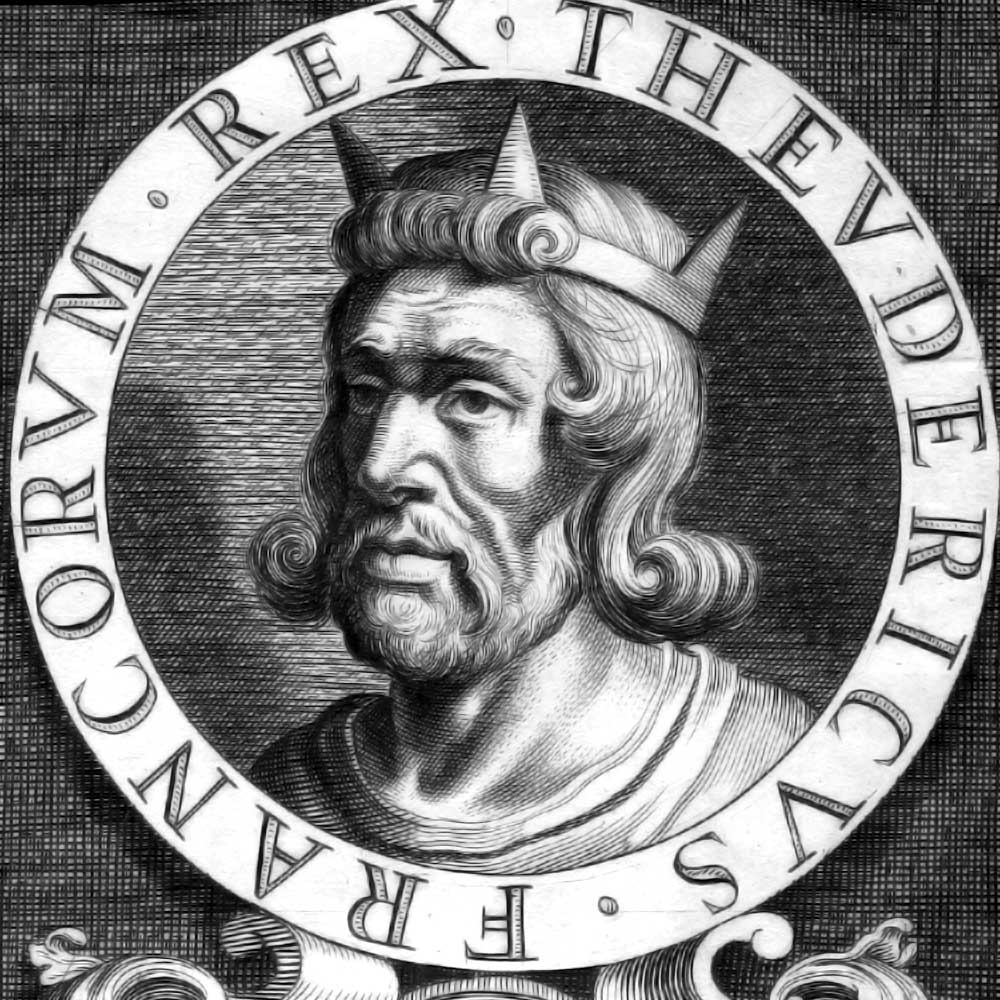
 King Theodoric the Great Called the Synodus Palmaris  to Deal With Two Rival Popes

It was particularly within the tax and military structures that the so-called barbarians became Roman, and continued with little or no change those same structures and customs. O'Donnell illustrates this effectively with the details of the reign of his central character, the Ostrogoth Theodoric the Great ( king of the Ostrogoths (475–526), ruler of Italy (493–526), regent of the Visigoths (511–526), and a patricius of the Roman Empire). Theodoric, raised and educated at the court in Byzantium,  ruled Italy longer than any Roman emperor other than Augustus.  He held it together even during the period when there were two popes simultaneously.  His period was much more prosperous and peaceful than old Rome's second century C.E. It was the last western era of religious tolerance.

After him the disasters are looming. This is when the real Christian prosecution by emperors and their representatives took place -- done to Christians by other Christians.  Backed by the uneducated and not terribly bright Justinian, his religious counselors determined that all the empire must worship and believe in the same way, and the conviction that identity was now the same as religious practice and the state came to rule.

It is no surprise that the forces of religion, driven by short-sighted and ignorant men who refuse to admit the reality of the regions' diversity that always had (and probably always will) worshipped and believed in a variety of ways.

 Shades of how the Europeans partitioned and reshaped the Middle East during and after WWI. We are dealing at this moment, past the middle of the second decades of the 21st century, with both the effects of the religious foolishnesses of the centuries subsequent to Theodoric's reign and the redistricting of the the 20th.


Empress Theodora, wife to Justinian, former entertainer and / or sex worker.

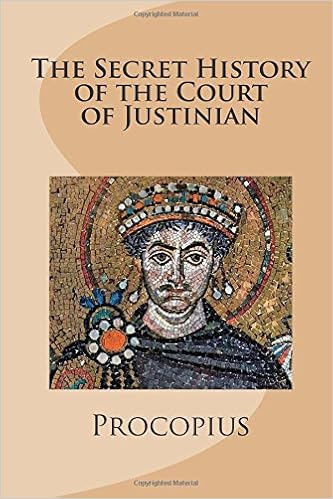
O'Donnell is particularly enlightening on Procopius.  As with so much of the content of this work, such as barbarian invasions, Roman emperors feeding Christians to the lions, etc. he warns the reader to discard everything everybody knows about Procopius.  Procopius was not a highly regarded court historian of Justinian's among other things. However, this reader at least, does wish that the author didn't push his metaphor of Justinian as Hamlet and what a terrible king Hamlet would have made if he'd survived to the throne, as it doesn't actually enlighten anyone attempting to think her way so far back in time in which these teeny religious differences and weighty discussions were of such burning interest to fairly dull intellects such as Justinian's.  He just wasn't that interesting a human being, at least after he became married to Theodosia and emperor -- unlike Theodoric, King of the Ostrogoths, at least.

Side notes: 


- I'm finally learning something about the background that produces Clovis, Charles Martel and the Merovingians, climaxing with Charlemagne -- or at least I get to my workout later this afternoon.  Theodoric the Great is only recently dead.

- O'Donnell refers to Attila as a Scythian. I haven't figured out if that is because Attila really was a Scythian or because he spent so much time in the region that hosted the Scythians -- and ruled them? There's so much that is puzzling when one isn't a scholar of the period one is reading about!


- What I have enjoyed immensely about The Ruin of Rome, as with the book about Charlemagne I read last year, is how well O'Donnell describes how rulers use artists, historians, poets, writers and / or religious hierophants to consciously change history, at least the part of history for which they responsible. -- thus the barbarian invasions and Rome sending Christians to the Games and their deaths for fun and profit. The figures of our own War of Rebellion are not by any means the first to do this -- but not many perhaps, at least in these times of near universal literacy and newspapers and other media, did it so successfully, so quickly while the people who were there and in opposition, still alive and still in power.

Wednesday, July 20, 2016

Did Himself Bring Home To Me A Box of Chocolate Truffles?

Charles kills Manfred. Of course  Manfred wasn't killed like this, in a duel.  He did die in the battle, but just how remained mysterious.

No it wasn't a box of chocolate truffles, but something that operates with me just like,  as Himself put it, "a box of chocolate corrupts someone who is on a diet."

I'm supposed to be working on popular culture, politics, etc. from the end of the War to Southern Rebellion to the erasure of slavery, revision of history, etc. and the Rise of the Glorious Lost Cause.  I'm supposed to be reading reams of African American newspapers.  And, btw, this stuff is supremely depressing, as depressing as our current national events horror movie, the roots of which are all in it.

So what does el Vaquero do?

"Hi, look what I found that I bet you're gonna like!!"


It's The Sicilian Vespers: A History of the Mediterranean World in the Later Thirteenth Century by Steven Runciman,. This classic work of history of this period of Sicilian history was first published in 1957 by Cambridge University Press, and reprinted now for the 10th time (2012).  I cannot keep my hands off it.  I'm devouring all this detailed history of the conflicts among the Roman Popes, the eastern Empire, the Arabs, the Holy Roman Empire and its emperors, the French kings, the parade of Henrys, Conrads, Tancred, Manfreds, Fredericks, the Norman kings of Sicily, the marriages with Portuguese and English princesses, Spanish invasion of Italy, crusades and Mameluks. Even more complicated the wars of the Guelphs and Ghibellines are involved so all these personages are in Dante's circles of hell too.  And, la the pièce de résistance -- the MONGOLS!  Ooo la lah, things were a'poppin' in the 13th century.  And Sicily was right in the center of it, as Sicily is the stepping stone between Europe and Africa, between west and east.


Church of the Holy Spirit in Palermo, site of the Vespers Uprising.

As for what are -- or rather what was the Sicilian Vespers, and why it matters -- it was the rebellion of Easter 1282, in which Sicily got rid of -- slaughtered - 3000 French.  But ultimately all this was about the war between the Hohenstaufans and the Pope for control of Italy.  This was called the War of the Sicilian Vespers.


So many incredible characters, so many amazing deeds, many of which were downright evil, and a few heroic.  No wonder there are operas made of them; see, for instance Rossini's Tancredi.

My friend, who also is my hair person. has relatives in Sicily.  She, who is not that much interested in history in general, knows of The Vespers.  We dreamed together yesterday of going to Sicily together.  I've never been there, and neither has she.

Reading this book, it's like going on vacation, but safely, into the very unsafe time and place of 13th century Mediterranean life.


Tuesday, December 1, 2015

'Tis the Dark Season - Short Days and Long Nights - Reading Wednesday

The lovely time of year, the crawl up to the winter solstice, is here, days of light filtered as through a martini, night dark and sweet as deep piled blue velvet.  We want our pleasure reading to enhance the alternating chill and coziness. The high Middle Ages and the Plantagenets fill this seasonal bill so well, since so many of our anglo Christmas and Yule traditions are associated the periods of their reigns. Here follow some suggestions.

Thus we may begin in the 13th century with Four Queens: The Provencal Sisters Who Ruled Europe  (2007) by Nancy Goldstone.  The four sisters in question are Marguerite (married to the King of France), Eleanor (married to the King of England), Sanchia (married to the King of Germany), and Beatrice (married to the eventual King of Sicily). Born and raised in Provence, these sisters played a large role in European politics for most of the 13th century.  These four sisters were as unequal in the power to influence politics as they were in the happiness of their marriages. There was much sisterly jealousy, jostling for first position in the great public feasts of the day, and therefore, some very public temper tantrums, and less public plotting against each other.


We continue with The Greatest Knight: The Remarkable Life of William Marshal, the Power Behind Five English Thrones (2014) by Thomas Asbridge.

William the Marshall was known throughout Europe as the greatest warrior of his time. But despite having served five different kings in close and trusted capacity, much of his life was difficult, not to mention dangerous.  Shoot, without even factoring in wars and battles, being close to rulers is dangerous in itself.  He  ascended to acting regent for the young Henry III (cr. 1216 - d.1272), son of the catastrophe that was King John, by the close of his long, remarkable life.

It was in the reign of Henry III that the "Tales of Robin Hood" began to circulate, due to Henry III's grasping nature and general incompetency (yet, considering he kept his throne all those years, he must have known how to do something right).  He it was who expelled the Jews from England, which, as the consequence, as we have seen elsewhere and in other eras, made the country poorer.  Much of what he grasped went into the beautification of his many homes and sumptuous living.

Henry III was father to Edward I, Hammer of the Scots.

Certainly the word pictures of the luxuries to be found in the castles of the Romances so popular in these times were what Edward I grew up among in the homes of his father, and his mother, Eleanor of Provence (this is one of the sisters of Four Queens).  Eating on gold and silver, drinking the finest wines and wearing the finest silks was matter of course.

A Great and Terrible King: Edward I and the Forging of Britain (2008) by Marc Morris tells the long tale of Longshanks, as this Edward was also known because his legs were long, was long-lived -- 1239 - 1307, and had a long reign -- 1272 - 1307. However that Scots business and Wallace were right at the very end of his reign.

After Longshank's own death, another generation of luxurious Christmas living in the reign of his son, Edward II, is celebrated in that wonderful Christmas poem, Sir Gawain and the Green Knight.

Richard's reign had problems but it was certainly a period of high literary achievement. Other excellent associated reading for the season is Geoffrey Chaucer's Romaunt of the Rose, and The Book of the Duchess, dedicated to the deceased Blanche of Lancaster, wife of the First Duke of Lancaster,l John of Gaunt, (1340- 1399. Lancaster was uncle to King Richard II.  Lancaster eventually made his mistress, Katherine Swynford, his third wife. Katherine's sister, Philippa, was married to Geoffrey Chaucer and had served the Duchess Blanche.  Further, Katherine, with the Duke of Lancaster, became an ancestor of Princess Diana Spencer as well as to members of all the dynasties that followed the end of that of the Plantagenets.


By now we're heading out of the medieval era into the modern the world, the 1400's, which will bring us the Age of Exploration and the collision of Europe with North and South America.  However, in Spain, the light of the Renaissance and the modern had not yet dawned.  It was pretty darned dark there in the mountain hideway where Isabella's mother secreted herself and her children from the murderous intentions of her husband the King.

The story of Isabella: The Warrior Queen (2014) by Kirstin Downey, who funded Christopher Columbus, makes a solid bookend to stories of the Plantagenets -- which are deeply entwined with that of the Iberian Peninsula during the preceding century via marriage, including that of Duke of Lancanster to his second wife, Constance, a Spanish infanta.  (Alas, this marriage never led to Lancaster crowned King of Spain, as he'd hoped.)

Isabella, who was the driving force to the union of Spain and driving out the Moors, is as exciting* as the Cantar de Mio Cid, and one essentially unknown to English-only reading readers.  For this reason alone I'd be grateful to Downey for writing this book.  It fills in much about British and French history in the 13th and 14th centuries as well, because the author carefully fills us in on Isabella's immediate family. Her survival in earlier years was as precarious as any princess's or prince'd in the family of the Delhi Moghul rulers of a somewhat later era.  Spain was a literally cutthroat political situation -- but then no more so that that of England, which all these works show in great and fascinating detail.

The greatest difficulty faced in reading these books is that everyone -- except for Blanche and Constance -- have the same names, over and over, generation after generation.  Especially Eleanor.  And I didn't even include a book specifically about her!  But then, she's 11th and 12th centuries.


However, her life certainly influenced many of the Arthurian Romances, particularly via the popularity of Geoffrey of Monmouth's History of the Kings of Britain, which remained equally popular in the time of Henry III and Edward I.

---------------------------

*   This is not to be taken as an endorsement for what the Isabella and Ferdinand did, expelling both the Moors and the Jews. See, above, that Spain wasn't feelin' the Renaissance, or at least not in the way other parts of Europe did.  They definitely felt the invade and conquer part.

Even in Edward I's time, the English court made as much fun of the clothes and customs of his Spanish bride, Eleanor of Castile (she put carpets on the stone floors!) as it reputedly did about Henry VIII's Spanish Catherine of Aragon -- though that seems to be rather exaggerated or perhaps even pure invention of fiction and drama writers -- and Charles II's Portuguese bride -- she who brought him the profits of several trading cities of western India. Not that even that was enough to fill Charlie's constantly empty coffers and privy purse and to satisfy the ever demanding paws of his favorites and consorts.  For that he had to resort to slave trading. And selling his wife's personal jewels and furniture.




Wednesday, September 16, 2015

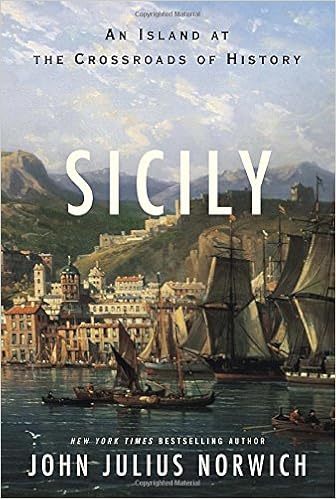
Reading Weds. - Sicily by John Julius Norwich

John Julius Norwich, now in his late 80's, is a distinguished popular British historian with a long bibliography.


The first book of his I ever read was A History of Venice: The Rise to Empire (1977), preparing myself for my first trip to Italy, at the conclusion of which I saw Venice for the first time.  That trip to Venice was mightily enhanced by having done so. It was very early in our marriage then, and el V was deeply, and happily impressed at what I could tell him about all sorts of the things we experienced and saw.  It was on that early journey in our marriage now of many, many journeys, wandering happy and excited through the deserted galleries of museums all through northern Italy (it was off-season, early winter and we got everything to ourselves) that we realized that we traveled very well together, each of us providing what the other didn't and together making it better than alone.

Norwich has written about Sicily before, but felt he hadn't made the best job of it, having left too much out and having learned more along the years as he returned on occasions to this Mediterranean island between Carthage and southern Italy. His interest in Sicily's history never flagged but only grew.  The result is Sicily: A Short History From the Greeks to Cosa Nostra (2015).  Surely, if one has never been to Sicily before and can read only one book to prepare, like Norwich's book about Venice, this is the one to read.

Sicily's history is a melange of cultures that are embedded in the Sicilian language. Sicilians, no more than Venetians, speak Italian, but have their own language, with a great deal of Greek, Arabic and Spanish influence, not to mention French from the short era when the Normans held much of Sicily. Additionally the Greek both ancient demotic Greek, as Sicily was their colony, and the Greek of the Byzantine empire.

Sicily's history has always been fractured by violence, conquest and resistance -- it isn't a happy history, but it is a fascinating one, filled with opportunities that kept getting lost or snatched away.

I enjoyed it all the more from having read so much about the era of Nelson and Napoleon in connection with Naples and Sicily.  He also manages to make sense for the reader of the inordinately complicated mess things became for Sicily with the competition between the Normans and the Holy Roman Emperor and their heirs, from which the island never really recovered. Moreover the interest for the reader does not flag as the eras roll on.  His accounts of Sicily in WWII is as interesting as anything during the age of the Roman emperors.

Thursday, July 9, 2015

Touché - The Literary History of the Duel

Touché: The Duel in Literature (2015) by John Leigh; Harvard University Press is the latest addition to the ever-popular histories of dueling. Among others, see: Dueling in the Old South: Vignettes of Social History ( 2000) by Jack K. Williams;  Dueling in Charleston: Violence Refined in the Holy City (2012) by J. Grahame Long;  Southern Honor: Ethics and Behavior in the Old South (1983) by Bertram Wyatt-Brown; The Duel in European History: Honour and the Reign of Aristocracy (1989) by Victor Gordon Kiernan;  Gentlemen's Blood: A History of Dueling From Swords at Dawn to Pistols at Dusk (2008) Barbara Holland.

But this may be the first literary history of the practice.


From the catalog copy:

Many of the greatest names in Western literature wrote about or even fought in duels, among them Corneille, Molière, Richardson, Rousseau, Pushkin, Dickens, Hugo, Dumas, Twain, Conrad, Chekhov, and Mann. As John Leigh explains, the duel was a gift as a plot device. But writers also sought to discover in duels something more fundamental about human conflict and how we face our fears of humiliation, pain, and death. The duel was, for some, a social cause, a scourge to be mocked or lamented; yet even its critics could be seduced by its risk and glamour. Some conservatives defended dueling by arguing that the man of noble bearing who cared less about living than living with honor was everything that the contemporary bourgeois was not. The literary history of the duel, as Touché makes clear, illuminates the tensions that attended the birth of the modern world.
Review here.