LINES OF THE DAY

". . . But the past does not exist independently from the present. Indeed, the past is only past because there is a present, just as I can point to something over there only because I am here. But nothing is inherently over there or here. In that sense, the past has no content. The past -- or more accurately, pastness -- is a position. Thus, in no way can we identify the past as past." p. 15

". . . But we may want to keep in mind that deeds and words are not as distinguishable as often we presume. History does not belong only to its narrators, professional or amateur. While some of us debate what history is or was, others take it into their own hands." p. 153

Silencing the Past: Power and the Production of History (1995) by Michel-Rolph Trouillot

Showing posts with label . U.S. history. Show all posts

Thursday, August 20, 2020

Basbanes, Nicolas A. (2020) Cross of Snow: A life Henry Wadsworth Longfellow


     . . . . Basbanes’s book overflows with interest for the literary, material and political historian of the US in the 19th C. The interest begins right at the start of the Introduction, in which Longfellow’s trajectory and fate are traced within the literary ‘canon’ critical establishment within, and without, academe.  Ten years ago surely, I would never have guessed that Longfellow would be rehabilitated as worthy by serious literature, but he has been.

All lives have tribulations, at least back before the medical advances of the later 20tht century.  Still, a very few led golden lives, and were also decent human beings, whom it was a joy to know, despite losses of loved ones to disease and childbirth.  Longfellow suffered grief due to losing those he loved, early in their lives, such as his first wife.  But still, like Walter Scott, he lived at time when it was nearly paradise for prosperous white men.

The story begins in Portland, Maine; of which Longfellow was a life-long proud and loyal scion,  presenting a cultural history of New England through his life time. Though not born into it, he joined that generational education-prizing Bostonian wealthy cultural and literary elite, which meant then, the literary elite of the nation. Our first recognized commerical publishers and editors were his friends before they became publishers, like Ticknor and Fields. To have all doors open to one at all times, wealth is very much the key. Longfellow’s father-in-law was the vastly wealthy fellow who pulled off industrial espionage, i.e. theft of propriatory information and design, from the textile factories of England, to institute the factories of Lowell, MA. Marrying into serious money is always a good move that improves life, even when already a popular eligible bachelor, a successful prof at Harvard, and published, prosperous money-making author.
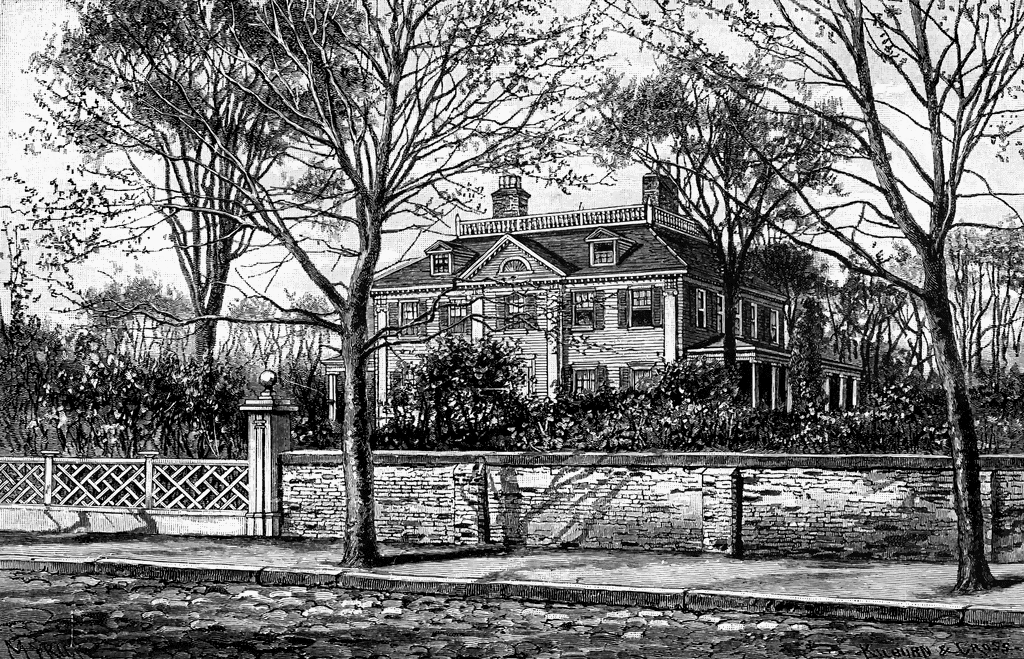

Craigie House, bought by Longfellow's FIL when he married Fanny. Washington bivouacked there. I always have imagined the Lawrence mansion in Louisa May Alcott's Little Women looking exactly like this.

Politically, Longfellow was mildly centerist all his life, which didn’t prevent a close life-long friendship with radical abolitionist-to-be, Charles Sumner. Nor did it prevent him from writing the lines that concluded his very popular, The Building of the Ship (published 1849), that made President Abraham Lincoln weep:

Thou, too, sail on, O Ship of State.

Sail on, O Union, strong and great!

Humanity with all its fears,

With all the hopes of future years,

Is hanging breathless on thy fate!

I confess, that in These Times, particularly after watching the Democratic Nominating Convention these last three days and hearing non-insane people speaking to a national audience, the lines make me weep too, as we all hardly even dare for “hopes of future years” in any way that we have known in the past.

Cross of Snow,  like such earlier biographies that have so delighted me, such as The Peabody Sisters:Three Women Who Ignited American Romanticism by Megan Marshall. Sophia Peabody was so much more interesting before she married Nathaniel Hawthorne, who was a Bowdoin schoolmate and later friend too, of Longfellow. Or, The Beechers by Milton Rugoff, an examination of the family. These provide the deeply engaging immersion that does a really fine historical family saga, such as that of Winston-Graham’s Poldark Saga.  

These kinds of books are inspiring, antidotes to the gorge of disgust, revulsion and despair about the USA and its history engendered by all these criminals in the news these days. They remind us there is a side of light after all to our past, that shone brilliantly in many locations -- in great opposition to the dark of Slaveocracy and those who made the War of the Rebellion -- and the Slaveocracy's descendents, these monsters from Lovecraft who are about nothing but ugly, hate, murder, pillage and destruction.

Monday, August 10, 2020

Louisiana -- Plus: John M. Barry's The Great Influenza

     . . . . Looks like the Postmambo digital festival-tour,  NOLA Reconnect, is a go -- three weekends in October.  

Interviews with figures such as Jason Berry and John M. Barry, film makers like Lily Keber, Mardi Gras Indians, musicians, live music, cooking lessons from New Orleans's 5 Star chefs, and o so much more.  People know they're stuck at home, and they are desperate to be able to look at other faces, hear other voices and interact with People, both those they already know and people they don't.  (El V frequently mentions how much he misses meeting new people -- he loves meeting people.) 

Some of the Frequent Rumbero Travelers of Postmambo, who paid in for the March tour that had to be canceled have said "Keep the change," as there are costs that don't have to be met, such as lodging and transportation, so they were entitled to a refund.  So Postmambo is going to take the 'change' and use it to fund participation for students who would love to be part of this experience but can't afford it.  A scholarship in New Orleans history, music and culture, so to speak.

People are Zoomed out, so we can't do it that way -- it has to be interactive, so people can interact with each other, even if it is digitally.  Great techs on the ground there in NO who can't wait to make this happen -- who have had quite a bit of experience doing this kind of thing already.  The captain of our ground crew did this with a conference in Havana herself -- she directed it -- from New Orleans!  Technology sometimes can be our friends.  People are really excited about this.

~~~~~~~~~~~

     . . . . I read John M. Barry's The Great Influenza: The Story of the Deadliest Pandemic in History (2004), plus later editions up to 2018) in about 5 days..  Each section of the book is fascinating and filled with pertinent information. I anticipated returning to it at my evening reading time throughout, despite how very painful and gruesome so much of it was.  Infuriating too, as we're experiencing all the same issues with our own pandemic a century later, except for not SEEING it, the way people of every class back a century ago saw the Great Influenza. Indeed, nobody could escape seeing and experiencing.


Barry never disappoints.  As I began reading the first section of biographical background to the heroes of The Great Influenza,

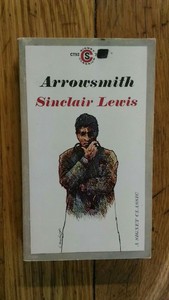
This is the edition in which I read Arrowsmith the first time -- A Signet PB.

I immediately flashed on how much of the trajectory was familiar to me from reading Sinclair Lewis's Arrowsmith (1925) -- which gratified me so much reading it the first time in my farmgirl's bedroom, because it began in North Dakota.  So I looked, and there the book is, in the index. It was part of the  context of discussing the institutes and universities the Great Influenza's hero medical scientists who founded such institutions as Johns Hopkins (which back then was referred to by all and sundry as "the Hopkins").  He has a small sub-section too, concerning how little writing and reference was committed either during or after to the Great Influenza; not by regular people or by writers like Hemingway, whose father was a doctor, or Faulkner.

I can think of only Katherine Anne Porter, in her short novel, Pale Horse, Pale Rider (1939 collection, 3 novellas)  tells the story of a couple caught by it. Pale Horse is one of the few works I've of hers I have read though.  Porter herself said that the title story was about the pale rider, Death, who takes away an entire era, as illustrated in the ironic last line: "Now there would be time for everything."* 

Chaucer and contemporaries didn’t write about the Great Mortality either.

This time around, as with 9/11, and now c19 writers were dedicating their their fingers from the gitgo to describe in dreary irrelevant detail every nuance of their own precious sensations, emotions, actions and non-actions, in their lovely summer retreats, second homes, surrounded by green and water, where they take walks in Nature and never see another person.  They don't see Covid-19 and those it sickens and kills either.

Nor does anyone else, in the USA at least, unless poor and of color, or working in the hospitals, morgues, nursing homes / assisted living and ambulances, actually SEEN anyone sick with c19, whether they recover or they don't. Back with the Influenza nobody could hide from it and what it wreaked. It was in everybody's house -- and in many places everyone who lived in that house died and there was nobody to move the bodies. And when it was over, who was left had to deal with them in however the region was dealing, whether in Philadelphia or a 3 house village in Alaska. But the yahoos out there now, rich and whatever -- they haven't seen and they know they aren't going to, so they are utterly unaffected. It's their life and they'll lead it as they choose.

Were writers of all sorts exhausted from 3 years of pandemic, the Great Influenza's indescribable gruesomeness that millions and millions experienced up close and personal, for themselves. and in company with everyone else around them? So very different from c19 -- so far -- but then the Great Influenza rolled for 3 years -- 1917-1920, with successive waves. Though generally, not always in every spot, it became rather milder and didn't outright kill as many -- it still killed in large numbers. So people had to get on with making life again, and also just wanted to forget this?

A lot of the literary writers were in the war one way and another.  Then came the Roaring Twenties and Prohibition (1920), followed by the Great Depression, followed by another great mobilization, WWII.  Maybe there wasn’t time to work all this horror out into words?

Something else too ... ithe Influenza, like c19, creates hallucinations and changes in the brain, which sometimes never changed back (people think this happened with Woodrow Wilson at the Peace Conference when it got it).  Flashbacks, even, sometimes to things that never happened. It sure does sound like the descriptions of Shell Shock.  So those poor saps got shell shocked from this incredible stupid war -- and they got this on top of that, along side of that.  No wonder so many people were lost after that stupid war ... the Lost Generation.

*  Katherine Ann Porter provided me with little of interest in that time of my life when I read her work, though I am hard-pressed to say why that was the case. I think it’s because horse was in the title and I was still young enough to be hopeful when ‘horse’ was in a title, inside there would be a ‘real’ horse.

Saturday, March 21, 2020

It's Official: We Are A "Major Disaster" Declares FEMA

     . . . . Could C19 be Nature putting humanity on a time out to give the planet a break? 

Had finished breakfast, which was our very old, dear friend, business partner and neighbor-across-the street B's wonderful cornbread, an apple, a banana and tea. Turned on the computer and learned FEMA has declared us officially a Disaster.  Not just any old disaster either.  A Major Disaster.  

Cuomo was addressing us at that very moment I turned on, but listening for a minute, I realized what he was saying was what I know. As for some of the information at this time, since no matter how much may be brought in, there are no masks, gloves, sanitizer, or testing -- or probably medical care -- available for us, since, it really MUST go to the health workers. And as hard as I tried to prepare for this, I have no means of making a mask. The masks had been taken by resellers already in February, as were the gloves and the sanitizer.

Breakfast came after going out early this morning, hitting both the Gourmet Garage and Morton Williams. Per usual there was a line for Trader Joe's, and people are not 6 feet from each other -- I check when I go out, just to see; have no plans to go there, anymore than to Raffettos, which also was open -- not even possible to do 6 foot separation.  Raffettos takes cash only and they aren't wearing gloves, even now, I saw through the window.

The GG was unpacking today's delivery towers of sanitary hand wipes for the stand at the door for handling the carts and baskets, and to dispose of them when leaving. I had brought a pencil and my own disinfectant wipes (for as long as they last) for punching in the pin for my card when paying, and handling the items. I had improvised that t-shirt mask, but ultimately it doesn't work. Cuomo has declared it mandatory for people in our age group to wear masks when we go out -- but we don't have any, so?

But anyway -- today is a lot better than yesterday, just physically. Finally, last night at some point in bed with a book, the radio on, my stomach unknotted, for the first time in many days and nights.

In this time loving and appreciating even more our usual radio programs. Last night was the weekly, WGBO's "Latin Jazz Cruise," hosted by our friend Bobbie Sanabría. He began with songs and rhythms of the orisha, Babalú-Ayé, the orisha of healing and the sick. Bobby was so matter-of-fact in his host patter between cuts, most of which was about the music and the artist that created it, just as usual, explaining for people who may not know the Afro Latin religion of Santería, from the Yoruba spiritual way of Lucumi. WBGO is the jazz station out of Newark, that plays every kind of music created by African Americans, and to much lesser degree that which has come of out of Afro Cuba and Puerto Rico.

It did us so much good!  Music is a healer, a soother and a cleanser, and it brings people together -- plus it brims with history. The rituals, never uncoupled from the sacred music, dance and drum, is expressed in (Yoruba/Santería/Lucumi, and in Haitian Vodún too) rituals that cleanse one from bad influences, stress, etc. -- are limpiado la cabeza, i.e. washing, washing the head and making one strong to resist and survive.  Cuba has always been this great cleanser for us and the Postmamboists, where all this ugly stuff is put away, and we disconnect digitally and otherwise, from the world here.

Music, being kind and thoughtful -- and laughing, are also limpiado!

Then Vaquero joined me and we read aloud, him getting silly, and we laughed together for the first time in a week -- which had a lot to do with rasslin' Zoom for distance teaching, and wrestling with Quick Books to issue Postmambo credit invoices for the postponed "For the Funk of It" trip. We began a new read-aloud-before-bed book, The End of the Myth: From the Frontier to the Border Wall in the Mind of America, Metropolitan Books, 2019 by Greg Grandin. Vaquero had already read it, but I haven't, and he loved it so much he wanted to read it again, but with us doing it together.

This is Greg's latest work, the first book to put the great saboteur in the context of our whole history of national mythology. These are along the lines of which I've been talking myself, for quite some time -- quite some time prior to 2016. But Greg has done it so brilliantly, cleanly and succinctly. He is not only a deeply intellectual analyst, but he possesses as well the tools of employing metaphorical, poetic (we really do need poetry now) and symbolic thinking, presenting this all in easily comprehensible and gorgeously composed prose.

Greg writes so well, it leaves one breathless. He cites us and American Slave Coast too. Plus he's clearly influenced in his thinking by the writers I've been living with in terms of our national mythology almost all my life, Leslie Fiedler and Richard Slotkin.

Slotkin was one of the innovators of American Studies, which brought together history, literature and pop culture, which meant music, movies and tv too -- O I was so there when learned there was such a discipline!)

Regeneration Through Violence: the Mythology of the American Frontier, 1600-1860 (Wesleyan University Press, 1973)

The Fatal Environment: the myth of the frontier in the age of industrialization, 1800-1890, (Atheneum, 1985)

Gunfighter nation: the myth of the frontier in twentieth-century America (Atheneum, 1992)

I have all three of these books here, Slotkin's written other works too, including some brilliant fiction of the War of the Rebellion) and though Vaquero knows my devotion to the works and has paid attention when I bring up Slotkin's analysis in pertinent ways, he's never read them. I think we'll start reading them aloud after finishing Greg's.

It's unbelievable how clenched in every bit of me I've been for days, now that -- for today anyway -- I've unclenched.  I was able to bring back a few things for the neighbor across the hall -- she's just helpless. She doesn't cook.  She doesn't even have a pot with a lid with which to make rice and doesn't know how to make rice anyway.  Among the items I brought was Vaseline Petroleum Jelly.  It's the only thing that gives relief and healing to our hands, which are constantly disinfecting and lathering.  She didn't know either that vaseline does this. Vaseline was a staple on the farm when I was growing up.

I'd never ever in a billion years been able to guess in the misery of my growing up years that at the end of my life I'd be grateful for having been brought up on a farm and taught from the time I could walk and hold things to cook, clean, plan meals, organized a household.

There are so many people like my neighbor, who have been eating out (in her case various aid and assistance organizations for elderly people -- and they've all closed down -- they'd delivered meals too, and she got totally dependent on them) and never cooking) for years.  One of our brilliant friends, who doesn't suffer any of the challenges and disabilities of our neighbor, told me once she refused to cook, even have a stove and dishes, because she couldn't stand washing dishes!

Every time --which is many times a day -- I wash dishes now, hands covered in hot water and soap, I feel I'm doing the right thing, and I feel safe.  😸

Tuesday, July 14, 2015

Thomas Jefferson and Greece's Financial Crisis

In 1803 Thomas Jefferson wrote a letter to William Henry Harrison:

William Henry Harrison, War of 1812
". . .  as the diplomatic crisis leading to the Louisiana Purchase unfolded, Jefferson suggested that if the various Indian nations could be encouraged to purchase goods on credit, they would likely fall into debt, which they could relieve through the sale of lands to the government.3"
So we see the practice of the well-off ensnaring the less rich in a web of indebtedness out of which they cannot extricate themselves other than losing everything they once owned -- even their bodies in many times and places, as in Rome, which demanded people sell themselves and their entire families into slavery to repay the patriarch's loan -- is ancient and well established.

The contemporary Greeks understand this very well.  Over these last days the media has been speaking with Greeks, Greeks who are the average woman in the street sort: small business owners, people who work in restaurants, teach, and so on.  While speaking in English as a second language, these people are articulate and well-informed.  They, their families, friends and communities have been thinking deeply about their condition relative to the EU and their place in it for a long time.

One of their ways of describing what they are subjected to is to compare their situation as a small, poor nation within the Eurozone with that of being Mississippi (the poorest state) in the United States.  To paraphrase generally:

[the United States, a big and powerful single entity includes poor states.  All the states pay taxes to the federal government but the richer ones pay more.  The poorer states receive more benefits in taxes, rather than having everything taxed and taken away from them.  But in the EU, controlled by very a coalition of very rich and powerful nations, with deep ties to the IMF and other international financial interests, the weak and poor are taxed of everything for their own benefit.  We see nothing in return.  it's that the U.S. takes and gives according to need not power that makes it a single nation, in which the people see themselves as citizens of the United States first and citizens of their states second. This allows the system to flourish.  The EU is composed of nations who see themselves first as citizens of their nations and citizens of the EU only as they can benefit from it.  This is not a whole, but a set of conflicting powers, in which the poor are preyed upon by the rich. The rich are not interested in helping the poor but only in exploiting us.  Thus the EU is not a single entity and cannot be, unlike the U.S.]

As things are now in the U.S. and always have been I might takes some issue about the U.S. being a single entity working for the benefit of all.  But I get the point they're making.

One of the primary themes in The American Slave Coast is the division of the colonies, first, during the Constitutional Convention second, and then third in the antebellum era.  The argument, which is not an original one exactly, is that the U.S. could never become a single nation until slavery was taken out.  There were two parallel economies at play all during our history, always in conflict with each other.  A credit, not cash economy, most of the slavery states' wealth was calculated in African American captives -- in whose bodies their credit was calculated.


It was a closed economic system, one in which its wealth could not be used outside itself, i.e. an African American could not be exchanged up north directly for a carriage, but one could do that very thing in the South, including paying one's gambling debts. Thus as a particular form of capitalism, it had to expand or die. It was an enormous drag on the economy and financial systems of the the free soil states, just starting with the stark obstacle that there could be no national system of money.


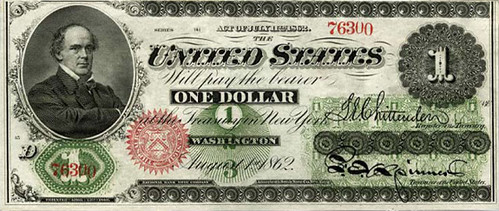
The first thing Lincoln did when Fort Sumter was fired upon -- after calling for volunteers for the army -- was commission Secretary of Treasury, Salmon P. Chase, to create a national currency.  Recall also that Buchanan's southern planter cabinet members and their appointees, as well as the southern senators and representatives stole every bit of specie -- and everything else they could -- from the federal government, even unto an office's petty cash, before decamping to TraitorLandia, where they then competed to become president of the CSA. There was no money at all to run the federal government.


Chase's greenback was the first national currency and it worked.  Even by the end of the war it still retained a bit more than 61% of its value.  We all know what happened with the CSA currency, backed by the wealth contained in the bodies of the captive African Americans . . . .

After the war, the U.S. did have a single currency, and then only was able to become a single nation.* The Greeks understand this, but they feel the EU isn't treating them fairly, which is how the U.S. treats Mississippi.  Recall, Mississippi went from the wealthiest state in the union in 1860, with the largest number of millionaires, to the poorest in 1865.

Will the EU survive?  As we are experiencing yet again in the U.S., we are questioning whether or not we can survive as a single entity, even with our common currency.

-----------------------

* The Southern slaveocracy was anti-paper and banks, as well as anti-city and public improvements, and certainly anti-tax -- and paying fair wages for labor -- and still is, for that matter!

BTW, a former Virginia governor is a blurber for The American Slave Coast!

Thursday, July 9, 2015

Touché - The Literary History of the Duel

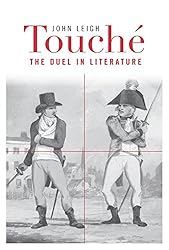
Touché: The Duel in Literature (2015) by John Leigh; Harvard University Press is the latest addition to the ever-popular histories of dueling. Among others, see: Dueling in the Old South: Vignettes of Social History ( 2000) by Jack K. Williams;  Dueling in Charleston: Violence Refined in the Holy City (2012) by J. Grahame Long;  Southern Honor: Ethics and Behavior in the Old South (1983) by Bertram Wyatt-Brown; The Duel in European History: Honour and the Reign of Aristocracy (1989) by Victor Gordon Kiernan;  Gentlemen's Blood: A History of Dueling From Swords at Dawn to Pistols at Dusk (2008) Barbara Holland.

But this may be the first literary history of the practice.


From the catalog copy:

Many of the greatest names in Western literature wrote about or even fought in duels, among them Corneille, Molière, Richardson, Rousseau, Pushkin, Dickens, Hugo, Dumas, Twain, Conrad, Chekhov, and Mann. As John Leigh explains, the duel was a gift as a plot device. But writers also sought to discover in duels something more fundamental about human conflict and how we face our fears of humiliation, pain, and death. The duel was, for some, a social cause, a scourge to be mocked or lamented; yet even its critics could be seduced by its risk and glamour. Some conservatives defended dueling by arguing that the man of noble bearing who cared less about living than living with honor was everything that the contemporary bourgeois was not. The literary history of the duel, as Touché makes clear, illuminates the tensions that attended the birth of the modern world.
Review here.