LINES OF THE DAY

". . . But the past does not exist independently from the present. Indeed, the past is only past because there is a present, just as I can point to something over there only because I am here. But nothing is inherently over there or here. In that sense, the past has no content. The past -- or more accurately, pastness -- is a position. Thus, in no way can we identify the past as past." p. 15

". . . But we may want to keep in mind that deeds and words are not as distinguishable as often we presume. History does not belong only to its narrators, professional or amateur. While some of us debate what history is or was, others take it into their own hands." p. 153

Silencing the Past: Power and the Production of History (1995) by Michel-Rolph Trouillot

Showing posts with label American Literature. Show all posts

Tuesday, August 17, 2021

Regarding Reizenstein's Mysteries of New Orleans & Cable's Old Creole Days

      . . . . For anyone with serious interest in the history of New Orleans, the history of the South, the history of the United States, American Literature per se, and the history of our literature that hailed from the slave states, this book will be fascinating, and revealing. 


Die Geheimnisse van New Orleans (The Mysteries of New Orleans) by Baron Ludwig von Reizenstein, published serially between in 1854-55 in the Louisiana Staats-Zeitung.  Rediscovered in the 1990's, translated and edited by Steven Rowan, published in 2002. 

From the penultimate paragraph of Mysteries of New Orleans, Chapter 4, p. 34, written in German, by someone who is coming to New Orleans, the South and the United States from outside, i.e. not born here, where all this was so normal people hardly remarked upon it.  Except, that by the time this was published in 1854-54, the red text was being remarked upon with ever increasing anger by ever increasing numbers.:

The person to whom these lines were directed is an old, respectable lady who, besides a few of the minor failings of her sex, has the great weakness of being somewhat obsessed over her aristocratic origins. Whoever violated her aristocratic pretensions even in the slightest immediately lost her favor.  Although she could not really be called rich, she owned three house in Bourbon Street and a volante with two horses.  A mulatto she just obtained through an inheritance completes her half-dozen slaves.  She belonged to that French clique in New Orleans that could still boast of the hereditary titles they brought with them in the period of the emigration.* This considerable clique of French aristocrats, which excludes even the richer Americans from its circle, since they are regarded as not of equal birth, play the same role in the small circle of New Orleans that the grandees of South Carolina play in the whole of the United States . . . .

One can't help but wonder if  George Branch Cable had familiarity with The Mysteries of New Orleans, that this work might have contributed in terms of format and treatment his Old Creole Days. The seven story collection was first published in 1879, which gave him rewarded him with literary renown (and sales!) in the North,  and the South's condemnation, so much so, he had to move North. The book was particularly loathed in New Orleans.


So, like Reizenstein's German language serial, New Orleans and the South labeled Cable as unfit to read, stuffed with dreadful ideas, exposing break after break in the color line via the most intimate of connections, though Cable's work was considered perverse for exposing such things to the eyes of the North -- lies, all lies! -- while Reizenstein'swas perversion, populated with lesbians, gays, cross dressers, etc. of all skin color heritages. Also lies, all lies! doncha know.  These things do not happen in New Orleans and the virtuous South.

* The Napoleonic wars and slave revolution in Haiti, from where many of them emigrated to Cuba, then when Napoleon went to war with Spain, were expelled and came to New Orleans, bringing their slaves with them, particularly their female slaves, as well as their free 'colored' mistresses and children, doubling the city's population in a single year.


Thursday, August 20, 2020

Basbanes, Nicolas A. (2020) Cross of Snow: A life Henry Wadsworth Longfellow


     . . . . Basbanes’s book overflows with interest for the literary, material and political historian of the US in the 19th C. The interest begins right at the start of the Introduction, in which Longfellow’s trajectory and fate are traced within the literary ‘canon’ critical establishment within, and without, academe.  Ten years ago surely, I would never have guessed that Longfellow would be rehabilitated as worthy by serious literature, but he has been.

All lives have tribulations, at least back before the medical advances of the later 20tht century.  Still, a very few led golden lives, and were also decent human beings, whom it was a joy to know, despite losses of loved ones to disease and childbirth.  Longfellow suffered grief due to losing those he loved, early in their lives, such as his first wife.  But still, like Walter Scott, he lived at time when it was nearly paradise for prosperous white men.

The story begins in Portland, Maine; of which Longfellow was a life-long proud and loyal scion,  presenting a cultural history of New England through his life time. Though not born into it, he joined that generational education-prizing Bostonian wealthy cultural and literary elite, which meant then, the literary elite of the nation. Our first recognized commerical publishers and editors were his friends before they became publishers, like Ticknor and Fields. To have all doors open to one at all times, wealth is very much the key. Longfellow’s father-in-law was the vastly wealthy fellow who pulled off industrial espionage, i.e. theft of propriatory information and design, from the textile factories of England, to institute the factories of Lowell, MA. Marrying into serious money is always a good move that improves life, even when already a popular eligible bachelor, a successful prof at Harvard, and published, prosperous money-making author.


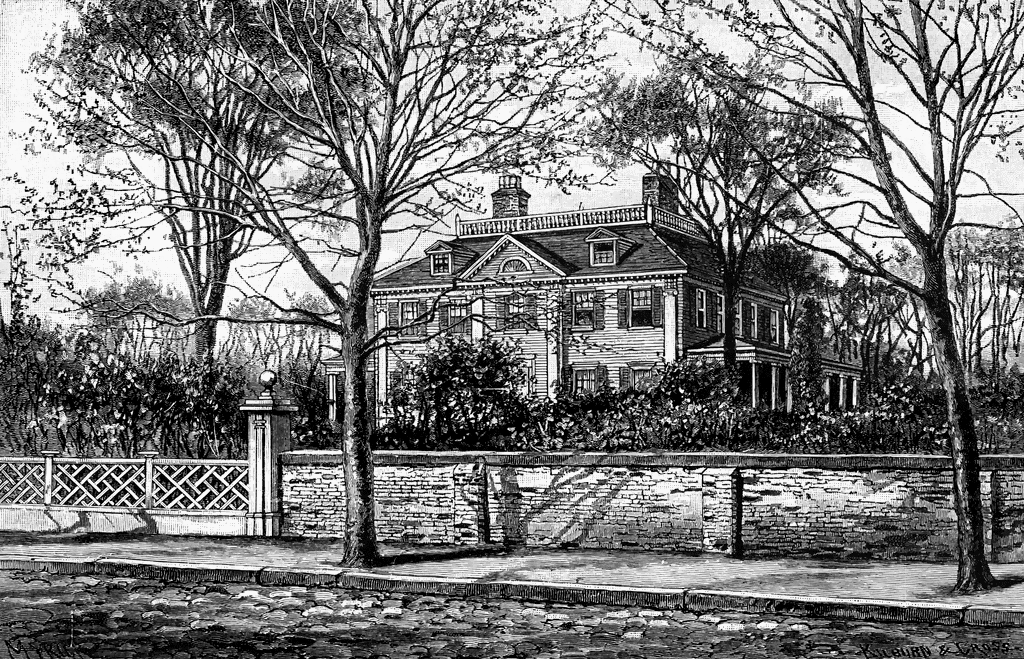
Craigie House, bought by Longfellow's FIL when he married Fanny. Washington bivouacked there. I always have imagined the Lawrence mansion in Louisa May Alcott's Little Women looking exactly like this.

Politically, Longfellow was mildly centerist all his life, which didn’t prevent a close life-long friendship with radical abolitionist-to-be, Charles Sumner. Nor did it prevent him from writing the lines that concluded his very popular, The Building of the Ship (published 1849), that made President Abraham Lincoln weep:

Thou, too, sail on, O Ship of State.

Sail on, O Union, strong and great!

Humanity with all its fears,

With all the hopes of future years,

Is hanging breathless on thy fate!

I confess, that in These Times, particularly after watching the Democratic Nominating Convention these last three days and hearing non-insane people speaking to a national audience, the lines make me weep too, as we all hardly even dare for “hopes of future years” in any way that we have known in the past.

Cross of Snow,  like such earlier biographies that have so delighted me, such as The Peabody Sisters:Three Women Who Ignited American Romanticism by Megan Marshall. Sophia Peabody was so much more interesting before she married Nathaniel Hawthorne, who was a Bowdoin schoolmate and later friend too, of Longfellow. Or, The Beechers by Milton Rugoff, an examination of the family. These provide the deeply engaging immersion that does a really fine historical family saga, such as that of Winston-Graham’s Poldark Saga.  

These kinds of books are inspiring, antidotes to the gorge of disgust, revulsion and despair about the USA and its history engendered by all these criminals in the news these days. They remind us there is a side of light after all to our past, that shone brilliantly in many locations -- in great opposition to the dark of Slaveocracy and those who made the War of the Rebellion -- and the Slaveocracy's descendents, these monsters from Lovecraft who are about nothing but ugly, hate, murder, pillage and destruction.

Wednesday, May 20, 2020

Part 2: John Quincy Adams on "the melancholy madness of Poetry without the inspiration"

     . . . . For maximum tickle-brain effect, the following first section really should be read aloud, in company with other writers.

First part of ""the melancholy madness of Poetry without the inspiration" here.

~~~~~~~~~~
Washington D.C. March 10, 1831

Sun rose 6:13. Fahrenheit 30. -- I lost one or two stanza's [sic] of Dermot, by my walk with Mr. Hagner, and should therefore get something by way of composition -- As I proceed with Dermot, the subject opens upon me, and I feel distressingly my wants.  I supposed I could make out of it a Tale of about 50 Stanza's -- I now think I cannot get through with it in less than one hundred.  My Style is the mock heroic; but it wants vivacity, humour, poetical invention and a large command of Language. -- I want besides a knowledge of Ireland, physical moral and political -- A knowledge of the manners, usages, prevailing opinions, modes of life, social habits and dress of the twelfth century.  I want a faculty of inventing and delineating character, of naturalizing familial dialogue and spicing my treat with keen and cutting Satire.  I want the faculty of picturesque description: of penetrating into the inmost recesses of human Nature -- of moralizing in harmonious verse -- of passing from grave to gay, from lively to severe -- of touching the cords of sympathy with the tender and sublime -- and to consecrate the whole by a perpetual tendency to a pure and elevated morality -- I do not believe there is in human history a happier subject for a mock-heroic Poem than the Conquest of Ireland by Henry the second -- But where are the legendary fables of Ireland for machinery [an 18th C term meaning the apparatus of something, whether culture, art, etc.] -- where the art of painting the intrigues of Dermot at the Court of Henry; where the art of describing Battles, and Sieges, the desolation of the Country during the progress of the Conquest, the destruction of Fernes, the Capitol of Leinster, the interior of the monastery where Dermot concealed himself upon his return after his expulsion -- All this a true Poet might paint with touches of the terribly sublime -- if I had undertaken it forty years ago I might have made something of it now -- At present, I might as well undertake to paint a Scene of the Deluge upon Canvas; or to compose the music of an Opera -- or to execute the Pediment of the Capitol which I designed. [Italian sculptor Luigi Persico's original design for the sculpture included figures of Peace, Plenty, and Hercules; these were replaced at the suggestion of President John Quincy Adams with the figure of Hope. Adams wished the design to "represent the American Union founded on the Declaration of Independence and consummated by the organization of the general government under the Federal Constitution, supported by Justice in the past, and relying upon Hope in Providence for the future."] Mr. John W. Taylor was here, and took leave of me -- Going in a day or two for home. I had a long conversation with him upon the aspects of political affairs, and upon the prostitution of principle as well as the hostility to me, manifested by the party now holding up Mr. Clay as the Candidate for the next Presidential Election -- I gave him instances and proofs, some of which were already known to him; others he had not heard of before
______

Washington D.C. March 12 1831

Morning walk omitted.  Proportional deduction from the progress of Dermot.  [The rest of this day's entry is entirely concerned with the matter before the Supreme Court, brought by the Cherokees, regarding the states essentially nullifying treaties made with them, which quite outrages and depresses JQ, as indeed it would any decent-thinking person.]


_____

     . . . . Sir Walter Scott's wildly popular long poem historical Romances were doubtless JQ's inspiration for doing The Tale of Dermont.  JQ always wished to be widely popular, and seldom achieved it, and only for short periods. 

1805: The Lay of the Last Minstrel
1806: Ballads and Lyrical Pieces
1808: Marmion
1810: The Lady of the Lake

~~~~~~~~~~~
Washington D.C.,  April 16th 1831


Rain -- I finished this Morning the fair copy of my Poem of Dermot MacMorrogh, and have now the measure of my own Poetical Power -- Beyond this I shall never attain, and now it is an important question whether I should throw this, and almost all the other verses I have written into the fire -- Hitherto I have confined myself to Translations, and fugitive pieces of a very few Lines of Stanza's; a small portion of whihc have been published in Newspapers and Magazines.  I have now completed a historical Tale, of upwards of two thousand line; the subject of my own Selection -- the moral clear and palpable -- the characters and incidents strictly historical -- The Story complete and entire -- It has amused and occupied two Months of my life and leaves me now like a pleasant dream, to dull and distressing realities -- To a sense of wasted Time to the humiliation of enterprize, ashamed of performance-- Yet at the same Time with an insatate thirst for undertaking again higher and better things.

~~~~~~~~~~~
And here we come to "The End" of Dermont, JQ's "a pleasant dream", which was his escape in those dreary winter days after leaving the White House and returning to Quincy in the spring. Once he has finished Dermont though, his mind falls back into his keen sense of humiliation and shame, for losing the presidency to Andrew Jackson.  But he is not finished, he resolves. As we shall see, soon he will be "undertaking again higher and better things."  Indeed, he will be returned to D.C. as a Massachusetts Congressman, who became hated by the slaveocracy, and by no one more than Andrew Jackson, for his unrelenting representation for the rights of the enslaved and for Abolition. His state of Massachusetts, which did so much to form the souls of his parents and his own, returned him to Congress, without challenge, until the very end of his life.

He died of stroke, on the floor of Congress, in the midst of a debate upon a resolution on which he was resolved to vote "No!" In thunder.


Part 1: John Quincy Adams on "the melancholy madness of Poetry without the inspiration"

     . . . . Copied from the Library of America 2 volume edition of the Diaries of John Quincy Adams, brilliantly edited by historian, David Waldstreicher.

The following entries feelingly describe his sorrow at being a failure as a poet while possessing all the passion to express himself as great poets do. He recognizes that as a writer of the imagination he fully lacks the necessary imaginative verbal power to transport his castles in the air onto paper. All writers feel this way, and not only writers of the imagination. His description (below) of what it is like to be in full creative throe and thrall to a project is recognizable and shared by all writers, whether they are good or poor writers. 

However, unlike most of us, JQA may have been an imaginative failure, but a as recorder of history, he is pure gold. He also manages right at the start of this meditation on his attempt to write an epic Tale of Dermont (a description of which arrives in the next entry) to get in a sly dig at Thomas Jefferson, which is right where I began to laugh.  I continued to laugh throughout these entries, but it is critical to understand that I was laughing with JQ, and with great sympathy, not at him. No one understood his own shortcomings as well as JQ, or understood there was nothing he could -- or in some cases, would do -- to remedy them. He was the son of John and Abigail Adams, and these arch Puritans inhabited him as fully as he inhabited himself.

~~~~~~~~~~~~~
March 8, 1831; Washington D.C.

Sun rose 6:16. Fahrenheit 30.  It is a doctrine of the medical faculty that bodily exercise to be salutary, should be taken with a vacant mind, and such is the precept of Mr. Jefferson.  By the instruction Buchan I have during the greater part of my life, followed this rule, and it has saved me from the composition of mechans vers douze fois, douze cens and ten times more -- At certain Seasons however the propensity becomes too strong for me. I walk and muse, and pour forth premeditated verse, which it takes me six or nine months to lay by, and then resume to find it good for nothing -- It never appears so to me when I compose it -- In a few instances I have suffered the publication of my effusions, and I am accredited, as one of the smallest Poets of Country -- Very short fugitive pieces and translations are the only rhymes I have ever committed to the press.  One short poem; the lines to Mrs. Hellen on the death of her two children -- and one translation, the 13th Satire of Juvenal have been favorably noticed. One Satirical song, overlooked when first published was dragged into light twenty years afterwards, for political effect against me because it laughed at the party lama Jefferson.  All the rest of of my published poetry has passed from the press into the waters of Lethé -- One of these rhyming fits is now upon me -- brought on by the inflammation of my eye, which debarred me from reading and writing, and threw me back upon my own scanty resources -- I write every morning one Stanza of paraphrase from the Bible; and in my morning walk from two to three Stanzas of a Tale which I have undertaken, far beyond my depth, and which I shall obviously never get through -- But so totally does it absorb my attention while engaged upon it, that in my morning walk round the capitol square, I go out and return almost without consciousness of the passage of Time -- the melancholy madness of Poetry without the inspiration -- I cooked up this morning one Stanza before rising from bed -- Then after three Chapters of Isaiah -- one Stanza, of paraphrase from the 3rd Chapter of Proverbs -- Then in my walk three Stanzas more of the Tale and this Evening after dinner, severely threatened with an inflammation of my left eye, and therefore, daring neither to read nor write, took up an Ode of Horace, exquisitely beautiful, from which more than twenty-five years ago I had wrung three Stanzas, and then given up the rest in despair -- They were three of the best Stanzas I ever wrote -- to which I now added two of the worst -- The thoughts of Horace, are as unmalleable as Platina. [Do not know if Platina here refers to the 15th C poet, or to the metal.  I am guessing the poet, but both are equally likely to inhabit the vast, multi-chambered mind of JQA!]

Tuesday, November 1, 2016

Our Remarks for Sunday Night's American Books Awards - Before Columbus Foundation

Dr. Roxanne Dunbar-Ortiz kindly read our words as we could not get to the West Coast within a few hours of the Symphony Space live performance with music event of The American Slave Coast . . .

       . . . .  Dear Dr. Roxanne Dunbar-Ortiz:

Thank you so much for lending your voice on behalf of our work as we happily accept an American Book Award. Your endorsement means a great deal to us.

Please thank Justin Desmangles on our behalf, and of course, the Before Columbus Foundation. We salute the Foundation on the longevity of the American Books Award, whose roster of recipients over the years takes on a historical perspective all its own, and in whose magnificent playlist we are now thrilled to reside.

Perhaps because of the stimulating name Before Columbus, and because The American Slave Coast is squarely in the genre of American history, it took a while for it to sink in for us that this wasn’t a history award but a literary award. Which is particularly gratifying, because we have long read history as literature, and vice versa. Creating historical narratives is inevitably a literary act, and it’s a never-ending task, because people interrogate history differently over time: different moments have different urgent questions, different reference points, different techniques, different sources, different taboos.

Our publisher, Chicago Review Press, published all three of Ned Sublette’s books prior to The American Slave Coast; all four were edited by Yuval Taylor, creating for us a long-term continuity of editor, publisher, and writer that is rare in present-day publishing. This solid editorial support has allowed us to create large historical structures, which goes against the grain of a publishing industry focused on short books and narrow topics. Our book is 265,000 words or so, and weighs 3 pounds in hardback. At first we were apologetic for its length and heft, but in New Orleans a woman said to us, “It takes a book that big to tell our story.”

Quote [from The American Slave Coast's text]:
The American Slave Coast is a history of the United States that takes into account something that everyone in slavery days understood: the workings of the slave-breeding industry, which was a unique creation of Anglo-American entrepreneurship, and which was central to American politics as long as it existed. All of American history looks different once the slave-breeding industry is taken into account, and indeed key events like the annexation of Texas and California are inexplicable without reference to it.

The book became a project in 2010, when Ned was named the Patrick Henry Writing Fellow at the C.V. Starr Center for the Study of the American Experience at Washington College in Chestertown, Maryland, and thanks also to our agent, Sarah Lazin. The argument is a little complicated, but here’s how we tried to explain it in the introduction, quote:

This is a history of the slave-breeding industry, which we define as the complex of businesses and individuals in the United States who profited from the enslavement of African American children at birth. At the heart of our account is the intricate connection between the legal fact of people as property—the “chattel principle”—and national expansion. Our narrative doubles, then, as a history of the making of the United States as seen from the point of view of the domestic slave trade.

It also traces the history of money in America. In the Southern United States, the “peculiar institution” of slavery was inextricably associated with its own peculiar economy, interconnected with that of the North.

One of the two principal products of the antebellum slave economy was staple crops, which provided the cash flow—primarily cotton, which was the United States’ major export. The other was enslaved people, who counted as capital and functioned as the stable wealth of the South. African American bodies and childbearing potential collateralized massive amounts of credit, the use of which made slaveowners the wealthiest people in the country. When the Southern states seceded to form the Confederacy they partitioned off, and declared independence for, their economic system in which people were money. . . .

The conflict between North and South is a fundamental trope of American history, but in our narrative, the major conflict is intra-Southern: the commercial antagonism between Virginia, the great

slave breeder, and South Carolina, the great slave importer, for control of the market that supplied slave labor to an expanding slavery nation. The dramatic power struggle between the two was central to the Constitutional Convention in Philadelphia in 1787 and to secession in 1861.
[End Slave Coast quote.]

      . . . .  For us, writing a book doesn’t end with publication, it merely enters a new phase. In the year since publication, we’ve been on the road when we can be, taking it as many places as possible, and hearing what connections people are making to this history in this age of police brutality, open-carry militias, and mass incarceration. We’ve learned so much about our own book by going around the country during the last year, reading, talking, and listening. We had a tremendous experience last month in Columbus, Indiana, where we spoke to 150 high school students. In doing this, we’ve had the privilege of hearing a cross-section of what people are talking about.

It’s been an uphill struggle trying to get the narrative out there: with a few much-appreciated exceptions, mainstream media haven’t been in a hurry to talk about the slave-breeding industry, but we’ve had wonderful experiences with regional black media, especially AM radio, and independent left media.

Unfortunately, we haven’t been to the West Coast yet, but we hope to remedy that in 2017. We’re at home today, just emerging from our Friday night performance at New York City’s Symphony Space of The American Slave Coast Live, a 2-hour reading of the book with multiple voices and a live score by Donald Harrison and musicians. For two hours, a theater full of people listened and responded to historical discourse. It was cathartic, and we hope to present it in other cities.

At the top of the show’s flyer, we proudly set a banner: AMERICAN BOOK AWARD WINNER. So many people have congratulated us on this award. Our publisher is very happy. We send a profound thank-you to the Before Columbus Foundation, and we feel dumb for not being there to celebrate with you.

Thursday, March 19, 2015

American Name of the Day

Thanks to Samuel Clemens / Mark Twain, and his Innocents Abroad, this on goes into the collection of favorite American names:


Bloodgood Haviland Cutter, an actual person, from a well-known 19th century family on Long Island.


He was a wealthy, go-getting sort of fellow, who was an obsessive rhymer, at length, into the bargain. This trait was not admired by Mr. Clemens.

Wednesday, November 26, 2014

Thanksgiving - Lincoln

One thinks of Lincoln and the Civil War at Thanksgiving.

Until only a few days ago I was ignorant of this poem.


"The Martyr"

GOOD Friday was the day
Of the prodigy and crime,
When they killed him in his pity,
When they killed him in his prime
Of clemency and calm--
When with yearning he was filled
To redeem the evil-willed,
And, though conqueror, be kind;
But they killed him in his kindness,
In their madness and their blindness,
And they killed him from behind.

There is sobbing of the strong,
And a pall upon the land;
But the People in their weeping
Bare the iron hand:
Beware the People weeping
When they bare the iron hand.

He lieth in his blood--
The father in his face;
They have killed him, the Forgiver--
The Avenger takes his place,
The Avenger wisely stern,
Who in righteousness shall do
What the heavens call him to,
And the parricides remand;
For they killed him in his kindness,
In their madness and their blindness,
And his blood is on their hand.

There is sobbing of the strong,
And a pall upon the land;
But the People in their weeping
Bare the iron hand:
Beware the People weeping
When they bare the iron hand.


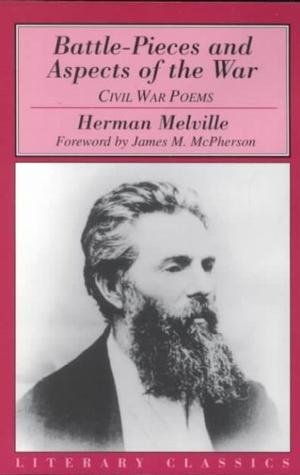
"The Martyr" was originally published in Battle-Pieces and Aspects of the War. Herman Melville. New York: Harper & Brothers, 1866.


The poet's grief and bewilderment still weep and bleed in these lines.

Why did this happen?  Madness and hatred and evil the poet says.  Poets can use those terms, historians cannot.  Except when it comes to acts of violence such as presidential assassinations and school shootings -- then everyone from police to journalists to historians rush to say, "This is the act of a lone madman."

Yet before and during the war, as well as after, even historians such as Henry Adams characterized the secessionists as mad men, filled with evil, because the secessionists' hatred was so inexplicable to the rest of the country.

But if John Wilkes Booth was "merely" mad, then certainly were all the fire eating secessionists, including those plotting to burn down NYC, Chicago and other northern cities, and take them over then, with a coalition of northern Democrats and southern secessionists come down from their refuge in Canada back in the fall of 1864.

So, what drove all these people insane?  It could only be centuries of living in a society that was made of slavery and white supremacy.


Wednesday, June 18, 2014

Mississippi: As It Was, So It Shall Always Be

The last few years were the Years of Henry Adams as my pathfinder into so many issues.

Here at the year's half way point, reviewing the notes and scribbles out of my researches for 2014, I can see that Mississippi is front and center this year.  It was time, of course.  But the trip in March, from New Orleans, through Natchez to Memphis, sealed the deal.

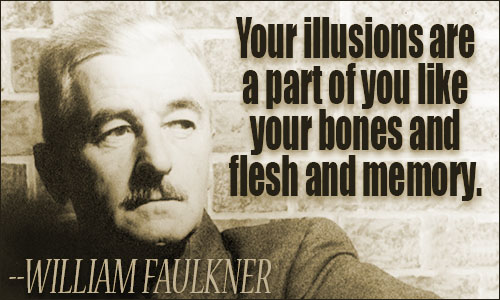
The pathfinder writers are Alexander Percy and William Faulkner.*  Thank goodness northwestern Mississippi Faulkner is a great writer, an interesting personality, with an intelligent consciousness -- because Delta aristo Percy is not.  It's been a hoot reading young Billy Falkner's reviews of Percy's poetry in the U of Mississippi's paper and magazines. **


The other night I discovered that Faulkner, one who hardly ever wrote notations or anything else inside his books, made in his introduction to Anthology of Magazine Verse for 1920 and Year Book of American Poetry*, in which the then literary arbiter, Bostonian William Stanley Braithwaite, wrote in in his introduction:
" ... Indian and negro materials ... are in our poetry still hardly better than aspects of the exotic.  No one who matters actually thinks that a national literature can be founded on such alien bases."
Faulkner's response was:
"Making one his extremely rare marginal comments, William Faulkner drew an arrow pointing to this passage.  Above it, in large letters, he wrote, "Good God." "
Unlike Braithwaite, despite his appointment to Atlanta University,  Faulkner spent his life in close interpersonal relationship with negroes, Indians and Indian-Black.

It's interesting, digging into the political battles between the Delta planter aristocrats such as Leroy Percy and the businessmen of the northwest, for instance,

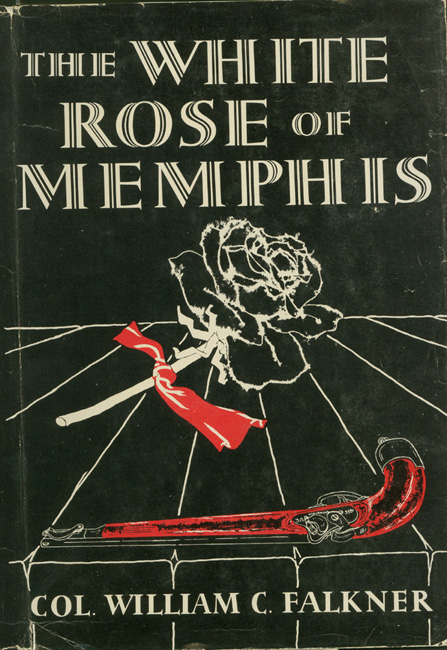
Published serially in 1880, this is the most successful of William Faulkner's grandfather's books; it sold something 160,000 copies. The White Rose of Memphis is a riverboat plying the Memphis to Crescent City route.
 Twain's Life on the Mississippi was published in 1883, though the first part was published in 1876.

among whom Faulkner's grandfather, William C. Falkner, was prominent.  (Falkner became Faulkner when Billy applied to the Canadian RAF training program toward the end of WWI, and pretended to be English, thinking his chances of acceptance would be greater.  He even trained in British-speak with an English public school buddy of his older friend, at Yale. Evidently the RAF never caught on that he wasn't English.) This antagonism, of businessmen, traders and those who wanted internal improvements, with the ruling elite planters goes back long before the Civil War.  You see this in other states' history, too, those states that would become the CSA.

It's a sad commentary on the United States and her history, that some things about Mississippi in 2014 stay exactly the way they were in 1860 -- which is how they lost the Waa! under that great Mississippian, Jefferson Davis.
The president of the board of supervisors, Lee Caldwell, a fellow Republican, can riff extensively on the local infrastructure projects that Mr. Cochran, Mississippi’s powerful senior senator, has helped bring to fruition, thanks to his skill at procuring federal funds: The construction of the air-traffic control tower at the Olive Branch Airport. The new east-west stretch of Interstate, which will bisect the county when completed. And a state-of-the-art regional sewer system that solved a chronic wastewater management problem, allowing DeSoto County to attract new industry and build new neighborhoods.
Yet Mr. Cochran is currently fighting for his political life after being trounced here in DeSoto County by a ratio of nearly 2 to 1 by the Tea Party favorite Chris McDaniel in the June 3 Republican primary. At issue for many Republicans is the idea that what Mr. Cochran does best is also what he does worst — spend federal dollars.
The result is a race that is raising a question at the heart of American politics, and especially the politics of the South: Do voters hate spending even when it is spending that comes home to them? On an instinctive level, for many Mississippi voters like Randy Harris, a retired auctioneer, the answer is yes.
“Everybody’s got their hand out like these damn people at the food stamp office,” Mr. Harris, 67, said between sips of coffee on Thursday at a local barbecue restaurant. “They’ve got to put an end to all of this spending.”
No public spending for the public good, even when it isn't MY tax dollars!
... like Jane Buehl Coln of Olive Branch, suspect that whatever benefits have come to Mississippi have come at a steep price.
“There’s no telling what kinds of liberal things he had to vote for to get those kinds of things for Mississippi — what kind of trading he had to do,” she said
Mississippi destroyed the United States credit rating by defaulting on Europe and Britains investment bonds for building public projects like canals, back in the 1840's.  They just refused to pay -- nor does anyone to this day know where the money went. This is what states rights looks like.

------------------
* I'm forced soon to go to Shelby Foote, another revisionist Civil War historian from Percy's circle in Greenville.

The southern writers who have fallen into well-deserved obscurity, because they were fire eaters and / or, after the waa!, revisionists, magnoliaists, confederate carpetbaggers, are becoming ever more interesting. This interest was sparked with a northern apologist for slavery, whom I read back in Chestertown, James Kirke Paulding.  This NY Knickerbocker's reward from T Jefferson was a well-paid sinecure in the U.S. Navy, from which he became Secretary of the Navy.  It truly was a sinecure appointment, allowing him much leisure time to be an author and help found the Salmagundi Club with Washington Irving, as T Jefferson dismantled the U.S. Navy.

** In this time of his early twenties, Faulkner was working very hard at writing poetry.  Mass market targeted magazines were still major markets for poetry then.  Faulkner had managed to sell one of his poems fairly early on to a major magazine but had failed ever since.  Naturally he was studying what the markets were publishing.


Saturday, April 12, 2014

Memphis is Mississippi

Memphis is really Mississippi, not Tennessee, no matter what the maps say.

Duh.


Memphis, not Nashville, was the economic magnet for the Delta, as Philadelphia was for the upper south, Maryland and Virginia, and even South Carolina,  in the colonial era -- until Baltimore, which rapidly took its place. In the southern "west" not Nashville, but Memphis, was the magnet for the working poor, black and white of the Delta. Elvis. Even though, as we see from Wiki, Tupelo isn't the Delta per se:
Tupelo is the county seat and the largest city of Lee County, Mississippi. It is also the seventh-largest city in the state. It is situated in northeast Mississippi, between Memphis, Tennessee, and Birmingham, Alabama, and is accessed by U.S. Route 78. 


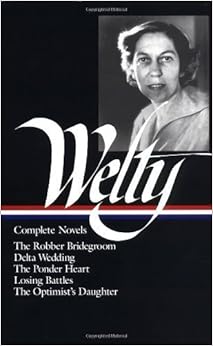
For the more prosperous Delta people, Memphis is where you go to shop for fashionable items and enjoy sophisticated entertainment. You see this in the fiction by the writers who are from this part of the country, as in Delta Wedding, by Eudora Welty, set in 1923, published 1946. The Fairchild's family's mercantile members live and own business in Memphis. Those who live on Shellmound plantation to there to shop, to celebrate and to party.


One way to understand this is to contrast the work of Welty, say, born in Jackson, Mississippi, with that of Peter Taylor, Nashville writer.

As another contrast is what the writing of William Alexander Percy, second cousin and adoptive parent of Walker Percy, reveals. The wealthy and powerful elite of the Delta, are cosmopolitan: sending their sons, at least, to Harvard, then to Europe and New York, with family connection throughout the old confederacy from Virginia and Georgia, to New Orleans and Nashville.

... William McChesny Martin, Walker Hill, and W.B.. Plunkett. Standing: Murray Carleton, Oscar Fenley, F.O. Watts, Walter W. Smith, and LeRoy Percy, from  A Foregone Conclusion, a history of the Federal Reserve Bank of St. Louis, serving "St. Louis, Little Rock, Louisville, Memphis."
Nashville for this class rather than Memphis, because Nashville was the regional political center. William Walker Percy's father, LeRoy Percy (1860 - 1929), served as a senator in D.C.


LeRoy Percy was a wealthy attorney who became a planter in Greenville, Mississippi (location headquarters for the Coen Bros.' film, O Brother, Where Art Thou), in the heart of the Delta. His plantation of Trail Lake covered 20,000 acres and was worked by sharecroppers. Thus it's not surprising that Leroy Percy died Memphis, the economic and cultural capital of the Delta.