LINES OF THE DAY

". . . But the past does not exist independently from the present. Indeed, the past is only past because there is a present, just as I can point to something over there only because I am here. But nothing is inherently over there or here. In that sense, the past has no content. The past -- or more accurately, pastness -- is a position. Thus, in no way can we identify the past as past." p. 15

". . . But we may want to keep in mind that deeds and words are not as distinguishable as often we presume. History does not belong only to its narrators, professional or amateur. While some of us debate what history is or was, others take it into their own hands." p. 153

Silencing the Past: Power and the Production of History (1995) by Michel-Rolph Trouillot

Showing posts with label U.S. slavery. Show all posts

Wednesday, September 28, 2022

What You Got There? A Book?

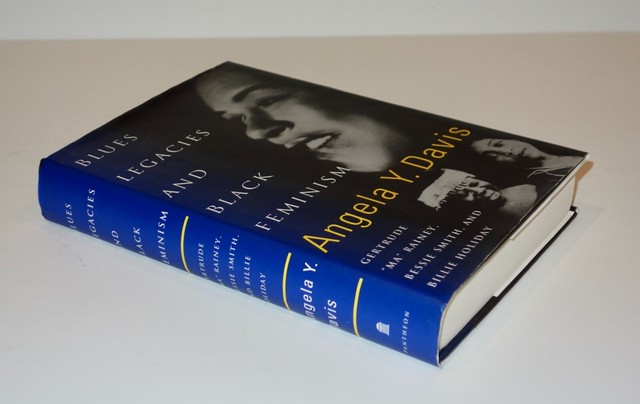
      . . . .  Blues Legacies and Black Feminism: Gertrude "Ma" Rainey, Bessie Smith, and Billy Holiday (1998) by Angela Davis. 


The moment we entered into her thesis, there was all kinds of self-kicking going on.  It was so obvious.  Prior to abolition African American music was primarily a communal expression,  done in the fields, in worship, at funerals.  It was also primarily spiritual.

After abolition, African Americans needed a whole new musical discourse.  They had to make it up because never before had there been opportunity in these lands for them to make music that wasn't communal, that wasn't about the lament of the condition and the yearning for that condition to have passed away, leaving them free to do as other people did.  

For Black women in particular, there was and could be no tradition that was about love, about sex, about romance, about what she wanted for herself, for Black women didn't have choice until after abolition -- and certainly wouldn't be allowed to sing about wanting to marry and raise her own children herself while cooking, cleaning, digging, and having her children go on master's credit side of the ledger and sold off any old time. So post abolition Black women had to invent a gendered, individual, popular musical expression  for themselves.

This was particularly necessary for Black women who would have preferred women as their sexual partners.

And thus, here we come to the Blues, performed by a solo singer, with a single instrument, the guitar, played by herself.  Of course these women couldn't afford more complicated set-ups, but this they could. 

Of course a man got the credit as "inventor of the Blues"*, Robert Johnson, with a powerful legendary tale of meeting the devil at the crossroads as to how he did it to boot.  

Why haven't we read this book before?

* Musicologists of course, know better.  They all know there were a slew of performers.


Wednesday, April 7, 2021

Let's Read Again Like We Did Last Year ~~

      . . . . Frequently my mind fails to make sense to me. 


 How did I manage to choose Bagehot: The Life and Times of the Greatest Victorian (2019) by James Grant as the audio book to follow Pale Rider: The Spanish Flu of 1918 and How It Changed the World (2016) by Laura Spinney, and The Zealot and the Emancipator: John Brown, Abraham Lincoln, and the Struggle for American Freedom (2020) by H. W. Brands for my workouts?

So far my great take-away is that Bagehot was not only a prototype of what we in later times tend to call a libertarian / neo liberal.  He formalized the concept, and described in detail  the necessity of a Central Bank and its functions for a stable government.  He did the same for Constitutional Monarchy. This while, though they benefit from both, the 'lower orders,' the poor, the uneducated, are incapable of understanding either economics or constitutions, and certainly lack the capacity for making political and governing decisions. Needless to say that women as a class aren't even that much of a consideration, despite his respect for the intellects of many of the women of his acquaintance, including his own mother, who also suffered serious mental illness.

This brilliant fellow, a prodigy already as a very young child, could not add or subtract. Yet his family put him in charge the family banking business, when he hated everything else including the law for which he qualified among his many other professional credentials, realizing he wouldn't be able to pull a Disraeli and move from writing to holding office and becoming Prime Minister. The family business's great fortune is that he seems to have spent more time doing anything but banking, while remaining a writing demon as to output, and a polymath in terms of what he wrote about. Naturally, due to his writing about how to run a country's finances, he got sent to India to put its finances on solid footing.  How more British and Victorian than this may we get?

Bagehot was praised for cool wit and epigrammatic style, which author Grant does his best to exhibit in his own economic writing. Nor did Bagehot stint in praise for himself in his own writing, knowing he knew what others did not, and taking knowingly contrary political positions such as favoring Louis-Philippe's coup against the election and naming himself France's ruler for life. Bagehot inevitably reminds this reader of that thoroughly self-satisfied, thoroughly knowledgeable of his own superiority, that fellow likely only Tories today recall, William F. Buckley.

On the other hand, George Eliot quite adored Bagehot as a thinker and his friend.  But no one has suggested George Eliot didn't have a strong conservative bent herself -- except for herself, of course.

~ ~ ~ ~ ~

Things do roll on, don't they. The period's royalties arrived, and so did spring, while winter, hopefully, is now departed for months.  El V got his second dose of Pfizer this afternoon.  He's currently lying down, but he generally feels sleepy before dinner so it probably means nothing.  I am making dinner, looking forward to my second dose of Moderna late Friday afternoon, and after dinner, I'm particularly looking forward to the HBO Max premiere of  the 4-part Exterminate All the Brutes.

In ‘Exterminate All the Brutes,’ Raoul Peck Takes Aim at White Supremacy

After the success of “I Am Not Your Negro,” HBO gave Peck carte blanche for his next big project. What resulted is a sweeping meditation on colonialism and the nature of truth itself. ... New York Times

Raoul Peck’s four-hour documentary for HBO is a dizzying retelling of the course of colonialism, slavery and genocide. ... New York Times

"....a Radical Masterpiece About White Supremacy, Violence and the History of the West" ... Time

This exploration of the "origin story of white supremacy" features two Revelators who have had deep effect on both el V's and my historical researches and formation of our historical perspective:  


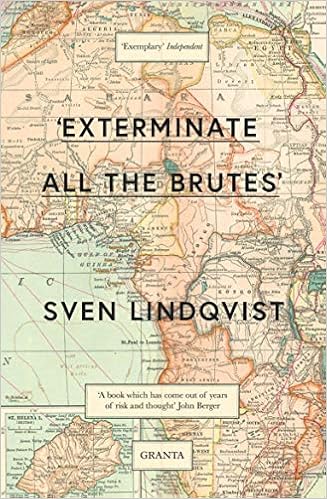
" .... It takes its title from Swedish historian Sven Lindqvist’s ruminative 1992 book about his travels through postcolonial Africa, which in turn wrestles with the source of the quote “exterminate all the brutes”: Joseph Conrad’s immortal novella Heart of Darkness. Peck also draws heavily on historian and activist Roxanne Dunbar-Ortiz’s An Indigenous People’s History of the United States and Haitian anthropologist Michel-Rolph Trouillot’s Silencing the Past: The Power and Production of History. In each episode, he credits himself as having made the series “together with” all three scholars, even though Trouillot died in 2012 and Lindqvist in 2019."

Seeing Roxanne Dunbar-Ortiz involved in this already highly praised non-dramatic, history series, feels particularly personal since she accepted on our behalf and read our "Thank you very much for this honor" for the 2016 American Book Award for The American Slave Coast: A History of the Slave Breeding Industry, as we weren't able to make it out to California for the event.  But it's particularly satisfying because Dunbar-Ortiz is a true pioneer of this kind of work.  When she began, it didn't exist, within or without academia.  Now, because of hers and others devoting their lives to inventing a methodology to study and recover history that has been both disappeared and denied, to see her, at her age, receiving this kind of recognition is truly exciting.

A quote from Michel-Rolph Trouillot is at the top of this Fox Home blog, as it has since the beginning.


Saturday, August 5, 2017

Words From Me Not Needed

     . . . . From Ava DeVernay's twitter feed, August 5th, 2017, 

 https://twitter.com/ava/status/893872487716585475   


Saturday, May 20, 2017

To Great Cheering, He's Down!

     . . . .VIDEO - Removal Of General Robert E. Lee Statue Monument From Lee Circle In New Orleans.

And it is accomplished to the accompaniment of the sort of celebration that can happen only in New Orleans.


What has always puzzled me about this particular New Orleans's CSA monument centers around the facts that Lee had no connection with New Orleans or Louisiana beyond sailing to San Antonio there at the outset of the invasion of Mexico in the Mexican American War. 

In the War of Southern Aggression Lee was all about, and only about. 'defending' Virginia. 
He wasn't even general of the Army of Northern Virginia when New Orleans and Louisiana were defeated and occupied by the Union forces.  He never had anything to do with Louisiana and the western states ever. This was unlike, o say, Sherman, who was superintendent of the Louisiana Military Academy when the War of Southern Aggression was declared.


A large standing bronze of Abraham Lincoln with the Emancipation Proclamation, by sculptor Leonard Wells. Is this not at least as much to historically honored as those who fought and killed for the sake of the expansion of slavery?

Contradicting those who defend these monuments, erected many years after Appomattox, as having nothing to do with slavery, but as preservation of our historical heritage, is there have been no monuments raised to Sherman or Grant in New Orleans. Nor, for that matter, have any been raised to Lincoln, though there was of Jefferson Davis (that one was been removed earlier). 

In other words, these monuments are part of the revisionist history of the United States, another white-wash of our national shame of slavery, telling a false tale of our history, and then glorifying the lies. This is why these monuments to owners of slaves need to be removed.*

------------------------

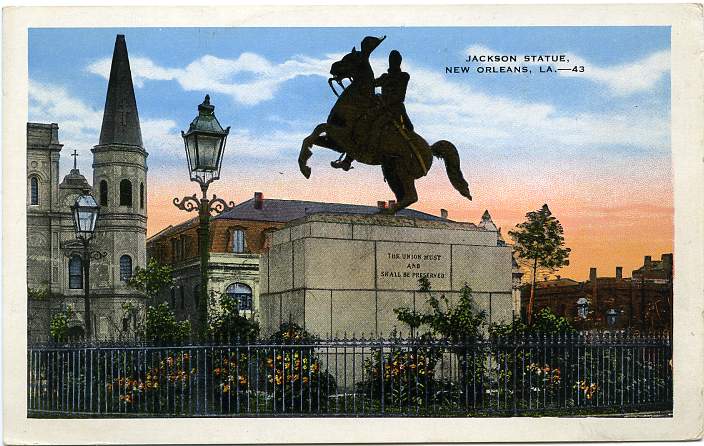
Equestrian statue honoring Andrew Jackson in Jackson Square, New Orleans.

*  I am no defender of Andrew Jackson (see the account of him in our The American Slave Coast: A History of the Slave Breeding Industry), who was a slave dealer and slave owner, an Indian killer, and hater of the English and anyone who crossed him. 

Nor am I generally a defender of that catastrophic War of 1812 (though the Brits were behaving most thuggishly).

However, the monument honoring Jackson in New Orleans memorializes his defense of the city against the British invaders, not his Indian massacres or slave dealing -- though of course that great Battle of New Orleans was fought after the treaty ending the War of 1812 had officially been signed. Yet the battle was fought, and the Americans under his leadership did soundly defeat the Brits -- helping wipe away the many shameful defeats of US forces elsewhere, including the catastrophe that was the US invasion of Canada.  So yah, I can see logic to having that kind of monument, which carries a very different meaning and significance than the ones honoring those who blatantly, publicly and loudly declared war on the United States in order to preserve and expand slavery everywhere in North America -- and even into Mexico, the Caribbean, Central America -- and even the most rabid of the secessionist fire eaters declared -- into the Pacific.


Wednesday, April 19, 2017

Reading Wednesday: The Underground Railroad + White Tears

     . . . .  During a recent get-together with friends Colson Whitehead's The Underground Railroad, having recently won the Pulitzer for fiction, was part of the discussion.


The speculative fictional central narrative device chosen by the author, is a physical, industrial railroad, that literally runs underground, was questioned. The reasons for questioning the wisdom of this choice were reasonable: "white people's kids are going to believe it and there are too many phony ideas about the underground railroad already." By this are meant the quilts with special designs, secret maps, white people ran the escape routes, by the means of a secret organization were able to whisk thousands of people from the Deep South's Cotton Kingdom states to free soil states in the north, and many more phony ideas of what the means of escape from antebellum slavery were.*


Whitehead's novel has joined the talking points in the African American community concerning the depictions of slavery being made in popular culture / entertainment, including the controversy that sunk the fortunes of Nate Parker's (2016) film, Birth of A Nation, which seemed poised at the BAFTAs for Oscar recognition until social media revealed to the mass audience that he'd been accused of rape back in college, found not guilty but the woman had committed suicide later. Then of course, there are the Tarantino's massive violence revenge fantasies in which a black slave shoots up evil white slave owners and their henchmen.

I've had long conversations with people, black and white, about the films, but until this occasion hadn't discussed The Underground Railroad. Thinking as both an historian and a fiction writer, the reason the book is called The Underground Railroad and that the author creates a speculative fiction device that is a literal (within the terms of fiction, the novel itself) railroad that runs underground, is that this allows him to recounts all the stations of the African American Passion (it was Easter dinner after all), which history has literally been kept underground, but yet has continued to run in legal and financial documents and in memory.

There is another reason too, which is that the author could then employ the device as form, structure and even to a degree style, all three of which are armors for the novelist's psyche, as well as part of the tool kit for making a coherent story (which often as we know real life is not -- a coherent story).

Beyond that too, the author was allowing himself some sardonic play with white people's -- and black too -- capacity to romanticize the idea of escape route, and generally get so very wrong. He pushed that anti-historical determination to the very limit. In many ways I thought this was brilliant, particularly in aspiration.

Whitehead is not alone among younger novelists who recently have published work that aspires to bring the penetration of the history of US slavery into the present.  But White Tears (2017) by transplanted from England to hipster Brooklyn, Hari Kunzru is not successful in his execution.


Like Colson's novel, White Tears has a spec fic aspect also -- or magical realism as so many love to call that kind of thing (I don't). Though in a sense possession of a so-white guy by a long dead (fictional) blues man who suffers horrendous abuse in prison after murdering with a knife his girlfriend -- and then somehow gets the white boy to murder people with a knife too and suffer terrible abuse in prison -- is perhaps more horror than spec fic?

Maybe Kunzru was attempting to make fun of white guys grasping for personal authenticity by going for 'authentic' black stuff? (Want something good, steal if from black people . . . .)  The author further attempted to mate these white boys' quest for cool authentic identity with our carcel state which historically and currently specifically targets black men by giving one of the boys a fabulously wealthy family, whose current wealth comes from private prisons as with Eric Prince and his ilks. Then he tries to hook up young white guys' putting on black identity to make themselves 'real' with the colonial - imperial war machine too. This doesn't work, particularly as almost all the book is focused on two souless white boy geeks, one rich the other not, about whom honestly who gives a shyte?

If Kunzru wanted to show that white people have no culture of their own, this book doesn't do it. Well, it does it, by the conscious choice to center specifically USian contemporary brand of socially and emotionally incapacitated white geek guys.
The Guardian recently ran a piece on Black writers engaging with both lit and spec fic here. **

Supposedly The Underground Railroad is going to be an amazilla television series.


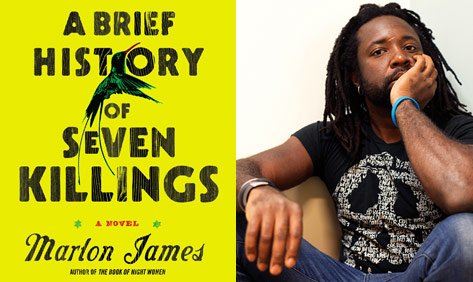
Marlon James (his A Brief History of Seven Killings (2014) got the Booker Prize) is currently engaged in an epic African fantasy project, titled Dark StarSeven Killings was optioned for an HBO series.


Junot Díaz's Brief Wondrous Life of Oscar Wao (2007) might be considered the gate opener for this successful combination of literary and genre fiction.  It won both the Pulitzer and National Book Awards, as well as other prizes. It was optioned for a film, if I am recalling correctly, back then, but there doesn't seem to be any recent news about that.

--------------------------------------------


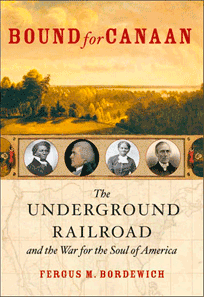
*  For the most complete and factual account of the means of who and how and to where slaves escaped their condition, from the earliest colonial era to the end of the Civil War, one cannot do better than read Fergus Bordewich's Bound for Canaan.

**   The brilliant fiction work that African American women are doing, with or without the inclusion of speculative fiction / genre tropes, seemingly is mostly ignored when it comes to the prestige prizes. The women who are first generation African immigrants, or from the Caribbean, seem to do somewhat better though, when it comes to the Big Validations, particularly in the UK. I'm not sure of this though, since I haven't gathered numbers and stats.  Somebody must have though!

Have any of their works been optioned for prestige television?


Friday, November 11, 2016

Amsterdam News Reviews Symphony Space Slave Coast Live Performance

Because the video advertisement on the page is so annoying, even though it's from CNN and shows thousands of people protesting the results of the election, I pulled the part of about Symphony Space and Slave Coast from the longer article and c&p ed it here.  The article's  author is the Amsterdam News's editor. Amsterdam News is the longest surviving original African American newspaper in New York City. It is the only Symphony Space performance review, of course, beyond the blog pieces written by white jazz music writers. 


The Amsterdam News Building at 2340 Frederick Douglass in New York has been adorned with some funky new murals as part of the #NotaCrime campaign 

The text came from Ned and Constance Sublette’s book, “The American Slave Coast: A History of the Slave-Breeding Industry” (Lawrence Hill Books). The passages were read by the authors; by vocalist Lezlie Harrison; by musician, vocalist Nona Hendrix; by actor, writer Carl Hancock Rux; by actress Kandia Crazy Horse; and by filmmaker Jonathan Demme. 
The music was composed by the saxophonist Donald Harrison and performed by his versatile quartet of guitarist/banjoist Detroit Brooks, pianist Zacci Curtis and drummer Darryl Staves. 
After reading “The American Slave Coast,” Harrison was inspired to write a composition with an intriguing edge anchored in the blues, and at times his New Orleans roots leaped out. 
For two hours the sold-out audience sat in scary silence as the music consoled them in the midst of being tortured by slavery’s agonizing truths. 
Ned stated, “I knew from the beginning this project needed to be performable.”
“The American Slave Coast” is the 2016 winner of the American Book Awards. Slavery, one of the most horrific crimes on the face of the Earth, is a crucial fabric of America. It is this contemplated abomination that has kept this country racially divided over the past 400 years. 
Last weekend the slavery empire built on terrorism and the torture of Black people, politics and economics traveled through time to sprout the heart-wrenching truth through the words of “The American Slave Coast: Live,”
at Manhattan’s Symphony Space. 
Today, one political candidate is using race as a talking point. But ssshhh! He isn’t using that word. He prefers the phrase “let’s make America great again.” Some folks ask, “Why don’t Black people just get over it? After all, slave masters weren’t really that bad.” 
Perhaps the slave masters they are referring to were former presidents Andrew Jackson, Thomas Jefferson and James K. Polk. Regardless of their presidency, these men were white supremacists who profited from and promoted the selling of African-Americans from birth to adulthood. 
“The American Slave Coast: A History of the Slave-Breeding Industry” is one of the most concise, graphic, historically researched books ever written on the subject. This book should be required reading for Americans, particularly those running for any political office.
By now there are 63 64 reviews of The American Slave Coast: A History of the Slave Breeding Industry up on amazilla.  With very few exceptions all the reviews are four and five stars.  I think, though I haven't looked myself, that the majority of the reviews are 5 stars.

Tuesday, November 1, 2016

Our Remarks for Sunday Night's American Books Awards - Before Columbus Foundation

Dr. Roxanne Dunbar-Ortiz kindly read our words as we could not get to the West Coast within a few hours of the Symphony Space live performance with music event of The American Slave Coast . . .

       . . . .  Dear Dr. Roxanne Dunbar-Ortiz:

Thank you so much for lending your voice on behalf of our work as we happily accept an American Book Award. Your endorsement means a great deal to us.

Please thank Justin Desmangles on our behalf, and of course, the Before Columbus Foundation. We salute the Foundation on the longevity of the American Books Award, whose roster of recipients over the years takes on a historical perspective all its own, and in whose magnificent playlist we are now thrilled to reside.

Perhaps because of the stimulating name Before Columbus, and because The American Slave Coast is squarely in the genre of American history, it took a while for it to sink in for us that this wasn’t a history award but a literary award. Which is particularly gratifying, because we have long read history as literature, and vice versa. Creating historical narratives is inevitably a literary act, and it’s a never-ending task, because people interrogate history differently over time: different moments have different urgent questions, different reference points, different techniques, different sources, different taboos.

Our publisher, Chicago Review Press, published all three of Ned Sublette’s books prior to The American Slave Coast; all four were edited by Yuval Taylor, creating for us a long-term continuity of editor, publisher, and writer that is rare in present-day publishing. This solid editorial support has allowed us to create large historical structures, which goes against the grain of a publishing industry focused on short books and narrow topics. Our book is 265,000 words or so, and weighs 3 pounds in hardback. At first we were apologetic for its length and heft, but in New Orleans a woman said to us, “It takes a book that big to tell our story.”

Quote [from The American Slave Coast's text]:
The American Slave Coast is a history of the United States that takes into account something that everyone in slavery days understood: the workings of the slave-breeding industry, which was a unique creation of Anglo-American entrepreneurship, and which was central to American politics as long as it existed. All of American history looks different once the slave-breeding industry is taken into account, and indeed key events like the annexation of Texas and California are inexplicable without reference to it.

The book became a project in 2010, when Ned was named the Patrick Henry Writing Fellow at the C.V. Starr Center for the Study of the American Experience at Washington College in Chestertown, Maryland, and thanks also to our agent, Sarah Lazin. The argument is a little complicated, but here’s how we tried to explain it in the introduction, quote:

This is a history of the slave-breeding industry, which we define as the complex of businesses and individuals in the United States who profited from the enslavement of African American children at birth. At the heart of our account is the intricate connection between the legal fact of people as property—the “chattel principle”—and national expansion. Our narrative doubles, then, as a history of the making of the United States as seen from the point of view of the domestic slave trade.

It also traces the history of money in America. In the Southern United States, the “peculiar institution” of slavery was inextricably associated with its own peculiar economy, interconnected with that of the North.

One of the two principal products of the antebellum slave economy was staple crops, which provided the cash flow—primarily cotton, which was the United States’ major export. The other was enslaved people, who counted as capital and functioned as the stable wealth of the South. African American bodies and childbearing potential collateralized massive amounts of credit, the use of which made slaveowners the wealthiest people in the country. When the Southern states seceded to form the Confederacy they partitioned off, and declared independence for, their economic system in which people were money. . . .

The conflict between North and South is a fundamental trope of American history, but in our narrative, the major conflict is intra-Southern: the commercial antagonism between Virginia, the great

slave breeder, and South Carolina, the great slave importer, for control of the market that supplied slave labor to an expanding slavery nation. The dramatic power struggle between the two was central to the Constitutional Convention in Philadelphia in 1787 and to secession in 1861.
[End Slave Coast quote.]

      . . . .  For us, writing a book doesn’t end with publication, it merely enters a new phase. In the year since publication, we’ve been on the road when we can be, taking it as many places as possible, and hearing what connections people are making to this history in this age of police brutality, open-carry militias, and mass incarceration. We’ve learned so much about our own book by going around the country during the last year, reading, talking, and listening. We had a tremendous experience last month in Columbus, Indiana, where we spoke to 150 high school students. In doing this, we’ve had the privilege of hearing a cross-section of what people are talking about.

It’s been an uphill struggle trying to get the narrative out there: with a few much-appreciated exceptions, mainstream media haven’t been in a hurry to talk about the slave-breeding industry, but we’ve had wonderful experiences with regional black media, especially AM radio, and independent left media.

Unfortunately, we haven’t been to the West Coast yet, but we hope to remedy that in 2017. We’re at home today, just emerging from our Friday night performance at New York City’s Symphony Space of The American Slave Coast Live, a 2-hour reading of the book with multiple voices and a live score by Donald Harrison and musicians. For two hours, a theater full of people listened and responded to historical discourse. It was cathartic, and we hope to present it in other cities.

At the top of the show’s flyer, we proudly set a banner: AMERICAN BOOK AWARD WINNER. So many people have congratulated us on this award. Our publisher is very happy. We send a profound thank-you to the Before Columbus Foundation, and we feel dumb for not being there to celebrate with you.
Thursday, October 20, 2016

El V Speaketh, er, um, emails?

     . . . . Off to lunch - rehearsal.  It's unsettling for me, because I am the only person involved in this Symphony Space project who not only isn't a professional stage performer, but I'm also the only one who has never had the slightest aspiration to be one.  But everyone is so nice, so talented, I'm sure I'll be fine.

Quote:
You haven't heard much from me lately, because I've been deep in the preparation of The American Slave Coast at Symphony Space a week from Friday. 
Oh, my gosh. We're really doing this. The speakers have begun rehearsing. There are seven of us (see below, but, in alphabetical order of surname besides me and Constance,
Kandia Crazy Horse, Jonathan Demme, Lezlie Harrison, Nona Hendryx, and Carl Hancock Rux), and the energy is so strong. 
It's going to be extraordinary. 
Music. By. Donald. Harrison.
Let me say that again. 
Music. By. Donald. Harrison. 
With a group including Detroit Brooks and Zaccai Curtis.
One performance. 
I want to have people in that theater. We need people to know about The American Slave Coast at Symphony Space. I didn't know they were gonna do this special offer, but suddenly, in a kind of flash-sale promotional move, all seats are $10 until 11 a.m. Friday (28). I tested it and it sure-enough works. 
Tell your friends, and let your media know! If you can't be with us in NYC that night, let your friends know about it anyway. Hell, buy 'em some tickets! Do it today! 
Get $10 tickets with code TEN online, by calling 212.864.5400, or at the box office window. This offer will expire on Friday, October 27th. 


* * *


http://us8.campaign-archive2.com/?u=d521ad7c6bbc721ca0e2cccf9&id=2720269cd7&e

Symphony Space, NYC
October 28
The American Slave Coast
American Book Award Winner
Authors Ned and Constance Sublette are joined by (in alphabetical order of surname): Kandia Crazy Horse, Jonathan Demme, Lezlie Harrison, Nona Hendryx, and Carl Hancock Rux -- masters of film, music, and the written word -- for an evening of creative exploration around the themes in the Sublettes' award-winning book, The American Slave Coast: A History of the Slave-Breeding Industry. The speaking voices are set into saxophonist / composer Donald Harrison's live improvised score, with musicians including Detroit Brooks and Zaccai Curtis. 

Monday, July 18, 2016

The American Slave Coast - Audio Version

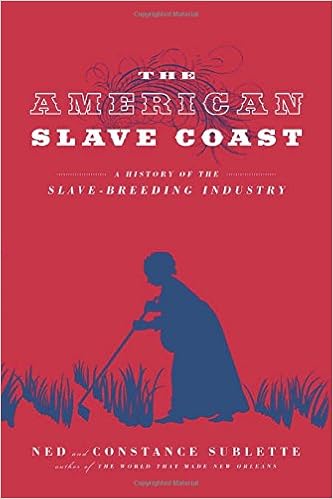
The audio package of The American Slave Coast: A History of the Slave Breeding Industry is now available.


Cover for the audio cd package of The American Slave Coast


Tantor Media's art department did a nice job adapting Slave's Coast's hardcover cover for the audio package.

We'll listen to at least some of it in the car as we take our long weekend wedding anniversary jaunt down to Thaddeus Stevens and the Gettysburg National Park area of Pennsylvania this coming weekend.  That should be interesting to hear these words in a voice that isn't ours.  The reader for Slave Coast is excellent.

In the meantime the reviews on amazilla for Slave Coast now number 59 -- almost all of them 5 stars.

Thursday, June 16, 2016

Reconstruction: Free State of Jones, the Antithesis to Gone With The Wind

Free State of Jones, directed by Gary Ross, opens here in NYC on June 24th.* Among others as protagonists it features Newton Knight, played by Matthew McConaughey, a rare white ally down there in Mississippi n the days after the Surrender at Appomattox, Reconstruction and Jim Crow.

The other day, after writing about my struggles with attempting to write accurately, vividly and accessibly to the events and arcs of what happened in the South and with our history after the Surrender, I mentioned the stereotype of the vile "carpetbagger."  Someone inquired whether that image of hatred was an historical one or merely created in our national consciousness by Margaret Mitchell in the course of her Gone With the Wind.  It was indeed an historical fact that such figures were vilified throughout the nation after the War, south and north. 

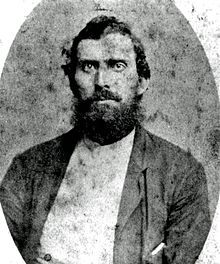
Newton Knight


The Free State of Jones -- about which more than one book of history has been written, illuminates one of the rare aspects of Reconstruction that created such figures.  The way Newt Knight was regarded and treated by white Southerners, first because he didn't believe in secession, and second because of his way of living with African Americans as if they were as good as he was, put his neighbors into a frenzy.  So imagine, how these people felt about northerners coming on down and -- if not directly working for the betterment of African Americans' futures, making a profit out of what the South had squandered.  Fortunately for Newt Knight, his family and this story, Newt had a gun, was not ever intimidated into not using it, and was a crack shot.  


"  While Knight is a hero, Mr. Ross said emphatically, he is not a white savior of African-Americans, but a white ally.I think we need to celebrate alliances,” he said. “And it is demonstrably true that Newt was allied with African-Americans all through Reconstruction after a lot of white people in the South had bailed.”
In carrying the Newton Knight story through the violent rollback of the promise of Reconstruction, Mr. Ross is taking on the negative image of the period driven deep into American consciousness by films like “Gone With the Wind” and D. W. Griffith’s “The Birth of a Nation,” as well as the Lost Cause nostalgia that has infused many movies since.
“This is not your granddaddy’s Civil War movie,” said the Yale historian David Blight, one of 11 historical consultants listed prominently in the closing credits. “It doesn’t in any way sentimentalize any element of the Confederate cause. Quite the contrary.”

Film, Free State of Jones, with Mahershala Ali and Michael McConaughey in the foreground.

This film come with a website "Free State of Jones, with footnotes to vouch for the authenticity of the characters and events.  The site includes film stills, clips and other information:

FOREWORD
   We felt it was important in an historical movie, especially a movie about such a crucial time in history, for the audience to know what was true and what was fictionalized, even if it was based on underlying source material.
In this site you will be able to navigate through the entire movie, click the areas that interest you, and see a brief explanation of the historical facts that informed the screenplay. If you are more curious about that part of the movie, we have footnoted the paragraph to see sources on which it is based. But footnotes themselves can be misleading, so if you want to see the entire primary source, you can click again and be transported to the original document. We hope this is helpful, maybe even fun. Some things need to be invented in a movie, but most things in Jones were not. I think it’s only right that you be able to tell which was which.
The NY Times has an article about the director and Free State of Jones on its site, here.

The Youtube video trailer isn't listed as for sharing, but can viewed here. It's powerful stuff.

------------------------------------

*  This is one of the two films I am planning to see this summer in a theater.  The other is, natch, Ghostbusters.  The Free State of Jones we'll see at a special screening occasion; at Ghostbusters we'll just be two average movie goers on hopefully opening day.

Saturday, June 11, 2016

Reading! + The Coughing + Radicals

I read two entire novels from start to finish in the last 10 days or so, which is by now abnormal.  It's not often a work of fiction that isn't a classic, whatever it is classified as being -- genre or literature -- can interest me beyond the starting of it.


The first one I read from first page to last page was Baltimore newspaper journalist turned mystery-thriller novelist, Laura Lippman's latest, Wilde Lake. As have some her other most recent novels, Wilde Lake features a plot that switches between the featured character(s)'s past and present.

This isn't one of her Tess Monaghan series -- the protag's evidently aged out of continuing, or else, Lippman, married to David Simon, has too much else going on to keep up the Tess series for now, as well as continuing her production of non-series works. I have very much enjoyed all of Lippman's novels, not least because they're set in Baltimore and the immediate environs.


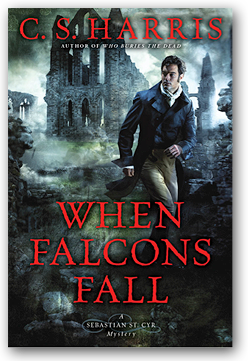
The second novel I read from first page to last is also a mystery thriller, though constructed within historical fiction. When Falcons Fallnumber 11 and the latest installment in the continuing Sebastian St. Cyre series by C.S. Harris. The tales are temporally located during the Napoleonic era. St. Cyr, Vicount Devlin,  is a special Londoner: fabulously handsome, intelligent, high ranking, highly skilled fighting with hands and weapons, possessing enhanced vision and hearing. To offset his entitlements he also carries the weight of what seems the insoluble mystery of his birth father's identity. The young lord is caught up in one murder after another that have political dimensions as well as personal ones. By now he's accompanied on his adventures by his equally high born and talented -- and of course, socially conscious far beyond their time -- wife, Hero. They have an infant son, who is the reason they married in the first place, as the two, who met not cute, but in hate, ended up having desperation sex in the face of their imminent deaths. However, obvs, they neither died, and truly adore each other.


The third novel it looks very like I shall be reading from the first page to last is Guy Gavriel Key's latest, Children of Earth and Sky (unfortunate title) set in a fantasy 16th century fantasy Venice, fantasy Prague and fantasy Ottomans. The little guys are fantasy kingdoms on the fantasy Dalmatian Coast. I started the novel last night, too tired to do anything else, thanks to the Coughing Whatever It Is, and got one third of the way through with no problems (other than usual ones with Kay's fantasy Spanish and other languages) before giving up to sleep.  The era and the region are ongoing interests of mine, in any case.  Kay also writes strong women, and the varieties of ways in which women can be strong, most effectively, meaning they are still women not men with the mere addition of primary female sexual characteristics.  He also has the great gift of keeping one wishing to turn the page.

I'm exceedingly hesitant to believe this, but last night I did have the most sleep I've had in weeks.  It was sleep uninterrupted by coughing. I didn't take the drops before bed, and I did take a part of a sleeping aid, for the first time in many weeks.  I only needed to take three drops during night, waked by coughing irritation. Normally it's been a lot more often and then I never get back to sleep.  So I feel a lot better today than I have in weeks. This is the start of week 5 since I came down with The Coughing.

It's difficult business, writing coherently and accessibly about Thaddeus Stevens, Henry Wilson, Charles Sumner and the so-called Radicals during Andrew Johnson's lies and and the catastrophes he opened for African Americans. The Coughing has made it seem just about impossible to achieve that objective.

This period of American history after Lincoln's assassination is murky at best to anyone who isn't a specialist in the first place, and most histories tend to say very little about any of what happens after Johnson is sworn in as POTUS. This isn't sexy history, but some of the worst of our history, particularly our political racist history, this throwing of the emancipated slaves to the CSA wolves. making it even more complex is that the House and Senate moved on two separate occasions to impeach Andrew Johnson.

Moreover, the reputations of everyone who struggled against the northern and southern white supremacists of the time -- were libeled as "Radicals", including General Grant. These clear-sighted adversaries of white supremacy have been subject during their own lifetimes and ever after to relentless calumny and lies.

Harper's Weekly woodcut of Stevens making his final argument to the House
The historical portrait of Thaddeus Stevens in particular has never recovered from the lies of the vile Birth of A Nation.  Mostly these men who never faltered in their advocacy of abolition and civil rights for African Americans were neglected, buried and written out of the historical record from before, during and after the Civil War. Gore Vidal outright lied about President Grant in his novel 1876.

As mentioned, most people, if they recognize the name of Stevens at all do so because of Griffith's portrayal of him as a lascivious man who kept a mulatta mistress (though Stevens, single all his life, did enjoy the company of women and never pretended otherwise, he did not have a mulatta mistress). Sumner is remembered as the man, who in 1856, secessionist Preston Brooks infamously viciously beat nearly to death (Preston did intend to kill him) with a cane in the Senate chambers, and maybe, as a close friend of the Adams's family, particularly Francis Adams, Henry Adams's father.  Does anyone know that Henry Wilson existed, though he wrote one of the most useful histories of the Civil War going, writing it while all the events were fresh in his memory?

So, even discounting feeling rotten from The Coughing, the difficulties I'm facing here are great. Please wish me luck in achieving my goal.  I need all the good wishes I can get!

Saturday, April 23, 2016

Depictions of Slavery and Slaves on Southern Bank Notes and Other Financial Instruments

Stories are all over the "news" media, featuring this history of depicting slaves and slavery on financial instruments issued by southern banks and insurance companies, and then on the so-called currency of the so-called CSA are everywhere now that it was officially announced that Harriet Tubman will take the place of Jackson on the U.S. $20 bill.

Issued by a JoJaw, bank.
There's a great deal of coverage of this matter in The American Slave Coast:  A History of the Slave Breeding Industry, as well as about how Jackson hated currency, hated banks and therefore, managed an excellent job of destroying both -- as well as the national economy.  Killing the Bank of the United States of America, and replacing it with the "pet banks" that printed notes but had no other backing than land fever inflation set off the longest, deepest economic depression the nation ever saw, up to the Great Depression of the 1930's.

What none of the stories mention, however, which is what The American Slave Coast describes in detail, is that slaves literally were antebellum southern states' money -- which was underlined by the CSA putting slaves on its money -- at least on the front; very quickly the CSA 'treasury' couldn't even print anything on the reverse of the bills.  Since slaves weren't money for any other nation, this had a lot to do with why no European nation would support the idea of the CSA as a nation -- which it wasn't.  It was an army, but it wasn't a nation and performed none of the other duties and obligations toward its people that a nation to be a nation must do.

Tomorrow, early in the AM, we're off to Georgia, to do some Slave Coast events and other things.


Wednesday, March 23, 2016

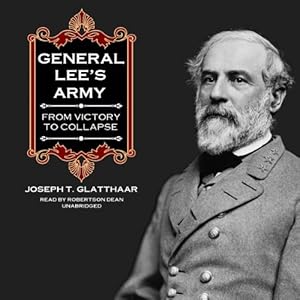
Reading Wednesday: General Lee's Army: From Victory to Collapse

General Lee's Army: From Victory to Collapse (2008) by Joseph T. Glatthaar begins roughly a year before the first Battle of Manassas a/k/a Bull Run. 


His argument, with which I agree, is that the Army of Northern Virginia was the closest to successful of any institution that the CSA established. Over the course of this history of Lee's army it emerges how only the Army of Virginia embodied all the elements that made it impossible for the CSA ever to have become a functioning state -- which it never was.  Our argument is that what the CSA was, was an army.  The army was always willing to fight, but it wasn't willing to take ordesr, recognize a chain of command or (until far into the war around the late 1863's-1864) dig trenches or build other defenses.  It would not do labor, manual or otherwise.  The officers lived a very different way from the lower ranks of poor whites, and ate far better,  Though Glatthaar doesn't mention this (or that there were signficant populations in the secession states who didn't agree with the war) -- it was the manners and behaviors of the well-connected officers that perhaps more than anything caused massive desertion, as particularly the wives and children back home were starving -- in great part to the planter class acting as tax in kind collectors, stealing everything they could.   He doesn't mention this either, but these officers were behaving to the lower ranks in the way slave owners behaved to their property . . . . 

Glatthaar never denies that the the South seceded and went to war for the sake of preserving slavery. He seems to have no idea, however, that the actual objective was to expand slavery.

Glatthaar's declarations with which I do not agree, are that the South only wanted to be left alone to leave the Union.  Glatthaar's a military historian, and this is the problem -- he doesn't see a large enough picture.  He deals only with the members of the army and the battles.

What is most valuable about this history is Glatthaar's painstakingly gathered stats on how many members of the army were deeply rooted in slave owning -- particularly the officer class.  The previous calculations of how many owned slaves, how many slaves owned, how wealthy they were are all vastly incorrect according to the information he's gathered.  Many soldiers may not have been able to claim they owned even a single slave, but they lived with their father, who did, in a relative's home who did.  Most of them were closely connected to those who owned 20 or more slaves -- which put them even above the comfortably middle-class.  In other words, it was difficult to find in any of the ranks above the lowest anyone who didn't live a way of life according to the benefits of possessing slavery.  Their clothes were washed and cared for, their food cooked and cleaned up after, their horses and horses' tack -- all this and more by slaves, even if they themselves didn't own the paper on them.

Saturday, March 5, 2016

Pat Conroy Dies

In some ways his books were my introduction to South Carolina, starting when he began publishing them.  As with so many readers certainly, that


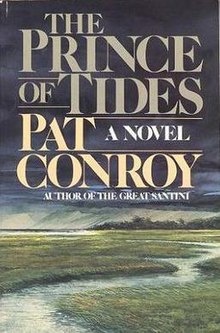
Prince of Tides (1986) contained the ambient charm of South Carolina -- for WHITE readers -- his work provided me with regional and thus exotic description of place and time, particularly that of coastal SC.


I read intently his book describing his experiences teaching on an isolated Sea Island school of all black kids. {c&p from Wiki}:
The Water Is Wide is a 1972 memoir [1] by Pat Conroy and is based on his work as a teacher on Daufuskie Island, South Carolina, which is called Yamacraw Island in the book. The book is sometimes identified as nonfiction[2] and other times identified as a novel.[3]

As this region of the U.S. is the cradle of secession and slavery is God's will by GAWD, it was particularly interesting he was very young then, and it was the Civil Rights and Vietnam era.  I didn't read The Water is Wide though, until I had all that history about SC and the slavery of the coast and the Sea Islands rice plantations. Anyone who possesses this historical information sees  Beaufort (site of what is known as "Secession House" the mansion built by Barnwell Rhett and his fire eating secessionist brothers; there's even an inscription they put on the basement walls that boasts, "in this house the first meeting of Secession was held")  and the Sea Islands with very different eyes than do snow birding tourists,

I'm looking forward to being down there again at the end of May.

Friday, February 19, 2016

Portrait of a Novelist

Because this is the internets all of which r belong 2 catz, from the NY Times Magazine feature piece on the novelist Dana Spiotta, this spot brings this delectation:

Novelist Dana Spiotta in her home, photographed by Erik Madigan Heck for the New York Times.

Life has been so crowded with music, weather, parties, Slave Coast events and preparations for them, and additional chaos, there's been little time for reading, watching, or thinking coherently. As far as thinking expressively of experiences experienced, all of what thinking that has been managed is deeply personal.

This is not easy, extracting the lessons that it is not about me and my feelings from the experiences of being questioned about race in this nation.

It is clear, however, that being in a position where one is questioned does demand continued, personal interrogration of historic givens, contemporary events and particularly, then, of self,

All these inquiries demand returning to the foundation construct of our nation, the fantasy of white supremacy, deliberately fabricated out of original warp and woof of our national triumphalist economic history, the artificial division between black and white, made to create a permanent slave society. Today it seems that this evil itself, with the consequences to the only members of our body politic whose ancestors were brought here by force, has been transmitted permanently into our national culture and politics.  How can that ever be changed?

When asked, "What do you, a white person, think about reparations?"  Does one respond, "Yes" -- meaning, that some sort of reparations are the only way to even begin redeeming our national sin -- and stop there?

Or does one ask how such reparations could begin.  Would this mean defining which U.S. citizens are or are not of African American descent? Who gets to decide?  Would there have to be registries as is done with the Native American tribes of today?  And what will that mean, how will that play out, having a national, racial registry in a nation so vehemently white supremacist?  Back in the 19th century there were even trials that went on for months, attempting to determine whether an individual was or was not African American. As invasive as at a slave sale, every physical attribute of the person in question was discussed and questioned, by the legal representatives of both sides: the side that agreed the person was white and the side that insisted s/he was black.

So many ways of looking at others' experiences, which are not one's own, as it isn't about me, who is not African American.  This in itself may be the crown of white privilege -- that I can say, "It isn't about me."

Which inevitably leads to the extraordinarily dreary white supremacist political theater we experience in sense around, as bad as anything that went on leading up to secession.  This in turn will lead to rants, and as one is ranting to the choir, pointless.

So it's been better these dismal winter weeks of Black History Month to have stayed away from the internet for a while, other than the most private  and small Elsewhere, conversing about home improvement, the weather, health, gardening, birds, and birthday parties.

Wednesday, January 27, 2016

Reading Wednesday -- Our Man in Charleston: Britain’s Secret Agent in the Civil War South

Our Man in Charleston: Britain’s Secret Agent in the Civil War South (2015) by Christopher Dickey.

Journalist and author Christopher Dickey
The title is misleading, as spying is not the point of the book.

What the book details is the diplomatic relations -- or attempts to establish diplomatic relations by the secession CSA slavocracy with the British government.

This never happened, and could not happen since the CSA was not a nation.

None of the world's nation-states, whether in Europe or elsewhere, ever accepted the CSA a nation-state, and indeed, could not do so, for then they would have had to declare the United States a non-state, and this no one was willing to do. Thus the CSA could not have a diplomatic, negotiating relationship with nations.

Somehow too, Charleston and South Carolina, cradle of secession and the War of Southern Aggression, conveniently forgot how long Britain had attempted to negotiate a roll-back of that evil law that permitted every kind of cruel excess, chicanery and extortion, of jailing every black sailor of every ship of every nation that came into its port (South Carolina was not the only southern state with this law) until the ship departed again, with the ship's captain having to pay for the jailing and other costs.  (Probably it's not necessary to say that many a black sailor went 'missing' -- i.e. sold for somebody's profit, free or not, or that young ship's boys and female stewards and cooks were raped in these jails.)  South Carolina and the south would not repeal these laws.

A very interesting review of this book can be found here, in an issue of the Charleston City Paper from last summer.  Here's a pull quote from the review:

The book also, however, offers a head-on view into not only the abject horrors of slavery and the transatlantic slave trade, but also the sickeningly bankrupt morality of 19th-century Charlestonians in particular, and Southerners in general, for whom slavery was an institution to be preserved and expanded at any cost — even, as we all know, the cost of war. In light of the recent Emanuel AME church shooting and the conflict around the removal of the Confederate flag from the S.C. Statehouse grounds, Our Man in Charleston is, sadly, a highly relevant look at the society that started the War Between the States.
The fact that preserving slavery was the reason for South Carolina's secession is not news to anyone who has studied the Civil War academically, rather than buying into the pervasive mythology that glorifies the Confederacy as a bright beacon of independence and states' rights while smoothly glossing over the slavery issue as if it were just a mild unpleasantness. But let's be honest: most of us haven't really studied the Civil War. The majority of books on the subject tend to be geared toward military buffs, while even those for a wider audience — Tony Horwitz' Confederates in the Attic comes to mind — do little, if anything, to show just how central slavery was to the cause of secession, especially in South Carolina.

When reading this review last summer I kept thinking of the secession era Charleston Mercury, owned and published by the most fire-eating of the fire-eating secessionists of Charleston and South Carolina, and how he must be howling in his grave even now to have such sentiments as above published in 'his' city, where in his day, by gum, anyone who spoke, wrote or even suspected of thinking such things would be attacked violently, tarred and feathered and even lynched.  It was illegal to think or speak or write such things in the days of Robert Barnwell Rhett.

So radical was Rhett that his paper was the anti-Jeff Davis, anti-Robert E. Lee paper (as well as highly critical of just about everyone in the CSA administration and armies), in contrast to the pro-Jeff Davis paper, the Charleston Courier.

Rhett's Charleston Mercury ceased with the Union occupation of Charleston, resumed publication in 1866, then permanently closed in 1868.


Sunday, December 13, 2015

Chauncey DeVega Podcast re The American Slave Coast

This brilliant, well-read, charming, young intellectual interviewed us concerning the matters of The American Slave Coast the first week of this month for his weekly podcast. It was a considerable pleasure -- if that word can be used in connection with such a terrible subject -- talking with him.  He's so smart!  Every time we get to interact with people like him who are so much younger than we are is a blessing.  At his age I sure wasn't as smart and well-informed as he is.

This was our final scheduled support event this year for the publication of The American Slave Coast, which made this special experience even more so.

The links for the variety of methods to hear it can be found in this entry, "A Conversation With Historians Ned and Constance Sublette About Their New Book "The American Slave Coast: A History of the Slave-Breeding Industry" " on his website, Indomitable, here.


"Ned and Constance do some serious teaching and sharing on a very difficult subject for this week’s show. Chauncey and his guests work through questions regarding the scale and scope of The Transatlantic Slave Trade, how many people were killed during that horrific business, why did the slave population in the United States grow as compared to other parts of the world, and what is “the capitalized womb” and “slave-breeding?”
"Ned and Constance also take on common white supremacist and other myths about how chattel slavery in the “New World” was not as harsh as the labor experienced by European serfs or North American urban white industrial workers."

Sunday, December 6, 2015

Today In U.S. History, 150 Years Ago

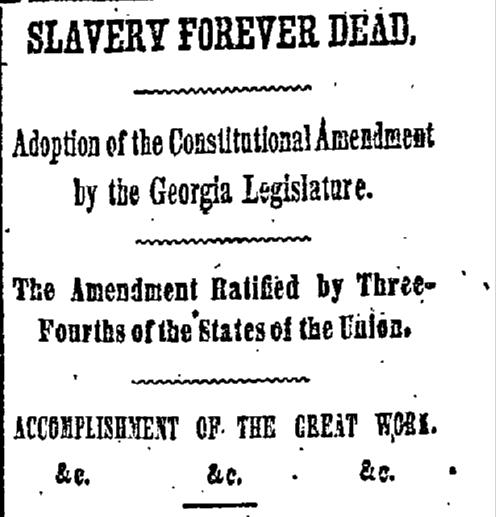
Today, December 6th, is the 150th anniversary of the ratification of The 13th Amendment.

Abraham Lincoln had been dead for most of the year, and thus never saw his proclamation of 1863 become the law law of the land.


Saturday, February 28, 2015

Whitney Plantation Slavery Museum

“Slavery gets understood as a kind of prehistory to freedom rather than what it really is: the foundation for a country where white supremacy was predicated upon African-American exploitation,” says Walter Johnson, a Harvard professor. “This is still, in many respects, the America of 2015.”


You all may or may not recall that we were invited and taken on a private tour of the Whitney Slavery Museum Plantation last year by the proprietor - creator, John Cummings.

The NY Times Mag did a piece on the Whitney for this weekend's edition of the publication. 

Built largely in secret and under decidedly unorthodox circumstances, the Whitney had been turned into a museum dedicated to telling the story of slavery — the first of its kind in the United States.
This is not by any means the first slavery museum in North America. I have visited quite a few of them, from slave markets as memorials and learning centers, to restored "quarters" on other plantations, to auction sites and slave jails. There's a large slavery museum in Richmond (along with a Confederacy museum; the Confederacy museum is located within a well-marked historical district -- the slavery museum, well, it's more difficult to access, shall we say?).

However, whatever first inspired Cummings to create this memorial museum out of a Louisiana sugar plantation, I recognize, intimately, what drives him. It's feeling that overwhelming obligation to bring out in an organized, structured, carefully documented public manner -- the revelation of  WHAT REALLY HAPPENED that we as individuals and citizens, and as a nation keep hiding and lying about:
. . . . “I started to see slavery and the hangover from slavery everywhere I looked,” he said. As a descendant of Irish laborers, he has no direct ties to slaveholders; still, in a departure from the views held by many Southern whites, Cummings considered the issue a personal one. “If ‘guilt’ is the best word to use, then yes, I feel guilt,” he said. “I mean, you start understanding that the wealth of this part of the world — wealth that has benefited me — was created by some half a million black people who just passed us by. How is it that we don’t acknowledge this?”

The Whitney Plantation is something different, and astonishing. It's art, a gigantic, multi-layered, multi-faceted memorial complex honoring the blood, sweat and grief of the thousands and millions of people, captured, victimized, tortured and held captive to their deaths, their entire lives devoured by estate-prison machines like the Whitney.


After visiting the Whitney Plantation, and then the Angola Prison, which is a fully functioning plantation, made from a plantation owned by the antebellum era's largest, most successful and wealthiest slave trader, what I'd learned about Jefferson and Virginia plantations from the penal colony of Monticello showed in even more disturbing relief.
Located on land where slaves worked for more than a century, in a state where the sight of the Confederate flag is not uncommon, the results are both educational and visceral. An exhibit on the North American slave trade inside the visitors’ center, for instance, is lent particular resonance by its proximity, just a few steps away outside its door, to seven cabins that once housed slaves. From their weathered cypress frames, a dusty path, lined with hulking iron kettles that were used by slaves to boil sugar cane, leads to a grassy clearing dominated by a slave jail — an approach designed so that a visitor’s most memorable glimpse of the white shutters and stately columns of the property’s 220-year-old “Big House” will come through the rusted bars of the squat, rectangular cell. A number of memorials also dot the grounds, including a series of angled granite walls engraved with the names of the 107,000 slaves who spent their lives in Louisiana before 1820. Inspired by Maya Lin’s Vietnam Veterans Memorial in Washington, the memorial lists the names nonalphabetically to mirror the confusion and chaos that defined a slave’s life.

These names have been taken from the database compiled by long-time amiga and colleague, the ground-breaking, pioneering scholar, Gwendolyn Midlo Hall. See her great works, which are now online, "Database for the Study of Afro-Louisiana History and Genealogy" and "Afro-Louisiana History and Genealogy 1719-1820".

Why this museum? Why now? (Why The American Slave Coast: A History of the Slave-breeding Industry? Why now?)
A nation builds museums to understand its own history and to have its history understood by others, to create a common space and language to address collectively what is too difficult to process individually. Forty-eight years after World War II, the United States Holocaust Memorial Museum opened in Washington. A museum dedicated to the Sept. 11 terrorist attacks opened its doors in Lower Manhattan less than 13 years after they occurred. One hundred and fifty years after the end of the Civil War, however, no federally funded museum dedicated to slavery exists, no monument honoring America’s slaves. “It’s something I bring up all the time in my lectures,” says Eric Foner, a Columbia University historian and the author of the Pulitzer Prize-winning “Fiery Trial: Abraham Lincoln and American Slavery.” “If the Germans built a museum dedicated to American slavery before one about their own Holocaust, you’d think they were trying to hide something. As Americans, we haven’t yet figured out how to come to terms with slavery. To some, it’s ancient history. To others, it’s history that isn’t quite history.”
The article is a very good one, reflecting, hopefully, the tone of the NY Times Magazine's roll-out of its brand new do-over.

Tuesday, January 6, 2015

We Iz A-Snowin' At 20º - Happy Kings Day!

Happy Three Kings Day, Twelfth Night and Epiphany, depending on what this day goes by where you are located.


The discovery of the infant Jesus by the Three Wise Men a/k/a Three Kings is as important in the annual round of uncommon observances as is the Nativity, and celebrated all around the world with street parades -- with bands and costumes -- family parties with music and dancing, as well as food.  O to be in San Juan today and tonight!

Traditionally in the Mediterreanean, South American and Caribbean world, it is Three Kings Day when children receive their gifts -- brought by the Kings, of course, not Santa Claus.


In New Orleans Three Kings is the first day of the Mardi Gras season, ya'all -- marked by the Phunny Phorty Phellows krewe * riding the street cars, with champagne and King Cake.


Mille-feuille Bakery Cafe, a superfine establishment, nothing in it is less than $5, including plain "american" coffee -- operated by young French ex-pats -- opened last year near us. They are offering French-style King Cakes (as the photo shows, the French King Cakes are less gaudy than NO's), with the tiny baby token  -- the one who finds the baby in her / his slice is the King of the party -- and, in New Orleans at least, is supposed to host the next party.

As the dinner party hostessed / hosted tonight uptown by C&K for a Louisianan actor - filmmaker - storyteller, Colin Gravois, who lives half the year in Louisiana and half in France, is tonight, I was planning on bringing one of these cakes as the hostess gift. But -- damn! they have none left! No more until later in the week.

Sheesh, it was cold when we got up today. Snowing. We're not supposed to get more than an inch. It wouldn't even stay on the ground if the ground temperature wasn't below freezing.

This is surely playing havoc with all the scheduled Kings Day parades and celebrations in the city in our large Caribbean, South American and Mediterranean communities.

---------------------

*   The Phunny Phorty Phellows were formed in 1878, in celebration of the official end of Reconstruction (which had effectively happened some time ago by an armed coup d'état) and the institution of Jim Crow -- another name for neoslavery.