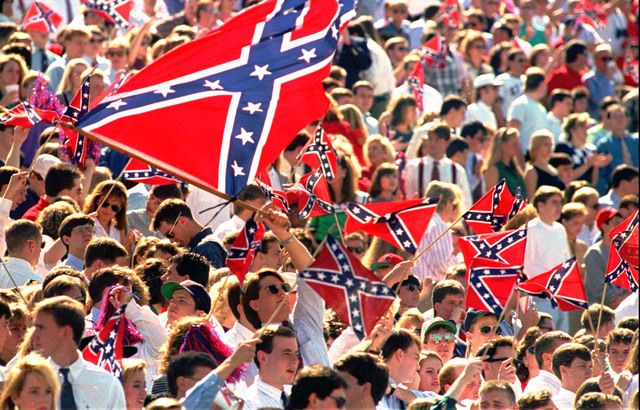
LINES OF THE DAY

". . . But the past does not exist independently from the present. Indeed, the past is only past because there is a present, just as I can point to something over there only because I am here. But nothing is inherently over there or here. In that sense, the past has no content. The past -- or more accurately, pastness -- is a position. Thus, in no way can we identify the past as past." p. 15

". . . But we may want to keep in mind that deeds and words are not as distinguishable as often we presume. History does not belong only to its narrators, professional or amateur. While some of us debate what history is or was, others take it into their own hands." p. 153

Silencing the Past: Power and the Production of History (1995) by Michel-Rolph Trouillot

Showing posts with label white supremacy. Show all posts

Wednesday, April 7, 2021

Let's Read Again Like We Did Last Year ~~

      . . . . Frequently my mind fails to make sense to me. 


 How did I manage to choose Bagehot: The Life and Times of the Greatest Victorian (2019) by James Grant as the audio book to follow Pale Rider: The Spanish Flu of 1918 and How It Changed the World (2016) by Laura Spinney, and The Zealot and the Emancipator: John Brown, Abraham Lincoln, and the Struggle for American Freedom (2020) by H. W. Brands for my workouts?

So far my great take-away is that Bagehot was not only a prototype of what we in later times tend to call a libertarian / neo liberal.  He formalized the concept, and described in detail  the necessity of a Central Bank and its functions for a stable government.  He did the same for Constitutional Monarchy. This while, though they benefit from both, the 'lower orders,' the poor, the uneducated, are incapable of understanding either economics or constitutions, and certainly lack the capacity for making political and governing decisions. Needless to say that women as a class aren't even that much of a consideration, despite his respect for the intellects of many of the women of his acquaintance, including his own mother, who also suffered serious mental illness.

This brilliant fellow, a prodigy already as a very young child, could not add or subtract. Yet his family put him in charge the family banking business, when he hated everything else including the law for which he qualified among his many other professional credentials, realizing he wouldn't be able to pull a Disraeli and move from writing to holding office and becoming Prime Minister. The family business's great fortune is that he seems to have spent more time doing anything but banking, while remaining a writing demon as to output, and a polymath in terms of what he wrote about. Naturally, due to his writing about how to run a country's finances, he got sent to India to put its finances on solid footing.  How more British and Victorian than this may we get?

Bagehot was praised for cool wit and epigrammatic style, which author Grant does his best to exhibit in his own economic writing. Nor did Bagehot stint in praise for himself in his own writing, knowing he knew what others did not, and taking knowingly contrary political positions such as favoring Louis-Philippe's coup against the election and naming himself France's ruler for life. Bagehot inevitably reminds this reader of that thoroughly self-satisfied, thoroughly knowledgeable of his own superiority, that fellow likely only Tories today recall, William F. Buckley.

On the other hand, George Eliot quite adored Bagehot as a thinker and his friend.  But no one has suggested George Eliot didn't have a strong conservative bent herself -- except for herself, of course.

~ ~ ~ ~ ~

Things do roll on, don't they. The period's royalties arrived, and so did spring, while winter, hopefully, is now departed for months.  El V got his second dose of Pfizer this afternoon.  He's currently lying down, but he generally feels sleepy before dinner so it probably means nothing.  I am making dinner, looking forward to my second dose of Moderna late Friday afternoon, and after dinner, I'm particularly looking forward to the HBO Max premiere of  the 4-part Exterminate All the Brutes.

In ‘Exterminate All the Brutes,’ Raoul Peck Takes Aim at White Supremacy

After the success of “I Am Not Your Negro,” HBO gave Peck carte blanche for his next big project. What resulted is a sweeping meditation on colonialism and the nature of truth itself. ... New York Times

Raoul Peck’s four-hour documentary for HBO is a dizzying retelling of the course of colonialism, slavery and genocide. ... New York Times

"....a Radical Masterpiece About White Supremacy, Violence and the History of the West" ... Time

This exploration of the "origin story of white supremacy" features two Revelators who have had deep effect on both el V's and my historical researches and formation of our historical perspective:  
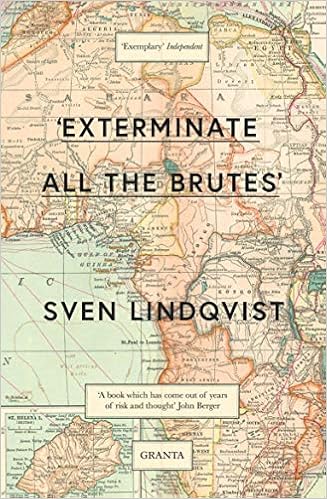


" .... It takes its title from Swedish historian Sven Lindqvist’s ruminative 1992 book about his travels through postcolonial Africa, which in turn wrestles with the source of the quote “exterminate all the brutes”: Joseph Conrad’s immortal novella Heart of Darkness. Peck also draws heavily on historian and activist Roxanne Dunbar-Ortiz’s An Indigenous People’s History of the United States and Haitian anthropologist Michel-Rolph Trouillot’s Silencing the Past: The Power and Production of History. In each episode, he credits himself as having made the series “together with” all three scholars, even though Trouillot died in 2012 and Lindqvist in 2019."

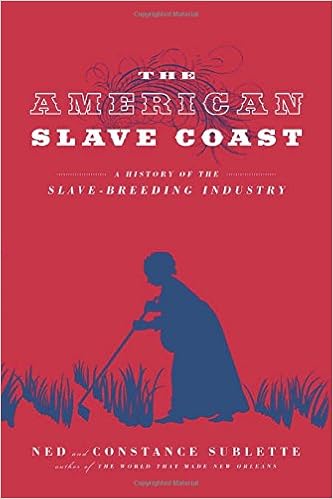
Seeing Roxanne Dunbar-Ortiz involved in this already highly praised non-dramatic, history series, feels particularly personal since she accepted on our behalf and read our "Thank you very much for this honor" for the 2016 American Book Award for The American Slave Coast: A History of the Slave Breeding Industry, as we weren't able to make it out to California for the event.  But it's particularly satisfying because Dunbar-Ortiz is a true pioneer of this kind of work.  When she began, it didn't exist, within or without academia.  Now, because of hers and others devoting their lives to inventing a methodology to study and recover history that has been both disappeared and denied, to see her, at her age, receiving this kind of recognition is truly exciting.

A quote from Michel-Rolph Trouillot is at the top of this Fox Home blog, as it has since the beginning.




Thursday, January 24, 2019

I Am Not An Expert But I Am A Privileged White Male, So Watch Me Bloviate Anyway Because, You Know, White Man = Expert

     . . . .Too long, don't read this rant following ☭  ☭  : but Kristof made me do it.

Imagine oneself Cuban, reading Nicholas Kristof's latest excrescence in the NY Times. The colonial, imperialist, white supremacist mindset permeates him, and he doesn't even know it. He actually thinks he's being nice and progressive about Cuba.

https://www.nytimes.com/2019/01/23/opinion/cuba-embargo.html?

This is why the United States (and England too) is a lurching, dysfunctional, chaotic, violent monster of gigantic destruction to itself and everything else. 

"I'm Not An Expert (nor does he even speak Spanish) BUT Listen to ME!!!!!!!! Tell Everybody All About Cuba." Bloviates Nicolas Kristof: 

  Quote
"....It’s simply a tired little country ..."
This, right at the top of his blowharding in the prestigious New York Times, reveals Kristof's profound ignorance of what is going on in Cuba -- he's never have written that if he went dancing Cubans, of any and all ages, or listened to Cubans making music, or spent time with them getting up every day to dress their kids as nicely as possible, figure out how to solve yet more shortage or invent yet another work-around, exchange tech expertise for pay, providing goods and services, doing a cattle round-up, make chocolate -- organic chocolate on organic, diversified beautiful farms, by hand, as well as raising, organically, the other two crops that naturally occur together, coffee and coconuts, as well as poultry, pigs, cattle, horses -- and, further run by a consortium of women, of all ages and colors, who love their machetes -- they give their machetes names -- and use them with great expertise -- and they don't look in the least like a cliche of what a farm woman or agriculture worker looks like.

If Kristof had any meaningful contact with Cuba beyond a service situation he would NEVER have called Cuba "a tired little country." Cubans have more energy than anybody in the USA, other than immigrants like the Haitians, and certainly a lot more than anybody currently in the White House or trying to be POTUS. 

It's not merely an ignorant observation, it's insulting, in the way one would expect from a privileged, comfortable old white guy who isn't an expert but is gonna tell people anyway -- even when the people he's telling know profoundly more about it than he does. 

 Quote
"Let’s make room for nuance: Cuba impoverishes its citizens and denies them political rights, but it does a good job providing basic education and keeping people healthy. As I noted in my last column, on Cuba’s health care system, Cuba’s official infant mortality rate is lower than America’s (its real rate may or may not be).
 
I’m not a Cuba expert, but ... "
However, Kristof is a privileged white male in very comfortable circumstances so he's gonna tell the USA what is what about what he doesn't know anything about, and all will read  his awesome brilliance and be in awe of of his awesomeness who went to Havana that one time -- and he shall be well paid. Don't bother looking out for somebody who does know and could tell us what we might want or even need to know. And who speaks Spanish.

Moreover, Kristof proves to have never met a cliche he won't seize on without thinking about it or investigating what is behind the cliche -- one that everybody invokes who is not an expert either, the cliche that everybody includes in every repetitive same-samey piece they all write about the subject of Cuba. (Who will bet against me that when Kristof writes or talks about New Orleans, he uses the dreaded hoary 'gumbo' cliche?) 

  Quote
"Plus, extra credit goes to a country that so lovingly preserves old American cars. I rode in from the airport in a pink 1954 Cadillac."
He has no idea that this pink Cadillac's body (all the rest of it was pillaged to get something else running for a little while) has rusted for decades without an engine, but is now running because the state fairly recently imported a large number of diesel fuel burning engines that those with these useless cars rushed to install in order to drive around ignorant old white guys who boast of riding in a pink Cadillac and further pollute beautiful Havana. It wasn't lovingly preserved, but created, with parts and paint the owner somehow managed to wangle recently from outside of Cuba.

People visiting their Cuban friends and family commonly bring in shock absorbers, fuel pumps and all sorts of parts even for vehicles much more recently manufactured than a 1954 pink Cadillac, such as Toyotas.  But he doesn't know that  Why?  If he'd asked, you know, he would have known. Responsible journalism, hello?

The following is the most infuriating bit, the most insulting bit. Kristof literally cannot imagine Cuba and Cubans existing in any way in the future except as in its previous relationship to the US when the US corporations and the mafia owned the whole damned island -- as a servant class to rich white old white Americans. Caregivers. Servants. Cooks, Cleaners. Gads, this is disgusting. He hasn't met any of the dynamic, innovative Cuban professionals. Just for one example of what he can't imagine is just at the end of this last year, a Hollywood production team came to Havana where they met with all sorts of agencies and people who work in television and film there. The Hollywood people were agreeably impressed with their knowledge, experience, record and creativity. But great economics white US guy can't think that there could be fine investment opportunity in film and tv production facilities in Cuba.  Nope. Cubans must clean up the vomit and shyte of tourists and elderly retired people. Who are rich, white USians.

  Quote
".... Some American seniors who now winter in Florida could become snowbirds in Cuba instead, relying on its health care, low prices, great beaches and cheap labor. You can hire a home health care aide for a month in Havana for the cost of one for a day in Florida...."

Cheap labor yay! That's what we can do with Cuba!  

Additionally this will help keep immigrants out who traditionally are supposed to be doing this work since we'll be outsourcing to Cuba our rich elderly family without the voting crisis of letting in to the USA people, who aren't, you know, white -- people, who work harder than privileged white men like Kristof can begin to imagine, to improve their families' futures and become US citizens -- and voters! which is the ruling class of the USA's worst nightmare. Total win-win for us, YAY!

You know Cubans are not thrilled about returning to their historic status as servant class to clean up the incontinent messes of rich old white guys of the USA. Additionally, they are already doing this for the elderly members of their families -- who live with them, not in retirement homes, where US prosperous ilks foist off the care for their elderly upon immigrants and others they assume are too stupid to do anything else, and should be GRATEFUL for this really low-paying, really difficult and exhausting work, while facing imprisonment and deportation any old time. But he, as an old white guy of privilege, demonstrates he literally cannot think of Cubans as deserving or capable of being anything more than  'servant' and providing 'service.' 

Has he noticed how much of the island's population is not white? Who does he think made the Cuban Revolution? Who does he think the Revolution served? Does he believe they have put up with everything the Cubans have had to put up with throughout their history and struggled to overcome throughout their history in order to -- raise their kids for the opportunity of cleaning his white bottom when he's old and drooling? What does he know about the great Cuban Revolutionary leaders such as Lt. General José Antonio de la Caridad Maceo y Grajales in Cuba's history of fighting for the abolition of slavery and independence, and the position of the US in those struggles? Clue, here:

The US was NOT in favor of the abolition of slavery in Cuba -- and opposed over the 19th century to various of Cuba's struggles for independence from Spain, because independent from Spain, Cuba would abolish slavery -- so the USA intervened with its big stick.  Can't have free black people by golly. Our slaves would run away to Cuba instead of us being able to sell our overpopulation of slaves to Cuba where the sugar industry would kill them in 10 years -- very profitable for us, that, yessirree bob! 

In the meantime, while Kristof mourns that the orange nazi (and the mummies of Florida like Rubio) want to roll back the baseball players deal, he hasn't noticed that the orange nazi and his mafia have sold Cuba to Putin and his mafia. The Russians are everywhere in Cuba again, providing building materials, industrial products from elevators to tractors, while the Russian oligarchs anchor their yachts in Cuba's Caribbean ports. Orange nazi feels right at home with yachts of course (or does he get seasick?) while giving not a ripe fart for baseball. 

My gawd, everything clown Kistof did not notice, that was right in front of his face, but he didn't see, blissing out on pink Cadillacs and cheap servants. 


Monday, February 12, 2018

It's A Comic Fer Pete's Sake!

     . . . . How can any film, even if it weren't merely part of a superhero COMIX franchise, fulfill the astounding amount of hype-aspiration-inspiration-political-cultural significance that has been piled upon Black Panther?


See the New York Times Magazine article earnestly explaining in detailed personal terms how this is the messiah of the second coming of the brave new world in which, finally African Americans are taking their more than well-earned position.  

URL rather than link presented since this is NY Times pay wall article:

https://www.nytimes.com/2018/02/12/magazine/why-black-panther-is-a-defining-moment-for-black-america.html? 


No matter that Black Panther surely is more imaginative and beautifully designed than the general dreary samey-same muddy brutality of the general superhero comix movie -- it is still a superhero comic movie, which means it must follow the endless arcs of blow it up, beat it up, zoom it up, throw it down, all to a howling decibel sound track, and do it for 30 minutes at a time.  Especially when the movie leaves the Panther's Wakanda kingdom and goes to hum drum superhero mundane 'white' cities . . .  as evidently it must?


Which, the Black Panther soundtrack, brings us to the accusations that British-Liberian artist, Lina Iris Viktor has brought against Kendrick Lamar -- already well-known for grabbing hold of other people's work and passing it off as his own -- has stolen her work for a sequence design of a music video that goes along with the Black Panther music album. A description of the problem is covered in this New York Times Arts section article:

https://www.nytimes.com/2018/02/11/arts/black-panther-kendrick-lamar-lina-iris-viktor.html?

The sequence in question shows up about 3.03 in this Youtube of the Vevo video:

https://www.youtube.com/watch?v=JQbjS0_ZfJ0&list=RDJQbjS0_ZfJ0&t=202


Viktor's standing in the art world  is  high enough that she can have one woman exhibitions well reputed venues-- one at the New Orleans Museum of Art is scheduled for October. To some eyes her work actually looks like graphic superhero panels anyway, so her work would be a natural to be considered for Black Panther on that level alone. Then, the work's got all that gold on it, providing weight and -- cheap? -- authority, or so it appears.  Viktor's work can be seen easily via Google Image.

In any case the rabid puppies - alt right - white supremacist - racist - sexist conspiracy to destroy Black Panther's record breaking, record setting ratings from fans and critics alike, as they did with the female Ghostbusters (they did do damage to this Ghostbusters, I fear) and Wonder Woman has failed miserably. As with Wonder Woman,the advance ticket sales are through the roof, and beating Wonder Woman all to heck -- there's never been anything like it before for a comic book movie. There's not a single person who lurves superhero comic movies who is going to stay away from this one. Not to mention how the hype machines of every media platform going has been cascading ooooo and awwwwwwwwwwwwsume! and life-changing for over a year already. 

On the other hand, this is Black History Month, all month, and there's not much happening on the main stream media platforms with that this year. So at least Black History Month has a comic book superhero as a platform on which to speak to and perform Black in this nation's current actively vicious virulent racism roiling south and north, from sea to shining sea. 

I'm such a cynic. 

Friday, November 18, 2016

We CANNOT Safety Pin Together This Shredded Republic

     AS IF the Republic can be pinned together!  Then we call it rebuilt -- while the secret midnight trains roll, and the after-midnight coffles with their shackles muffled by rags to not awake the precious sleeping (white) babes and their precious (white) mommies see out the window by chance, clanking their way to the slave cars.  Shades of Reagan -- give something a different name and it's all fixed now yah!

Nightime coffle in D.C., capital of the brave and home of the free, being shipped further south for sale into the Cotton Prison Camps of the Deep South.


      . . . . In the meantime some bennies may trickle down (for white people), which makes it all the more difficult to see, hear, speak, write, while the rest are ever more marginalized and the midnight trains roll.

That we may even be dithering about whether to safety pin or not to safety pin ought to tell us just what a risible, useless, empty gesture it is.

If you don't believe me, read this, from The Root:


Quote:

Let’s call these safety pins what they are: an empty gesture. Of the white people who actually voted in the election, the majority of them, including white women, voted for a man who rants about banning Muslims and building walls to keep immigrants out and who thinks all “the African Americans” live in inner cities and will be shot going to the store. This same man jokes about grabbing women by their vaginas. And because of that vote, white people are being called out—again—on their racism, this time with actual numbers to back it up. Oh, voting for Trump doesn’t mean you’re a racist? OK. Let me quote you a popular and accurate meme making the rounds: “Not all Trump supporters are racist, but all of them decided that racism isn’t a deal breaker. End of story.” 
These pins—not the wearing of them or the pictures posted of folks wearing them—are not about safe spaces. They’re about not wanting to be perceived as a racist. Like, “I might be white, but I’m not like them, over there. I’m enlightened.” 
No, you’re not. You’re trendy. These safety pins are the 2016 version of a 2004 “Live Strong” wristband. No. Wait. The money spent for those bracelets actually benefited cancer research. Who is benefiting from your safety pin purchase? Wal-Mart? CVS? Rite-Aid? 
Look. I’m all for safe spaces. Don’t get me wrong. But how does your little pin really help someone like Ernest Walker? How does your trite pin help a young Muslim woman who’s forced to remove her hijab or else be set on fire? How does your trendy pin soothe a kid who shows up to school and his teacher tells him his parents will be deported because Trump is president now? 
These are the things happening to disenfranchised groups, and you think they’re gonna turn to you? You? Not their mom? Or their partner? Or their clique? Or their church? To you? You who just realized Tuesday that the racism and bigotry that people of color have been complaining about forever is actually as bad as we’ve all been saying it was? You? You, who finally got informed half a millennium late and showed up $14 trillion (reparations) light and bought a damn pin? You? If this ain’t some white-savior-complex mess, I don’t know what is. 
Like, a pin. A pin? Really? Not even an actual pen, which is said to be mightier than a sword, to write to your local congresspeople demanding that they vote in favor of actual justice and equality for all or else you’re voting them out in the midterms in two years? Not even a figurative pen, like a Facebook screed calling out your grandmom, and hell, your mom, too, about the casual racism of people who continue claiming, “I’m not a racist”? 
Just a pin. The solution for fastening a baby in his nappy or keeping a blessed-in-the-chest girl from busting open her button-down is the same solution you’ve applied to fighting racism, sexism, homophobia and religious intolerance. 
The only time your little pin might maybe mean something is if you’re wearing it to an anti-Trump protest rally or one that supports black, LGBT or brown lives. Extra points if you hold a sign and post the picture on your Instagram so all your friends and family know you’re about that life. Your shiny pin shines sparkles if you put on your big drawers like Brad Pike and call out your racist family members on Facebook. Bonus points if you go HAM over the ham at Thanksgiving. You can relieve the white guilt of your whole bloodline if you film that moment and submit it to WorldStar. 
Your pin will actually count for something if, the next time you see something bad happening to a person of color, you speak up and intervene instead of staring wide-eyed and silent and then writing about it in a status update that’s all about how you were traumatized by witnessing a terrible thing that happened to someone else. 
You want to help? You want your little pin to matter like black lives? Actually create a safe space instead of cheaply designating yourself one because you fastened a piece of malleable metal to your sweater. 
It's more than time for we the people of this nation to put away childish things and grow up.  WE BROKE IT.  WE OWN IT.

Wednesday, August 10, 2016

Reading Wednesday -- What We CAN'T Read

Science Fiction and Fantasy short fiction written by African American authors is what the average sf/f reader won't be able to read.


Fireside's  Fiction’s report, #BlackSpecFic, finds less than 2% of SF stories published in 2015 were by black writers; Black science fiction writers face 'universal' racism, study finds.

Full data Excel spreadsheet of African American stories can be viewed here  found in Sf/F short fiction publications, including Analog, Beneath Ceaseless Skies (still despise that name!), etc.
The report, published by the magazine Fireside Fiction, states that just 38 of the 2,039 stories published in 63 magazines in 2015 were by black writers. With the bulk of the industry based in the US, more than half of all speculative fiction publications the report considered did not publish a single original story by a black author. “The probability that it is random chance that only 1.96% of published writers are black in a country where 13.2% of the population is black is 0.00000000000000000000000000000000000000000000000000000000000000000000000000000321%,” says the report.

 The report, with links, that includes accompanying essays, here.
Author Troy L Wiggins wrote in another accompanying essay that: “The truth is that I have a better chance of being wrongfully convicted of a crime than I do of selling a piece of short fiction to a major speculative fiction magazine.”
This situation is just, just -- well there are no words to describe what this situation is, except three.

Monday, July 18, 2016

The American Slave Coast - Audio Version

The audio package of The American Slave Coast: A History of the Slave Breeding Industry is now available.


Cover for the audio cd package of The American Slave Coast


Tantor Media's art department did a nice job adapting Slave's Coast's hardcover cover for the audio package.

We'll listen to at least some of it in the car as we take our long weekend wedding anniversary jaunt down to Thaddeus Stevens and the Gettysburg National Park area of Pennsylvania this coming weekend.  That should be interesting to hear these words in a voice that isn't ours.  The reader for Slave Coast is excellent.

In the meantime the reviews on amazilla for Slave Coast now number 59 -- almost all of them 5 stars.

Monday, February 8, 2016

Tonight - Tune In Context of Whte Supremacy C.O.W.S. /Black Talk Radio Network

The C.O.W.S. w/ Ned and Constance Sublette : The American Slave Coast


Monday, February 8th 8:00PM Eastern/ 5:00PM Pacific


http://www.blacktalkradionetwork.com/2016/02/08/the-c-o-w-s-w-ned-and-constance-sublette-the-american-slave-coast/


Thursday, June 18, 2015

Will South Carolina Lower the CSA Battle Flag Over Its State House in Respect and Mourning


Will South Carolina lower its CSA battle flag flying at the state capital in respect and mourning of the good, Christian people murdered by terrorist attack in Charleston? 

I first learned of this awful event while, by sorrowful coincidence, we were fact-checking, copy editing via reading aloud this morning the chapters in The American Slave Coast that trace the history of South Carolina, founded in white supremacy, slave trading and slavery of both Natives and Africans from the start of some of the founders in Barbados. 

The Obamas knew the murdered pastor. This has got to be a terrible day for them, recognizing in many ways those shot in cold blood were surrogate targets for First Family.

How many times must it be proven that white supremacy and guns are a deadly combination for any nation that proclaims equality and democracy and diversity as positive goods.

From President Obama's speech:

Mother Emanuel is, in fact, more than a church. This is a place of worship that was founded by African Americans seeking liberty. This is a church that was burned to the ground because its worshipers worked to end slavery. When there were laws banning all-black church gatherings, they conducted services in secret.  When there was a nonviolent movement to bring our country closer in line with our highest ideals, some of our brightest leaders spoke and led marches from this church’s steps. This is a sacred place in the history of Charleston and in the history of America.

One of Mother Emanuel's founders, in fact, was Denmark Vesey, a black martyr for African American freedom (we have a photograph of the ground where he was hung in The American Slave Coast).

The fact that this took place in a black church obviously also raises questions about a dark part of our history. This is not the first time that black churches have been attacked. And we know that hatred across races and faiths pose a particular threat to our democracy and our ideals.

Will this white supremacist be given the death penalty as has the surviving Boston Marathon Bombing brother?

Wednesday, June 3, 2015

Reading Wednesday: The Most Southern Place on Earth

The previous week contained very little reading due to being on the move almost all the time one wasn't asleep: research plus the travel time, meeting up with friends and concluding with the annual Caribbean Studies Association conference. Next year this unfortunately acronymed for USians -- CSA for many of us immediately means the Confederate States of America -- meets in Port-au-Prince, in a tourist hotel bubble surrounded by direst poverty.  You cannot go wondering about outside if you don't know your way around the local landscape, cultural, political and economic.

One wonders how this location will work out. There was a great deal of controversy this year, we learned, about holding the conference in New Orleans, as New Orleans is not part of Caribbean geography, as anyone who has looked at a map knows. This latter has been, of course, an argument we have been making for over 20 years now.  Though, as our plenary pointed out, "Caribbean" is a terrific brand.  As el V put it, 'Nobody was going to spend millions of dollars to create a movie franchise called Pirates of the Gulf of Mexico."  (Just like Cuba, Havana and New Orleans are all also excellent brands.)


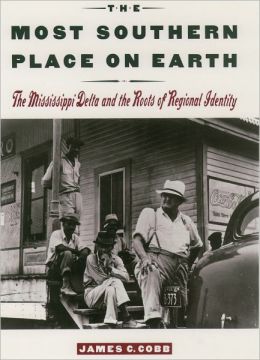
Being so occupied, the only book I read in, the reading limited to the flights to and from NO, and in Breaux Bridge for an hour before bed, when the internet got knocked out from a lightning strike, was The Most Southern Place on Earth: The Mississippi Delta and the Roots of Regional Identity (1992; Oxford University Press) by James C. Cobb. This is one of the seminal works that explains the contemporary south by viewing the economic and cultural history of this place, a rough triangle between the lower Mississippi River and the Yazoo River.

The green is the Mississippi Delta.


It is not the Mississippi River delta -- which tends to confuse those unfamiliar with deep south geography. the Mississippi River delta is way down further south. "Delta" here means this particular locale within the state of Mississippi. Or, as author/ historian David Cohn wrote in 1935:

Peabody Hotel 1886

"The Mississippi Delta begins in the lobby of the [Memphis] Peabody Hotel and ends on Catfish Row in Vicksburg. The Peabody is the Paris Ritz, the Cairo Shepherd's, the London Savoy of this section. If you stand near its fountain in the middle of the lobby... ultimately you will see everybody who is anybody in the Delta..."
This region is peculiar even within the milieu of the rest of the deep south, and even the state of Mississippi itself. This was a re-read; the first reading was before the March 2014 sojourn there. It was valuable for that sojourn to have read it before spending boots on the ground time there, but even more valuable to read again after having done so. All the markers that Cobb hits in The Most Southern Place on Earth are still present to be read, in the other deep south states, like Alabama and places in Mississippi, as Biloxi.


Africatown in Pritchard (where settled the descendants of the last slave ship, the Clotilda, from Africa to land on U.S. shores in 1860, brought as deliberate provocation to war, settled after the Civil War) outside of Mobile, remains as shocking in its tumbledown, malnourished poverty in May, 2015 as it was in May, 1910 or 1930 or 1940.

Katrina made all of it worse, as it's obvious no FEMA monies got trickled down to any of these Africatowns in the deep south, though of course the fracking so-called presidential library of Jefferson Davis got 10 million federal FEMA dollars and the mansion which a wealthy widow gave him, Beauvoir, received 4 million FEMA dollars for repairs after Katrina.  But the homes of the poor black citizens of Mississippi and Alabama -- nada.  You can see this, with your own eyes. They can't even hide it.  But nor do they care obviously, as the stars and bars flies over all the Welcome to Mississippi rest stops . . . .

Among the elements that Cobb works in so cogently within his main threads of white supremacy, labor economics and political dominance of the ruling Delta planter aristocracy is the development of the Blues -- why the development of the Blues, and their significance, in this particular region.  He provides maps that coordinate the birth places and earlier years of a legion of legendary Blues


musicians, which run up and down the Mississippi and cluster with the density of cotton bolls in the Delta. One chapter devoted particularly to the Blues is titled, "The Blues Is A Lowdown Shakin' Chill," one of the Blues classics particularly


attributed to the legendary Robert Johnson.  I had skipped ahead to that chapter on this re-read, in the hour before meeting up with friends and dinner, and then going out to hear contemporary Blues-man, Brother Tyrone at the Ooh Poo Pah Doo Bar, which  is named after the 1960 hit by the owner's father, the late R&B legend Jessie Hill.

The thickest number of blue markers of Blues musicians's birthplaces or place of early prominence is at the top, left. This is the  Mississippi Delta.  As Chicago, for obvious geographical reasons was a primary destination for Mississippi's black labor's outward migration, this explains why Chicago also is historically an important blues scene -- and later, for rock 'n roll.
All this history is chilling, but the hardest to deal with as an historian, perhaps, is chapter 12, "Somebody Done Nailed Us On the Cross". This is the chapter that describes how the power of the Delta capitalists was retained, regained and expanded into contemporary times, to remain entrenched in conscious white supremacy and denial of any economic opportunity -- and came via the federal tax dollars of the whole nation, poured into the Delta in order to provide aid and assistance for the Delta laborer to raise out of poverty -- stayed in the pockets of the planter class aristocracy. This is supremely depressing reading for all of us who wish to turn around the injustices of economic, political, social oppression, as can be understood from this, the last paragraph:
As was often the case with American assistance to other nations, in the Delta aid offered in the name of economic rehabilitation and human uplift was routed, in the interest of political expediency and stability, through those at the top of the region's socioeconomic structure.  As a result, the story of the interaction of agricultural, civil rights, and social welfare policy in the Mississippi Delta is especially instructive. Regardless of region, nation, or hemisphere, when economic reform proceeds under safeguards against redistribution of wealth or power, social and political rights will prove difficult to extend and dangerous to exercise.  Meanwhile, whether its story is told in the smudged ledgers of the landlord or the antiseptic memoranda of the bureaucrat, the phenomenon of economic and sociopolitical dependence is likely to remain as real and debilitating as ever.
The lesson is that neither assistance nor reform can happen from "inside" or from the top down via the ruling establishment.

Frequently Cobb draws understanding from the Delta's white supremacy wealth and power's support by the federal government, used by it to maintain black labor poverty and powerlessness, that this process isn't limited to one place in the United States, or to the klepto governments abroad.  This is a deliberate cooperation between one power and another power, united to keep the flow of wealth concentrated in a few hands while keeping oppressed and helpless the rest. The local power achieves wealth, and in return they provide the government the order of local stability.  (The Civil Rights era blew this out of the water for a while.)  More than once Cobb suggests -- back in 1992! -- that this process will spread out of the Delta to affect the rest of the United States in the near future, because that is how power and capitalism operate.

In other ways though, reading The Most Southern Place on Earth for the first or repeat experience, is exhilarating.  Cobb is a fine historian and an equally fine writer. The book is dense with information about the evolution of the planters' ruling class that adjusted to every change from Emancipation through Reconstruction, Jim Crow, FDR and the Civil Rights era to maintain its supremacy, while the laboring class, both poor white and black, always did worse. It's a brilliant study, particularly how the planters such as the Percys were able to divert any and all federal funds for "relief" during the New Deal to themselves, just as they did later with the Food Stamp program. But they were doing this even before Appomattox.

This is a book worth reading even if the south isn't a particular interest of the reader's, if the reader is at all interested in changing the way things are right now as fewer people own more and more of the wealth and the rest of us are left holding the bag.

One thing Marx wasn't able to foresee -- though Cobb was already getting glimmers of it -- that capital would reach a pinnacle of power in which it didn't need human labor at all.

I need to read this one next:


Then I'll be ready to backtrack to an earlier historian, C. Vann Woodward, and his Origins of the New South, 1877–1913 (1951), The Strange Career of Jim Crow (1955) and The Burden of Southern History (1955).  Woodward, a Bancroft Prize winner, one of the most influential of historians, who died in 1999, did not like the direction the younger, 'new' historians such as Cobb were going.  He tended to quite sneer at them in fact, particularly Cobb's breaking the ground in terms of southern economic-political history, by declaring the biggest change came in the New Deal era, not the Reconstruction and Jim Crow eras.

Which is why my method is to read the more contemporary historians in a subject before the older ones.  It makes it easier for me to glean what is still worth learning from the earlier studies, because I won't need to fulminate about -- o dear what you got wrong! If one denies oneself digging into earlier works there's a great deal worth knowing that one misses.

Friday, February 21, 2014

Consequences: From Ebony and Ivy to Today's Campus Life

Two articles that should be considered together when thinking about our institutions of higher "learning."


This, a report from the NY Times of the neck  Ol Miss'd  James Meredith statue desecrated with a lynch noose and CSA flag,  + other racial incidents common on that campus;

and this report-history on fraternities from the Atlantic Monthly.


This is just the first paragraph!
One warm spring night in 2011, a young man named Travis Hughes stood on the back deck of the Alpha Tau Omega fraternity house at Marshall University, in West Virginia, and was struck by what seemed to him—under the influence of powerful inebriants, not least among them the clear ether of youth itself—to be an excellent idea: he would shove a bottle rocket up his ass and blast it into the sweet night air. And perhaps it was an excellent idea. What was not an excellent idea, however, was to misjudge the relative tightness of a 20-year-old sphincter and the propulsive reliability of a 20-cent bottle rocket. What followed ignition was not the bright report of a successful blastoff, but the muffled thud of fire in the hole.
Historical enlightenment, of how the past keeps crawling into the present, is to read these two articles in the context of Ebony and Ivy League, Race, Slavery, and the Troubled History of America's Universities by Craig Steven Wilder.

Recall, Ol Miss was founded in 1848.  This is when Mississippi was the richest state in the Union, with the most millionaires, slaveholders all, who literally owned almost all the state and also owned the majority of its inhabitants. This is Jefferson Davis's world, which got the U.S. to go to war with Mexico to increase the wealth of the south generally and Mississippi's in general.  By this time Mississippi herself was no longer a slave consuming territory, but looking for territory to which she could sell her "overstock."

1848 was the chronological heart of the fire eater philosophy's successful conversion of southern thinking: slavery is God's will, the the most superior way of life, confirming that slaveowners were born to rule everyone else, no matter what their skin tone's heritage -- they were right, everyone else was wrong, and by god NO FRACKIN' TAXES! NO PUBLIC IMPROVEMENTS! NO TAXES FOR FEDERAL GUMMIT OR LOCAL EITHER.  NOTHING WHATSOEVER FOR THE PUBLIC GOOD!  ANYONE WHO WANTS PUBLIC GOOD IS FIT ONLY TO BE A SLAVE!  By 1850, losing the battle to force California's addition to the Union as a slave state, the fire eaters organized and held the first Secession Convention, in Nashville.*

Therefore, they lost the war that the fire eaters themselves forced upon the U.S.. Other associated attitudes came with fire eater philosophy, that supported their cultural assumptions, presumptions and behavior, further contributed to their inevitable defeat:

-  somebody else do it, I don't do -- that's for slaves;  I talk and give orders that must be obeyed on pain of whipping, slave and even death, if I so choose;

-  non-cooperation; refusal to take orders but only give them;

-  blowharding, blowharding, blowharding NO CONTRADICTION instead of dealing with facts and real information;

- devotion to a slave economy, that then perforce was an economy of credit only -- credit 100% dependent upon possession of the slaves in which credit was literally embodied -- and no hard, dependable currency or specie.

History does repeat itself, sadly.

---------------------------

* This is not strictly true.  The New England Federalists held a secession convention in Hartford in 1814, in opposition to the War of 1812.  However, the official minutes of the meeting left out the secession discussion, when the minutes were published.