LINES OF THE DAY

". . . But the past does not exist independently from the present. Indeed, the past is only past because there is a present, just as I can point to something over there only because I am here. But nothing is inherently over there or here. In that sense, the past has no content. The past -- or more accurately, pastness -- is a position. Thus, in no way can we identify the past as past." p. 15

". . . But we may want to keep in mind that deeds and words are not as distinguishable as often we presume. History does not belong only to its narrators, professional or amateur. While some of us debate what history is or was, others take it into their own hands." p. 153

Silencing the Past: Power and the Production of History (1995) by Michel-Rolph Trouillot

Showing posts with label Guns. Show all posts

Saturday, November 18, 2017

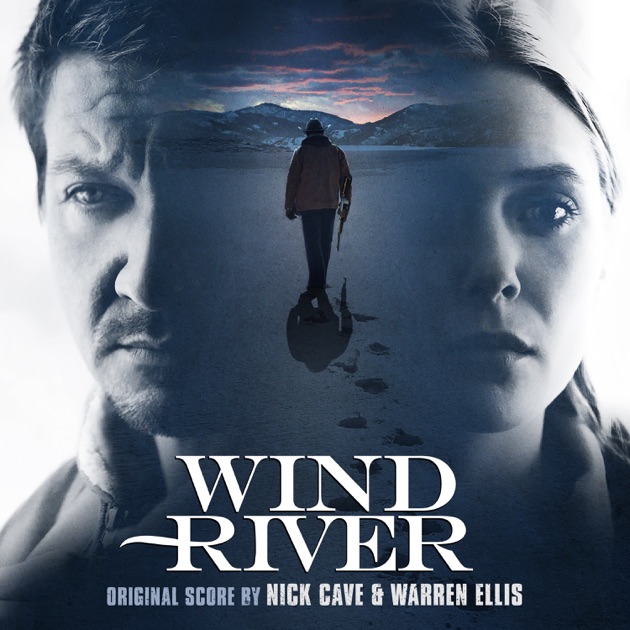
Wind River (2017) + Longmire

     . . . . Wind River (2017) premiered at Sundance, as a Sundance Film Festival pick, where it achieved a theatrical release deal. Ironically, this from a Weinstein company, from which the film severed ties in October. It also picked up several awards and nominations, including for Canne Film Festival. 


     . . . . Death in winter, on a Wyoming res At the center, is a  professional hunter, employed by Fish and Wildlife, who is divorced from a native woman, evidently due to the mysterious death of their daughter, which has happened prior to the opening.  He finds another dead young woman while hunting a mother mountain lion and her young, who have taken to killing livestock.  Her death is the film’s opening, a prolonged death running barefoot in the snow, breathing freezing air. The examiner determines she has been been violently assaulted sexually and otherwise either multiple times or by multiple assailants. But the death cannot be listed as homicide since it was breathing freezing air that burst her lungs, and which ultimately killed her.


That's the whole story, which is provided to the viewer in the first 5 minutes, followed by some soft-focus, lingering and detailed scenes that are pure gun and ammo porn.  However we know what's his name -- people's names in this film do not matter -- is the good guy because he gives his kid a gun safety lesson, and makes his own ammo.

All that's left for the rest of the film to occupy itself is who done the rape - murder.  The surface is a more than satisfying viewing experience, but there's little beneath, and what is, does come through as glib, to put it kindly. However, one does feel that the production, writing and filming honchos are so familiar and at ease with the locations and the matters of these places and their residents that they didn't realize that this is how it would come across to other viewers. It might be intentional though, as so many think its this is best thing they've watched all year.

It’s shot with that signature graceful, authoritive surface that tells the audience  they are about to experience a solid entertainment, in the old-school sense of that word applied to Hollywood films. Nothing that will truly disturb them will be on offer, either in action, character or story. Whether or not there is violence, all will end as it should, and the viewer is going to enjoy going on the ride.  Which itself some viewers may well find disturbing as at the end, with two fathers, one native, one white, sitting together grieving the loss of their native daughters, exchanging wise-cracks, a title card states that “missing persons statistics are kept for every demographic except Native American women, whose numbers remain unknown.”

Wind River projects the same quiet confidence and authority that is the signature of the on-screen presence these days of Robert Redford and Jane Fonda, and which no one possessed so completely as Paul Newman, from whom, presumably Redford learned a great deal. Newman could say more by standing, sitting or watching than most actors could in 20 minutes of on screen action.

As well, Redford has had much experience shooting in snow-covered mountains in his own star turns in movies such as Downhill Racer, Jeremiah Johnson, The Electric Horseman and The Horse Whisperer among others in his long, distinguished career as actor, director, producer.  These snow-covered mountains are virtually the backyard of Sundance, Utah’s first citizen, Robert Redford -- which is where Wind River premiered and was picked up by Weinstein productions, if I understand the film's history correctly.


BTW, the lovely Longmire television series, its final season up on netflix today. It's set in a fictional Wyoming that is really New Mexico; one of its chief recurring character's actor is also in Wind River. Longmire is possessed of the same gloss and authority, but less confidence, stumbles sometimes, and frequently is disturbing in terms of character, action and story line, i.e. a less comfy viewing.

Sunday, December 13, 2015

Chauncey DeVega Podcast re The American Slave Coast

This brilliant, well-read, charming, young intellectual interviewed us concerning the matters of The American Slave Coast the first week of this month for his weekly podcast. It was a considerable pleasure -- if that word can be used in connection with such a terrible subject -- talking with him.  He's so smart!  Every time we get to interact with people like him who are so much younger than we are is a blessing.  At his age I sure wasn't as smart and well-informed as he is.

This was our final scheduled support event this year for the publication of The American Slave Coast, which made this special experience even more so.

The links for the variety of methods to hear it can be found in this entry, "A Conversation With Historians Ned and Constance Sublette About Their New Book "The American Slave Coast: A History of the Slave-Breeding Industry" " on his website, Indomitable, here.


"Ned and Constance do some serious teaching and sharing on a very difficult subject for this week’s show. Chauncey and his guests work through questions regarding the scale and scope of The Transatlantic Slave Trade, how many people were killed during that horrific business, why did the slave population in the United States grow as compared to other parts of the world, and what is “the capitalized womb” and “slave-breeding?”
"Ned and Constance also take on common white supremacist and other myths about how chattel slavery in the “New World” was not as harsh as the labor experienced by European serfs or North American urban white industrial workers."

Saturday, December 12, 2015

End of Year Holiday Season Weekends in the Neighborhood 2015

Today, the climate-change way above normal temperature in the 60's has people sitting outside again while drinking their coffee, eating their weekend brunch, and talking with their companions.

I am hearing discussions and explanations up and down the sidewalks as one person in the duet or the group attempts to explain what the Second Amendment is really about, how the NRA has played the history of guns and racism and slavery for decades to achieve such power with extremists of all kinds in this nation, including the police.  These discussions and explanations are couched in the same terms as we explain them in The American Coast: A History of the Slave-Breeding Industry, that puts the history of slavery and violence front and center in the history of the U.S. from the earliest colonial era through 1865.

We were not hearing this, reading this everywhere even after the Sandy Hook massacre that took place three years ago this month, or even last year after, o, say, which mass gun murder should we randomly grab from 2014? how about May 23, 2014 -- a killer left 6 dead, 7 wounded in Isla Vista, California. We heard about this terrorist because he targeted white, middle-class sorority women (though of course there is no relationship between a man's hatred and resentment of women and his sense of entitlement and gun violence against women, o no! so this cannot be terrorism -- ask any NRA philosopher).

Scrolling through the mass murders in the database linked to above, many -- most -- of them, never made the mass media. These mass shootings are so common there has to be some very specific hook for the national media to even report. Yet, by now, with this many going on every day, and some days more than one, we can't see this as terrorism, aided, abetted by the gun industry and other political and financial agendas at work in the U.S.

People are talking about this now, and particularly in terms of racism and #blacklivesmatter.  But how many black lives were taken by random terrorists like George Zimmerman and police across the nation, before the media would even begin to notice this connection?  It took a massacre in Charleston, South Carolina, in the basement of a black church, of all black victims by a self-declared white racist who self-declared he wanted a race war, for the media to even touch on these ideas.

But today, on the sidewalks of my neighborhood as climate change manifests, where so much of it has been despoiled literally by the demagogue who would be POTUS, people are talking about this.

Beyond that, there is this also in my neighborhood today:

Around the St. Anthony's of Padua Church are a group of women singing carols, beautifully acapela.  They are doing this to raise money from passers-by for City-Food.  They have dressed their small, cute dogs in Christmas finery and brought them along.  The dogs are enjoying the outing with each other and greeting all the other dogs passing by.  Their barks fit nicely somehow with their persons' voices soaring into "Glory to God, In the Highest Heaven."  The temperatures say it's spring but the sky and slant of light still inform us it's December.

I dropped a five into their donation bucket. Then I stood there listening, looking up at the winter sky. I have an anti-singing voice, but I know these carols -- they were my first music -- all the verses.  I sang them thousands of times growing up. I sing along -- well, really, more mouthing along in respect for these real singers. Yet I am soaring too, up up ever up into the rapidly darkening sky.  I realize more and more people have stopped.  They are singing too.


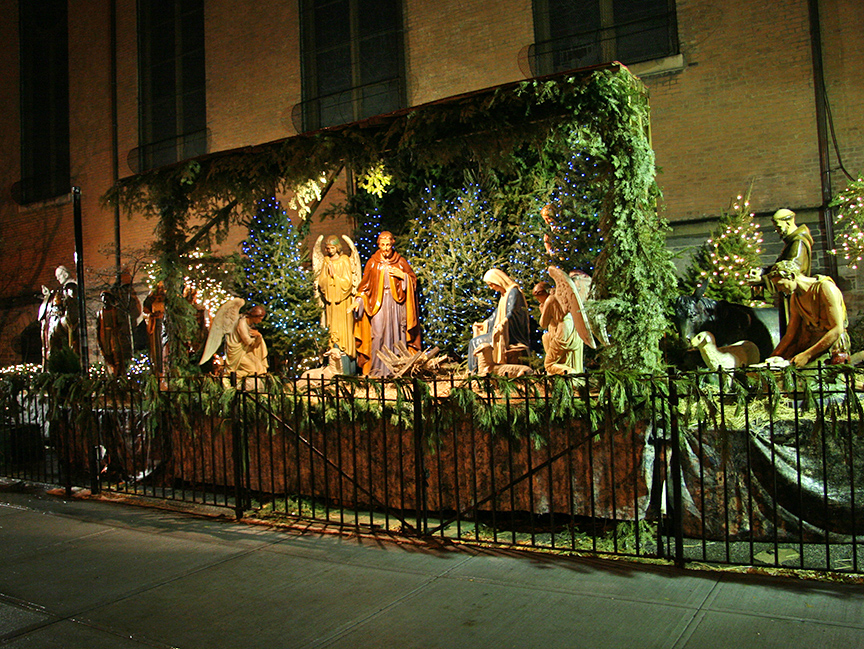
So I go on my way, which as usual in this season includes paying my respects several times a day to the creche St. Anthony's puts up  on the Houston Street side every year.


As well, there's a vendors market all along Houston, including vendors set up in front the creche.  Passerby are stopping, many of them buying.  Beautiful wares, including blankets and scarves made by the Peruvians of alpaca wool in jewel-tone colors. I want one so much.  And maybe, if we were having a real winter, I might have broken down and bought one.  I may still do so, since at some point there's going to be a repeat of the last two very cold, endless winters.

Everywhere colored lights twinkle among swags of greenery.  Today's also that hideous commercial spew called Santa Fest, in which college students from everywhere come to NYC to drink cheap in a succession of bars all day and night. But they've created so much havoc in past years that many bars have refused to participate -- almost all the bars in our neighborhood among them.  So it's pleasant to see people in Santa and elf costumes because they aren't drunk and screaming.

So that's how the holidays are behaving in my neighborhood today.


Friday, October 2, 2015

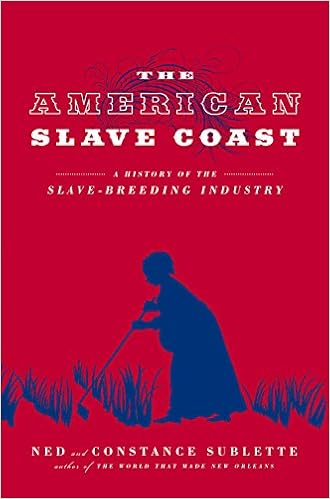
Review -- The American Slave Coast: A History of the Slave-Breeding Industry

BOOKS
People are saying the production and
package of The American Slave Coast
 are attractive and impressive

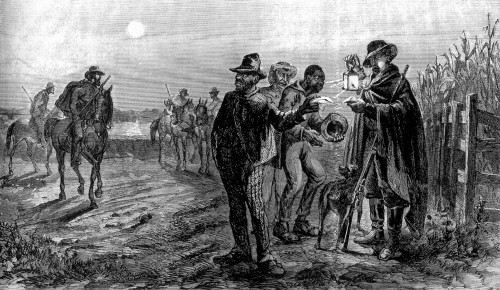
Photo credit: Lawrence Hill Books,
one of many illos in The
American Slave Coast.


New Book: "America Was Built On Slavery And It Was Much Worse Than You Might Imagine: Slaves as money. A breeding industry. Founding fathers of white supremacy."

By Steven Rosenfeld

Thursday, June 18, 2015

Will South Carolina Lower the CSA Battle Flag Over Its State House in Respect and Mourning


Will South Carolina lower its CSA battle flag flying at the state capital in respect and mourning of the good, Christian people murdered by terrorist attack in Charleston? 

I first learned of this awful event while, by sorrowful coincidence, we were fact-checking, copy editing via reading aloud this morning the chapters in The American Slave Coast that trace the history of South Carolina, founded in white supremacy, slave trading and slavery of both Natives and Africans from the start of some of the founders in Barbados. 

The Obamas knew the murdered pastor. This has got to be a terrible day for them, recognizing in many ways those shot in cold blood were surrogate targets for First Family.

How many times must it be proven that white supremacy and guns are a deadly combination for any nation that proclaims equality and democracy and diversity as positive goods.

From President Obama's speech:

Mother Emanuel is, in fact, more than a church. This is a place of worship that was founded by African Americans seeking liberty. This is a church that was burned to the ground because its worshipers worked to end slavery. When there were laws banning all-black church gatherings, they conducted services in secret.  When there was a nonviolent movement to bring our country closer in line with our highest ideals, some of our brightest leaders spoke and led marches from this church’s steps. This is a sacred place in the history of Charleston and in the history of America.

One of Mother Emanuel's founders, in fact, was Denmark Vesey, a black martyr for African American freedom (we have a photograph of the ground where he was hung in The American Slave Coast).

The fact that this took place in a black church obviously also raises questions about a dark part of our history. This is not the first time that black churches have been attacked. And we know that hatred across races and faiths pose a particular threat to our democracy and our ideals.

Will this white supremacist be given the death penalty as has the surviving Boston Marathon Bombing brother?

Wednesday, March 6, 2013

Charleston's Pre-Revolutionary Militia


Via:

Sellers, Leila. (1934). Charleston business on the eve of the American Revolution. University of North Carolina Press, Chapel Hill.


. . . The king’s troops could not garrison all of these fortified places. The colony must do its share. The defense of the province was provided for by militia against foreign foes, and by patrols in the country and night watches in the town against domestic enemies. Every citizen, says Hewatt, joined the military to the civil character. Every man between sixteen and sixty years of age able to bear arms had to enroll in the militia. . . . Merchants and tradesmen found military duty inconvenient because it interrupted business. The planters, however, who were more at leisure on account of the task system of managing their plantations, had plenty of time for military exercise and prided themselves upon their martial spirit.

This sounds like reasonable planning to defend the city against other nations' invasion -- and, of course, Indians, right?

But in practice, this is what that militia really was about -- and why that well-regulated militia clause is in the Constitution:


The domestic tranquility of the province was provided for by small patrols drawn every two months from each company. Their duty was to ride along the roads and among the Negro houses in small districts in every parish once every week or as occasion required. To preserve good order in Charleston, where there was danger of insurrection because of the great number of slaves from Africa constantly imported, a night watch was established and paid for by money raised from tavern licenses. In 1770 the night watch consisted of 3 commissioned officers, 3 sergeants, 3 corporals, 3 drums, and 96 privates, armed with muskets and cutlasses; one-third mounted guard every night to “prevent disturbances among disorderly negroes and more disorderly soldiers.” [source: Public Records of South Carolina, XXXII, 385.]

Additionally, imagine what "Their duty was to ride along the roads and among the Negro houses in small districts in every parish once every week or as occasion required" might be like for the Negroes living in those houses. Those plantation fellows out on the town all day and then out into the country, after drinking and whooping it up for hours with their fellows.  Imagine how terrifying for the inhabitants in these small houses on a weekly basis.  Recall these white fellows could do anything to anyone they felt in the mood to do, because it was all in the name of keeping order.  That's how domestic terrorism works to keep the local populations in line.

Thursday, January 10, 2013

History of the Second Amendment


“The Hidden History of the Second Amendment,” by Carl T. Bogus, Professor at Law. This paper can be found at: 31 U.C. Davis L. Rev. 309 (1998)
“This work, copyright 1998 by Carl Bogus, was originally published in the UC Davis Law
Review, vol. 31, p. 309, copyright 1998 by The Regents of the University of California.
Allrights reserved. Reprinted with permission.”
This paper can be downloaded free of charge from the Social Science Research Network:  http://ssrn.com/abstract=1465114
Abstract:
Professor Bogus argues that there is strong reason to believe that, in significant part, James Madison drafted the Second Amendment to assure his constituents in Virginia, and the South generally, that Congress could not use its newly-acquired powers to indirectly undermine the slave system by disarming the militia, on which the South relied for slave control. His argument is based on a multiplicity of the historical evidence, including debates between James Madison and George Mason and Patrick Henry at the Constitutional Ratifying Convention in Richmond,Virginia in June 1788; the record from the First Congress; and the antecedent of the American right to bear arms provision in the English Declaration of Rights of 1688.
It’s a most useful paper to read in regard to the ever on-going and ever-more serious issue.
Recall that in the slave holding states until after the Civil War -- and in many places even decades, yea verily even a century after the Civil War -- all of the criminal system was about slavery, not about crime and criminals as we think of crimes and criminals.  It was about keeping the South in complete lock down --  it was a police state in every sense. Not only could you be arrested, tried and imprisoned for publishing or even possessing Abolition materials, in Charleston, for instance, there was a curfew for slaves in the street. Even respectable white people retired behind the walls of their homes after sundown for fear of running into the Patrollers and other loosely created groups to keep the slaves in order. anyone found on the streets after dark were automatically considered whores, slaves and other up-to-no-goodniks.  Bounty hunters prior to the Civil War?  Only for run-away slaves. Or, up north, labor agitators ....
Since this is a pdf I can't cut and paste, but this part of the paper and the history of the Second Amendment begins on page 15.