LINES OF THE DAY

". . . But the past does not exist independently from the present. Indeed, the past is only past because there is a present, just as I can point to something over there only because I am here. But nothing is inherently over there or here. In that sense, the past has no content. The past -- or more accurately, pastness -- is a position. Thus, in no way can we identify the past as past." p. 15

". . . But we may want to keep in mind that deeds and words are not as distinguishable as often we presume. History does not belong only to its narrators, professional or amateur. While some of us debate what history is or was, others take it into their own hands." p. 153

Silencing the Past: Power and the Production of History (1995) by Michel-Rolph Trouillot

Showing posts with label Colonialism. Show all posts

Wednesday, April 7, 2021

Let's Read Again Like We Did Last Year ~~

      . . . . Frequently my mind fails to make sense to me. 


 How did I manage to choose Bagehot: The Life and Times of the Greatest Victorian (2019) by James Grant as the audio book to follow Pale Rider: The Spanish Flu of 1918 and How It Changed the World (2016) by Laura Spinney, and The Zealot and the Emancipator: John Brown, Abraham Lincoln, and the Struggle for American Freedom (2020) by H. W. Brands for my workouts?

So far my great take-away is that Bagehot was not only a prototype of what we in later times tend to call a libertarian / neo liberal.  He formalized the concept, and described in detail  the necessity of a Central Bank and its functions for a stable government.  He did the same for Constitutional Monarchy. This while, though they benefit from both, the 'lower orders,' the poor, the uneducated, are incapable of understanding either economics or constitutions, and certainly lack the capacity for making political and governing decisions. Needless to say that women as a class aren't even that much of a consideration, despite his respect for the intellects of many of the women of his acquaintance, including his own mother, who also suffered serious mental illness.

This brilliant fellow, a prodigy already as a very young child, could not add or subtract. Yet his family put him in charge the family banking business, when he hated everything else including the law for which he qualified among his many other professional credentials, realizing he wouldn't be able to pull a Disraeli and move from writing to holding office and becoming Prime Minister. The family business's great fortune is that he seems to have spent more time doing anything but banking, while remaining a writing demon as to output, and a polymath in terms of what he wrote about. Naturally, due to his writing about how to run a country's finances, he got sent to India to put its finances on solid footing.  How more British and Victorian than this may we get?

Bagehot was praised for cool wit and epigrammatic style, which author Grant does his best to exhibit in his own economic writing. Nor did Bagehot stint in praise for himself in his own writing, knowing he knew what others did not, and taking knowingly contrary political positions such as favoring Louis-Philippe's coup against the election and naming himself France's ruler for life. Bagehot inevitably reminds this reader of that thoroughly self-satisfied, thoroughly knowledgeable of his own superiority, that fellow likely only Tories today recall, William F. Buckley.

On the other hand, George Eliot quite adored Bagehot as a thinker and his friend.  But no one has suggested George Eliot didn't have a strong conservative bent herself -- except for herself, of course.

~ ~ ~ ~ ~

Things do roll on, don't they. The period's royalties arrived, and so did spring, while winter, hopefully, is now departed for months.  El V got his second dose of Pfizer this afternoon.  He's currently lying down, but he generally feels sleepy before dinner so it probably means nothing.  I am making dinner, looking forward to my second dose of Moderna late Friday afternoon, and after dinner, I'm particularly looking forward to the HBO Max premiere of  the 4-part Exterminate All the Brutes.

In ‘Exterminate All the Brutes,’ Raoul Peck Takes Aim at White Supremacy

After the success of “I Am Not Your Negro,” HBO gave Peck carte blanche for his next big project. What resulted is a sweeping meditation on colonialism and the nature of truth itself. ... New York Times

Raoul Peck’s four-hour documentary for HBO is a dizzying retelling of the course of colonialism, slavery and genocide. ... New York Times

"....a Radical Masterpiece About White Supremacy, Violence and the History of the West" ... Time

This exploration of the "origin story of white supremacy" features two Revelators who have had deep effect on both el V's and my historical researches and formation of our historical perspective:  
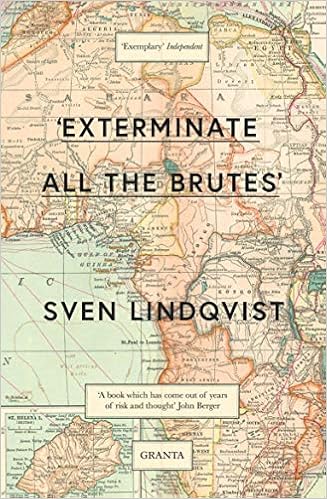


" .... It takes its title from Swedish historian Sven Lindqvist’s ruminative 1992 book about his travels through postcolonial Africa, which in turn wrestles with the source of the quote “exterminate all the brutes”: Joseph Conrad’s immortal novella Heart of Darkness. Peck also draws heavily on historian and activist Roxanne Dunbar-Ortiz’s An Indigenous People’s History of the United States and Haitian anthropologist Michel-Rolph Trouillot’s Silencing the Past: The Power and Production of History. In each episode, he credits himself as having made the series “together with” all three scholars, even though Trouillot died in 2012 and Lindqvist in 2019."

Seeing Roxanne Dunbar-Ortiz involved in this already highly praised non-dramatic, history series, feels particularly personal since she accepted on our behalf and read our "Thank you very much for this honor" for the 2016 American Book Award for The American Slave Coast: A History of the Slave Breeding Industry, as we weren't able to make it out to California for the event.  But it's particularly satisfying because Dunbar-Ortiz is a true pioneer of this kind of work.  When she began, it didn't exist, within or without academia.  Now, because of hers and others devoting their lives to inventing a methodology to study and recover history that has been both disappeared and denied, to see her, at her age, receiving this kind of recognition is truly exciting.

A quote from Michel-Rolph Trouillot is at the top of this Fox Home blog, as it has since the beginning.


Wednesday, December 23, 2020

Gilded Age Adventure Fiction: Allan Quatermain

     . . . . Haggard, H.R. (1887) Allan Quatermain, second volume, sequel to King Solomon’s Mines (1885). I’ve read King Solomon’s Mines, of course, and She, and maybe another Haggard novel, but if I had read Allan Quatermain it was long enough go that I have recalled nothing.

The series of narratives that are Quatermain’s memoir cover 50 years of the life of a fictional representative of those imperial stalwarts the Empire hatched in their thousands for a couple of centuries out via the English public school system, to fill the needs of the East India Company, the British army and the douty UK middle class. They were as much glorified by Kipling, as the grunt in his writing, and writers in the same mode as Haggard. 

This universal admiration for this dream ideal alpha (white) male, has Quatermain resembling Kipling in a way that at the time, Kipling couldn't imagine. Quartermain's  loss of his dearly beloved only son, Harry, is the motive for this novel. Harry died in a smallpox hospital where he was a physician. Quatermain blames himself, because though very well off financially, he wanted his son to stand on his two feet without dad’s financial support, to toughen up, be a real man, which Harry did, refusing to go home to daddy when the smallpox epidemic raged. Quite like Kipling's pushing of his son inexorably to join up to fight in WWI, and who, to Kipling's shock and grief was killed.

Colonial Brit Imperium superiority is on display on nearly every page of Quatermain, with long lectures on what makes an admirable man and the general inferiority of non-whites, unless exceptions out of a warrior 'race' such as the Zulu. 

It’s also broadly accepted that ‘white’ ultimately means British, only. Other Europeans, whether German, French etc.(Alphonse in Allan Quatermain is nothing but a list of ticked off boxes of French coward, fool and ignorance), included to show their inferiority as buffoonish figures of diversion and exploitation, at best, as well as targets of physically brutal abuse, as well as verbal contempt. This mode was eagerly displayed by other adventure genre writers, from Edgar Rice Burroughs, and continued to proliferate within the sf/f fields, including the buffoon as alpha male writer, John Norman and many others, even now. 

What makes Haggard exceptional among many genre adventure writers though, is his inclusion and featuring, women of agency who are strong enough to rescue themselves -- though not even their courage, proven ability and his admiration can stop Quartermain from mansplaining to them what a real woman is, and how to be/come that.  Worse, in Allan Quartermain, the girl child who rescued herself with tremendous courage and presence of mind, the reader is carefully informed that for the rest of her life, she was 'nervous' and subject to great starts and frights 

Theodore Roosevelt admired Haggard the writer enormously, writing him a letter saying so. He wished very much they could meet. They did have friends in common. The adventures and hardships of our heroes in Allan Quatermain are astonishingly similar to what’s in River of Doubt: Theodore Roosevelt's Darkest Journey (2005), which I read earlier this year. It seems a miracle that Roosevelt did not die – many times – on that terrible journey in the Amazon. Nor was it entertainment, not a novel for boys (which books TR loved), but what really happened, to real people.

Original British P-1885 Martini-Henry MkIV Rifle Pattern A


By the by, the Allan Quatermain narrative mentions several times the Martini-Henry rifle which came in, in 1871. Could the martini cocktail, supposedly invented in 1887, have gotten its name from the Martini Henry rifle, an brought into the British Army then? Martini–Henry rifles were used throughout the British Empire for 47 years.

The Martini-Rossi vermouth was created earlier, in the mid-1800’s, from which some think the cocktail derived its name.  It's not far from the favored gin-and-tonic of the Raj and African colonies to a martini, stirred, not shaken.


Sunday, January 22, 2017

It's Official: Frontier is Awful. And Preposterous Too


     . . . .  Frontier (2016) season one. Canadian Discovery Channel – Netflix.  It's been renewed for a second season already.


It's unclear just when this period costume series is set.  It's evident that it is after the conclusion of the War of Independence, but not necessarily after the the Constitutional Convention and ratification (1788 - 1789).  The neighbors south of the Canadian territories are referred to as "Americans," and we didn't start doing that until about the time of we began the process of separation with Britain at the time of the tea parties, around 1773 and forward.  The series' opening title sequences include a manikin colonial soldier with a musket positioned in front of a red and white stars and bars with a circle of 13 stars on blue field in the corner. It's a cheap mock-up of such title sequences that have been done so brilliantly with visual and graphics and music as in Black Sails and Vikings great intro (though the series itself has turned to merde).


So we have a rough idea of chronology here, which matters considering there are competing 'companies' from ore than one place trying to break the Hudson's Bay fur monopoly for harvest, trade and employment of the Native groups to do the hardest work of the fur trade, which has a long colonial history both above and below the Canadian line, among the colonists / USians, the British companies, the French, the Spanish and the French.  We need to know these matter too in order to figure out who the characters are and why they are so mutually hostile.

But where are we, exactly?  That's even more vague.  Supposedly in The North -- The Wilderness, quite unpopulated by colonists at least, around Hudson Bay and the part of it called James Bay, north of the relatively civilized Montreal. (So we are definitely not in the 1760's, since until then it was French, you know! And supposedly there are now British banks there, as well as Hudson Bay offices and trans-shipment points.)  So when not trekking through seasonally incoherent and inconsistent northern wildernesses, we are trekking between Montreal and Fort St. James, which at this time is merely a rough trading station providing some supplies and sustenance to trappers and hunters, and is also a trans-shipment point for at least the Hudson's Bay Company.  However, people dash back and forth between the Wilderness and St. James with a rapidity that is only more astonishing than the rapidity they make the dashes back-and-forth between St. James and Montreal.

There are lot of good actors in this 6-episode series. But the writers are so awful, that the characters the actors play are probably the most mentally challenged people in North America in 1780's and 1790's -- even more stupid than King George III was about North America.

The stupid things they do, from pretending they are being sneaky and clandestine and hiding identities, to not killing their rivals any time they have a chance -- and instead they talk talk talk talk.


The villain instead of killing his nemesis, Declan Harp, a half Cree and half Irish fellow whose father was a Hudson's Bay employee, played by the rather splendid Jason Mamoa, who has no opportunity to redeem this stupid stuff, tries his best to talk him to death instead.  So Harp is rescued, but only to be so stupid as to go back and peer at his nemesis who had tortured his dead wife and child and tortured him too, and NOT KILL HIM every time he had the opportunity.

Everybody does this bs -- getting away, coming back, getting away, coming back.  While unimportant characters, many of them, are killed frequently in grisly manners.  Though there's always sexual threats against the women, they tend to avoid that -- on screen anyway, thank goodness.  It really makes one think that the writers are all believe they are channeling James Fennimore Cooper of the Leatherstocking Tales.  I pardon Cooper (for that at least) but not these jokers.

Many of the scenes are shot so darkly that no matter what one does, one can barely see what is going on.

Grace Emberly, who naturally owns the only tavern, "The Ale Tavern" in Fort Saint James.  She seems also to be the only woman in St. James, except for her bar maid, Mary, and The Villain's whore-spy, who he transported all the way from London to spy on Emberly.  But despite them all using their very feminine wiles and assets to beguile any and all men, they are not whores, no siree bhob!  Ms. Emberly also wears really nice spandex leggings and trousers and knee high leather boots.  Note, how dark everything is!  The viewer can hardly make out anything.

This was so poorly done that I spent a lot of time clicking away from the netflix screen where the episodes were running to researching the fur companies, the historical situation, checking that women really did not wear such stylishly tailored clothing in the Wilderness that one thought were actually in Montreal in 2017. Additionally -- there are too many parallels between Frontier's plot and characters and the latest great white tv hope, Taboo, to ignore. Whew!

In other words, I watched this so nobody else has to.  I feel so sorry for the actors.  They have all earned better -- well maybe not Katie McGrath, who was Morgana in Merlin and other equally silly productions?

Res police officer, Officer Mathias. played by Zahn McClarnon, whose character is in his own way is as smart as Henry Standing's Bear's character, played by Longmire co-star, Lou Diamond Phillips, and as admirable.

But certainly actors such as Zahn McClarnon, whom I first got to appreciate in the Longmire series. But he got only a single episode in Frontier. Then he was killed, which is what happens, you know, to good Native Americans.

This was Discovery Canada's first scripted drama.  They have a long, long, long way to go -- and they really need to give back the History Channel's Vikings' teleporter too. Worse, it is obvious all the places where the production is pretending, instead of spending money.  For instance there a couple of transition scenes that the viewer is supposed to see as real human beings dressed in red coat Hudson Bay -- or British army uniforms (which is which is n't always clear!). However anyone can see that it is a model of the so-called governor's house and those guys standing there are manikins, not human actors.  Good way to save money, of course.  They also tell us a geat deal instead of showing, and saving more money, by using long quotes on title cards -- one even from . . . Ice Cube!

It's all too bad, because there is so much going for such a series set in these landscapes, during these times, with all these conflicting forces.


Sunday, March 27, 2016

Irish Writers Reflect on the 1916 Easter Uprising

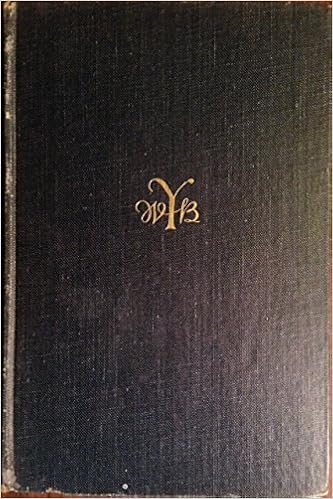
My copy of Yeats' Collected Poems
     As Yeats is so impressed upon my literary bones this was of interest.  His great commemorative poem, Easter 1916, is cited by most of the writers, Irish literary lights as they all are.


As  example,  from Colm Tóibín, who connects dying in a military - political condition that made success impossible with that of the suffering of Irish women:
] "The men of 1916 had no chance of success. They went out to die, a few hundred of them – while thousands were being slaughtered each day in the trenches of Belgium and France. The scale was important. Big wars are terrible and killing civilians is just cowardly, but pitching a few hundred men against the might of the British army is a revolution. It was a transcendental moment of sacrifice and of suffering. Perhaps it was a result of colonisation, with its enforced poverty and shame, but Ireland was for a long time interested in the idea of suffering well, or of suffering better than the oppressor; none was expected to suffer more, or more quietly, than the women of Ireland, into whose bodies and biology suffering was hard-wired. So the idea of blood sacrifice is not removed, in my mind, from a modern state that cannot legislate for the proper medical treatment of pregnant women, because suffering is something we are supposed to do well. Also dying, if it comes to that. 
All nations have founding myths. I suppose I would prefer to have a revolution in my country’s past than a monarchy. I would prefer to move on from Catholic nationalism than from fascist dictatorship. But the truth is that local history has given way, in my lifetime, to global economics, and we have no good stories for this: no parades, no revolutions. The stories we tell ourselves about the past are not about politics. I mean they are not about fairness, about who has power and where the money goes. They contain a deeper madness. The stories we tell are about killing and being killed, and why that was all a terrific thing to do." ]
In contrast to the gravity of Tóibín's and  the others' pieces which generally were serious meditations upon death and politics, was Roddy Doyle's bit. He is the only member of this group who has a comic sense of the universe, and did it ever show.

I've always liked Irish humor. As well, culturally religious as the Irish are, either because of that, or in spite of it, they are the group I know of in which there are many folktales of an Irishman getting the best of the devil -- outwitting even the greatest Trickster of them all.  This deeply impressed me from the first time I ever encountered such stories in some of the tales included in a book in my small school's meager library. I thought, "No such story of the devil would ever have been told in my religion!"  This provoked further thoughts such as, "Do Catholics have more fun than Lutherans?" since the relationship my Catholic friends had with their parents seemed so much warmer and relaxed than those we Lutheran kids had with ours.


Of course that was long before I ever learned anything about Ireland colonization by England or just about anything else.  I hadn't yet read a single poem of Yeats -- or even heard of the man with whose words and life I would spend so much of my 20's.


Wednesday, December 30, 2015

The Imperious Drive


This last week Antipope's Charlie's Diary examined "Fantasy Shibbolths" here.

Earlier this month Charlie's Diary took on "Science Fiction Shibboliths" here.

In the course of both of these articles and the discussions of the subject matters that follow, empire, imperialism and colonialism were unavoidable topics.

Yet we get this silly article about SF/F in the LA Book Review here, that complains the person from part of the former UK empire is not employing the correct terms to talk about SF/F.  Both writers, the subject of the criticism and the critic, miss the really important points that writers of sf/f  such as Charlies don't.


Empire, above.

Empire, below.


Fantasizing that sf/f -- or any pop culture -- saves the world is alike to living in an imperialist theme park because the default of the field is always empire one way and another. It's impossible to argue that steampunk isn't about class and empire, though the field is to be applauded in fact on how many diversities of empire it can envision.

Which is why even an article about the #1 UK television baking show speaks of it in terms of the yearning for empire even in desserts and faux competition here (NY Times article so use one's paywall work-around of choice).

Quote:
It’s astonishing to think that not even a century ago, Britain was the largest, most effective and arguably the most brutal empire the world had ever seen — one of the fundamental political institutions that structured the entire world. This might explain why British national identity, such as it is, continues to manifest itself in signifiers left over from the days of Empire: gin, tea, cricket, flags, those wretched “Keep Calm and Carry On” posters, all of them now zombified and divorced from their material basis. Their appeal is the dream of an endless summer of Pimm’s, bowls and thwarted romantic expectations on the lawn of a great country estate, as if this lifestyle could ever be made possible without the violent exploitation of around one-third of the population of the earth. Ten years ago, adorning oneself with these signifiers might have been considered a somewhat alternative statement. Since then, though, they’ve gained a great deal of popularity, to the point where they’re firmly established in the mainstream of middle-class culture in the British Isles.
For sf/f, telling doncha think, the author's use above of "zombified?

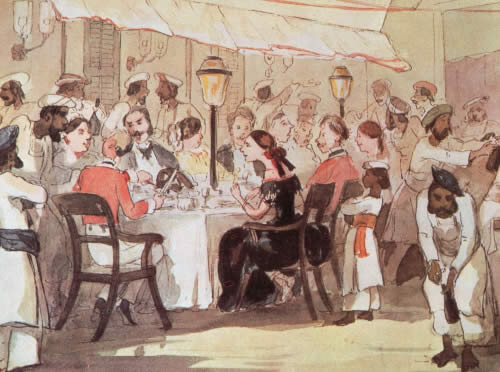
Which brings one to another new restaurant that has opened in the neighborhood, that largely and loudly beckons the truly non-historic consciousness of the young tourists in their deluded fantasy of finding NYC's historical golden past of of a hip and happening underground -- a cultural rebellion of the above ground fortunate --proclaims itself as serving up an authentic colonial Indian food experience (owned by recent immigrants from either Pakistan* or -- India). Is this a sign of the desperate times in which the underground, the vast majority of the world live, that the formerly colonialized too feel it necessary to mine the hip hip hooray above ground colonial golden past of empire, in order to survive in a new world.  Will we be seeing the Native populations of North America open theme park restaurants celebrating the fun and delicious era of the Trail of Tears?

------------------------

*  Here it has been noticed that often restaurants owned by people of Pakistani origin bill themselves as "Indian" because this designation is understood more easily by the young and the tourists who are honestly ignorant of both history and geography.

Tuesday, December 2, 2008

A Question -- Does Colonialism Need to Be Learned?

Do groups need to learn the structures and methods of colonialism, genocide and slavery, or are these patterns of community behavior innate in human societies because the species is a hierarchal one, as well as a cooperative one?

Or have these all been learned thousands of years ago by the universal oppression and suppression and co-opting of women's (and children's) autonomy, bodies and non-remunerated labor, and what their labor produces?

Is this even a legitimate question?

I've been thinking about this, provoked by DuBois and Naipaul.