LINES OF THE DAY

". . . But the past does not exist independently from the present. Indeed, the past is only past because there is a present, just as I can point to something over there only because I am here. But nothing is inherently over there or here. In that sense, the past has no content. The past -- or more accurately, pastness -- is a position. Thus, in no way can we identify the past as past." p. 15

". . . But we may want to keep in mind that deeds and words are not as distinguishable as often we presume. History does not belong only to its narrators, professional or amateur. While some of us debate what history is or was, others take it into their own hands." p. 153

Silencing the Past: Power and the Production of History (1995) by Michel-Rolph Trouillot

Showing posts with label violence. U.S. history. Show all posts

Wednesday, January 5, 2022

Learning the Craft From the Greats Gone Before + Weather

      . . . . In a sense this is a follow-up comment to the observations concerning Anthony Horowitz's Hawthorne and Horowitz mystery/crime series, and Andrea Camelleri's final novel in his very long Comissario Montalbano series, writers teaching writers how to write.

     . . . . Iconic US author Joan Didion passed away December 23, 2021, of Parkinson's and being 87. Since the announcement, I've been pondering her work, which, if it were music, could justifiably be said was a soundtrack to the years I have observed play out in this same nation her fiction recorded.  Perhaps not the only soundtrack -- there's the entire playbook of alternative soundtracks from out of Spanish and African heritage people handling things differently, but Didion's was the one that underscored the major themes of violence, cruelty, lies, isolation, betrayed hope and refusal of responsibility -- our national white, determination as white people since the Vietnam War, to never grow up, to remain forever immature, and expect every wish to be instantly gratified, that there won't be consequences for selfish harms inflicted upon others, even the planet -- and above all, our national god given right to be FAAAAAAYMOUS! Most of all, our national delusion that WE/ME can never die.

 In many ways, I feel, she was the real and only inheritor of Hemingway’s mantle, the only American writer who understood his diction, his syntax, his rhythms, how and why he used them. She was able to make that authentically her own too, through diligent, brilliant, long study and practice.  She, being she, wasn’t distracted by the bs of the masculinity cult, of winning and losing, as were other writers -- not surprisingly, all male -- who were determined to wrest Hemingway’s mantle for themselves, such as Norman Mailer.

For which, it seems, there were women who wrote, who would forever resent Didion (ironically, quoted in The New Yorker, for which both did write):

“Ridiculously swank,” Pauline Kael described the novel “Play It as It Lays.” “I read it between bouts of disbelieving giggles.”


Anthony Perkins, Tuesday Weld, Play It As It Lays (1972)

But yet, dear Pauline, no book of yours was adapted for your beloved films, and nobody ever asked you to write a script.

Alas, though, you both died of Parkinson's.  RIP, both of you.

~~~~~~~~~~~~~~

     . . . . Why, yes, it is January.  All month.  A nasty weather wise, which is the normal for NYC,  health wise, where once ya, flu and colds, but now, holy cow Omicron in combination with an utter idiot as NYC's mayor -- can you believe I am missing Bill de Blasio???????-- psychologically-wise, utterly despairing, as tomorrow is the first anniversary of the first all-out violent coup attempt, with many more being planned.

I did manage to get myself out today, early, to Trader Joe's for certain essentials, and then to the library to pick up Holds.  This despite the rain.  At least today the bitter cold is in abeyance, though it is scheduled to return even more bitter, after the Maybe Snow here Thursday night - Friday morning.  Good to have the milk, eggs and sour dough bread here already, as the already borked supply lines and deliveries have been further borked by the Big Snow that happened in and around D.C.    That TJ's sliced sour dough makes the best toast!

Well back to fund-raising planning for Tierra Sagrada.


Monday, November 2, 2020

The Road To Vote Is Crooked With Many Obstacles

     . . . . Why won't the media call this for what it is, which is terrorism. 

This isn't 'election tensions.' This is straight up terrorism, yet the media won't say it.  Why?

Armed Terrorist Truck Trains closed down the bridges to and from NYC and New Jersey yesterday. It's only going to get worse. Cops did NOTHING because they're all in bed with Them. 

https://www.nytimes.com/2020/11/01/us/trump-biden-election-campaign.html

https://www.nytimes.com/2020/11/01/us/trump-biden-election-campaign.html

Variations of this is going on all over the country, and in many places far more violent with the active inclusion of the cops committing the violence.

Yesterday was, let's admit it, a scary day. For a while, I watched funny animal vids in order to take some deep breaths.

This, this! is much better:

https://www.washingtonpost.com/lifestyle/2020/11/02/navajo-nation-horse-vote-polls-election/


Sunday, August 23, 2020

As He Said: "The Past Isn't Even Past"

     . . . . Most of our current crises are connected to this nation's founding history in genocide and African slavery -- economically, politically and socially, even down to emergency natural disaster crews. 

As we all know, the vast majority of our vast incarcerated populations are of color -- and poor. Now many local California politicos and pundits -- and the state fire fighting agency --  are bitterly criticizing the state for giving prisoners early release due to the hotspotting prisons are for outbreaks of covid-19.  Guess what?  The state's fire fighting agency, underfunded by the taxpayers and the politicians, depend instead on what is essentially slave labor -- which for the moment at least it does not have so our homes burn.  How much you want to bet California doesn't make this mistake again?

We all benefited, we benefit even now, from this nation's history of  slavery and perennial racial injustice to African Americans and Native Americans, even if we are more recent immigrants, whether we are white or not. 

We are seeing it so clearly with our dependence upon the poor and of color as the real line of disaster fighting -- and just to get groceries, to get medical care.* Because, you know, we believe don't need to pay them even a living wage.


Really, who believes in their heart that $1 - $2 a day for fighting these wildfires is pay?  particularly for those whose lives and health are at such a high level of risk? Plus, we all know too, these firefighting prisoners are legally prohibited from getting jobs as professional fire fighters because that means paying salaries and benefits. It's so much more practical and tax saving to just refresh the prison population constantly.  Keeping people who have served their sentence from getting real jobs is an effective method of ensuring that constant refreshment.

We all benefit, then and now, who aren't African American, who aren't Native American.

The brilliant light of 19th Century literature in this country couldn't have happened without the resources of slavery.  Longfellow's wife, recall, was vastly wealthy, like all those Boston cultural luminaries were -- allowing them to dedicate their lives to art and culture. There were so many who had that wealth resource that within 3 centuries of first colonization the US there were enough heirs of such wealth to support a leisure class that supports the arts and literature.

Where did much of that wealth of New England and the North, like NY, come from?

As with Longfellow's wife, her father owned the vast wealth creating textile factory complexes such as his Lowell, MA.  Those textiles were produced from the slave-grown cotton.  Much shipping and insurance and banking in so many ways out of slavery -- even after the African slave trade to the the US was abolished, even after slavery itself supposedly was abolished.  

Immediately after the war those wealthy northern and New England movers and shakers headed south** and allied with the great pioneers of neo-slavery, sharecropping, such as the Percys of Greenville, Mississippi (Walker Percy's family -- which was why he could live and write without a job.)


It is nearly impossible to look at even the brilliant light elements of our past and not see it rooted in and shadowed by slavery and genocide -- including the massive removal out of "Dixie" to make that vast territory safe for slavery. 

This morning there's a Marine Dem retweeted on Bill Gibson's Twitter feed, who warns us from where he lives within a huge maga country enclave, that 'they' hate 'us' with almighty passion, they are voting.... it's all about white vs everyone else -- and women. If you can only get it by giving over all power to the insane, and destroying what's left, and dying too, so be it. Long rage the covid-19 hoax! as proclaimed by a relative undergoing chemo for cancer in a rally in a waiting room of fellow unmasked cancer victims.

It merges well with Jon Meacham on the history of the revisionist Glorious Lost Cause history of the War of the Rebellion -- which began immediately.*** 

https://www.nytimes.com/2020/08/23/books/review/lost-cause-meacham.html?

[....]Here, then, was the ur-text of the Lost Cause, of the mythology of a South that believed its pro-slavery war aims were just, its fate tragic and its white-supremacist worldview worth defending. In our own time, the debates over Confederate memorials and the resistance in many quarters of white America, especially in the South, to address slavery, segregation and systemic racism can in part be understood by encounters with the literature of the Lost Cause and the history of the way many white Americans have chosen to see the Civil War and its aftermath.

To Pollard, the Southern side had fought nobly for noble ends. “The war has left the South its own memories, its own heroes, its own tears, its own dead,” he wrote. “Under these traditions, sons will grow to manhood, and lessons sink deep that are learned from the lips of widowed mothers.” Pollard declared that a “‘war of ideas,’” a new war that “the South wants and insists upon perpetrating,” was now unfolding.

And in many ways it unfolds still. The defiance of federal will from Reconstruction to our own day, the insistence on states’ rights in the face of the quest for racial justice and the revanchist reverence for Confederate emblems and figures are illuminated by engaging with the ethos of which Pollard so effectively wrote. He enlarged on his thesis in “The Lost Cause Regained,” published in 1868. Pollard wrote that he was “profoundly convinced that the true cause fought for in the late war has not been ‘lost’ immeasurably or irrevocably, but is yet in a condition to be ‘regained’ by the South on ultimate issues of the political contest.” The issue was no longer slavery, but white supremacy, which Pollard described as the “true cause of the war” and the “true hope of the South.”

The Civil War, then, was to be fought perennially....

We're already fighting our second civil war -- but while they are using their guns and everything else already, we insist on pretending it hasn't happened yet and it won't happen because we are going to win (one) election.  Which latter is in NO WAY assured of happening either. They certainly are doing everything, including shooting, to make sure it doesn't happen.

~~~~~~~~

*  For a breathtaking account of earlier dependence on coerced African American labor  even when slavery supposedly was over, see John M. Barry's Rising Tide (1997) for how the Walkers did it in their Yazoo Delta Kingdom in the Great Mississippi Flood of 1927.

*One of the most well recognized among those even now, is J.P. Morgan.  Not to mention all the racial injustice placating D.C. and presidents such as Theodore Roosevelt did for them, helping make labor laws and court cases go away, as he did for the Walkers with whom he happily went hunting.

***  In truth, though Meacham doesn't mention it, the revisionism began at least as soon as Vicksburg fell, with Davis and others suddenly dropping 'slavery' from their cause for fighting -- though it was top and center in their constitution as a 'nation' and the secessionist state constitutions, and in their many other printed works before and after secession.

Sunday, January 22, 2017

It's Official: Frontier is Awful. And Preposterous Too


     . . . .  Frontier (2016) season one. Canadian Discovery Channel – Netflix.  It's been renewed for a second season already.


It's unclear just when this period costume series is set.  It's evident that it is after the conclusion of the War of Independence, but not necessarily after the the Constitutional Convention and ratification (1788 - 1789).  The neighbors south of the Canadian territories are referred to as "Americans," and we didn't start doing that until about the time of we began the process of separation with Britain at the time of the tea parties, around 1773 and forward.  The series' opening title sequences include a manikin colonial soldier with a musket positioned in front of a red and white stars and bars with a circle of 13 stars on blue field in the corner. It's a cheap mock-up of such title sequences that have been done so brilliantly with visual and graphics and music as in Black Sails and Vikings great intro (though the series itself has turned to merde).


So we have a rough idea of chronology here, which matters considering there are competing 'companies' from ore than one place trying to break the Hudson's Bay fur monopoly for harvest, trade and employment of the Native groups to do the hardest work of the fur trade, which has a long colonial history both above and below the Canadian line, among the colonists / USians, the British companies, the French, the Spanish and the French.  We need to know these matter too in order to figure out who the characters are and why they are so mutually hostile.

But where are we, exactly?  That's even more vague.  Supposedly in The North -- The Wilderness, quite unpopulated by colonists at least, around Hudson Bay and the part of it called James Bay, north of the relatively civilized Montreal. (So we are definitely not in the 1760's, since until then it was French, you know! And supposedly there are now British banks there, as well as Hudson Bay offices and trans-shipment points.)  So when not trekking through seasonally incoherent and inconsistent northern wildernesses, we are trekking between Montreal and Fort St. James, which at this time is merely a rough trading station providing some supplies and sustenance to trappers and hunters, and is also a trans-shipment point for at least the Hudson's Bay Company.  However, people dash back and forth between the Wilderness and St. James with a rapidity that is only more astonishing than the rapidity they make the dashes back-and-forth between St. James and Montreal.

There are lot of good actors in this 6-episode series. But the writers are so awful, that the characters the actors play are probably the most mentally challenged people in North America in 1780's and 1790's -- even more stupid than King George III was about North America.

The stupid things they do, from pretending they are being sneaky and clandestine and hiding identities, to not killing their rivals any time they have a chance -- and instead they talk talk talk talk.


The villain instead of killing his nemesis, Declan Harp, a half Cree and half Irish fellow whose father was a Hudson's Bay employee, played by the rather splendid Jason Mamoa, who has no opportunity to redeem this stupid stuff, tries his best to talk him to death instead.  So Harp is rescued, but only to be so stupid as to go back and peer at his nemesis who had tortured his dead wife and child and tortured him too, and NOT KILL HIM every time he had the opportunity.

Everybody does this bs -- getting away, coming back, getting away, coming back.  While unimportant characters, many of them, are killed frequently in grisly manners.  Though there's always sexual threats against the women, they tend to avoid that -- on screen anyway, thank goodness.  It really makes one think that the writers are all believe they are channeling James Fennimore Cooper of the Leatherstocking Tales.  I pardon Cooper (for that at least) but not these jokers.

Many of the scenes are shot so darkly that no matter what one does, one can barely see what is going on.

Grace Emberly, who naturally owns the only tavern, "The Ale Tavern" in Fort Saint James.  She seems also to be the only woman in St. James, except for her bar maid, Mary, and The Villain's whore-spy, who he transported all the way from London to spy on Emberly.  But despite them all using their very feminine wiles and assets to beguile any and all men, they are not whores, no siree bhob!  Ms. Emberly also wears really nice spandex leggings and trousers and knee high leather boots.  Note, how dark everything is!  The viewer can hardly make out anything.

This was so poorly done that I spent a lot of time clicking away from the netflix screen where the episodes were running to researching the fur companies, the historical situation, checking that women really did not wear such stylishly tailored clothing in the Wilderness that one thought were actually in Montreal in 2017. Additionally -- there are too many parallels between Frontier's plot and characters and the latest great white tv hope, Taboo, to ignore. Whew!

In other words, I watched this so nobody else has to.  I feel so sorry for the actors.  They have all earned better -- well maybe not Katie McGrath, who was Morgana in Merlin and other equally silly productions?

Res police officer, Officer Mathias. played by Zahn McClarnon, whose character is in his own way is as smart as Henry Standing's Bear's character, played by Longmire co-star, Lou Diamond Phillips, and as admirable.

But certainly actors such as Zahn McClarnon, whom I first got to appreciate in the Longmire series. But he got only a single episode in Frontier. Then he was killed, which is what happens, you know, to good Native Americans.

This was Discovery Canada's first scripted drama.  They have a long, long, long way to go -- and they really need to give back the History Channel's Vikings' teleporter too. Worse, it is obvious all the places where the production is pretending, instead of spending money.  For instance there a couple of transition scenes that the viewer is supposed to see as real human beings dressed in red coat Hudson Bay -- or British army uniforms (which is which is n't always clear!). However anyone can see that it is a model of the so-called governor's house and those guys standing there are manikins, not human actors.  Good way to save money, of course.  They also tell us a geat deal instead of showing, and saving more money, by using long quotes on title cards -- one even from . . . Ice Cube!

It's all too bad, because there is so much going for such a series set in these landscapes, during these times, with all these conflicting forces.


Monday, December 8, 2014

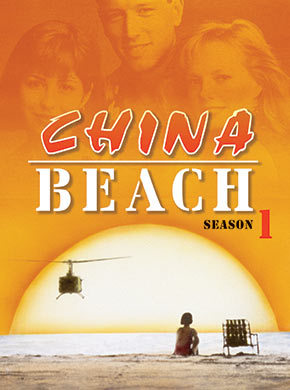
China Beach, Season 1 (1988) ABC

China Beach had four seasons. Only season one (1988), composed only of six episodes including the pilot, seems available from netflix.*  


It stars Dana Delany.


The location of the series is the Da Nang evacuation hospital and R&R center, at My Khe, nicknamed by the occupying forces, "China Beach." However, the locations for the video shoots were in California and Hawaii.

Inevitably, China Beach got associated with with the eternally beloved series, Mash (1972 - 1983)  -- which was transferred for television from the original setting Altman's 1970 Mash, which was intended to be read by all as Vietnam, not Korea.  It was savage, and most savage of all to women.

China Beach is dark, less satirical, very cynical and, while sharp and witty, unlike Mash, this series is not a comedy. Nor is it a "war" series.  The fighting, the consequences of which the hospital and the shipment center of dead bodies deal with most days and nights happens off screen.

Most of the focus is on the women at the hospital base, who are there to clean up the messes made by and of men, whether of their bodies, their lives, their quarters, and war – while also providing all emotional support, nurture and healing -- and of course, entertainment and recreation. Who thinks of doing any of this for them?  Generally speaking, tentatively and experimentally, only each other.


These experiences of the women who worked the bases as nurses, administrators, services personnel, such as the young Vietnamese woman at the community center which the Red Cross My Khe director, Lila, is attempting to build, are based on the book Home Before Morning (1983) written by former U.S. Army Nurse Lynda Van Devante.  They too have PTSD.   Lynda Van Devante died in 2002.

While anti-war in Vietnam protest is full blown, and both protest and the war are highly criticized at the hospital, on the base, and among the men as irrational, useless and terrible waste, feminism has not yet raised its terrible head in the military.

This dark cynicism about war and the top-bottom military organization  made this series, while popular with critics, unpopular with viewers ....

The episodes are written with the multiple characters in the traditional manner of network television, following each character's various fracas, conflicts and problems, as well as their shifting relationships with each other. However, there is arc in the telling over the season, as well as nuance and dimension in the conflicts that weren't as expected from a television series then. So, like Homicide, Xena and Babylon-5, China Beach too, might be one of the early indicators that a new golden age of television was dawning. 

The penultimate episode of China Beach is titled "Brothers."  It principally creates a denoument of two of the characters' through-lines of the season.

Michael Boatman plays Beckett on China Beach
Beckett is the African American grunt in charge of the base's GRU -- Graves Registration Unit. His job, dealing hands on with the dead, makes him a pariah among those who go in country.  Even his shadow falling on them might put them next in the body bag shipment home. Isolated mostly by the other soldiers, he has come to commune with "my men," the dead. The other principal arc is that of Cherry, the wide-eyed, blonde from Iowa, a Red Cross volunteer, who serves doughnuts in the canteen and talks to the men back from in country -- the young women who have volunteered for such jobs are called "Dolly Girls."  She came to Vietnam to find her missing older brother, whom she has hero-worshipped all her life.

Through Beckett we can figure out how humanity gets religion from death and the dead, transmitted from those who live with them, who take on the dead's terror and taboo. Beckett walks through worlds. When some of his "brothers" attempt to recruit his dead as transport for heroin, he won't do it, no matter how much he's appealed to in the name of brotherhood. "My men don't want this." They aren't going to participate in the killing of other brothers, in the burned over ghettos of back home.


Cherry's wide innocent eyes see the the truth, faces it with courage, that her beloved brother has become a criminal, preying on everyone, via violence and his enterprise of guns, drugs and whores. The episode is powerful, not sy sll sentimental. There's not closure. Nor is there redemption for dealers or for Cherry's brother.  There's no punishment either, other than the hell of their own heads. Both of these men, who don't know each other, have made by the corrupt enterprise that this war is, but they also made their choices to wallow in the filth, as much as Beckett and Cherry have made their other kinds of choices..

The vast amount of the series’s budget spent on music permissions.


Worth it though, particularly for the title cut – “Reflections,”  the first single released as Diana Ross and the Supremes, in the Summer of Love, July 24th, 1967. "Reflections" is also notable for being the first time Motown incorporated a bit of the psychedelic touch, as heard in the opening bars. Highly effective – every time the opener comes on my screen, I get a lump in my throat.  But the series, like the song, never ever overdoes psychedelia, slang or any of the 60's, or uses them in a cliched manner.  The reality everyone is in, there in one of the armpits of the world, is already sufficiently irrational.

The audio values of the China Beach production are brilliant -- loudness of the insect and amphibian life after dark, the churn and thud of choppers, screech, wail and thunder of various weaponry, the constant thump of fans, dehumidifiers, generators, and if, a character is lucky, a whistle of an air conditioner, are as omnipresent source audio as are the hit songs of the day spontaneously sung acapela, out of radios, on tapes, by cover entertainers, and, when the troops are lucky, the actual performers, such as Nancy Sinatra.

This season one of 6 episodes, including the pilot, make for a coherent and satisfying arc themselves, and are more than worth watching.  I sure wish I could see the rest of the other seasons.

----------------------------