LINES OF THE DAY

". . . But the past does not exist independently from the present. Indeed, the past is only past because there is a present, just as I can point to something over there only because I am here. But nothing is inherently over there or here. In that sense, the past has no content. The past -- or more accurately, pastness -- is a position. Thus, in no way can we identify the past as past." p. 15

". . . But we may want to keep in mind that deeds and words are not as distinguishable as often we presume. History does not belong only to its narrators, professional or amateur. While some of us debate what history is or was, others take it into their own hands." p. 153

Silencing the Past: Power and the Production of History (1995) by Michel-Rolph Trouillot

Showing posts with label reconstruction. Show all posts

Sunday, August 23, 2020

As He Said: "The Past Isn't Even Past"

     . . . . Most of our current crises are connected to this nation's founding history in genocide and African slavery -- economically, politically and socially, even down to emergency natural disaster crews. 

As we all know, the vast majority of our vast incarcerated populations are of color -- and poor. Now many local California politicos and pundits -- and the state fire fighting agency --  are bitterly criticizing the state for giving prisoners early release due to the hotspotting prisons are for outbreaks of covid-19.  Guess what?  The state's fire fighting agency, underfunded by the taxpayers and the politicians, depend instead on what is essentially slave labor -- which for the moment at least it does not have so our homes burn.  How much you want to bet California doesn't make this mistake again?

We all benefited, we benefit even now, from this nation's history of  slavery and perennial racial injustice to African Americans and Native Americans, even if we are more recent immigrants, whether we are white or not. 

We are seeing it so clearly with our dependence upon the poor and of color as the real line of disaster fighting -- and just to get groceries, to get medical care.* Because, you know, we believe don't need to pay them even a living wage.


Really, who believes in their heart that $1 - $2 a day for fighting these wildfires is pay?  particularly for those whose lives and health are at such a high level of risk? Plus, we all know too, these firefighting prisoners are legally prohibited from getting jobs as professional fire fighters because that means paying salaries and benefits. It's so much more practical and tax saving to just refresh the prison population constantly.  Keeping people who have served their sentence from getting real jobs is an effective method of ensuring that constant refreshment.

We all benefit, then and now, who aren't African American, who aren't Native American.

The brilliant light of 19th Century literature in this country couldn't have happened without the resources of slavery.  Longfellow's wife, recall, was vastly wealthy, like all those Boston cultural luminaries were -- allowing them to dedicate their lives to art and culture. There were so many who had that wealth resource that within 3 centuries of first colonization the US there were enough heirs of such wealth to support a leisure class that supports the arts and literature.

Where did much of that wealth of New England and the North, like NY, come from?

As with Longfellow's wife, her father owned the vast wealth creating textile factory complexes such as his Lowell, MA.  Those textiles were produced from the slave-grown cotton.  Much shipping and insurance and banking in so many ways out of slavery -- even after the African slave trade to the the US was abolished, even after slavery itself supposedly was abolished.  

Immediately after the war those wealthy northern and New England movers and shakers headed south** and allied with the great pioneers of neo-slavery, sharecropping, such as the Percys of Greenville, Mississippi (Walker Percy's family -- which was why he could live and write without a job.)


It is nearly impossible to look at even the brilliant light elements of our past and not see it rooted in and shadowed by slavery and genocide -- including the massive removal out of "Dixie" to make that vast territory safe for slavery. 

This morning there's a Marine Dem retweeted on Bill Gibson's Twitter feed, who warns us from where he lives within a huge maga country enclave, that 'they' hate 'us' with almighty passion, they are voting.... it's all about white vs everyone else -- and women. If you can only get it by giving over all power to the insane, and destroying what's left, and dying too, so be it. Long rage the covid-19 hoax! as proclaimed by a relative undergoing chemo for cancer in a rally in a waiting room of fellow unmasked cancer victims.

It merges well with Jon Meacham on the history of the revisionist Glorious Lost Cause history of the War of the Rebellion -- which began immediately.*** 

https://www.nytimes.com/2020/08/23/books/review/lost-cause-meacham.html?

[....]Here, then, was the ur-text of the Lost Cause, of the mythology of a South that believed its pro-slavery war aims were just, its fate tragic and its white-supremacist worldview worth defending. In our own time, the debates over Confederate memorials and the resistance in many quarters of white America, especially in the South, to address slavery, segregation and systemic racism can in part be understood by encounters with the literature of the Lost Cause and the history of the way many white Americans have chosen to see the Civil War and its aftermath.

To Pollard, the Southern side had fought nobly for noble ends. “The war has left the South its own memories, its own heroes, its own tears, its own dead,” he wrote. “Under these traditions, sons will grow to manhood, and lessons sink deep that are learned from the lips of widowed mothers.” Pollard declared that a “‘war of ideas,’” a new war that “the South wants and insists upon perpetrating,” was now unfolding.

And in many ways it unfolds still. The defiance of federal will from Reconstruction to our own day, the insistence on states’ rights in the face of the quest for racial justice and the revanchist reverence for Confederate emblems and figures are illuminated by engaging with the ethos of which Pollard so effectively wrote. He enlarged on his thesis in “The Lost Cause Regained,” published in 1868. Pollard wrote that he was “profoundly convinced that the true cause fought for in the late war has not been ‘lost’ immeasurably or irrevocably, but is yet in a condition to be ‘regained’ by the South on ultimate issues of the political contest.” The issue was no longer slavery, but white supremacy, which Pollard described as the “true cause of the war” and the “true hope of the South.”

The Civil War, then, was to be fought perennially....

We're already fighting our second civil war -- but while they are using their guns and everything else already, we insist on pretending it hasn't happened yet and it won't happen because we are going to win (one) election.  Which latter is in NO WAY assured of happening either. They certainly are doing everything, including shooting, to make sure it doesn't happen.

~~~~~~~~

*  For a breathtaking account of earlier dependence on coerced African American labor  even when slavery supposedly was over, see John M. Barry's Rising Tide (1997) for how the Walkers did it in their Yazoo Delta Kingdom in the Great Mississippi Flood of 1927.

** One of the most well recognized among those even now, is J.P. Morgan.  Not to mention all the racial injustice placating D.C. and presidents such as Theodore Roosevelt did for them, helping make labor laws and court cases go away, as he did for the Walkers with whom he happily went hunting.

***  In truth, though Meacham doesn't mention it, the revisionism began at least as soon as Vicksburg fell, with Davis and others suddenly dropping 'slavery' from their cause for fighting -- though it was top and center in their constitution as a 'nation' and the secessionist state constitutions, and in their many other printed works before and after secession.

Sunday, June 19, 2016

The Coughing Regression Again + Dyckman House + Reconstruction


 I went uptown to Innwood Thursday to attend beloved friend C's presentation at the historic Dyckman Farm House museum on 205th St. on the Dyckman family and the first excavator / archivist of the associated Old Nagle Cemetery,  Reginald Pelham Bolton. Dyckman House is the last surviving Dutch-style and built farm house on Manhattan Island. As the original owners of the farmstead were very respectable, decent persons, there is little to say about them as people, or about their descendants who bought back the property after the previous, Independence era generation had fled New York for England, as they were Loyalists, not Patriots. But Bolton now -- there is a fellow! 


Dyckman Farmhouse 19th century
Dyckman House Currently
 
  C was both informative and entertaining.  She's spent over a year going through the untouched archive / collection of artifacts Bolton collected, sorting, organizing, tagging and photographing all the items. What a material historian she is -- as well as a terrific artist of fabric and costume.

I'd had a bad night of coughing, but once I got up it went away again, and I felt much better.  I'd been looking forward to this outing so much, the first really, since The Coughing began.  Alas 2/3 of the way through the professional archeologist's part of the program talking about the history of urban archeology and the archeology of this area of Innwood / Manhattan. Coughing began.  I had to flee the backyard veranda where the presentation was taking place.

K (C's husband), concerned, followed. I'd expected the Cough to recede, and it finally did. After the event wound down I went with C and K and a new friend of theirs, who I took to as much as they have, to a nearby three block row of Inwood's hispanic nouvelle restaurants and bars  Some coughing ensued not much though.

But by the time I got back home downtown, The Coughing was fully back. I coughed all night, all the next day, all the next night and now it is three days without sleeping and I'm melting down.  Full reset of it, all right. Nothing much helps. I've seen a doctor. He shrugged, told me rest and take lots of liquids and wait it out. Taking those horrible Ricola drops is about all I can do.  As usual, they make my mouth taste awful, food taste awful, and kill my appetite -- though not hunger, just any impulse to try and eat anything. Between hunger and sleeplessness I'm a mess all right.

A state of mind that reflects the state of mind with which I've learned about the systematic process of rewriting the history of slavery, the Civil War, Reconstruction and everything before and after. The blame for an enormous part of this history revisionism has to be put squarely upon the decision-makers of the North and the Republicans, starting with the new history textbooks created after the war to service the growth of federally mandated national public education.

Since the textbooks were for every region of the U.S. the editors didn't want to antagonize any Southerner, and particularly the southerners on the education committees, so slavery was written out of the basic school room histories at all levels of education.  Already by the late 1870's people who had lived and fought and lost people to the way, northerners, were writing with shock that the generation that was following them was ignorant of the whole business -- that many of the youth in their communities seemed not to even know there had been a war, much less why there had been one.

 Despite the many letters to the editor in newspapers across the land, the op ed pieces, articles in the magazines and journals, nothing was changed.  Sound familiar?

Monday, September 9, 2013

Nathan Bedford Forrest

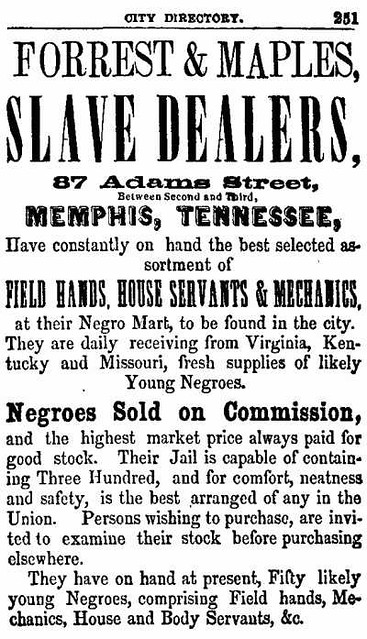
It's fairly common knowledge that Nathan Bedford Forrest was a vicious and brutal fellow, who made a huge fortune trading in Tennessee and Mississippi slaves before the Civil War.


It's fairly controversial knowledge that Forrest was responsible for executing the black Union soldiers who, among white Union troops, defended Fort Pillow against Forrest's much greater force. It's fairly well known too, that after the War he quickly moved to being a founding, eminent, active member of the KKK during Reconstruction. He lied about his membership when called before the Joint Congressional Committee in 1871 to testify about the KKK.

What is less common knowledge is how Forrest re-established his wealth after Reconstruction. Slaves again, except they were 'convicts' who stocked his prison farm on President's Island, near Memphis.

Some years later, Gen. Nathan Bedford Forrest contracted with local officials to establish a penal farm on the island, using able-bodied prisoners in the corn and the cotton fields. Having lost a fortune in the Civil War and through unprofitable railroad investments, Forrest was in search of new and lucrative opportunities and was one of the first to try to develop a business (of sorts) on the island.

He offered to pay the county 10 cents a day for each worker and to provide food, clothing and housing. His offer was accepted, and a five-year contract was signed. However, Forrest died in 1877, possibly of dysentery from drinking impure island water. Responding to stories that the prisoners had been mistreated, a grand jury investigated the prison farm and recommended some changes in the operation. In 1878, another penal farm contract was signed with Forrest's son William.
Supposedly in his later years Forrest spoke in public that African Americans should be able to vote for any candidate they wished, which is supposed to be proof of a change of heart in his white supremacy, to a sort of vision of equality.  It's hard to buy though.

It's particularly difficult to buy in light of the neo-confederates glorification lately of Forrest as their image for the Glorious Lost Cause, as, to them, the value of the rose-colored vision of Robert E. Lee's parfit gentil knight, who surrendered, fades. The eulogy at Forrest's funeral was delivered by Jefferson Davis, who never requested a pardon from the U.S., and never surrendered.

Wednesday, June 23, 2010

*Impeached* by David D. Stewart

Highly recommended is Impeached: The Trial of President Andrew Johnson and the Fight for Lincoln's Legacy (2009) by David O. Stewart to those who want or need to know more about the immediate history of the U.S. after Lee's surrender at Appomatox, Lincoln's assassination and Reconstruction.

The Johnson impeachment is complicated and complex and can't be reduced to a soundbite.  That's not the only reason it's not actually taught in American historry classes, whether middle-school, high school or college, though.  The real reason it's not taught is because this event has a starring role in the revisionism of the history of the Civil War, Reconstruction and the causes of the entire epic, which began even  before the War of Southern Aggression was finished -- which ended only with the assassination of President Lincoln by rabid confederate Booth, and the barely avoided impeachment of Johnson, avoided only because of the massive amounts of cash poured into the effort by the confederates, their sympatizers and the lobbyists -- one vote.  This was also revised, via Wilson and others, that rather than a act of veniality, this was as an act of patriotic heroism that saved the nation and the Constitution, an act which outranked Lincoln's efforts by a fair amount, something even JFK bought into 100%,

That the author is a lawyer, who "defended an impeachment trial of a Mississippi judge in the U.S. Senate in 1988," contributes no small amount to his ability to make easily comprehensible -- to an adult, used to thinking, who doesn't suffer ADD, and who has a decent outline of U.S. history -- this hydra-headed, significant event to the general reader.  Stewart cogently summarizes all of it in the first 35 pp, succinctly and clearly.  While a practicing attorney his briefs must have been a joy for his colleagues to read -- trust me on this, that would not be said of most lawyers's briefs.

The rest of the book goes into chronology and detail of the players, characters, the historical context and events.  For those of us who see General Grant as an authentic hero, he does not let us down during this crisis either.  One of the most enjoyable aspects of this work is seeing Grant's military abilities deployed upon the political battleground of the executive and legislative branches of the Capitol.  His close relationship with his other generals like Sheridan and Sherman plays a role as well.  The portrait of Thadeus Stevens, the arch villain of Birth of a Nation, is invaluable.

What is hard reading is the portrait of what happens to the freedmen and women in the defeated confederacy after Lincoln's assassination, during the years of Johnson's regime.  You may think you know, but you likely don 't, not in this detail, and at that Stewart is restrained in his description and detail of the horrors and the scope of the horrors committed against and upon them.

President Grant put a stop to that.  The real Reconstruction then began.

We briefly met David O. Stewart at the Starr Center during our visit there earlier this month.  It just so happened that this book was in my bag but neither of us made the connection at that moment between the man in the office and the book in the bag.  Our encounter was more than pleasant -- it was interesting, leaving both sides wanting more.  So we'll probably meet here in August before our move to Chestertown, while he's visiting Yankee Stadium with his son (though they won't cheer the Yankees!), and working in some of the Aaron Burr archives and collections for his current project, which is Burr's fantasy of carving out his own kingdom in the Louisiana Territory and his treason trial.

Wednesday, April 7, 2010

An Account of Reconstruction, 1865 - 1866 by a British Imperialist

K -- you will find this fascinating, in light of the books you're currently reading. 

"Sir Charles Wentworth Dilke’s fascinatingly odd Greater Britain: A Record of Travel in English-Speaking Countries," (published 1868).

The heads-up for this from a blog I like, though some of the blogger's statements are, if not exactly wrong, not correct. For example the blogger states that the UK backed the Confederacy. The UK government never did back the Confederacy in any of the ways that mattered, and for which the Confederacy lobbyed until the end: financially (no loans), no weapons and no embargo of the Union, either diplomatic or mercantilist.

As for the blogger's conclusion, I have to agree wholeheartedly:

But the most telling passage for me, is this one — which occurred in the ellipsis above — in which we see most clearly how the problem of black free labor literally disappears under racism. When he asks the assembled whites about what kind of work the free blacks do, they literally cannot answer him. Though he has seen almost nothing in the entire town but black industrious labor, free black labor is so unthinkable to the ” poor trash” that when he points it out, they erase his very words with a spelling lesson on race hatred:

Strangers are scarce in Norfolk, and it was not long before I found an excuse for entering into conversation with the “citizens.” My first question was not received with much cordiality by my new acquaintance. “How do the negroes work? Wall, we spells nigger with two ‘g’s,’ I reckon.” Virginians, I must explain, are used to ” reckon” as much as are New Englanders to ” guess,” while Western men ” calculate ” as often as they cease to swear.) ” How does the niggers work? Wall, niggers is darned fools, certain, but they ain’t quite sich fools as to work while the Yanks will feed ‘em. No, sir, not quite sich fools as that.” Hardly deeming it wise to point to the negroes working in the sun-blaze within a hundred yards, while we sat rocking ourselves in the verandah of the inn, I changed my tack, and asked whether things were settling down in Norfolk.
That non-work ethic of the former confederacy? It’s alive and well among certain white southern populations still, as we learned while living in New Orleans.

Saturday, January 26, 2008

2 New Books of Interest (at least mine!)

The number of meticulously researched and sourced histories of the U.S. post-Civil War era commonly called "Reconstruction" continues to add titles. This is the latest one of which I'm aware. I've seen reviews of it in other places, but this week it's covered by one of my favorite writers about book, Jonathan Yardly, in this weekend's Washington Post Book World section, THE BLOODY SHIRT: Terror After Appomattox by Stephen Budiansky. Here follows a pull, the first 2 paragraphs of JY's essay:

[ The decade-long period known as Reconstruction, which began shortly after the Civil War and ended with the presidential election of 1876, probably has been subjected to more misinterpretation, misunderstanding and outright factual distortion than any other time in American history. For a variety of reasons, including white Southern mythologizing and national indifference to the desperate situation of the former slaves, beginning in the late 19th century fictions about Reconstruction gained not merely wide popular acceptance but also the endorsement of many prominent historians, who gave them legitimacy and staying power.

These fictions presented the white South not as instigator, perpetuator and defender of black slavery, but as the victim of politically motivated mistreatment by "carpetbaggers" and other outsiders dispatched by Radical Republicans in Washington to wreak vengeance on the South. By contrast with the rapacious industrial North, the South was portrayed as -- in the words of one historian -- "a garden for the cultivation of all that was grand in oratory, true in science, sublime and beautiful in poetry and sentiment, and enlightened and profound in law and statesmanship." Slavery metamorphosed from a "peculiar" institution into a benevolent one, and it was argued that only the South could hope to help the former slaves because "the Southern white man is the only man on earth who understands the Negro character." If only the North had left the South to settle its own problem, the fictions contended, everything would have been fine. If Reconstruction failed, the fault lay solely with the North. ]

In other words, the phony mythology that made Griffith's Birth of a Nation, and brought back the Ku Klux Klan, the foundation of decades of the movie industry's propaganda machine re the "Western," which was from the beginning of the cinema age in the U.S. the financial and popular mainstay of studios, and remained so until comfortably post the WWII era. I continue to marvel at the success of the historical revision of the Reconstruction era -- as well as of the Civil War. The principal reason for the success of this revisionism is the development of the penny press Western, followed so soon by the movies. From the beginning the pioneers of this format saw it as an unparalleled means of propaganda, and so it was, and continues to be. The principals of Western movies, even the occasional few made now, were enlisted in the Confederacy.

This is particularly ironic when examined by the light shed by the founding father of the Western as a genre (as he also founded the genre of sea stories and that of the Revolutionary romance), James Fenimore Cooper, in "The Leatherstocking Tales."

Then, to go with my reading of the Keay The Honorable Company: A History of the English East India Company, pub date 1993 -- and which, despite a plethora of fascinating personalities and lots of really great adventure tales, I'm finding very hard going, and, in fact, rather dull -- and the reading of of a history of New Amsterdam, The Island at the Center of the World, comes this, reviewed by another terrific WaPo writer about books, Michael Dirda, Vermeers's Hat: The Seventeenth Century and the Dawn of the Global World by Timothy Brook.

[ . . . There doesn't seem to be any obvious reason why such a formidable Sinologist should be bringing out a book with a 17th-century Dutch painting on the cover and the title Vermeer's Hat.

But the explanation turns out to be quite simple: This book isn't about Vermeer's brushstrokes or the use of light in his paintings. Instead, it really does focus on the fur hats -- and the old maps and the dishes of fruit and the silver coins -- pictured in those paintings. As his subtitle suggests, Brook hopes to use these pictorial elements to describe "the dawn of the global world," in particular the economic entanglements between the Netherlands and China. . . .

. . . . For instance, in the chapter titled "School for Smoking," he notices that 17th-century Dutch porcelain, representing Chinese scenes, often shows people smoking. Where did the painter get the idea that the Chinese smoked? This leads to an overview of tobacco commerce and consumption in Asia, building on accounts of the shipping routes, the trade laws and the movement of silver, as well as tobacco, to the East. But Brook also takes time to discuss the social impact of chi yan or "eating smoke."

Such interlacing of the economic with the social and ideological Brook labels "transculturation," a term first coined by the Cuban historian Fernando Ortiz to describe "the process by which habits and things move from one culture to another so thoroughly that they become part of it and in turn change the culture into which they have moved." Sometimes this results in the destruction of what is already there, and usually "the outcomes of these globalizing processes cannot be controlled." ....

. . .Throughout Vermeer's Hat, Brook keeps his economic history striking and anecdotal. "If there is one overwhelming condition that shaped the history of the seventeenth century more than any other, it is global cooling." Between 1550 and 1700, according to the book, temperatures fell all over the world. Grain prices rose; cold and plague decimated Venice and Amsterdam. But Dutch fleets enjoyed a herring boom, giving them money to invest in shipping. Why did Champlain push into unexplored Canada? For beaver pelts. And why did Europeans want those pelts? For expensive, durable hats. Profits from those hats would pay for something important: the search for the supposed water route across North America to China. ...

. . . . Commercially, the 17th century was an age of silver, tobacco and slaves, and Brook shows how the three interconnect to form an intricate economic network. This new international economy is revealed in every aspect of life, not only in the account books of the VOC and the histories of the Jesuit missionaries in China and Latin America, but also in the items depicted in paintings by a Delft artist who died young. All our experience is global. ]

Thus this book appears filled with answers to questions I never asked, such as the Chinese tobacco one, despite life-long acquaintance with quaint illos of sedate Chinese bearded sages with pipes in hand, if not in mouth -- even as described in the pages of Louisa May Alcott's Eight Cousins, in a scene at the Boston wharfs, in a warehouse that is part of her wealthy, merchant ship owning family's fortunes.

Monday, October 22, 2007

Travels With Herodotus

The meditation memoir on Herodotus the man and the historian and the traveler, of noted Polish journalist, Ryszard Kapuscinski. Herodotus's Histories was his companion on his first travels outside of Poland as a very young journalist, during the era of Stalin. Herodotus went with him on many other of his assignments as well, including Africa. His reports from Africa, particularly the war(s) in Angola against the apartheid South Africa and the other U.S. backed forces may be what he's most well-known for.

This comes from close the end of this, his final book, pp. 245-246. These are thoughts he was having while staying on the Isle of Goree, one of the most infamous of the African Atlantic coast slave castles, from which so many Africans were transported on the Middle Passage to death in the New World.

[ How often do we consider the fact that the treasures and riches of the world were created from time immemorial by slaves? From the irrigation systems of Mesopotamia, the Great Wall(s) of China, the pyramids of Egypt, and acropolis of Athens, to the plantations of sugar on Cuba and of cotton in Louisiana and Arkansas, the coal mines of Kolyma and Germany's highways? And wars! From the dawn of history they were waged in order to capture slaves. Seize them, chain them, whip them, rape them, feel satisfaction at having another human being as one's property. The acquisition of slaves was an important, and frequently sole cause of wars, their powerful and even undisguised prime motivation.

Those who managed to survive the transatlantic journey (it was said that theships carried 'black cargo') brought with them their own Afro-Egyptian culture, the same one that had fascinated Herodotus and which he had described so tirelessly ion his book long before that culture reached the Western hemisphere.

And what of Herodotus himself, what sort of slaves did he have? How many? How did he treat them? .... What happened to them after Herodotus's death? Were they put up for sale in the marketplace? .... ]

I finished the Kapuscinski volume a few days ago. Currently I am reading a most painful work of history on the Reconstruction. Redemption: The Last Battle of the Civil War by Nicholas Lemann, has just been published. It is another account of that period about which hardly anyone knows anything these days, and counters with real history that little which is "known," which is almost entirely lies. Though Lemann is not the first to write this, and indeed, during the period it was well known for what it was -- the Civil War was not finished with surrender by the Confederacy. The war continued, but this time directly against the former slaves, in order to have what Kapuscinski stated above:

[ "And wars! From the dawn of history they were waged in order to capture slaves. Seize them, chain them, whip them, rape them, feel satisfaction at having another human being as one's property. The acquisition of slaves was an important, and frequently sole cause of wars, their powerful and even undisguised prime motivation." ]

There is no disguising that this next movement of the Civil War was motivated by this -- that the Civil War was about this and nothing else. The accounts from the archives and collections that Lemann brings forth proves this without doubt. It was also a further war against the Union. Which backs up our sense here that this nation is NOT a nation, which came into bold conviction post the failure of the levees, which the North and Grant, in the more consuming interests of the vast plutocratic fortunes being made, and the federal government -- bolstered with many a legislator returned by foul means from the South (sound familiar?) allowed this to happen.

The nearest we ever came to being a united nation was with the New Deal and WWII -- when government worked! After that the same reactionary forces that came to the fore prior, during and post the Civil War, have waged relentless warfare upon the government, to make it not work, to make it be the enemy, just as it was perceived all along by the states that became the confederacy.

This is a terrible book. I sometimes skip entire pages because of they are contemporary newspaper reports of the terrorism the southern gentlemen carried out on the bodies of the former slaves: men, women and children. Holocaust of torture, burnings, rape and murder against entire communities, relentless and continual.

As for the stories of the carpetbaggers? Propaganda, lies, created by the sons of the confederacy, deliberately. They were helping set up schools and banks and advising the former slaves on how to build their own farms. Since such evil was being carried out against black people who cared ultimately, once the "carpetbaggers" were forced out by terror and torture and murder?

The slavers won.

What we've got today is the consequence.