LINES OF THE DAY

". . . But the past does not exist independently from the present. Indeed, the past is only past because there is a present, just as I can point to something over there only because I am here. But nothing is inherently over there or here. In that sense, the past has no content. The past -- or more accurately, pastness -- is a position. Thus, in no way can we identify the past as past." p. 15

". . . But we may want to keep in mind that deeds and words are not as distinguishable as often we presume. History does not belong only to its narrators, professional or amateur. While some of us debate what history is or was, others take it into their own hands." p. 153

Silencing the Past: Power and the Production of History (1995) by Michel-Rolph Trouillot

Showing posts with label cities. Show all posts

Sunday, June 19, 2016

The Coughing Regression Again + Dyckman House + Reconstruction


 I went uptown to Innwood Thursday to attend beloved friend C's presentation at the historic Dyckman Farm House museum on 205th St. on the Dyckman family and the first excavator / archivist of the associated Old Nagle Cemetery,  Reginald Pelham Bolton. Dyckman House is the last surviving Dutch-style and built farm house on Manhattan Island. As the original owners of the farmstead were very respectable, decent persons, there is little to say about them as people, or about their descendants who bought back the property after the previous, Independence era generation had fled New York for England, as they were Loyalists, not Patriots. But Bolton now -- there is a fellow! 


Dyckman Farmhouse 19th century
Dyckman House Currently
 
  C was both informative and entertaining.  She's spent over a year going through the untouched archive / collection of artifacts Bolton collected, sorting, organizing, tagging and photographing all the items. What a material historian she is -- as well as a terrific artist of fabric and costume.

I'd had a bad night of coughing, but once I got up it went away again, and I felt much better.  I'd been looking forward to this outing so much, the first really, since The Coughing began.  Alas 2/3 of the way through the professional archeologist's part of the program talking about the history of urban archeology and the archeology of this area of Innwood / Manhattan. Coughing began.  I had to flee the backyard veranda where the presentation was taking place.

K (C's husband), concerned, followed. I'd expected the Cough to recede, and it finally did. After the event wound down I went with C and K and a new friend of theirs, who I took to as much as they have, to a nearby three block row of Inwood's hispanic nouvelle restaurants and bars  Some coughing ensued not much though.

But by the time I got back home downtown, The Coughing was fully back. I coughed all night, all the next day, all the next night and now it is three days without sleeping and I'm melting down.  Full reset of it, all right. Nothing much helps. I've seen a doctor. He shrugged, told me rest and take lots of liquids and wait it out. Taking those horrible Ricola drops is about all I can do.  As usual, they make my mouth taste awful, food taste awful, and kill my appetite -- though not hunger, just any impulse to try and eat anything. Between hunger and sleeplessness I'm a mess all right.

A state of mind that reflects the state of mind with which I've learned about the systematic process of rewriting the history of slavery, the Civil War, Reconstruction and everything before and after. The blame for an enormous part of this history revisionism has to be put squarely upon the decision-makers of the North and the Republicans, starting with the new history textbooks created after the war to service the growth of federally mandated national public education.

Since the textbooks were for every region of the U.S. the editors didn't want to antagonize any Southerner, and particularly the southerners on the education committees, so slavery was written out of the basic school room histories at all levels of education.  Already by the late 1870's people who had lived and fought and lost people to the way, northerners, were writing with shock that the generation that was following them was ignorant of the whole business -- that many of the youth in their communities seemed not to even know there had been a war, much less why there had been one.

 Despite the many letters to the editor in newspapers across the land, the op ed pieces, articles in the magazines and journals, nothing was changed.  Sound familiar?

Sunday, August 31, 2014

Only Lovers Left Alive (2013)

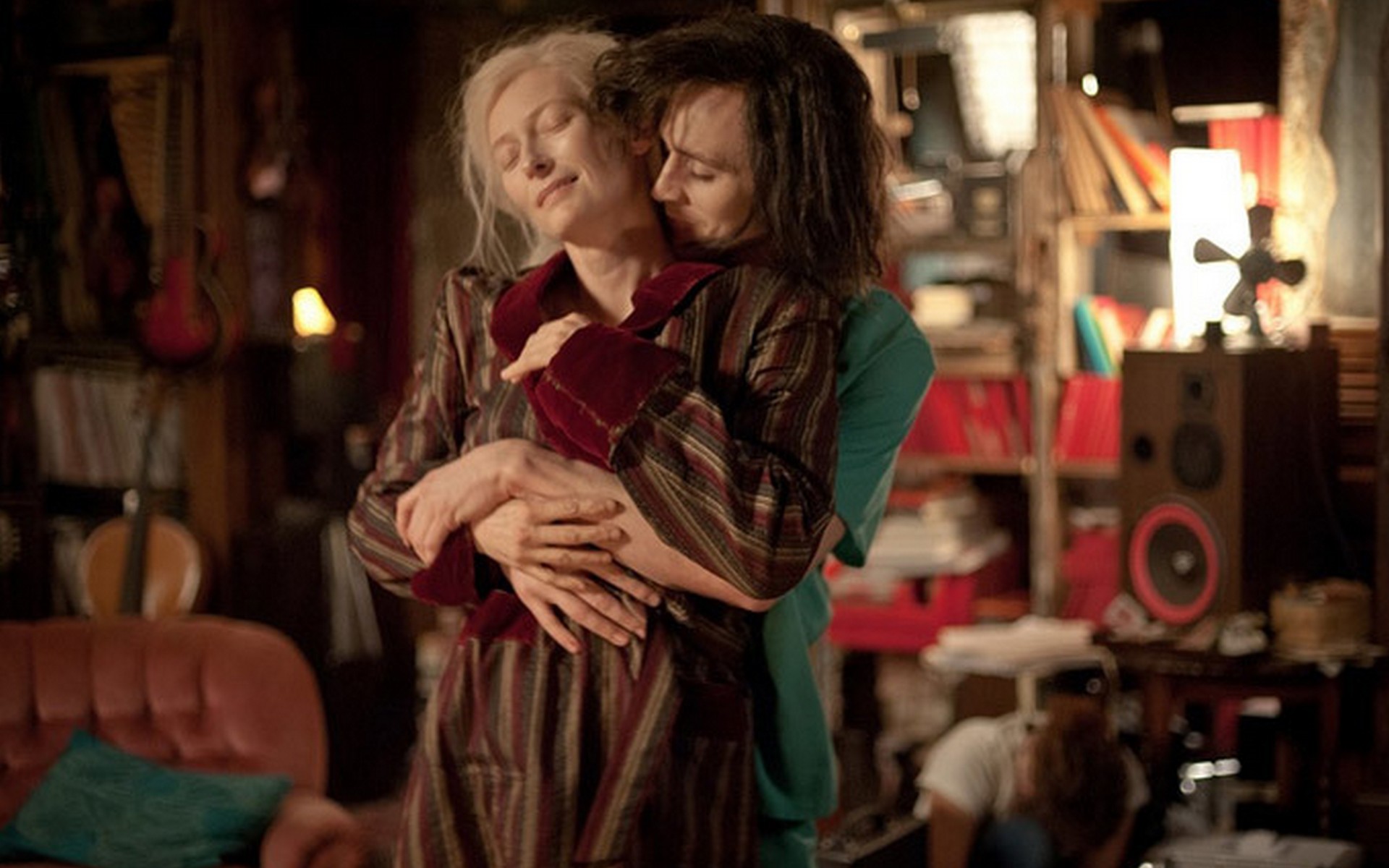
Jim Jarmusch  wrote and directed this novel vampire film, Only Lovers Left Alive (2013), starring Tilda Swinton and Tom Hiddleston.


By describing Only Lovers Left Alive as "a novel film" is intended to convey that Jarmusch created something new with vampires.  It also implies a question about vampires I've meditated on now and again ever since a dream I had way back in the early 80's of the last vampire, his face peering at me out of a broken television set screen, on a desertified earth, on which there is no blood left at all.  Somehow, I, per se, wasn't there, I was only feeling what the vampire's face was expressing: horror, terror and despair.


Jarmusch's film goes deeper than that brief but so vivid dream.  His vampires have existed since at least the 16th century;

John Hurt as Kit Marlowe, Eve's blood supplier in Tangier
Kit Marlowe is one of the few other characters in the film.*  They are among the world's obscenely wealthy, the wealth employed for privacy, acquisition of toys and the purest, fresh blood, blood that in the 20th and 21st century they no longer needed to hunt, but can purchase in various ways.  They appropriately suffer the ennui of the dissolute idle rich who lack any purpose in existence.

Adam with his gofer, Ian, played by Anton Yelchen; he's terrific in the role.

A Detroit Punk Club, in which it has forever remained the 1970's.
Adam, Hiddleston's character, is a legendary pop musician whom no one knows or sees.  Evidently his music and musicianship has been featured in many mythic recordings since, perhaps, the late 50's into the 60's and through the 70's?  I'm guessing those three decades because of the pop music references shared by Adam and his wife Eve, played by Swinton, and the sorts of dinosaur recording equipment and technology that litter Adam's rickety, decaying mansion, **  in the area of Detroit. Adam's out-of-step with the 21st century ennui makes for very understated but effective occasional comic touches.

So here we have it -- the vampire tropes, played as an exploration of degeneration of our planet, focused through the deserted areas of Detroit and, in ever-widening circles of alarm, the ever-widening toxic contamination of the planet. By now, not only is much if not most of the global water supply been poisoned, so has most of the global blood supply.

The film takes its own time moving along its unexpectedly delicious trajectory, which may bore some viewers. Additionally, if the viewer knows nothing about guitars, recording or pop music from the 50's, 60's and 70's, or anything about Literature -- yes, Literature with a capital L -- that viewer will miss many delicious bits of meta and witty commentary.

However, my favorite line from the film is not about either music or literature. Instead, it's a subject about which I ponder much more seriously on a daily basis. While Adam and Eve are taking a drive through the ruins of Detroit, Adam respond's to Eve's lamentation as to what the zombies have done to this splendid city:
"It's blessed with water. It will come back and the southwestern zombies who did this to Detroit and have used everybody else's water will want it back."
I've been thinking that this could well happen as well. Water = the blood of our planet.

Zombies in Only Lovers Left Alive are the vampires' code word for human beings, which is a bit of meta commentary on current popular entertainment too.  The vampires are clear that human beings, the zombies, are responsible for the ruin of the world.

-----------------

* In perhaps the only misstep Jarmusch makes in this film, in all the scenes that include Marlowe it's a given he's the author of Shakespeare's works.

* *  Eat your heart out, Elizabeth Hand -- how often has she employed the tropes of impossibly wealthy recluses, decaying mansions and artists from the 60's - 70's has she lovingly attempted to create by now?  It's not impossible at all that Jarmusch has read one or two of her novels -- though it wouldn't have been necessary for the making of this film.  These are such common tropes, and Jarmusch knows personally many a dissolute wealthy pop culture icon from those decades.

Saturday, July 20, 2013

The Barbarians Loot Detroit

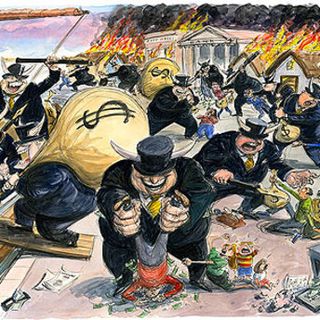
Watching the looting of a city by means other than military conquest -- corporate and legal.  Which means we can see it up close, as it happens in bureaucratic slow motion.

It's the treasures they go for first.


If you are a tiny town without treasures, as with Havre de Grace on the Eastern Shore of Maryland during the Brit blockade of the Chesapeake in the War of 1812 they'll take your baby's cradle and burn your house for good measure.


In Detroit that means the art, which booty is already being quarreled over.


Chicago, it's seizure of the public schools that are the opening battery.  In New Orleans it was the schools, and the hospitals, just like here in NYC, though here we've added the public library system to the list. Real estate is one reason. Teachers and nurses, their unions, i.e. their voting affiliations another. Then there are the pensions, which, as in Detroit, are found often already looted.  In other words, anything that is part of public, community service, pleasure and support is under relentless attack in the war to transfer all such assets everywhere to the private, i.e. corporate-real estate plutocratic oligarchy.