LINES OF THE DAY

". . . But the past does not exist independently from the present. Indeed, the past is only past because there is a present, just as I can point to something over there only because I am here. But nothing is inherently over there or here. In that sense, the past has no content. The past -- or more accurately, pastness -- is a position. Thus, in no way can we identify the past as past." p. 15

". . . But we may want to keep in mind that deeds and words are not as distinguishable as often we presume. History does not belong only to its narrators, professional or amateur. While some of us debate what history is or was, others take it into their own hands." p. 153

Silencing the Past: Power and the Production of History (1995) by Michel-Rolph Trouillot

Showing posts with label pop culture. Show all posts

Monday, December 8, 2014

China Beach, Season 1 (1988) ABC

China Beach had four seasons. Only season one (1988), composed only of six episodes including the pilot, seems available from netflix.*  


It stars Dana Delany.
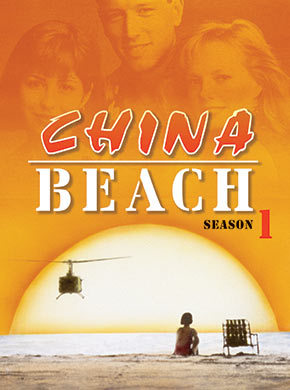

The location of the series is the Da Nang evacuation hospital and R&R center, at My Khe, nicknamed by the occupying forces, "China Beach." However, the locations for the video shoots were in California and Hawaii.

Inevitably, China Beach got associated with with the eternally beloved series, Mash (1972 - 1983)  -- which was transferred for television from the original setting Altman's 1970 Mash, which was intended to be read by all as Vietnam, not Korea.  It was savage, and most savage of all to women.

China Beach is dark, less satirical, very cynical and, while sharp and witty, unlike Mash, this series is not a comedy. Nor is it a "war" series.  The fighting, the consequences of which the hospital and the shipment center of dead bodies deal with most days and nights happens off screen.

Most of the focus is on the women at the hospital base, who are there to clean up the messes made by and of men, whether of their bodies, their lives, their quarters, and war – while also providing all emotional support, nurture and healing -- and of course, entertainment and recreation. Who thinks of doing any of this for them?  Generally speaking, tentatively and experimentally, only each other.


These experiences of the women who worked the bases as nurses, administrators, services personnel, such as the young Vietnamese woman at the community center which the Red Cross My Khe director, Lila, is attempting to build, are based on the book Home Before Morning (1983) written by former U.S. Army Nurse Lynda Van Devante.  They too have PTSD.   Lynda Van Devante died in 2002.

While anti-war in Vietnam protest is full blown, and both protest and the war are highly criticized at the hospital, on the base, and among the men as irrational, useless and terrible waste, feminism has not yet raised its terrible head in the military.

This dark cynicism about war and the top-bottom military organization  made this series, while popular with critics, unpopular with viewers ....

The episodes are written with the multiple characters in the traditional manner of network television, following each character's various fracas, conflicts and problems, as well as their shifting relationships with each other. However, there is arc in the telling over the season, as well as nuance and dimension in the conflicts that weren't as expected from a television series then. So, like Homicide, Xena and Babylon-5, China Beach too, might be one of the early indicators that a new golden age of television was dawning. 

The penultimate episode of China Beach is titled "Brothers."  It principally creates a denoument of two of the characters' through-lines of the season.

Michael Boatman plays Beckett on China Beach
Beckett is the African American grunt in charge of the base's GRU -- Graves Registration Unit. His job, dealing hands on with the dead, makes him a pariah among those who go in country.  Even his shadow falling on them might put them next in the body bag shipment home. Isolated mostly by the other soldiers, he has come to commune with "my men," the dead. The other principal arc is that of Cherry, the wide-eyed, blonde from Iowa, a Red Cross volunteer, who serves doughnuts in the canteen and talks to the men back from in country -- the young women who have volunteered for such jobs are called "Dolly Girls."  She came to Vietnam to find her missing older brother, whom she has hero-worshipped all her life.

Through Beckett we can figure out how humanity gets religion from death and the dead, transmitted from those who live with them, who take on the dead's terror and taboo. Beckett walks through worlds. When some of his "brothers" attempt to recruit his dead as transport for heroin, he won't do it, no matter how much he's appealed to in the name of brotherhood. "My men don't want this." They aren't going to participate in the killing of other brothers, in the burned over ghettos of back home.
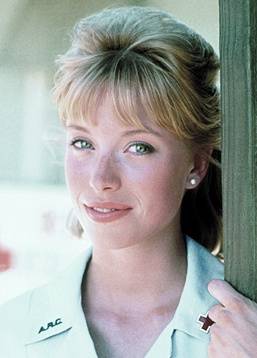

Cherry's wide innocent eyes see the the truth, faces it with courage, that her beloved brother has become a criminal, preying on everyone, via violence and his enterprise of guns, drugs and whores. The episode is powerful, not sy sll sentimental. There's not closure. Nor is there redemption for dealers or for Cherry's brother.  There's no punishment either, other than the hell of their own heads. Both of these men, who don't know each other, have made by the corrupt enterprise that this war is, but they also made their choices to wallow in the filth, as much as Beckett and Cherry have made their other kinds of choices..

The vast amount of the series’s budget spent on music permissions.


Worth it though, particularly for the title cut – “Reflections,”  the first single released as Diana Ross and the Supremes, in the Summer of Love, July 24th, 1967. "Reflections" is also notable for being the first time Motown incorporated a bit of the psychedelic touch, as heard in the opening bars. Highly effective – every time the opener comes on my screen, I get a lump in my throat.  But the series, like the song, never ever overdoes psychedelia, slang or any of the 60's, or uses them in a cliched manner.  The reality everyone is in, there in one of the armpits of the world, is already sufficiently irrational.

The audio values of the China Beach production are brilliant -- loudness of the insect and amphibian life after dark, the churn and thud of choppers, screech, wail and thunder of various weaponry, the constant thump of fans, dehumidifiers, generators, and if, a character is lucky, a whistle of an air conditioner, are as omnipresent source audio as are the hit songs of the day spontaneously sung acapela, out of radios, on tapes, by cover entertainers, and, when the troops are lucky, the actual performers, such as Nancy Sinatra.

This season one of 6 episodes, including the pilot, make for a coherent and satisfying arc themselves, and are more than worth watching.  I sure wish I could see the rest of the other seasons.

----------------------------

Thursday, November 6, 2014

Coaly-Bay, The Black Stallion vs. My Little Pony

There are so many pop culture obsessions and interests about not only am I entirely ignorant, but don't even know exist.  Here is another one, "My Little Pony."  Is my ignorance due to not having little kids of my own and / or not having grown up on television? Our rural community's households didn't get connected for television until I was about eleven. As well, during summers the television frequently quit on us, and my parents refused to get it repaired until after school resumed.

I spent part of this morning in bemused reading of this essay in New York Magazine, by Lisa Miller: "How My Little Pony Became a Cult for Grown Men and Preteen Girls Alike."  It's very long by NY Mag's standard. 

A pull from the essay:


If you’ve heard of My Little Pony, you’ve probably also heard about “Bronies,” the zealous (and somewhat suspect) brotherhood of adult male fans. But to focus too closely on the Brony phenomenon is to wade in shallow water and pretend to know the ocean. My Little Pony is a worldview, and a way of life, for millions of non-creepy people who find the show entertaining and amusing, yes, but who also say it provides them with the personal guidance, moral ­lessons, and comforting perspective that previous generations used to find in places like church. Fans refer to the show itself — 91 episodes in four seasons, with a fifth to come in 2015 — as “the canon,” and over at Equestria Daily, the largest fan site, they participate in something like midrash, avidly hashing over references, meanings, and inconsistencies. But there’s also a whole world of apocrypha — art, video games, music, T-shirts, and fiction — created by fans and based loosely on the canon but jumping off in unorthodox directions. It’s not unusual to find online Pony versions of other cults: Super Mario Pony, Minecraft Pony, Dr. Who Pony, and, my favorite, My Little Game of Thronies.

This is what in the essay really grabbed me, and kept me reading to the end:


. . . . In the final moments of the premiere, Twilight’s glittering anime eyes widen as she realizes that the Elements of Harmony are right by her side, the five flesh-and-blood friends she has made with her mentor Celestia’s help. Applejack represents honesty; Rarity, generosity; Flutteryshy, kindness; Rainbow Dash, loyalty; and Pinkie Pie, laughter. Twilight herself possesses the magic that binds them together. In Equestria, this friendship is a superpower; it safeguards the world. And it is a superpower wielded entirely by females.

My daughter noticed when she was approximately 3 that adventure stories were for boys. Magical powers are bestowed upon certain special, deserving boys — Peter Pan, Peter Parker, Harry Potter — while other boys (Luke Skywalker, King Arthur, the boy-esque Bagginses) inherit potent tools that aid them in their fight for right. Some boy-heroes work alone (Superman, Spider-Man), others in teams (X-Men, Avengers); the girls, if they’re there at all, feel obligatory, ancillary, like sidekicks. But Lauren Faust’s career tracks closely with a sea change in entertainment for girls, starting with the makeover of the movie princess, who no longer cools her heels, locked up or asleep, as she attends to her prince, but outfights and outshoots her brothers (Brave), defies convention (Maleficent), heals the sick (Tangled), and copes with the existential consequences of supernatural gifts (Frozen). At this very moment, dissertations are being written (“Hermione Granger and the ­Heritage of Gender”) about the magical Muggle-born who bravely claims a place for girls in worlds — of wizards, of English boarding schools — that were formerly hostile to them, and Pixar is putting the finishing touches on Inside Out, to be released this summer, which unfolds inside a girl’s brain. The YA shelves are filled with girl vampires, girl warriors, girls who can fly, and orphaned sisters destined for greatness. There’s Wicked, of course. And for my money, the most exquisite indicator of the ascendancy of the underage superheroine is Broadway’s Matilda, a musical adaptation of a Roald Dahl tale, featuring a cranky, sensitive, brainy girl with a finely tuned sense of justice, who, when pushed past her limit, resembles the Hulk more than any little girl in the history of myth.

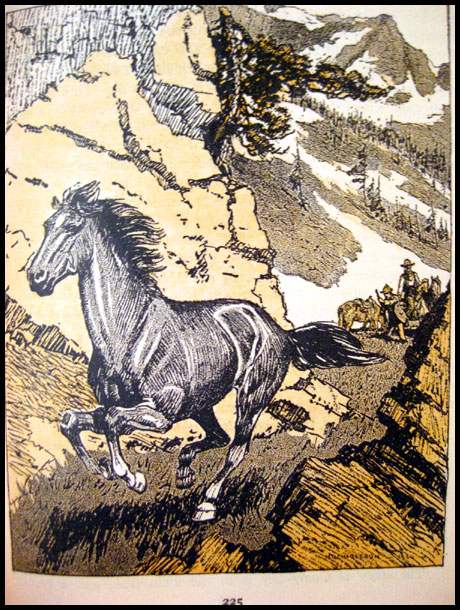
As a child and girl and young woman I was possessed by horses.  I read everything I could find about horses, looked at horse art and illustration, gazed for hours at horses in the pastures, played with horses, played horses, write stories about horses.  I fantasized long, arch stories featuring horses; while trapped in the very many boring conditions of my mundane life in the backseat of the car, a church pew, hoeing weeds in the garden, hanging clothes on the line, waiting to fall asleep, etc.


"Coaly-Bay The Outlaw Horse", one of my childhood's favorite
stories, in Volume 7 of The Animal Book (1938), by Ernest
Thompson Seton
. The story, with Seton's own illustrations,
can be read here
.

By-and-large my horse fantasy world was without human beings entirely, even without me.  I wasn't my visually impaired, clumsy, homely self, I was The Black, I was Coaly-Bay.


So, it seems, despite My Little Pony's world being called Equestria, this universe has little to nothing to do with horses as horses.

But maybe it has a lot to do with having power and agency?  However, judging by some of the comments responding to Miller's essay, a lot of people think it means quite the opposite -- a desire to never mature, grow up and take on adult responsibilities and deal with the global messes that we've created.

One might think too, that in this day and age, this --


Once upon a time, in a mythical, magical, distant past, Equestria was ruled by two sister pony princesses, one black and one white, hybrids of a supernatural kind — “alicorns,” my daughter whispered authoritatively. Celestia, the white princess, was in charge of the sun, and Luna, the black one, ­controlled the moon. The sisters reigned harmoniously until Luna began to notice that the ponies of Equestria frolicked and played under her big sister's watch, but under her own, they did nothing but sleep. Jealousy turned Luna into the monster Nightmare Moon, a villainess who threatened to plunge all of Equestria into perpetual darkness. To save Equestria, Celestia was forced to take a stand against her sister. Calling upon her most potent magic, she invoked the mysterious “Elements of ­Harmony” and cast a spell that banished Nightmare Moon to the moon.

making the goodie white and the baddie black is, at best, uncreative, at worst, a bad choice of character stereotyping for a world that is supposed to inculcate friendship, tolerance and happiness.


Sunday, August 31, 2014

Only Lovers Left Alive (2013)

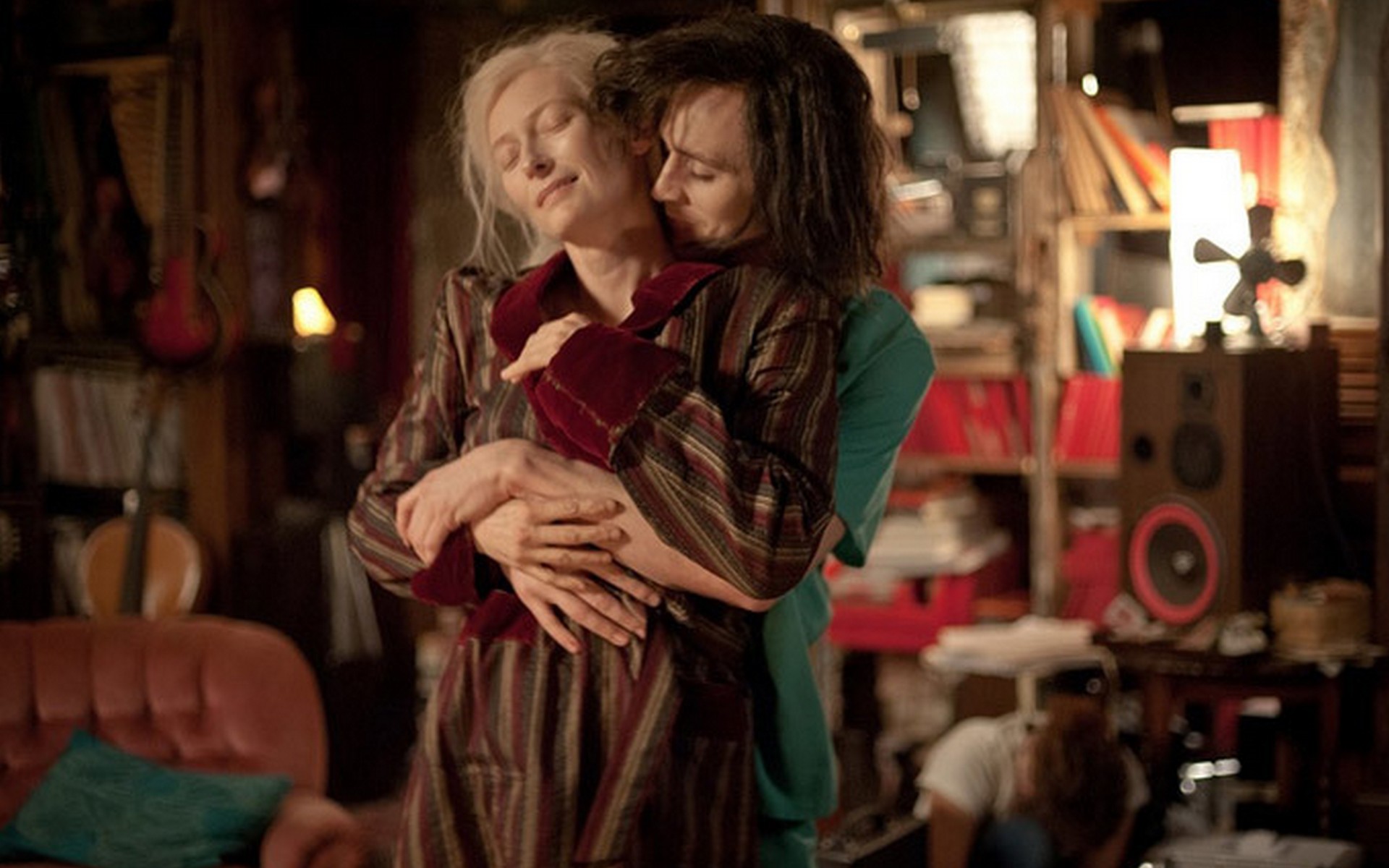
Jim Jarmusch  wrote and directed this novel vampire film, Only Lovers Left Alive (2013), starring Tilda Swinton and Tom Hiddleston.


By describing Only Lovers Left Alive as "a novel film" is intended to convey that Jarmusch created something new with vampires.  It also implies a question about vampires I've meditated on now and again ever since a dream I had way back in the early 80's of the last vampire, his face peering at me out of a broken television set screen, on a desertified earth, on which there is no blood left at all.  Somehow, I, per se, wasn't there, I was only feeling what the vampire's face was expressing: horror, terror and despair.


Jarmusch's film goes deeper than that brief but so vivid dream.  His vampires have existed since at least the 16th century;

John Hurt as Kit Marlowe, Eve's blood supplier in Tangier
Kit Marlowe is one of the few other characters in the film.*  They are among the world's obscenely wealthy, the wealth employed for privacy, acquisition of toys and the purest, fresh blood, blood that in the 20th and 21st century they no longer needed to hunt, but can purchase in various ways.  They appropriately suffer the ennui of the dissolute idle rich who lack any purpose in existence.

Adam with his gofer, Ian, played by Anton Yelchen; he's terrific in the role.

A Detroit Punk Club, in which it has forever remained the 1970's.
Adam, Hiddleston's character, is a legendary pop musician whom no one knows or sees.  Evidently his music and musicianship has been featured in many mythic recordings since, perhaps, the late 50's into the 60's and through the 70's?  I'm guessing those three decades because of the pop music references shared by Adam and his wife Eve, played by Swinton, and the sorts of dinosaur recording equipment and technology that litter Adam's rickety, decaying mansion, **  in the area of Detroit. Adam's out-of-step with the 21st century ennui makes for very understated but effective occasional comic touches.

So here we have it -- the vampire tropes, played as an exploration of degeneration of our planet, focused through the deserted areas of Detroit and, in ever-widening circles of alarm, the ever-widening toxic contamination of the planet. By now, not only is much if not most of the global water supply been poisoned, so has most of the global blood supply.

The film takes its own time moving along its unexpectedly delicious trajectory, which may bore some viewers. Additionally, if the viewer knows nothing about guitars, recording or pop music from the 50's, 60's and 70's, or anything about Literature -- yes, Literature with a capital L -- that viewer will miss many delicious bits of meta and witty commentary.

However, my favorite line from the film is not about either music or literature. Instead, it's a subject about which I ponder much more seriously on a daily basis. While Adam and Eve are taking a drive through the ruins of Detroit, Adam respond's to Eve's lamentation as to what the zombies have done to this splendid city:
"It's blessed with water. It will come back and the southwestern zombies who did this to Detroit and have used everybody else's water will want it back."
I've been thinking that this could well happen as well. Water = the blood of our planet.

Zombies in Only Lovers Left Alive are the vampires' code word for human beings, which is a bit of meta commentary on current popular entertainment too.  The vampires are clear that human beings, the zombies, are responsible for the ruin of the world.

-----------------

* In perhaps the only misstep Jarmusch makes in this film, in all the scenes that include Marlowe it's a given he's the author of Shakespeare's works.

* *  Eat your heart out, Elizabeth Hand -- how often has she employed the tropes of impossibly wealthy recluses, decaying mansions and artists from the 60's - 70's has she lovingly attempted to create by now?  It's not impossible at all that Jarmusch has read one or two of her novels -- though it wouldn't have been necessary for the making of this film.  These are such common tropes, and Jarmusch knows personally many a dissolute wealthy pop culture icon from those decades.

Tuesday, June 4, 2013

Sexism Makes SF/F Women Writers Tired

This merely another in the series of frequent eruptions of How SF/F and SFWA can embarrass itself and look foolish, sexist and / or racist / and / or whatever other bad mannered and socialization behavior can be engaged in.  Most people on the face of the planet won't know much less care.  This is the sort of thing that made me give up the org and the culture so long ago -- yet, like so many things that are bad for us and our blood pressure, not to mention taking up space in our little brains that could be used so much more profitably -- I can't keep my eyes away from these eruptions.
How every single discussion about Sexism and woman-type stuff on the Internet (and real life) has ever happened and ever will happen, always, forever, until the Earth finally falls into the Sun (or until the Patriarchy is dismantled.)
It goes with this:

"Sexism and SFWA, as seen by a former SFWA president.

Is there any more reason to wonder why sf/f is so riddled with such yahoo-saurian types as consumers and writers? Even when so many -- men and women -- explain.

They cannot and will not and don't want to hear.  Sexism.  It exists.  Get over it. Besides, sexualized female bodies are still the greatest marketing tool of all time, and selling our stuff is the name of the game.

Now there is another thing, the unfortunate editor of the SFWA Bulletin (for which there has never seemed to be an earthly use (so many reasons I left the org), is / was female, and she's resigned.  Undoubtedly the two men who set off this typical sfwa firestorm this time won't resign from anything -- indeed one of them isn't even a member of the org -- but a woman must be punished for their sins.  Because these saurians of the community are untouchable.  There's no other reason their inane and silly maunderings ran for frackin' 15 years in the Bulletin, because this field is all about the Sacred Name and Ancestor Worship.  So the misogyny and sexism and the rest are embedded in the org from the beginning.  It's not going to stop, particularly since this is the field that is the crown of nerd culture, which currently dominates pop culture from top to bottom.