". . . But the past does not exist independently from the present. Indeed, the past is only past because there is a present, just as I can point to somethingover there only because I amhere. But nothing is inherently over there or here. In that sense, the past has no content. The past -- or more accurately, pastness -- is a position. Thus, in no way can we identify the pastas past." p. 15
". . . But we may want to keep in mind that deeds and words are not as distinguishable as often we presume. History does not belong only to its narrators, professional or amateur. While some of us debate what history is or was, others take it into their own hands." p. 153 Silencing the Past: Power and the Production of History (1995) by Michel-Rolph Trouillot
. . . . I could not wrap my mind around the fact that we walked to this place from our hotel in Jerez, that this was in the middle of the 'new' city of Jerez.
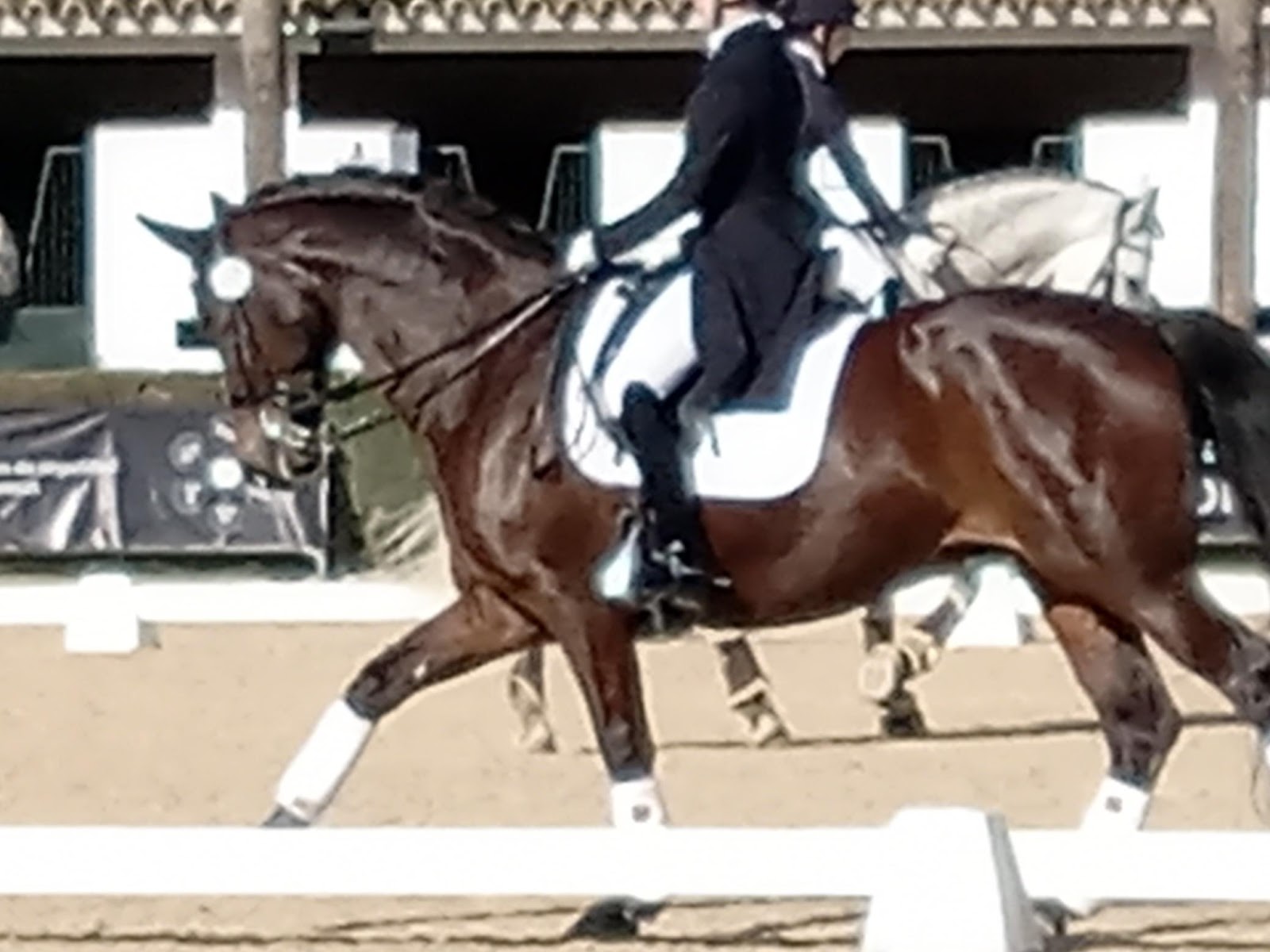
El V took some fotos that day of me taking fotos and sent them off in the real time experience smart fones allows us to do, "Because you looked so happy," and those he sent them to said the same. I was really enjoying myself. As well as being breathless seeing in real time the horses and riders executing their moves with such incredible rhythm and precision -- that nano second pause between one hoof hitting the ground as another was lifted -- I swooned. By the way, the relationship in this part of the world between these horses, what they are bred and trained to do, is so close with the omnipresence of Flamenco.
Our friend in Jerez, who has a foundation that promotes Flamenco between Jerez and New Orleans, dances Flamenco and runs festivals -- told me there are times when some of her people are around these horses, they have fallen into the Flamenco clapping, as people do in Spain all the time, particularly the closer one gets to Sevilla and Granada. The horses, hearing the clapping, riderless as they are, begin moving with the rhythms. Flamenco, dressage, bullfighting -- they are related, as are the fans and the tipica Flamenco fringed shawl. See how the movements of the dancers, with and without shawls and fans, as well as their postures are mirrored by matadors and their capes.
I Was Particularly Struck By This Team. Stables at the top of the Exercise - Warm Up - Practice Ring.
Stables. One of the horses in a loose box kicked up one heck of a fuss for quite some time, kicking and kicking. S/he would push head out the door, and then go back inside and kick some more.
Expecting To Make Points!
For No Reason This Rider, With Whom I Was Already Falling Love, Stopped to Chat With Me. So We Did, In Spanish and In English. It's Embarrassing How Many Spanish Speak English, While We Don't Speak Spanish -- Particularly as This Is A Nation Also of Spanish Heritage.
This Rider Had Sparklies On the Front of Her Helmet; Her Horse Had Matching Sparklies On Bridle's Head And Nose Bands.
Next up will be Cádiz, the oldest continually inhabited city in Europe.
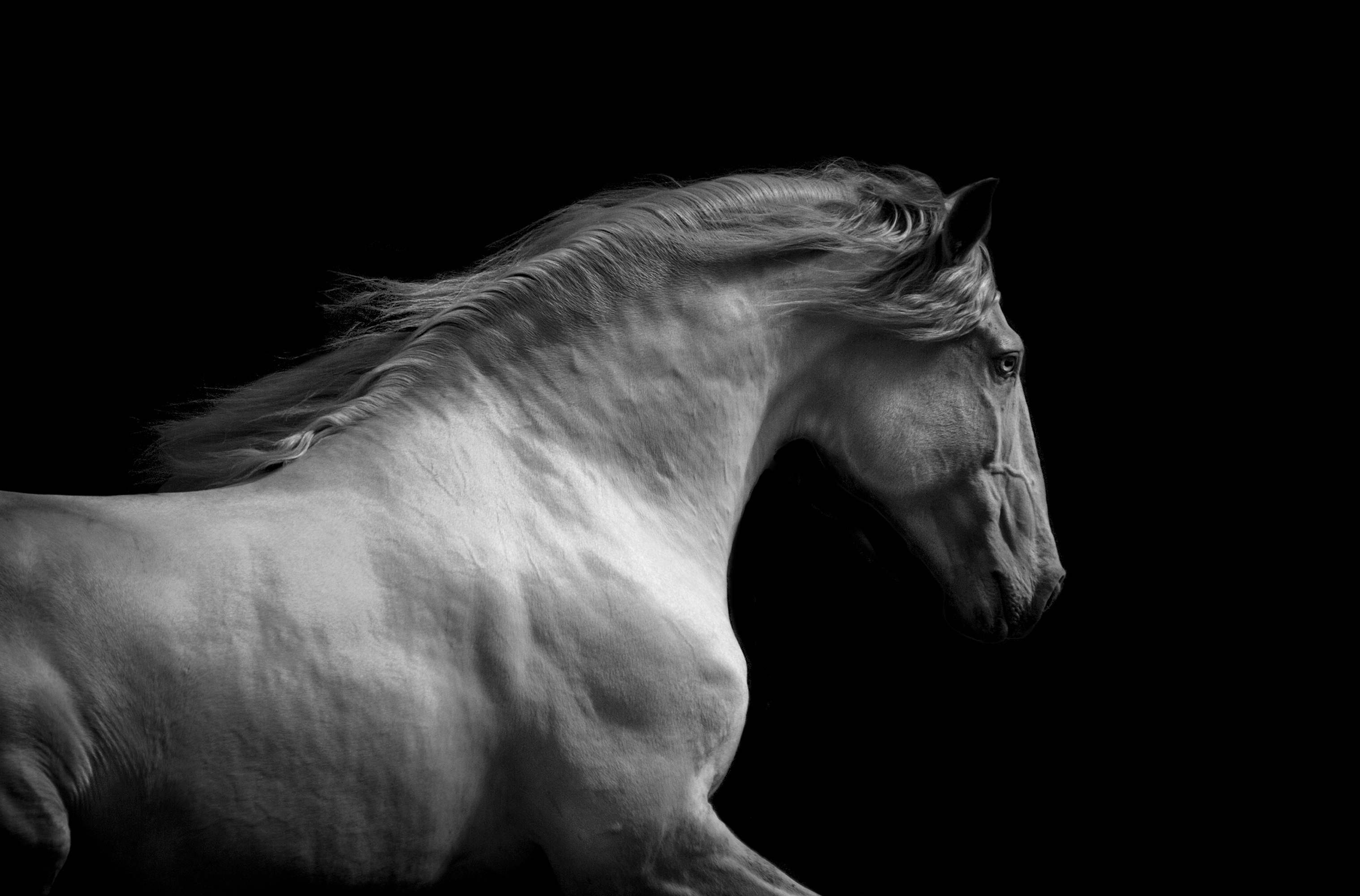
. . . . Here are horses, horses whose coats literally glowed and gleamed. Depending on the color and tone of the coat, I could see my face reflected from their smooth flanks reflecting the sun. There was a chilly wind, but otherwise the weather was likely optimal for the events. So it became even more pronounced, how very hard the horses worked, for at the end of each performance, when they were allowed to drop their heads and necks out of the constant curve, their necks were so wet -- and with the drop out of position, their necks suddenly looked lighter and smaller. I was so close I could see all the veining under their thin, sensitive skins.
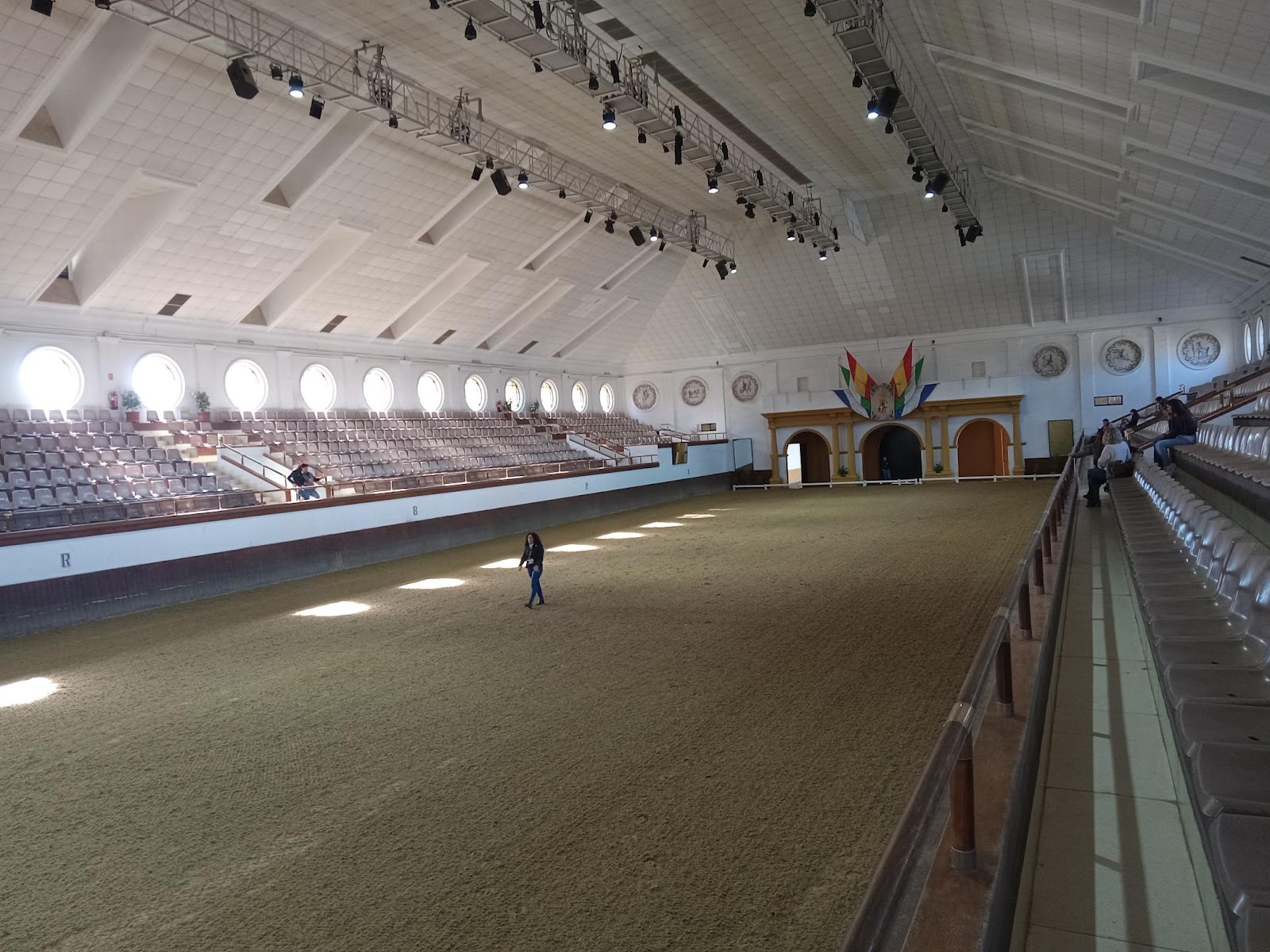
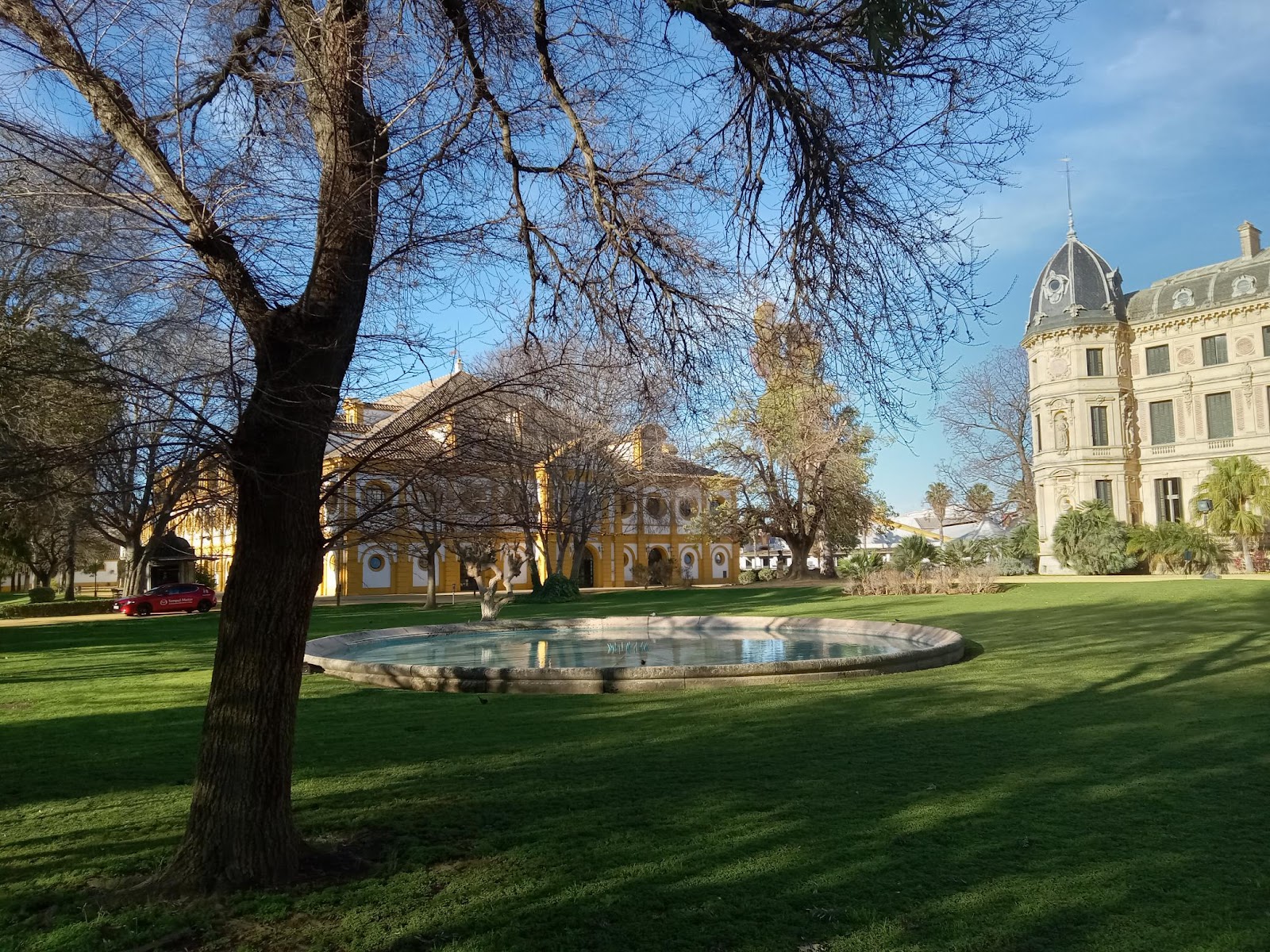
Jerez Royal Andalusian School of Equine Arts: Warm Up, Practice and Exercise Ring; The Yellow Building Behind is the Palatial Indoor Ring, Bar, Restaurant, Cafeteria, Bathrooms, Store. Though So Early, the Bar Was Doing Good Business.
There's another bar, restaurant, cafe outdoors by the Competition Performance Ring. It too did fine business.
. . . . At Jerez de la Frontera we entered the Southern Land of Oranges, Horses, Fans and Flamenco.
As per usual, I remain fascinated with the financial, administrative matters concerning housing, feeding and stabling and other organizational structures that make such a vast enterprise as this work -- and it is far from the only one of vast Equestrian centers to be found in Spain.
These Competitions Are Part of the 50th Anniversary of Jerez's Royal Equestrian Arts Institute, Founded, A Plaque Informed Me, by "los amigos de caballos".
Jerez, School's Extensive Grounds Inside the City Divided From Pedestrians and Street Traffic
Entrance/Exit to Stables and Competition Grounds
Jerez School Administration Offices - Some Of Them
Window On School Indoor Riding Ring and Theater
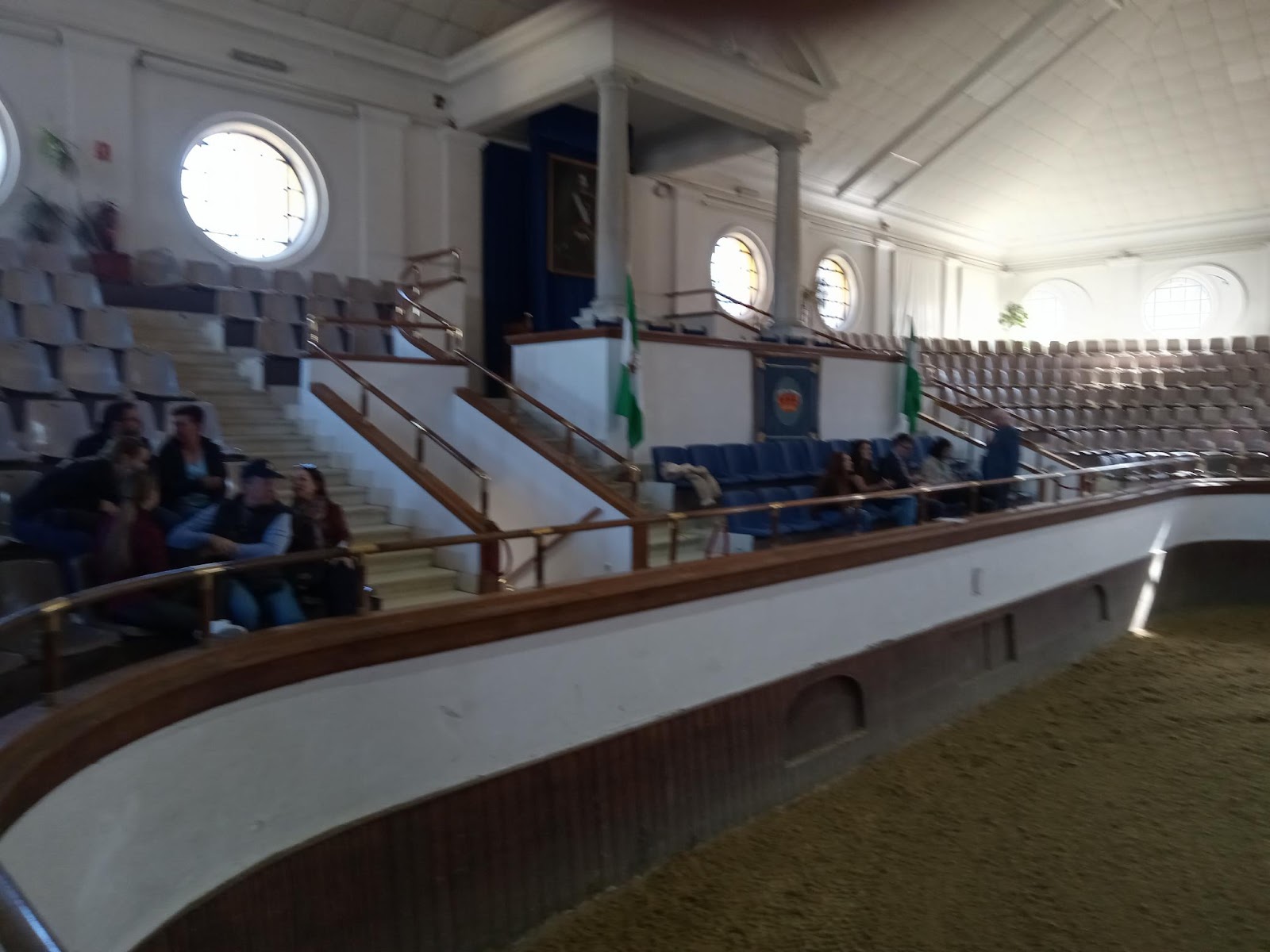
Royal Box Indoor Theater and Competition Ring
Opposite End From Royal Box, Entrance/Exit Performers and Competitors. I don't know the function of the mirrors there, which at this size aren't clear are mirrors.
Jerez Royal School Grounds. The Lower Roofed Building is the Indoor Ring, the White Building Is Offices.
Some of the horses next post. The videos truly show the horses floating above ground. But I cannot (at least so far) figure out how to get a video shot on fone (a very low grade fone at that) to either my desktop video files to blog here or the Other Place.
As this is the longest stretch of travel in Spain for our itinerary, we flew from Madrid to Jerez.
Holy cow is this ever horse country! Descending to the airport, taxi-ing into the (very small) city, to our hotel, everywhere there are exquisite horses, of elegant conformation and silhouette. Quite the highest end designer equine runway models.
Plus, there is Flamenco and sherry. And the classic Islamic White Cities of the Atlsntic and Mediterrean coasts. After deplaning, in the terminal, you are greeted by a welcome to Jerez mural that is first, a gorgeous horse, and a beautiful dancer in classic Flamenco form.
Last night in Madrid, we saw a Flamenco show in a very up close and personal space, deliberately created to be as close to the underground and caves-cellars (generally those belonging to a taberna, thus wine storage, all over Spain, and particularly in the south, dating from at least the Roman eras, but I'd guess from the Carthaginian ones too) from which the tradition emerged. (We were the only mask wearers, but so what?) It was the first time I have been that close to the performers. So I could parse how much of their classic poses are the same as those of bullfighters, fo one thing. Though none of the dancers used cotenants, one of them wore a shell medallion, which I like to think was a homage to the ancient predecessors of cotenants, already in the days the Roman's, who used clam shells.
Tomorrow we're taking a tour of the largest Roman amphitheater in Spain. But first, dressage!
I can't believe I'm finally here, where I've wanted to go since 4th grade. Better late than never is true . . . .
. . . . More foney-fone fotos of horses in braids, and even, yes, in sparklies, than any sane person can take! Sparklies, though subdued and tastefully minimal, on the riding helmets too. What? They think they're royalty, nobility, or something?
Indoor ring though, no sparkles. But mirrors at one end, the Royal box at the other, with a gigantic portrait of the king on the back wall of the box. I guess that's sort of a mirror for somebody? No fotos allowed, not even with foney-fones.
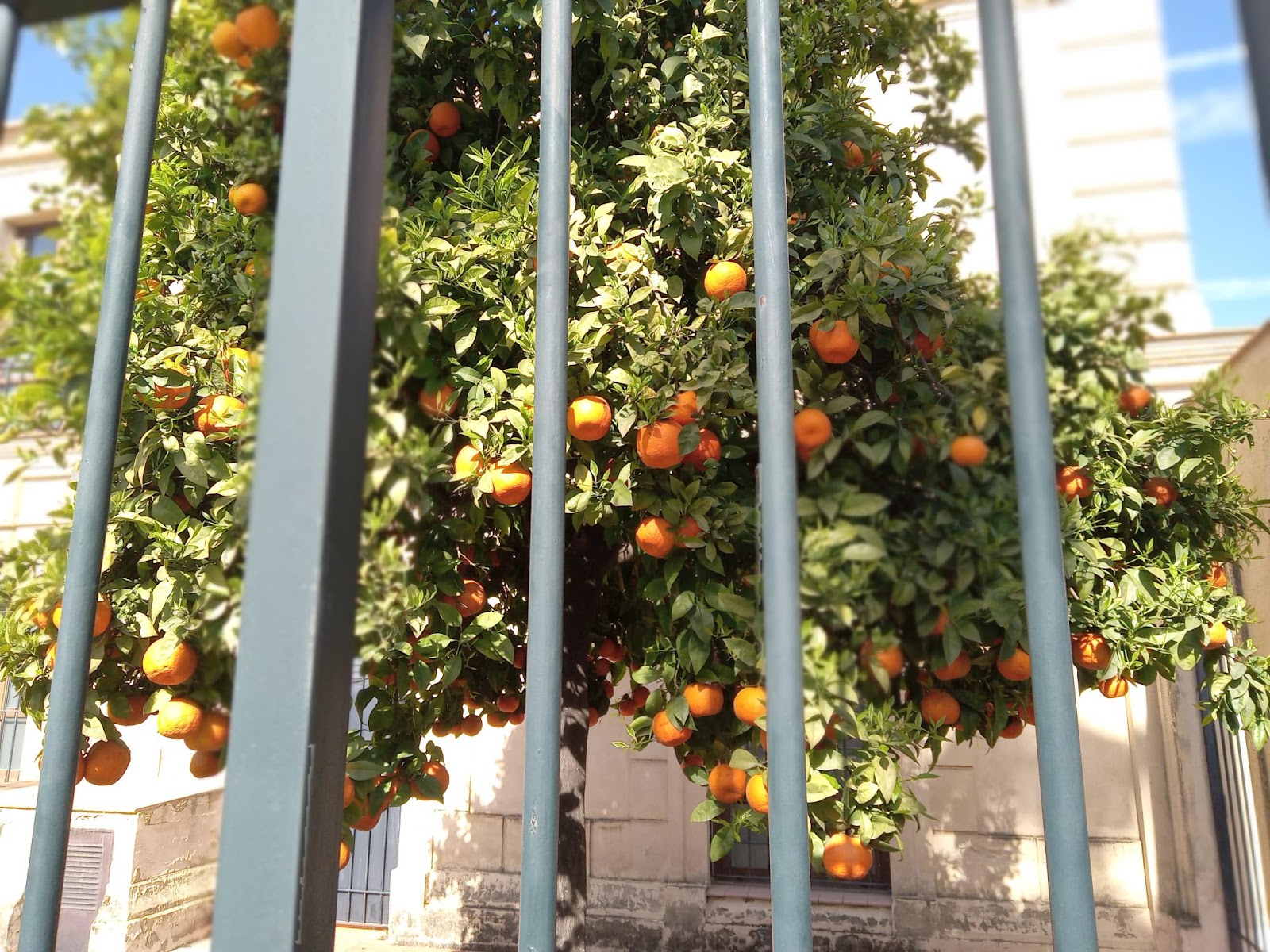
Orange trees in the grounds. Fotoed those.
Must move on to next thing now, and train, to Cadiz.
. . . . The word used in Spanish for 'dressage' is 'doma.'
Essentially, it is the Spanish who gave us 'dressage' , which, ya, we all know, but just in case we didn't I thought I'd mention it. People forget that in the 16th Century, Austria and the Habsburgs were inherited by the Spanish throne, which is why it is called the Spanish Riding School in Vienna. Think about what this all means in terms of the history of the breeding of the horses themselves, who came from Spain in the 16th C.
Doma vaquera riders usually choose breeds such as the traditional PRE (Pure Spanish breed) or Lusitano (pictured above), Thoroughbred-crosses or Arabians. These breeds are usually brave and calm, yet spirited and able to maneuver with lightning quickness. (Credit: olgaIT)
Here's an interesting piece from Dressage Today, concerning contemporary developments out of the Spanish-Spanish dressage techniques into the New World generally, and particularly the US West, called doma vaquera.
In Spain, doma vaquera is also connected with the art of bullfighting. Both the work in the bullfighting arena and with cattle requires speed, quickness, agility and a high degree of collection from the horse. Unlike in dressage riding, where riders ride with one (snaffle bridle) or two reins (double bridle) in each hand, doma vaquera requires the rider to hold the reins in one hand, typically the left. The right hand must be free for work, such as holding the garrocha, a long pole designed to distract the bull. The discipline of bullfighting from a horse is called rejoneo. The horse for rejoneo is a doma vaquera horse that performs movements such as piaffe, passage, terre-a-terre, jambette, pirouette on three legs, etc.
. . . . Hitler: A Career (German: Hitler – Eine Karriere) (1977)
West German documentary film about the career of Adolf Hitler directed by Christian Herrendoerfer and Joachim Fest and written by Fest, a German historian.
Everything on screen is documentary film footage shot at the time in real time, though the narration – in English -- is not, and overdubbed.
This latest edition of the digitally restored period film footage, which the team that got this on Netflix did, taking out the herkyjerky fast walking and so on that we were used to from footage of the time – the miracles that can be done now. It’s much easier watching this 1977 film in 2022 than it was to watch on television in 1977.
As per usual, my first question was the same as it always is when watching nazi documentaries. Where did the nazi organizers get these hundreds of thousands participants in the spectacles, that are viewed by an equal number of wildly cheering spectators, how is it possible the paraders and performers can execute the endless vast unison parading and maneuvers that, among other things, create monumental swastikas of human beings? (Later in the film there's some analysis as to why so many of these spectacles were arranged at night -- the dark covered up much of the reality of what was there.) I also think, seeing the scenes of the nazi youth groups how much I’d hated growing up in nazi Germany – those girl youth camps in which one is told that washing clothes for the family was more fun for girls than going to school, forced to play volleyball instead of reading books. They sound like mother did, having a fit when she asked, "Why don't you like anything about housework?" and I looked at her as insane.
Poland, is often regarded as comically out of date confronting Hitler’s invasion of tanks and aircraft, without any of the weapons and infrastructure of a modern army.* However, we forget -- if we ever knew -- how little time Poland had in the last 100 years or so to even BE A NATION, much less have the money or time to create a modern army, since the partition and disappearance of it in the 18th C. Under the circumstances, that it took Hitler’s forces 2 weeks to subdue Poland seems, to me, at least, admirable and truly heroic, not something for non-Poles to feel superior about. Not to mention our current home-grown nazis would never heroically make a stand like that against even an equal force, much less such an overwhelming one. Shoot, they can't even stand up to not having somebody cooking breakfast and handing to them, or have teenage girls laugh at their trux.
On! To Moscow. Mud up to the horses’ shoulders. Mud past the tanks' treds. Then snow, higher than the horses' bellies. This is footage shot on that advance, and the defeat WWII -- a scene of Hitler walking in snow behind the lines and the front's 'advance', stating, "I hate snow. I never want to see snow again." Then going back to Germany, where, presumably some heads rolled, due to snow not foretold or removed.
Whilst the viewer ponders how so many of the scenes of vast numbers adoring Hitler and the nazis, united in joy of hatred, often in tears – thousands of girls melting down over the Beatles have nothing on these hormonal charges – we’ve been seeing in the last few years.
On Sept. 1, 1939, a Polish Cavalry regiment operating along Poland’s northwestern border attacked a column of unsuspecting German infantry.
The invaders were quickly scattered, but before the Poles could celebrate, a squad of German armoured vehicles appeared on the scene and inflicted heavy casualties on the horsemen with their canons and machine guns.
The next day, war correspondents were brought to the scene and told that the Poles had charged German tanks.
Despite no one actually having witnessed the supposed charge, seemingly overnight the story spread across the globe and was quickly accepted as true. Both Time Magazine and The New York Times described the incident in hyperbolic detail; high ranking German officers recalled it in their memoirs; and even Winston Churchill mentioned it in his history of the Second World War.
I suppose we need not be surprised that one of the most solid, enduring platforms of this myth is a film the nazis shot to show their infinite military superiority to everyone?
…. Perhaps
the most notorious example was the pseudodocumentary Kampfgeschwader Lützow,
which featured staged footage of Polish cavalry charging panzer tanks. ….
. . . . I keep forgetting to put up the trailer for the Postmambo Colombia Music Seminar, which is coming right up.
People are so looking forward to this trip, for a multiple of reasons. As activities are outdoors, the restaurants are open sites, travel within the area will be open to air, and the group is small enough that people can can move --masked -- in separate vehicles -- people feel secure. The weather is terrific now too.
~~~~~~~~~~~
. . . . It's been non-stop busy here. Even this weekend of splendid weather -- about to break for the more usual July of 90+ temperature and humidity -- it was a small, local arts community in New Jersey, with its own gorgeous theater, where the organization provided a showing of Tierra Sagrada to its community. Trying to decide whether to go to Lisbon in the fall, for the annual WOMEX conference, where Tierra Sagrada will be part of the film festival. Plus there was the 4th of July uptown in our friends courtyard garden, el V's bd at the Metropolitan Museum of Art where we got to view the just opened exhibit, Chroma: Ancient Sculpture in Color. These were reconstructions of pieces that we've always seen a white and bare of any color at all. On occasion, the original, as we have it, was shown next to the reconstructed color pieces. I took this occasion to use the Android's camera for the first time.
Northern Bowman, Persian or Scythian
The city's exploding with music events, with musicians coming in from Latin America, particularly. Last night it was Brasil, at Central Park's Summer Stage. It was the most successful event the series has had so far this summer.
~~~~~~~~~~~
. . . . Non stop anxiety here due to the raging covid numbers, and the fool of a mayor who succeeded the previous fool of a mayor. All the officials gravely intone -- finally forced to admit that the numbers in the hospitals alone has us in extreme high risk category for infection -- we should maybe consider wearing masks indoors. We are surrounded by people having to deal with this, while their beloved relatives are in hospital with other conditions and then contract covid from the staff, and they are not allowed, then, to see their relatives. Which means they can't keep monitoring how their relatives are being treated. In one case, there is a doctor who insists on giving the patient an epilepsy med. She doesn't have epilepsy, and it turns her into a zombie -- and thus incapable of protesting anything they do or don't do for her. Why yes, we just received two new boxes of high quality masks from amazilla.
~~~~~~~~~~~~~
. . . . Non stop rage and despair on most other fronts. What fools -- when not just outright evil, which there is no doubt most of them are -- these jerkwaddies who have counted coup on the country, and what greater fools are us, who have allowed it and done nothing.
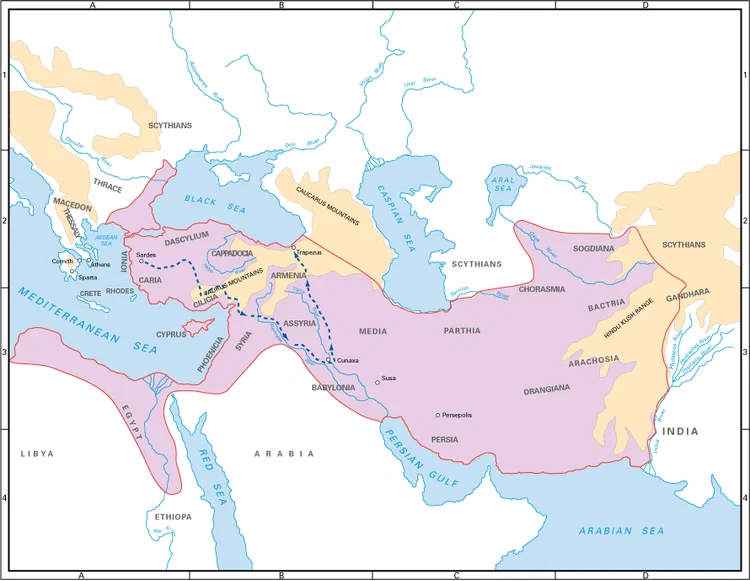
A map of Persia, indicating major settlements, regions, and mountain ranges, as well as the march of the Ten Thousand (dotted line).
. . . . I take consolation from Xenophon's Anabasis -- the March of the 10,000 --and Tom Holland's Persian Fire: The First World Empire and the Battle for the West (2005 -- so author's filled with 9/11 Clash of Empires interpretation of everything).
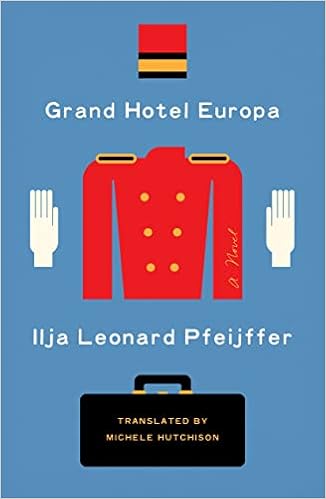
Additionally, I have become immersed in the splendid novel, Grand Hotel Europa, from Dutch author, Ilja Leonard Pfeijffer, originally published in Europe in 2018, and translated and published here this last month. The presiding genius of Grand Hotel Europa is Clio, as the lost lover, muse of European history, particularly Italy and Central Europe's. Though not exactly historical fiction, it's difficult to imagine someone who takes historical fiction seriously not being at the very least intrigued by the novel. It's very long, so I fear its beguiling aspects may begin to pale at a certain point, but if this is the case, I have not yet reached that point. Michele Hutchisson's translation fulfills the shimmering, yet transparent beauty of the prose, which wins as much admiration as the reader can provide.
~~~~~~~~~~~~~~~~~
. . . . Watching Indian historical epics, during long hot nights, which not only sends me constantly looking at my World Atlas -- such a huge book, it is fortunate the bed is near my screen -- while marveling at the integration of elephants as not only known and usual, but essential elements of the societies in such a variety of ways -- but teaching me about a whole new breed of horse, the curly-eared Marwari warhorse.
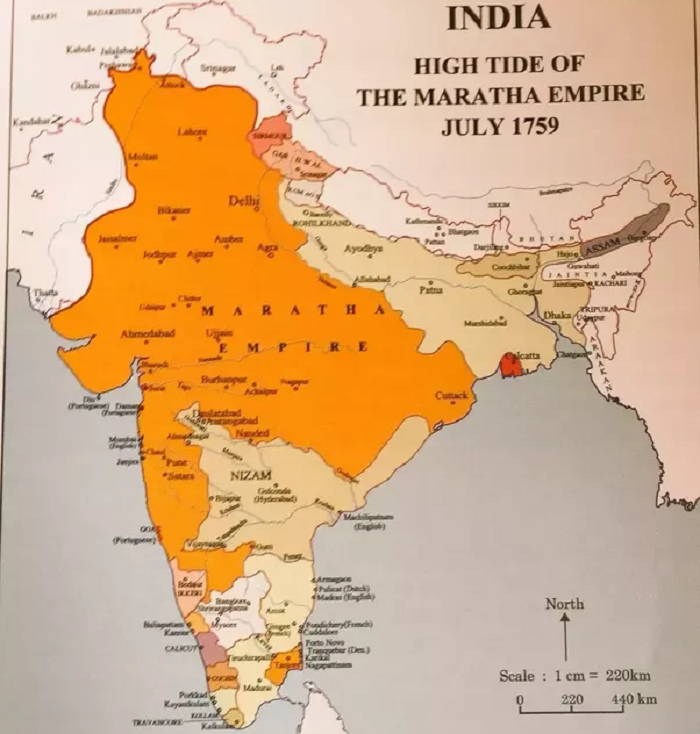
These horses appear to have been bred originally -- perhaps starting in the 13th-4th centuries, post the Mongolian-Turcic conquests of Central Eurasia -- in northwestern India, crossing some Arab stock with 'native' equines and the horses of the Mughuls and the Khanates. They became signature horses of the various northern kingdoms such as Jodhpur (Marwar) region of Rajasthan, and by the 17th century then, the horse of the kingdoms of Maratha Empire, which at its zenith covered all of Central India, most of the western seacoast, the Doab, that fertile land between the Ganges and its greatest tributary, the Yamuna. I think it was the Brits who called it "Hindustan."
These horses, while large and powerful, thus warhorse, also need far less water and forage than most horses. This is more than useful for an empire that encompasses extensive desert and rough infertile ground. The mares typically are larger than the stallions. They have loyal and courageous natures, are said they would not leave their rider even when he was killed in battle. It is also said that when engaging an army that used war elephants, fake elephant trunks would be fastened to their bridles, which confused the elephants into thinking the horses were baby elephants, allowing the riders to attack the elephant unexpectedly. The favorite coat for the cavalry warhorse is said to have been 'pinto', as we see in the painting above.
So it is again, when all else fails, horses still give me delight.
~~~~~~~~~~~~~~
. . . . Listening via streaming to a Cali, Colombia radio station. It is all over the music festival Postmambo will be attending, among other activities. The things we can do these days ....
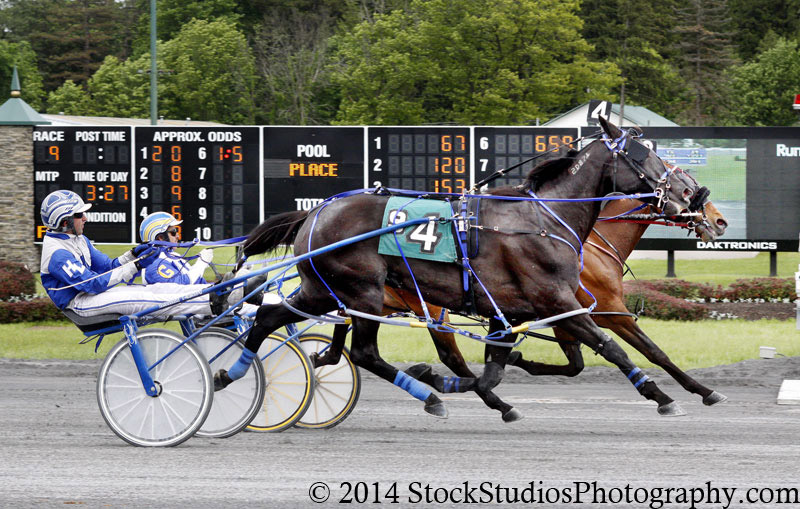
. . . . Horses continue to do their part for Black Lives Matter, as opposed to the horses coerced by police against Black Lives Matter.
How one woman on a horse at an Oakland protest became a symbol for revolution‘You can’t ignore a big, old pretty horse with a black woman on it,’ says Brianna Noble
Though somehow Owen Wister*, author of The Virginian(1902), which takes place in Wyoming, and his best buddy, Theodore Roosevelt, who proudly claimed the title of Cattleman and Rancher to describe himself, and both wrote extensively about "the cowboy", somehow they both managed to not notice there were black cowboys. Theodore Roosevelt went so far as to say, invoking his slaveowning Georgia family, that being a "Cattleman" was as good as being a plantation owner. Owen Wister's Virginian flatly stated that the West was "white man's country." Judge Henry, the Rich Feller in Wister's novel, who like Theodore Roosevelt, in North Dakota, owns the vast kingdom that he calls his ranch, which is made up of public lands to great extent, flatly explains to the effete eastern school teacher, that all this land was made for his exploitation, and when he's extracted all the animals, grass and minerals, they will just move on. Explains a lot about this country, doesn't it. Thus these stories of Black Lives Matter riders, both men and women, are particularly important parts of correcting our erroneous ideas of history, both of who 'settled' the West and who made western culture. ~~~~~~~~~ * Wister was one of the children English actress, Fanny Kemble, lost, when she left her husband, Pierce Butler, perhps at the richest slaveowner in the USA, appalled when she learned what slavery was. Some years later she published (1863) Journal of a Residence on a Georgian Plantation 1838-1839. This was done at the urging of abolitionists in the hope this account of a slave plantation would mobilize British opinion against the CSA. During the course of researching and writing The American Slave Coast, we got to visit St. Simon's Island, where the plantation Fanny Kemble lived on, was situated. Bits and pieces of it are still there.
. . . . In an entry Elsewheres, I concluded with "Lord. How long. How Long." To my astonishment, people asked what that means. . . . . People with a religious background or any experience of protestant, Jewish, African American recognize it immediately. It's part of US literary tradition by now, in many parts, even recognized within canon. This is the rhetorical Introduction and Refrain of passionate lamentation over inexplicable suffering and oppression, begging an explanation from God, of Why, Lord? why at all? Why to me? to us? and for how long, Lord, will you allow this to go on? Versions of "How Long" are everywhere in the Old Testament, whether in the Book of Habakkuk or the Psalms. It is in protestant hymns and prayers, it is naturally, particularly prevalent in African American religious tradition, whatever the mode of expression, and beyond that has been heard even in pop music made by African Americans and covered by whites, yea, even in the UK -- even when the lamentation is about another band member playing off on the side in secret with another band, as with Ace's one hit wonder.*
So, yes, among the lamentation of African Americans -- and British people of color too, who are at least as religious out of the protestant traditions as in the US, to speak "Lord. How long. How long,' as a response to a white guy doing absolutely nothing for racial justice except to say, ya! go risk your life and health -- go go go! and then demand cookies from god himself (who he is currently referring to as karma points!) for typing that in the comfort of his comfy home and bank account, far far far away from anything remotely threatening, whether the pandemic, eviction, or police brutality, is something very many people immediately 'get', so to speak. But not this tone deaf white guy -- who also poo pooed Covid-19 as a cozy disaster that would over in two weeks. Thus, this traditional African American expression in prayer, in sermon-oratory -- see Dr. Martin Luther King
and music, secular and popular, and has been since the early days of slavery -- is appropriate. How long, Lord, must we put up with clueless complacent white guys typing clueless, complacent words, and then demanding a reward? * Another example of how African American traditions get reworked into commentary upon what is happening right this minute can be heard in the soundtracks to both Coppola's Apocalypse Now, and Spike Lee's imminent release, Da 5 Bloods, which comments on our conditions both back in political and film history -- Vietnam -- and that history commenting on contemporary events.
~~~~~~~~~~~ The BLM Protest movement is indeed global. The monument to African slave trader, Edward Colston, in Bristol, on which Bristol's modern fortune was founded, was pulled down. The protest in London by the US embassy is enormous! https://www.itv.com/news/westcountry/2020-06-07/thousands-attend-black-lives-matter-protest-in-bristol/ https://www.reuters.com/article/us-minneapolis-police-protests-britain/thousands-join-black-lives-matter-protest-outside-u-s-embassy-in-london-idUSKBN23E0A3? https://www.itv.com/news/2020-06-07/more-black-lives-matter-protests-to-take-place-across-the-uk-on-sunday/ With horses featuring in stories about the clashes between cops both here
and the UK, with the horses and the cops in armor, while a pandemic rages, I have no trouble re-visioning the uprisings in the 14th century in England,
particularly the largest, longest one, the Watt Tyler Revolt, or, the Peasants' Uprising, against Richard II -- particularly directed at his uncle, Duke of Lancaster, John of Gaunt -- whose newly built palace, reputed to be the most exquisite in Europe, was not looted, it was destroyed, deliberately, every part of it, from marble wall facings to the smallest bibelot, ground to shards and dust, and then burned. That's how tired the people were of waiting for justice, dignity and food for So Long. So. Long. So. Very. Long.
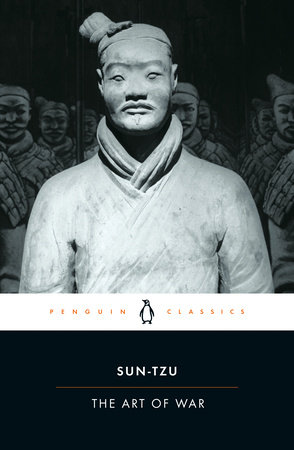
. . . . I have not posted since the penultimate day of July. My goodness time does fly when busy with the present, including friends with medical emergencies, and planning the future, of which there is a lot of planning as so much travel is involved, from New Orleans and Texas, to the Caribbean, to Europe -- and lordessa save us, Abu Dahbi. I have been reading some very interesting books, though, such as this Penguin edition of The Art of War: The Essential Translation of the Classic Book of Life (2009) by Sun=Tzu; Introduction by John Minford; Edited by John Minford; Translated by John Minford.
This edition was chosen because of the Introduction provides historical context and because the editor/translator has included extensive Commentary on the chapters by a variety of Chinese scholars and generals past and present. These are the chapters of the bare text: Chapter 1: Making of Plans Chapter 2: Waging of War Chapter 3: Strategic Offensive Chapter 4: Forms and Dispositions Chapter 5: Potential Energy Chapter 6: Empty and Full Chapter 7: The Fray Chapter 8: The Nine Changes Chapter 9: On the March Chapter 10: Forms of Terrain Chapter 11: The Nine Kinds of Ground Chapter 12: Attack by Fire Chapter 13: Espionage Last night I watched the Battle of Crecy episode from the television adaptation (2012) of the 14th century historical fiction doorstop, World Without End, by Ken Follett (no one loves rape and humiliation and degradation of women as much as he, not even GRRM).
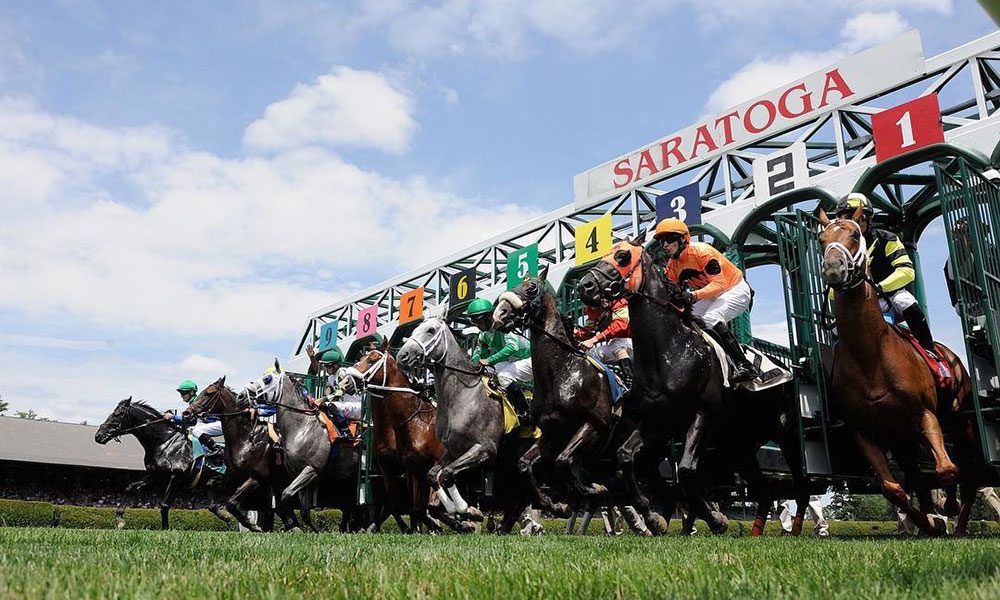
I kept checking off the aspects of King Edward's plans for Crecy against Sun Tzh's instruction. It included everything Sun Tzu admonishes, about, including when to do or not to do a forced march. I was quite impressed. But then one sees how much all successful historical generals such Caesar, Napoleon and Grant follow his guidelines too, whether they did so consciously or not. The most important aspect evidently is speed of action, because Sun Tzu brings it up often, in more than one section of his advice. One has noticed that most successful commanders before mechanized warfare and air warfare has rapid movement in common. I could not help but compare and contrast Grant and Lee with Sun Tzu instructions -- and how Lee in so many ways did not adhere to the Sun Tzu exhortations, while Grant always did. Clausewitz had read Sun Tzu it is said. So might have Grant, though he never mentions it. Napoleon is widely thought to have carried the books with him everywhere. The first western translation of The Art of War was 1782, by a Jesuit priest, into French. Why, since I have read Clausewitz, why had I notread The Art of War? It's so short too, quite unlike Clausewitz. But then, Clausewitz, though seemingly permeated with Sun-Tzu, is also Enlightenment in his approaches (which tends to really make him mostly out-of-date, experts say, for 19th and 20th century warfare -- what about 21st C warfare?), whereas, as mentioned, Sun-Tzh, who may well be the same sort of composite figure as Homer, is for the ages. Though warfare by plane, drone and intercontinental missiles changes everything, doesn't it? The Art of War, though so short, may actually be even more dense than Clausewitz, since so much is couched in metaphor that we (well, at least me) of our place and age are not able to quickly and easily penetrate and grasp. But I do recall how Grant is / was universally praised for the brevity and clarity of his battlefield plans and orders. Now I'm thinking of The Art of War in terms of the battles of Saratoga, since as of tomorrow we're on a jaunt with a friend to visit a Postmambo Traveler amigo who lives there. My two objectives for our mini vacay is to visit the ground where Benedict Arnold pulled the Continental Congress and the as yet unborn nation's chestnuts out of the British military fire, was dreadfully injured, but allowed the French to come in who really pulled the US chestnuts out of the fire -- and then that nasty piece of work, General Gates, stole all the credit for himself, when he earned none -- sulking the whole time in his tent.
After that I'm going to take the tour of the cottage where Grant finished his Memoirs of the Mexican American War and the War of the Rebellion, one of the greatest works of military history, as great as Julius Caesar's War Commentaries on his Gallic Wars, and one of the United States great works of literature. I'll probably look at some horses too, and who knows what else? There's no dearth of things to do and see in Saratoga.
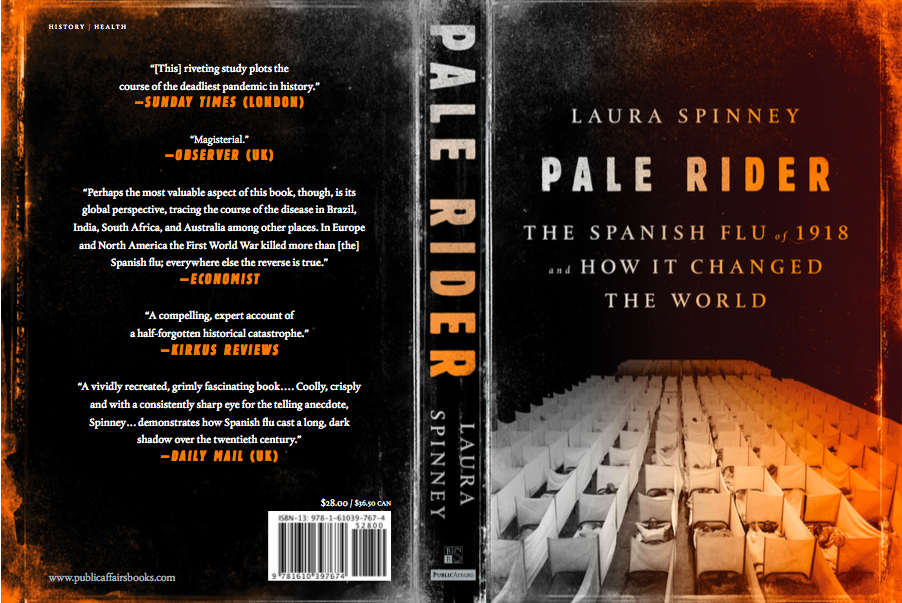
I listened to some Spinney interviews last year, though I haven't read the book -- I do have the flu currently, alas. (Yes -- I got the flu shot, back at the start of September, but we know this year was iffy for protection against the Big Mutator.) With the current flu getting so much news coverage one does think of this book, as well as because this is the centenary of the Spanish flu pandemic. I learned from the review, (written by a physician) the three centers from which its global spread probably issued. I didn't know any of this before. Maybe for me the most interesting factoid I got though -- is that perhaps the first flu epidemic was in 'Asia' 2000 years ago, acquired from horses. Was this the first strike against the rest of humanity by the Eurasian steppes and the nomads. long before the Mongols?
Baiju Noyan is a bad man, a VERY bad man.
I think of such a thing since I am watching the second season of Resurrection: Ertugrul, in which the big bad is the Mongols, and particularly Ogedei's general, Baiju Noyan. Unlike in Jack Weatherford's histories of the Mongols, they are really eviLe here (though Weatherford pulls no punches when it comes to Genghis's sons, whom he holds responsible for what the Mongols came known for). They are worse by far than the first season's Crusaders. Even the nomad tent and their warriors (alps) say this is so. Certainly more prone to random acts of cruelty and torture for the sake of it, and bloody on a grand scale. This season is more graphically violent and grisly than the second one, which is only one large difference between the series' season 1 and season 2. Initially, with the first episodes, I thought the second season was going to retell the first one, merely shifting roles around as to antagonists and protagonists and maybe even recreating the same characters but with different names and tribal membership. But once I'd gotten a few episodes in, it was clear this season was very different. The poetry and passion of romance have almost disappeared. Halime Hatun, Ertugrul's love, to whom he now is married, is pregnant -- the longest pregnancy ever -- but she hardly ever appears except for him to order her "to be patient and wait." (I fear tremendously the Big Bad is going to kidnap her.) Mother Hayme seems to have lost her great wisdom just when she needed it most -- but plausibly so.
This season is far less concentrated on God's will, and the gorgeous mysticism and maybe, even the magic, of Islam. (However, we have a hermit who appears whenever Ertugrul is in the direst of straits, feeds him, hides him his cave, reunites him with his loyal alps -- some are traitors). Other annoyances of the first season, such as the predictable episode arc of at least one exceedingly lengthy battle scene, and the truly annoying predictable slo-mo, stop action, of horses galloping, have been dropped. Each episode moves faster than in the first season, and seem shorter though they are the same length. Season 2's Ertugrul (called "Brave Man") is focused in utter desperation on keeping the promised arrival of the Golden Horde from overrunning all of Anatolia -- and perhaps, though much of this is vague, particularly in terms of the years involved, the Persian Seljuk Anatolian Sultanate of Rûm (Rome, i.e Byzantium, though that word wasn't used until the 16th century, while Istanbul didn't come into use until 1923), which borders the lands of Byzantium. Along with this comes something I really like, the often overlooked aspect of the Mongolian generals' front line operations in the lands they are targeting for conquest. It didn't happen in one sudden, massive invasion. Cohorts were sent ahead long before the arrival of the Golden or the Blue Hordes -- sometimes years. Not only did they perform terrorist lightning strikes along the borders and penetrate deeply into the targeted territory. They spent years subverting tribal influencers with bribery, kidnapping of family members controlling and using them behind the scenes. Yet another aspect was to disrupt the local economies of trade, herding and manufacture (this is in the charge of women) as much as possible. As Baiju Noyan says, "The only thing I love more than fighting is winning a battle without having to fight it." However, the Turkmen Seljuks employed the same tactics themselves when moving out of Central Asia into Asia Minor, with the same devastating effects upon the population and trade as the Mongols accomplished.
Battle of Köse Dağ; Mongols won, Seljuks lost.
From this I'm picking up that even today the Turks harbor no forgiveness for the Mongols, recalling with hatred their subjection of over a century, which happened after getting clobbered at the battle of Köse Dağ (1243) -- won, not coincidentally one might think, by -- Baiju Noyan. Seemingly (I don't know -- my ignorance is abysmal) this subjection of the 300 year Seljuk Empire in Anatolia by the Mongols until their own empire fell apart is the reason there aren't histories of the Anatolian Seljuks per se as there are of other Seljuk spheres as in Persia, or the Arab eras, etc. Additionally, Anatolia was where the Byzantines Greeks and the Ilkhanate Empire (the Mongolian dynasty that took over from Seljuk Rûm) clashed the most, constantly ceding and conquering and reconquering, despite their many alliances. So the region was in state of flux and disruption at the best of times for all these years.
"The Mongols and the "Franks" [including the Venetians] made many alliances against the Egyptian Mamluks, the wall against which Mongols and Europeans always broke. Also Frankish-Mongol alliances weren't very effective to start with. The Mongols, i.e. the Ilkhanate Empire [see above] were allied with Byzantium -- though that also broke down constantly as well. Despite many attempts, neither Hulagu [brother of Kublai; ruler of the Ilkhanate Empire, including most if not all of Anatolia] nor his successors were able to form an alliance with Europe, although Mongol culture in the West was in vogue in the 13th century. Many new-born children in Italy were named after Mongol rulers, including Hulagu: names such as Can Grande ("Great Khan"), Alaone (Hulagu), Argone (Arghun), and Cassano (Ghazan) are recorded.[27]"
Which reminds me of how often I see the name 'Attila' in the credit rolls of Italian television series -- another legendary hero's name (depending on one's perspective) that never lost in Italy associations of overwhelming power.
OTOH, this perhaps provided the liminal space where flourished the legendary aspects of the Oghuz and Osmans, from of whom rose the origin stories of the Ottomans, and the legendary warriors such as Ertugrul of the Kayi tribe. This season his trajectory has Ertugrul resembling both Christ and King Arthur, i.e. sharing aspects, as mythical figures invariably do. This is the era when the Mongol conquers in Asia Minor converted to Islam, while also importing vast numbers of Chinese scholars and administrators from the Yuan dynasty back in Eastern Asia. What these alliances did do (as with Venice) was facilitate trade routes and exchange between east and west across Asia Minor to China and back -- and across Africa too.
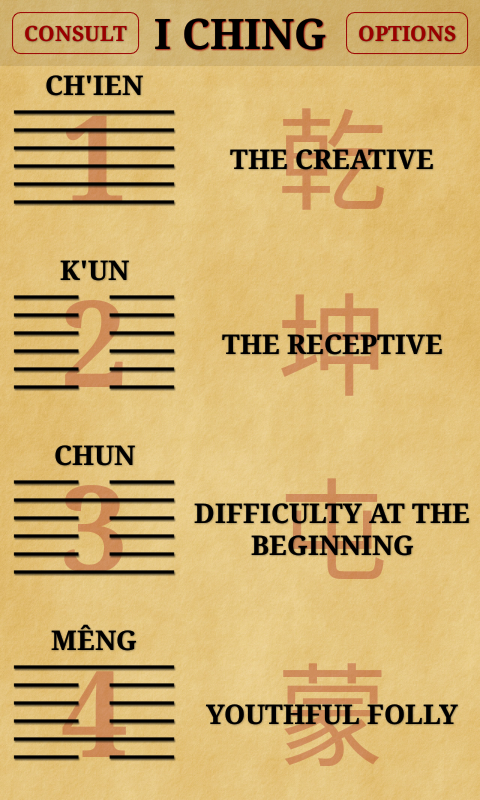
A reading done by Ifá; versus the Dilogun, produces 256 possible combinations of symbols which define specific combinations of Odu. The Odu are indicted by throwing cowrie shells in the sand tray.
The I Ching advisories are found via throwing coins.
This is probably when Ifá probably came to the burgeoning West African kingdom of Oyo, home of the Yoruba. El V has always believed that the Ifá readings of shells and trays and signature advice was based on the I Ching. By the 13th and 14th century the Yoruba had firmly embedded Muslim counselors from "the North," i.e. Islamic Africa El V studied the I Ching when he was taking Chinese classes, and of course he's studied Ifá -- which, it seems not too many, or anybody else, has done both. And now he's got me to bring him the historical trajectory of trade and conquest that made this cultural interpenetration possible. (The Yoruba have always been brilliant at taking something from another culture and transforming it to fit their own expression -- they still do it, as we see in Cuba all the time. Or here, for that matter -- Africans and African Americans are just brilliant at expression, form and style.) History is so exciting! I think telling el Vaquero this stuff made him fall in love with all over again. Ha! And to think this all is because I watch a Turkish telenovella. At one point a primary character is wearing a robe that I swore had Chinese designs on it. So I went looking at more history again. And by golly, that's yet another historic detail the series has right. It's always all about trade. We've only resumed treading aloud, now that el V's back from Cuba, Barry Cunliffe's By Steppe, Desert, and Ocean: The Birth of Eurasia. The maps are brilliant. It's extra exciting when we hit sections that deal with the same peoples I've beeen watching on Qin Empire: Alliance, and Resurrection: Ertugrul, as well as in Jack Weatherford's books on the history of the Mongols. I've been thinking about the steppes, nomads, Mongolians, China, Islam, and trade for several years now. But it's so complicated, and I have no grounding in the geography, so it's hard to grasp this. Once again, I understand how impossible it is to deal with history without geography and vice versa. Ertugrul sends me back to both after every episode I watch, and I think I'm all the more improved because of it.
It's worse than sad though, that we, as USians and Europeans do NOT know this geography and history -- history of actual, long-standing empires that we've never even heard of. If we did have more than a passing acquaintance, at best, with these matters, maybe the world wouldn't in quite the state it is currently.
. . . .Vaquero, an avid twitter follower of carefully curated twits, though not a user himself, drew my attention to this teeny video of teeny pony. I watch it several times a day because it makes me happy. https://twitter.com/NaomiKyle/status/955994132018749440
I wanna go out and play in the snow! O this is so scary! So hard! How do I do this! O O O! I can do it! I can do it! I can do it! O O O I did it I did it I did did did! Yay me!
Not to mention the adorable tiny round hooves . . . .
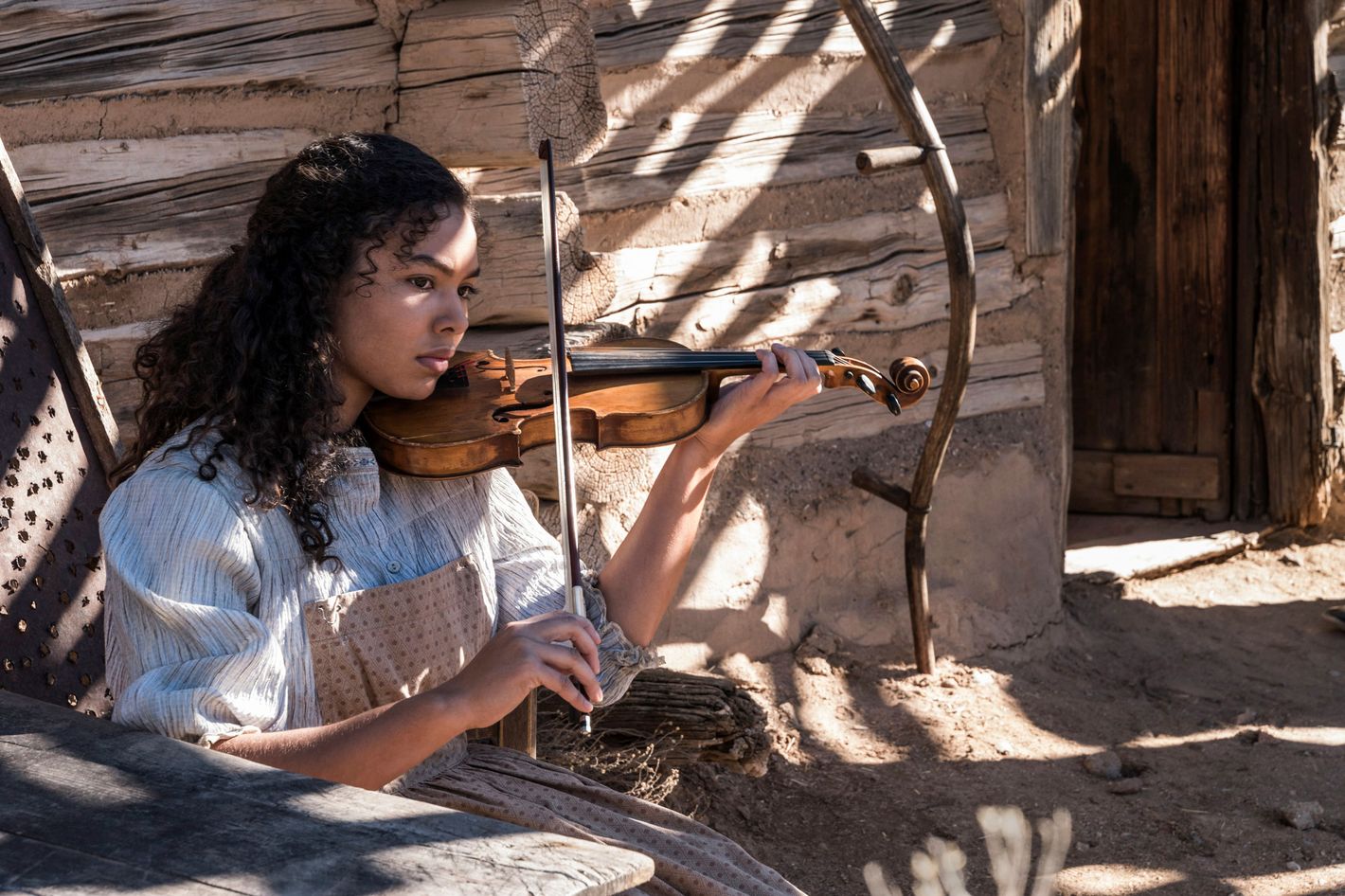
. . . . Godless is a limited (7 episodes only) original mini series. The cast is stellar, starting with that scenery chewer, Jeff Daniels, playing the most eviLe of EviLe.
Godless is the third Western I've watched this month, along with Wind River and Longmire. Godless is set mostly in the town and environs of La Belle, in Taos County, of the New Mexico Territory, in 1884. With few exceptions, the men of La Belle died two years ago on the same day from a mine disaster -- the silver mine being the purpose of this new town. In the meantime a long operating gang (more like a small army) of sociopaths, run by a "preacher" named Frank Griffin -- the number one villain -- is preying on the payrolls and metal shipments of silver mines throughout the region. They are responsible for dead piled up like foothills, women are raped and killed, for no other than the gang gets their jollies this way. They are also responsible for chewing up all the scenery with their evil.
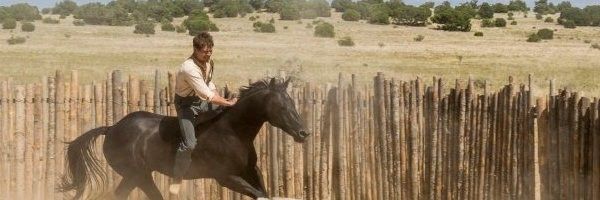
Roy Goode, the good guy, rides a wild horse sans bridle and saddle.
Long ago Frank "adopted" a very young boy without family, Roy Goode (if we can't tell by his name, Roy is perhaps the numero uno good guy; if we couldn't tell he was good guy from his name we know he is because he's a Horse Whisperer). Among the many Hollywood classics of the western genre that Godless most frequently references are Shane, High Noon, The Man Who Shot Liberty Valance, Stage Coach. Shades also of The Searchers, McCabe and Mrs. Miller, and many others. What follows are from the notes I made while watching Godless. As mentioned here, I have been living with the western genre in print and screen all my life, starting from my earliest days as my dad was a huge Western fan. Episodes 1 - 3: Favorite Western trope subversionso far -- unlike, say, McCabe and Mrs. Miller (Robert Altman's 1971 film, much praised for his "unorthodox" and "revisionist" take on the Western, as well for its beauty), in a town where women become widows, they don't become whores. The brothel shuts down, the sex workers move away, or do something else, like become the town's school teacher. They do take on the roles that their husbands filled, from clearing the mind, continuing to explore the silver veins, being mayor, running the hotel. What felt so promising about this is it's clear which men in town didn't die in the mine accident, which reveals starkly economic / class structure: the sheriff, the owner of the general store, the guy who owns and tends the bar, the owner of the livery stable and his black ostler. It's never explained why the mayor had gone down the mine that fateful day, but now his wife, sister of the sheriff, is acting mayor. This all looked so exciting.
Horses – how dangerous these big animals can be. More than once we see big jaws viciously snapping, aimed at ripping out another horse's flesh. However, not once do I believe these are mustangs. For one thing, only human agency trim and shape their hooves so perfectly. Which brings us to – Teaching the kids. Played by Michelle Dockery, The Widow’s son Truckee (her name is Alice Fletcher, but I think of her as The Widow, due to Western trope characters), is afraid of horses and doesn’t know how to ride, despite his Paiute heritage and being on the verge of manhood. So Roy teaches him. Which brings us to --
My favorite character, mayor Mary Agnes McNue, played by Meritt Wever, (with the Widow, Alice Fletcher)
Clothes. Mary Agnes McNue (Merritt Wever's arguably the best actor in the Godless series), now the acting mayor, has put off her women's clothes in favor of her husband's. There’s a bit about Roy wearing Truckee’s dead father’s clothes, to which Truckee's Paiute grandmother mightily objects. It’s after being given the clothes of Truckee’s father that Roy successfully starts teaching the boy what he needs to know to be a man in this environment. How did the reviewers miss this massive transference? Frackin’ shades of Shane! Women – would a woman really go riding around town stark naked? In the summer blazing sun of high altitude New Mexico territory? Frackin’ shades of Longmire! Another favorite trope subversion -- The very young, but highly skilled gun slingin' deputy to Sheriff John McNue, Whitey Winn, played by Thomas Brodie-Sangster (JoJen Reed in GOT) turns out not to be a version of sociopathic, idiot Billy the Kid (who found his end in New Mexico, btw). African Americans -- Among the tropes of classic Westerns, what was missing among the settlers, ranchers, outlaws, doctors, newspaper editors, bartenders, general store owners, etc.? African Americans. We never saw African American characters in print or on screen, yet they were there. Like everyone else, from defeated confederates to railroad investors to German immigrants, they too came west, looking for affordable land and a new life. They are here, in Godless, thank you Jesus, a settlement of ex-Buffalo Soldiers and their families, right where we’d find them historically in 1884.
They also provide the only source music in the series. Of course.
RIP Sam Waterston's Marshal John Cook. You are gone far too early. Thanks to Waterston, Cook's every scene lights up, opens up, relaxes, and provides comfort, which the populations of Godless certainly need. And so do I. Biz men from back east -- if we didn't know they too were evil and filled with more shit than a chicken coop, the lead biz guy mistreats his horse. They shall certainly get theirs. Hopefully from Frank, so they can see what a real bad guy is. Thoughts re 4th & 5th episodes: Alice the Widow's horse ranch -- hookay, shades of Liberty Valance perhaps? John Wayne's character, Tom Doniphon, who did take out Liberty, had this mysterious horse ranch business, which is hinted to be located in New Mexico too . . . and let us not forget how much Ford was trying to subvert the classic Western tropes in Liberty Valance (though, in the end, it's still the one righteous he-man with a gun who saves the day) -- and makes the legend. It would be so cool if it is Alice -- or Mayor Mary Agnes -- who takes out Frank Griffin, not Sheriff McNue or Roy Goode. Please gods of television, let it be so . . . . Classic Western trope subversion -- the cavalry isn't going to save the day . Pinkertons, per usual, are not good guys. But this trope is well and truly frackin' subverted -- he's not even a Pinkerton! How much clothes matter in this series, the putting on of others' clothes and the taking off our old ones, beginning with Roy digging up his father's coffin and putting on the union uniform in which he was buried. This theme continues throughout these two episodes. Horses! More horses! They weave their way through the series as they weave their way through Western classics, and indeed the entire history of humanity. 6th -- & 7th Final Episode A small thing -- I am absurdly delighted with every episode having at last one scene in which those classic Western old-school round canteens are attached to riders' saddles. Until Godless I'd forgotten how long it had been since I saw such a canteen when they were always part of the supplies attached to the saddles of every western I watched as a kid. Boy, was episode 6 ever filled with frackin' shades of Shane! Had to take a break from the final episode because, for me at least, it's all too tense -- these women in one place, attacked by all these men, men who are fresh from the massacre of Blackmond Buffalo Soldiers and their families. The other women and the children hiding in the mine, what will happen to them? With the recent memories of the atrocities in the Bosnian war and others one knows much better what will happen to them than we did in the days of hailing the refreshingly massive, prolonged depiction of so-called Western violence brought to us by1969's Sam Peckinpah's The Wild Bunch. After The Wild Bunch movies continued increase the length, intensity and detail of all varieties of violence. Finished. My biggest criticisms are all about the writing. Why in HELL was Whitey Winn by himself in the sheriff's office, instead of with the women in the hotel where he could do a lot of real good shooting down the evil guys? Shyte, he doesn't even get off a single shot, and isn't even taken down by a faster slinger, but a knife. What the Eff? He's smart enough to rescue his lady love, Louise Hobbs, and her little brother but not smart enough for this? Also, I have to think -- a guy in love with an African American girl and his name is -- Whitey? And how come his is the only funeral we see when so many women were killed? Who buried the African Americans? What happens to Louise Hobbs, who with her brother, are the only survivors of Blackmon? And why in HELL did not a single one of these Buffalo Soldiers, who had chased Frank and his gang out of southern New Mexico and Texas, never get off a single shot and killed not a single one of the gang? And most of all -- why in hell did the wife and mother invited them into her house? Didn't she ever watch The Searchers and learn that evil must never be allowed to cross into the threshold into domestic interiors? My other biggest criticism is that the creators who are so lovingly, meticulously recreating every detail of the Western left out the snubbing post, so characters like The Widow get dragged around by a wild horse after she ropes it. In ranching work, even now, a snubbing post for the handling of cattle and horses in an enclosed space is essential. Rope the animal and wrap the rope around the post so the heavier, stronger creature doesn't take off and pull you along behind it while your clothes and skin are rasped away by the grit and velocity. The saddle horn of a western saddle is mini snubbing post, powered not by being pounded deep in the ground, but the weight of the rider's horse. I did rather like, though it is heavy handed, but keeps that clothes theme going, that Roy again changes clothes, takes off the clothes of the father and husband he had been wearing while working for the Widow and teaching her son, Truckee, and puts back on the clothes of the bad outlaw in preparation for taking out the adoptive father that he's repudiated, sociopath Frank Griffin. I don't get the ghost Indian, horse and dog -- and is there a connection between them and Truckee's grandmother? Someone suggested this might be the Shoshone ghost and his dog were Bill's spirit guide. At least until Roy saw him too. Then there's this too:
"Truckee (Wuna Mucca,[1] The Giver of Spiritual Gifts,[1] Old Winnemucca, One Moccasin,[1] Onennamucca,[1] sometimes known as Captain Truckee) was medicine chief of the Northern Paiute and an influential prophet.[1]"
But if this is so, it didn't go anywhere, while demanding the viewer google, which is a negative, even a deficit, on the part of the writers. As far as Truckee and Frank -- holy cow, talk about grooming, as Frank tries to pull in Roy's surrogate son, for -- well, what, really? the seed of a new band of sociopathic killers? My only previous reference to "Truckee" have come from old 19th century popular songs of the Gold Rush, and the post War of the Rebellion era, about railroads, and the carnage of Indians and the buffalo massacres, which lyrics contain geographical points such getting washed out crossing the Truckee River. And that newspaper editor -- o yes, the media was as filled with liars then as now. Damn! somehow that skank survived. Yet more frackin' shades of Liberty Valance, subverting a subversion. No printing of legends here, only lies, i.e. fake news. In any case, the series begins in a cloud of dust, it -- mostly -- concludes in a cloud of dust, fire smoke and gun fire smoke. From the dust thou hast come and to the dust thou wilt return. Do not requiescat in pace, Frank Griffin, you evil, terrible, ugly man. May you suffer through all eternity. Conclusion: I immensely enjoyed seeing the series of homages to the great Western movies that we all know and have watched so often. I particularly then enjoyed how, in the right places, the creators of the series twist them around from what they've always been. They don't do it in every case, but one can feel and see the intelligence behind choosing not to subvert the trope. So the series works beautifully at this level, particularly because it is seamlessly united with what Westerns by the Hollywood greats, John Ford, Howard Hawks, even Sergio Leone, etc. looked like. However, this strategy for creating a world class Western depends on the viewer knowing these previous films. This strategy then becomes almost a game for the creators, playing with their own favorite, most admired material out of the work of others many decades ago, particular the cinematography. In that sense Godless is a personal production, aimed at insiders, not necessarily aimed at everyone. Unfortunately that means that the creators didn't care as much about narrative power and audience's engagement by seeing all the parts add up to something larger than the parts. These beautifully composed, lighted and filmed scenes receive significance, they don't provide it. The more the viewer knows the homage, the more the viewer sees. The less the viewer knows, the less the viewer receivers. Godless didn't work well on these levels of story and character. Today, the more I think about it, the less successful it appears. The narrative tension and drive don't come from unfolding plot and character revelation, but from the audience's foreknowledge that yet another terrible massacre will be coming from Frank Griffin and his gang of sociopaths -- horrific, beautifully detailed violence -- frackin' shades of Peckinpah and The Wild Bunch. Will Roy save the day? Will the women of La Belle save their own bacon -- or be as hideously raped and murdered as we've seen the gang do already? Then, in the end, despite the shout lines about Godless that the story is about a town of women and children, somehow, with plot armor and hand wavium, two Real Men save the day. Which doesn't quite make sense either. Frank's gang has 30 members. The women took down at least 82 guys by themselves by my count -- yet Frank isn't shot and there are still 30 men to be taken out by Roy the rogue outlaw and Bill McNue the Sheriff, plus then, the final show down (Classic trope!) between Frank and his adopted son, Roy. We never find out why one of La Belle's women shot Alice Fletcher's husband -- and in the back no less. Nothing more is ever made of her dead husband other than her giving Roy his clothes. Alice's Paiute mother-in-law says this is bad because Roy is death and she wants him gone. When he does go, she calls him "dove" -- frackin' shades of Lonesome Dove, maybe the most successful New Western ever on television. We don't know why the wife of this new settlement's mayor is the sister of the sheriff, making a nice power bookend for the town, right? We don't know how the general store owner and his sons behaved after the sheriff forced to them to rescind their forced and illegal occupation of the Widow's ranch. It really bothers me that the class / economics strata don't get any attention. We never learn how the Widow became a successful horse supplier and dealer, despite evidently never hearing of a snubbing post or how to break horses en masse. And in the end it is made cinematically clear, despite what the creators told us, this wasn't the story of a town of women, but of men, particularly one single solitary man, who rides off into the gorgeously shot western scenery for more than the last EIGHT minutes of the final episode's screen time, who is the last thing we see before fading to the credits. How much more unsubverted, non-revisioinist classic western trope can ya get? So yah -- like Wind River, another New Western I watched this month, this is all surface -- beautiful, gorgeous, meticulous surface -- but not much content.
Who wouldn't want this coat, since we know it was not made of baby seals but some faux fur substitute? (Normally Declan Harp doesn't look this good -- he gets beat up and bloody at least as often as Walt Longmire and Henry Standing Bear do in Longmire.)
. . . . Western next up, the second season of Frontier, another Netflix original, located in the very early 18th century, in Canada, featuring the struggle over control of Canada's extraordinarily lucrative fur resources. Among the actors are Jason Momoa, who played Drogo, the Dothraki ruler, who made Daenerys, Mother of Dragons, his wife, and Katie McGrath who plays Morgana Pendragon in the Adventures of Young Merlin series.
Vulpine, canine, feline, porcine & equine avatars. Gone to heaven Gone to hell Gone to jail Gone to work Gone to school Gone to lunch Gone to bed Gone to bad Gone to pee Gone to earth. Gone Gone Gone. Fox's earth is Blue Gotham City. Shorter sojourns are spent in other, more dangerous, locations.
















/cdn.vox-cdn.com/uploads/chorus_image/image/57711769/818_161005_JM_A_06_038R.0.jpeg)