LINES OF THE DAY

". . . But the past does not exist independently from the present. Indeed, the past is only past because there is a present, just as I can point to something over there only because I am here. But nothing is inherently over there or here. In that sense, the past has no content. The past -- or more accurately, pastness -- is a position. Thus, in no way can we identify the past as past." p. 15

". . . But we may want to keep in mind that deeds and words are not as distinguishable as often we presume. History does not belong only to its narrators, professional or amateur. While some of us debate what history is or was, others take it into their own hands." p. 153

Silencing the Past: Power and the Production of History (1995) by Michel-Rolph Trouillot

Showing posts with label Poland. Show all posts

Monday, November 14, 2022

The Struggle That Failed 1919 -- 1945

     . . . . Hitler: A Career (German: Hitler – Eine Karriere) (1977)

West German documentary film about the career of Adolf Hitler directed by Christian Herrendoerfer and Joachim Fest and written by Fest, a German historian.

 Everything on screen is documentary film footage shot at the time in real time, though the narration – in English -- is not, and overdubbed.

This latest edition of the digitally restored period film footage, which the team that got this on Netflix did, taking out the herkyjerky fast walking and so on that we were used to from footage of the time – the miracles that can be done now.  It’s much easier watching this 1977 film in 2022 than it was to watch on television in 1977.

As per usual, my first question was the same as it always is when watching nazi documentaries. Where did the nazi organizers get these hundreds of thousands participants in the spectacles, that are viewed by an equal number of wildly cheering spectators, how is it possible the paraders and performers can execute the endless vast unison parading and maneuvers that, among other things, create monumental swastikas of human beings?  (Later in the film there's some analysis as to why so many of these spectacles were arranged at night -- the dark covered up much of the reality of what was there.)  I also think, seeing the scenes of the nazi youth groups how much I’d hated growing up in nazi Germany – those girl youth camps in which one is told that washing clothes for the family was more fun for girls than going to school, forced to play volleyball instead of reading books. They sound like mother did, having a fit when she asked, "Why don't you like anything about housework?" and I looked at her as insane.


Poland, is often regarded as comically out of date confronting Hitler’s invasion of tanks and aircraft, without any of the weapons and infrastructure of a modern army.* However, we forget -- if we ever knew -- how little time Poland had in the last 100 years or so to even BE A NATION, much less have the money or time to create a modern army, since the partition and disappearance of it in the 18th C. Under the circumstances, that it took Hitler’s forces 2 weeks to subdue Poland seems, to me, at least, admirable and truly heroic, not something for non-Poles to feel superior about. Not to mention our current home-grown nazis would never heroically make a stand like that against even an equal force, much less such an overwhelming one.  Shoot, they can't even stand up to not having somebody cooking breakfast and handing to them, or have teenage girls laugh at their trux.

On! To Moscow. Mud up to the horses’ shoulders. Mud past the tanks' treds.  Then snow, higher than the horses' bellies. This is footage shot on that advance, and the defeat WWII -- a scene of Hitler walking in snow behind the lines and the front's 'advance', stating, "I hate snow.  I never want to see snow again." Then going back to Germany, where, presumably some heads rolled, due to snow not foretold or removed.

Whilst the viewer ponders how so many of the scenes of vast numbers adoring Hitler and the nazis, united in joy of hatred, often in tears – thousands of girls melting down over the Beatles have nothing on these hormonal charges – we’ve been seeing in the last few years. 

* Poland's cavalry charge against tanks and aircraft is a myth.

The true story behind the myth is as follows.

On Sept. 1, 1939, a Polish Cavalry regiment operating along Poland’s northwestern border attacked a column of unsuspecting German infantry.

The invaders were quickly scattered, but before the Poles could celebrate, a squad of German armoured vehicles appeared on the scene and inflicted heavy casualties on the horsemen with their canons and machine guns.

The next day, war correspondents were brought to the scene and told that the Poles had charged German tanks.

Despite no one actually having witnessed the supposed charge, seemingly overnight the story spread across the globe and was quickly accepted as true. Both Time Magazine and The New York Times described the incident in hyperbolic detail; high ranking German officers recalled it in their memoirs; and even Winston Churchill mentioned it in his history of the Second World War.

I suppose we need not be surprised that one of the most solid, enduring platforms of this myth is a film the nazis shot to show their infinite military superiority to everyone?

…. Perhaps the most notorious example was the pseudodocumentary Kampfgeschwader Lützow, which featured staged footage of Polish cavalry charging panzer tanks. ….

Wednesday, October 20, 2021

Crime In Our Hands (Books), Crime On Our Screens (TV)

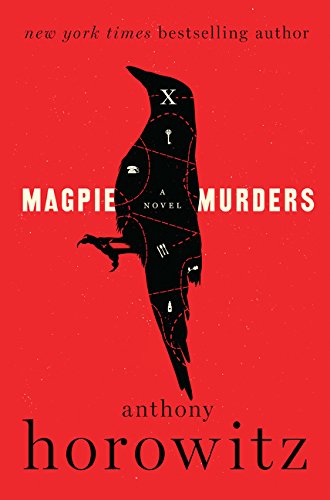
     . . . . Horowitz, Anthony. (2016 in the UK, 2017 in the US) Magpie Murders.


In some ways this is an odd, if clever, duck of a crime novel that is two novels in one.

There is The Magpie Murders itself, the last novel by Alan Conway, a best selling crime author whose series features Atticus Pünd, a detective much like Poirot, though German, not Belgian, and rather younger than Poirot, having gone through internment in a nazi death camp. His rescue by the British allowed him to remove to England, thus the series's plots are set in the 1950's. The second, the framing novel, is set in our present, narrated via Susan Ryland, the verging on middle-aged editor of Conway's Atticus Pünd series.

Throughout the two novels, past and present, do homage to the golden age of British crime fiction divas such as Christie and Allingham. They also reference constantly the crime novel series that Horowitz has been instrumental in producing, adapting and writing series for television, which are many, and all of which I've watched, just starting with Agatha Christie's Poirot, Foyle's War and o my, but not only! -- Midsomer Murders!  To be sure, the opening chapter of the framed Conway novel feels right out of the opening shots of the pre-Neal Dudgeon Barnabys of Midsomer Murders, with a pan of the village and the character-suspects

Magpie Murders was a thoroughly engaging whodunit until -- soon in the second section of the framing novel, with us back to Susan Ryland's pov and narration. It sags then, going on too long, and ultimately the solution of the crime within it and who did it, is as unsatisfying as the one at the conclusion of the framed Atticus Pünd Magpie Murders. 

.... Horowitz first developed the concept of Magpie Murders during the first season of Midsomer Murders, which premiered in 1997. He has stated that he wanted the novel to "be more than just a murder mystery story" and to be "a sort of a treatise on the whole genre of murder mystery writing. How the writers come up with the ideas; how these books are formed."[1] ....

It is that indeed, which is entertaining and even useful in itself for anyone who likes to read and watch such series, and anyone who wishes to read them.  Additionally, the book is as overstuffed as candied fruit in a Christmas fruit cake with real life best selling crime series writers’ and reviewers encomiums to Pünd, such as Ian Rankin, Ann Cleeves, etc.  Does one need to say Horowitz is adapting this novel for Britbox and PBS? 


.... In July 2020 Deadline announced that PBS’ Masterpiece would adapt the novel into a six-part drama series and air it in the US, and will air the series on BritBox in the UK.[12] ...

This Horowitz guy, never stops writing!  Check it out here.

~~~~~~~~~~~~~~~

     . . . . And yet more village crime!

In For A Murder - W Jak Morderstwo in Polis (2021) Netfix Poland Original.

It revolves around a murder that takes place in a small town in Poland and Magda, a resident in the neighbourhood takes it upon her to investigate the case and solve the murder. However, when the case draws back to some past incidents, the events that follow seem to get complicated.

An updated, Polish Agatha Christie given the screen treatment we know so well by now from Brit tv, like Midsomer Murders etc. and by now later updates such as the Daniel Craig Knives Out.   We even begin with long tracking shots of a lovely youngish blonde woman, riding a bicycle on lovely wooded tracks, getting lovely veg and fruit and honey from the street market, returning home to cute kids in a lovely house. But the husband, nope, not so much . . . 


The W/V necklace we see here is significant to the crime and mystery In For A Murder.


I enjoyed this very much, not least because of its location, which isn't either England or the US,


 in the same way I so enjoy Candice Renoir, the French policier featuring a blonde verging on middle-age detective who is a divorced mom, kind of messy, anxious about her weight, but not that much! brillian  -- and whose smile should be registered as a dangerous weapon.  She turns that smile on someone and any resistance goes out the door.


Friday, December 30, 2016

The Black Cross and Blu-Ray

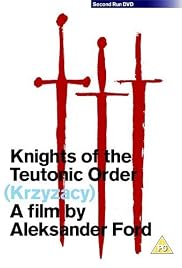
     . . . . I watched about half of Polish director Aleksander Ford's Krzyżacy / The Black Cross / The Knights of the Teutonic Order (1960) last night in blu-ray (there are a variety of titles by which this film is known outside of Poland).


The novel by Nobel-prize winner for literature, Henryk Sienkiewicz, from which the film was adapted, was published in 1900. Sienkiewicz's historical novels are one of my historical fiction passions and admirations. The author wrote them in fire, from his passion for educating the Polish people in their language, culture and history, all of which, even lullabies, were forbidden under the occupation years of her 18th century partition,


This was my first blu-ray experience. It was an eye-popping visual experience, which additionally was critically revealing. I admit that blu-ray is a superior medium for experiencing certain kinds of films, though it probably doesn't matter for the run-of-the-mill shoot and / or blow up everything that moves or bro-mance drunken stupor varieties.


The Black Cross is one of those whose excellence is truly revealed by the meticulous restoration and blu-ray conversion of Scorsese's Masterpieces of World Cinema treatment.*


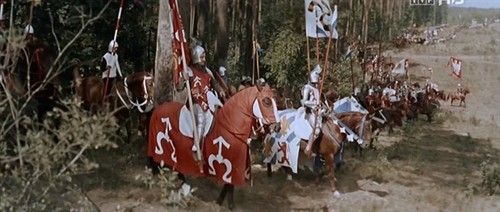
It's an historical epic, filled with crowd scenes (of actual human beings, whether mobs, armies, weddings -- not CGI cloned mud), panorama landscapes of rivers, forests and mountains, close-ups of wild life, such as owls, in which the subtle shading of every feather is visible.


As the tale is set in the late medieval era (14th century -- Battle of Grunwald, the film's conclusion, was in 1410), showcasing the traditional social and cultural life in Poland's town and country. Whether disappeared among Prussia, Russia and Austria, or under soviet occupation, the palaces, fortresses, and other buildings remained intact, not torn down and replaced. The wild regions were pristine too in 1960 -- and remained so until now under this current Polish plundering 'populist' government. Each brick is clearly visible, each bit of fabric of a gown or a fur -- the colors of the townspeople's traditional dress in crowd scenes, the outfits of the musicians, the armor of the warriors and the tack of their horses -- they're all brilliant and pulsing with historical information.


I have attempted to watch this same film previously on dvds from the NYPL. It was so unsatisfactory I had to quit, particularly as the subtitles were often unreadable. There is no resemblance between these blu-rays and those dvds beyond the plot. As I hopefully have shown, there are many reasons to watch these films that have nothing to do with plot. However, this being Polish and based on a novel that was certainly politically motivated, the plot does serve to illustrate those concerns as well.

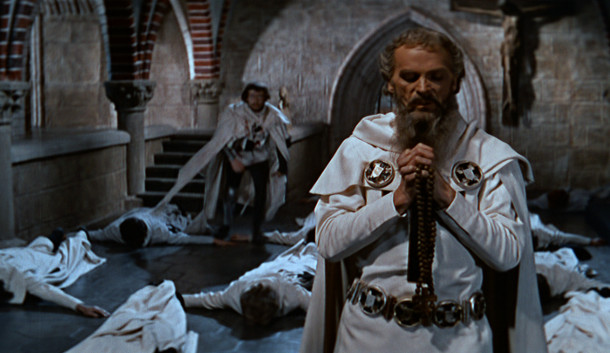
All that said though, it does feel somewhat odd to see so much of the histrionics of early cinema acting employed by the actors, particularly in the scenes among the Teutonic Knights in Schytno, their castle-fortress,  as well as the claustrophobic cinematic techniques soviet era Russian filmmaker that we see in Sergei Eisenstein's two-part historical, Ivan the Terrible. That was filmed in black and white, so the shadows and sense of being enclosed underground, extreme in its foreboding of the "coming of Stalin," were deeply affecting to the audience and fit well with the exaggerated, stage operatic physical acting, even though the film was released in 1944.


But Black Cross is in brilliant, sparkling color of 1960's film, so this jars. But it probably is supposed to -- as the Knights' dress is black and white, and their fortress is a dungeon from top to bottom (the views of that fortress and the drawbridge and all its impregnable defenses are worth seeing all alone). And director Aleksander Ford was highly educated in film history.

None of that above is anything I was able to see and reflect upon in the other dvd version of The Black Cross I saw. This is why Scorsees's Masterpieces of World Cinema - Criterian collections are such expensive, limited editions and aimed at professional cinephiles, presumably.

The horses and the horsemanship are spectacular. The dancing is equally so. These are Poles riding and dancing, so, of course!


I wish that this same treatment had been given to the Jerzy Hoffman films made from what is known as Sienkiewicz's Trilogy of the time of Poland's great troubles in the 17th century.  They are even more brilliant than The Black Cross.


---------------------------------


*  Go here to see the contrast in the film before the Scorsese treatment and after.

Friday, April 8, 2016

Polish Arab Studs In International Scandal

     Horses have historically been central to Poland's pride, honor and culture -- as well as defense.


Lately Poland's government decided to interfere with the management of these ancient stud farms. Why is this global news? an international scandal?  Because the Polish Arab breeding studs have been supplying and augmenting the Arab breed's pedigrees for generations of the international Arab breeding class.  And now the breeding stock is imperiled.  This particular malfeasance that affects the rich pits the globally rich and famous against Poland's governing class, many of whom are also very wealthy.


  Post Card: Janow Podlaski Arabian Stud Horses, Polish Tourism Promotion Poster
    
During the cold war, the stud discreetly supplied the world’s elite from behind the Iron Curtain, providing a valuable source of hard currency to the communist regime.
The Arabian is considered one of the oldest horse breeds in the world and has been recognised on 4,000-year-old rock paintings. The qualities of Arabian horses – endurance, grace and speed – mean their bloodlines are found in most modern breeds of riding horse. They arrived in Poland in the 16th and 17th centuries as war spoils from battles with the Ottoman empire.

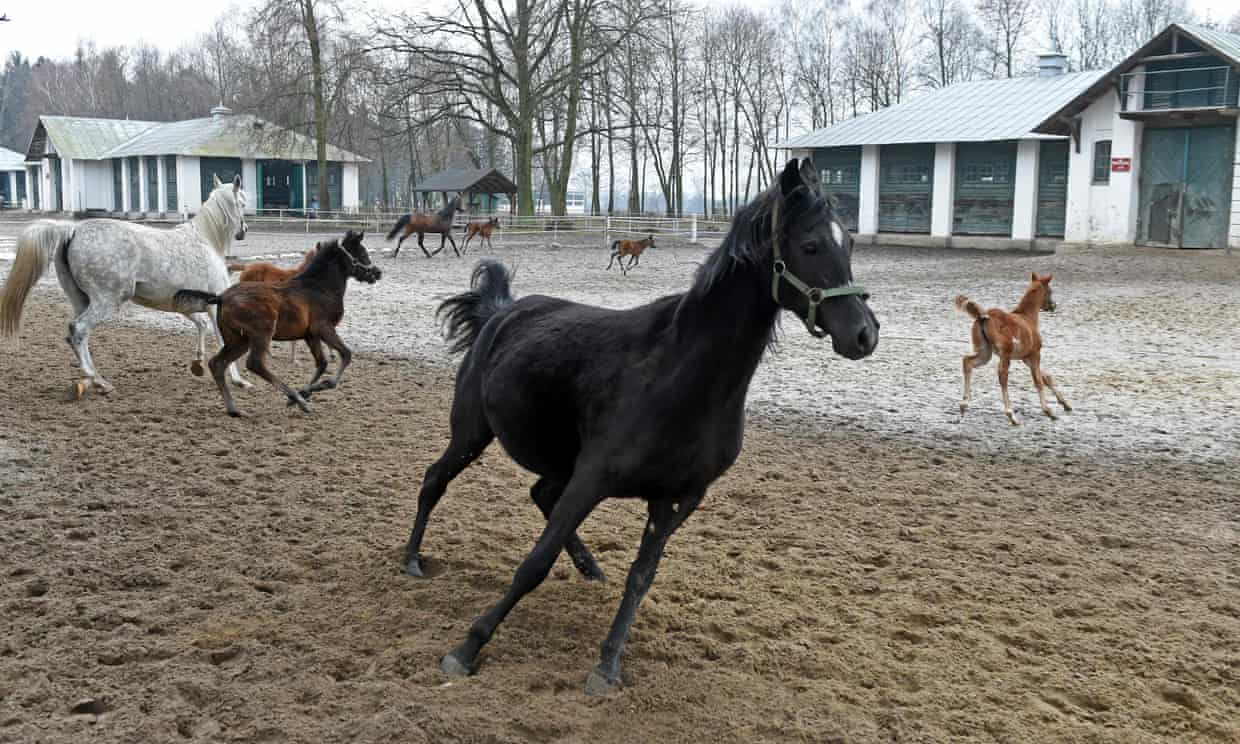
 Horses play in Poland’s state-owned Janów Podlaski stud farm. The stud is famous for its world-class Arabian horses but its director was recently sacked. Photograph: Janek Skarżyński/AFP/Getty Images

Among those profoundly affected by the mismanagement instituted by the Polish government's changes to to the personnel running the stud farms is the wife of Rolling Stones' Charlie Watts, Shirley Watts:


     The British horse breeder Shirley Watts, who runs a stud in Devon with her husband, Charlie, the Rolling Stones drummer, is threatening to sue Polish government officials after the death of two valuable Arabian mares she owned at a state-run stud in eastern Poland.
Poland’s agriculture minister, Krzysztof Jurgiel, is already facing the ire of the tiny but highly influential Arabian horse breeding world after he sacked three respected state-employed breeding specialists.

The two 16-year-old horses, Amra and Preria, died while in the care of Poland’s prestigious Janów Podlaski stud, to which Watts had loaned four mares in a cashless arrangement to help expand a valuable Arabian bloodline. Her two surviving mares, which are pregnant, were being transported home from eastern Poland to Halsdon stud with urgency.

Poland's government seriously effed-up.  Keep politicians -- particularly male politicians -- out of reproductive processes!


     She [Anna Stojanowska, Poland's national horse breeding inspector] said: “Poland’s reputation for breeding was hard built, by people with passion who never watched the clock. Trela has been replaced by an economist, Marek Skomorowski, who says horses are his hobby. Once we lose our reputation, that’s it, forever. It happened to Russia’s studs and it may now happen to ours.”

Warsaw-based Stojanowska said the sackings had been “part of political games” by the Law & Justice government, which won the October 2015 parliamentary election pledging to institute “dobra zmiana” – good change – in state enterprises where central government is perceived as having lost control. The policy has already led to dozens of sackings and resignations from state companies including a major regional insurer, PZU, the main electricity and gas utility companies and the mining conglomerate KGHM.