LINES OF THE DAY

". . . But the past does not exist independently from the present. Indeed, the past is only past because there is a present, just as I can point to something over there only because I am here. But nothing is inherently over there or here. In that sense, the past has no content. The past -- or more accurately, pastness -- is a position. Thus, in no way can we identify the past as past." p. 15

". . . But we may want to keep in mind that deeds and words are not as distinguishable as often we presume. History does not belong only to its narrators, professional or amateur. While some of us debate what history is or was, others take it into their own hands." p. 153

Silencing the Past: Power and the Production of History (1995) by Michel-Rolph Trouillot

Showing posts with label African American History. Show all posts

Wednesday, March 24, 2021

Reading and Listening: Black Nerdom

      . . . . In a sad way, because in this absolute white supremacist historical nation, the common denial that this subject even exists is as normal as mass gun fire massacres. But though I am anything but a nerd of any kind, much less one who is Black, I still feel a sense of personal skin in this game. 

This is due to an incident that happened at the last sf/f gathering I attended, which happened to be a reading, in the early aughts of this, the 21st Century.*  A White man, ended threatening me with rape and murder because he insisted that Black people did not and never did have anything whatsoever to to do with sf/f and its peculiar** visions of the past or the present or the future. He slammed a chair on a table when I tried to draw attention to Afro Futurism and African American musical vision in funk, jazz,  including as early with, but not limited to, Sun Ra.
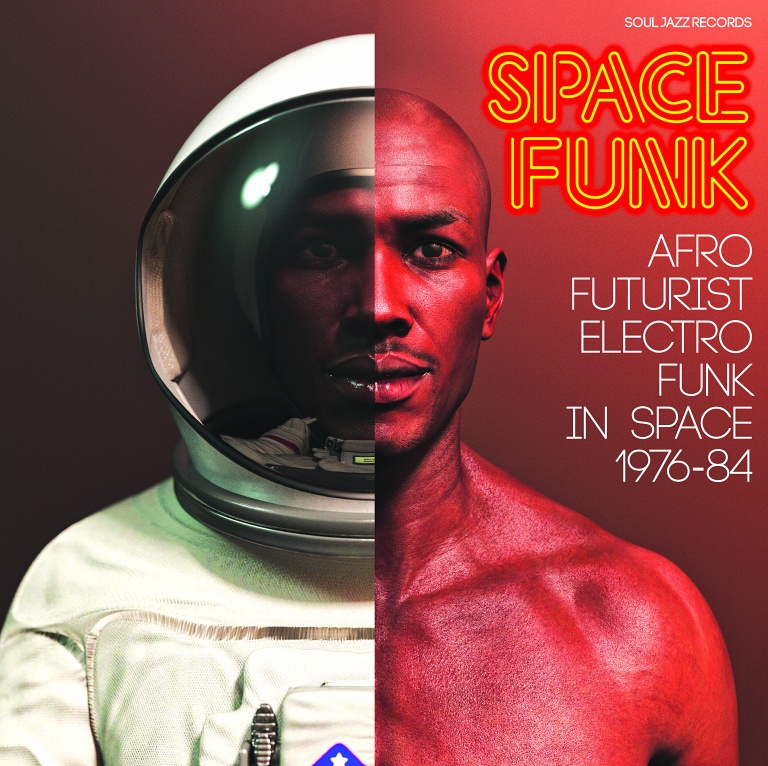


 He screamed I was a liar, that I'd made-up Afro Futurism.  There was no such thing, and certainly not in Science Fiction and Fantasy.  For one thing HE had never heard of it, and he knew science fiction and fantasy inside out,  because he was now 50 and had been reading it all HIS life.

Alas, we are certainly still holding on with fang and claw to that peculiar* white version of sf/f -- and all the other related pop cultural expressions and experiences.


Long read article in the New York Times Magazine.  As the NYT is paywalled, here is the url:

https://www.nytimes.com/2021/03/24/t-magazine/black-nerds-culture.html

The Black Nerds Redefining the Culture by Adam Bradley

"By pushing back against centuries-old stereotypes, a historically overlooked community is claiming space it was long denied."

The piece is a fine run-down of pop culture sf/f nerdom and Black expression.  However, this is my favorite part, which is equally essential information for White nerds who are BLM allies:

....A BRIEF HISTORY of Black nerds dates back to before the Revolutionary War, to Phillis Wheatley, the young Black woman born a slave who was the first person of African descent to publish a collection of English poetry — only to have to prove her authorship, as well as her knowledge of the works of Homer, Ovid and Virgil, to a panel of “the most respectable characters in Boston,” as the 18 white men described themselves in a note “To the Public” that introduces her “Poems on Various Subjects, Religious and Moral” (1773). The Black nerd also lives in the pages of Charles W. Chesnutt, whose short-story collection “The Conjure Woman” (1899) reads like a late 19th-century iteration of Peele’s “Get Out,” where the resources of the Black imagination overcome the sunken place of white mythmaking and domination. And it lives in Ralph Ellison’s “Invisible Man” (1952), whose nameless Black male protagonist is a self-described “thinker-tinker” writing the story of his life from his underground lair fitted with precisely 1,369 light bulbs; even the novel’s title evokes H.G. Wells’s science fiction classic “The Invisible Man” (1897), repurposing invisibility as a metaphor for the erasure of Black identity under the racist white gaze....


Alas, unmentioned are two early expressions -- these would be very early even if the author was White -- of sf/f imaginings, Iola Leroy, or Shadows Uplifted (1892) by Frances E. W. Harperand, even prior to the War of the Rebellion and abolition, Blake; or The Huts of America: A Tale of the Mississippi Valley, the Southern United States, and Cuba (1859) by Martin Delany.


(Anyone who knows me or el V can see why this discovery excited us so much.  Ha!)

~~~~~~~~~~~~~

In the meantime, even though The American Slave Coast has been out of print in print for months, due to the covid-19 aggravated shortage of print and production plants, Robert Christgau was moved to give the book his current Substack space, And It Don't Stop.  He told us yesterday, when informing us it was going up, that he'd been working on this 'stack' for weeks.  It also took him years to read Slave Coast because the content is so painful to read.  But it is a permanent, large, part that is our nation's history. 

~~~~~~~~~~~~~
*  This incident had a great deal to do with my removal of self from the field.


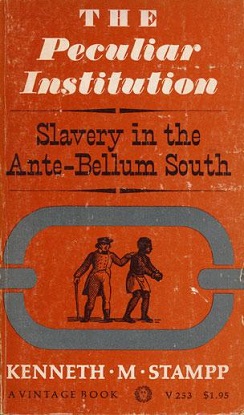
*See the classic history by Kenneth E. Stampp, The Peculiar Institution: Slavery in the Ante-Bellum South (1956). The book was revelatory still at the end of the 1980's when I read it first.  It is still most worth reading, particularly if one is beginning a program of self-education into these matters, in hopes of being a better informed ally of BLM.


Friday, June 12, 2020

Horses Have Their Part FOR Black Lives Matter

     . . . . Horses continue to do their part for Black Lives Matter, as opposed to the horses coerced by police against Black Lives Matter.
How one woman on a horse at an Oakland protest became a symbol for revolution‘You can’t ignore a big, old pretty horse with a black woman on it,’ says Brianna Noble

Since she brought Dapper Dan to downtown Oakland on May 29, she’s inspired black cowboys and cowgirls throughout the country to join protests.

Though somehow Owen Wister*, author of The Virginian (1902), which takes place in Wyoming, and his best buddy, Theodore Roosevelt, who proudly claimed the title of Cattleman and Rancher to describe himself, and both wrote extensively about "the cowboy", somehow they both managed to not notice there were black cowboys. Theodore Roosevelt went so far as to say, invoking his slaveowning Georgia family, that being a "Cattleman" was as good as being a plantation owner.  Owen Wister's Virginian flatly stated that the West was "white man's country."

Judge Henry, the Rich Feller in Wister's novel, who like Theodore Roosevelt, in North Dakota, owns the vast kingdom that he calls his ranch, which is made up of public lands to great extent, flatly explains to the effete eastern school teacher, that all this land was made for his exploitation, and when he's extracted all the animals, grass and minerals, they will just move on.  

Explains a lot about this country, doesn't it.

Thus these stories of Black Lives Matter riders, both men and women, are particularly important parts of correcting our erroneous ideas of history, both of who 'settled' the West and who made western culture.

~~~~~~~~~

*  Wister was one of the children English actress, Fanny Kemble, lost, when she left her husband, Pierce Butler, perhps at the richest slaveowner in the USA, appalled when she learned what slavery was.  Some years later she published (1863Journal of a Residence on a Georgian Plantation 1838-1839. This was done at the urging of abolitionists in the hope this account of a slave plantation would mobilize British opinion against the CSA.

During the course of researching and writing The American Slave Coast, we got to visit St. Simon's Island, where the plantation Fanny Kemble lived on, was situated.  Bits and pieces of it are still there.

Friday, April 10, 2020

Stayin' Alive R U ?

     . . . . Woke to it being cold again, due to snowstorm in New England.  Thank goodness amiga Eliza and her family are still OK in their Vermont family home, though still not having that much wifi -- shestill  drives to the deserted high school campus about 6 miles away, and sits in her car with her devices to teach her five Distance Courses for the University of Chicago and the New School. She's looking forward to it being warm enough that she can sit outside at one of the HS's campus picnic tables to do this.

One of E's distance learning students wrote this essay, re Disney's The Princess and the Frog, employing copious Sublette quotes.  

Week Eleven: Viewing/Reading Responses for New Orleans in Lit, TV & Film.A.Sp20.Online:
Hi everyone,
Hope you're all doing alright!!
The Princess and the Frog is a film I'd seen many times before because my younger sister has always loved it. After completing this weeks readings, I re-watched the film through a completely new lens and so many issues jumped out at me.
I immediately noticed how segregation was prevalent in the restaurant where Tiana works. Although there were black and white customers, none of them were seated together. Tiana and her mother are also shown sitting at the back of the street car, and of course, at around 24 minutes, Mr. Fenner reveals that Tiana was outbid but consoles her by saying "...a little woman of your background would have had her hands full trying to run a big business like that." All of these issues contribute to the intersection of socio-economic class and race that show up throughout the film.
While the instances of segregation and Mr. Fenner's blatantly rude/racist/sexist remark both make historical sense for the time, since the movie is based on a fairytale and is totally imaginary and up to the discretion of Disney to create—why not either create an incredibly rich and diverse movie that can be fantastical and fun, or, actually take the time to dive into the issues that are so clearly present? "From Edwards' perspective, "the forces were against Tiana [her]—it could be sexism, racism, classism. But we didn't want this story to be one that teaches people about racism," (Gregory 443-444). If the movie isn't meant to teach people about racism, then racism should not be included. Disparity runs rampant and it is so obvious visually how racism plays a role in the version of New Orleans that Disney specifically chose to create. The La Bouff mansion is juxtaposed with Tiana's neighborhood in the Ninth Ward "...without questioning or problematizing the socio-economic disparity or difference encoded within the streetcar journey between the two," (Turner 85). I thought that was problematic as well. Unless a little kid (the films target audience) asks their parent about these inequities, how are they expected to learn? Most of the more serious offenses took place in the beginning of the film, so that by the end you're left with the "happily ever after" mentality, which is incongruent with history.
I also noticed that Prince Naveen's character spoke an imaginary language at times and was from a made up place, Macedonia. With such a rich history of immigration, I didn't understand why Naveen could not have been from a real country like Haiti or Cuba when the film was set in a real city anyways. As Ned Sublette wrote in The World That Made New Orleans, “...the uniqueness of New Orleans owes in no small part to its rapid succession of three distinct colonial eras, each with its own ruling European language and distinct associated African world,” (Sublette 277). Because some aspects of reality, like jazz, were incorporated into the film, the line is blurred between fantasy and what life was really like in the 1920s south. Disney "...uses The Princess and the Frog to make jazz (and therefore blackness) more accessible to its white audience," but this form of "blackness" is very particular and easily commercialized (Gregory 441).
In terms of what we read from The World That Made New Orleans, I was very struck by the idea that “Whether Jefferson exercised his option or not, he could have sex with Sally Hemings whenever he wanted. The matter of consent was irrelevant, because she could not refuse. Because that’s what slavery was,” (Sublette 216). I thought this was such a blunt way of putting things but very necessary to get the severity of the point across. Following this, it was insane to realize that although under Jefferson some slaves could learn how to read, writing was prohibited “...because if they could write, they could forge passes to leave the plantation,” (Sublette 216-217). That is just pure evil!! It makes it so clear that slave owners knew perfectly well how poorly they were treating slaves and knew if they taught them to write they would essentially try to escape.
In relation to The Princess and the Frog, I couldn't help but to think about Tiana's own lighter-skinned appearance when I read that “The market term for young, light-skinned sex slaves was fancy girls. It was the most notorious, and the most profitable, segment of the slave trade,” (Sublette 237).
Looking forward to reading everyone's responses to this week's content. Sending love and California sunshine to everyone.
~~~~~~~~~~~~~~~

Last night slept well. After about four nights in a row of less than 5 hours of sleep, and not consecutively, last night I must have been out well before 11 PM. Was awake only once, when el V roused me from a nightmare, about 11:45. It seems rubbing the CBD Freeze lotion into the lower back at bedtime works really well in combination with the CBD Rich Tincture EC sent.The sub labial tincture I do when drinking breakfast tea. As far as workouts go, I’m almost 100% again with weights, stretches, cardio-respiratory and reps. One more session to go and I’ll be there. That’s four sessions now. Not too bad, since I only resumed on April 3rd, after March 6th last workout. In any case, whatever the reasons, thank the lordessa that yesterday wasn't Wednesday. That was a horrible, awful, heebie jeebies utterly terrifying day.

In this AM's email received an inquiry as to our well being, this one from a woman who often handles my research library borrowing requests: "You are far and away our favorite patron, always interesting, always paying attention and never giving anybody a hard time, instead making us all feel good about ourselves and what we do."

el V, however, didn't sleep at all, so stressed. Now he's in an online conference on Cuba for an hour and a half.  He won’t stay off the computer for anything.  He should be exercising.  His blood pressure and reflux are off the charts. We have a blood pressure measuring device now and it says so.

~~~~~~~~~~~

The Post Office is seriously in trouble; chiefbloodonhishands refuses to allow them any assistance. Hey, no voting by mail -- make all the Dems stand in long lines and get sick and die, you betcha!

It does look as though the post office will collapse early this summer, without federal rescue. I've written several papers as to the historical background as to why the rethugs have been trying to destroy the United States Post Office since the days of Nixon, when he removed the Constitutionally mandated Post Office as a Cabinet Agency.

Goddamn! even Genghis Khan organized a government postal service because without one his empire would soon collapse. According to the international criteria to be a nation state, there must be a postal service. So the news remains grim and deadly, for the whole country and particularly for New York City.

They are waging war and massacre upon us via bio-chemical means.  They may not have invented and released covid-19, but They know how to take advantage of it to increase and consolidate Their power.


Saturday, August 5, 2017

Words From Me Not Needed

     . . . . From Ava DeVernay's twitter feed, August 5th, 2017, 

 https://twitter.com/ava/status/893872487716585475   


Wednesday, April 19, 2017

Reading Wednesday: The Underground Railroad + White Tears

     . . . .  During a recent get-together with friends Colson Whitehead's The Underground Railroad, having recently won the Pulitzer for fiction, was part of the discussion.


The speculative fictional central narrative device chosen by the author, is a physical, industrial railroad, that literally runs underground, was questioned. The reasons for questioning the wisdom of this choice were reasonable: "white people's kids are going to believe it and there are too many phony ideas about the underground railroad already." By this are meant the quilts with special designs, secret maps, white people ran the escape routes, by the means of a secret organization were able to whisk thousands of people from the Deep South's Cotton Kingdom states to free soil states in the north, and many more phony ideas of what the means of escape from antebellum slavery were.*


Whitehead's novel has joined the talking points in the African American community concerning the depictions of slavery being made in popular culture / entertainment, including the controversy that sunk the fortunes of Nate Parker's (2016) film, Birth of A Nation, which seemed poised at the BAFTAs for Oscar recognition until social media revealed to the mass audience that he'd been accused of rape back in college, found not guilty but the woman had committed suicide later. Then of course, there are the Tarantino's massive violence revenge fantasies in which a black slave shoots up evil white slave owners and their henchmen.

I've had long conversations with people, black and white, about the films, but until this occasion hadn't discussed The Underground Railroad. Thinking as both an historian and a fiction writer, the reason the book is called The Underground Railroad and that the author creates a speculative fiction device that is a literal (within the terms of fiction, the novel itself) railroad that runs underground, is that this allows him to recounts all the stations of the African American Passion (it was Easter dinner after all), which history has literally been kept underground, but yet has continued to run in legal and financial documents and in memory.

There is another reason too, which is that the author could then employ the device as form, structure and even to a degree style, all three of which are armors for the novelist's psyche, as well as part of the tool kit for making a coherent story (which often as we know real life is not -- a coherent story).

Beyond that too, the author was allowing himself some sardonic play with white people's -- and black too -- capacity to romanticize the idea of escape route, and generally get so very wrong. He pushed that anti-historical determination to the very limit. In many ways I thought this was brilliant, particularly in aspiration.

Whitehead is not alone among younger novelists who recently have published work that aspires to bring the penetration of the history of US slavery into the present.  But White Tears (2017) by transplanted from England to hipster Brooklyn, Hari Kunzru is not successful in his execution.


Like Colson's novel, White Tears has a spec fic aspect also -- or magical realism as so many love to call that kind of thing (I don't). Though in a sense possession of a so-white guy by a long dead (fictional) blues man who suffers horrendous abuse in prison after murdering with a knife his girlfriend -- and then somehow gets the white boy to murder people with a knife too and suffer terrible abuse in prison -- is perhaps more horror than spec fic?

Maybe Kunzru was attempting to make fun of white guys grasping for personal authenticity by going for 'authentic' black stuff? (Want something good, steal if from black people . . . .)  The author further attempted to mate these white boys' quest for cool authentic identity with our carcel state which historically and currently specifically targets black men by giving one of the boys a fabulously wealthy family, whose current wealth comes from private prisons as with Eric Prince and his ilks. Then he tries to hook up young white guys' putting on black identity to make themselves 'real' with the colonial - imperial war machine too. This doesn't work, particularly as almost all the book is focused on two souless white boy geeks, one rich the other not, about whom honestly who gives a shyte?

If Kunzru wanted to show that white people have no culture of their own, this book doesn't do it. Well, it does it, by the conscious choice to center specifically USian contemporary brand of socially and emotionally incapacitated white geek guys.
The Guardian recently ran a piece on Black writers engaging with both lit and spec fic here. **

Supposedly The Underground Railroad is going to be an amazilla television series.


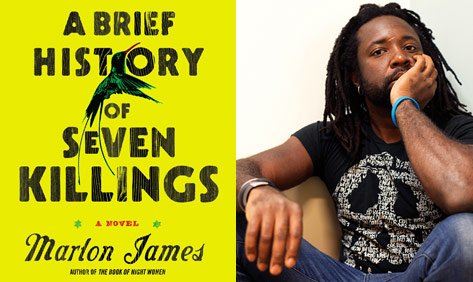
Marlon James (his A Brief History of Seven Killings (2014) got the Booker Prize) is currently engaged in an epic African fantasy project, titled Dark StarSeven Killings was optioned for an HBO series.


Junot Díaz's Brief Wondrous Life of Oscar Wao (2007) might be considered the gate opener for this successful combination of literary and genre fiction.  It won both the Pulitzer and National Book Awards, as well as other prizes. It was optioned for a film, if I am recalling correctly, back then, but there doesn't seem to be any recent news about that.

--------------------------------------------


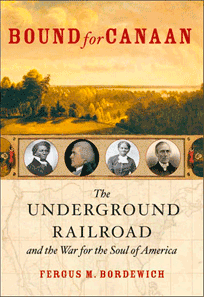
*  For the most complete and factual account of the means of who and how and to where slaves escaped their condition, from the earliest colonial era to the end of the Civil War, one cannot do better than read Fergus Bordewich's Bound for Canaan.

**   The brilliant fiction work that African American women are doing, with or without the inclusion of speculative fiction / genre tropes, seemingly is mostly ignored when it comes to the prestige prizes. The women who are first generation African immigrants, or from the Caribbean, seem to do somewhat better though, when it comes to the Big Validations, particularly in the UK. I'm not sure of this though, since I haven't gathered numbers and stats.  Somebody must have though!

Have any of their works been optioned for prestige television?


Thursday, November 17, 2016

Blank Spaces On The Map -- Here Be Dragons (But Not, YOU KNOW WHO!)

   . . . . After seeing the trailers I will not be watching the latest Harry Potter franchise blockbuster, Fantastic Beasts and Where to Find Them.

Location is New York City.  Time period is 1926. Pop quiz, kiddos: What is happening in New York City in 1926, hmmmmmmmmmmm?


However this primary cultural, social, economic and political phenomenon is seemingly not even hinted at -- much less having actual characters who happen to be African American?  Why does Rowling persist in getting the U.S. and the many peoples who inhabit this nation and its history so wrong?  Or, perhaps, more to the point, why does she disappear them -- or turn them as in her Wizarding school debacle -- into something they are not?


In Rowling's imagination African Americans and Native Americans in the U.S. are infinitely MORE RARE reaching to IMPOSSIBLE TO FIND -- than imaginary beasts. What does this say?

Wednesday, July 6, 2016

WPA Slave Narratives

 This review of the history of the WPA interviews that make up that body of federal slave narratives contains pretty much what we have learned about them in the last decades. 

I recall back in the early days of social media, prior to the interwebs, writing about the WPA slave narratives, a protesting commentator insisted that these WPA slave narratives often spoke about missing the good old days of slavery on the plantation, so obviously slavery wasn't so bad, actually quite a carefree and easy life.

My response then is remains the same as it would be to such a statement today:

1) many of those interviewed had been young children in the last days of the antebellum south, in regions where the slave system had just reached maturity, so as with so many of us, their memories have a rather golden glow. It also meant they hadn't experienced the horrors of being sold off or having their prime age parents sold off as overstock -- in another few years, if the fireeaters hadn't driven the antebellum south off the secession cliff, they'd have had that.


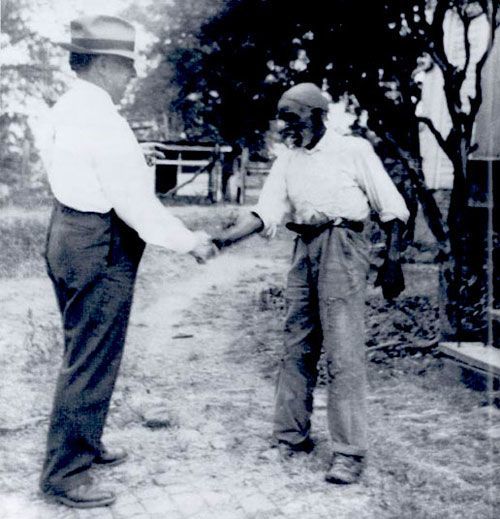
Allan Lomax interviewing a freedman.  Lomax filed copyright on many of Leadbelly's and other bluesmen's compositions.

 ". . . there was a conscious effort, at the federal level, to swing interviewers toward the folkloric and away from the controversial personal histories of enslavement. In 1937, Stewart finds, Lomax, then the WPA’s national editor on folkways and folk culture, redirected Ex-Slave Project interviewers to try to find out more about black folk customs and folk tales. While the information gleaned from this approach has been immensely useful for latter-day researchers trying to write histories of these aspects of black culture, Lomax privileged these stories over the ex-slaves’ assessments of slavery as an institution, preferring interviews about (as he wrote to the Georgia staff in directing their work) “the stories current at that time, the gossip of their associates, the small incidents of farm and home life, etc.”
2) most of the interviewers were white people (interviewers such as Zora Neale Hurston in Florida were exceptions, not the rule) for whom in general freed people, as much as the slave of the antebellum era, had little or no trust, and perhaps a great deal of well-hidden contempt. Telling these people what they wanted to hear and not telling them what they didn't want to know was rule that governed so much of interactions with white people;

3) some of the interviewers were members of the families who had owned them and / or their parents in the antebellum and Civil War years, had been determined to reenslave them before Reconstruction, and treated them badly in what was still the Jim Crow era-- people who still owned all the power where the interviewee lived. 

So, I had learned this in the 80's when I first began reading the WPA narratives. Most of it is obvious to see for the average inquiring reader's eye Thus we included some caveats about the WPA slave narratives in The American Slave Coast.

It seems the (white) media, for the nonce, has finally caught up with this clear-eyed reading. So, once again. the racial wheel of history of the U.S. is being reinvented (rediscovered), as it seems it will have to be eternally.

One can almost long for a Khaleesi who vows, "I'm not going to stop the wheel, I'm going to break the wheel."

See  Catherine Stewart's new book Long Past Slavery: Representing Race in the Federal Writers’ Project.  The value of her examination is incalculable.

Sunday, July 26, 2015

Poet Elizabeth Alexander

While working out this afternoon I listened to poet Elizabeth Alexander speak and recite her poetry. Like I have, many who recognize Alexander's name probably first learned of her work when she recited at Obama's second inaugural.


Her mother was an historian. She's a professor herself as well as a poet. The professor part supports the creative part of her life in many more ways than the financial -- just as being a mother does, she thinks. She's so articulate, her thinking so deeply grounded, that her language shimmers as much while speaking as on the page.

She spoke of reading Toni Morrison's Beloved, or rather, how for some years she avoided reading it. "I thought I just can't take it right now.  Some other time."  When she did read it, she could read it only in small bits, over a long period of time.  The novel has captured terrible dimensions of the African American historical experience -- particularly that of the antebellum mother's experience, in the language of poetry. It's terrible beyond describing yet Morrison did it, in language that "shimmers" in words of "radiance."

In the course of the program Alexander said without centering the black experience and culture in our educational system we have no idea what this nation and its history are.  Of course she's far too generous, intelligent and compassionate to even think that this centering of African American history and culture must be accomplished by, or even should be, through the exclusion of everything else.

A review of Alexander's latest book here.


What she means, what we believe, is that this experience must be finally taken from the sidebar and put as much front and center as that of the battles and diplomacy of the War of Independence.

When I brought this up to my partner and co-author of The American Slave Coast he responded: "that indeed is where many historians are at these days.  I think the general weight of the history profession now is there. We have the moral force of history on our side . . . "


Tuesday, July 7, 2015

"The Subversive Science Fiction of Hip-Hop" by Rose Eveleth

"The Subversive Science Fiction of Hip-Hop" by Rose Eveleth


on Motherboard - Vice Media is interesting for all sorts of reasons. Because of The American Slave Coast's subject, this section of the article stood out particularly:

In fact, as Junot Díaz pointed out on an episode of the Fan Bros podcast back in 2013, many of the themes in science fiction don’t even make sense without living in a world with marginalized people. He said it best:
Look. Without our stories, without the true nature and reality of who we are as people of color, nothing about fanboy and fangirl culture makes sense. What I mean by that is, if it wasn’t for race, X-Men doesn’t make sense; if it wasn’t for the history of breeding human beings through chattel slavery, Dune doesn’t make sense; if it wasn’t for the history of colonialism and imperialism, Star Wars doesn’t make sense; if it wasn’t for the extermination of so many indigenous nations, most of what we call “first contact” stories don’t make sense. Without us as the secret sauce, none of this works, and it is about time that we understand that we are the Force that holds the Star Wars universe together. We’re the Prime Directive that makes Star Trek possible. We are… in the Green Lantern Corps? We are the Oath. We are all of those things. Erased, and yet without us? We’re essential.
The sections of the essay are divided into the traditional sfnal tropes, such as transformation, the replicant, alien and revolution. The sections are illustrated with references to well-known sfnal writers and music videos.  It's pretty darned interesting.


Tuesday, June 16, 2015

Acadiana - HBO True Detective, Season 1

The first HBO series of True Detective is located and shot in Louisiana's cajun Acadiana.  The friend we visited in Breaux Bridge highly recommended I watch, as he pointed out various places and views as being in the HBO series. The program had conveniently arrived dvd, so after getting back home, I ordered up on netflix.


What did I get?

Immediate references to the traditional practices in Acadiana of Santería, which is claimed to be the serial killer's theatrical set-up of the discovered victim. (In fact, that antlered crown blahblahblah looks a whole lot more like some idiot's fantasy of ancient European earth sacrifices or something). Speaking as someone who knows what Santería is, in the Caribbean and in Brasil, and in its mother non-syncretized practice as Lucumi in Nigeria's Yoruba land -- who knows personally the initiated and the "priestly" class -- who knows which African and Afro-Caribbean groups came to Louisiana, which parts and when, she howls: NO! NOT IN LOUISIANA -- NOT EVEN IN THE U.S.!

Next, immediate reference to Voodoo, also part of the serial killer's display. WHAT? This reference means nothing, nor is anything made out of it in the script. Nor is whatever is called voodoo in New Orleans the Vodún of Haiti, or the practice in Dahomey -- Benin.  For reasons, again, that have to do with who came in the inward San Domingue and Cuban migration to Louisiana during the Napoleonic era, and when. Again, I personally know practitioners, houngans and mambos, from both Haiti and Africa. I also am acquainted of what is called voodoo in New Orleans, and thus am qualified to make this call.

The signature twisted branch, vine and bone forms found with the victims of the serial killings, if there is an actual African-derived underpinning to them, it would be from the religion that in Cuba is called Palo, and which comes ultimately from what we now call Mbanza-Kongo, Angola. Captives from this region are the fundamental layer of all New World slavery populations: South America, the Caribbean and North America. This region of Africa was slaved first and longest, from beginning to the end of slavery in the New World. Thus these spiritual practices were continuously refreshed, until, of course 1808 in what was now the U.S. when the constitutional ban on importing Africans came into place, as protectionism for the Upper South's dominance of the domestic slave trade.  But there is not a word about any of this in the script.  Nor, of course, would a Palo practitioner be using it as an excuse to be a serial killer.


In fact, the theatrical set-ups of the victims are much more like some fantasy of old European earth magic sacrifice, than anything that would come out of Africa.

Marty Hart 2012

This viewer never stopped being thrown out of the show by protagonist Martin Hart (Woody Harrelson) straining all his words through a mouth fist-full of gravel. I kept thinking of the guy who plays Deacon on Nashville, who also delivers his lines through his teeth, meanwhile plumping up his cheeks like a squirrel's filled with nuts.

Rust Cohle 1995


Rust Cohle/Matthew McConaughey's way of delivering his lines is equally odd, though in a different sort of way.  It is even hypnotic, as one would expect from someone the script continually hints is as equally psychopathic in his violence as the serial killer(s).

These delivery styles are supposed to convince the viewer that Martin is a native Louisianan, and Rust used to live in Texas? I kept thinking of all the very bad Brit television shows that always make the U.S. characters come from Texas or somewhere in the South, because evidently that's the only way actors can think of to talk like a USian, and how preposterous they sound.  Certainly not like a Texan or any Southerner ever born.

Marty Hart 1995
Rust Cohle 2012
That's the deal -- true detectives not only refuse to give up detecting. They never give up their partner either.  Most importantly they have the capacity and the skills to deliver most explosive violence. Equally important  as detective partners their preferred form of violence and their drive to commit it must be different ,yet complementary. One must be tormented by good vs. evil, the other must be less philosophical.  Rust is always ready to intone his philosophy of the Evil World.  Best line thus


is delivered by Marty, "I've got an idea. Let's make the car a place of silent reflection from now on, all right?" Prime time crime novelist, James Lee Burke, with his has worked this vein deeply in his long-running Robicheaux- Purcell series.

In the middle of the series comes the episode in which our two heroes infiltrate a biker drug gang -- every member of which has hair to ass in the back and down to his nipples in the front. Our Heroes have clean chins and cop  haircuts. WHERE IS THE UNDERCOVER?  This was a fairly pointless episode, evidently included  for the sake of a lot of shooting, and o did the reviewers adore it,

In the final episode both Heroes impossibly survive a knife to the gut (Rust Cohle/Matthew McConaughey) (hoisted into the air on that knife and held there) and a hatchet into the chest (Martin Hart / Woody Harrelson). James Lee Burke’s Dave Robichaeux and Clete Purcell, moved from New Orleans to Acadiana, never die either (though wives and girlfriends do), not from the most ghastly wounds, meat-grinding vehicular crashes or fire blazing explosions. Whatever knocks them out, evidently the air of Acadiana can preserve Heroes to fight the Real Evil another day.

Brothel in the swamp, right where you want it.  Mosquito joy.


Women in True Detective.  Hmm. What are women? Evidently to be female is to be non-dimensional cray-cray, hapless victim, prostitute -- ALWAYS HAVE PROSTITUTES -- or  bad wife who coerces sex from her husband's partner because she has learned her husband serially cheats on her, and though she tells him to get out, he won't leave.

To quote from Vulture:
It’s made from equal parts film noir, Chinatown-style corruption parable, serial-killer potboiler, 3-a.m.-in-the-dorm-room-with-bong-hits philosophical inquiry, and buddy-cop comedy. And it climaxed with a bloody, ridiculous, yet kind of awesome installment that


presented its hero, Matthew McConaughey’s Rust Cohle, as some kind of cornpone risen Christ.

True Detective was beautifully photographed, and it is engrossing. McConaughey's cheekbones are particularly mesmerizing.

The most interesting aspect of the series for me is how it slides through time, the past and present, and the musings of the future.  Katrina is the breaking place between their shared past and their present encounter, which is absolutely true for Louisianans -- and then Rita, in Acadiana, following Katrina.  So much is lost, not least pre-digitized criminal records. Having them encounter each other again after that break shows how the two men changed and how they did not, and how certain actions (and irritations) between two allies can follow all the way up

The reason the viewer isn't interested in these killers.  The others get away with it.
the time line -- but forgiveness can be achieved.. The killers remain the same, but we're not interested in the killers, or even the victims. They are the pretext to present us us two very different men, and their relationship, and how their trust in each other ultimately is put to the greatest tests, and transcends whatever irritations and wrongs may have been committed.

Starting off the drive around the region, our Breaux Bridge friend took us to have breakfast at a local establishment that would be at home anywhere with a hipster population: local artists' work on the walls, and for sale; designer coffee drinks made to order, local baked goods from bread to muffins to sinful desserts, sandwiches and salads and other dishes, none of which was priced much or at all below what an NYC place would charge.  Wi-Fi.  An associated art gallery.  After breakfast he took us on an itinerary of music clubs, museums, art - performance spaces, theaters.

On our way to the local artisnal brewery I asked, "Is this place as filled with truly evil people as James Lee Burke writes about or in True Detective?"  (I was meaning right now, not the horrific slavery past of sugar plantation-prisons; our friend knew what I meant.)

He was silent.

Then he said, "Yes."


Saturday, February 7, 2015

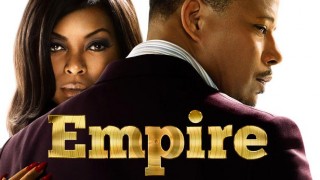
Empire - Fox - Season 1

Despite it being noon on Saturday in Soho, the temperatures, the ice everywhere and the intermittent snow left Gourmet Garage so quiet that the sound system -- Pandora, Spotify -- whatever service they use that eats musicians' profits and leaves none at all for the creators -- could be heard so clearly that one of the few other customers was dancing to the hiphop track that was currently playing.


In the course of being checked out I observed to the young African American behind the counter, "Gee, that sounds so old school it could be on Empire."

She interrupted processing my purchases to toss me a look.  "Are you saying this cut's that's playing is on an Empire soundtrack?"

"No, no. it just that whatever-this-is, has so copped that sound, from, like, 20 years ago or something, that it could be Empire. That whole picture the show makes of the music, the biz, the lingo, the bling, though not the shoes or the dresses of the female characters who aren't Cookie, the aspirations, are from at least 20 years ago, but nobody seems to notice that."

She says, "It's older than that!  1997, no wait, really, it's 1993."

Thoughtfully, she adds, "I was one then, in 1993. I like the sound and looks from then, though, maybe because it was my mom's music."

We love Empire's Cookie!
We love Nashville's Rayna!


We love Treme's Desiree!
Part of the reason Empire feels 20 + years earlier in many ways, though set in the present, is because Cookie has been in prison for about that amount of time, and has just gotten out.

Empire big extended not-so happy family.
Empire is a hiphop music soap, in the way Nashville is a country music soap -- which, when I first looked at it, struck me as the Treme for white people, the same white people who couldn't get how music and musicians, instead of gangastas, could be the center of a show that had so many black characters.

Anika, the bougie baby who thinks she can take Cookie's stuff.
I love all three of these series, primarily I'm sure because some very interesting and strong women are in the front of them, as only one woman among several other women whom the male characters need to reckon with. The music is strong too: Treme's live music was provided by some of the very best living musicians; the music supervisors for Nashville's first season was T-Bone Burnett; Timbaland is Empire's music supervisor

The writing for Empire's pilot was very, ahem, strong.  So much got effortlessly established in terms of who everyone is, their relationships and the plot.  None of the subsequent episodes so far have quite equalled the pilot, but they still exert that same effortless engagement on the part of the viewer.

For ye fans of olden, golden daze Buffy the Vampire Slayer, Danny Strong is one of  creators and executive producers of Empire -- along with Lee Daniels.  They have previously worked together on 2013's multiple-award nominated film, The Butler, set in the White House over the course of 8 presidents' administrations.

Saturday, November 29, 2014

This Shit Ain't Over!

The Absolute RIGHT Line of This Week That Is Almost Was.


George Clinton and P-Funk, to a huge, densely packed house, at least 2/3 African American of all generations (including the babies of GC's granddaughters who came long dancing with their mamas deep into the show):

"This shit ain't over!"

If anything that's what Ferguson showed this nation this week.

Monday, May 26, 2014

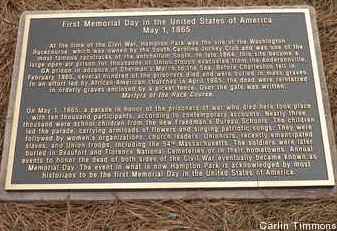
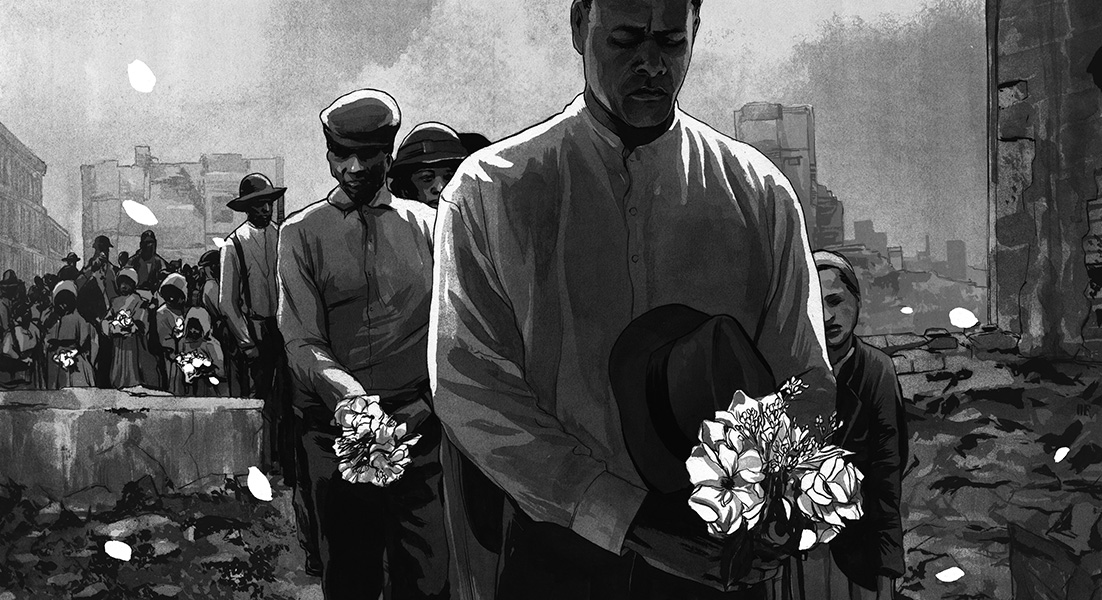
Decoration Day

The assumption, here, is everyone who thinks about the significance of  Memorial Day knows this day was started by African Americans in Charleston, South Carolina. After WWI Decoration become known as Memorial Day. Despite having started the commemoration, African Americans such as the Hell Fighters were segregated out of the commemoration ceremonies and parades then as well, despite their great heroic sacrificial contributions to the effort. This has remained to be the case most often until, perhaps, the Vietnam War.


For more history of Decoration Day, go here.

From a black newspaper, the New Orleans Semi-Weekly Louisianan dated June 15, 1871. It describes an event that occurred at the then-newly-established Arlington National Cemetery. Like the U.S. Colored Troops who’d been denied a place in the grand victory parade in Washington in May 1865, the black veterans discovered that segregation and exclusion within the military continued even after death:

DECORATION DAY AND HYPOCRISY.
The custom of decorating the graves of soldiers who fell in the late war, seems to be doing more harm to the living than it does to honor the dead. In every Southern State there are not only separate localities where the respective defendants of Unionism and Secession lie buried, but there are different days of observance, a rivalry in the ostentatious parade for floral wealth and variety, and a competition in extravagant eulogy, more calculated to inflame the passions than to soften and purify the affections, which ought to be the result of all funeral rights.

Besides this bad effect among the whites there comes a still more evil influence from the dastardly discriminations made by the professedly union [sic.] people themselves.
Read this extract from the Washington Chronicle:

AT THE COLORED CEMETERY

While services were in progress at the tomb of the “Unknown” Comrade Charles Guthridge, John S. Brent, and Beverly Tucker, of Thomas R. Hawkins Post, No. 14 G.A.R., followed by Greene’s Brass Band, Colonel Perry Carson’s Pioneer Corps of the 17th District, Butler Zouaves, under the command of Charles B. Fisher, and a large number of colored persons proceeded to the cemetery on the colored soldiers to the north of the mansion, and on arriving there they found no stand erected, no orator or speaker selected, not a single flag placed on high, not even a paper flag at the head boards of these loyal but ignored dead, not even a drop of water to quench the thirst of the humble patriots after their toilsome march from the beautifully decorated grand stand above to this barren neglected spot below. At 2 ½ o’clock P.M., no flowers or other articles coming for decorative purposes, messengers were dispatched to the officers of the day for them; they in time returned with a half dozen (perhaps more) rosettes, and a basket of flower leaves. Deep was the indignation and disappointment of the people. A volley of musketry was fired over the graves by Col. Fisher’s company. An indignation meeting was improvised, Col. Fisher acting president. A short but eloquent address was made by George Hatton, who was followed by F. G. Barbadoes, who concluded his remarks by offering the following resolutions, which were unanimously adopted:
Resolved, that the colored citizens of the District of Columbia hereby respectfully request the proper authorities to remove the remains of all loyal soldiers now interred at the north end of the Arlington cemetery, among paupers and rebels, to the main body of the grounds at the earliest possible moment.

Resolved, that the following named gentlemen are hereby created a committee to proffer our request and to take such further action in the matter as may be deemed necessary to a successful accomplishment of our wishes: Frederick Douglass, John M. Langston, Rev. Dr. Anderson, William J. Wilson, Col. Charles B. Fisher, William Wormley, Perry Carson, Dr. A. T. Augusta, F. G. Barbadoes.

If any event in the whole history of our connection with the late war embodied more features of disgraceful neglect, or exhibited more clearly the necessity of protecting ourselves from insult, than this behavior at Arlington heights, we at least acknowledge ignorance of it.

We say again that no good, but only harm can result from keeping up the recollection of the bitter strife and bloodshed between North and South, and worse still, in furnishing occasion to white Unionists of proving their hypocrisy towards the negro in the very presence of our dead.

###


Monday, May 12, 2014

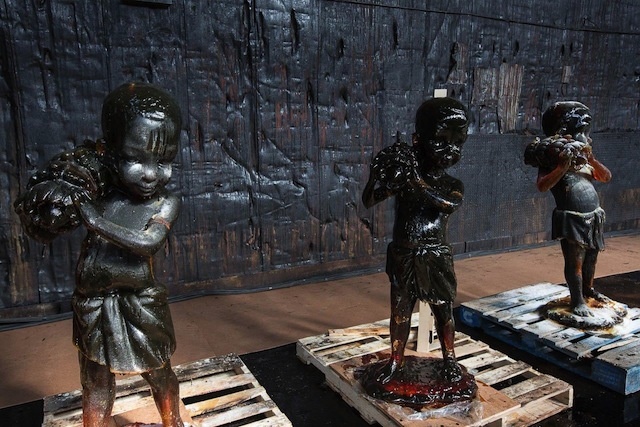
A Subtlety, or the Marvelous Sugar Baby - Kara Walker

Kara Walker's new show,is an installation  site-specific -- the abandoned Brooklyn  Domino Sugar Factory. The visitor is presented with figures from our country's southern antebellum past, made of sugar and other sugar industry products such as molasses.

 It's profoundly historical in an ever-widening pattern web of  relationships and events connecting the European Middle Ages to the present, economically, culturally and politically.


This is revealed immediately in the title she has given this show is brilliant, invoking European history back to the crusading medieval era, when the lucrative, if dangerous and very expensive sugar trade with the Middle East brought the sweet stuff to the tables of the ruling elite. Their kitchens fashioned  the sugar into extravagant shapes, landscapes and emblems served as centerpieces at banquets, called an entremet, and in England, more commonly by the Renaissance, a subtlety. By the Renaissance the Europeans were already slaving Africa, taking the people to the New World, to work in the gold and silver mines that financed the architecture and wars of Europe's baroque, rococo and neoclassical periods, and the sugar plantations that would finance the Industrial Revolution.


"Carrying either big baskets or bunches of bananas, they are enlarged from small cheap ceramic figurines still made in China."


... Dominated by an enormous sugarcoated woman-sphinx with undeniably black features and wearing only an Aunt Jemima kerchief and earrings, it is beautiful, brazen and disturbing, and above all a densely layered statement that both indicts and pays tribute. It all but throws possible interpretations and inescapable meanings at you.

Sunday, April 13, 2014

The Blues: Recovering Lost History

We've lost so much in that transition between music's prehistory and early recording. Here's the story of getting back just a teeny bit of it.

This is another New York Times interesting article about earlier American popular music, but this one's in the NY Times Magazine: "The Ballad of Geeshie and Elvie" --  On the trail of the phantom women who changed American music and then vanished without a trace, by John Jeremiah Sullivan.

The article includes listening links that you do not leave the page to hear, video and photographs.  It's one of the Times Magazine's efforts at creating authentic interactive journalism.  Beyond the content text, this is one hell of a production.

This is one of the early paragraphs:
Outside any bullyingly hyperbolical attempts to describe the technical beauty of the songs themselves, there’s another facet to them, one that deepens their fascination, namely a certain time-capsule dimension. The year 1930 seems long ago enough now, perhaps, but older songs and singers can be heard to blow through this music, strains in the American songbook that we know were there, from before the Civil War, but can’t hear very well or at all. There’s a song, Geeshie’s “Last Kind Words,” a kind of pre-blues or not-yet-blues, a doomy, minor-key lament that calls up droning banjo songs from long before the cheap-guitar era, with a strange thumping rhythm on the bass string.
Via the embedded music that can be turned on or off at the reader's convenience, what Sullivan's talking about becomes clear.

Reading this essay is rather like sitting with Elijah Wald,  sharing the research information of our latest projects with wild enthusiasm -- which has been our pleasure to do again this weekend as he's visiting. BTW, EW's having a terrific spring -- The Dozens: A History of Rap's Mamma, his latest book, has sold out already!

As Dylan shows up in Sullivan's piece so he does in Elijah's work-in-progress, which is about the folk music scene of the 1950's and early 60's.

Here's another intriguing paragraph, about legendary, but not so well known Blues collector, Mack McCormick, about whom EW and I talked yesterday, among other collectors who aren't able to write books of their own out of their laboriously created archives (there are several we know in the latin music world, particularly those who have lived their own lives in Puerto Rican music in New York; they are aging, in poor health -- and poor; so much of what they know will be lost -- yet they don't want to let go of what they know, at least to very many people):
He had said he didn’t want to talk about Robert Johnson, for personal reasons and on principle. But his talk spiraled inexorably toward Johnson anyway. The singer loomed over his memory as he had over his career. What he told me took me aback. McCormick said that what he realized, in the quarter century since Guralnick’s book came out, was that most of what we think we know about Robert Johnson — which is to say, most of what McCormick thought he knew — was highly unstable. We’re not even sure, McCormick said, that the man in the pictures we have, the smiling man with long fingers, holding the guitar, is Robert Johnson. Or that he is, as McCormick put it, “the guy who made the records.” He is a Robert Johnson. But according to McCormick, the more he has lived with the evidence, the more he doubts. Of the people he interviewed so long ago, more than one of those who had met Johnson and been present at one of his two sessions in Texas told McCormick, when they were shown the famous photograph, “That’s not the guy.” It didn’t look like him, they said. Not everyone said that, but a few.
According to EW, who, obviously, is well versed in many of the matters of the blues, "It's not as though blues scholars haven't known for ages that much is mythology and not historically factual. This isn't new news (as he shows in his Escaping the Delta), it's that didn't matter much to them."

It's sort of like the Story of the Egyptian Captivity and Exodus -- which historically never happened. We choose the stories we want rather than historical fact, because the stories we make up, we make up to nurture, to sustain ourselves. Those stories are more essential to our continuing to live this life, out of which none of us gets alive.

Friday, July 26, 2013

MD's Eastern Shore: Oldest Free Black Community in the U.S.?

Dig at Eastern Shore site, built by freed slaves, shows it may be U.S.’s oldest black community -- it may be older than New Orleans's Treme. There's a video that goes with this story from yesterday in the Washington Post, which provides another level of  visual commentary to it worth contemplating.

There is another of these not unusual for Maryland free communities outside of Chestertown, also still inhabited, called Wharton. There's been an archeological explosion of illuminating finds in the last ten - fifteen years of digging down into Maryland and Virginia's soils.

This isn't true only about African American or colonial English history either; there's bits and pieces of Spanish and French history to be found on occasion.  As for the First Peoples of the Chesapeake, there is far more to be found than previously believed could be discovered..
The thing about Talbot County is, it’s rich in history,” said Carlene Phoenix, president of Historic Easton, who lobbied for the neighborhood research. “But when it comes to especially African American history, it was always about slavery. But now we’ve got another story.”
The project researchers found that many Talbot County slaves were freed after the abolitionist Quaker preacher John Woolman came through Easton in 1766, urging fellow Friends to abandon slavery.
Easton sea captain Jeremiah Banning, who personally bought his 21 slaves in Senegal, freed them in his will.
And the researchers came upon the story of a slave, Grace Brooks, who purchased her freedom and that of her children and grandchildren with money she earned as a midwife.
Many of these now-free blacks probably made their way to the Hill, which was fast becoming an island of liberty surrounded by plantations, Green said.
Well, Maryland, after Virginia, was the mother of slavery. But it wasn't all slavery in Maryland, was it?  Which is even more interesting and illuminating to the discovery of our earlier national history.

These communities such as in Easton and Wharton, were instrumental in helping the enslaved escape.  One of those who escaped via such assistance was Frederick Douglass.  His first wife was a free woman of color who lived in this community. In the 1850's these communities were vital to the formation of 'safe houses' along the "Underground Railroad's" route out of Virginia and Maryland, to Philadelphia, New York and New Jersey, and then on to Canada.  (With the Fugitive Slave Act and southern bounty hunters and slave traders forever abducting even free people of color born and bred in the north for sale down south, it wasn't safe for an escapee to stay in the U.S.)


Easton is where we C'towners go on Easter morning for a splendid service of Gospel, followed by a splendid church breakfast.   The church pictured above was originally built by Quakers, and not that much later turned over to African Americans so they too could have a place of worship.

Then there is this response from a reader of the above-linked article that brings more historical information about these free communities:
We have a community here in Staten Island, NY called "Sandy Ground" that was founded by free blacks from the Eastern Shore. We had huge oyster beds and the "Oystermen", who learned their trade in Maryland settled here in the early 1800s. Many of their decendents still live in the area and get together yearly for the Sandy Ground festival. Nice to know the roots of Sandy Ground. Keep digging, history is fascinating!


Tuesday, July 23, 2013

The Bancroft Papers -- Better Than the Best Historical Fiction

Spending hours a week in them -- better than an historical novel, miniseries or movie.

It's frustrating that U. S. readers are so uninterested in our own history, either as historical fiction (unless it turns into romance-erotica bs) or television miniseries.

Our nation's history may not be as long as Europe's or Asia's, even when we take into account the First Peoples and all they did -- at least Europeans and Asians think so.

But as relatively short then, our continents' recorded histories may be -- when it comes to the depth, the scope, the range -- the endless parade of vivid, fascinating characters -- we need not take a back seat to any other country.

When the box is delivered to my table, I choose what to delve into. More often than one might think, I need to send the box right back. The papers' finding aids are usually worse than useless, they're misleading, because mislabeled, and earlier researchers have torn their order to pieces. Too often the box's contents are useless for my research, such as the scrapbooks of Frederick's brother's career -- he and Edgar were so close and so admiring of each other, that Frederick kept meticulous clippings and copies of every speech Edgar ever made. Frederick donated reams of his brother's career documentation, along with his own research papers. Frederick wrote most of Edgar's speeches, being an excellent writer, while Edgar's talent was for making money.  But interesting and useful as these boxes might be for a student researching the Gilded Age, they are of no use to The American Slave Coast.

But once I find a folder that is concerned with antebellum matters in the South, I fall, fall, fall ever deeper into another world that is more vivid to me than this one in every way.  I'm confronted by one new figure after another, all of them of great interest, all of them I wish to know more of.  Sometimes I do know more of them, but not always.  For one thing, there's more of the natural world, that natural world that's nearly gone, embedded in everything.

Wild Turkey, Edisto Island

I dream of these matters now, constantly, every night.

On the other hand, I also push far away the horror of the matters with which I'm most concerned.  Then, unexpectedly, something I read, something el V and I discuss, as last night at the Bistro over the perfectly chilled beers, while the rain poured and steam rose from the sidewalks, the horror grabs us both.  And we stare, into our glasses, and look at each other from the corners of our eyes.  The eyes of us both are damp, our stomachs clenched with shame that this is how our country was built.


Tuesday, May 21, 2013

Virginia Smells Good

Virginia's air is perfumed.

Often overcast, humid and since Sunday afternoon, warm, often raining, the air is oxygen rich.

Since C'town, we've visited significant sites on the Historic Bancroft Slave Breeding and Trading Industry Tour in Alexandria, Richmond, on the James River plantations and Monticello. Bancroft's Slave Breeding and the Slave Trade in the Old South  (1931), the classic work of stats breaking out year-by-year, decade-by-decade, state-by-state, the natural increase and the de-population of the upper south and the un-natural increase of African Americans then in the lower and western south, has been serving as guidebook.  It still works ....

Today is our last in Virginia. We spent the night in a non-chain lovely old place called the English Inn in Charlottesville.  We had a ridiculous dinner with our historian friend who lives here.  Due the controversy around his Master of the Mountain, he was surprised to learn it's in the Monticello gift shop bookstore after all.  We are being taken on a tour of UVA in a short time.  Then we will hit the road, going along the James river to the founding site of Jamestown (where there isn't anything really, just the sight, then  Williamsburg -  William and Mary.

As another friend says, who builds the amplifiers for telescopes such as the Very Large Array, who grew up here too, "If it wasn't for the knucklehead, this would be paradise on earth."


O, and yes.  The cicadas are out at Monticello.