LINES OF THE DAY

". . . But the past does not exist independently from the present. Indeed, the past is only past because there is a present, just as I can point to something over there only because I am here. But nothing is inherently over there or here. In that sense, the past has no content. The past -- or more accurately, pastness -- is a position. Thus, in no way can we identify the past as past." p. 15

". . . But we may want to keep in mind that deeds and words are not as distinguishable as often we presume. History does not belong only to its narrators, professional or amateur. While some of us debate what history is or was, others take it into their own hands." p. 153

Silencing the Past: Power and the Production of History (1995) by Michel-Rolph Trouillot

Showing posts with label Katrina. Show all posts

Thursday, February 9, 2023

We Went There

      . . . . And so we did, go to New Orleans...

As miserable prepping for the 10-day journey was, mostly due to the very mixed weather and temperatures we would experience, as well as the knowledge that for the first time in years, I would be spending entire days within the company of over 50 other people -- and more due to some of the venues being clubs! the going itself was just fine and as smooth as it could possibly be.  LaGuardia airport’s renovation and remodeling has included handling TSA lines a lot better, smoother and faster. el V did everything anyway, via his fone, so I had nothing at all to do but show my passport. At the TSA metal detectors, again, I was questioned as to my non removal of footgear; the TSA person said I didn’t look old enough to be pardoned that requirement! so I should feel complimented by her inquiring. This was also the case at departure. (Surely it would have been different if I wasn't wearing a mask though!) Throughout the security process and inside the security perimeters, I was comfortable in my mask, in the terminal and on the plane, i.e. not anxious, despite so many coughing and not masked. What the heck, yanno?  I decided to do this, so there it is. As our beloved Dr. Song, says, "The mask is the vaccine." And so it is. The rain-wind storms were over by the time we were ready to land at New Orleans's new Louis Armstrong airport.


Outside the Lolis House in Treme, which was our base camp for the Treme Second Line Parade Sunday. Spike Lee gave us both t-shirts from his production in response to the Levee failure of Katrina, If
God  Is Willing and Da Creek Don't Rise. El V was interviewed on camera for the film.  The great geographer and scholar of New Orleans, Richard Campanella, provided fascinating and heartbreaking history of New Orleans, the levees and pumping stations, particularly around the why of the pumping station failure and flooding of Katrina.

"For the Funk of It" was another extraordinary Postmambo experience.  None of us got covid , or a cold, or anything else. This is much easier to do, when the schedule is so carefully planned and calibrated, for an environment which is highly ventilated as part of the eco-structure of the place as is New Orleans, and mask wearing inside the transportation -- with open windows when possible. It would be a lot different moving 50 people around NYC in winter than in New Orleans.  Which is why we did "For the Funk of It" on these days.

Then, yesterday, we left Spring behind and returned to Winter, though of course, our friends here, will not allow us to ignore the fact they endured some of the most brutal Winter NYC's had in a while, while we danced under the moon (the last nights anyway) and heard the best music.  As one of our multiple generations of on-the-ground-in-the-community guides said to me, "Every artist we saw, every act was pure Star -- not three stars, not four stars, not four and a half stars, but FIVE STAR WORLD CLASS, Babeee, and if I wasn't doing this gig I'd never have gotten to hear this!"

As I have been feeling this trip confirmed that New Orleans is in the midst of another Renaissance of artistic, creative explosion.  The energy there is incredible, which is felt and seen in everything from music to art to cuisine.  New Orleans is changing a lot, thanks to the influence of the numbers of 'others' moving in, from Honduras and Mexico, to Haitians and Cubans.  Particularly the Haitian and Cuban musicians who have chosen New Orleans, rather than Miami, as their US city of refuge. When we lived in New Orleans during the days of the Tulane Fellowship for The World That Made New Orleans: From Spanish Silver to Congo Square (for which 4 digit audio royalties came in again, the day before we left on "For the Funk of It") there were no Cuban or Haitian musicians or bands there.  The influence percussively and vocally is flowing back-and-forth, inspiring fresh takes and innovation from both directions.  What is particularly exciting about what is going on there currently, is that, this being New Orleans, so rooted generationally in the mud of the place, that the gorgeous, foundational mosaic that made New Orleans unique and special in the world musically isn't being thrown out at all.  It is still the base, the center, but that base is growing, spatially, up, down and all around.

This makes the city a crackling, sizzling place of excitement and vitality -- quite unlike, say, Manhattan.  However, one fears, that like, say Manhattan, the greed capitalist land speculators are going to shut it all down by making it impossible for anyone who isn't quite, quite rich to live there.  Even within our own 'woke' group of Travellers, are quite a few who have second homes in New Orleans, which means people like our generationally planted ground crews, are having one hell of a time finding somewhere to live, since the Katrina floods took out their multiple generational family prosperity and homes. One sees the effect of this in the undeniable fact that all the service industries, whether hotels, restaurants, doctors, ophthalmologists, etc. can't get the staff they need to operate full-time.  Many are leaving New Orleans.

It is clear, the trauma of Katrina has by no means left the fibers and sinews of New Orleans and her people.

One other thing is clear, yet again, what Postmambo Seminars do and accomplish, cannot be done without dedicated, experienced, caring people who know the people and the territory, inside and out, who are connected, to the very height and depths of their souls.

One way and another, "For the Funk of It" gave back to New Orleans, did not just take -- we pumped at least $100,000 directly into the musical and Black communities. Which is something, a small thing, but something.

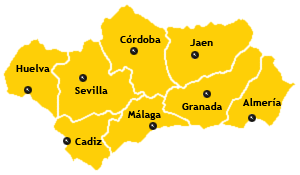
It also showed that when done mindfully, carefully, in cooperation with and guidance from the knowledgeable, connected people who live there, like-minded group travel can be done again, safely.  So we are starting to believe Postmambo al-Andalus can be done with our people in 2024.


Monday, February 8, 2016

Chris Jackson and Beyoncé

Chris Jackson, is the co-owner with his now ex-wife Sarah McNally, of Jackson McNally, the first successful NYC indie bookstore to open after amazilla killed all the stores.  He's featured in the New York Times Sunday magazine here.

Chris Jackson and Ta-Nehisi Coates, National Book Awards
At one point in this article, Chris Jackson says this, which is fully sensible:
‘‘The great tradition of black art, generally,’’ he started again, ‘‘is the ability — unlike American art in general — to tell the truth. Because it was formed around the great American poison, the thing that poisoned American consciousness and behavior: racism. And black culture, such as it is, was formed around a necessary resistance to this fundamental lie. That’s the obligation. And this is the power that black art has.’’
This amplifies what he stated above:
This power — the power of the unvarnished truth — is what is at stake when we talk about the problem of exclusion in the world of books. What believable version of American reality can be the product of an industry that, according to a recent survey, counts black people as just 4 percent of its employees? We can admit that race is not our only national reality without denying that it clarifies the workings of — and relations among — the others. A kind of American Rosetta Stone. 
This is the unique claim on the truth that black art can make: It draws its energy from its embrace of hybridity, from a rejection of the illusion of American purity. The joy of expression and the sorrow of experience, properly commingled, might result in something new — and true.
How can that be argued with?  As we all understand that this poison can never be drained from our national expression and attitude until the truth is told, told as matter-of-fact, and starting at the earliest years in our education system, among many other institutionally racist venues.


In many ways, Beyoncé's video for her single, "Formation," dropped for the Super Bowl is saying the same thing.

It can be viewed here on the Rolling Stone site.  Guarantee -- watching it only once won't do.


Beyond that, however, are the reactions particularly of African American women from different entry points, but are saying the same things, but in different ways.

The writing about "Formation" by African American women is filled with brilliant imagery.  Looking at just three different responses to "Formation" illustrates what A.O. Scott is describing when he asked, "What is criticism, what is reviewing?"

Here are three different African American women actively thinking about their experience of "Formation"

In fact, it's bloggers like these who have most impressed me, beyond the video itself.

http://newsouthnegress.com/southernslayings/

https://netarthud.wordpress.com/2016/02/07/black-secret-technology-beyonces-formation/

http://www.theguardian.com/commentisfree/2016/feb/08/beyonce-formation-black-american-narrative-the-margins

Three different approaches, three different 'languages', all of them deeply expressive in their different manners of thinking hard, thinking actively, i.e. critically in response to an experience that was aesthetic, entertaining or political, depending on the approach.  And I'm responding to their language and imagery in response to her imagery (seeming more than to the lyrics, but hey, music video!)  in a very positive way.  I.e. they are persuasive.

---------------------

For some of we white people who have been crowing that the lyrics' referencing of "slayer" and "slaying" is inspired by Buffy -- no, it's not.  This terminology comes from of the early days of hiphop and rap: slaying the competition, rivals, obstacles, whatever, was constant usage long before the Buff was a glimmer in Whedon's eye, and it still is.

Beyoncé proves once again she and Jay-Z are not only the most successful figures  globally in entertainment today, but  likely the smartest business people too.
Beyoncé slayed -- she even slayed football.  She's the winner of the Super Bowl. There's a whole more talking about "Formation" than there is about the game. She certainly substituted white space with space that is fully black matters.

Tuesday, June 16, 2015

Acadiana - HBO True Detective, Season 1

The first HBO series of True Detective is located and shot in Louisiana's cajun Acadiana.  The friend we visited in Breaux Bridge highly recommended I watch, as he pointed out various places and views as being in the HBO series. The program had conveniently arrived dvd, so after getting back home, I ordered up on netflix.


What did I get?

Immediate references to the traditional practices in Acadiana of Santería, which is claimed to be the serial killer's theatrical set-up of the discovered victim. (In fact, that antlered crown blahblahblah looks a whole lot more like some idiot's fantasy of ancient European earth sacrifices or something). Speaking as someone who knows what Santería is, in the Caribbean and in Brasil, and in its mother non-syncretized practice as Lucumi in Nigeria's Yoruba land -- who knows personally the initiated and the "priestly" class -- who knows which African and Afro-Caribbean groups came to Louisiana, which parts and when, she howls: NO! NOT IN LOUISIANA -- NOT EVEN IN THE U.S.!

Next, immediate reference to Voodoo, also part of the serial killer's display. WHAT? This reference means nothing, nor is anything made out of it in the script. Nor is whatever is called voodoo in New Orleans the Vodún of Haiti, or the practice in Dahomey -- Benin.  For reasons, again, that have to do with who came in the inward San Domingue and Cuban migration to Louisiana during the Napoleonic era, and when. Again, I personally know practitioners, houngans and mambos, from both Haiti and Africa. I also am acquainted of what is called voodoo in New Orleans, and thus am qualified to make this call.

The signature twisted branch, vine and bone forms found with the victims of the serial killings, if there is an actual African-derived underpinning to them, it would be from the religion that in Cuba is called Palo, and which comes ultimately from what we now call Mbanza-Kongo, Angola. Captives from this region are the fundamental layer of all New World slavery populations: South America, the Caribbean and North America. This region of Africa was slaved first and longest, from beginning to the end of slavery in the New World. Thus these spiritual practices were continuously refreshed, until, of course 1808 in what was now the U.S. when the constitutional ban on importing Africans came into place, as protectionism for the Upper South's dominance of the domestic slave trade.  But there is not a word about any of this in the script.  Nor, of course, would a Palo practitioner be using it as an excuse to be a serial killer.


In fact, the theatrical set-ups of the victims are much more like some fantasy of old European earth magic sacrifice, than anything that would come out of Africa.

Marty Hart 2012

This viewer never stopped being thrown out of the show by protagonist Martin Hart (Woody Harrelson) straining all his words through a mouth fist-full of gravel. I kept thinking of the guy who plays Deacon on Nashville, who also delivers his lines through his teeth, meanwhile plumping up his cheeks like a squirrel's filled with nuts.

Rust Cohle 1995


Rust Cohle/Matthew McConaughey's way of delivering his lines is equally odd, though in a different sort of way.  It is even hypnotic, as one would expect from someone the script continually hints is as equally psychopathic in his violence as the serial killer(s).

These delivery styles are supposed to convince the viewer that Martin is a native Louisianan, and Rust used to live in Texas? I kept thinking of all the very bad Brit television shows that always make the U.S. characters come from Texas or somewhere in the South, because evidently that's the only way actors can think of to talk like a USian, and how preposterous they sound.  Certainly not like a Texan or any Southerner ever born.

Marty Hart 1995
Rust Cohle 2012
That's the deal -- true detectives not only refuse to give up detecting. They never give up their partner either.  Most importantly they have the capacity and the skills to deliver most explosive violence. Equally important  as detective partners their preferred form of violence and their drive to commit it must be different ,yet complementary. One must be tormented by good vs. evil, the other must be less philosophical.  Rust is always ready to intone his philosophy of the Evil World.  Best line thus


is delivered by Marty, "I've got an idea. Let's make the car a place of silent reflection from now on, all right?" Prime time crime novelist, James Lee Burke, with his has worked this vein deeply in his long-running Robicheaux- Purcell series.

In the middle of the series comes the episode in which our two heroes infiltrate a biker drug gang -- every member of which has hair to ass in the back and down to his nipples in the front. Our Heroes have clean chins and cop  haircuts. WHERE IS THE UNDERCOVER?  This was a fairly pointless episode, evidently included  for the sake of a lot of shooting, and o did the reviewers adore it,

In the final episode both Heroes impossibly survive a knife to the gut (Rust Cohle/Matthew McConaughey) (hoisted into the air on that knife and held there) and a hatchet into the chest (Martin Hart / Woody Harrelson). James Lee Burke’s Dave Robichaeux and Clete Purcell, moved from New Orleans to Acadiana, never die either (though wives and girlfriends do), not from the most ghastly wounds, meat-grinding vehicular crashes or fire blazing explosions. Whatever knocks them out, evidently the air of Acadiana can preserve Heroes to fight the Real Evil another day.

Brothel in the swamp, right where you want it.  Mosquito joy.


Women in True Detective.  Hmm. What are women? Evidently to be female is to be non-dimensional cray-cray, hapless victim, prostitute -- ALWAYS HAVE PROSTITUTES -- or  bad wife who coerces sex from her husband's partner because she has learned her husband serially cheats on her, and though she tells him to get out, he won't leave.

To quote from Vulture:
It’s made from equal parts film noir, Chinatown-style corruption parable, serial-killer potboiler, 3-a.m.-in-the-dorm-room-with-bong-hits philosophical inquiry, and buddy-cop comedy. And it climaxed with a bloody, ridiculous, yet kind of awesome installment that


presented its hero, Matthew McConaughey’s Rust Cohle, as some kind of cornpone risen Christ.

True Detective was beautifully photographed, and it is engrossing. McConaughey's cheekbones are particularly mesmerizing.

The most interesting aspect of the series for me is how it slides through time, the past and present, and the musings of the future.  Katrina is the breaking place between their shared past and their present encounter, which is absolutely true for Louisianans -- and then Rita, in Acadiana, following Katrina.  So much is lost, not least pre-digitized criminal records. Having them encounter each other again after that break shows how the two men changed and how they did not, and how certain actions (and irritations) between two allies can follow all the way up

The reason the viewer isn't interested in these killers.  The others get away with it.
the time line -- but forgiveness can be achieved.. The killers remain the same, but we're not interested in the killers, or even the victims. They are the pretext to present us us two very different men, and their relationship, and how their trust in each other ultimately is put to the greatest tests, and transcends whatever irritations and wrongs may have been committed.

Starting off the drive around the region, our Breaux Bridge friend took us to have breakfast at a local establishment that would be at home anywhere with a hipster population: local artists' work on the walls, and for sale; designer coffee drinks made to order, local baked goods from bread to muffins to sinful desserts, sandwiches and salads and other dishes, none of which was priced much or at all below what an NYC place would charge.  Wi-Fi.  An associated art gallery.  After breakfast he took us on an itinerary of music clubs, museums, art - performance spaces, theaters.

On our way to the local artisnal brewery I asked, "Is this place as filled with truly evil people as James Lee Burke writes about or in True Detective?"  (I was meaning right now, not the horrific slavery past of sugar plantation-prisons; our friend knew what I meant.)

He was silent.

Then he said, "Yes."


Monday, April 6, 2009

Shooting Tremé

From the Sunday NY Times Media and Advertising section, "A Disaster Still Raw, Years Later," by David Carr. Much of the column is constituted of an interview with David Simon. A pull, below, the content of which matters all more with the stupidities of the Jindal Gang doing its best to wreck whatever progress has been managed so far:

The emergency has passed, but the crisis remains, abetted by feckless municipal
leadership and a national attention span that is measured in days, if not
minutes. Some events require not just recollection, however, but endless
examination.
The lessons of Katrina and those of the financial collapse that
now commands our attention seem remarkably similar: warnings went unheeded,
hubris obscured the dimensions of a tragedy, and an effective response came too
late. To those who were here after the flood, the epic ruination of an American
city is still something that does not seem real. But it was.
And real is a
specialty of Mr. Simon. During a panel discussion at the Tennessee Williams/New
Orleans Literary Festival the weekend before, Mr. Simon called the decline of
American journalism “heartbreaking.” But you get the feeling that he’s still in
the same business, working with a different and much larger pencil. “The way
people here talk is like gold laying in the street,” he suggested, his voice
filled with wonder.
If the show is picked up this spring, Mr. Simon’s crew
could start shooting the rest of the first season as soon as this summer. But
nothing is going to happen until November — beginning shooting any time before
that would be to go into the teeth of the hurricane season, and the insurance
cost would be prohibitive. New Orleans is a place where vulnerability is a way
of life.

Sunday, August 17, 2008

Katrina Fatigue

Today's NY Times film section does a story on New Orleans documentaries about the post Katrina devastations and catastrophes.

Here's a problem we've got to face too. Within about 16 months publishers saw any project that concerned "New Orleans" as a "Katrina book," and, "Katrina books don't sell." They call it "Katrina fatigue." (That was because, as any fool could have told them was GOING TO HAPPEN, they rushed a passel of badly writte and repetitious books about Katrina into print and yeah, they didn't sell.) So foreign publishers don't want our New Orleans books, though they aren't about Katrina at all. Yet, foreign readers who get hold of them, devour them and praise them, citing them just the way USian readers do, for giving them history within a cultural and political matrix that they can understand, and which they've never known before, because no one else has ever pulled all these strands together, and connected all these dots. (Just for starters, unlike Vaquero, most music writers aren't musicians and don't have his vast range knowledge of musics, which he's internalized so deeply that knowledge is there to draw on, effortlessly.)

[ If most Katrina films have had a hard time getting beyond the festival circuit and into theaters, it probably stems from an industry belief that these projects are uncommercial. While trying to raise financing for “Trouble the Water,” Mr. Deal said, “we heard the word ‘fatigue’ a lot.”

This perception may stem from the sense that Katrina reached media saturation point almost immediately. Or it may reflect more pernicious biases: Mr. Deal said one executive asked “if we could find some white characters.” The tagline for “Trouble the Water” — “It’s not about a hurricane. It’s about America” — speaks to the film’s deft handling of race and class but also reflects a reasonable defensiveness. ]

[ Implicit in claims of Katrina fatigue is the assumption that there is only one story to tell. In reality there are almost as many approaches as there are films.

Cauleen Smith’s “Fullness of Time,” a commissioned companion piece to last year’s outdoor production of
“Waiting for Godot” by the artist Paul Chan and the Classical Theater of Harlem, experiments with science fiction, an apt corollary for the alienness of the wrecked landscape. Phoebe Tooke’s short documentary “Circles of Confusion” contemplates the suicide of Stevenson Palfi, a New Orleans filmmaker. One of the most accomplished Katrina films, “The Second Line,” a 20-minute drama directed by John Magary and shown at Sundance, is a simmering moral tale about a young man driven to extremes after his FEMA trailer is burgled. { Fox here: Several of our friends had this terrible experience, including a doctoral student at Tulane, a brilliant young Jamaican, who lost all four of his computers, with his four different books-in-progress and all his research to his neighbors looting his house. FYI, his neighbors were not people of color. }

Standing apart from the other Katrina movies, Benh Zeitlin’s “Glory at Sea,” a 25-minute film that screened at South by Southwest, displaces the tragedy to the realm of myth even as it evokes the celebratory rituals of New Orleans as it used to be. In this exuberant fantasy, a ragtag band of storm survivors build a boat from materials found on the streets — car parts, a bed, a bathtub — and set sail in the hopes of reuniting with their loved ones at the bottom of the ocean.
]

Vaquero's going to be on radio and television in the next couple of weeks, re the disaster of the levees' failures. He may have been the first on a national broadcast to call for the impeachment of the puppet currently holding the Oval Office, which he did on Labor Day, 2005, Al Franken's show on Air America. Like the rest of the 'important people" in this nation, he went on vacation. He went on vacation even though Air America as a progressive talk radio network had just gotten started. You cannot establish presence while not being present. Another really stupid move, broadcasting frivolity, not seriousness of purpose, the same as just about every other damned institution and organization in this nation since the days of Reagan. Laura Flanders was filling in for Franken and she called Vaquero.

We're even more angry now than we were then. The puppet is still. They have not been incarcerated, but instead are still rampaging and pillaging the nation. Their actions continue to destroy the Constitution and Iraq and Iraqi people. Who would have thought that to be possible? Ah, we're suffering Katrina fatigue, so how can you expect poor us to do anything about them or anything else?

Friday, June 15, 2007

Katrina: Defining Moment

The storm that won't go away. Appropos, Chertoff was here in NYC last week, touring our hurricane preparedness. He announced the city was in excellent shape for dealing with a hurricane. I am terrified.

________________________________________________________

Will Katrina Be Our Defining Moment
by John ZogbyZogby.com
June 15, 2007

I have been saying for some time that the top issue in the 2008 presidential campaign is going to be the Iraq war, with the war on terror a clear second.

This is not rocket science; our polling has shown this for many months. The vast majority of Americans believe the Iraq war will still be raging as a new president is sworn in.

In the shadow of these mammoth international problems are domestic concerns: health care, Social Security reform, the environment. But these issues pale in the face of a widespread sense of real trouble ahead for America. Barely 30 percent think the nation is now headed in the right direction, and 73 percent say the U.S is in a serious crisis, according to our recent polling.

This suggests a need to redefine the very nature and structure of U.S. federalism. In our post-Katrina polling, we found a hunger nationwide for a new model for the federal government. In many ways, I believe Katrina, over the long haul, will prove to be more of a defining moment in American history than the terrorist attacks of Sept. 11, 2001.

I realize this may be a stunning statement and that I may be a little ahead of the polls on this, because a poll provides us with a snapshot in time.

But there is a trend pointing to this conclusion. While sour memories of the post-Katrina failures have dimmed, the hunger for a better government model has not. The implications for the 2008 presidential election are fascinating. Our polling shows that Sept. 11, 2001 and its aftermath left a majority ofAmericans resigned to the idea that we will face another major attack on ourown soil. It is, to a certain extent, out of our control. Likely because response to that attack required efforts that were largely limited to the several blocks around the World Trade Center and the Pentagon, governmenta lresponse was relatively straightforward, and was largely regarded as asuccess.

But Katrina was different. It involved an entire region, and revealed a dramatic structural failure of our system of government.

Ultimately, the failures sent a single message to America: the United Statesis not prepared for a major disaster, natural or otherwise.

The feds get the most blame because they are seen as the government solution of last resort. When the governments of New Orleans and Louisiana failed inthe run-up to, and aftermath of, the storm, Washington acted more like the error-prone Little Leaguer you try to hide in right field than the superhero swooping in to save the day.

And so the 2008 presidential campaign is being waged against a backdrop of national unease over Washington's competence. With the candidates already pretty well-defined on the dominating issue of the Iraq war, the winner maybe the one who best defines a new role for how Washington performs when crisis strikes here at home. Americans want the job done, and done right, and the candidate who successfully outlines a plan for national unity and a marshaling of resources is going to have a decided edge.

Our polling shows Americans, faced with a major disaster, don't want the federal government to solve all their problems by dominating state and local governments with bureaucratic dictates from Washington. Instead, they want a nimble federal government that acts as a clearinghouse, an organizer, a traffic cop for all levels of government and other organizations, including faith-based groups and non-governmental organizations.

Even if candidates don't talk about these concerns, American voters will be judging them based on whether or not they have what it takes to build that kind of national government. In a post-Katrina world, these may well be the defining issues not just of the 2008 presidential election, but of this generation.

John Zogby is President and CEO of Zogby International