". . . But the past does not exist independently from the present. Indeed, the past is only past because there is a present, just as I can point to somethingover there only because I amhere. But nothing is inherently over there or here. In that sense, the past has no content. The past -- or more accurately, pastness -- is a position. Thus, in no way can we identify the pastas past." p. 15
". . . But we may want to keep in mind that deeds and words are not as distinguishable as often we presume. History does not belong only to its narrators, professional or amateur. While some of us debate what history is or was, others take it into their own hands." p. 153 Silencing the Past: Power and the Production of History (1995) by Michel-Rolph Trouillot
. . . Chevalier was a great disappointment for many reasons. Its fast and loose playing with the known facts of Joseph Bologne, Chevalier de Saint-Georges's biography, and of history even -- Marie Antoinette did not give him his title, that was Louis XV -- are only the beginning.
It's such a shame that this man, who I first learned of via reading letters of (later to be President) John Adams, who was so accomplished, who did so very many important things, just starting with music composition and musicianship, was reduced to an affair with an aristo.
He is the most accomplished Man in Europe in Riding, Shooting, Fencing, Dancing, Music. He will hit a button on the Coat or Waistcoat of the Masters. He will hit a Crown Piece in the Air with a Pistol Ball.
Recall, that among his many achievements, he successfully led an all-black regiment in the French army -- until, Napoleon erased all Black people of achievement from their positions and out of history, particularly those of military achievement, not least, Alexandre Dumas's father.
This film is the equivalent of making a film of the life of Frederick Douglass, and reducing everything he did and created to the single matter that he married a white woman.
Additionally, thereby, the filmmakers chose to navigate precariously closely those waters on which sail a mainstay of porn, the enslaved black stud and the white lady.
I am not the only person to feel this way. For a single example our (Black, Haitian) friend who is a symphony orchestra director, composer and conductor, who has been conducting performances of the Chevalier's music in many cities, just HATES this film. He, like el V, is particularly outraged by the cutting game between the Chevalier and Mozart that opens the film -- this is something Blues musicians only began, here, in the USA. As per usual, movies, particularly made by Americans, cannot imagine a Black experience that isn't African American. Moreover, it seems that the two composer/musicians were friends, not rivals, with Mozart even living in the Chevalier's house for a short time. But then, movies/tv very, very, VERY seldom know who and what musicians -- or artists generally -- are -- musicians particularly. Really, as Joseph and Amadeus were about the same age, it is far more likely they joyed to make music together than tried to cut each other down. Musicians really like to do that, you know?
The positive for the film is several really fine female actors with juicy roles, even though the characters' depictions are either utterly fantasy or historically wrong for the time -- or non-existent. The exception to this might be the Chevalier's mother.
However, if only inadvertently, the above does point to the essential truth of success in which Napoleon was tutored by those who survived both the Revolution and the Terror, into the Directorate, that in France, "Women are politics." Alas one of the ways this point is made is the filmmakers claim that Marie Antoinette was the reason there was a French Revolution.
. . . . As my personal record of this Viajeit is necessary to include more foto notas from Madrid, as Madrid was our first city on the itinerary. It was an excellent preparation for all that came next, including getting over the worst of jetlag in the comfort of the 5 star Hotel Prado. Additionally to the comfort, it was location. The famous Neptune Fountain is in the circle plaza outside, and a few steps away, cross the street, walk through the tipica big Hispanic city leafy, flowered, grass covered with public toilets, cross the street on the other side, and there you are: at the Prado Museum.
At this time at least, Spain is inexpensive, which is why we could do this trip as 4 and 5 stars -- the dollar is so strong against the Euro. However, this isn't the case for changing money. Big fees are charged, so we used cards almost exclusively.
Spain was vastly less expensive than anywhere in the US, particularly NYC. Last night at our local, we had only wine and an appetizer last night at our local. It cost significantly more than any full meal with wine we had in Spain, including the most 'splurge' meal we had in Cádiz, in one of the very best restaurants in Spain, with an international clientele.
And, ya, the wine last night was not near the quality of the Spanish terroirs; Europe doesn't tax wine and beer to death as the US does, nor must they it travel across the ocean, or even land -- so much of it is made near the restaurants. Many of restaurants have on their wine list wines available only in that particular restaurant-bar-taberna, meaning a special relationship with the vintners.
First Cena (Dinner) in Madrid, a restaurant that specialized in regional wild mushrooms. Along with the wine, of the Castile Terroir, this may have also been the very best, most delicious meal we had on this journey. The plates and other dishes all had individual regional mushrooms and surrounding plants as their design.
As she cannot go on such a viaji, the bird pin placed on the design was gifted to me by as friend in her place right before we left. She has for a year been fighting cancer, with extraordinarily difficult treatments, who is scheduled for surgery very soon.
The pin was always in my cross body bag. Throughout the journey, at different meals, I clicked this Bird of Passage and texted the fotos to her in real time. She said they picked up her spirits after yet another round of chemo.
Alvaro de Bazan y Guzman (1526-1588), a hero of Lepanto, 33 years as General Admiral of the Spanish Navy, never was defeated. I was so excited to encounter this monument to him in an enclosed courtyard on our way to visit the 9th C Muslim Wall remains. The Battle of Lepanto truly was a one of those most significant events in history. Though almost a draw in terms of lives and ship lost, it did prevent the Turks from moving into the western Mediterranean. It also increased, not only Spain's, but Europe's anger and disgust with France. She was not at Lepanto. Thanks to Francis I, France was allied, as she'd been for long, with the Turks. Something we don't hear much of over here in terms of European history. Spain was one of the few European nations to send help to the Siege of Malta against the Turks. France was begged to, but did not.
Most of all, I think, I was excited because I knew who Alvaro de Bazan y Guzman was! I didn't need to read the plaque to find out, I just needed his name. I knew about Lepanto and the Great Siege of Malta! I felt the same way so often in the Prado, looking at portraits of different Spanish court grandees painted by Goya -- I knew who people such as Godoy and Floridablanca were.
This was the first time I noticed that Spain's historic sites have information plaques in Braille as well as print. It was the same at the 9th C Muslim wall remains.
This is one of Goya's historical interpretation of the battles with the French invasion forces. This one features Egyptian Mameluke Imperial Guard cavalry regiments. Yet another stupidity of Napoleon. By the supreme Católica God who gave Spain back to the Christians after more than 7 centuries, how could he think the Spanish would passively accept a takeover that centered Muslim fighters? [This is not my photo, as no photography or recording of any kind is allowed in the Prado.]
This Is Not the White House. The royal palace in Madrid, not far from the 9th C Muslim Wall remains. This was the weekend, and tourists from near (Spain) and far were present even as closing time was imminent. No, one cannot go in. Not sure though, whether the flag meant the king was in residence. This palace is surrounded by vast gardens that are essentially woods. The Spanish kings were even more insane about hunting than the English and French ones. This tradition has continued into the present: recall the Spanish royal scandal not that long ago regarding members killing elephants.
Madrid, our first Flamenco performance in Spain. We were seated next to a lovely Japanese American couple from Seattle. This was their final night before flying home from their vacation, which began in Fez, Morocco. They liked Marrakesh much more than Fez, and Spain more than that. The wife is a Flamenco aficionado, who takes classes back in Seattle. El V and I were the only audience members who masked.
Red is Passion. See those hands clapping that distinctive Flamenco cracking rhythm? Despite the late 19th C Spanish officials and intellectuals, and later, Franco's repressive attempts to stop the prevalent popularity of Flamenco music and dance with foreigners and tourists, it was a failure. At this time there is no national Spanish music at all, except Flamenco. It is everywhere. Students come in droves from everywhere to study in every city in Spain, though particularly in Sevilla and Granada, of course. No matter where you are, you will hear casual Flamenco clapping as men and even little kids practice, even in train stations.
From my seat I had a splendid view of the dancers' feet. The dancers are percussionists. They and the musicians and singers are on a particularly constructed platform called a tablao (pronounced tabl-ow! ow like meow). This platform is actually a drum head, with air space between it and the 'ground' that makes for a resonator, as the belly of a non-electric guitar is a resonator. 'Tablao' is used interchangeably to refer to the stage-platform and to Flamenco itself.
. . . . Pennsylvania's Punxsutawney Phil came out of his burrow at Gobbler's Knob and saw his shadow, predicting six more weeks of winter.
Out There has all the signs of another 6 weeks of this winter to go. At least. It's still snowing. Or raining. Or both. Something is still falling out of the sky t 7 PM Tuesday!
The last I heard, back around 9 AM this morning, is that Central Park had registered at least 17.2 inches. But I don't know how much really fell by now, as it got to be very wet stuff, which is heavy, so compacts.
We have another snow dropper rolling up for around Friday, but maybe not a blizzard?
Nevertheless yesterday and today were quite pleasant. It's not that we did anything different, just that we knew there was no point, no point at all, in even trying to do anything outside. So we didn't have to do that anxious gearing up to Go Out, calculating masks, timing, etc., and now all the clothes and gear we have to take with us Out, to be safe for ourselves and others. I even let go the biography of Confucious that I've been wanting forever, and the library finally got for me. I was to pick it up yesterday or today, and just cannot. O wait! I just went to the website, and they've extended the pickup to Friday!
The best part of yesterday was that el V was able to make art -- his own art. Junior Mance, the great jazz piano artist has died. He did a video shoot out of the window in the back in the storm yesterday, and then set it to music he had done with Junior way back in 1996. The week they recorded this, was one right after a major blizzard too. The cut el V chose is "The Wind in the Willows": lyrics by Lawrence Weiner; piano, Junior Mance; vocals and guitar, el V.
The music video is very beautiful. Today el V's so calm. It's been so long since he's been able to do work like this. Work, with no objective than to do something beautiful and true.
. . . . For maximum tickle-brain effect, the following first section really should be read aloud, in company with other writers. First part of ""the melancholy madness of Poetry without the inspiration" here. ~~~~~~~~~~ Washington D.C. March 10, 1831 Sun rose 6:13. Fahrenheit 30. -- I lost one or two stanza's [sic] of Dermot, by my walk with Mr. Hagner, and should therefore get something by way of composition -- As I proceed with Dermot, the subject opens upon me, and I feel distressingly my wants. I supposed I could make out of it a Tale of about 50 Stanza's -- I now think I cannot get through with it in less than one hundred. My Style is the mock heroic; but it wants vivacity, humour, poetical invention and a large command of Language. -- I want besides a knowledge of Ireland, physical moral and political -- A knowledge of the manners, usages, prevailing opinions, modes of life, social habits and dress of the twelfth century. I want a faculty of inventing and delineating character, of naturalizing familial dialogue and spicing my treat with keen and cutting Satire. I want the faculty of picturesque description: of penetrating into the inmost recesses of human Nature -- of moralizing in harmonious verse -- of passing from grave to gay, from lively to severe -- of touching the cords of sympathy with the tender and sublime -- and to consecrate the whole by a perpetual tendency to a pure and elevated morality -- I do not believe there is in human history a happier subject for a mock-heroic Poem than the Conquest of Ireland by Henry the second -- But where are the legendary fables of Ireland for machinery [an 18th C term meaning the apparatus of something, whether culture, art, etc.] -- where the art of painting the intrigues of Dermot at the Court of Henry; where the art of describing Battles, and Sieges, the desolation of the Country during the progress of the Conquest, the destruction of Fernes, the Capitol of Leinster, the interior of the monastery where Dermot concealed himself upon his return after his expulsion -- All this a true Poet might paint with touches of the terribly sublime -- if I had undertaken it forty years ago I might have made something of it now -- At present, I might as well undertake to paint a Scene of the Deluge upon Canvas; or to compose the music of an Opera -- or to execute the Pediment of the Capitol which I designed. [Italian sculptor Luigi Persico's original design for the sculpture included figures of Peace, Plenty, and Hercules; these were replaced at the suggestion of President John Quincy Adams with the figure of Hope. Adams wished the design to "represent the American Union founded on the Declaration of Independence and consummated by the organization of the general government under the Federal Constitution, supported by Justice in the past, and relying upon Hope in Providence for the future."] Mr. John W. Taylor was here, and took leave of me -- Going in a day or two for home. I had a long conversation with him upon the aspects of political affairs, and upon the prostitution of principle as well as the hostility to me, manifested by the party now holding up Mr. Clay as the Candidate for the next Presidential Election -- I gave him instances and proofs, some of which were already known to him; others he had not heard of before
______
Washington D.C. March 12 1831 Morning walk omitted. Proportional deduction from the progress of Dermot. [The rest of this day's entry is entirely concerned with the matter before the Supreme Court, brought by the Cherokees, regarding the states essentially nullifying treaties made with them, which quite outrages and depresses JQ, as indeed it would any decent-thinking person.]
_____
. . . . Sir Walter Scott's wildly popular long poem historical Romances were doubtless JQ's inspiration for doing The Tale of Dermont. JQ always wished to be widely popular, and seldom achieved it, and only for short periods. 1805: The Lay of the Last Minstrel 1806: Ballads and Lyrical Pieces 1808: Marmion 1810: The Lady of the Lake ~~~~~~~~~~~ Washington D.C., April 16th 1831
Rain -- I finished this Morning the fair copy of my Poem of Dermot MacMorrogh, and have now the measure of my own Poetical Power -- Beyond this I shall never attain, and now it is an important question whether I should throw this, and almost all the other verses I have written into the fire -- Hitherto I have confined myself to Translations, and fugitive pieces of a very few Lines of Stanza's; a small portion of whihc have been published in Newspapers and Magazines. I have now completed a historical Tale, of upwards of two thousand line; the subject of my own Selection -- the moral clear and palpable -- the characters and incidents strictly historical -- The Story complete and entire -- It has amused and occupied two Months of my life and leaves me now like a pleasant dream, to dull and distressing realities -- To a sense of wasted Time to the humiliation of enterprize, ashamed of performance-- Yet at the same Time with an insatate thirst for undertaking again higher and better things. ~~~~~~~~~~~ And here we come to "The End" of Dermont, JQ's "a pleasant dream", which was his escape in those dreary winter days after leaving the White House and returning to Quincy in the spring. Once he has finished Dermont though, his mind falls back into his keen sense of humiliation and shame, for losing the presidency to Andrew Jackson. But he is not finished, he resolves. As we shall see, soon he will be "undertaking again higher and better things." Indeed, he will be returned to D.C. as a Massachusetts Congressman, who became hated by the slaveocracy, and by no one more than Andrew Jackson, for his unrelenting representation for the rights of the enslaved and for Abolition. His state of Massachusetts, which did so much to form the souls of his parents and his own, returned him to Congress, without challenge, until the very end of his life. He died of stroke, on the floor of Congress, in the midst of a debate upon a resolution on which he was resolved to vote "No!" In thunder.
. . . . Copied from the Library of America 2 volume edition of the Diaries of John Quincy Adams, brilliantly edited by historian, David Waldstreicher. The following entries feelingly describe his sorrow at being a failure as a poet while possessing all the passion to express himself as great poets do. He recognizes that as a writer of the imagination he fully lacks the necessary imaginative verbal power to transport his castles in the air onto paper. All writers feel this way, and not only writers of the imagination. His description (below) of what it is like to be in full creative throe and thrall to a project is recognizable and shared by all writers, whether they are good or poor writers. However, unlike most of us, JQA may have been an imaginative failure, but a as recorder of history, he is pure gold. He also manages right at the start of this meditation on his attempt to write an epic Tale of Dermont (a description of which arrives in the next entry) to get in a sly dig at Thomas Jefferson, which is right where I began to laugh. I continued to laugh throughout these entries, but it is critical to understand that I was laughing with JQ, and with great sympathy, not at him. No one understood his own shortcomings as well as JQ, or understood there was nothing he could -- or in some cases, would do -- to remedy them. He was the son of John and Abigail Adams, and these arch Puritans inhabited him as fully as he inhabited himself.
~~~~~~~~~~~~~ March 8, 1831; Washington D.C. Sun rose 6:16. Fahrenheit 30. It is a doctrine of the medical faculty that bodily exercise to be salutary, should be taken with a vacant mind, and such is the precept of Mr. Jefferson. By the instruction Buchan I have during the greater part of my life, followed this rule, and it has saved me from the composition of mechans vers douze fois, douze cens and ten times more -- At certain Seasons however the propensity becomes too strong for me. I walk and muse, and pour forth premeditated verse, which it takes me six or nine months to lay by, and then resume to find it good for nothing -- It never appears so to me when I compose it -- In a few instances I have suffered the publication of my effusions, and I am accredited, as one of the smallest Poets of Country -- Very short fugitive pieces and translations are the only rhymes I have ever committed to the press. One short poem; the lines to Mrs. Hellen on the death of her two children -- and one translation, the 13th Satire of Juvenal have been favorably noticed. One Satirical song, overlooked when first published was dragged into light twenty years afterwards, for political effect against me because it laughed at the party lama Jefferson. All the rest of of my published poetry has passed from the press into the waters of Lethé -- One of these rhyming fits is now upon me -- brought on by the inflammation of my eye, which debarred me from reading and writing, and threw me back upon my own scanty resources -- I write every morning one Stanza of paraphrase from the Bible; and in my morning walk from two to three Stanzas of a Tale which I have undertaken, far beyond my depth, and which I shall obviously never get through -- But so totally does it absorb my attention while engaged upon it, that in my morning walk round the capitol square, I go out and return almost without consciousness of the passage of Time -- the melancholy madness of Poetry without the inspiration -- I cooked up this morning one Stanza before rising from bed -- Then after three Chapters of Isaiah -- one Stanza, of paraphrase from the 3rd Chapter of Proverbs -- Then in my walk three Stanzas more of the Tale and this Evening after dinner, severely threatened with an inflammation of my left eye, and therefore, daring neither to read nor write, took up an Ode of Horace, exquisitely beautiful, from which more than twenty-five years ago I had wrung three Stanzas, and then given up the rest in despair -- They were three of the best Stanzas I ever wrote -- to which I now added two of the worst -- The thoughts of Horace, are as unmalleable as Platina. [Do not know if Platina here refers to the 15th C poet, or to the metal. I am guessing the poet, but both are equally likely to inhabit the vast, multi-chambered mind of JQA!]
. . . . Yay, Our Vaquero -- who had so much to do with making this Cuban Jazz - New Orleans Jazz celebration happen!*
New Orleans and Cuban musicians join in Havana’s annual jazz festival, defying Trump’s efforts to weaken US-Cuba relations
https://www.theguardian.com/world/gallery/2020/jan/16/conga-and-carnival-havanas-jazz-festival-in-pictures Additional coverage here https://www.nytimes.com/reuters/2020/01/15/arts/15reuters-cuba-usa.html? But dayem, even a nonby-lined Reuters report has to stick in the by now irrelevant designation "communist run Cuba." Shame on them.
... The visiting New Orleans musicians said they were frustrated it was so hard to come to Communist-run Cuba due to President Donald Trump's tightening of restrictions on U.S. travel to the Caribbean's largest island. That tightening has hurt Cuba's tourism industry - one of the ailing economy's top earners of hard currency - that had benefited from a brief U.S.-Cuban detente between 2014 and 2016 under Trump's predecessor, Barack Obama.
"Americans love Cuba, they will always want to come, so different restrictions frustrate us just as much as it frustrates you guys," said Hubbard....**
~~~~~~~~~ * Vaquero is in Havana right now, after leading Tierras Segrada (Sacred Ground), a religious culture and music experience, much of it far out in the country, with 3 - 4 events every day. For the rest of the month he's teaching an annual NYU music course there, which deliberately is scheduled to occur concurrently with the annual Havana Jazz Festival. He did an enormous amount of work, along with some others, to make this Cuban - New Orleans musicians and groups come together as part of the Festival. Yesterday he did a presentation in Spanish discussing the long connection musically and historically -- and economically then too -- between New Orleans and Cuba. New Orleans is just sizzling these days with brilliant Caribbean musical adventure and cultural innovation. New Orleans, Cuba and Haiti have truly become a cultural and artistic triangle. New Orleans is where there is the greatest scope for Americans to experience this. We / Postmambo are leading a music, culture, vodun and food New Orleans and Cajun Louisiana trip in March. So many Frequent Rumberos / Postmambo Travelers are signed up, including people who actually live in New Orleans or have second homes there, or go there all the time anyway. That's what has to be called endorsement of the Postmambo experience, right? ** The regime basically has killed Postmambo in Cuba, thereby destroying much of our livelihood, but we're planning for 2020-20021, because, you know, we / all of us absolutely have to! So many people's way of making a living, so many small businesses like ours, have been destroyed by Them.
. . . . Art Deco style seems to be have been designed to illustrate Tolkien . . . .
A fox passing through the wood on business of his own stopped several minutes and sniffed. "Hobbits!" he thought. "Well, what next? I have heard of strange doings in this land, but I have seldom heard of a hobbit sleeping out of doors under a tree. Three of them! There's something might queer behind this." He was quite right, but he never found out more about this. -Fellowship of the Ring
It is all magic.
Cooper Hewitt, "The Jazz Age: American Style in the 1920's"
. . . . We had a long New Year's Eve, delicious, enjoyable and energizing.
The activities of the children of our friends are the cause of feeling chipper and energized this morning. Or rather this afternoon -- I got enough sleep too, as we've only recently arisen. I am not ashamed because everything during this long night that brought in the New Year was both positive and lovely.
. . . . People are going to fight back. In fact they have been for quite some time. We aren't paying enough attention. And the media isn't paying attention at all, even as it wrings its collective hands and wails mea culpa mea maxima culpa and woes is us -- it doesn't change at all except to intensify its naval gazing and complacent self-serving that serves neither itself nor anything else.
. . . . The revolution will not be online, that junkyard of lies*, commercials, and hate. It won't be on television, the opioid of the eyeballs. It won't be in podcasts, those audio and incestuous masturbations It will be in real space, with real people. This is what the Young are up to on so many fronts. Doing things. Bless 'em!
For a single example -- our old friends' son and his friends, and his girlfriend, who have recently graduated.
Yes, he's got all the support necessary for a young person just finished with school could have, including his parents' home to live in and all the resources of his parents' friends, which not very many people, particularly the young radicals with their optimism and energy, have -- which makes coming to NYC and other cities like this almost impossible. But this is going on in other places than NYC as well -- this is a very large country. His girlfriend is working in public health and doing a residency for experience in Australia. She's got the support from her family and family friends that many others don't have as well.
However they are doing things that have to do with the public good and community.
M, like some others, is putting his talents to work in theater. However, theater in this context does not mean the thin content of posing and emoting and singing for personal stardom as in dinner theater, musical theater.
May 1849 Uprising Dresden. Richard Wagner, at the time Royal Saxon Court Conductor, was a passionate participant -- at that time. Later, not so much.
What it is, is yet another renewal of a very old public, political use of theater, going back at least to the 1700's, of the theater as a form of protest, information and revolution, a center for action. I have been seeing this happening here -- or so it has felt to me who knows nothing of theater really, let us not forget -- for the last few years, and certainly since Occupy Autumn.
In contrast, the theater consists of real bodies in real space, working ensemble, which includes writers, actors, directors, staff, audience and community. In the 20th century, think the Czech Velvet Revolution and Václav Havel, the Open Theatre Festival in Wrocław (what are the progressive young doing in Poland today, one wonders) in the days of the end of the soviet. The theater movements throughout the 20th century in South America in the last century. Think of the German states in the middle 1700's in Europe, in which both Schiller and Goethe participated. Think of the plays and musical performances that incited riots in the 1840's -60's, helping create the Belgian revolution and the revolutions in France.
. . . .Repeat: the revolution ain't gonna happen online.
The "digital revolution" has proven to be the overt enemy of democracy, information and freedom. Instead it's the preferred art form of those who support violence, bigotry, coercion, repression and oppression, -- when it isn't being a sewer of pressures to conform to idiocy, buy garbage and attack any dissent to destruction of the planet to women's rights to be authentically human. Other than the great convenience to primary document research -- and even that has severe limitations -- the internet has become an abattoir of hate and destruction.
The Young of our friends are committing to more than this, including radical health care that includes mental health care -- one of our friends' sons is autistic. He and his girlfriend have opened a mental health community clinic staffed with other recently credentialed certified autistic friends for more severely affected people on the autistic spectrum. What these kids are doing goes on and on.
In this country, finally, music, the arts, and authentic critical discourse are going to be recognized as vital to a healthy society in a way that they've not been in a long time. Expect to see an explosion of great work.
Yes -- hope! and energy!
-----------------
* Just stop already with this fake news bs, Call this ooze of pus for what it is -- LIES.
Aquariusis the most perfect film I've seen in many years. By most perfect I mean how very tight the film is in terms of language, beats, story - plot, character and metaphor. Everything meshes in the way a jigsaw puzzle does when one puts in the last piece. On the surface the film is unassuming, lacking in pretension. But the more it is looked at, the more a brilliant piece of cinema it reveals itself to be.
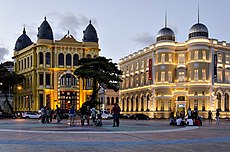
Clara, a 70 year old woman in Recifie, the capital of Pernambuco, Brasil, is a breast cancer survivor of over 30 years. She's the single holdout owner of her apartment in a perfectly fine, lovely old building located barely across the highway from the local beach. The developer who has bought the building, cannot commence demolition and building a high rise banal, souless luxury rental - condo until gets Clara out. The means stooped to are horrible, but entirely unexpected. Other unexpected things happen. However, the violent acts the viewers are so trained to expect from USian flix do not take place.
Historical Recife
Tourist Recife
. . . . Do we want a powerful, kick-ass, empowered, empowering, powerful, effective woman of agency in films and television? A woman who lives on her own terms, in whom we can believe? We'll have to go a long way, alas, before finding another Clara. O no, she does not resort to being man with t*ts, carrying a gun and doing martial arts -- she's not even her own age-bracket Helen Mirren kind of kick-ass Hollywood female protagonist. In fact, Clara has only one t*t . . . . So there.
Aquarius's parts work perfectly and beautifully, because this is Brasilian sensibility, and the music is Brasilian. Additionally Sonia Braga remains one of the most beautiful women on the planet and one of the best actors.
If the viewer knows something about current Brazilian politics and business and the horrors of what's happening with the rain forests, the perfection of the final metaphor just shouts out. But it's not necessary to know.
HIGHLY recommended. How good was it? El V watched the whole thing and he never watches movies. He goes with and leaves within 15 minutes almost always.
Nope, we're still not able to do anything today, still dealing with the exhaustion of Friday night catharis of weeks of work for the Symphony Space live reading with multiple voices and music from The American Slave Coast. We're totally passive. I am making pasta though and drinking wine while doing so. Music is Bob Dylan's Tempest, (2012)
.
The weather had changed drastically from Friday's so hot-and-humid-all-day-and-night at some point, with a bit of rainfall and temperature dropping into the 60's. So it stayed cool and damp of yesterday and last night and still is, at least at the moment, about noon on Sunday. This was not what They Said it was to be, of course.
However, though it was misty and cool, while we were ate, talked, sang and danced on the West Village rooftop, it never actually rained until right at the moment el V and I got out of the cab coming home -- and then it poured. But not a thunderstorm.
The attendees were just as wonderful as on the bus and hotels and restaurants and music events in Cuba, back in January. Even more so, maybe. One way and another everybody who was on the January trip, wherever they live, managed to make it to the Birthday BBQ Reunion, with the exception of only three -- one from Atlanta, another from California and one from North Carolina.
Just as in January, the party operated as an integrated group. People fell together in teams to help bring food up to the roof, to taken things back down to the kitchen and to clean up. The hosts, who had done so much work all week preparing for the party, at least didn't have to have clean-up. What so impressed me is there was no discussion about it. People just Did It.
The people who are partnered, but whose spouses, fiancés, fiancées, boyfriend, girlfriend etc. weren't on the Cuba trip, brought them to the party. Guess what? Their spouses, etc. were just as interesting and cool as the Travelers themselves.
Another way to put is this was a party of people who couldn't be more different than this (from the New York Observer).
I did have a lot of trouble hearing, but so did others -- who were getting over or suffering the same thing I am. But my coughing -- just about entirely gone - YAY! So I had a wonderful time too.
Nor were the terrible events of the week ignored. That was another thing -- there wasn't a single person there who is a secret or semi-racist in any way. These are people whose outlook is international, cosmopolitan, compassionate, empathic, generous and kind.
As well they are very talented. For instance, several are in performance productions that are scheduled for Scotland's annual International Fringe Festival -- and are touring with their groups about the east coast in preparation for their heading over to Edinburgh in August. For another example, most of the musicians are playing a gig at Lincoln Center one night or week in August (all separate engagements). A lot of us will be in attendance those nights.
One of my personal favorites among the guests is someone I see often as G lives here (and knew him long before January 2016). G's a lawyer who made so much money practicing corporate law he quit, mostly, keeping only a few very lucrative private clients. He's passionate about Latin music, particularly Cuban and Puerto Rican salsa.
Currently he's in the process of getting a doctorate in the history of the Scottish Enlightenment. He's been taking classes so far via internet from the University in Edinburgh, and at Harvard. But next winter he's going to go live in Edinburgh for about 7 months and do f2f course work with tutor/advisors. We have such terrific conversations about history -- and last night about the 18th century philosophers, during which we said nice things about Hume, bad things about Kant, and were so-so about Berkeley. I had quite a few very bad things to say about John Locke and his personal contributions to theconstitution of the colony that became South Carolina. Except for Locke, the facts of the matter is that I myself really don't understand these guys. But G is so good at explaining and so passionate about them I sometimes think I do! G's honed legal mind is perfect for 18th C philosophers.
Times Square 1975.
Another of my personal favorite friends in the group is BL. H also lives here and I've known him and his wife, a brilliant public television documentary film maker, for many years by now. B reached out to us the year The World That Made New Orleans was published, which became one of the Treme cast and crew's bibles. David Simon was just getting serious about making Treme at that point. B's the music director - supervisor for most of Simon's stuff since The Wire. Now B's working on DS's new HBO series, The Deuce. They've recreated the 1970's Time's Square uptown, and we're supposed to come and visit. B said, "Once Deuce is finished you will be as educated into the sex industry as you got educated in the drug industry by the end of The Wire." He jhrugged, turned up hands and kind of laughed. What can ya do? It's David S!
So many other terrific conversations as well, including several with S, about various matters including and his intense experiences with whales and dolphins off the coast of California, from which trip he'd just returned. As per usual when S and I are together, at some point we talk about Foyle's War.
During the year when the cancer came back and nothing more could be done medically, and S's beloved, beloved wife A was dying, they watched Foyle's War. S still doesn't know why A fixated on that series through the haze of the heavy duty drugs. But that was all she wanted to watch, and he said, "She wanted it, she got it. It was so little that I could do. I'd get in bed, hold her in my arms, and we watched Foyle's War. For A, each re-watch was fresh and new." S still doesn't know if that was due to the drugs or the cancer itself. But every time they finished up the 9 seasons she insisted they start all over from the first episode of the first season to the end, and then start all over again.
She died in February 2015.
The Cuba trip a year later was what allowed him to come alive again, he says.He didn't have any idea this would happen. It was just something to do to fill up his empty life. But it ended reconnecting him with life on so many levels, even as with every new person he met and and made friends with, he thought of just how much A would have loved it all herself.
But then, S is an awfully terrific, vital person himself.
I'd never had any interest in watching Foyle's War myself, until hearing him tell me about watching it with A while she was dying. And I still didn't. Nevertheless, after coming back from that January Cuba trip and S's and my conversations there, I watched Foyle's War myself, in solidarity with my new friend S and memorial to his A, who by all the many and varied obits of her, was a most wonderful, special and talented human being.
These are the kinds of friendships that get forged on el V's Cuba trips.
I feel so much better. I can't wait for the ears to clear up. I'm going back to an ENT person this week.
The library notified me this AM that three of my holds were available for pick-up today, just in time to be trapped inside for a long weekend of snow, wind and maybe also ice and sleet and rain, beginning for at 4 AM Saturday. If the storm effects that arrive here (it's going to be much worse further south) turn out as bad as They Say the potential is, we're supposed to stay inside for as long as possible, during the storm and the initial clean-up after. Honestly, after having lost so much time traveling, the holidays, then traveling, then the long holiday weekend and now another 3 - 4 day weekend due to weather, I could really do without this hiatus.
However, we're ready with all we need to be ready with.
Plus, now, three books I've been looking forward to reading: Cornwell's latest Saxon Chronicles, Warriors of the Storm(so appropriate a title for this weekend!), the biography of a Victorian marriage, Mr. and Mrs. Disraeli, by Daisy Hay, and Robert Harris's concluding fictionalization of his three volume life of Cicero, Dictator.
Additionally I have a dvd of a 1997 BBC production of Wilkie Collins's novel, The Woman in White.
Mostly though I'll be working on my 2015 Best Reading Round-up.
All I know so far is that Life On The Mississippi, and, Isabella: Warrior Queen, are on it. There are more, of course, but I haven't been able to get myself to go through my reading and watching journal for 2015 yet. It's a lot slimmer with commentary than previous years -- reading almost solely for The American Slave Coast, and mostly not reading at all, in the final quarter of 2015.
As well, we'll have to devote some time in the next two days getting our 3 -4 months calendar in order. We have some dates already scheduled, including here in townL the CUNY Grad Center, a bookstore in Harlem, The Museum of the Moving Image, and the Jumel Mansion. We've got other dates in Boston, Kentucky, Tennessee and Georgia -- and New Orleans again -- so far.
I guess we'll stay occupied, even if we feel trapped.
At least this evening we get to to attend the reception - event at the Metropolitan Museum of Art around African art. Since the storm doesn't start until after midnight there was no need to cancel this. I'm so glad since it means I'll get to see the exhibit of Ancient Egyptian Art: The Middle Kingdom, that closes on Sunday. I can use my Christmas camera some more.
The first major collaborative exhibition between the Yale University Art Gallery and the Yale Center for British Art, The Critique of Reason offers an unprecedented opportunity to display together treasured works from both museums’ collections. The show comprises paintings, sculptures, medals, watercolors, drawings, prints, and photographs by such iconic artists as William Blake, Théodore Géricault, Francisco de Goya, and Joseph Mallord William Turner. The broad range of work selected challenges the traditional notion of the Romantic artist as a brooding genius given to introversion and fantasy. Instead, the exhibition’s eight thematic sections juxtapose arresting works that reveal the Romantics as attentive explorers of their natural and cultural worlds. The Critique of Reason celebrates the richness and range of Yale’s Romantic holdings, presenting them afresh for a new generation of museumgoers.
Since seeing the film, Mr. Turner, last year, Romanticism has again been much on my mind, and wondering how much, if any impact it had upon the thought of the new United States and her political - intellectual classes.
The War for Independence has been profiled as a product of the Enlightenment, without considering that continental and British Romanticism might have had equal or even contradictory influence. For instance, see the successive religious waves ofThe Great Awakening, and their huge footprint in American history.
CBS News did a segment about it. Their commentary afterwards isn't the usual empty drivel. Among what the segment includes is the mother of of someone we know learning that her first American ancestor was brought from Africa to the Whitney.
“Slavery gets understood as a kind of prehistory to freedom rather than what it really is: the foundation for a country where white supremacy was predicated upon African-American exploitation,” says Walter Johnson, a Harvard professor. “This is still, in many respects, the America of 2015.”
Built largely in secret and under decidedly unorthodox circumstances, the Whitney had been turned into a museum dedicated to telling the story of slavery — the first of its kind in the United States.
This is not by any means the first slavery museum in North America. I have visited quite a few of them, from slave markets as memorials and learning centers, to restored "quarters" on other plantations, to auction sites and slave jails. There's a large slavery museum in Richmond (along with a Confederacy museum; the Confederacy museum is located within a well-marked historical district -- the slavery museum, well, it's more difficult to access, shall we say?).
However, whatever first inspired Cummings to create this memorial museum out of a Louisiana sugar plantation, I recognize, intimately, what drives him. It's feeling that overwhelming obligation to bring out in an organized, structured, carefully documented public manner -- the revelation of WHAT REALLY HAPPENED that we as individuals and citizens, and as a nation keep hiding and lying about:
. . . . “I started to see slavery and the hangover from slavery everywhere I looked,” he said. As a descendant of Irish laborers, he has no direct ties to slaveholders; still, in a departure from the views held by many Southern whites, Cummings considered the issue a personal one. “If ‘guilt’ is the best word to use, then yes, I feel guilt,” he said. “I mean, you start understanding that the wealth of this part of the world — wealth that has benefited me — was created by some half a million black people who just passed us by. How is it that we don’t acknowledge this?”
The Whitney Plantation is something different, and astonishing. It's art, a gigantic, multi-layered, multi-faceted memorial complex honoring the blood, sweat and grief of the thousands and millions of people, captured, victimized, tortured and held captive to their deaths, their entire lives devoured by estate-prison machines like the Whitney.
After visiting the Whitney Plantation, and then the Angola Prison, which is a fully functioning plantation, made from a plantation owned by the antebellum era's largest, most successful and wealthiest slave trader, what I'd learned about Jefferson and Virginia plantations from the penal colony of Monticello showed in even more disturbing relief.
Located on land where slaves worked for more than a century, in a state where the sight of the Confederate flag is not uncommon, the results are both educational and visceral. An exhibit on the North American slave trade inside the visitors’ center, for instance, is lent particular resonance by its proximity, just a few steps away outside its door, to seven cabins that once housed slaves. From their weathered cypress frames, a dusty path, lined with hulking iron kettles that were used by slaves to boil sugar cane, leads to a grassy clearing dominated by a slave jail — an approach designed so that a visitor’s most memorable glimpse of the white shutters and stately columns of the property’s 220-year-old “Big House” will come through the rusted bars of the squat, rectangular cell. A number of memorials also dot the grounds, including a series of angled granite walls engraved with the names of the 107,000 slaves who spent their lives in Louisiana before 1820. Inspired by Maya Lin’s Vietnam Veterans Memorial in Washington, the memorial lists the names nonalphabetically to mirror the confusion and chaos that defined a slave’s life.
These names have been taken from the database compiled by long-time amiga and colleague, the ground-breaking, pioneering scholar, Gwendolyn Midlo Hall. See her great works, which are now online, "Database for the Study of Afro-Louisiana History and Genealogy" and "Afro-Louisiana History and Genealogy 1719-1820".
Why this museum? Why now? (Why The American Slave Coast: A History of the Slave-breeding Industry? Why now?)
A nation builds museums to understand its own history and to have its history understood by others, to create a common space and language to address collectively what is too difficult to process individually. Forty-eight years after World War II, the United States Holocaust Memorial Museum opened in Washington. A museum dedicated to the Sept. 11 terrorist attacks opened its doors in Lower Manhattan less than 13 years after they occurred. One hundred and fifty years after the end of the Civil War, however, no federally funded museum dedicated to slavery exists, no monument honoring America’s slaves. “It’s something I bring up all the time in my lectures,” says Eric Foner, a Columbia University historian and the author of the Pulitzer Prize-winning “Fiery Trial: Abraham Lincoln and American Slavery.” “If the Germans built a museum dedicated to American slavery before one about their own Holocaust, you’d think they were trying to hide something. As Americans, we haven’t yet figured out how to come to terms with slavery. To some, it’s ancient history. To others, it’s history that isn’t quite history.”
The article is a very good one, reflecting, hopefully, the tone of the NY Times Magazine's roll-out of its brand new do-over.
I love David Suchet's ITV's Agatha Christie's Poirot (1989 - 2013), though it takes a turn around 2008 which is darker and uglier, less a luxe entertainment of justice served and order restored, though not necessarily more realistic. Poirot begins to feel the stress of his years of being the instrument of bringing justice to murder's victims, while his solitude begins to weigh on him. His large eyes -- like those of an owl -- that see in so many directions at once, also well with tears, more than once. In Murder on the Orient Express (2010), which pointedly is located in 1938, though he solves the crime, he cannot force himself be the agent of justice. Even his mustache points, point if not down, straight, not curved upwards in Poirot's signature second smile.
No little provocation for that love is embodied by the design and score of the title sequence. These are a seamless blend of the Poirot period elements (end of WWI, to nearly the outbreak of WWII) signaling sophistication, elegance and glamour. The opening title sequence deconstructs the decorative arts of the historical era that is being recreated. Art Deco and modernist, i.e. both revolutionary while harking back to certain more traditional decorative arts, such as the Asian and Egyptian. All this, plus at the end, a soupcon of occult suggestion. that further plays up the announcement that this program will deliver nothing of the ordinary.
See for instance, the 1993, series 5 episode. “Dead Man’s Mirror” (which is specifically named at the auction as Art Deco) where all these elements of Deco, Egyptian, Modernist etc. roll together seamlessly. The era's class considerations, roll together equally as seamlessly -- which is where Poirot differs so much in treatment from American attempts at these entertainments.
This floats with a buoyancy one would not expect of a series drama centering murder, in the decades that include the Depression and the lead-up to WWII. So we are further promised that we're about to escape into a English world that is as much a fairy tale in a never-never-land -- though without the delicious frou frou -- as are the American Astaire-Rogers madcap song and dance romance extravaganza films, the sets for which also frequently employ extensively Art Deco set design.
The title sequence literally pulls us into the series's escape by centering travel, which, for the elite and privileged who could afford it, had finally become authentically comfortable and easy. (To learn what travel was like, prior to the age of steam and the innovation of passenger ships, even for the privileged, read the accounts by John Quincy Adams's first voyage to Europe, with his father, John Adams.)
In Poirot's opening sequence, comes first a plane (presented by a rendering influenced by period, industrial design, small enough to be a private plane).* Air travel was just beginning to be common -- again for those who could afford it, the most up-to-date glamorous mode of travel. The plane pulls along the older form of travel, a train which has first class cars. For only an instant we see "Liner" printed upon the side of something racing along in these transportation scenes, which could mean either the train or that even older luxe form of travel, the first class passenger ship liner.
The 1920's and 30's are the interim between the old world of rigid class definition, in which almost everyone was either a servant or had a servant -- or very many servants -- and the world of reliable factory work, modern housing developments and modern conveniences that made servants too expensive and difficult for nearly everyone. Among many other elements this series is presenting, made from murder mysteries written in those decades, is a milieu that reassures the class elite's anxieties about a changing world, no matter how many of them are murdered by their relatives and lovers. (That supposedly is the attraction of murder mysteries: a bloody destruction of how things are, then, with the revelation of the killer, traditional social order is redeemed and returned.)
This wasn't going to last much longer, babies, and one might guess that Ms. Christie was rather more aware of this than many of her contemporaries.
ITV's Poirot shows up the Downton Abbey crew as fusty and musty as it is. They may pretend they're in the 1920's, but they're still lurching along in the 18th century. The comedy perhaps comes out of knowing that the audience identifies itself primarily as Lady or Countess so-and-so when, in the reality of those days, we'd be the skivvy -- who doesn't even rate her own name, as even ladies' maids in those days were called by their Lady's name.
If I have a criticism to proffer about this long-running series, is that characters who are supposed to be Americans just don't talk like Americans. But then, this is said about Americans who are supposed to be playing Brits on American television too. But it can be grating that British television actors on a British television program, when playing an American default to something that evidently is supposed to be either Southern or Western, and never is either one.
The mouse that runs all through Hickory Dickory Dock is not cute and endearing, particularly as it not quite tracks through a victim's blood.
Quite a few episodes of Poirot I'd not previously seen became available via streaming on netflix, including the brilliant 1995 series 6 episode "Hickory Dickory Dock." For starters, the episode is seen extensively from the point of view of a mouse, including the opening, as the mouse runs down the clock. One of the suspects is played by a very young Damian Lewis, now Henry VIII in the BBC's Wolf Hall. It seems too, that Rowling / Galbraith borrowed some of the elements from it -- or from the book? I've never read any Poirot novels, never seen a one around here, and am reliably informed that the book Poirot is very different from the Suchet Poirot. In Galbraith's The Silkworm, a meeting takes place in the venerable Cheddar Cheese pub-bar between protagonist private detective, Cormoran Strike, and Nina Lascelles – a junior editor, whose body language and appearance are perceived by Strike as those of a mouse. The locations of Hickory Station, etc. are also in The Silkworm.
Poirot, the Greatest Detective in the World and the Most Famous, flanked by his friends, decomissioned Captain Hastings and Chief Inspector Japp of Scotland Yard.
Miss Lemon, Poirot's faithful and extremely competent assistant.
Agatha Christie's Poiret may be perhaps one of the greatest television series ever made, particularly if one's criteria include the design and cinematography. The writing and acting are top-of-the-line, with a fine ensemble cast that one greets joyfully in each episode -- just as their characters do with each when having been separated for long periods by circumstance -- sometimes they've been separated for entire seasons. --, and often not pleasant circumstances. As many of the episodes show, even as Poirot and Company travel comfortably to stay in the most luxe of hotels, to the most ancient of places in Mesopotamia, Rhodes, Egypt, among those unhappy circumstances is time itself. Time just keeps going, with murder and all the other darkness of humanity flowing along its currents from the furthest past into futures that we can barely see, so darkly does the future loom for Poirot's world.
------------------------------
* See the first Astaire-Rogers movie pairing, before they became the feature marquee attraction, Flying Down to Rio (1933). In fact, their last film pairing was the 1939 biopic The Story of Vernon and Irene Castle, in which Vernon dies tragically in a training accident preparing to be a war pilot for the Royal Flying Corps in WWI. Among others, there is Dorothy Sayers's second Lord Peter Wimsey (1926) Clouds of Witness, adapted for BBC television in 1972.
Yesterday at least 25,000 peacefully marched and protested here in solidarity with the March in Washington D.C., protesting police brutality and the actions that include results such as unjustified death, executed with impunity, with no consequences to the perpetrators.
Those who demonstrated against this yesterday were surrounded at all times by police in riot gear, carrying the same weapons as the military, surveilled by helicopters and drones.
Yesterday was also NYC's unwelcome situation of hosting the annual Santacon -- thousands of really drunk college revellers who are really obnoxious and badly behaved. Mostly, need we say, white people. Not a cop was in sight where they charged and held up traffic, barfing and insulting those around them. Anyone who objects to these hordes descending upon us the second Saturday in December, making our lives difficult -- we're called grinches and anti-liberty. Nevertheless, the hipsters of Williamsburg, Brooklyn, where the organizers wanted these jerks to pee and vomit this year, refused to participate. Can't have a Santacon without participating bars serving discounted drinks . . . .
Under these circumstances, an Alvin Ailey (a New York dance company, it was founded in 1958) choreographed dance biography of the performer of "Freedom Trilogy" (1962), in the heart of the Civil Rights era, seems about as appropriate as NYC can be.
Vulpine, canine, feline, porcine & equine avatars. Gone to heaven Gone to hell Gone to jail Gone to work Gone to school Gone to lunch Gone to bed Gone to bad Gone to pee Gone to earth. Gone Gone Gone. Fox's earth is Blue Gotham City. Shorter sojourns are spent in other, more dangerous, locations.










.jpeg)