LINES OF THE DAY

". . . But the past does not exist independently from the present. Indeed, the past is only past because there is a present, just as I can point to something over there only because I am here. But nothing is inherently over there or here. In that sense, the past has no content. The past -- or more accurately, pastness -- is a position. Thus, in no way can we identify the past as past." p. 15

". . . But we may want to keep in mind that deeds and words are not as distinguishable as often we presume. History does not belong only to its narrators, professional or amateur. While some of us debate what history is or was, others take it into their own hands." p. 153

Silencing the Past: Power and the Production of History (1995) by Michel-Rolph Trouillot

Showing posts with label manners. Show all posts

Thursday, August 20, 2020

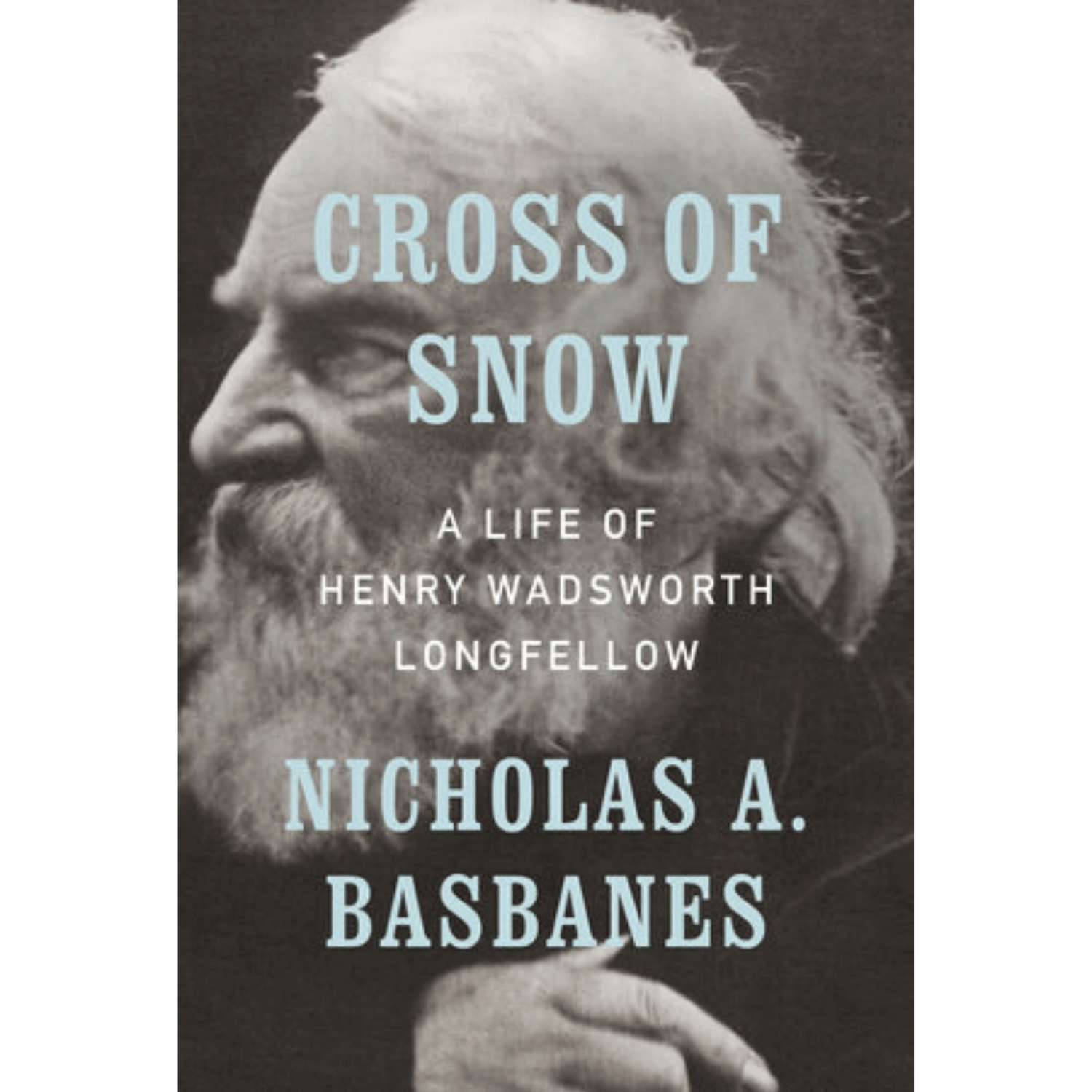
Basbanes, Nicolas A. (2020) Cross of Snow: A life Henry Wadsworth Longfellow


     . . . . Basbanes’s book overflows with interest for the literary, material and political historian of the US in the 19th C. The interest begins right at the start of the Introduction, in which Longfellow’s trajectory and fate are traced within the literary ‘canon’ critical establishment within, and without, academe.  Ten years ago surely, I would never have guessed that Longfellow would be rehabilitated as worthy by serious literature, but he has been.

All lives have tribulations, at least back before the medical advances of the later 20tht century.  Still, a very few led golden lives, and were also decent human beings, whom it was a joy to know, despite losses of loved ones to disease and childbirth.  Longfellow suffered grief due to losing those he loved, early in their lives, such as his first wife.  But still, like Walter Scott, he lived at time when it was nearly paradise for prosperous white men.

The story begins in Portland, Maine; of which Longfellow was a life-long proud and loyal scion,  presenting a cultural history of New England through his life time. Though not born into it, he joined that generational education-prizing Bostonian wealthy cultural and literary elite, which meant then, the literary elite of the nation. Our first recognized commerical publishers and editors were his friends before they became publishers, like Ticknor and Fields. To have all doors open to one at all times, wealth is very much the key. Longfellow’s father-in-law was the vastly wealthy fellow who pulled off industrial espionage, i.e. theft of propriatory information and design, from the textile factories of England, to institute the factories of Lowell, MA. Marrying into serious money is always a good move that improves life, even when already a popular eligible bachelor, a successful prof at Harvard, and published, prosperous money-making author.


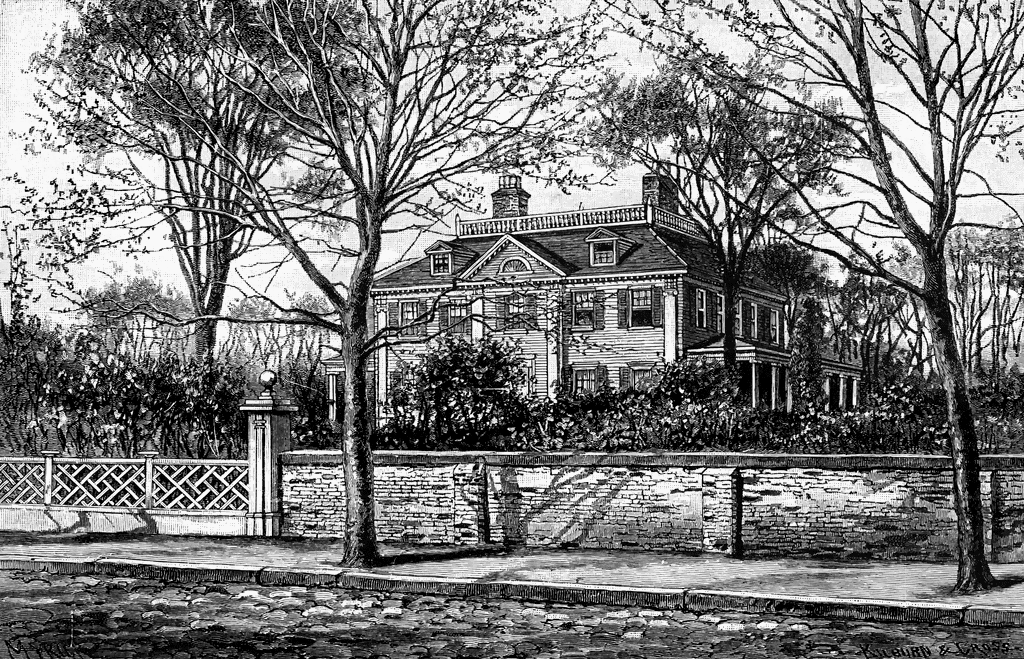
Craigie House, bought by Longfellow's FIL when he married Fanny. Washington bivouacked there. I always have imagined the Lawrence mansion in Louisa May Alcott's Little Women looking exactly like this.

Politically, Longfellow was mildly centerist all his life, which didn’t prevent a close life-long friendship with radical abolitionist-to-be, Charles Sumner. Nor did it prevent him from writing the lines that concluded his very popular, The Building of the Ship (published 1849), that made President Abraham Lincoln weep:

Thou, too, sail on, O Ship of State.

Sail on, O Union, strong and great!

Humanity with all its fears,

With all the hopes of future years,

Is hanging breathless on thy fate!

I confess, that in These Times, particularly after watching the Democratic Nominating Convention these last three days and hearing non-insane people speaking to a national audience, the lines make me weep too, as we all hardly even dare for “hopes of future years” in any way that we have known in the past.

Cross of Snow,  like such earlier biographies that have so delighted me, such as The Peabody Sisters:Three Women Who Ignited American Romanticism by Megan Marshall. Sophia Peabody was so much more interesting before she married Nathaniel Hawthorne, who was a Bowdoin schoolmate and later friend too, of Longfellow. Or, The Beechers by Milton Rugoff, an examination of the family. These provide the deeply engaging immersion that does a really fine historical family saga, such as that of Winston-Graham’s Poldark Saga.  

These kinds of books are inspiring, antidotes to the gorge of disgust, revulsion and despair about the USA and its history engendered by all these criminals in the news these days. They remind us there is a side of light after all to our past, that shone brilliantly in many locations -- in great opposition to the dark of Slaveocracy and those who made the War of the Rebellion -- and the Slaveocracy's descendents, these monsters from Lovecraft who are about nothing but ugly, hate, murder, pillage and destruction.

Saturday, July 8, 2017

Reading In the 18th Century - Public and Participatory

     . . . . In 18th century England and Europe, with the technological innovations in what was still the rather new-fangled printing press technology books became available commercially to anyone who could afford them.


Sor Juana Inés de la Cruz, self-taught scholar and poet of New Spain (Mexico).

No longer was reading for pleasure, inspiration or information limited to  academics and churchmen with access to archives and libraries, or exceedingly wealthy individuals who could patronize poets, scholars and historians, and buy expensive hand-written manuscripts and the finely crafted tomes.

Though the price remained out of reach for poor people, the rapidly expandng middle-class could easily afford books. Even those who served the middle-classes were able to acquire reading materials for fun and instruction.

Still, candles remained expensive, and so did fuel for fires.  Many people's vision was too poor to read for themselves in such dim light -- and it would be only at night they could find an hour for themselves.  So it was the most natural thing in the world that along with the flood of commercial reading materials came the practice of reading aloud in groups.


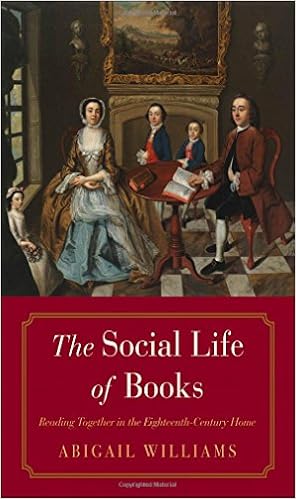
Abigail Williams has presented us with a lively account of the vastly popular activity of reading aloud in The Social Life of Books.  
Williams, who teaches at Oxford University, explains that from the vantage of our own age, saturated as it is with entertainment and information, “it is hard to imagine the excitement felt by previous readers at the possibility of gaining access to a new book.” 
.... In the pages of his magazine, the Spectator, Joseph Addison commanded that culture come “out of Closets and Libraries, Schools and Colleges, to dwell in Clubs and Assemblies, at Tea-Tables, and in Coffee-Houses,” and it did. 
Review of The Social Life of Books here.
She explains how reading became something of a “spectator sport.” Of course, as with any type of performance, one had to be properly prepared, and this led to a surge of instructional manuals, further fueling what Williams designates “the great age of elocution,” in which Britons of all backgrounds were gripped with “a near obsession with learning to read out loud.” Tradesmen formed what were rather memorably known as “spouting clubs” for aspiring public speakers, relying on such handbooks as “The New Spouter’s Companion” and “The Sentimental Spouter.” Women, who very often found themselves omitted from public performances, quickly took to them in the home, entertaining friends and family with tales and poems while they knitted or otherwise busied themselves around the hearth.


One of the reasons this reader particular enjoyed Abigail Williams study of books as a popular social activity is because it brought back vividly my first ideas of reading aloud, entertainment, instruction and novels went together naturally.  It was an illustration, of a servant girl by the kitchen fire, reading aloud to the rest of the household staff, the latest installment of Samuel Richardson's Pamela: Or Virtue Rewarded.


In the Book of Knowledge's history of literature section, it was carefully explained to the young reader how important reading and novels were in instructing the poorer, less educated classes in morality and social behavior. Pamela was the paragon of virtue that all young women should model themselves on.  The most important lesson of all that Pamela taught poor young girls who served in more prosperous homes that at all costs she must preserve her chastity from the household men who all would set siege to corrupt her from the paths of virtue.  But if she followed Pamela's example she would not only preserve her all important good reputation -- she may well marry the son of the house and become the lady of the house, no longer a servant.

I have looked and looked in vain for an 18th century illustration that shows a young servant girl reading aloud by kitchen fire light to her gathered sister - fellow servants, but have not found one. That illustration must have been commissioned by The Book of Knowledge staff for that section.

It seems that in the 18th century when servants congregated together below stairs, out of the view of their employers, the lower household orders did nothing that interested the popular press illustrator other than drinking and generally roistering upon their masters' substance.  Which reveals even more about the popularity among servants for reading aloud together 'improving' literature.

Sunday, December 18, 2016

Under The Bright Surface, the Darkness of Jane Austen's Novels's Depths

    . . . .  This is a perceptive essay by a mature reader and literary scholar


Poor Fanny at the bridge of the ha-ha.
who sees a different Jane Austen than did her younger self, one that is far more true to the age in which they were written than the fantasies woven about them these days by so many contemporary female readers.

The author, Mikita Brottman, spends several satisfying paragraphs on Mansfield Park. Something new -- these days, her students, so sensitive to bullying and victimization, feel a deeply personal, sympathetic bond with Fanny Price, so unlike many feminist literary students of my era.

I now see Austen as a very dark writer and Mansfield Park as her darkest work, a book full of sexual repression and unconscious conflict, with no forgiveness or redemption for anyone who dares struggle against the social code. The world of taffeta and lace exists only on the surface; underneath it, these well-bred young women are trapped like rats. 
"Trapped like rats," describes how I've seen almost all the women in Austen's works.

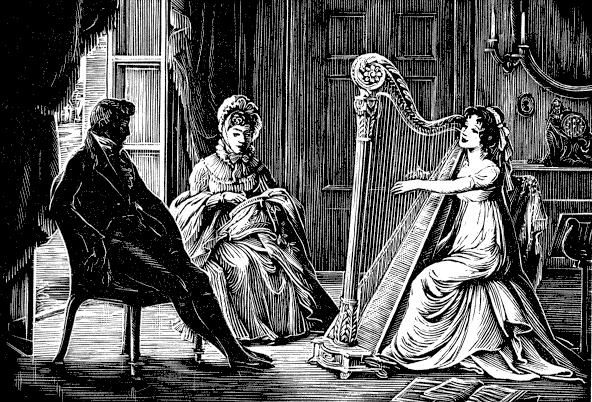
Mary Crawford seduces plays the harp for Fanny's Edmond.
(The single exception may be the most conventional of them all, Emma. But then her cage is the most gilded of Austen's protagonists. She has the least to gain or lose --  by breaking out, with the exception of Mary Crawford, who we are to abhor for stealing Fanny's beloved. *)
At one point, she (Fanny) overhears Maria flirtatiously asking their neighbor, the handsome Henry Crawford, whether he thinks she’s as lively as her sister.
Henry’s reply is ambiguous. “You have a very smiling scene before you,” he observes.
“Do you mean literally or figuratively?” says Maria. “Literally, I conclude. Yes, certainly, the sun shines, and the park looks very cheerful. But unluckily that iron gate, that ha-ha, give me a feeling of restraint and hardship. ‘I cannot get out,’ as the starling said.”
Maria Bertram is using a reference to Lawrence Sterne's 1768 A Sentimental Journey to describe her own condition.  Who would have thought that such a superficial privileged pretty young woman could have the knowledge and the intelligence to see the similarities between herself and this incident in Sterne's novel?  Surely such perceptions are confined to darling, bookish, insignificant perfect Fanny, hmmmmm?
. . . . .To give weight to her feeling of being trapped, Maria alludes to an incident in A Sentimental Journey, Laurence Sterne’s 1768 novel. The narrator, Yorick, is visiting the Bastille, thinking that imprisonment there might not be so bad. The prison, he muses, is just a kind of tower, and is a tower really so different from a house you can’t leave? Suddenly, he hears the same words repeated twice over—“I can’t get out—I can’t get out”—and looking up, sees a starling in a little cage. He tries to free the bird, but discovers the cage is locked in such a way that you can’t open it without destroying both cage and bird. All at once, Yorick is brought back to reality. “Mechanical as the notes were, yet so true in tune to nature were they chanted, that in one moment they overthrew all my systematic reasonings …”
Like the starling, Austen’s heroines cannot get out. . . .
Nor does darling rigidly conventional Fanny object to the consequent very real imprisonment abroad of Maria as punishment for breaking out. But she has the very most to lose by breaking out -- until she does and goes home and consaequently performs a 360, proving her very conventional value to the family whose blood daughter really did break out. Fanny's happy ending is the only happy ending a female can achieve -- doing everything according to society's demands.

Neither Austen nor her readers were about to see things the way we see things these days.  And that world was a dreadful, truly dreadful prison for just about all women.
 “The greatest blessing to every one of kindred with Mrs. Rushworth,” thinks Fanny, “would be instant annihilation.”
What does this say about contemporary young readers, one wonders.  That they adore Fanny for suffering, but have no sympathy for a woman who kicked over the traces of what she was condemned to by family and society?  It's as though we have all gone backwards again as a gender, a society and a culture.

The 19th century illustrations of Austen novels, of course, have helped feed that non-reality based, nursery rhyme - fairy tale perception of subsequent generations of fanciful female readers.
------------------------

Does this not just make you sick?  Mansfield Park and Austen do not deserve this!
*   Only the deluded could really believe that the brilliant, independent Mary Crawford fell even the least little bit for that stick, Edmund.

P.S. Mansfield Park has become my favorite Austen by far.  It shows no mercy.


Tuesday, January 19, 2016

What to Wear While Exploring, Fairyland Geography -- See Yesterday's Post!

At the Museum of Fashion Institute of Technology:

Inspired by The Snow Queen, naturally -- and purrfect for today's 18º F.
[ " . . . . Fairy Tale Fashion features more than 80 objects placed within dramatic, fantasy-like settings designed by architect Kim Ackert. Since fairy tales are not often set in a specific time period, Fairy Tale Fashion includes garments and accessories dating from the 18th century to the present. . . . " ]
[ " Fairy Tale Fashion is a unique and imaginative exhibition that examines fairy tales through the lens of high fashion. In versions of numerous fairy tales by authors such as Charles Perrault, the Brothers Grimm, and Hans Christian Andersen, it is evident that dress is often used to symbolize a character’s transformation, vanity, power, or privilege. The importance of Cinderella’s glass slippers is widely known, for example, yet these shoes represent only a fraction of the many references to clothing in fairy tales. " ]
[ " The exhibition’s introductory space features artwork that has played a role in shaping perceptions of a “fairy tale” aesthetic. These include illustrations by renowned early 20th-century artists such as Edmund Dulac, Arthur Rackham, and A.H. Watson. Several recent, large-scale photographs from Kirsty Mitchell’s award-winning Wonderland series are also on display. . . .  Connections between fashion and storytelling are further emphasized by a small selection of clothing and accessories, including a clutch bag by Charlotte Olympia that resembles a leather-bound storybook. " ]
Fairytale Fashion Magazine.
A video of a runway Fairy Tale Fashion show from 2010:


Tuesday, June 23, 2015

Another Period -- Comedy Central

The Comedy Central series, Another Period, parodies the Downton Abbey era costume soaps that portray happy, contented, loyal downstairs who know and keep and love their place, who  understand how much superior to themselves are


their upstairs betters. Another Period is set in the Gilded Age Newport, which, it is said, where Julian Fellows plans to place his next a-historic extravaganza. Eps run about 22 minutes. A series of sketches, sketchily stitched together, the viewer wouldn't want more at a time than 20 minutes.


Among the featured plays is Christina Hendrick, Joan Holloway in Mad Men. She is a terrific actress with a wide range, as Mad Men showed.  Mad Men also showed that she's a terrific comedian, which she is here.  Her timing is impeccable.

I just watched the pilot, which pointed to historical class nasties enough to be favorably amusing. Christina Hendricks was in the pilot the primary reason it worked.  Her character's name is Celine, however her betters provide a name more suitable to a servant, "Chair."

Monday, March 2, 2015

Authors & Review(er)s + Text Excised from Trollope's Duke's Children Discovered

From the Guardian: "Why All Writers Are Vain" as their vanity appears to a writer who is also a reviewer:


. . . . The vast majority of writers, if they have a modicum of self-awareness, must know that they probably belong among the literary also-rans rather than the exceptional elites. In my own case, I know I am not the cleverest or most original thinker and my prose is not the most beautiful. But if I am honest, somewhere inside me, probably not too far beneath the apparently modest surface, is the hubristic belief that if I can apply my skills of clear exposition and synthesis to the right subject, I might just write a book of exceptional worth.
I doubt that I am unusual. I’ve met, interviewed and shared stages with many writers over the years, and the majority have come across as modest, grounded people. Only one has turned up in a hotel lobby wearing sunglasses, and that was a performer turned author. Of all the speakers at one literary festival which requires participants to wear head-set microphones, only two have so far refused to do so because it messed up their hair – both male. And yet although the writing profession is generally free of the ostentatious egotism of rock’n’roll, the ways in which it is infused with vanity have become increasingly evident to me. The excessive admiration or pride in their own work that I detected in those two writers would reappear time and again, and eventually I would come to recognise it in myself.

For those who are happy readers of Anthony Trollope's novels, particularly his Palliser novels, or as they are also known, The Parliamentary Novels, there is this:


A limited, deluxe edition is being published that restores the cut text, amounting to about 40,000 words.

“It’s quite extraordinary the different cumulative effect it has, on the richness of the text and the subtlety of the characters,” said Joe Whitlock Blundell at the Folio Society. “When I first read The Duke’s Children 30 years ago, it all seemed to be focused on the Duke’s reactions. But in the restored version, the characters of the children come through far more sympathetically.”
Amarnick writes in a commentary to the new edition that the “thousands of cuts did tremendous damage” to the work. Although Trollope did not delete any of his 80 chapters, he removed consecutive paragraphs in some places; in others, he cut sentences, phrases and words, even replacing a word with one which was slightly shorter on some occasions.
. . . . “There is no concrete evidence for who exactly forced him to make the cuts, though it seems probable that it was Charles Dickens Jr who requested a shorter book for serial publication,” said Whitlock Blundell. “As for his reluctance, there can be no doubt about it. He was very sensitive to any requests to cut his work, and wrote in his autobiography, ‘I am at a loss to know how such a task could be performed. I could burn the MS, no doubt, and write another book on the same story; but how two words out of every six are to be withdrawn from a written novel, I cannot conceive’.”
This may bring tears of justification to the eyes of many an author instructed to cut their own works to improve the narrative flow, structure and rhythm, or for the "economy of cost".

As a friend commented elsewhere, ". . . it's kind of hard to believe Trollope would be improved by the restoration of verbiage."

Like her, I'm not an admirer of Trollope as a prose stylist. As an observer of his times,, most certainly he's a novelist to be mined. But most of his books are nearly unreadable, as far as I'm concerned. Exceptions would be The Way We Live Now, some of the Palliser chronicles and some of the Barsetshire books. But the Pallisers and Barsetshire sequences only after I learned a great deal more about the Victorian era politicians, issues and the Church of England than in previous readings. If one doesn't know the political and Church of England historical miliieu these books are near impenetrable morasses -- or at least they were for me.

Partly this was because, as same amiga remarks in the discussion, "What bugs me are the inevitable purity/virgin subplots. I'd like every one of them cut entirely." 

Yet, there are ladies in his novels who, despite the author, end up successful without being virgin.  But all that Trollope verbiage tends to conceal that they avoided humiliation, disgrace, despair and death. 

Then there's his habit of naming characters with silly names -- such as Killancodlem, Quiverful, Filgrave --  thinking he was following in Dickens footsteps, while viewed as witty by some readers, for others are annoying at best. At worst one cannot take such names seriously, as the age of Dickens had long since been superceded. OTOH, there are a plenitude of astonishingly preposterous names among the English aristos, at least to the ears and eyes of Merikans. 


Even Trollope's novel about wife abuse, stalking, etc., He Knew He Was Right (2004), is a slog to read, and, for that matter, so is the BBC production of it a nearly unendurable slog, except that it does have Bill Nighy in his delightfully slimy persona.


The major exception to the slogs is The Way We Live Now, all about money and publishing and marriage. These matters read just fine to contemporary literature-minded Merkians, even without knowing anything about the Age, so to speak.

Like The Way We Live Now (2001) did, anchored by David Suchet playing the financial ponzi schemer, August Melmont, fortunately some of these other books too have made terrific television, as they excise enormous wadges of Trollope's plodding text. I still love BBC's The Pallisers (1974 - 1975) -- which also gives the Duchess of Omnium the focus she should have -- and 

Susan Hampshire as the Duchess of Omnium during her unhappy European marriage tour.

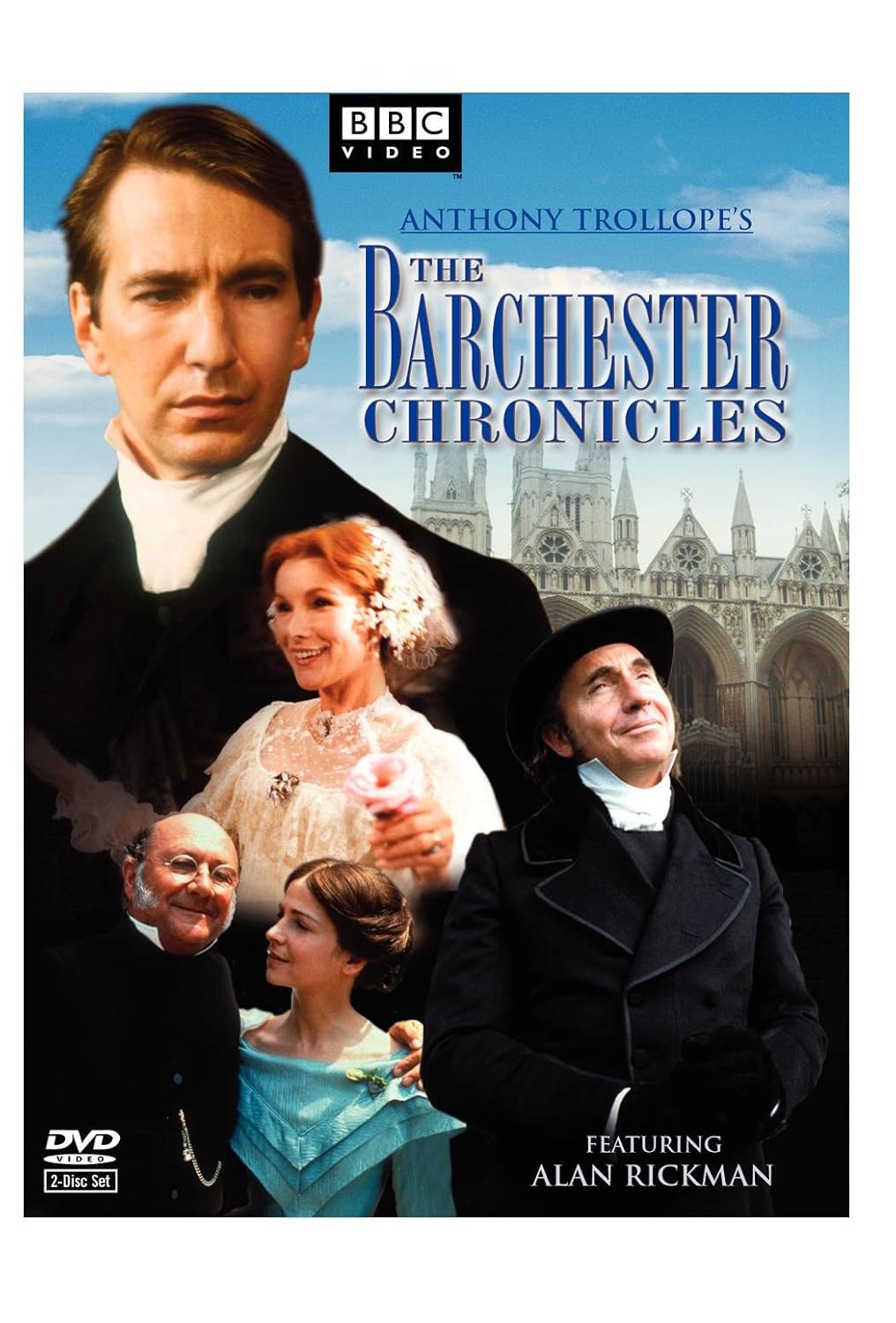
played by the delightful Susan Hampshire, -- and the Chronicles of Barset (1982 in which Alan Rickman inhabits Obediah Slope -- and it even includes Susan Hampshire, again, as delightful in the role of  La Signora Madeline Vesey Neroniwooed, alas, by Slope, as she was in The Pallisers and as Lady Churchill, in The First Churchills. 


All of these series are happy ways to spend this endless winter.

Saturday, February 21, 2015

Poirot

I love David Suchet's ITV's Agatha Christie's Poirot (1989 - 2013), though it takes a turn around 2008 which is darker and uglier, less a luxe entertainment of justice served and order restored, though not necessarily more realistic. Poirot begins to feel the stress of his years of being the instrument of bringing justice to murder's victims, while his solitude begins to weigh on him. His large eyes -- like those of an owl -- that see in so many directions at once, also well with tears, more than once. In Murder on the Orient Express (2010), which pointedly is located in 1938, though he solves the crime, he cannot force himself be the agent of justice. Even his mustache points, point if not down, straight, not curved upwards in Poirot's signature second smile.


No little provocation for that love is embodied by the design and score of the title sequence. These are a seamless blend of the Poirot period elements (end of WWI, to nearly the outbreak of WWII) signaling sophistication, elegance and glamour. The opening title sequence deconstructs the decorative arts of the historical era that is being recreated. Art Deco and modernist, i.e. both revolutionary while harking back to certain more traditional decorative arts, such as the Asian and Egyptian. All this, plus at the end, a soupcon of occult suggestion. that further plays up the announcement that this program will deliver nothing of the ordinary.


See for instance, the 1993, series 5 episode. “Dead Man’s Mirror” (which is specifically named at the auction as Art Deco) where all these elements of Deco, Egyptian, Modernist etc. roll together seamlessly. The era's class considerations, roll together equally as seamlessly -- which is where Poirot differs so much in treatment from American attempts at these entertainments.

This floats with a buoyancy one would not expect of a series drama centering murder, in the decades that include the Depression and the lead-up to WWII. So we are further promised that we're about to escape into a English world that is as much a fairy tale in a never-never-land -- though without the delicious frou frou -- as are the American Astaire-Rogers madcap song and dance romance extravaganza films, the sets for which also frequently employ extensively Art Deco set design.

The title sequence literally pulls us into the series's escape by centering travel, which, for the elite and privileged who could afford it, had finally become authentically comfortable and easy.  (To learn what travel was like, prior to the age of steam and the innovation of passenger ships, even for the privileged, read the accounts by John Quincy Adams's first voyage to Europe, with his father, John Adams.)

In Poirot's opening sequence, comes first a plane (presented by a rendering influenced by period, industrial design, small enough to be a private plane).* Air travel was just beginning to be common -- again for those who could afford it, the most up-to-date glamorous mode of travel.  The plane pulls along the older form of travel, a train which has first class cars. For only an instant we see "Liner" printed upon the side of something racing along in these transportation scenes, which could mean either the train or that even older luxe form of travel, the first class passenger ship liner.

The 1920's and 30's are the interim between the old world of rigid class definition, in which almost everyone was either a servant or had a servant -- or very many servants -- and the world of reliable factory work, modern housing developments and modern conveniences that made servants too expensive and difficult for nearly everyone. Among many other elements this series is presenting, made from murder mysteries written in those decades, is a milieu that reassures the class elite's anxieties about a changing world, no matter how many of them are murdered by their relatives and lovers. (That supposedly is the attraction of murder mysteries: a bloody destruction of how things are, then, with the revelation of the killer, traditional social order is redeemed and returned.)

This wasn't going to last much longer, babies, and one might guess that Ms. Christie was rather more aware of this than many of her contemporaries.

ITV's Poirot shows up the Downton Abbey crew as fusty and musty as it is. They may pretend they're in the 1920's, but they're still lurching along in the 18th century. The comedy perhaps comes out of knowing that the audience identifies itself primarily as Lady or Countess so-and-so when, in the reality of those days, we'd be the skivvy -- who doesn't even rate her own name, as even ladies' maids in those days were called by their Lady's name.

If I have a criticism to proffer about this long-running series, is that characters who are supposed to be Americans just don't talk like Americans. But then, this is said about Americans who are supposed to be playing Brits on American television too. But it can be grating that British television actors on a British television program, when playing an American default to something that evidently is supposed to be either Southern or Western, and never is either one.

The mouse that runs all through Hickory Dickory Dock is not cute and endearing, particularly as it not quite tracks through a victim's blood.
Quite a few episodes of Poirot I'd not previously seen became available via streaming on netflix, including the brilliant 1995 series 6 episode "Hickory Dickory Dock."  For starters, the episode is seen extensively from the point of view of a mouse, including the opening, as the mouse runs down the clock. One of the suspects is played by a very young Damian Lewis, now Henry VIII in the BBC's Wolf Hall.  It seems too, that Rowling / Galbraith borrowed some of the elements from it -- or from the book? I've never read any Poirot novels, never seen a one around here, and am reliably informed that the book Poirot is very different from the Suchet Poirot. In Galbraith's The Silkworm, a meeting takes place in the venerable Cheddar Cheese pub-bar between protagonist private detective, Cormoran Strike, and Nina Lascelles – a junior editor, whose body language and appearance are perceived by Strike as those of a mouse. The locations of Hickory Station, etc. are also in The Silkworm.

Poirot, the Greatest Detective in the World and the Most Famous, flanked by his friends, decomissioned Captain Hastings and Chief Inspector Japp of Scotland Yard. 

Miss Lemon, Poirot's faithful and extremely competent assistant.
Agatha Christie's Poiret may be perhaps one of the greatest television series ever made, particularly if one's criteria include the design and cinematography. The writing and acting are top-of-the-line, with a fine ensemble cast that one greets joyfully in each episode -- just as their characters do with each when having been separated for long periods by circumstance -- sometimes they've been separated for entire seasons. --, and often not pleasant circumstances. As many of the episodes show, even as Poirot and Company travel comfortably to stay in the most luxe of hotels, to the most ancient of places in Mesopotamia, Rhodes, Egypt, among those unhappy circumstances is time itself. Time just keeps going, with murder and all the other darkness of humanity flowing along its currents from the furthest past into futures that we can barely see, so darkly does the future loom for Poirot's world.

------------------------------

*  See the first Astaire-Rogers movie pairing, before they became the feature marquee attraction, Flying Down to Rio (1933).  In fact, their last film pairing was the 1939 biopic The Story of Vernon and Irene Castle, in which Vernon dies tragically in a training  accident preparing to be a war pilot for the Royal Flying Corps in WWI.  Among others, there is Dorothy Sayers's second Lord Peter Wimsey (1926) Clouds of Witness, adapted for BBC television in 1972.

Wednesday, January 21, 2015

It's Chaucer, It's Ballet, It's Kate Chase Sprague. It's Huey Long - It's All History

I don't always have time to participate in the Reading Wednesday meme, as I haven't got the time for recreational reading, since I spend so much of every week in focused reading for research and fact-checking.  However, here are four books I'm currently reading purely out of my need for escape from the matters of slavery and the slave trade.

Each one deals significantly with a particular era in history.  I list them here in that chronological order.


Chaucer's Tale: 1386 and the Road To Canterbury (2014) by Paul Strohm. This is a small book of history that, happily for me, deals with the wool trade's administrative structures, and the political cut-throatery of who controlled it in these peak centuries when it was all England had to finance a nation and the crown.

As interested as I am in England's wool industry of the 14th and 15th centuries, and that its central figure is the author of The Canterbury Tales, this small history is remarkably dull reading.  Which it shouldn't be since the story is interesting: how this man whose only claim to notice is that he was married to  Philippa de Roet,  whowas a lady to Blanche, Duchess of the powerful Duke of Lancaster, and Philippa's  sister, Katherine, became this same Duke's long- time mistress and finally his third wife.  But his sister-in-law had some years  yet before marriage with Lancaster, when Chaucer was one of London's wool custom controllers, and a member of Parliament -- and what happened to Chaucer when his faction fell out of power.

Nevertheless a great deal of political and economic information necessary to fully understand the Wars of the Roses is within the purviews of this book. Fortunately I know enough about this era -- though not even approaching a specialist's knowledge -- that the dull narrative didn't get in the way of reading the whole story


Apollo's Angels: A History of the Ballet (2010) by Jennifer Homans.  I'm particularly thrilled to be reading this as it's been on my reading list since it was published.  Since it was among my Christmas gifts this year, it's as though I finally received permission to do so. The history begins in 1533, with the wedding of Catherine Marie de Medici to the French king, Henry II. Anyone interested in the development of manners, etiquette, courtesy and their relationship to the King's Body Royal, courts and the body language that goes with them, and the further significance to realm political is going to find the first sections essential reading -- and absolutely fascinating.  I've read much of this information in other books, but never in one continual chronological narrative that includes the political and social history of the early Renaissance in Europe.

Homans, who has a Ph.D. in Modern European History (all this means within the acadamy is its not Ancient or Prehistory -- it doesn't mean the 20th century specifically), is the Distinguished Scholar in Residence in History and European and Mediterranean Studies at NYU.  That she brings this deep historical knowledge to her experiences with ballet makes this study very special.

For a ballet lover like herself, Homans's conclusion about ballet's future history is a melancholy one.  She thinks the art form's not likely to survive, as all ballet's the elements are anchored by the body and how it communicates in motion and space, is progressively less interesting to generations more anchored in digital kinetics and communication.  They are -- and employing this word deliberately -- in dynamic opposition.


American Queen: Rise and Fall of Kate Chase Sprague, Civil War "Belle of the North" and Gilded Age Woman of Scandal (2014) by John Oller.  This one might be a contender for the longest title for a single subject biography, but then this title was surely the publisher's idea, attempting to cram as many search tags into it as possible.

Kate was the most beautiful woman not only in Washington D.C., but in the country, and the nation's foremost social hostess, none of which small, manic-depressive Mary Todd, with family fighting for the CSA, could be. Gads, Mary Todd Lincoln hated Kate Chase! She had her reasons, starting with Kate's father, Salmon P. Chase, who believed he should be POTUS and while Lincoln's Secretary of Treasury, campaigned from that position to take Lincoln's place. Kate devotedly did her best to help her father fulfill his ambition. If Chase succeeded, Kate would serve as First Lady.

As Kate's beauty blossomed when photography was becoming common we can see her reputation as a great beauty is not exaggerated.  Considering how photographs of the time fade, how immobile the subjects had to be, and the acres of fabric in which the female body was swathed in those days -- that her beauty still shines from these photos like a brilliant star among dull clouds, is the proof.

Her wedding to the wealthy Rhode Island financier, Richard Sprague, was hailed as the social event of many seasons, the union of a prince and a princess.  We know that often those fairy tales turn out badly, and Kate didn't escape that fate.


Kingfish: The Reign of Huey P. Long (2006) by Richard D. White. This is an easy-reading book that covers what many other books about Louisiana's famous son, Huey Long, have described. But for later generations whose great-grandparents were barely born in the 1920's and the 1930's, this book will inform them why Long's still particularly relevant to our particular political time and climate.  It gives a good account too as why populism so often becomes demagoguery, which will lead to no good, as we saw in the same decades with Mussolini and Hitler. They weren't the only ones by any means, and Huey Long wasn't the only one in the U.S. by any means either.

While Long himself did not use black race baiting among his tactics, he didn't do anything for African Americans, and he did include as much anti-semitism in his electioneering and power plays as any other demagogue like Vardaman (Mississippi) did, and a lot more than the average politician, who used plenty.

Anyone wanting to believe the silly adage that an armed society is a polite society should become familiar with how public life played in this period. Armed conflict between individuals anywhere was the rule, whether in a hotel, on the street or in the halls of justice and legislation. Conflicting corrupt political machines brought their own armed gangs to law-making and battled each other up and down and around the state.

For me, personally, perhaps the most important thing I gained from this biography is a deeper understanding of the importance of patronage in politics. Long went to war against FDR because he wasn't allowed to have control of federal money and jobs creation FDR's policies were putting in place.  The party who controls the patronage controls a state, and who controls the patronage also controls the party.

This finally satisfactorily explains to me:

1) Why the South's always been against federal taxes for federal funding of public works, often, like Long, blocking it in Congress, as with any infrastructure public works that we so desperately need, and even refusing it such as increase in Medicaid funding as several southern states have done; they don't control it.

2) Why the first federal agency Nixon and the anti-government repubs targeted for destruction, way back in the 1970's was the Post Office.

Controlling the Post even in colonial times was a license, literally to print money -- it also was a printer so it printed the colonies' financial paper.  The basis for Benjamin Franklin's influence and fortune, was winning the Crown's appointment as Philadelphia's postmaster in 1737.  He also owned a printing press to print the Post's commissions for official documents and so on.  He rose to become the Colonies' Postmaster General. The office only become more important once there was independence and a nation. The patronage out of the Post Office may have been the greatest of any agency, and reached down to the the bottom of the most isolated corner of the U.S. -- i.e. the job of mail carrier in remote rural areas often made all the difference to the mail carrier's family's finances, keeping them fed and clothed, particularly in hard economic times.

That had to be done away with in order to undermine the power of big government, allow more power to the private corporate sector and undermine the Dems as a corollary -- because in many places with majority black voters, post office jobs were very good ones to have, and the Dems locally tended to reward their base with those jobs. So removing the Post Office as a federal agency, destroyed both a voting base's power and a powerful union.  Nevermind that the Post Office been an admirably functioning agency for two centuries. He started the project in 1970, with the removal from the cabinet of the office of Post Master General and the Post Office as a cabinet-level department. The destruction of the U.S. Post Office has been ongoing every since.  He also began the destruction of U.S. health care by de-regulation of the health insurance corporations.

Ah yes, even recreational reading teaches . . . .
Thursday, March 22, 2012

Clover Adams and Kate Chopin's *The Awakening*

I’ve been reading deeply in Henry Adams’s work as part of research for The American Slave Coast, particularly his nine volume history of Jefferson and Madison’s administrations, The History of the United States of America, and all he has to bring to them around the Constitution, the Louisiana Purchase, the San Domingue Revolution and the War of 1812. An historian whose great grandfather was the second POTUS, whose grandfather was the POTUS ousted by the Jacksonians and notable among the very many Bloody Andy’s personal nemeses -- Jackson referred to John Quincy Adams as the Arch-Fiend of Hell -- whose own father was a co-founder with Charles Sumner of the abolitionist Free Soil Party, Henry Adams brings the perspective of the actors in these subjects that other historians cannot.

As well as history Adams wrote two novels, Democracy, during the happy days of living in Washington D.C. with his wife Clover, and Esther, when they both were no longer as happy -- and neither of them really knew why they were no longer as happy. Partly because of Clover's nature, and partly due to Henry's. I keep seeing them quite like Newland and Mary Archer in Wharton's The Age of Innocence.


Esther was published in 1884, modeled to a degree on Clover's frustrations with the condition of being a woman in this world that allows so little scope for independent action and agency. Clover Adams famously committed suicide in 1885 by drinking one the chemicals that she used to develop her famous photographs. Though Esther is a painter, while Clover was a photographer, there are too many similarities in their condition not to notice them. One then thinks of Kate Chopin's The Awakening in which the artist- protagonist, Edna Pontellier, commits suicide, the reason for which has remained a puzzle for many readers to this day.

There are many reasons Kate Chopin may have known about both the novel Esther and Clover Adams's suicide, if only because at some point her social circles likely included, if not personal acquaintances, someone who knew someone who knew the Adamses and their sad history.
Natalie Dykstra's Clover Adams: A Gilded and Heartbreaking Life (2012),covers the novel Esther in pp. 151 - 159.There's no mention of Kate Chopin or The Awakening's Edna in this biography of Clover Adams. Once one knows both sets of work and circumstances, it is hard not to speculate.

There are problems with this biography. As one example, Dykstra says Henry Adams practiced journalism after his post-Harvard study in Europe in 1859, but he did not. Henry says in his Education of Henry Adams that he read law in a prestigious Boston law firm from which he was rescued by his father, Charles Francis Adams. His father had been called upon by Lincoln to become minister of the U.S. Legation in London, charged with the mission to keep Britain from recognizing the Confederate States of America, and get the Liverpool shipyards to stop building ironclads for the CSA. Charles Francis Adams took Henry, his youngest son along as his private secretary, a well-established Adams’s pattern by then.
Nevertheless this work is a useful addition to the reader looking to learn more of the culture and manners of polite society in the Gilded Age.