LINES OF THE DAY

". . . But the past does not exist independently from the present. Indeed, the past is only past because there is a present, just as I can point to something over there only because I am here. But nothing is inherently over there or here. In that sense, the past has no content. The past -- or more accurately, pastness -- is a position. Thus, in no way can we identify the past as past." p. 15

". . . But we may want to keep in mind that deeds and words are not as distinguishable as often we presume. History does not belong only to its narrators, professional or amateur. While some of us debate what history is or was, others take it into their own hands." p. 153

Silencing the Past: Power and the Production of History (1995) by Michel-Rolph Trouillot

Showing posts with label clothes. Show all posts

Tuesday, January 11, 2022

Ridiculous Dressing: Cheering Oneself Up During Weeks Colder than 17°

     . . . . I'm watching Beyond Ridiculous Clothes. Laughter is a warming activity!
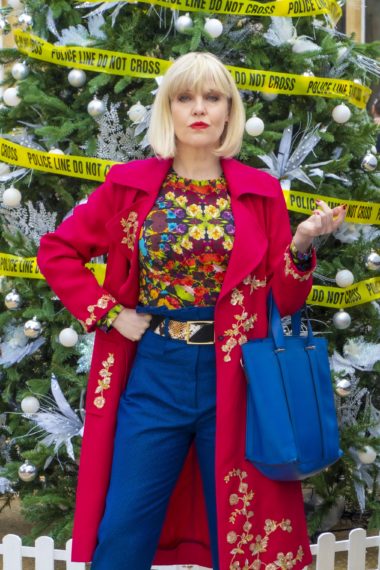


Agatha Raisin's Christmas Murder Mystery. 

The protagonist's blindingly color blocked wardrobe could kill all by itself at 20 paces.
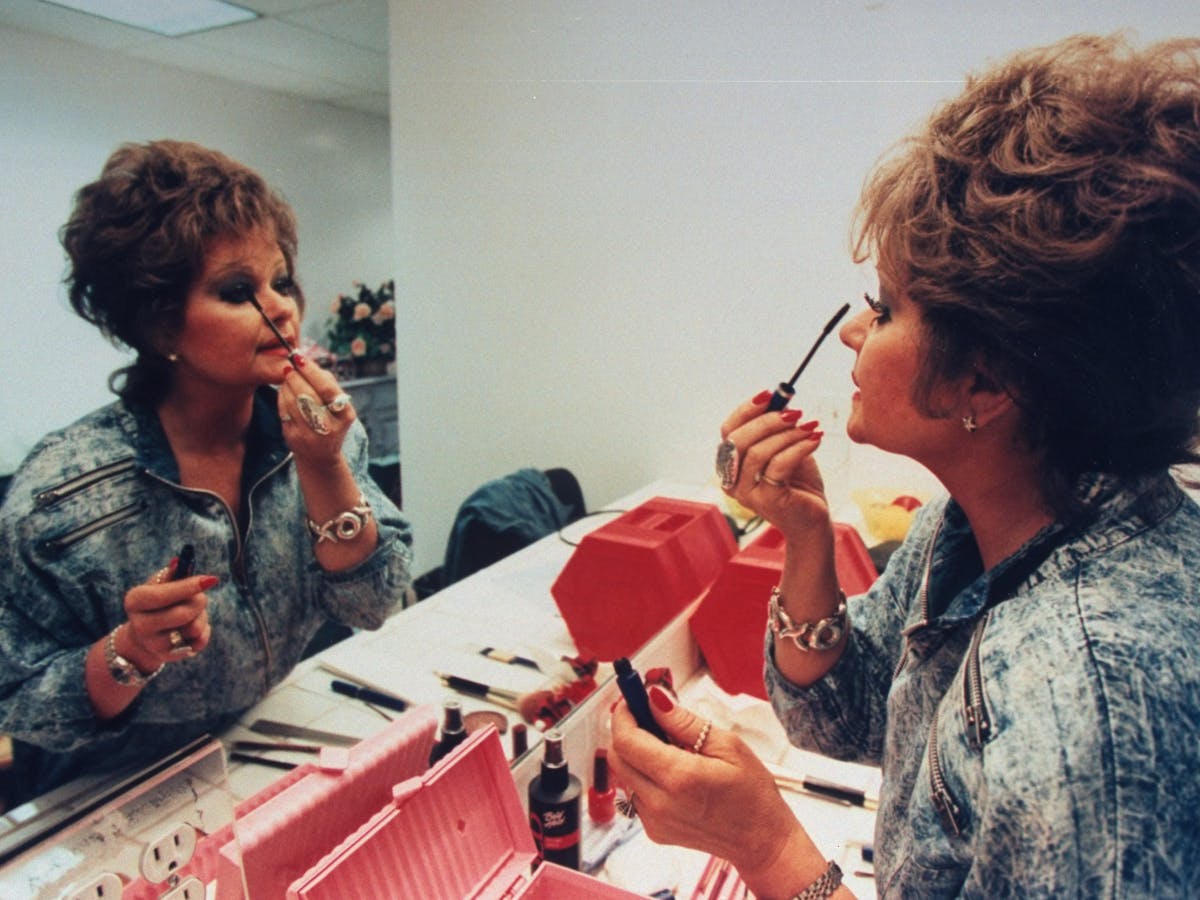


The Eyes of Tammy Bakker (2022). Chastain takes 18-20 Tammy in perky, cute, cheerleader 1960’s outfits all the through the increasingly ridiculous outfits Bakker sported as her talons grow ever long and more pointy, her make-up every thicker and more permanent, and her hair goes from natural to peroxided to what red wig piques her fancy that day – the Tammy Bakker everybody pictures when her name comes up.


Plus My Fair Lady, which is about Clothes you betcha, but over the top brilliant costume design, not ridiculous, well, not quite, not really.  After all, Audrey Hepburn's no Lily Collins (EIP) or Sarah Jessica Parker (AJLT), both of whom urge the viewer to bitch slap them with every moue, which is their idea of acting, in every beat, every scene.

     . . . . So, as is evident, the contest for Most Ridiculous Clothes On Television Today is more than competitive.  But we have ... a winner!  Two winners in fact, co-winners, all due to the efforts of just one man.

And Just Like That, sequel to Sex And the City, and Emily in Paris (skipped the first season, so I'm in ep. 4 of the second one).  They share the same inspiration and producer, Darren Star, queen of portraying women as more shallow than a dish drainer. 


Gosh these clothes are -- foolish, So are the characters, so it's all one thang. The best Emily in Paris character is the mixed Asian friend, Mindy, who busks with two fellas, as the vocalist. And is a Madame PeePee (yes, her job as the daughter of a supremely weathy father, is to take a teeny coin in return for handing a square of tp to the people entering the Toilet) at a Drag Queen Club.  She sure can sing though, if the actor is indeed the singer.  The only thing is in the show worth watching is Mindy singing. Yet the songs always take second place to whatever Mindy is wearing. The purpose of the songs is to give the half hour episodes more opportunities to show More Paris so no one has to strain the brain for much plot, character or doing anything at all -- just like Instagram, which is the real star and real concern of Emily in Paris.
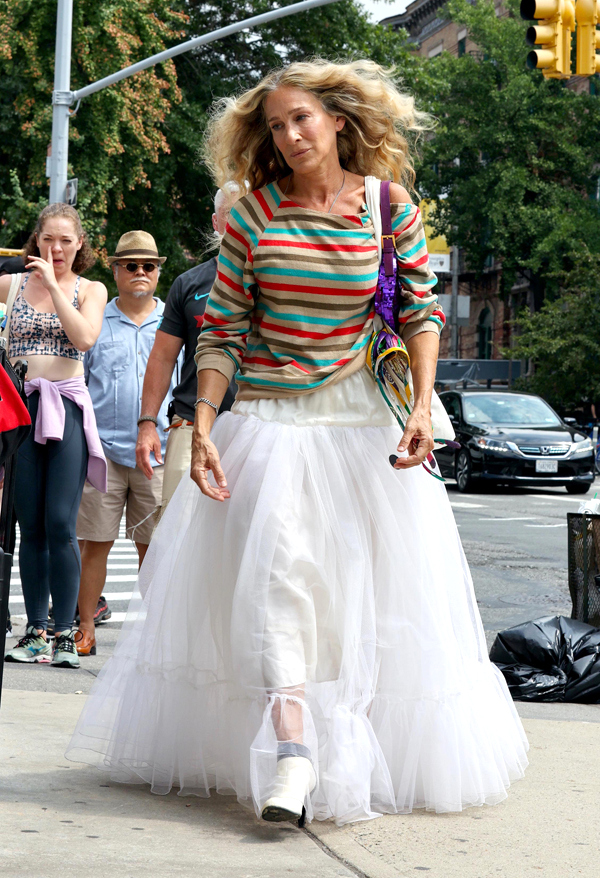


     . . . . SATC -- Ep. 6.  These characters, even if they are not White, are just like the White Carrie, Miranda and Charlotte – so well off, so consumed with what we call First World Problems.  It’s not as though we see these new characters behavior as informed by their heritage. They have the same never enough status and privilege as their White counterparts, which of course they would, but isn’t there something more the show could show us? At Seema’s family’s Diwali party, we see only her family’s desire Seema marry a rich fellow and produce grandchildren, etc. and nothing cultural at all, except the saris – one of which Carrie wears in the same way she wears those silly tulle skirts we are still seeing little girls wear with their fairy wings in the street, unless the temps demand coats, even though Carrie's now in her mid-50’s, showing how she can pull out her edgy at will. 

The exception is the stand-up comic star-podcaster character, Che Diaz. Same as in their real life, Sara Ramirez plays a non-binary Afro-latino butch-bitch sort. Except this character are only about their sexuality, and anyway, we don’t see Che much now, except in Miranda’s fantasy replay sex life, and unanswered texts. As is often the case with White people, the point of the Other is my sexual fantasy.  The show just doesn’t do culture/people wrong, even its all-and-nothing-but-surface is wrong.

 Charlotte reacts like a Karen or something to Miranda’s outing of her Che sexcapade – "Are you a lesbian now or what?!?!!!!!!??????" The show -- and Charlotte, like Carrie and Miranda and the show itself, has written out memory of the episode in which Charlotte was partying hearty w/lesbians.*

This surface is neither fun nor interesting, since there's no evidence any of the character have learned anything since the glory days of the friendship, i.e. the 7 season of SATC, or during the last 15 years.  Moreover, its brittle depiction of the good life on the verge of snapping and splintering at any moment – quite as the USA YAY has done.

Worst of all, as with SATC, they appropriate downtown / SoHo. In AJLT, there's scene in the very costly sari shop here on West Broadway.  As per usual it’s weird to see this perspective on where I live. Totes consumerist vision for Carrie, etc., not at all mine Another big boulder of superficial in this episode, is that Carrie buys a millions of dollar coop "downtown. Even as she does so, she says, "I used to come downtown all the time, but I never thought I'd live here." Yet the show keeps making a huge deal out of Carrie wanting to cocoon her husband-bereft self back in her first apartment -- which, while show called its location "the Upper East Side," it is in reality a real brownstone in the West Village.  This is something even casual watchers of SATC know -- see: the endless convoys of tourist buses and tours on that block.  And truly the watchers of And Just Like That were anything but casual watchers of Sex and the City.

Not to mention the afternoon a SATC shoot shut down my entire block, forbidding me to leave my apartment building or re-enter it, because Somebody in the crew was standing there.

~~~~~~~~~~~~~

Though to be honest, Audrey Hepburn no longer enchants me, but gets on my nerves. Which is neither here nor there, not now or then.

**
Eileen: Are you gay?

Charlotte: No, I'm not. But I do so enjoy the company of all these women. Everyone's so smart and funny. After spending too much time and attention on men......it feels like such a safe, warm environment. And while sexually, I feel that I am straight......there's a very powerful part of me that connects to the female spirit.

Eileen: Sweetheart, that's all very nice. But if you're not going to eat pussy, you're not a dyke.

                   -- Season 2, episode 6, "The Cheating Curve," Charlotte meets Lesbian                                 Chic

Saturday, December 26, 2020

Bridgerton: Netflx's Scrumptuously Dressed, Sexy, Romantic Holiday Greetings

     . . . Bridgerton (2020) Season 1,  Netflix Original.

 Shonda Rhimes adaptation of a print Regency Romance series, but with black characters as nobility and other aristocratic figures of agency for themselves and their world.

Julie Andrews is the unseen character, Lady Whistledown. Her character pens a gossip-scandal sheet distributed among the 'ton' -- a term never used by those people historically, invented out of French something or other by Georgette Heyer.  This narrator inexorably has one reminded of Sex and The City. Most SATC episodes begin with the voice over of Carrie Bradshaw's character musing on white women's dilemmas -- she's also a columnist for readers of a rag read by the rich politically, financially, socially powerful Ladies Who Gossip, and their aspiring wannabes back in 1990's NYC.

After dinner last night, I watched three episodes out of eight, of the first season of Bridgerton.  So far so good, though I remain on the critical wall regarding black Dukes, a black queen Charlotte with a set of black ladies in waiting, etc., being made nothing of by the white characters. Thus, definitely, Alternative History. Shoot, even the most wealthy Indian raja was still seen as not quite, by the Brits, both in India and at home during the Regency and certainly after.  But these are purely white characters in black costume out of Romance Regency fiction, without any cultural signatures either, and that bothers me.  Only in the third episode at some point the scored music of scene most faintly included congas – which only somebody steeped in Afro-latin music w/could notice -- if only because she was listening for any hint that certainly in music at least, there would be some black influence?

Supposedly somewhere in the middle of the season we wo;; learn why there’s diversity, not racism, in Bridgerton's world. If I have this correctly, this diversity wasn't in the books from which the series is adapted, though supposedly Alternative Universe (AU) is now a major aspect of Regency Romance.  

The NY Times has informed me that Bridgerton makes the historical Queen Charlotte, rumored [Fox here: rumored by her enemies] to have been a descendant of a Black branch of the Portuguese royal house Britain's regent. Thus Bridgerton's inclusive society.

So, there's another reason I’m on the critical fence on this matter. Portugal and her monarchs were major players and suppliers in the Atlantic African slave trade. They were there first and they were last to stop, either on the continent or in the “New World.”  Portuguese and Brasilians (and Usians, particularly New Yorkers) remained trading, bringing captured Africans to Cuba and Brasil, under the safety of US flag from the anti-slaving British navy, until the African slave trade was finally put an end to in 1862, by the US War of the Rebellion.


An excellent source, highly recommended that explains exactly how it all worked in every aspect, is John Price’s The Last Slave Ships: New York and the End of the Middle Passage (2020).

I do comprehend no Romance genre, Regency or otherwise, deals in historical reality, and thus AU, nor is it required to, but it’s another element that leaves me sitting on the critical wall, unsure, so far, whether this color neutral AU adaptation is a good thing or a wrong thing -- or even if it is a color neutral thing.

I haven’t stumbled (yet) upon any Regency Romance black critics' opinions -- British or USian -- whose point of view is essential here.  But there are also more episodes for me to watch, so who knows how this will play out ultimately.

Nevertheless some poking of the innernetz informed me whether or not all the characters in the books were white or not, at least the first novel, The Duke and I, out of which most of this first season is adapted, is controversial in a very large way among the fandom due to a very particularly scene in the novel, which too, evidently is a plot driver.  Will not speak of why, due to spoilers, but it is evidently -- of course it is! This is Shonda Rhimes! -- in the netflix version too. The Netflix version is controversial among fandom too.

This is soap opera, based as it is on a series of Regency Romance novels by a Julia Quinn, which have the sorts of covers that broadcast to my kind of historical fiction reader, "Nope."  But such novels can make entertaining tv. 

Nevertheless, my sort tires of soap operas at some point. Shonda Rhimes's Scandal and How to Get Away With Murder, left me yawning as the seasons rolled on, so quit watching after  3 – 4 seasons. The point of soap opera is -- no point. There’s no  momentum, no end point, just ... more … of everything.  Downton Abbey was the same. I hope Bridgerton doesn't turn out to be like -- well that utterly vile production of Jane Austen's fragments of Sanditon from last year.

Poldark is the the sort of successive seasons’; screen dream that can carry my sort all the way through, and leave me sad when there is No More.

This is to say that the Poldark series, books and television, at least the first BBC version from the 1970’s, are accurate portrayals of their world, as much as the author was able to make them, not Romances, though love, sex and marriage play huge roles, as historically they do in every culture in every era. Winston Graham’s Poldark novels and television series was in the period/historical tradition of Galsworthy's Forsyte Saga, not Georgette Heyer’s fabricated, imaginary Regency Romance. So, like Dumas’s historical fiction and much else, that has lots of sex, love and romance, Poldark works for my kind, whereas Heyer does not and never has.

Another question that immediately reared was, why / how did our primary marriage market figure, Daphne, go from in one scene as the season's 'perfect diamond' due to the Queen declaring her so, whom all suitors wish to suit, to having lost the favor of the Queen in the next big scene and nobody comes to call. There's a suggestion that her protective brother scared them all away, but that makes no sense either, since he tries to -- well spoiler, so will say no more. No matter how important her fall from Queen's grace is to making a plot, it shouldn't, you know, force me to wrinkle my already non-smooth forehead trying to figure it out. And then Daphne’s back in the Queen’s grace, or at least her mother is. Confused.

And --why did they make Polly Walker merely replay HBO Rome’s Atia of the Julii in a different period’s clothes as Lady Featherington?  Walker could do so much more.

However, that Duke Simon Basset Hastings, played by Regé-Jean Page, is the most dishalicious dish!  And his velvet tail coats -- there is one in particular, a deep, but soft purple, with the perfect collar and lapels -- ooo la la! His wardrobe is by far and way the most scrumptious character in the series.  Well ... maybe.  He doesn't actually need clothes you know, to be scrumptious.  As this is at least partially a genre of female gaze, there's lots of male to gaze upon.


Dayem, but it is cold out there.  But at least after the Christmas storm, we were so fortunate as to keep power, lights, heat, innernezzes. So many around us have not been.  So we see I'm also fortunate to have lots of watching on hand, as it's too cold to even go out.  I know.  I did it, and skeedaddled right back in, whimpering like little short-coated dog without her sweater.


Monday, September 18, 2017

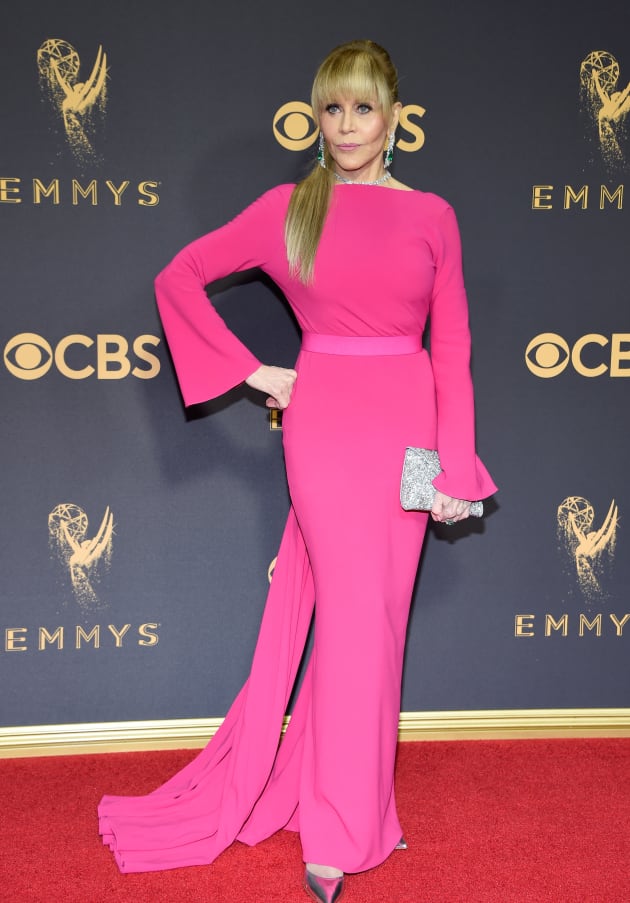
Leslie Jones Most Glamorous of 2017 Emmys!

     . . . . My one and only Emmy vote goes to Leslie Jones, for the most stunning and glamorous at the Emmys of 2017.

Here is why:


Few could carry this, but O Lordessa, can Leslie Jones ever!

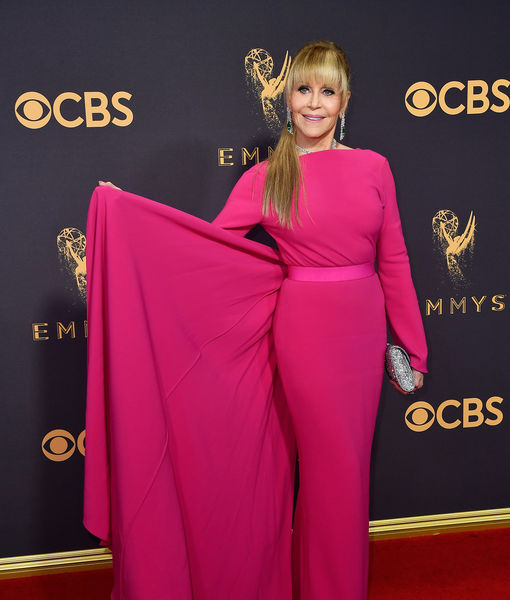
Runner-up, Jane Fonda:


Front

And

Back

And

Side

Tuesday, January 19, 2016

What to Wear While Exploring, Fairyland Geography -- See Yesterday's Post!

At the Museum of Fashion Institute of Technology:

Inspired by The Snow Queen, naturally -- and purrfect for today's 18º F.
[ " . . . . Fairy Tale Fashion features more than 80 objects placed within dramatic, fantasy-like settings designed by architect Kim Ackert. Since fairy tales are not often set in a specific time period, Fairy Tale Fashion includes garments and accessories dating from the 18th century to the present. . . . " ]
[ " Fairy Tale Fashion is a unique and imaginative exhibition that examines fairy tales through the lens of high fashion. In versions of numerous fairy tales by authors such as Charles Perrault, the Brothers Grimm, and Hans Christian Andersen, it is evident that dress is often used to symbolize a character’s transformation, vanity, power, or privilege. The importance of Cinderella’s glass slippers is widely known, for example, yet these shoes represent only a fraction of the many references to clothing in fairy tales. " ]
[ " The exhibition’s introductory space features artwork that has played a role in shaping perceptions of a “fairy tale” aesthetic. These include illustrations by renowned early 20th-century artists such as Edmund Dulac, Arthur Rackham, and A.H. Watson. Several recent, large-scale photographs from Kirsty Mitchell’s award-winning Wonderland series are also on display. . . .  Connections between fashion and storytelling are further emphasized by a small selection of clothing and accessories, including a clutch bag by Charlotte Olympia that resembles a leather-bound storybook. " ]
Fairytale Fashion Magazine.
A video of a runway Fairy Tale Fashion show from 2010: