LINES OF THE DAY

". . . But the past does not exist independently from the present. Indeed, the past is only past because there is a present, just as I can point to something over there only because I am here. But nothing is inherently over there or here. In that sense, the past has no content. The past -- or more accurately, pastness -- is a position. Thus, in no way can we identify the past as past." p. 15

". . . But we may want to keep in mind that deeds and words are not as distinguishable as often we presume. History does not belong only to its narrators, professional or amateur. While some of us debate what history is or was, others take it into their own hands." p. 153

Silencing the Past: Power and the Production of History (1995) by Michel-Rolph Trouillot

Showing posts with label slave trade. Show all posts

Thursday, April 9, 2015

The Whitney Plantation Museum

CBS News did a segment about it. Their commentary afterwards isn't the usual empty drivel.  Among what the segment includes is the mother of of someone we know learning that her first American ancestor was brought from Africa to the Whitney.

Video here.


The word is getting out.  People are being as deeply affected as Mr. Cummings, the creator of this slavery memorial art, has wanted.

Other Foxhome entries about the Whitney Plantation Museum here, and here.

Tuesday, March 31, 2015

Bancroft History Prize + -- the Return of el V!

So many very fine history titles came out last year that the judges awarded the Bancroft Award to two titles. The Bancroft is one of the oldest and most prestigious history prizes given out in the U.S.  I don't think it is ever awarded to anyone who isn't an academic (which means TASC automatically wouldn't be considered, though the prize-winners are often published by non-academic, trade/commercial publishers. It is sponsored by Columbia University so that would make sense.

This year Greg Grandin's Empire of Necessity won along with Sven Beckert's Empire of Cotton. Both authors received a fair amount of media attention when their books came out -- at least here.  Grandin is well known already, and won other awards. We don't know Beckert but Greg's an amigo.


Both books deal with the global aspects of capitalism, cash crops, slavery and the slave trade. They're both "Big Picture" histories.  Both books are eminently readable though their authors are academics.

I mention the readability because I've been frequently seeing online this winter that academic histories cannot be big picture and cannot be written in accessible, readable prose, and thus are objects of derision. This appears to be repeated mostly by non-professionals and non-historians and by those who are uninterested in history, so uninterested in history, that they flat-out deny it's a discipline and profession at all. Academics do, of course, worry about readability and accessibility -- but many of them, like most people everywhere, aren't gifted writers, thus  we still have all these works that don't read well -- which is too bad, for them, but most of all, for us, as readers and scholars.  (Of course, a great deal else goes into the research of history beyond reading and writing, including math, archeology, statistical analysis, and other sorts of data mining.)

I've paid particular attention to this year's winners because both Grandin and Beckert deal with some of what TASC deals with (in fact, Cuba and Its Music is cited in Empire of Necessity). Another reason is I'm reading 


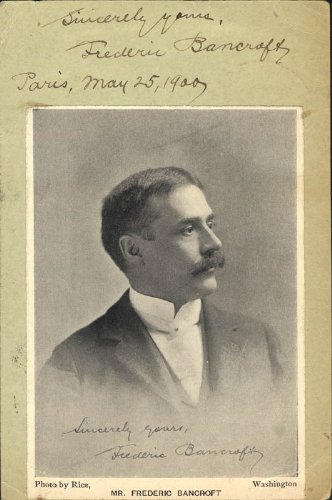
Foner's Gateway to Freedom: The Hidden History of the Underground Railroad (2015), for which much of his research took place in Columbia University's Butler Library's Rare Book collection (i.e. includes papers and archives). Two summers ago we did a great deal of research there in the papers of Frederic Bancroft. 


Not only did he establish and fund the Bancroft History Prize, but he's the founding father of the history of the U.S. domestic slave trade studies, with his self-published Slave-trading in the Old South (1931).


Slave-trading in the Old South was self-published because he could afford to pay for it (which was very expensive in those days). In this era the southern revisionist vision of the antebellum south and slavery dominated the current publishing industry as it did politics and history. Since he could afford to self-publish Bancroft chose to side-step embarrassing rejections from all those editors -- many of whom he knew well, as he, like they were, was among America's aristocratic class -- and thus avoid embarrassment all around.

Additionally, Bancroft was a contemporary of Henry Adams and other American aristocrats, within and without the discipline of history, whose works we've read thoroughly throughout the process of researching and writing The American Slave Coast.

Not that any of this matters to anyone but myself, but I like to keep track of these moments where I feel part of the mighty currents that make up the study of Matter of America and its history.

-----------------------

El V comes back tonight, late. The weather is not pleasant, so this time he won't be bringing nicer weather with him upon his return, as he so often when having been away.  I've missed him so much!


Thursday, October 9, 2014

Not The Best of Days Or Night Either

Over the weekend a very close friend and colleague collapsed.  He was diagnosed with a non-infectious form of meningitis.  He's been in a medically induced coma ever since.  This has depressed el V as much as would be expected.

Yesterday, before going to the hospital to sit with R, I sliced open my left forefinger while washing el V's tea pot. A chunk had broken out of the rim, which I hadn't noticed until the blood rushed out.


Sat with R for a while. El V played him some music that he knows R likes and R waved his foot when el V addressed him, to say what he was going to play.  The doctors had expected r would have died by now. The meningitis infection had indeed spread into his brain.  He's a tough bird, all right.

After leaving the hospital I went to get my annual flu shot -- and unlike previous flu shot this one hurt and hurt worse as the night went on and hurts like heck this AM.  I Feel draggy and tired, and my throat is scratchy.  I've never had this kind of reaction to a flu shot before.

It's a kinda dark day.  Well, honestly no, it's not at all.  It just feels that way. Weather yesterday was very nice, and warm -- though windy, which may be the real culprit responsible for the sore throat. Today is nice too, but not as warm.

I'm doing the acknowledgements in preparation for really getting The American Slave Coast: A History of the Slave Breeding Industry out of the house. I should be happy -- particularly as writing thank yous is such a pleasurable part of of making a book. Instead, I feel, depressed.


Maybe it's due to having spent these last weeks studying the slave trade in American Indians, particularly that engaged in by colonial South Carolinians.  The numbers from the Mississippian culture tribes populating what would become the antebellum Cotton Kingdom are mind-boggling. That so many survived for Andrew Jackson, later, to wage a war of extermination against them for more decades, should put down for once and for the lie justifying the land thefts by the invaders settlers because "there was nobody there and those who were weren't making use of the land anyway".  The decades' long depopulation of these lands via slave trade mirrors in every way the methods used in Africa, just as Jefferson Davis's CSA government, right down to naming the president's house in Richmond, "the White House," mirrors that of the Union.  Of course, there were significant differences too -- slavery, no draft, no interstate cooperation, invasion of other lands for conquest to spread slavery, etc.


I've been listening to interviews and talks by David McPherson this last week, promoting his new biography, 
Embattled Rebel: Jefferson Davis as Commander in Chief (Penguin). These have reminded me of that mirroring I'd noticed between the two capitals of the U.S. War of Rebellion (to employ General Grant's nomenclature for it).  It was so extensive that both commanders in chiefs' families lost a dear child while in their White Houses.

McPherson approaches his subject non-polemically. So much so, the study comes across as detached from the matters at hand, which, so far, has left me, at least, wondering why he bothered?  McPherson hasn't had anything new to add to the tale of Jeff Davis, the never reconstructed, never asking pardon, representative par excellence for the Glorious Lost Cause -- which Jeff Davis did so much to create as a polemic that ruled our historic thinking about the war of southern rebellion until the last three decades or so.

Studying these matters within this current political climate of, at best, irresponsible rhetoric, incompetence and corruption is enough all by itself to depress a person.  It doesn't need a flu shot reaction or even the imminent, projected death of an old friend to provoke it.

Friday, July 4, 2014

Cool July 4th

72 degrees. Deeply overcast. Raining at the moment, though not hard.

I find nothing to celebrate today about this country, other than some people keep trying to push back against the protected, openly armed cadres that are ready to go if anyone attempts to bring back the former democracy that was in place before Reagan's first term.

They've got all the structures firmly in place now. Excellent planning on the part of the One percent. They did an impeccable job getting all these people to go against their real interest in favor of acting out hatred with impunity in a phony facade of superiority as white men and women against all women, African Americans, immigrants and all the others of us.


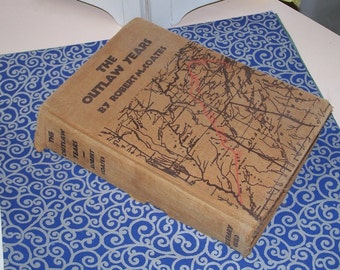
Spending today organizing packing for the Texas trip and reading The Outlaw Years: The Land Pirates of the Natchez Trace (1930) by Robert M. Coates -- dedicated to Malcolm Cowley. I must I stumbled upon mention of this work via reading in Mississippi writers, as it's all new to me. I found the text from a search in Bobcat, which directed me to the U of Michigan, which has a google digital edition that one can download as pdf, complete with illustrations.


It opens with a b&w reproduction of an Audubon painting of Natchez circa 1805 -- before the slave market was pushed out to the Forks in the Road, which we can see in the painting. That bluff above the river we see on our left? That where the slave traders threw the bodies of the dead and dying merchandise, creating "a noisome and pestilential nuisance" which was never cleaned up until the market was closed with the Civil War.

Now it's paved over and lined with automotive shops of all kinds. You can still see those steeples from there though.

All the following -- plus even more!  is in the first chapter.

We get going with Daniel Boon [sic] *(1760) and labor in James Calk's starved 1775 expedition that follows in Boon's path.


In 1779 the Overmountain Men party set off, including Colonel Donelson  (he for whom Fort Donelson is named) and his daughter Rachel (the future wife of Andrew Jackson) is with them. Their flatboat is aptly named the "Adventure"  as their river journey is a non-stop hair-raising series of events, all the way to Muscle Shoals (located right at the borders of Alabama, Mississippi and Tennessee). Indians hunt them the entire way. Many members are lost, to Indians and to the river -- an entire boatload to both early on -- and to the weather. This section quotes copiously from Donelson's:

Journal of a voyage, intended by God's Permission, in the good Boat Adventure, from Fort Patrick Henry on Holston river to the French Salt Springs on Cumberland River,
kept by John Donaldson.”
Decem. 22 1779

From there they drift down the Tennessee, in search of the Ohio River. More privations, starvation and other dangers are surmounted, and thus Donelson, James Robertson and the Overmountain men found Nashville in 1779.

From Outlaws:
Few of them lived long, or died in any way but violently. Anthony Bledsoe was killed in July, 1787, his brother Isaac in 1793: both, fighting Indians. Two sons died in the same way. Captain Hall was
attacked while moving his family to the settlement at Mansco's Lick; he and his son were killed and scalped. But while they died, others came to replace them. One sees them, their figures shadowy and gigantic, like the figures of men seen moving in a mist. . .
This is just the beginning The Outlaws. These are Andrew Jackson's people. Nobody these days is as tough as they were.  I am not sneering here.  I mean it. The guys running around today,waving their prosthetic masculinity enhancers in your face open carry are pathetic poseurs when you measure them against a Donelson or Jackson -- or even, when it comes to enduring horseback and other kinds of travel, considering how much they traveled, John Adams, George Washington, and even Abigail Adams and Catherine, John Quincy Adams's wife.

This is a lush book, despite filled with violent event after violent event.  For an example of what I mean, here's this:
... the dreamed-of Mississippi, that lay like a liquid spine in the wilderness' midst.
The metaphor of the Mississippi River as the nation's "liquid spine" runs shivers down my own.

Waiting for the rain to end, so I can pick up a few things from the supermarket. The rain will be over, we are promised, by the time we head off for Lincoln Center. It's supposed to be very nice the rest of the holiday weekend that celebrates Rah Rah Rah USA We Got Even More Guns Today!

Considering my state of mind since the Hobby Decision it's probably for the best that we were too under the gun to join our friends at the beach house on Long Island for the long weekend.

------------------------

* Coates is an interesting figure in his own right (1895 - 1973), who for years was The New Yorker art critic, and wrote fantastical fiction.  One wonders what prompted him to write this book about the history of the Natchez Trace region.


** Perhaps one can no longer assume these days that everyone is familiar with the iconic American figure of Daniel Boone.  Is this so?

Friday, November 29, 2013

Ebony and Ivy: The Secret History of How Slavery Helped Build America’s Elite Colleges

Amy Goodman of Democracy Now interviews Craig Stevens Wilder, the author of Ebony and Ivy: The Secret History of How Slavery Helped Build America’s Elite Colleges (2013).

Craig Steven Wilder, professor, MIT, author of Ebony and Ivy
It's a brilliant work of scholarship, delving into deep historical detail the close relationship between the most highly ranked of the institutions of higher learning in the U.S., slavery and the African-Atlantic slave trade.  It also shows how institutions such as Harvard, Yale, Columbia and Princeton deliberately formed a 'science' of eugenics to help forge closer bonds between southern and West Indian planters, who had money to endow chairs and legacies, but who by-and-large had no universities of their own.  This is pretty rough stuff.

There is no aspect of the U.S. before the Civil War that wasn't infected with slavery and the slave trade, starting in the colonial era.  New England's Indian wars tended to conclude with the captives being shipped to West Indian slave markets and sold.  There is no institution after the Civil War that wasn't tainted with white supremacy and Jim Crow.  That's depressing.

However, Wilder makes clear there were always members of these institutions too, who throughout this sad history, pushed back against slavery, against white supremacy, eugenics, colonization and the slave trade.  Often they suffered for it, but the antagonists persevered.
AMY GOODMAN: So, talk about America’s most elite universities. What relation do they have to slavery?
CRAIG STEVEN WILDER: I think there are multiple relationships. The first and probably most poignant, most provocative, is the relationship to the slave trade itself. In the middle of the 18th century, from 1746 to 1769—fewer than 25 years, less than a quarter century—the number of colleges in the British colonies triples from three to nine. The original three were Harvard, Yale and William & Mary, and all of a sudden there were nine by 1769. And it triples in that 25-year period. That 25-year period actually coincides with the height of the slave trade. It’s precisely the rise and the elaboration of the Atlantic economy, based on the African slave trade, that allows for this sort of fantastic articulation of new growth of the institutional infrastructure of the colonies.

Monday, September 9, 2013

Nathan Bedford Forrest

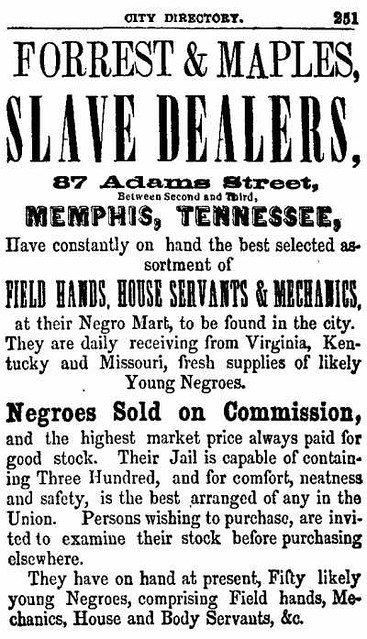
It's fairly common knowledge that Nathan Bedford Forrest was a vicious and brutal fellow, who made a huge fortune trading in Tennessee and Mississippi slaves before the Civil War.


It's fairly controversial knowledge that Forrest was responsible for executing the black Union soldiers who, among white Union troops, defended Fort Pillow against Forrest's much greater force. It's fairly well known too, that after the War he quickly moved to being a founding, eminent, active member of the KKK during Reconstruction. He lied about his membership when called before the Joint Congressional Committee in 1871 to testify about the KKK.

What is less common knowledge is how Forrest re-established his wealth after Reconstruction. Slaves again, except they were 'convicts' who stocked his prison farm on President's Island, near Memphis.

Some years later, Gen. Nathan Bedford Forrest contracted with local officials to establish a penal farm on the island, using able-bodied prisoners in the corn and the cotton fields. Having lost a fortune in the Civil War and through unprofitable railroad investments, Forrest was in search of new and lucrative opportunities and was one of the first to try to develop a business (of sorts) on the island.

He offered to pay the county 10 cents a day for each worker and to provide food, clothing and housing. His offer was accepted, and a five-year contract was signed. However, Forrest died in 1877, possibly of dysentery from drinking impure island water. Responding to stories that the prisoners had been mistreated, a grand jury investigated the prison farm and recommended some changes in the operation. In 1878, another penal farm contract was signed with Forrest's son William.
Supposedly in his later years Forrest spoke in public that African Americans should be able to vote for any candidate they wished, which is supposed to be proof of a change of heart in his white supremacy, to a sort of vision of equality.  It's hard to buy though.

It's particularly difficult to buy in light of the neo-confederates glorification lately of Forrest as their image for the Glorious Lost Cause, as, to them, the value of the rose-colored vision of Robert E. Lee's parfit gentil knight, who surrendered, fades. The eulogy at Forrest's funeral was delivered by Jefferson Davis, who never requested a pardon from the U.S., and never surrendered.

Saturday, September 7, 2013

George Fitzhugh - Proslavery Philosopher


From the Documenting the American South website:
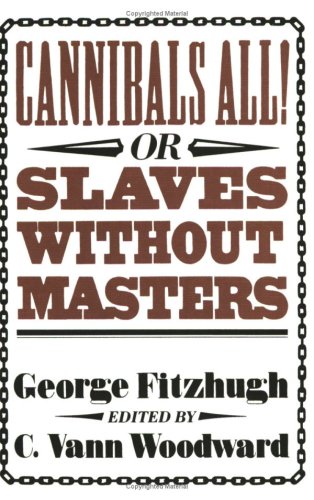
Fitzhugh, George, 1806-1881. Slavery advocate. Fitzhugh, from Port Royal, Va., was the descendant of an old southern family that had fallen on hard times. He practiced law and struggled as a small planter but made a reputation with two books, Sociology for the South (1854) and Cannibals All! (1857) which alarmed northerners like Abraham Lincoln and roused southerners to take new and higher ground in defense of slavery.
Fitzhugh insisted that all labor, not merely black, had to be enslaved and that the world must become all slave or all free. He defined "slavery" broadly to include all systems of servile labor. These views had become commonplace in the South by the 1850s. His originality lay in the insight that slavery could only survive and prevail if the capitalist world market were destroyed. He understood that organic social relations and attendant values could not survive in a world dominated by capitalist competition and bourgeois individualism.
His call for war against the modern world, expressed in a harsh polemical style, made him a solitary figure. Numerous others agreed that free labor spelled class war and invited anarchy. They also agreed that slavery overcame the "social question" by establishing a master class that combined interest with sentiment to offer the masses security. But, having no confidence in his utopian vision of a reversal of history, they generally tried, however illogically, to convince the European and northern bourgeoisie to restore some form of slavery in a corporatist order.
Fitzhugh opposed secession until the last minute, arguing that a slaveholding Confederacy could not survive until the advanced capitalist countries had themselves converted. After the war, which once begun he loyally and enthusiastically supported, Fitzhugh sank into obscurity, becoming increasingly negrophobic and idiosyncratic. To all intents and purposes, he died at Appomattox.
Eugene D. Genovese
University of Rochester
Eugene D. Genovese, The World the Slaveholders Made: Two Essays in Interpretation (1969); Harvey Wish, George Fitzhugh: Propagandist of the Old South (1943).
Genovese is one of the classic historians in the study of American slavery as economic institution.  His paternalist economic analysis is fairly outdated now, but there remains so much of value in his work that any historian dealing with slavery must be well acquainted with his work.

I've read as much as I can stomach of Fitzhugh's publications.* Fitzhugh was one of those firebreathers that South Carolina's Low Country elite produced in numbers, who were certain that everything is better with slavery, so much so that slavery should be expanded to include anyone who isn't wealthy, even if they were white. This really scared the North, provoking advocacy for Northern secession as much as the Fugitive Slave Act did.

-------

Ah swan, that the x right talking point memos have gone to school in the southern radical slave power's proslavery philosophical and economic rationality, logic and history writers.

Tuesday, July 30, 2013

Down By the Riverside + The Yearling

What the U.S. Civil War meant for those nearly four million most directly affected was absolutely clear to that four million from before the first shots were fired.  They knew it was planned for years of listening to shouting red-in-the-face white power elites while they served at dinner, drinks on the veranda, drove the carriages, held the horses while the cards hit the table, just for starters.

I've been going through the highly respected Down By the Riverside: A South Carolina Slave Community by Charles Joyner (1984 - 25th anniversary edition).  It's a problematical book about antebellum Sea Islands' culture, particularly in the South Carolina parishes of All Saints and Waccamaw.  The problematical consists of several parts.


This matters because the book is so admired, and it often is the only book most people consult when looking for information of what it was like to be a slave on the plantation. This is a book much cited by those who argue that "slavery wasn't bad, and slaves lived better than most people."  This is not the fault of the author, and in should in no way negatively impact the deserved esteem in which he is held.

First, the research was conducted prior to 1984.  Research focii and techniques that tell us origin points of populations have changed our knowledge in these matters considerably since then. Today, no one would include either Yoruba or Fon (from where comes Vodou) cultural folkways and religion in this region these days because we know better. Nor would the large numbers of Islamized peoples be ignored -- or just not seen. Yoruba never came to North America in any numbers that could impact the African folkways of the majority peoples from Senegambia  (both fresh out of Africa -- so many of them Muslim -- during that period of great importation between the Constitutional ratification and the end of the Atlantic trade in 1808 and the older populations culturally assimilated with English folkways out of Virginia), Ghana and always, Angolan (Gullah).

Second, Joyner describes a culture and folkways at a mature, rooted stage of development. Almost all of his references are from 1859, and those who were still living into the later 19th century.  So the descriptions he gives the conditions of living on the 'street" (the row of slave cabins) are charming even -- a kind of golden age English feudalism --  with more than ample food, possessions, stable, long-established families, and lots of time off, in which they make their own money.  It was a very different situation in the 17th and 18th centuries, digging all those trees out of the swamp, digging the canals and all the rest -- and in very many places, even in the 1840's, as Fanny Kemble's Journal of a Residence on a Georgia Plantation in 1838-1839. Ms Kemble's account of the slaves on her husband's plantation is one of horror.  She divorced Butler as consequence. If what Ms Kemble saw on Butler Island had been what Joyner describes on the Weston's plantation, Hagley, in All Saints -- the Westons accounted even by their own people, the 'bes massa'  --  it's unlikely Kemble would have been so horrified that she needed to leave the marriage (there were other reasons to leave Butler as well, but they were all rooted in his being a member of the rice plantations' unimaginably wealthy ruling slave power elite). As Joyner doesn't see the Islamic elements in the culture, he glosses over the constant threat of sale and violence. Yet, by now, South Carolina had long been a principal slave exporting state, as much as were Virginia and Maryland.

Third, this region is exceptional in the availability of wild food, for personal consumption and to sell -- with easy water access to markets such as Georgetown and even Savannah and Charleston. Rice is persnickity as to where it will grow -- it needs vast amounts of water, both salt and fressh.  Consequently, unlike in the Cotton Kingdom (or in the tobacco years of Virginia) where every possible square foot is given over to growing the cash crop, destroying the habitats of food animals and even fish, the rice plantations were surrounded by woods filled with food animals.  As well there were fresh water fish, and salt water fish, oysters and shrimps in bounteous measure, easy to get. The soil of the slaves' own provision plots was fertile and produced a wide range of food. Again, these are long-established plantations, held in the hands of the same families. In contrast, the cotton plantations were young, and there was a great churn of people and ownership going on. (Among this churn were the importation of slaves from this very region, which is how the black cat bone and the harmonica get to Mississippi.) The sugar plantations? They were death camps. 

Fourth, it's again rice.  Many skills from measuring water, to careful carpentry, even the threshing of it, are demanded.  Indeed, this is why the majority were Senegambians in origin, deliberately taken from homelands where the growing of rice had been community tradition for generations.  The plantation owners didn't have this knowledge. Unlike cotton or tobacco or sugar, rice couldn't be successfully brought to market via gang work.  Task work was how the labor was assigned on the rice plantations.  The worker, accomplishing his or her task, had the rest of the day free. Relatively better treatment of such skilled labor was demanded. You couldn't just show up in Natchez and find a replacement for a man who could build the sluice trunks that shut off or brought in the demanded salt water when needed or drained out the fresh water when needed -- and who knew the timing of the tides of the water, and timing of the season for salt, for fresh, for no water at all. The plantation owner wanted his people's children to survive, so their parents could impart their skills to the next generation.  Joyner seems not to take these imperatives into account when frequently including the relatively good treatment of these South Carolina slaves.

But there are excellent parts, that reveal Joyner does, of course, 'get' the most important thing -- people don't want to be slaves.  As one of Joyner's sources reports as the Civil War gets started, while on a visit to Hagley, even the Weston people knew what this war was about and looked forward to no longer being Westons' people:


In All Saints Parish blacks outnumbered whites nine to one. "Suppose," said Scipoio, "dat one quarter ob dese niggas rise -- de rest keep still -- whar den would de white folks be?"  The norther visitor observed that "most of you have kind masters and fare well." Scipo replied, "Dat's true, massa, but dat ain't freedom, and de black lub freedom as much as de ewhite.  De same blessed Lord made dem both, and He made dem 'like, 'cep de skin.  De black hab strong hands, and when de day come you'll see dy hab heads too!" All Saints slaves recognized slavery as an evil institution quite independently of whether the master, overseer, or driver, was "good" or "bad," was brutal or permissive.  A slave named Pompey told an English visitor:
"'pears to me Englad must be a good country to lib in." "Why so?" "All free dar, sa!" "Why you'd have to work harder than you do here, and have nobody to take care of you.  The climate wouldn't suit you, either, there's not enough sunshine.  You couldn't have a kinder or better master than Colonel -- I'm sure." "No, sa!" with a good deal of earnestness; "he fust-rate man, sa, data a fac; and Mass Philip and de young ladies, dey berry good to us. But --" and the slave hesitated. "What is it, Pompey? Speak out!" "Well, den, some day de Cunnel he die, and den trouble come, suah!  De old plantation be sold, and de hands sold too, or we be divide 'tween Mass Phil, Miss Jule, and  Miss Emmy.  Dey get married, ob course. Some go one way, some toder, we wid dem -- neber lib together no more. Dat's what I keep t'inking ob, Sa!"
Not so charming living without freedom after all; those who were property knew all too well the price they paid of living without freedom.
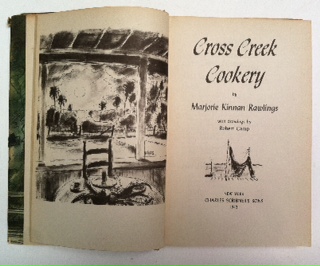
Worth reading in this context: the story by Rebecca Sharpless that begins "Dora Charles and Idella Parker, two black Southern cooks, were born nearly a half century apart . . . "  Paula Deen is just one in a long line of white women taking credit for what their black cooks do and create – while providing rotten working conditions and a lot of disrespect.  .  Yes, one of them is the author of The Yearling (1938), Book of the Month selection and best seller, edited by Maxwell Perkins.


The comments are unusually perceptive as well.  Things change clothes but stay quite a lot the same inside those clothes, it seems, particularly in the former slave states.

Sunday, June 23, 2013

Questions Regarding Liberal Outrage about Slavery, By An Academic of Color

These questions come at the end of an early paragraph of a review in the Los Angeles Review of Books of two recent admirable works.

Lawrence P. Jackson on Master of the Mountain: Thomas Jefferson and His Slaves, and River of Dark Dreams: Slavery and Empire in the Cotton Kingdom
"Pictures from a Peculiar Institution: Writing American Slavery"

The steady stream of cynical liberal outrage is an important context to two recent books about slavery by white men: Henry Wiencek’s Master of the Mountain and Walter Johnson’s River of Dark Dreams. Both books are, in their own ways, commanding studies of a central area of American history, and pioneering works in an ongoing battle for justice. Wiencek provides more detail about Thomas Jefferson’s history of slaveholding than has ever existed in one place before, making an important adjustment to a bowdlerized historical record; and Johnson reimagines the era that transformed the geospatial reality of the Mississippi River cotton corridor, in the process providing the fuel for the industrial and financial transformation of the western world. But in both cases, I wonder, to what avail? What does it mean to have an agile, ready intellectual force prepared to do this kind of work, on this kind of subject, at this time? How are the appearances of Wiencek and Johnson’s books connected to the phenomenon of the first black president, on one hand, and the probable end of protective voting rights acts and affirmative action, on the other? In other words — to put it rather bluntly — have we reached a moment when the white liberal’s comfort zone is firmly in the archival dust of the 18th and 19th centuries, while they explicitly avoid the jagged edges of the 21st century.
It's important that we hear such questions from the perspective a black man. A well-placed, respected academic, nonetheless a black man, Jackson is subject to racial profiling (recall Henry Louis Gates was arrested for 'breaking into' his own house in Massachusetts), that sends a disproportionate number of young African Americans to fill the prison industrial complexes. These men face the sort of potential homicide and wreckage of reputation that Treyvon Martin and others have suffered in Florida and elsewhere. In view of these legal steps into re-establishing a neo-slavery,  neo-Jim Crow, Jackson has to ask himself and all of us, how, or even if, our studies, and our outrage that the studies we publish provoke, connect in a useful way with the accelerating destruction of Civil Rights.

This is increasingly a matter for all of us (for the sake of privacy and likely retaliation upon the victim I will not tell what happened two nights ago to a close friend on the streets of NO, when the cops thought he was a black man).  However, people of color, particularly men of color, are the first and most obvious targets.  And do I ever share the outrage over slavery and the ever-widening circles of destruction into the present day that fuels the work of Walter Johnson, the New Orleanian native author of the second work reviewed, River of Dark Dreams. 

So Jackson's questions are not only excellent questions, but necessary ones.

I have some answers for myself, as we travel the world, meeting with friends old and new, in a broad range of communities in the arts, journalism, history, music, even in Harlem among some of the most articulate and intellectually / historically aware friends we have. When asked, I give a brief rundown of the subject matter of  The American Slave Coast, the most succinct of which is, "The book is a study of slave breeding industry in the United States before the Civil War."  The inevitable response is, "I didn't know that! I never knew! I can't wait to read your book. It explains so much about why things are the way they are now."


What we mean by the way things are now, besides Stand Your Ground and other laws and statutes, includes the military-surveillance complex. The slave breeding industry + slavery explains "the well-regulated militia" beloved of gun-owners, tea partiers and libertarians: those militias, formed long before the Declaration of Independence, weren't about an external threat, not even about Indian attack. Those well armed night patrols were about keeping the slaves down on their plantations and incapable of planning and making rebellion. It was about regulating the 'enemy' among us, the enemy that we depended upon absolutely for our wealth and well-being, to plan rebellions of our own.

This nation went right to post grad studies on how to keep people from rebelling with the legal system, surveillance and punishment since the 17th century, long before we were a nation. It also received an intensive in how to get rich and powerful from it.  These lessons learned out of our slave system were never forgotten.


Friday, June 21, 2013

Thomas Jefferson, Slave Owner, In the News Again

In the Los Angeles Review of Books: Lawrence P. Jackson on Master of the Mountain: Thomas Jefferson and His Slaves and River of Dark Dreams: Slavery and Empire in the Cotton Kingdom.

Jackson begins with Henry's Master of the Mountain.  For him, that on Jefferson's Monticello  ..."the fact of the “small ones” being beaten meant something to me personally, because my own father’s grandfather was not freed until the Civil War ended, when he was 10."

He includes this family information following a long paragraph about his own experience with the suppression, elisions and white washing by generations of historians about Jefferson the slaveholder:

As a graduate student reading the work of Jefferson, chiefly the Declaration of Independence and Notes on the State of Virginia, I was unaware that the edited materials I had at my disposal in the library contained anything less than the complete historical record. I was still rather naïve, and expected the evidence of brutality to lie easily on the surface; I did not yet have a sophisticated sense of the kind of digging necessary to obtain an alternative perspective on enslavement from the documentary evidence left by slaveholders. This is not to say that my own mother wit had left me. I suspected that any number of accredited history books were based on lies constructed to justify genocide. I simply couldn’t prove it. My professor, a renowned Jefferson scholar who appeared on national news programs during the Fourth of July, emphasized (I assumed for my benefit) that Jefferson was a kind master. Thus, I was quite surprised to learn of the suppression, in Edwin M. Betts’s 1953 edition of Jefferson’s Farm Book, of a line from the president’s correspondence about the routine of brutalization meted out to enslaved children. Jefferson’s overseer regularly whipped “the small ones […] for truancy.” It was partial scholars like Betts, and not merely Jefferson’s own descendants, who created a record of piety and purity for Jefferson that he did not deserve. It’s important to understand this: that the attempt to paint a portrait of Jefferson that tolerant liberals could stomach is what produced the whitewash. The more we seek to make slavery better, the worse we make it.
Jackson continues with a rundown of Jefferson's cruelties of commission as a slave owner.  He follows up with two cruelties of ommision, including his infamous behavior with the slaves gifted to Thaddeus Kosciuszko by a grateful Republic for the Polish freedom fighter's heroic actions in the War of Independence:
.... Edward Coles, a prominent Virginian who served in James Madison’s White House, regularly wrote to Jefferson, begging him to lend his national stature to the emancipation cause. “Liberate one-half of our fellow beings” from “ignominious bondage,” the young man requested. In response, Jefferson told him that enslaved Africans “are pests in society by their idleness.” In 1819, Coles undertook something he had “long been anxious to do,” and which required courage: he took the people he owned, traveled to Illinois, purchased land, and “made up my mind to restore to them their immediate & unconditional freedom.” The young squire went to his patron for guidance and gave better than he got. A second example proves that Jefferson had opportunities to end the bondage of at least some of the people that he owned, but preferred not to set them free. In 1817, Polish Revolutionary War hero Thaddeus Kosciuszko desired to have Jefferson execute a trust of $20,000 and purchase freedom and land for as many black people as the number might have freed. Jefferson decided to ignore his friend’s request.*

The slaves and land were eventually sold;  the proceeds went to Kosciuzko's nearest living relative, who owned serfs in what was now part of one of the three empires that had divided Poland among themselves: Prussia, Russia and Austria, all three of which found the very idea of liberty for anyone not of royal and noble family anathema.

Jackson concludes sadly, despite the careful work that historians like himself and Wiencek do, that by now no one can put right the history of Jefferson and slavery.  There has been too much dedicated whitewash of Jefferson, starting with Jefferson's own organized, assiduous efforts. Or, as Henry himself concludes: “Jefferson’s unchangeable symbolic role is to make slavery safe."

-----------------
 In Jefferson's time there were accusations that Jefferson had appropriated the $20,000 Kosciuszko had given him in trust to buy the slaves' freedom.  So far this has not been definitively proven. As it took some time to prove to contemporary historians what was known in Jefferson's time, that he had a slave mistress and fathered children with her, the documentation for this act may also be found, under the whitewashing, elisions and suppression earlier historians have worked on the Jefferson papers.  There are many volumes yet to be published of Jefferson's papers.

Thursday, June 20, 2013

Dub Bush's Great + 4 Granddaddy an African Slave Trader

But then, so was Thomas Jefferson's father-in-law.

This is the family founder for whom the 'W' in GWB stands for.

What is striking is that this ancestor in the 18th century carried the nick-name of 'Beau' -- Thomas 'Beau' Walker, like George Bryan 'Beau' Brummell and Richard 'Beau' Nash.  Can't you just see his quadruple grandson in this: cock walking, smirking, sneering and uttering mendacities?

This comes to us from the now-regular history feature on Slate, here, four screens in length. The link is to the single page view.

What this isn't, is surprising.  This is how people got rich, and got rich quick in the 17th and 18th and 19th centuries -- they bought and sold slaves, and nowhere so much as in England and the colonies that eventually became the United States.  Recall Andrew Jackson was an out-and-out slave trader.  Benjamin Franklin was a slave trade 'faciliatator,' not only coining money with adverts for slave sales and run-aways, but holding slaves in the basement of his business quarters, and owning some himself.  It is everywhere in the history of the U.S. until the end of the Civil War.
Roberts said that while he had not known of Walker's slave dealing, the finding did not surprise him, given that the Walkers were a mercantile family and Baltimore, where they established themselves in the United States, was a hub for the slave trade. "It would strike me as being perfectly logical and perfectly expectable," he told Slate.
It's also fascinating that part of the hard evidence for these facts was found in Africa, Sierra Leone.
The historical evidence suggests that Thomas Walker died at sea in 1797 when his own crew mutinied and threw him overboard. Documents in the British House of Lords Sessional Papers indicate Thomas Walker is the same man as a “Beau Walker,” whose unpleasant end is in turn recorded in the journal of Zachary Macaulay, a British anti-slavery activist, sometime governor of Sierra Leone and father of the celebrated Whig historian Thomas Macaulay.
Macaulay’s journal entry for Oct. 24, 1797, is as follows:
“You have heard of the noted Beau Walker, an English slave trader of these parts. He arrived at the Isles Du Los [off present-day Guinea] lately in an American Brig being bound to Cape Mount [in present-day northwest Liberia] for slaves. He had scarce arrived at the last place, when exercising his usual barbarities on his officers & crew, they were provoked to conspire against him.  As he lay on one of the hencoops a seaman came up & struck him on the breast with a handspike, but the blow being ill directed, did not produce its intended effect and Walker springing up wd soon have sacrificed the mutineer to his fury, had not a boy at the helm, pulling a pistol from his breast, shot him dead on the spot. His body was immediately thrown overboard. Thus ended Walker’s career, an end worthy of such a life. The vessel left Cape Mount, and it is supposed has gone for the Brazils or South Seas. There could not possibly have been a more inhuman monster than this Walker. Many a poor seaman has been brought by him to an untimely end."
As above, can't you just see his descendant in this guy?

Thursday, May 30, 2013

We Have Walked ALL the Historical U.S. Southern Atlantic Coastal Slave Trade Routes!

Concluding with the vital Cuba and Spain connections.  We did it.  We really did it. I'm dizzy.  Can't wait to have some peace and transcribe all my notes.  Good thing I did take so many because we're getting confused as to what and when.

By last night in the early summer heat and humidity of east Florida -- in which the Spanish governor abolished slavery in the early - mid 1700's as an act of gratitude to the run-away slaves from Carolina who helped him beat off the Brits, a huge reason both colonial and early Republic US were fixated on getting the Floridas for themselves -- I crashed so hard.  I could hardly take a photo in the castillo or write notes, and there was so much wonderful information that was new to us.  This is Florida and it is still Spanish .... the descriptive texts were bi-lingual*, at least half of the visitors are Spanish speakers ... and the history is told from the Spanish and Cuban perspective, even Oglethorpe's Siege -- which is told very differently in Georgia and South Carolina.  Right down as to why the Siege was lifted after 28 days and nights of shelling, and why Oglethorpe left behind his artillery when he withdrew.  Never mentioned in the South Carolina and Georgia description of what happened at the Siege (during the Brit-Spanish war over here called the War of Jenkins' Ear) that, um, a relief convoy from Havana of Spanish warships with reinforcement soldiers and supplies showed up.  O no -- the Brit Commodore and the colonial land forces withdrew because of the oncoming hurricane season!  Nary a word about the Cuban convoy of Spanish warships ....

Gads, it's awful that every tourist destination only has really horrible music, and no live music scene at all.  (Well, that doesn't mean places like NYC or London.)  What a gorgeous Old Town is St. Augustine, and filled with the most ugly tourist everything. But then, it was like that around the Taj Mahal too, as soon as it was built. And thus it has ever been, even in the ancient world.

In the meantime wonderful news of a whole series of Las Vidas Perfectas dates for 2014 which I can't talk about yet came in, as well as a date for Ned this fall in -- Cardiff! And another in -- Kalamazoo, MI.

I fly home this afternoon, after touring North America's oldest house.  So much writing to do.

-----------------

* This is the only national / Park Service / State Department / World Heritage site of the many we visited that included any language than English.  This is different in NYC, where we generally have a half dozen languages, and at least English and Spanish.

Friday, May 24, 2013

Departing the Liminal

This last week it was the Mother of Slavery.

The last two days were transitional, the change of state:

From the world of George Washington and Thomas Jefferson, who had moral qualms about slavery (TJ found that living from selling slaves and slave labor trumped morality every time, while Washington, at least, freed his slaves in his will) to the world of no moral qualms at all in South Carolina -- no siree bhob! slavery is a positive GOOD FOR THE SLAVES!;

Change of water into land, land into water;

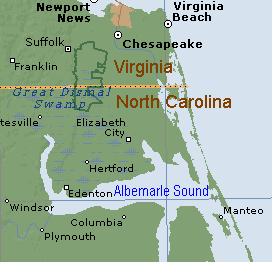
The Norfolk-Portsmouth-New Port News-Hampton Roads region -- from which tens of thousands of people of color changed their state of mere enslavement for life to that of the dark regions of early death's no return further south and west. This, along with Richmond and Charleston and other Atlantic ports, mirror on this side of the Atlantic the slave entrepots and out ports on the African Atlantic coast;

North Carolina's Albemarle County -- which was thefted from Virginia and given to Carolina, mostly in order that Carolina in that day might have one county that had white population;

The Great Dismal Swamp, location of so much of Virginia's William Byrd's -- he of Westover -- dreams and fantasies;

And Albemarle Sound.


Down to the vital port of the CSA, Wilmington, North Carolina.

Today we enter the Heart of Darkness.  We go to Beaufort, South Carolina.  Old John C. will be spinning in his crypt, perhaps.

Geography is the second pillar of history (the first, of course, chronology).  There is the reason the Father of History, Herodotus, traveled the lands and the peoples who lived in them. The historian must know the typography, the distance, the climate and what exists therein.  How vast, how very vast, the Chesapeake regions, how varied.  We have traveled the entire length, from Maryland down to Albemarle now.

We had lunch-breakfast yesterday in a nice little place in Windsor.

It's hot.

Tuesday, April 30, 2013

Perfect Spring Day

Lovely sunshine, no wind, the temperature just about 70 degrees.

I meet el V for lunch at CUNY -- their cafeteria is wonderfully priced, with a variety of choices for healthy, nutritious tasty meals and dishes -- and the most sinful of desserts.  (We split a pecan cheesecake that was the perfect combination of salty crunch -- the pecans and thin caramel crust -- and silky cheese.)

Then came the reason for a lunch date today when there were so many other necessary ways to spend our time on schedule: a lecture on the poet Phillis Wheatley by David Waldstreicher.


As Wheatley does, he brought together so much about her era: Africa, the classics, empire, Thomas Jefferson, slavery -- another way of putting it, is the conundrum of slavery and libery in a world of empire. Empire, in the guise of slavery itself, was a threat to home liberties, which Mansfield (British judge, 1772, who declared in England -- as opposed to the colonies --  property could not be found in persons) saw in the course of coming to his Somerset Decision. (We have long held now, particularly after reading Waldstreicher's earlier works, that the Somerset Decision had a great deal with the Southern slaveholding power elite's determination to force Independence.) Waldstreicher makes the case that Phillis Wheatley, very likely by the very reason that she was a young, enslaved girl from the Sene-gambian region in Africa, and taken at that time, to that place, Boston -- and was, not least, a genius -- understood how the world from which she was taken mapped upon the classics and the world they described and then mapped upon the world in which she found herself -- and consciously directed that for her own good.


Further, Waldstreicker provides the case as to why it was so important to Thomas Jefferson to sneer at her poetry, as "merely religious, not classic." (In fact few if any of the Founding Fathers themselves could read Latin or Greek either, which, at least in Jefferson's case contributed to his angry sense of colonial inferiority -- which he often then, remedied / played out as 'race.'

Wheatley is having somewhat of a revival, starting with The Trials of Phillis Wheatley: America's First Black Poet and Her Encounters with the Founding Fathers (2003) by Henry Louis Gates.

Waldstreicher's approach in his book-in-progress is to see Wheatley seeing herself within the context of the political imperium and the controversy of liberty, slavery and race.

A most stimulating afternoon!

Sunday, April 14, 2013

New Orleans & el V

On Wednesday this week El Vaquero will be heading to New Orleans:

where I will be participating in the very exciting banjology conference at Tulane put together by Dr. Laurent Dubois, which will in turn be part of a larger conference triple-play. I will be participating in an informal conversation on Monday (April 22) at 1:30, and a roundtable at 4. Details below. It's free and open to the public -- New Orleanians, if you're interested in the banjo or in broader issues of African American music history, this should be great, please do come out. 
So let me explain about the triple play. The EMP popcon (an always stimulating weekend conference of journalists and academics who write about popular and pop music) this year is divided into five regional mini-popcons, all happening the same weekend in New York, New Orleans, Cleveland, Seattle, Los Angeles. If I were going to be in New York, I'd go to the one at NYU, but i'll be in New Orleans, and you know that's a good thing.

EMP in New Orleans is April 18-21 at Tulane (though the opening party, the night of the 18th, is at Mimi's in the Marigny, with Los Po-Boy-Citos performing). I did not submit a proposal this year (too busy on the book), and will not be presenting at EMP, but will be there in attendance. It looks like it will be great. I'm especially looking forward to seeing Matt Miller's bounce movie (his fine book, Bounce: Rap Music and Local Identity in New Orleans, is required reading for New Orleans hiphop.) The banjology conference overlaps on Sunday with the "banjo brunch" (see below).
Then, on the back end of the banjo conference, is another conference at Tulane (Apr 22-25), and I'm so pleased to be able to attend: the International Colloquium on Saint-Louis, Senegal - New Orleans: Two Mirror Cities (17th - 21st Centuries) -- a subject of considerable interest to yours truly. This is a follow-up to a previous conference last June held in Senegal with New Orleanians in attendance -- the attendees I talked to were knocked out by the experience -- and this year, Senegalese come to New Orleans. Dr. Emily Clark, who organized it, promises that music will be a major focus. And rightly so. I don't have a full schedule yet, but their opening event will feature the five-member Njum Waalo Band from Senegal, featuring xalam player Demma Dia
What mediates between Senegal / New Orleans and EMP? The banjo, of course. It's great to see all these resources talking to each other. And como si todo esto fuera poco, the day after the Senegal conference, Jazzfest begins, though I'll be back in NYC by then. New Orleans has got a lot going on these days.

Sunday, April 21stEMP Conference, 10a.m.-1 p.m.
Brunch discussion/concert with Don Vappie, Carl LeBlanc, and Demma Dia in conversation with Laurent Dubois, Bruce Raeburn, and Tal Tamari
Monday, April 22nd1:30-3:30:
Informal workshop with roundtable participants and Tulane faculty
125D Hebert Hall, Tulane University
4-5:30:
“The Banjo and the African Diaspora: A Roundtable”
Freeman Auditorium, Woldenburg Art Center, Tulane University
Topic: How can we write the early history of Afro-Atlantic music? Through a focus on the history of the banjo, this gathering of scholars will offer insights into how we can pull together fragments of text, images, and material culture from the era of the slave trade, along with the study of contemporary musical cultures, in order to answer this question.
The roundtable is open to all, and we invite those interest to visit the following website which offers readings, images, and resources which the panelists will be drawing on in the discussion: https://sites.duke.edu/banjology/.
Panelists:
Ned Sublette, Bruce Raeburn, Kenneth Bilby, Tal Tamari
Moderators:
Laurent Dubois, Sara Le Menestrel

Friday, March 22, 2013

This Time, It Was To Glasgow

I've read with great interest the review of outstanding Marxist historian and all around cultural and political critic, Eric Hobsbawm's final book, Fractured Times: Culture and Society in the 20th Century, a posthumous collection of his essays, as well as the extract taken from it, "The American Cowboy," both in the Guardian.

In the comments to the Guardian review a commenter wrote:

My city Glasgow became an industrial powerhouse built upon the
enslavement of Africans, you can still see it in street names: Virginia
Street, Tobago Street etc.
For instance:


There were slave owners in Glasgow also; here is one who wishes to sell his 19 year old slave woman, who was brought from Charleston, South Carolina:


You never know where things will lead you.

Friday, March 15, 2013

The History Writer Experiences Bliss

I've been living it these last two weeks.

I made a huge discovery for The American Slave Coast a couple weeks back by doing something nobody I know has done, or at least no one I know has done in decades. I have been reading the speeches and other collected writings of John C. Calhoun. As I scrabbled with them, I discovered a tiny book, less than 200 pages, published way back in the Civil Rights and Voting Act era, 1963, John C. Calhoun, by an historian few these days are familiar with, Richard N. Current. (As a contrasting example, Robert V. Remini was coming up in that same era, and he's still got juice, as he owns Andrew Jackson and the entire era.) He's a solid scholar, one who can write. Current, Professor of History at the University of Wisconsin, is jargon free. His prose is clear, concise and explains issues in astonishingly few words, sometimes issues I have been still puzzling over.


Published in something that was called The Great American Thinkers Series, by Washington Square Press, in paperback, the series begins with Jefferson >yikes<, includes some people I've never heard of, as well as those everyone has heard of Benjamin Franklin, and others that back in the day anyone with a solid B.A. should at least have a nodding acquaintance with the name, such as Veblen, Jonathan Edwards, etc.

The book's sections are a Chronology, The Man and His Career, The Theory of Government, Significance and Influence [which includes a chapter titled "The Neo-Calhounism of the Twentieth Century," which -- recall -- this was the Civil Rights era] and, Literature on the Subject. Footnotes and Bibliography. Such a guide for Calhoun's papers is splendid. I'd been going through the shelf of Calhoun's papers at Bobst Library -- this little book cut down my search time!

I found in his papers a consistent line of argument that the North was going to destroy the interstate / domestic slave trade, with statistics to show what this would mean for the economy of the Slave Power (he uses the term on occasion himself) -- you can't get more pertinent to The American Slave Coast than this.

This is the sort of thing that is unadulterated joy for an historian, with the value add that current historians seem to have written this pivotal figure out of their work, as too dusty or -- who knows?

It's the way Henry Adams's histories have been written out of the bibliographies of American history now for almost a century. Why? I have speculated, but I really don't know. He's a treasure house of information, all of it thoroughly cited in primary sources, as well as what he learned first hand, being a member of that family who was there for much of it -- and knew the figures involved personally, and even made a lot of the history themselves.

But on the other hand this allows us to bring in materials that will be brand new to a lot of people, and that's good.

He also lays out in organized and detailed arguments why there was no other consideration for living than white supremacy, and why abolition was -- I quote -- "the disease that will destroy this nation." That isn't part of our mission in The American Slave Coast, but it cannot be ignored. And with the determination to strike down the Voting Rights Act and so much other racial bigotry out in the open again in this country, one understands why Current felt it was important to do this little book in 1963, for an inexpensive, easily available series.

I bought it for $1.50. Plus shipping and handling. It's been helping me write too.

And now I seem to have come down with something. Head aches, eyes itch, throat hurts, nose sniffly. This is smashing right into my productivity.

Saturday, October 6, 2012

We Need *Cold Comfort Farm* - Andrea Arnold's *Wuthering Heights*

Literature grad students specializing in the English novel have long given thanks for Stella Gibbons's Cold Comfort Farm (1932) -- and even more so for the BBC 3-part 1995 adaptation, which had a theatrical release in the U.S.

Cold Comfort Farm parodied a genre popular then, sometimes called the 'Loam and Lovechild' novel. Among the writers well-known for their efforts in this sort of specifically located rural life were Mary E. Mann, the Brontës, Mary Webb,  D. H. Lawrence, Sheila Kaye-Smith and Thomas Hardy. Some will include the George Eliot of Adam Bede in this earthy school.*

Wuthering Heights doesn't have characters with redeeming features, except perhaps Mr. Earnshaw's own honor, and his compassion for this foundling. This is what fascinated me.  Heathcliff's and Catherine's great struggle for dominance -- their so-called romance --  never spellbound me, as it seems to have so many. It was destructive to the players and everyone around them -- and perhaps even to the land, their shared passion for the land, supposedly the foundation of their passion for each other.

It's a very strange book. What's even more strange is how so many readers have persisted in reading it as something it is not. But then, the film versions are what most of them are referencing anyway, which have generally glossed over how severe, cruel, amoral and hard it is. A fitting composition of a woman who refused treatment or assistance while dying in terrible pain for months, a woman who was able to beat her obstinate, fierce dog, Keeper -- not only into submission -- but into absolute loyalty to herself -- when Keeper committed the crime of sleeping on a white counterpaned bed.

What has fascinated me about Wuthering Heights was the Heathcliff tale -- what is not said about him, what is implied through Brontë's word choices, -- and its parallel to Charlotte Brontë's Rochester and his mad wife in the attic, brought back from the Caribbean, in Jane Eyre. Additionally to consider, the Victorian deus ex machina of plot resolutions, the unexpected legacy from a distant relative that Jane Eyre receives comes from an uncle who exported wine to the Caribbean colonies.

This why I've so liked Patricia Rozema's 1999 film version of Jane Austen's Mansfield Park. She too opened up a classic novel to the reality of slave economy  of the time that supported so many of England's wealthy men. Rozema did it, it seems to me, in manner plausible to what Austen would know, and Fanny Price would encounter.  They just wouldn't talk about it in a drawing room -- unless in the terms of abolitionism, of which there was a strong movement even in those days in England, with many supporters. Fanny Price or Jane Austen wouldn't talk about this in public, not due to a silly kind of modesty, but because the knowledge of slavery was so awful, it wasn't fit for children to know. Knowing what slavery meant about men you lived with, were dependent on -- you could not throw this out to the winds. You would be so horrified and ashamed for them -- and even more so for they would not be ashamed themselves. They would, however, be angry that you knew of their behaviors. They would blame you for possessing the knowledge, be horrified by you, a female who has knowledge of impurity. Yet they, the men who do these things, are not considered either impure or to be shamed -- it is the slaves who are impure and shameful -- like you are, now that you know.  Moreover, women are not allowed to judge what men do, because men are set above women in all things. This is all implied with a very few images and screen shots in Rozema's Mansfield Park.

This is something everyone knew about as part of their world, but conventionally couldn't speak of much, or at all -- if they were nice**. But then, the Brontës were widely considered not nice for writing what they wrote. So here's a paradox: these sisters' books, generally criticized at publication as having gone wildly out of polite and womanly bounds in their expression of experience, are now icons of the apotheosis of the ideal Romance -- at least Jane Eyre and Wuthering Heights are. Throwing slavery and the slave trade into the mix of any story is the antithesis of Romance.

But Emily Brontë's novel was anti-romance in another way. Wuthering Heights is a portrait of home life as power struggle, the power struggle conducted via domestic and animal abuse.***  It is the trajectory of the abused becoming the abuser, the now widely recognized signals of abusive personality starkly in evidence: the violence against a child followed by tenderness, and, particularly, the many incidents of  hurting animals, especially dogs.  Heathcliff hangs a King Charles Spaniel as the last thing he does before taking Isabella Linton off to marry, in order to hurt Catherine who married Isabella's brother Edgar and got pregnant by him. (What happens to Isabella and the child Heathcliff gets on her are not included in the film -- the child himself isn't in the film either.) Later, Hindley Earnshaw's son (Hareton, who is never named in this film of Wuthering Heights -- seemingly only Cathy-Catherine and Heathcliff are large enough to receive frequent, articulated naming in this church-invaded yet godless universe of Yorkshire moors) is seen hanging dogs too. These cruelty to animals scenes have been left out of the previous films based on Wuthering Heights.  Arnold's camera lingers, in tight frame, on the dogs' struggles.****

Arnold's Wuthering Heights is the mud and cold of Yorkshire, the shit and piss,  the obstinacy, the cruelty, the dumbness of animals and humans, the hardness -- and the pointlessness -- of this rural life. Only the wild creatures are free, can live (that is, if they can evade snares, and surely, in season, the beaters for shooting parties). The beauty to be found here, is found in very small things that are enlarged to fill the entire movie screen, so enlarged they frequently transform into shapelessness, losing all identifying markers: a single feather from a lapwing, a drop of the endless rain hanging from a bud of heather, a leaf falling in the endless chill.  Or in the vastness of the endless sky.  The blood and feathers and wool of domestic animals on stone of kitchen hearth, in the cold muck of cold barn floor, in the buckets of endless offal fed to the dogs, these are mirrors of the blood spilled in domestic violence, the beatings Hindley gives Heathcliff, wounds layered over old slave whipping scars that Cathy kisses in twisted rapture, the beatings that Heathcliff inflicts upon others, and upon himself.

According to the Wiki entry for Andrea Arnold, she wrote a paper***** when a young school girl about the evils of the slave trade.  Presumably, then, this, as well as Liverpool and Yorkshire's attention to the regional slave trade industry in 2007-08 (2007 was the 200th anniversary of England's abolition of the Africa-Atlantic slave trade) prompted her to cast the young and older Heathcliff with actors of color.  However, Arnold does nothing with this casting. ******  In contrast Rozema's Mansfield Park used the fact of the West Indian colonies' slave system to open up the enclosure of the Park. She shone some light on the darkness that supported  so many Austen lovers's fantasy of English country estate-and-gentry, to further expose the character of some the principals in the story. She did this without invalidating Austen's novel. Arnold did not do this.

What Arnold does with the overt centering of Heathcliff as a black slave is to treat the actor as a slave, i.e. take his body for her / the camera to do with as she / it likes. She frequently exposes his nakedness to our gaze. No other character in this film is seen even partially nude. Yorkshire is a cold climate. Casual nudity isn't natural. So why is Heathcliff  frequently seen entirely naked? This is what we do to people of color in film: we make them naked, we make them kill each other, and make them be killed. Showing us Heathcliff's naked back, with the scars of whipping is one thing.  But showing him disrobing entirely before getting into bed in conditions that don't even include a fireplace or much in the way of bedclothes, providing full frontal glimpses, camera lingering upon his buttocks, is exploitation.  Further -- it is ridiculous -- see cold climate.

If the camera's micro and macro shots are of natural beauty, the middle ground, upon which the human beings are centered, those shots consistently swirl together the erotic gaze with equal parts grossness and the ridiculous. The longest scenes are of Heathcliff suctioning Isabella's mouth, beating himself in rages, and his necrophilic sexual release upon Catherine's corpse. These scenes are portrayed so grossly they make you sick. Heathcliff's obsession is not awe-inspiring, it's disgusting -- and  implausible -- the watcher cannot suspend her disbelief.

Nor does the mere fact that a black man is playing these scenes have a significance.  Whoever enacted the script as Arnold and her collaborator, Olivia Hetreed, wrote it, would be equally preposterous and gross, as very little is shown of  the characters. Most of the characters are not even provided names, though Brontë names everyone, and the first framing narrator, Lockwood, like so many other characters who make the story, is not in the film. To us, the audience, the constant brutality, which all commit upon each other (which is not the case in the novel, particularly between Catherine and her father), seems unprovoked and mysterious.

This is what we see:

It's dark, Mr. Earnshaw brings home a mysterious fellow who is almost full grown, it's dark, Hindley hates him, it's cloudy on the moors, Cathy takes the youth to some rocks, it rains and blows and is dark, Hindley goes away, Cathy and Heathcliff sit on rocks, Mr. Earnshaw dies, it's dark, it's cloudy, Hindely comes back with a wife, it's dark, Hindley beats Heathcliff some more, it rains and blows, Cathy meets Edgar, it's dark (sometime Hindley's wife dies and there's a baby), Catherine announces she's getting married, somebody gets beaten, it's dark, Heathcliff goes away, Heathcliff comes back, it's cloudy (does Hindley die now? or does he just go poof from the film?), Heathcliff runs away with Isabella, it rains and blows (does Heathcliff own Wuthering Heights now or did he own it before?), Heathcliff and Isabella return, it's dark, Catherine dies, Heathcliff beats himself,  it rains and blows, Heathcliff goes (even more) mad, it's dark,  Heathcliff beats himself, it rains and blows, Heathcliff beats himself, has sex on Catherine's corpse, it rains and blows, (somewhere Heathcliff howls) Heathcliff beats himself, it rains and blows, Heathcliff digs up Catherine's coffin, it rains and blows, mud. The End.

This is less than satisfying to the movie goer. Even if that's Arnold's objective, that we be dissatisfied, we have no idea why she wants us dissatisfied.

She's made a Wuthering Heights that is about the camera. If you allow, the camera divides you from what you are seeing.

The telling element Arnold brought to Wuthering Heights was to tightly frame the brutality embedded in the novel, which perhaps was nurtured by the stark and even bleak beauty of the landscape in Brontë's book. Arnold works transformation of this bleakness into ugliness and grossness.  Brontë's transformations were into the formless quietude of the infinite, while still showing a truth of living a life filled work, mud, guts and blood. Arnold left out the deeper context of the novel's universe, despite casting a black man as Heathcliff, despite the rain beaded spider webs and sun shafted cloud giants. She neglected the novel's reconciliation, also a part of the natural world, a coming of peace, to the most non peaceful of personalities.

This why we are grateful there is the witty parody of Cold Comfort Farm to cleanse our palates from this noxious nostrum of a film, that fails to show us the true strangenesses of Emily Brontë's novel, while exposing yet another person of color to an objectifying, exploitative gaze.

--------------------------

* My own critical judgment challenges those who want to include Adam Bede in the Loam and Lovechild tradition. I've finely sifted Eliot's methodist, political reformist movement and science infused text via many re-readings, and do not find the pagan and primitive strands for which some of these novelists, such as Lawrence or the Brontës, are noted. Nor is it a depiction of the desperation of rural poverty that Hardy and Mann have done in some of their works. It shows an honest rural prosperity earned by hard work and common sense.

** Beyond the social conventions of polite discourse, particularly for women, not speaking of 'not-nice' matters -- slaves are not allowed to protest their condition verbally or physically -- further, slaves, like women, are forbidden, in the ideal world of the slave holding economies,  to feel sadness or pain from being beaten, sold, losing their families.  Forbidding the subject speech, with the associated coercion of violence, are the primary tools of domination.  If the subject of abuse cannot speak, then, the surrounding society cannot speak of the abuse either, and thus the abuse -- and the abuser -- is safely protected not only by the legal system that sanctions the violence, but by the even more powerful social system that demands silence and invisibility from those it rules.

*** An excellent analysis (though the author has some of the details of the novel wrong -- Cathy Earnshaw and Heathcliff are not cousins, as she states, for instance -- Heathcliff is a foundling from Liverpool, not a relative of any sort) of the connection of domestic abuse and animal abuse in  Wuthering Heights is:

"Emily Brontë and Dogs"
Maureen B. Adams in Society & Animals Journal of Human-Animal Studies; Volume 8, Number 2, 2000

The connection between those who abuse animals and domestic violence was understood by George Eliot too, as we see in Daniel Deronda.  Henleigh Mallinger Grandcourt treats his dogs the way he treats his other dependents, including his wife, Gwendolyn Harleth. Unlike his dogs though, his wife does not bond to her abuser, and she escapes. This is a different solution from Catherine and Heathcliff, each determined to make the other a thrall, neither of them succeeding, unless Catherine does, as the first of the two to escape into death from the endless struggle between them. (Why do they struggle for dominance? Why are they obsessed with it? I've never figured it out, and this film doesn't help any.) For that matter, Emily's sister Anne, finds escape from a violent, drunken husband the right solution for her primary character in The Tenant of Wildfell Hall. Animals also play important roles in Anne Brontë's novel, as they do in her sister's, including precepitating her protagonist's escape, when she sees her son abusing birds, at his drunken father's instigation.

**** This audience member wondered how these scenes were staged to protect the dogs from physical and mental anguish.  I stayed until the house lights went up.  "No animals were hurt or harmed during the course of filming," was not included in the credit crawl.

***** At first it seemed Arnold would do something  to open further the tale by presenting Heathcliff s as an escaped, lost or freed slave in Liverpool. The old house of Wuthering Heights creaks in the wuthering of the wind. The roar is like the constant roar surrounding the slaves of the Middle Passage, chained below water level, as heard in the video simulation in the International Slave Museum.  It's an awful video; nothing is spared, from the vomit of sea sickness, the galls from the shackles, the slop provided to eat once a day, the roiling feces and urine.  But that's the last thing in the film that might be brought in by the virtue of casting a black actor as Heathcliff.  That, and the whipping scars on his back, are all there is -- and the exploitive, objectifying gaze at his nakedness.

****** During my undergrad years the prof of a history of the novel course set us to do a 'creative' project for our final class project instead of yet another paper.  I created Isabella's diary of her time with Heathcliff, which included how she learned he'd made his fortune when away from Wuthering Heights and the moors via the slave trade -- which was vigorously pursued during the presumed timeline of the novel, which reaches from 1757 to 1803, when Cathy, Catherine's daughter, makes plans to marry her cousin, Hareton, Hindley's son. (The genealogy of Wuthering Heights's three generations is as hard to grasp as anything else about the book, at least for me.)