LINES OF THE DAY

". . . But the past does not exist independently from the present. Indeed, the past is only past because there is a present, just as I can point to something over there only because I am here. But nothing is inherently over there or here. In that sense, the past has no content. The past -- or more accurately, pastness -- is a position. Thus, in no way can we identify the past as past." p. 15

". . . But we may want to keep in mind that deeds and words are not as distinguishable as often we presume. History does not belong only to its narrators, professional or amateur. While some of us debate what history is or was, others take it into their own hands." p. 153

Silencing the Past: Power and the Production of History (1995) by Michel-Rolph Trouillot

Showing posts with label historians. Show all posts

Thursday, January 6, 2022

The Dark Ages On Three Kings Day

     . . . . Today is Three Kings Day, the day which begins the count down to Mardi Gras

In Roman Catholic countries, and here, in New Orleans, we eat King Cake.  We have some, from Mille Feuille, our local French bakery -- which makes all the very best of everything that it makes.  It feels all the more important to observe King's Day since, for a very long time, 01/6/21 will be thought of on this date, in the USA  

Mardi Gras's comin', BAAAAAAAAAABEEEEEEEEEEEEEEEEEEEE! Doncha fergit it!

In the meantime, even in the Dark Ages, surely, at least in the monasteries, Three Kings Day a/ka/ Epiphany was observed.
~~~~~~~~~~~~~~

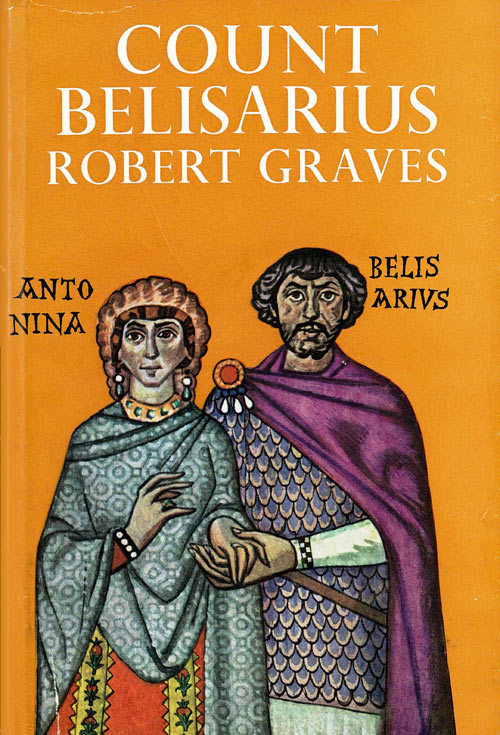
     . . . . A long time ago, 1938 in fact, Robert Graves, who made the Empress Livia live forever, thanks to his character of Emperor Claudius, the BBC, and actor Derek Jacobi, way back in 1972, published an historical novel of another age, a different Roman Empire, a newish religious era, titled Count Belisarius.


For newcomers to these names, Commander Belisarius is an historically lauded general of the 6th C -- 505 - 565. He was part of the times that historians have called Europe's "Dark Ages." This is the century that has been the favorite chronological location for Britain's King Arthur.

Looking through this so readable novel, it differs in so much from what the current historians of his time and actions I've been reading for the last ten years.  This was another effective military commander badly treated by a fearful, jealous Byzantine emperor. But even so, Graves seems to be wrong, deliberately or otherwise, about much of even the small, basic stuff we do know about the Commander.  For one thing, Graves has chosen, according to himself, to present this story as a Legend, a Romance in the mode of the Arthurian cycles as written in the Medieval period.  Partly that is due to Graves depending on Procopius as his major source -- as do all, of course, including respectable historians -- but Procopius is infamous for all the axes he grinds in his Secret History, his prejudices, his personal antagonisms, his conscious pay-back and sheer malicious joy in blackening reputations. Though he loved Belisarius, oooo how he hated the Empress Theodora!

Unlike Graves's two Claudian novels, which I've read several times, this is a first read of Count Belisarius. I'm starting to think  Gore Vidal's Julian (the Apostate) - 1964, and Robert Harris's Cicero Trilogy, were influenced by this earlier book, particularly with Vidal's structure, and Harris's choice for narrator.

It's been a bright spot in these damned Omicron-coupled-with-insane politico clowns weeks, to feel I've finally gotten something of a handle on the Gothic, Vandal and Hunnic wars of the 5th century, and some of the 6th century, for both the western and the eastern empires (which, by the end of the 5th century, the western empire was in the agony that transformed it into the states that became Europe). 

I'm really understanding why it is so many archaeologists and historians warn, "Be grateful you were not born in the 6th , 7th -- a century that brought Bubonic Plague to Constantinople and Europe, among all the other ordeals and horrors -- and 8th centuries -- though honestly, for So Many, the 5th and 9th + centuries don't look all that good either. At least in the 9th century Europe got Charlemagne and his dreams of a unity Christendom (he failed, as Christianity and all religions fail at that sort of unity), culture, civilization and knowledge.

I'm trying to get a firmer grip on the Goths in the Danubian lands, Italy, Africa, Gaul and Iberia prior to the Arab explosion in the 7th century. So dark, the written information so scarce -- and all of it biased as heck

I do not think I shall ever get even a slippery grip on the Persians -- there were so many iterations of the Persians, starting so far back, and going on for many eras.  So very very VERY many eras. To this day so many in Iran speak Farsi-Persian, as well as speakers of Dari Persian throughout Afghanistan and Pakistan.

~~~~~~~~~~~~~~~~~~~~~

Looking at the stat NYC covid map: there are large parts of the boroughs that are more than 50% infected -- or just positive?  They don't tell us that. Our nation hit 1,000,000 new cases today.  Yes.  One MILLION. So, we are not at all out and about these days. 

Plus. it's cold here.

Though not as frigid as it will be the weekend, and this weekend won't be as frigid as next week.  Tomorrow morning we have Maybe Snow. Tonight we're doing serious comfort food for dinner.


Some hearty red Spanish wine.    


Saturday, July 28, 2018

Historian Receives Death Threat + Decline of Civil War Reenactments

     . . . . Historian and journalist, Minisha Sineha (her specialty is African American abolitionists and their writing) wrote this piece pointing out what our current administration and POTUS share with Andrew Johnson and his disastrous period in the White House:

https://edition.cnn.com/2018/07/25/opinions/what-happened-the-last-time-a-president-chose-americas-enemies-over-its-friends-sinha/index.html?


She then delineates what is different between then and now:
  Quote Congressional Republicans in the 1860s, tempered in the fire of the Civil War, put their country before a traitorous President. They first passed the Tenure of Office Act of 1867 to protect Republican Cabinet members and office holders from Johnson. When Johnson violated the law by firing Secretary of War Edwin Stanton, congressional Republicans drew up articles of impeachment against him. 
Congressional Republicans today, in contrast, have not lifted a finger to protect Justice Department officials and special counsel Robert Mueller's investigation from the threat of interference by Trump. In fact, they have aided and abetted the Trump administration's undermining of both.
The consequence for writing this piece is that Sinha received a death threat from an individual who knew her home address and other personal information -- cops were able to track him down in about 24 hours. Guess where the guy threatening to kill her lives . . . . 

https://twitter.com/profmsinha?lang=en

Always knew being an honest historian was a dangerous thing. 

Alas, today there are no Grants and Shermans to keep the wrecked ship of state from going under prior to the next election when Johnson was thrown out. 

This is also went up yesterday - today:

"Civil War Reenactors in Decline" in the NY Times -- PAYWALL: 

https://www.nytimes.com/2018/07/28/style/civil-war-reenactments.html?

Focus of the story is the annual Battle of Gettysburg reenactment. Great photos! 
  Quote “Up until the last five or 10 years, the social causes of the war did not come into what we do,” he said. “We were paying tribute to the fighting man.” 
“It wasn’t ‘I’m racist and I want to glorify slavery,’” he said. “Nobody really thought a lot about the social reasons of why the South went to war. It was just these poor guys who were underfed, undermanned, underequipped, fighting valiantly to the last man, until they couldn’t stand anymore.” 
Brad Keefer, a 61-year-old corporal in the Union re-enactor ranks and a professor of history at Kent State University, said: “Re-enactors look at the war as a four-year period between 1861 and 1865 in which you can cut out all the stuff leading up to the war and very much ignore everything that happened afterward.” 
It’s a vision of history placed in narrow context. The military details are meticulously researched and recreated down to the stitching of a uniform, but the broader social and political realities of the Civil War — the profound struggle over slavery and emancipation, racism and equality, citizenship and disenfranchisement — are largely confined to the margins. 
Still, those issues can’t be ignored. After a white supremacist rally in Charlottesville, Va., in 2017, where demonstrators wore swastikas and carried Confederate flags, and where an anti-racist protester named Heather Heyer was killed, at least two smaller Civil War re-enactments were canceled. That the battle flag Confederate re-enactors carry is still used as a means of intimidation makes it hard to defend as a purely historical object, independent of its racist implications. 
“You build a comfort zone for the hobby to function,” Mr. Keefer said. Pointing to the Confederate camp, he said: “And give them the benefit of the doubt that they weren’t at Charlottesville.” . . .
This is what happens when ignoring history and / or insisting on lies as history, and constantly pushing them out there as historical truth -- and there is a lot of that withing reenactment.

  Quote Some Confederate re-enactors, including Kenny Glass, 46, an emergency medical technician from Selma, Ala., said that slavery had little to do with Southern secession, an assertion that is at odds with historical scholarship. 
“I’ve been called a racist, a bigot, everything you could think of in the world when people find out I do this,” Mr. Glass said. “I tell them they need to learn their history. It wasn’t fought over slavery. It was fought over Southern rights, that’s just the way I see it.” 
Part of the problem is that the historical beliefs have modern day implications. Scrutiny of Civil War re-enacting from outside — as well as introspection and concern about its future on the inside — reached a fever pitch after the violence last year in Charlottesville, Va. But it built along with protests in many cities that demanded the removal of Confederate statues and monuments from state grounds, spurred by the murder of nine black worshipers in South Charleston, S.C., by the white supremacist Dylann Roof. 
 Last year a pipe bomb was found at a reenactment of the Battle of Cedar Creek (the culminating action in the 1864 Shenandoah Valley Campaign): 
  QuoteA month later, a threat was made against participants in a parade that commemorates Lincoln’s Gettysburg Address.
So, along with aging out, video games etc., white supremacy terrorism is having an effect on suppressing our Civil War's reenactment participation. 

So one can see why these two pieces of journalism seem to go together, right?  The forces of white supremacy commit  and / or try to commit violence, down to murder, of those they hate and disagree with, even  where innocent children are found.

Yet -- the anti-white supremacy, anti-bigotry, anti-immigration ban, anti-corporate money in elections, anti-voter repression, pro environmental and consumer regulations, pro gun regulation people -- are called uncivil because their words hurt the feelings of white supremacists, etc.

Wednesday, May 10, 2017

Reading: Rome, Merovingians, Charlemagne, the Middle Ages & the US War of Independence

     . . . .Having the night before finally finished reading Ian N. Wood's The Merovingian Kingdoms 450 - 751 (1994), way back on May Day night (the 1st) we began our new Read-Aloud-Before-Bed work: The Middle Ages (2014) by Johannes Fried, trans. by Peter Lewis.


Guess with whom The Middle Ages begins? Theodoric and Boethius, of course, whom I first met at the start of the year in The Ruin of the Roman Empire: A New History (2009) by James O'Donnell, which I lived with for some very happy weeks early this year, as well as in Wood's book.

Fried's Middle Ages covers 500 A.D. up to Columbus's voyages to the New World and Luther's Reformation -- though not the voyages or the Reformation per se. I approve of his perspective that the Middle Ages end decisively with the invention of printing, the incalculable extracted wealth out of Africa, North America,  the Caribbean and South America, and the protestant revolution -- which latter, perhaps, couldn't have happened the way it did either, without two entire continents suddenly available to pillage.

El V had been reading The Middle Ages by himself for a long time but whenever there was an interruption -- and there were many,  Cuba being only the most lengthy -- he had forgotten anything he might have absorbed. He would start over because upon resumption it felt as f he'd never read it at all. He loves the author's view of time and geography and everything about how the translation is working. He thinks though, he didn't have enough prior historical knowledge that would allow him enough focus to truly comprehend, and thus remember.


Working with Woods's book the way we did, reading it aloud together, as much as we made fun of it, laughing and giggling, still, we remembered the material. So we decided to do Fried's book this way too. It's a lot longer, however. Already though, I can tell Fried is a great historian, and a very good writer. All the messy non-organization an other problems of Woods's book -- none of that for Professor Fried! Germans are terrific scholars of the Middle Ages anyway, especially those who take a long and wide view.  However, he is not an historian for the general reader.  He's an historian for those who have the tools to read carefully and follow long, complex arguments and whose minds already possess a fairly detailed outline for European history in those 1500 years.

Kirkus review of The Middle Ages here.

This second review that includes Fried's book is worth reading if only to remind oneself -- if one needs reminding -- that one cannot rely on reading a single work to learn what needs to be known about an era, an event -- or anything at all, for that matter. This is true if only due to the unconscious biases of the authors, which, by the way, includes reviewers themselves, and those who publish them.


For myself, the second Roman history by which I've been  engrossed this year was The Rise of Rome: The Making of the World’s Greatest Empire (2012) by Anthony Everitt. It's the most detailed account of the founding of the city of Rome and pre-Caesarian Rome I’ve read. It's particularly good with the Etruscans and Carthagenians, and the pre-Republic wars with the Greeks.

I admired so much the author's way with latin, matter-of-factly dropping in information, without digressing or making anything of it. For example, he will inform the reader that a position such as pontifax comes from the original duties of building, guarding and repairing the bridges -- pontem. Bridges and ships -- another Latin word that matters -- rostrum:
Latin Rostra, plural, a platform for speakers in the Roman Forum decorated with the beaks of captured ships, from plural of rostrum] a : an ancient Roman platform for public oratorsb : a stage for public speakingc : a raised platform on a stage. 
Not only do these bits illuminate the  surrounding content, but provoke delight.


I've begun a third Roman history, Adrian Goldworthy's (2016)  Pax Romana: War, Peace and Conquest in the Roman World. It's too soon to know what I think of it yet, but so far it's very promising.


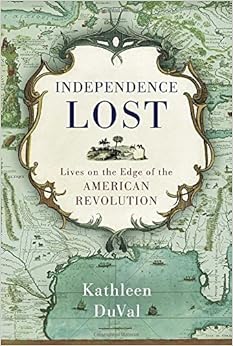
Another history read this spring was Kathleen DuVal's (2015) Independence Lost: Lives on the Edge of the American Revolution -- an account of the English colonists, the various Native tribes, and the French and Spanish in the Floridas, Louisiana and the Mississippi territories and their conflicting support for the War of Independence or those who preferred to stay loyal to England.

But now it's all Charlemagne, all the time.


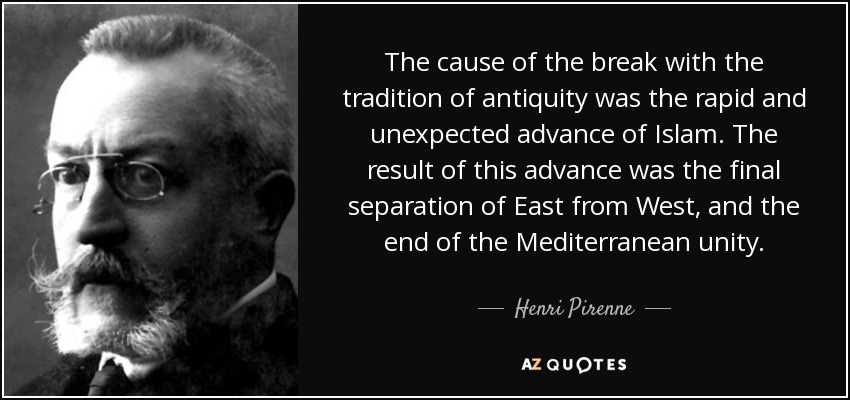
Last week el V brought home for my pleasure Towns and Trade in the Age of Charlemagne (2000) by Richard Hodges. This slender book made me hug and kiss him! It's one of the titles in the Debates in Archaeology series. It deals with what I've been trying to figure out since my attempts to get a handle on the Merovingians and the Franks. While giving credit where credit is due, this book clearly lays out the refutation to the Pirenne Thesis, which I've been doubting for quite some time, which, in fact, provoked a lot of this reading in the first place.

The most extensive unfolding of Pirenne's Thesis is found in his works, Medieval Cities: Their Origins and the Revival of Trade (1925),  and Mohammed and Charlemagne (1935).


The Pirenne thesis was propounded by Belgian historian Henri Pirenne. In his famous essay on Mohammed and Charlemagne (1937) Pirenne argued that the continuity of Roman civilization in transalpine (northern) Europe after the fall of Rome, created real change in Europe came from the rise of Islam, not barbarian invasions.[1] His famous summary said, "Without Islam, the Frankish Empire would have probably never existed, and Charlemagne, without Muhammad, would be inconceivable."[2] That is, he rejected the notion that barbarian invasions in the 4th and 5th centuries caused the collapse of the Roman Empire. Instead the Muslim conquest of north Africa made the Mediterranean a barrier, cutting western Europe off from the east, enabling the Carolingians, especially Charlemagne to create a new, distinctly western form of government.
Since the 1980's historians who disagree with Pirenne's Thesis have gained a great deal of critical acceptance, which goes along with their choice to characterize that whole long period between the 5th century and 1500 as the Middle Ages. Historians of these matters divide themselves, according to academic jargon, as 'optimists' and 'pessimists'. Hodges is an unabashed 'optimist' -- as is, for that matter, Woods.

They tend to agree that Rome never did fall, per se, particularly when factoring in the endurance of Rome in the east. Archaeology's discoveries have played an enormous role in these matters since the 1970's, which weren't in play for Europe in the era of the World Wars. Prior to this historians of Europe seldom if ever included archaeology's studies and discoveries in their scholarship, which they do now.  Digs at emporia sites such as Viking era, Birka, Dorestadt in Friesland, founded specifically for trade, with their goods, mints, monesteries and trade routes across the eastern Rhineland, the Black Sea and down to Constantinople make persuasive argument in favor of the optimists.

Johannes Fried biography here.
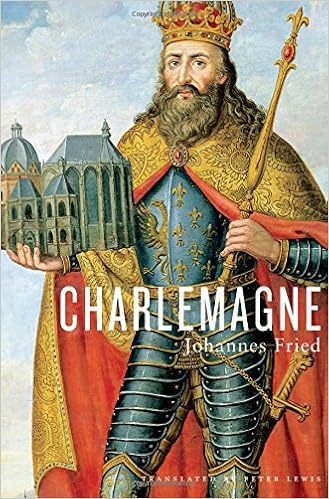
Then, yesterday when I was at the library to pick up materials on the conflicts between Bonanza farming and smaller homesteading farmers in the Red River Valley, I spied two copies of a book displayed in the new book section. It was Fried's Charlemagne!  I've been so longing for a good biography of this figure! Also translated by Peter Lewis, Charlemagne is even more hefty than Fried's Middle Ages covering 1500 years.  Admirably, in this age of subtitles that cram in every possible key search word, as with his 2014 The Middle Ages, Fried kept to the most simple title possible -- a single word.

These are the first sentences of the Preface:
"The following book is not a novel, but it is a work of fiction all the same -- a fiction based on this author's visualization of Charlemagne. And even though the resulting image does, quite properly, adduce all the available evidence from the period in question, it is nonetheless subjectively formed and colored. It is impossible nowadays to fathom the depths of a life lived more than twelve hundred years ago, so the only thing remaining for a writer to fall back on is his own imagination . . . . Perhaps those same critics will also censure this author for the way he has chosen to approach his subject, although all they would be able to offer would be a different, no less subjective and fragmentary image.  An objective portrayal of the great Carolingian ruler is simply not possible."
El V in particular loved hearing this, from the PW review, as he just cannot get enough of Spanish history prior to Cristobal Colon's voyages.
Fried also elucidates the role the Franks played in Spain, both in the battle against the Basques at Roncevalles (778) and in later dealings with the Umayyad and Abbasid caliphates.
Win-win for us both.


We decided to buy Charlemagne. It's too extensive a work not to have on hand for reference. It's going to take me the rest of the year to read it through as it's such a dense accomplishment of scholarship and interpretation.

Also, as the author's German, deeply concerned with the philosophical significance of historical temporality (reminds me here very much of Jan Assman's The Mind of Egypt:History and Meaning in the Time of the Pharaohs (2002) in particular, not to mention other of Assman's works which I / we have not read, alas), and its a translation, the text and syntax are thick, ungraspable by skimming pixels on a screen.

Sometimes while reading I feel as if the signification of the sentence and paragraph are water I'm attempting to pick up with my hand and pour into my organ of comprehension -- the significance drains away before it gets to the mind.

So German, this temporal -- as opposed to chronological narrative -- approach to history as meditation on time itself.  One can see it, and how it has influenced modern historians, as with the Annales School -- so French! --  (at least now I can see it, I couldn't of course when I first encountered the Pirenne Thesis as an undergrad). As my linear track, narrative-oriented mind lacks any philosophical bent, and this massive life's work of scholarship is pinned to philosophical concepts of time and and interpretation -- you can imagine my struggles.

These are the books that have been my consolations in the previous 12 days. At the end of April we received the terrible, unexpected news that someone very dear to us both had been diagnosed with terminal lung cancer.  M's diagnosis was four months more at most.  It didn't take anywhere near that long, thank goodness as he was in terrible pain. He passed early Friday morning.

His wife and daughter are devastated. M has produced a significant, beautiful, strong, body of art over his career, so dealing with his estate is complicated.  Handling his funeral and / or memorial is also not straight-forward for several reasons, starting with the fact that he was a fully trained and initiated houngan in the Vodun religion.  Several of their friends are working with his wife, helping her to make the decisions and take the actions, both spiritual and practical.

At the same time over the past 6 days quite a few of the March Oriente Travelers were here to participate in the first reunion.  During these days some of them who live here, including el V, had had music gigs long scheduled.

So it's been a busy, complicated, sorrowful, and happy run of time since I posted last.

I am so grateful to have the consolations of friends, music and history to get me through these very sad times.
Sunday, February 26, 2017

Philosophical History = Bad History

     . . . . Why I dislike 'philosophical' -- pattern, cyclical theories of history -- which certainly leads to counterfactual and thus to 'non-factual fax' and 'fake-alt news' and even superstitious, religious beliefs of what is not so, here, behind the WaPo, pay wall. [For those who don't have a subscription here is the link:

https://www.washingtonpost.com/entertainment/books/where-did-steve-bannon-get-his-worldview-from-my-book/2017/02/24/16937f38-f84a-11e6-9845-576c69081518_story.html? ]

Remember this? That's what one gets without the rigorous thought demanded.
This takes care of explaining why Toynbee and the Durants never worked for me, even as an adolescent.  Single, simple explanations for anything in history are automatically suspect, and all the more so the large arc of time and more eras are covered in these repeating pattern explanations and descriptions. Another way of putting this, is one squeezes anything into a pattern and discards  what doesn't fit.  It's simple-minded deliberately, providing ideas to people who aren't thinking, but by quoting such ilks believe it shows them deeply learned in history -- without having done any of the rigorous work that real historical analysis demands.  These guys are doing their best to bring back the idea of clash of civilizations that Toynbee and his ilks championed as real history, when the real roots of actions and events tend to be found in vast inequalities of wealth and resource distribution, and oppressions of certain groups by others.  But that is Marxism!  Can't have that!  Even though we lurve Lenin and Putin!

History does indeed appear to repeat itself, but that is because someone(s) have a vested interest in making things fall apart for their own power and profit.
Quote:
We reject the deep premise of modern Western historians that social time is either linear (continuous progress or decline) or chaotic (too complex to reveal any direction). Instead we adopt the insight of nearly all traditional societies: that social time is a recurring cycle in which events become meaningful only to the extent that they are what philosopher Mircea Eliade calls “reenactments.” In cyclical space, once you strip away the extraneous accidents and technology, you are left with only a limited number of social moods, which tend to recur in a fixed order. 
Along this cycle, we can identify four “turnings” that each last about 20 years — the length of a generation. Think of these as recurring seasons, starting with spring and ending with winter. In every turning, a new generation is born and each older generation ages into its next phase of life.
The cycle begins with the First Turning, a “High” which comes after a crisis era. In a High, institutions are strong and individualism is weak. Society is confident about where it wants to go collectively, even if many feel stifled by the prevailing conformity. Many Americans alive today can recall the post-World War II American High (historian William O’Neill’s term), coinciding with the Truman, Eisenhower and Kennedy presidencies. Earlier examples are the post-Civil War Victorian High of industrial growth and stable families, and the post-Constitution High of Democratic Republicanism and Era of Good Feelings.
The Second Turning is an “Awakening,” when institutions are attacked in the name of higher principles and deeper values. Just when society is hitting its high tide of public progress, people suddenly tire of all the social discipline and want to recapture a sense of personal authenticity. Salvation by faith, not works, is the youth rallying cry. One such era was the Consciousness Revolution of the late 1960s and 1970s. Some historians call this America’s Fourth or Fifth Great Awakening, depending on whether they start the count in the 17th century with John Winthrop or the 18th century with Jonathan Edwards.
The Third Turning is an “Unraveling,” in many ways the opposite of the High. Institutions are weak and distrusted, while individualism is strong and flourishing. Third Turning decades such as the 1990s, the 1920s and the 1850s are notorious for their cynicism, bad manners and weak civic authority. Government typically shrinks, and speculative manias, when they occur, are delirious.
Finally, the Fourth Turning is a “Crisis” period. This is when our institutional life is reconstructed from the ground up, always in response to a perceived threat to the nation’s very survival. If history does not produce such an urgent threat, Fourth Turning leaders will invariably find one — and may even fabricate one — to mobilize collective action. Civic authority revives, and people and groups begin to pitch in as participants in a larger community. As these Promethean bursts of civic effort reach their resolution, Fourth Turnings refresh and redefine our national identity. The years 1945, 1865 and 1794 all capped eras constituting new “founding moments” in American history.
There is much more bullshit in this article - theory, just starting with declarations like this
Quote:
Earlier examples are the post-Civil War Victorian High of industrial growth and stable families, and the post-Constitution High of Democratic Republicanism and Era of Good Feelings.
This clown doesn't even know what what was meant by "era of good feelings," which was single party rule, and it happened BEFORE the Civil War, way back the Napoleonic era and the War of 1812.

The more closely one looks at this article the more ignorance of history is displayed by the writer.

People like his cohorts are actively working to destabilize our nation and literally to destroy all the institutions of government and replace it with a tyranny that they control from top to bottom -- and some have been doing so since what they label High, FDR and the post WWII era. How dare they say this is a naturally occurring cyclic event?  Moreover, they are doing their best to make wars where there were none until they rode in on their chosen steed of the Apocalypse.  They think it is fun!

Saturday, October 22, 2016

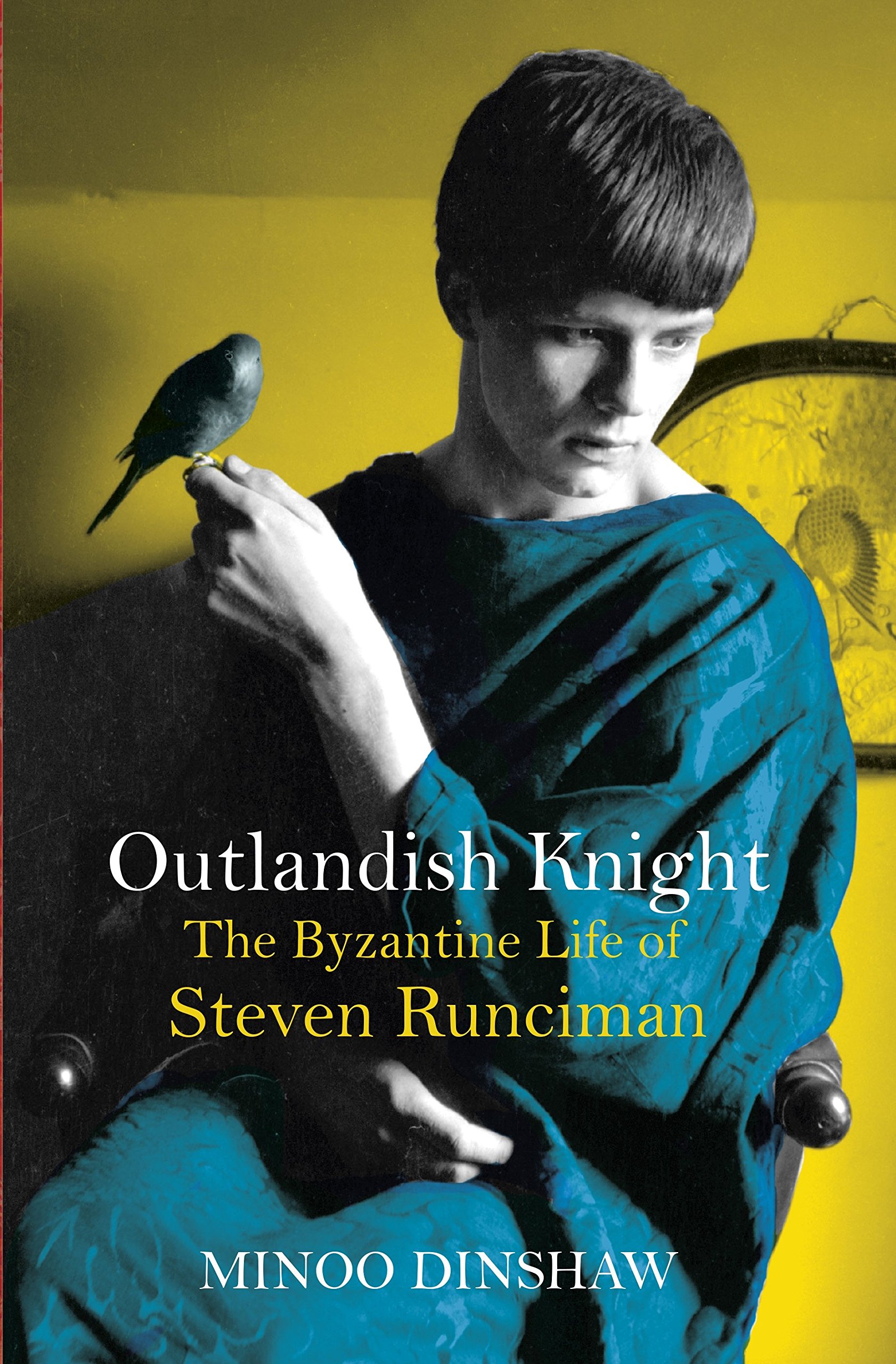
Outlandish Knight: The Byzantine Life of Steven Runciman by Minoo Dinshaw + The Magnificent Century

Steven Runciman is the English historian I discovered back in June - July because el V brought home for me a copy of the author's The Sicilian Vespers (1958).


Thanks to the London Review of Books I now know a great deal more of this historian than before, as it has put up online, "Herberts and Herbertinas" by Rosemary Hill,  a review of Outlandish Knight: The Byzantine Life of Steven Runciman, published by Penguin last month (September).


Looking at the photos above of the young Runciman that makes the cover of the biography, and this photo from inside, and knowing the geographical region of so much of the historian's work, one then is not in the least surprised to learn that, why, yes, Runciman was more than acquainted with Patrick Leigh Fermor.  They worked together worked together at the British Council in Athens after the second world war -- though, mostly Fermor legged it out of there, over the hills and far away.  But both men had a fascination with what came to be called the Balkans and eastern Europe, its ways and culture prior to WWII and the soviet hegemony.  However, the older Runciman, though not religious hiimself, was equally enthralled by the design, shall we call it, of the Byzantine Empire and its Greek Orthodox Christianity.  Runciman designated this the Eastern Roman Empire.

Suleiman in a portrait attributed to Titian c.1530
(b. 1494; d 1566; reign 1520 - 1566),
The information about Runciman's historical work embedded in the review of Outlandish Knight arrived at a particularly good moment for me, enthralled in turn as I am at the moment with the events and history created by the Ottoman Empire of the 16th century. This is the long era when the Istanbul sultans, particularly Suleiman I the Magnificent , who, like his predecessors, not only extracted tribute and subjection from Eastern Europe, but kept western Europe and the Mediterranean in a state of constant defensive warfare resisting further Ottoman conquests.

It was while reading Kris Downey's biography of Isabella of Castile and Spain, Isabella: Warrior Queen, that I finally realized how much her anti-Muslim and Others policies were shaped by the terror of another Muslim conquest of the Iberian Peninsula,  These fears were not the fantasies of an hysterical weak woman, but the intelligent geopolitical calculations of a ruler whose lands were specifically targeted in public declaration and actions by a belligerent, aggressive and very successful military power. This was a power that had advanced in her lifetime already into southern Italy out of the Mediterranean.

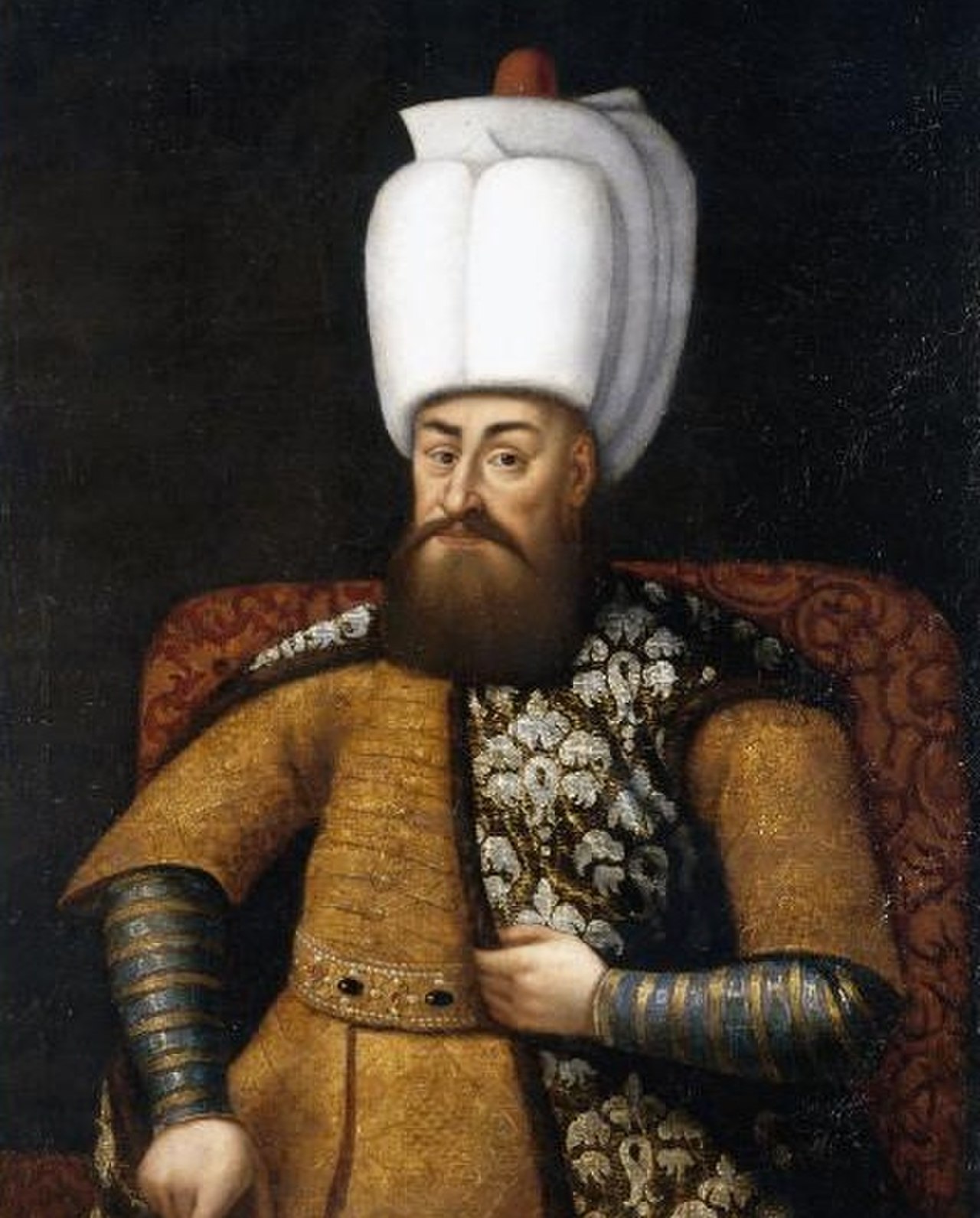
Sultan Murad III
   Suleiman the Magnificent wrote to Martin Luther's powerful, aristocratic supporters. Sultan Murad III (reigned 1574 - 1595) had a correspondence with Queen Elizabeth.  The Ottomans stressed during the 15th and 16th centuries how much more protestants had in common with Islam, which was more tolerant of religions in their dominions than with the Roman Catholic rulers' aggressive intolerance.  Is it necessary to mention the Ottomans's attempts to join forces with the protestants didn't get any traction from either the protestant leaders or their supporters (perhaps because a variety of protestants were no more tolerant than the Catholic Church?).

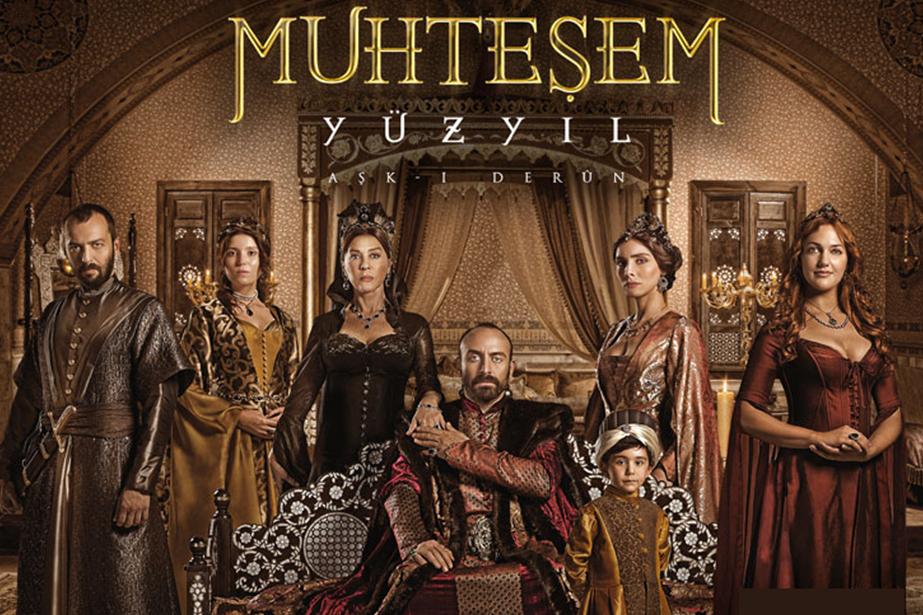
So interested have I become in the role that the Turks play in European history, particularly during the first great age of European global colonialism, 15th - early 8th centuries, that I've been watching with fascination Turkey's vastly popular -- though not in all Turkish quarters! -- telenovella, MuhteÅŸem Yüzyıl -- in English titled The Magnificent Century (2011 - 2014)  Essentially this is a soap opera, definitely fictionalized re-telling of Suleiman's reign.  Suleiman is the Ottoman emperor notorious for having married a Christian European (perhaps from a raid into Hungarian Ukraine) out of his harem.  She is called Roxelana / Alexandra in Europe, Hurrem in Turkish.

Sulieman the Magnificent, around whom gravitate like small asteroids all the court and empire, including his family and harem.
 In the television series Hurrem falls so deeply in love with Suleiman she converts voluntarily to Islam in order to share with him his religious devotion.  No child of non-Muslim can be considered for the empire's throne, a bit of information that is brought up soon in the course of events, after her first nights with Suleiman, but prior to Hurrem's first pregnancy,  The fly in Hurrem's ointment is Mahidevran Sultan, Suleiman's first consort to have provided him with a son and, thus the designated heir -- as far as there could be such a thing within this Ottoman dynasty as a designated heir.  The heir was charged in those days to strangle all his brothers upon the pasas agreeing to put one of them on the throne.  Thus it was an unwritten rule that concubine who gave birth to have only one son. Nor did the emperors generally marry any of them.

Mahidevan is very much a favorite with Suleiman's mother, who is the Valide Sultan -- the queen mother. -- the legal mother of the ruling emperor.  As Suleiman drops Mahidvan from his favor and out of his bed with the arrival of Hurrem's entertaining antics, the former favorite (and the other former, lesser favorites) become more rabid and active in the expression of their hate for the usurper -- which turns Suleiman all the more against them.  Until, of course, Hurrem, acts just like them.  OOOO the DRAMA!

This is a court harem series. Almost everything is told from the harem's pov.  Even the queen mother and her daughter, Suleiman's "precious" sister Hatice, are isolated within the harem walls.  What they have, with their wealth as 'family' and favorites, is more opportunity to gather information from outside and to smuggle information from the inside to outside too. But their lives are constrained and confined to a degree that would drive a contemporary woman, no matter who is she is and believes, quite mad. Everything depends on the emperor.  When / if he dies, they're likely dead too, along with all their children.

To our eyes, spoiled as we've been for so long with peak television, the look of the series, its editing and so on, seem clumsy and small budget, even amateur.  The method is that of talking heads as we see in the BBC I, Claudius.  But the stakes are so high, and the situations so tense, that we almost don't notice that all the action is talking and shots of people moving through the endless corridors of the Topkapi Palace*, going from one insulated room or set of chambers to another.

Hurrem throws a party to get the harem to press the 'like Hurrem' button.


Appropriately these chambers are smothered in brilliant jewel-hued fabrics: silk, satin, velvet.  Gems poured from hand-to-hand glitter in their brilliant colors, the pearls glow in their caskets. All these women do is try on and take off and get made new gowns, and talk.  Occasionally, if given the permission, they throw themselves little parties with special delicacies to eat and drink (no wine, of course) and dance together to the music of other female musicians. What else can they do?  Gossip and stab each other in the back and practice the most petty of rank snobberies.

However, I for one, feel the writers have failed with that most important of these women, Hurrem. I'm through nearly 23 episodes so far of The Magnificent Century (many more to come yet, yay!) and cannot believe this Hurrem could have so fascinated the Emperor. We are told her name was given to her by him, and means something like "the Blithe One," or "She Makes me Smile," but she behaves in such an unhinged matter one doesn't see it.  Nor are her temper tantrums and flouting of the harem rules in the least bit smart -- if the real Harrem behaved like this just once she'd have disappeared from the harem damned quick.  Earlier we see her working hard to learn Turkish and maybe -- what? poetry? and writing (the emperor is a very cultured and educated fellow), which, like becoming a Muslim, would be smart.

But really, how does such an outsider survive to become -- much later -- a wife to the emperor, his only wife, without having supporters in the harem and the palace, and very powerful ones too?  We are given that the third most powerful harem overseer, another young woman, likes her, but we're not shown why.  So far, though it seems she's finally getting control of her public expressions of rage and terror, she doesn't seem to have progressed very far in this direction.  She's still not back in Suleiman's favor -- and her second child was girl. There is more than a suggestion that to some degree at least she's a witch, so say her enemies at least.

It seems the inability for television writers to imagine a truly plausible, strong and effective woman with agency isn't confined to European and American television shows.

On the other hand I find it all the more interesting that whether intentional or not, Hurrem is truly unlikeable (at least so far).  Having a, if not THE central protagonist as someone genuinely cruel and unsympathetic, this is something that no American television series would ever do.  It always broadens one's own scope of understanding to become in immersed in perceptions that aren't culturally one's own.  This applies to how television is made and what is shown: no wild sex scenes of ripping of the clothes to get naked.  Instead, poetry and beautiful fabrics and much tenderness and happiness.  Indeed, one can see the outline of the heavy trousers under her full gowns the censors certainly have Hurrem wear when in the bed with Suleiman.  Which is rather delightful, though perhaps even deliberate -- Turkey's conservatives were outraged when they thought wine was being served Suleiman in one scene -- it was yogurt the program's producers assured them, not intended to wine at all.  Blood letting is all off screen.

O did Mahidevan  go mad, truly mad, with jealousy when Suleiman gave Hurrem this emerald ring that he'd designed and made himself (jewelry making is one of his hobbies).
Note THE RING on Hurrem's finger.
I still like The Magnificent Century though -- the intrigues are believable and they are tense and they about something.  And it moves very fast. Plus I love these jewels and fabrics.  A jewel even has a role in the plot! -- AND! so does Dante's The Divine Comedy!  How can one resist a television series in which poetry, actual poetry by great poets, is so much spoken?  I think Runciman would probably have enjoyed watching The Magnificent Century himself.

----------------------

*  These shots were all done within the actual museum that the Topkapi Palace now is.

Sunday, August 9, 2015

Reading A Thatcherite - Napoleon Bonaparte

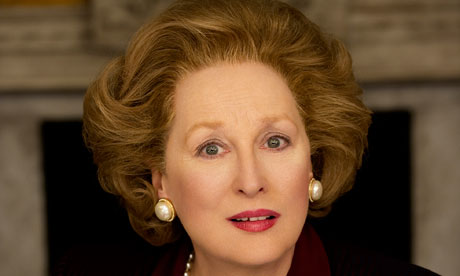
Huh. This doesn't look like Merryl Streep.

I have on hand Napoleon: A Life (English publication title, Napoleon The Great) by Andrew Roberts (2014).

This isn't the first biography or study of Napoleon I've taken on by any means.  But it is the first one to be published since the massive publication of all of Napoleon's correspondence; the past editions left out a third of the letters for various political or axe-grinding reasons. It is also the first work on Napoleon written by a self-proclaimed Thatcherite.  On his wiki and other sites, Robert refrains from mentioning any other reason for his conversion to Thatcherism other than he agreed that the UK had no reason to join the European Union and / or change it's own currency.  From early in his adult life he has always been deeply embedded in the UK's upper echelons of the business and financial communities -- he's currently married to the CEO of "the Brunswick Group LLP and a Governor of the South Bank Centre." 

Roberts is a prolific and most successful historian - journalist.  For all his publications and many honors and dignities received, including several BBC programs made from his books go his wiki here.  

There's a lot here to make me skeptical about his work.  On the other hand, he has a deep and authentic knowledge about the man and the era via his previous works, all of which are mostly well received.

As far as this bio of Napoleon, the reviews are mixed.  Several have mentioned that Roberts has allowed his hero-worship of the man spoil his interpretation and perceptions.  For my own most important concerns around Napoleon, which is slavery, the slave trace, the Saint-Domingue slave uprising, Toussaint, the Caribbean wars with Britain, the sale of the Louisiana Territory, and the earlier accompanying matters of the Revolution's and Directory's relationships with and treatment of the very young United States -- there's hardly anything. This isn't unusual in studies of Napoleon, particularly those by British writers.  They got their own ass kicking in Saint-Domingue and don't like thinking about that much.  They also overplayed their hand with the U.S. in this era, which led to the War of 1812, which wasn't good for Britain in the end.  And most of all the Brit historians lurve Rear-Admiral Nelson, Trafalgar, the Peninsular War and Waterloo. So there ya go -- no Saint-Domingue or Louisiana or the U.S.

But this sort of thing reminds us how basic it is to research to read only a single work by a single writer, and that we need to read many works by many writers from different political and social perspectives -- and from different eras.

I don't think there's need to question Roberts on the facts of the matters -- it's all about the spins he gives them.  So I like to compare and contrast.

I do respect and profoundly admire what Roberts has accomplished in his life's works.  There are thousands and thousands of works on Napoleon alone, many published even when he was alive -- and he's read enormous numbers of them. His french must be perfection, which I envy!  I also envy him his resources: he's personally visited, in company of experts, over 50 of the 63 battle grounds where Napoleon personally commanded.

Tuesday, March 31, 2015

Bancroft History Prize + -- the Return of el V!

So many very fine history titles came out last year that the judges awarded the Bancroft Award to two titles. The Bancroft is one of the oldest and most prestigious history prizes given out in the U.S.  I don't think it is ever awarded to anyone who isn't an academic (which means TASC automatically wouldn't be considered, though the prize-winners are often published by non-academic, trade/commercial publishers. It is sponsored by Columbia University so that would make sense.

This year Greg Grandin's Empire of Necessity won along with Sven Beckert's Empire of Cotton. Both authors received a fair amount of media attention when their books came out -- at least here.  Grandin is well known already, and won other awards. We don't know Beckert but Greg's an amigo.


Both books deal with the global aspects of capitalism, cash crops, slavery and the slave trade. They're both "Big Picture" histories.  Both books are eminently readable though their authors are academics.

I mention the readability because I've been frequently seeing online this winter that academic histories cannot be big picture and cannot be written in accessible, readable prose, and thus are objects of derision. This appears to be repeated mostly by non-professionals and non-historians and by those who are uninterested in history, so uninterested in history, that they flat-out deny it's a discipline and profession at all. Academics do, of course, worry about readability and accessibility -- but many of them, like most people everywhere, aren't gifted writers, thus  we still have all these works that don't read well -- which is too bad, for them, but most of all, for us, as readers and scholars.  (Of course, a great deal else goes into the research of history beyond reading and writing, including math, archeology, statistical analysis, and other sorts of data mining.)

I've paid particular attention to this year's winners because both Grandin and Beckert deal with some of what TASC deals with (in fact, Cuba and Its Music is cited in Empire of Necessity). Another reason is I'm reading 


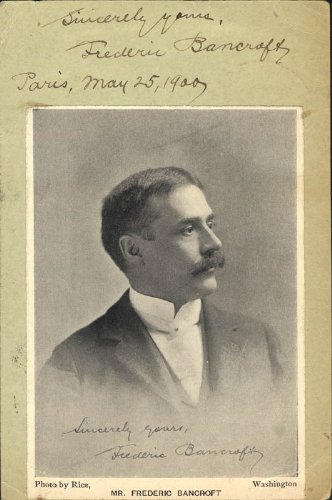
Foner's Gateway to Freedom: The Hidden History of the Underground Railroad (2015), for which much of his research took place in Columbia University's Butler Library's Rare Book collection (i.e. includes papers and archives). Two summers ago we did a great deal of research there in the papers of Frederic Bancroft. 


Not only did he establish and fund the Bancroft History Prize, but he's the founding father of the history of the U.S. domestic slave trade studies, with his self-published Slave-trading in the Old South (1931).


Slave-trading in the Old South was self-published because he could afford to pay for it (which was very expensive in those days). In this era the southern revisionist vision of the antebellum south and slavery dominated the current publishing industry as it did politics and history. Since he could afford to self-publish Bancroft chose to side-step embarrassing rejections from all those editors -- many of whom he knew well, as he, like they were, was among America's aristocratic class -- and thus avoid embarrassment all around.

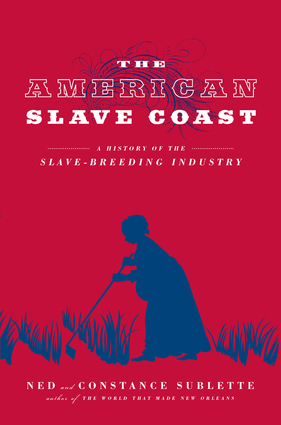
Additionally, Bancroft was a contemporary of Henry Adams and other American aristocrats, within and without the discipline of history, whose works we've read thoroughly throughout the process of researching and writing The American Slave Coast.

Not that any of this matters to anyone but myself, but I like to keep track of these moments where I feel part of the mighty currents that make up the study of Matter of America and its history.

-----------------------

El V comes back tonight, late. The weather is not pleasant, so this time he won't be bringing nicer weather with him upon his return, as he so often when having been away.  I've missed him so much!


Saturday, January 3, 2015

The American Slave Coast

It still doesn't seem real, that 5 - 6 years of work to create The American Slave Coast:  A History of the Slave Breeding Industry, is reaching its culmination (then there is other work, once it is published, but that's different).


Thursday, December 4, 2014

Waiting For the Morning Train: An American Boyhood by Bruce Catton

Waiting For the Morning Train: An American Boyhood, is Mr Civil War Centennial Bruce Catton's memoir.  Written, probably, at the end of the 1960's, as it was published in 1972, when Mr. Catton was six years from his death in 1978, it is firmly grounded in the 19th century, as he was born in 1899.


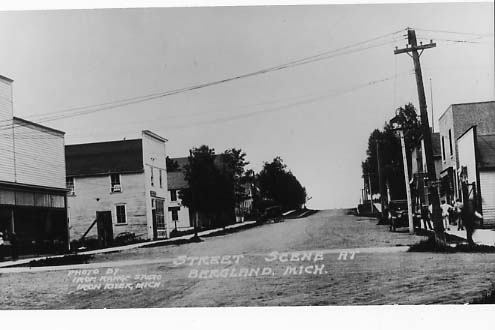
Benzonia, Michigan, where Catton grew up


This must explain, at least partly, why these words so resonate with me -- because though born much, much, much later, due to where I was born, I too am at least knee deep in the 19th century:
.... There is a story, probably apochryphal but significant none the less, about a United States Senator who was running for re-election a few years ago.  According to this story, the Senator got to a small north country town one evening to make a campaign speech, and just before he was led into the hall where the speech was to be delivered the local party chairman gave him a briefing about the issues that were on people's minds locally.
"You'll notice, at the back of the hall, quite a few Indians," he said.  "it would be helpful if somewhere in your speech you could say that you are fully aware of their problem and that you will do your best to solve it."
The Senator promised that he would do this.  Then -- moved by simple curiosity -- he asked: "By the way, what is their problem?"
The local man looked at him wide-eyed.
"What's their problem? he repeated.  "God damn it, they're Indians!
Yet the Indian was incidental.  It was the earth and the fullness thereof that mattered. It passed into American hands just as the tools to exploit it were being perfected -- the tools and the driving urge to use them -- and the men who held the tools moved in as if they had to get the job finished before nightfall. They succeeded (at any rate, recognizable nightfall has not come) and in about a century the job was done.  The trees had gone to build homes for half of America, the copper had gone to serve the new age of electricity, and if the iron lasted longer it had been moved south by millions of tons, in a progress as inexorable as the Sleeping Bear's ponderous drift to the eastward, to make railroads and machinery and skyscrapers and weapons; and the land was left bruised and scarred, with the radar domes to indicate that the age of applied technologies advances by geometrical progression.
So we live as the Indians of Lewis Cass's time lived * between cultures, compelled to readjust ourselves to forces that will not wait for us.  There is no twentieth-century culture; the twentieth century is simply a time of transition, and the noise of things collapsing is so loud that we are taking the prodigious step from the nineteenth century to the twenty-first without a moment of calm in which we can see where are going.  Between nineteenth and twenty-first there is a gulf as vast as the one the stone-age Indians had to cross.  What's our problem? We're Indians.
The frontispiece photo of Catton in the 250 copy limited edition of Waiting for the Morning Train
What he says in that last chapter resonates deeply with me on an emotional level. However, this does not obscure that his sympathy for the Indians comes out of his own sense of being out of place in his time.  But unlike Henry Adams, who became mean and bitter about it, Catton chooses to smooth out the edges of his temporal alienation by waving a worn velvet cloak of words that are in the cadences of purple nineteenth century prose, an elegiac confetti that are to signify the author's dignity, courage and honor.  He chooses "the figure of the Indian" as his conveyance for his own sense of displacement, while in truth he's been blessed with every advantage Native Americans have not had for centuries. He can do this because, as he makes clear in preceding pages, the Native Americans of his part of Michigan at least are not now and never have been a threat, so effectively had the tribes been beaten down and degraded by the turn of the 18th into the 19th centuries.  They are no threat to him.

In contrast, as he will get to, mostly by ignoring them as he does in his histories of the Civil War. the "Black Man" is still a threat as the events of the Civil Rights era shows.  This is why, perhaps, Catton was able to ignore the place of African Americans and slavery in great epic of the Civil War?

---------------------------

* That I know who Lewis Cass is, without looking him up, shows how many years I've been studying history.  Woo.

Monday, November 24, 2014

Favorite Line of the Week So Far

From David Blight, summing up Andrew Johnson, as a states' rights Unionist from Tennessee, hates black people, total white supremacist, festering resentment of the planter class, self-made success and politician:
"He was a complicated guy.
[Meditative Pause] 
 He could have been interesting."

Yah.  This was one of the times Lincoln politically screwed the pooch.  Maybe if there wasn't a white supremacist as vp, assassinating Lincoln may not have been seen as such a good idea, then Reconstruction would have gone the path Lincoln had planned, and so on and so forth.  But that's 100% counterfactual, which has no place in writing history.

Sunday, November 16, 2014

Glory Road and Gone With the Wind

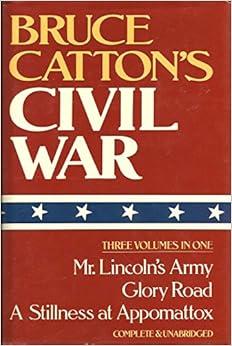
Bruce Catton's Glory Road, second volume in his first trilogy, Army of the Potomac, was published in 1952. The concluding volume of the trilogy, Stillness at Appomattox, received the Pulitzer for history in 1954, and the National Book Award for nonfiction. 


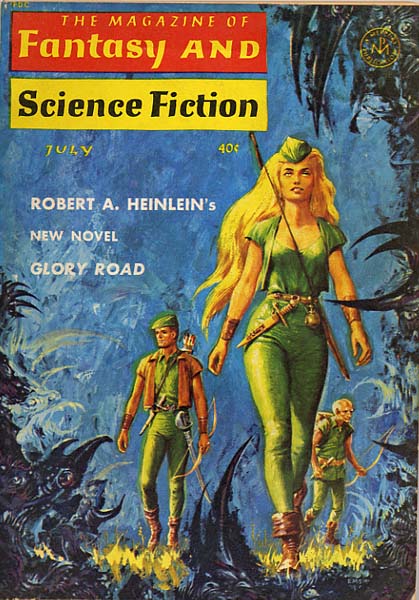
Heinlein serialized his Glory Road in the high summer of the Civil War centennial, 1963.  I've often wondered whether Catton had any influence on Heinlein's choice of title for that space adventure, or in any other way.
By 1963 the Civil War was branded as Catton's War as he published his second trilogy of the Civil War, called The Centennial History of the Civil War (1961 - 1965).  His 


books sold -- no exaggeration -- in the millions.  From his first publication, he was a successful popular history writer, but his Civil War books drove his reputation up into the stratosphere. During the Civil War's Centennial Catton was on television, radio and in all the publications. At least so says the biographical materials. 

I wouldn't know about that from personal experience since I too young and too far out in nowherelandia -- in a state that didn't become a state until 1889 -- for the Civil War centennial to matter or even be noticed. Settled mostly by immigrant Nordic, German, Polish and Russian farmers in the homesteading years at the end of the 19th century, there were few if any people in my my state who had a great, a grand or father who fought in the Civil War. In 1861-66 Sherman and his railway cronies hadn't even yet begun the slaughter of the great buffalo herds in my state. The gallant officers of the Lost Cause went to the Far West, like Wyoming, to reinvent themselves as stockmen/cattlemen (as Theodore Roosevelt divided owners from labor (the cowboy), or to New York, London, Chicago to become successful lawyers, bankers and investors,  not as dirt farmers in the midwest. The Civil War was only talked about in the 4th grade American History class and the high school sophomore American history class.

But Catton's name as synonymous with the Civil War was so pervasive it did penetrate my consciousness a little because he was listed among the offerings from the Book of the Month Club that my grandmothers weren't interested in, and there were adverts for the books in the Sunday Minneapolis Tribune's book pages, which I would glance at without reading, while waiting for my dad to get through with the comix section.  After church, while waiting for us kids and Mom to get out of Sunday School -- she was one of the Sunday School teachers -- he'd drive to town and buy the Minneapolis paper, almost only for the comix.

Whether Heinlein had any interest in the Civil War, I don't know.  But Catton might have been interesting to him if only because he was such a successful writer, who served briefly in the navy during WWI, began his writing life as a journalist, who quickly became so popular and successful he was syndicated. He served as an information specialist in WWII (too old by then for active field service) and was the editor of The American Heritage Magazine until his death -- if I have that correctly. And then there was the Civil War Centennial.

I find Catton unreadable, despite all the positive remarks about him made by David Blight -- for whom I have the greatest respect.  Blight admires Catton's writing style, which I find purple, mawkish and sentimental, and thus, his text, too often, ultimately dishonest.


Catton came by his fascination with the Civil War honestly, in the same way that his contemporary, Margaret Mitchell did, by listening to the veterans of the war in his small town telling each other experiences in the war, and attending gatherings of observances and pageants that were rather like early Civil War reenactments --see his memoir, Waiting for the Morning Train (1972), which is a lovely book, about an America that had long been gone for Catton too. 

In some ways his first trilogy at least was a reaction to Gone With The Wind, as the war is perceived from the viewpoint of the average Union troop.  But he can't resist falling for the gallant courageous knights in grey* and the glory that is war, death in service to a Greater Cause. Despite the Centennial History inclusion of social and economic causes and effects of the war, slavery, well, he's not particularly interested in it, and ultimately doesn't think the average black slave was as unhappy with his condition as northerners though. However, the war was a tragedy, in that the blood of so many gallant white people was poured into the ground in an effort that may not need to have been mobilized.

That there might some tragedy involved here for the millions of the African Americans about whose bodies everybody was fighting, including themselves to possess themselves, isn't part of his narrative. For Catton the significance of slavery and the Civil War is embodied in Abraham Lincoln, the Emancipation Proclamation and the Union's triumph, which is America's triumph of perfecting itself in its unfinished glory of its exceptionalism. What Catton thought about it can be found here.

Part of that for Catton, was that he, like most historians (did he or his academic full-time research assistant paid for by his publisher, read Kenneth Stampp's blow-up-the-paradigm, The Peculiar Institution, one wonders, published in 1956?) followed the line of definitively disproven thinking that slavery was an inefficient and economically non-productive system, which would soon have withered away, if the fire eaters on both sides, that of secession and abolition, had been effectively gotten to sit down and shut up. 


Another way of putting it is that Charles Sumner got what he deserved from Preston Brooks.  (Edmund Wilson certainly thought so, as we see in his Introduction to Patriotic Gore.)

Catton's vision of the Civil War is essentially Romantic, which has fully digested the Glorious Lost Cause revisionism. He cites how often Byron was found in the possession of a dead troop on both sides, and even, here we mention them, in a slave's cabin, harvested from the left behind possession of his former master, running from the Union army. In this way, I will state that Margaret Mitchell was a more honest writer than Catton: Scarlet O'Hara saw and never did see anything glorious and Romantic about the War, before, during or after.  She saw it as a terrible stupid waste of time and blood, and of women's hopes and dreams.


What they had in common though, was a negative: neither of them was interested in the waste of time and blood, the hopes and dreams of African Americans.

This, while the Civil Rights movement was at its height ....

Then, there's Shelby Foote's narrative of the history of the Civil War, from the same period.  Ken Burns, what you wrought was a regression yet again.  But that's yet another tale.

What I really want to say, which is a caution: reading these books is still a worthwhile experience, but they should not be the first books about the Civil War one reads, because imprinting is inevitable, nor should they be the only books read about the Civil War.  This holds at least as much for Foote as for Catton.

 ----------------

* Most of the troops in the CSA army never received a uniform and those that did hardly ever got a second one; the CSA couldn't organize itself to uniform its army. But then they were mostly poor men, who were, in the opinion of many of their planters' sons' officers, no more worthy of the respect of clothes than their slaves back on the plantation.  They weren't paid or given leave, tents, blankets or food either -- just like the people back home on the plantation that the troops were bleeding for the planters' to keep possession of.

Wednesday, October 22, 2014

Robert O'Connell's biography of W.T. Sherman

This summer Random House published a new biography of President Grant's general (and President Lincoln's too, of course): Fierce Patriot: The Tangled Lives of William Tecumseh Sherman, by Robert L. O'Connell.


O'Connell, with his history Ph.D. from the University of Virginia, has spent his


professional career within the National Ground Intelligence Agency, much information about which is not easily come by, as when one clicks on the url for the NGIA, one is barred as unsafe. However, there is this: and this, and many other sites, since, it seems, the agency is huge, with so many employees there are housing / real estate offices dedicated to helping them find somewhere to live within the Charlottesville area. Monticello is also in the area, illustrating once again how much Virigina -- and Maryland -- have profited since the federal capital was moved from Philadelphia to a situation carved from what was their state land. 


These days O'Connell's a visiting professor at the Naval Postgraduate School, was formerly a contributing editor to MHQ: The Quarterly Journal of Military History. Over the course of his career he's written six books of military history, and a novel, Fast Eddy: A Novel in many Voices, a fictional biography of Captain Eddie Rickenbacker. PW review here.

This favorable review of the novel opens by characterizing the author as
". . . an iconoclastic military historian . . ."
so one cannot be surprised by O'Connell's leaving the material of about Sherman the small child who loses his father, is separated from his mother and siblings to be raised in a foster family, not at the front of his biography, but at the end. The first interest O'Connell has in these matters is that Sherman's stepfather is wealthy and influential, thus an appointment to West Point, and rapid, early preferment - promotion in Sherman's career after graduation. These effects, O'Connell believes, part of the complex power struggle between Sherman and his foster father, who becomes his father-in-law, for possession of his foster-sister, then wife, Ellen, who is described as "Daddy's Girl."

Divided into "Part I: The Military Strategist"; "Part II: The General and His Army"; "Part III: The Man and His Families" the narrative moves as rapidly as "Sherman's Bummers" the foragers who fed the Union army as it burned slavery to the ground during Sherman's March to the Sea.

A short book, written in a rather annoying slangy style that one feels the author's editor imposed, this isn't the biography of a whole man in his times, in the way David McCullough's John Adams attempts. This is the biography of man who interests military men written by a military historian. Thus it opens with West Point, and concludes with Sherman's mistress. The first chapter provides the information that Sherman was very fond of women.  Later O'Connell describes Sherman as possessing the healthy sex drive of a warrior.

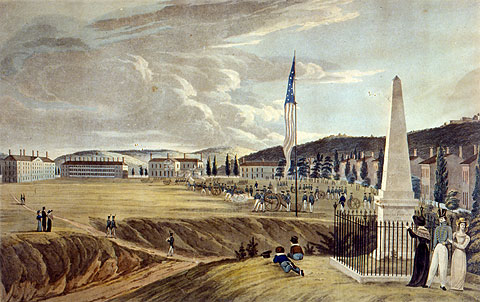
The Plain of West Point (1828); little if any of pre-20th century West Point remains.


Most of the emphasis of the West Point period -- gotten through briefly -- is what it meant to all these future officers of the Civil War that they shared the West Point experience, even that this was more important to all of them than their experience in the Mexican War.  It was West Point that instilled into them all what to expect from each other, no matter which side they were on.  Yet, when it was necessary, in order to win and finish the war, both Grant and Sherman behaved in unexpected ways, which shored them both up when necessary. The south's in-fighting -- every man king of his own plantation -- made this kind of  effective outside-the-box behaviors impossible.

It's an interesting slant through which to view General Sherman's mind, and the military mind in general, or, which, perhaps, provides some unasked for information about mind of the author. One of the elements O'Connell's book keeps to the fore throughout is the political and personal jockeying within the army itself, before, during and after the war, for the sake of favor, promotion and fame. As most historians should learn early on, whether or not military matters are their area, is that war provides great opportunity to generals with dreams of political office, officers dreaming of general's stars, and even those who are considered in peace times of little account -- as with, General Grant, who would never have become General Grant or President Grant without the War of Southern Rebellion.

There is new information in this book for me, who is neither a military historian nor a specialist in the War of Rebellion itself and the battles, but who knows well the lead-up to secession and the war, and what happened to the country -- and the African Americans -- after Appomattox. This reader was taken very early by


O'Connell's account of Sherman in the second Seminole War, which began in 1835, and lasted just long enough for the new West Point graduate to get a bit of a baptism as to battle and campaign. However, O'Connell doesn't mention -- isn't interested? -- that the Seminoles was a 'new' tribe, created out of self-emancipated slaves and survivors of Mississippian tribes who suffered genocide during the colonial South Carolina era, and finished off by Jackson as consequence of the War of 1812.

This is why we always need to read more than a single biography -- or even four or five -- of significant figures in history -- there's always something new to learn, and something the writers don't know.