LINES OF THE DAY

". . . But the past does not exist independently from the present. Indeed, the past is only past because there is a present, just as I can point to something over there only because I am here. But nothing is inherently over there or here. In that sense, the past has no content. The past -- or more accurately, pastness -- is a position. Thus, in no way can we identify the past as past." p. 15

". . . But we may want to keep in mind that deeds and words are not as distinguishable as often we presume. History does not belong only to its narrators, professional or amateur. While some of us debate what history is or was, others take it into their own hands." p. 153

Silencing the Past: Power and the Production of History (1995) by Michel-Rolph Trouillot

Showing posts with label U.S.History. Show all posts

Wednesday, October 22, 2014

Robert O'Connell's biography of W.T. Sherman

This summer Random House published a new biography of President Grant's general (and President Lincoln's too, of course): Fierce Patriot: The Tangled Lives of William Tecumseh Sherman, by Robert L. O'Connell.


O'Connell, with his history Ph.D. from the University of Virginia, has spent his


professional career within the National Ground Intelligence Agency, much information about which is not easily come by, as when one clicks on the url for the NGIA, one is barred as unsafe. However, there is this: and this, and many other sites, since, it seems, the agency is huge, with so many employees there are housing / real estate offices dedicated to helping them find somewhere to live within the Charlottesville area. Monticello is also in the area, illustrating once again how much Virigina -- and Maryland -- have profited since the federal capital was moved from Philadelphia to a situation carved from what was their state land. 


These days O'Connell's a visiting professor at the Naval Postgraduate School, was formerly a contributing editor to MHQ: The Quarterly Journal of Military History. Over the course of his career he's written six books of military history, and a novel, Fast Eddy: A Novel in many Voices, a fictional biography of Captain Eddie Rickenbacker. PW review here.

This favorable review of the novel opens by characterizing the author as
". . . an iconoclastic military historian . . ."
so one cannot be surprised by O'Connell's leaving the material of about Sherman the small child who loses his father, is separated from his mother and siblings to be raised in a foster family, not at the front of his biography, but at the end. The first interest O'Connell has in these matters is that Sherman's stepfather is wealthy and influential, thus an appointment to West Point, and rapid, early preferment - promotion in Sherman's career after graduation. These effects, O'Connell believes, part of the complex power struggle between Sherman and his foster father, who becomes his father-in-law, for possession of his foster-sister, then wife, Ellen, who is described as "Daddy's Girl."

Divided into "Part I: The Military Strategist"; "Part II: The General and His Army"; "Part III: The Man and His Families" the narrative moves as rapidly as "Sherman's Bummers" the foragers who fed the Union army as it burned slavery to the ground during Sherman's March to the Sea.

A short book, written in a rather annoying slangy style that one feels the author's editor imposed, this isn't the biography of a whole man in his times, in the way David McCullough's John Adams attempts. This is the biography of man who interests military men written by a military historian. Thus it opens with West Point, and concludes with Sherman's mistress. The first chapter provides the information that Sherman was very fond of women.  Later O'Connell describes Sherman as possessing the healthy sex drive of a warrior.
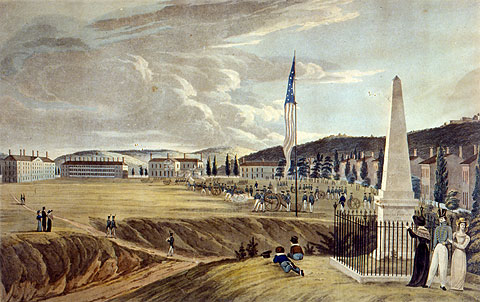
The Plain of West Point (1828); little if any of pre-20th century West Point remains.


Most of the emphasis of the West Point period -- gotten through briefly -- is what it meant to all these future officers of the Civil War that they shared the West Point experience, even that this was more important to all of them than their experience in the Mexican War.  It was West Point that instilled into them all what to expect from each other, no matter which side they were on.  Yet, when it was necessary, in order to win and finish the war, both Grant and Sherman behaved in unexpected ways, which shored them both up when necessary. The south's in-fighting -- every man king of his own plantation -- made this kind of  effective outside-the-box behaviors impossible.

It's an interesting slant through which to view General Sherman's mind, and the military mind in general, or, which, perhaps, provides some unasked for information about mind of the author. One of the elements O'Connell's book keeps to the fore throughout is the political and personal jockeying within the army itself, before, during and after the war, for the sake of favor, promotion and fame. As most historians should learn early on, whether or not military matters are their area, is that war provides great opportunity to generals with dreams of political office, officers dreaming of general's stars, and even those who are considered in peace times of little account -- as with, General Grant, who would never have become General Grant or President Grant without the War of Southern Rebellion.

There is new information in this book for me, who is neither a military historian nor a specialist in the War of Rebellion itself and the battles, but who knows well the lead-up to secession and the war, and what happened to the country -- and the African Americans -- after Appomattox. This reader was taken very early by


O'Connell's account of Sherman in the second Seminole War, which began in 1835, and lasted just long enough for the new West Point graduate to get a bit of a baptism as to battle and campaign. However, O'Connell doesn't mention -- isn't interested? -- that the Seminoles was a 'new' tribe, created out of self-emancipated slaves and survivors of Mississippian tribes who suffered genocide during the colonial South Carolina era, and finished off by Jackson as consequence of the War of 1812.

This is why we always need to read more than a single biography -- or even four or five -- of significant figures in history -- there's always something new to learn, and something the writers don't know.

Monday, May 27, 2013

I Did See Fort Sumter, Fort Moultrie and Much Else This Day of Memory

It being Memorial Day, with the numberless U.S. flags all around us here in militarylandia at half mast and the humans heading to the many beaches all around us here, enjoying their water craft all around us here, reunionizing and touristing too, black soldiers were much in the forefront of my mind this long weekend.

There are many black soldiers all around us here, doing everything everybody else was doing doing, like all the other military personnel all around us here, and like everybody else these soldiers were in civies this weekend, because they had leave of one kind or another.  That they are in the military though, shows through -- young, fit, upright, meeting and greeting each other in the streets, whether in groups (all of those groups were mixed) or with their families (a lot of these families are mixed race) or solitary.  But whenever any military fellow (and I did not see a single obviously military woman this whole time) met up with another fellow military, they seemed to know each other, pummeled and high fived and otherwise indicated solidarity and confrere status.

So military.  Members of the military are trained to use all kinds of weapons from those they fly in the air to those they carry at their sides or on their shoulders or over their backs.  They weren't wearing any today as far as could be told -- as their clothing was generally light it would have been hard to conceal concealed carry.  There certainly was no open carry anywhere around us ....

I could not help think about the days of the Civil War, with the CSA getting whupped, running out of weapons and ammo and manpower both.  Once again it was brought up in the CSA house and senate: What about we draft Our Negroes and give them guns and have them kill Yankees?  That got shot down by the same power elite that moved and shook the slave holding south into seceding and fighting a war on their behalf.  You CANNOT arm a nigrah.  You CANNOT. Shades of San Domingue and Nat Turner, YOU CANNOT.


So, there was a terrific irony there are African American men now, roaming freely the city of Charleston, in the very beating heart of the slave holding aristocratic CSA, all highly qualified in handling all kinds of deadly weapons, and today, they were being honored.  In Charleston.

It was a long, long, long time coming.

This all came to mind along with that episode from the soap opera series, Army Wives, set on an imaginary army base outside Charleston (there is no army base here, but a naval one, and that's located on a former air force base; location shots are on the naval base, formerly an air force base which quite tickles me as to the rivalry of the military service branches ....).  It is a time travel episode, which examines what our protagonists would be like on the same base during WWII instead of now.  Class and sexual conflicts are the same. The present-day general and his wife, generationally army are at the top of the heap in WWII too. The poor white trash couple are finding the army life to be a good career move into upward mobility and opportunity for their kids just as they do in the present. The couple who has trouble with gender roles -- still in that condition but in a very different way as the Colonel has been badly wounded and is no longer in the military but runs a bar-restaurant, and his wife is deeply dissatisfied -- in present day she's a physician and her husband hated her practicing.  She was to stay home and take care of him and domestic things.  Then there is the black couple.  In present day Joan is a commanding officer of a combat platoon.  Her husband is a psychologist who is also the house husband and does much of the care of their child.  But back in WWII he was a draftee and Joan?  She was a cleaner in Frank's restaurant-bar.  He gets jumped by a bunch of racist yahoos who don't think he should be in Frank's restaurant.  All our regular characters gather around to beat the yahoos off.  Because this is a soap opera and all must feel good by the end. But still.  This was a fascinating episode that tried very hard to show how much the army's changed since WWII.

But now it's facing a hurdle even higher than that of racism: the millennia ingrained  conviction that the right of military man is to rape women.  Even women who are their sisters in combat.  It breaks the heart.

One victim of long-time, repeated assault by her commanding officer testified in tears a couple of weeks ago that she now believes the only reason the military began accepting women as regular soldiers is to be 'comfort women,' as the Japanese did to the Korean women in WWII.  When our military got stationed in locations where women were off-limits due to the culture, and even prostitution, unlike Vietnam, is nearly impossible among the locals, women were allowed in.  And that's their real function -- to be sexual outlets for Our Boys Who Are Entitled to Sexual Satisfaction Whenever With Whoever.  Her heart was broken, and so much else.

So steps ahead -- black men who know weapons can roam at will in Charleston.  Women, well, maybe not so much.

Saturday, April 27, 2013

Happy Birthday, President - General Grant

Born today, in 1813, in Point Pleasant, Ohio.


As president, Grant was a staunch upholder of Lincoln's plan of Reconstruction, defending the full integration of black men into the legal, economic and political institution of the United States. Therefore, since he was also the general who won Abraham Lincoln's war, Grant was a primary target in the South's subsequent revisionism of the run-up to war and the war itself, turning itself into the victim of the war they started, their loss into the Glorious Cause and writing slavery out of the history all together. While turning Robert E. Lee into the contrasting saint, Grant's character was shredded: a drunk butcher of men, enabler of that other butcher, Sherman, dishonorable and incapable. He could never have defeated the chivalrous, brilliant Lee except he had unfair advantages.

Northerners played into that game, starting with Henry Adams, who held a grudge against President Grant. Grant didn't provide Charles Sumner, an old, close Adams's family friend, with the office Sumner wished for. President Grant believed the Senator, never fully recovered from the vicious caning by South Carolinian Rep. Preston Brooks in 1856, and now elderly, wasn't up to it.  Gore Vidal followed the sly insinuations Adams insinuated into his novel of post-war D.C., Democracy. In 1876, the post-Civil War volume in his Chronicles of Empire series, Vidal painted a thoroughly mendacious portrait of Grant as pathetic, incompetent and unpopular.

During his long, painful death from throat cancer Grant wrote Personal Memoirs of Ulysses S. Grant, published by Mark Twain. The Memoirs was organized in two parts. The first section, though it deals only briefly with his early life, is a plain but nevertheless vivid account of growing up in a small Ohio community in the Jacksonian era.  It smoothly segues into his time at West Point. Then he describes his experience in the Mexican-American War, which, Grant states, as well-understood at the time, that he like so many others in the U.S.,  heartily disapproved of this war, for it was an unjust war  made by and for the benefit of the Slave Power, which the nation as a whole had to finance. The Memoirs was enormously successful as a work of history, and as a publishing venture.  In literary judgment it ranks with Julius Caesar's The Gallic WarsThe Memoirs has never been out of print.


Grant's funeral procession became an historical "Pageantry of Woe," as Americans of every class and region flocked to pay respects to the man, who with Lincoln saved the Union, who had exercised particular magnanimity to General Lee at the Surrender at Appomattox. On the day of his funeral, churches in hamlets, small towns and cities everywhere observed special commemoration.

His tomb is in New York City's Riverside Park, overlooking the Hudson River.

Monday, February 25, 2013

Elite, Powerful, Wealthy British Families Received Fortunes in Compensation for Abolition of Slavery


Britain's colonial shame: Slave-owners given huge payouts after abolition
 David Cameron's ancestors were among the wealthy families who received generous reparation payments that would be worth millions of pounds in today's money

I ran into this article in the Independent yesterday, while looking up something else.  The database, "Legacies of Slave Ownership,"on which this article is based, will be available to the public here, starting on Wednesday (February 27, 2013). El V thought it mattered enough to make it today's Da List post.

How much did the slave owners get?
The British government paid out £20m to compensate some 3,000 families that owned slaves for the loss of their "property" when slave-ownership was abolished in Britain's colonies in 1833. This figure represented a staggering 40 per cent of the Treasury's annual spending budget and, in today's terms, calculated as wage values, equates to around £16.5bn.
I wonder if this enormous payout of national resources to the sugar baronage, which had so long controlled Parliament, had a relationship to the horrible state of wages and opportunity in England during the 1830's, whether in the rural regions or the industrial manufacture regions. There labor unest led to riots -- riots over the price and availability of the most basic foodstuffs, for only a single example.  Though emigration opportunities had been curtailed, ironically prison transportation of economic protesters, along with so many other sorts of undesirables, increased.

The article is a long one, packed with information.  The two paragraphs below are the shocking conclusion.

Campaigning against slavery began in the late 18th century as revulsion against the trade spread. This led, first, to the abolition of the trade in slaves, which came into law in 1808, and then, some 26 years later, to the Act of Parliament that would emancipate slaves. This legislation made provision for the staggering levels of compensation for slave-owners, but gave the former slaves not a penny in reparation.
More than that, it said that only children under six would be immediately free; the rest being regarded as "apprentices" who would, in exchange for free board and lodging, have to work for their "owners" 40 and a half hours for nothing until 1840. Several large disturbances meant that the deadline was brought forward and so, in 1838, 700,000 slaves in the West Indies, 40,000 in South Africa and 20,000 in Mauritius were finally liberated.
I've never understood when so many felt so much compassion for slave holders losing their forced labor force (whether in Britain or the U.S.) there was so little compassion for those who lives were stolen.  There was enormous discussion here about levels of federal compensation provided the slave holders of the Confederate States of America after the Civil War -- something on which the dismissed "radical extremist emancipators" such as Thaddeus Stevens held the line against providing.  But the forty acres and a mule reparation for the former slaves received little or no serious consideration. What we did do here in the U.S. was compensate the Washington D.C. slave owners for emancipation -- from wiki:
It was called “compensated emancipation.” was a law that ended slavery in Washington, D. C. by paying slave owners for releasing their slaves. Although not written by him,[1] the act was signed by U.S. President Abraham Lincoln on April 16, 1862. April 16 is now celebrated in the city as Emancipation Day.
As mentioned at the top, it was one of those serendipitous moments, encountering by chance, this article when I'd just run into this, concerning John C. Calhoun, and his, by now long-matured strategy to make slavery universal as a system and accepted as right, moral and God's will:
Upon assuming his new office [Calhoun was appointed Sec of State by Tyler in 1844] Calhoun found an unanswered
letter from the British minister in Washington,
who explained that his government, having
abolished slavery in its own empire ( 1833 ) , was ready
to assist in abolishing it throughout the world. Calhoun
wrote and sent a remarkable reply. The United
States, he said, must frustrate the insidious aim of the
British and, to do so, must get possession of Texas.
Otherwise, Texas might be induced to emancipate its
slaves and thus, by setting a bad example and by extending
the free-soil border, might increase the difficulties
of preserving slavery in the United States. But
slavery must be preserved. It was the ideal institution,
for slaves no less than masters. To clinch his point, Calhoun
cited statistics from the latest federal census to
show that feeblemindedness and insanity were more
common among the free Negroes of the North than the slaves of the South.ftn 20 
No matter how long one studies these matters,  how deeply, how broadly one has already delved in these matters, every day still throws up something important about which I, at least, had no idea. Or, another way of putting it might be, one understands every day that no matter how much you know about our European - American centuries of the slave economic system, that was worse than you know or can imagine.

Thursday, December 1, 2011

It Beginning to Look Like Christmas

The first week of December has long been my favorite week of the holidays. Thanksgiving hurly burly has come and gone – isn’t it grand how the one holiday that really was about friends and family is now about gigonomous BUYING? Is capitalism great or what? Why I like this week is because routines are back and observed, while real people as opposed to retail oppressors, are leisurely, here and there, putting out lights and other Christmas decorations, and they are sparkling and bright, not yet tired. I love the light at this time of year. And now with the re-instatement of normal temperatures, the light and the feel of the air have matched up again. Next week is traditionally the favorite one for both private and corporate and charity Christmas parties, so this weekend kicks into high gear the hurly burly of Christmas and New Year's. Thus, we'll be in uncommon, non-routine mode for the next few weeks -- particularly as el V's so taken up with rehearsals and the premiere of the first three sections of LasVidas Perfectas on the 15th, 16th and 17th.

Since the Obama family moved into the White House I've been uncharacteristically, and for the first time, fascinated with how things are done there. I love how the First Lady and her staff do Christmas, and in particular how they decorate the White House. The WaPo always covers in detail the unveiling of the Christmas White House, so today all of us get to see it. The star of the Holiday White House this year is Bo, which surely is something kids all over the country can appreciate. The WaPo coverage, "Bo is Christmas star in White House decor," is here.

There is a slide show of photographs, and a video also -- though just now it doesn't seem to be working so well.

Merry Christmas! Woof Woof Woof!

Saturday, November 19, 2011

Council of Elders dialogue with OWS this Sunday, Nov. 20th

In New York City on November 20th, members of the Elder Council will spend time with those encamped at Zuccoti Park, beginning at 2:30 PM. They will lead a worship service in front of the “red structure” within Zuccotti Park at 3:30 pm. Elders will then host a dialogue with Occupy Wall Street demonstrators and other interested individuals at 5pm, at 74 Trinity Place. Both events are open to the public.

http://www.belovedcommunitycenter.org/

Veterans of America’s 20th Century civil rights movement will enter the 21st Century Occupy Wall Street movement in New York, Oakland, San Francisco and Los Angeles on Sunday, November 20.

Known as the “Council of Elders,” they will step inside the nationwide encampments to symbolically share the torch of hope and justice and engage the Occupiers in dialogue about defining movements of the past. “We want to contribute to this intergenerational movement,” says Dr. Vincent Harding, activist and writer in the civil rights movement. “We are thankful for the efforts of Occupy Wall Street to unite the 99% and bring the many gifts and great energy of millions into effective action to transform our nation.”
The Council of Elders is an independent group of leaders from the farm workers, sanctuary and human rights movements that shook the nation’s conscience with public protests over the past 50 years.
“We see Occupy Wall Street as a continuation, a deepening and expansion of the determination of the diverse peoples of our nation to transform our country into a more democratic, equitable, just, and compassionate society,” excerpt from the statement of solidarity by the Council of Elders to be read at each of the Occupy encampments.

By bringing their voices to the Occupy Wall Street movement, the elders are addressing a litany of social grievances, including poverty, mass incarceration, and what they call a culture of war and violence. Dolores Huerta, activist with Cesar Chavez and the farm-workers movement, believes today’s conditions create bitter divisions among peoples across the United States and throughout the world.
“We applaud the miraculous extent to which the Occupy initiative around the nation has been non-violent and democratic, especially in light of the weight of the systematic violence under which the great majority of people are forced to live,” says Rev. James Lawson, leading theoretician, tactician and theologian of the civil rights movement.

The economic crisis which sparked the Occupy Wall Street movement also motivated the veteran protesters. They cite soaring unemployment rates, home foreclosures, and inadequate health care as issues that require public outcries.
The Council of Elders promotes compassion and non-violent action as the highest values to reverse trends that put profits ahead of people in its quest to contribute to the much-needed movement for a more just society and a more peaceful world.
The council members are urging elders from around the nation to join the Occupy Wall Street movement.
In New York City on November 20th, members of the Elder Council will spend time with those encamped at Zuccoti Park, beginning at 2:30 PM. They will lead a worship service in front of the “red structure” within Zuccotti Park at 3:30 pm. Elders will then host a dialogue with Occupy Wall Street demonstrators and other interested individuals at 5pm, at 74 Trinity Place. Both events are open to the public.

Click here to download press release