LINES OF THE DAY

". . . But the past does not exist independently from the present. Indeed, the past is only past because there is a present, just as I can point to something over there only because I am here. But nothing is inherently over there or here. In that sense, the past has no content. The past -- or more accurately, pastness -- is a position. Thus, in no way can we identify the past as past." p. 15

". . . But we may want to keep in mind that deeds and words are not as distinguishable as often we presume. History does not belong only to its narrators, professional or amateur. While some of us debate what history is or was, others take it into their own hands." p. 153

Silencing the Past: Power and the Production of History (1995) by Michel-Rolph Trouillot

Showing posts with label Labor. Show all posts

Friday, February 27, 2015

Interstitiality of Racism, Bigotry, Criminality, De-personification and Literature

What has helped provide this week's warmth, life's snap and crackle that keeps us keeping on, is our Vanderbilt amiga being here. She's so frackin' brilliant! It's a terrific mind-workout challenge being with her, so stimulating, so interesting and I always learn something, see things in new ways.

Her capacity for using the professional languages designed to exclude, designed, even, to identify, those who are designated as expendable, extraneous, less than "human," is superb. She exposes the interstitiality among the professional languages, where the boundaries between religion and literature dissolve into the languages of case law and incarceration.  Further, this is enabled by the formulized rituals of the legal system to debase the body, and remove it entirely from the person's own control. When a person cannot control even her own body for a movement or a moment (i.e. as with slavery), there is no more personhood.

Angola Prison Plantation work gang 2014
The complete control of the body means complete control of the mind. I saw all of this in operation in how Monticello's master, more than any other plantation I've visited, implemented physical control via surveillance, and even minute arrangements of situation and organization. This includes armed guards, no different in operation and effect than at the contemporary Angola Prison in Louisiana, which I've also visited. Angola is deliberately kept as an antebellum plantation, with the cotton and other crops planted, cultivated and harvested, mostly by hand.  I felt the same creepy, oppressive, desolate depression at Monticello as I did at Angola. The entire antebellum south was a gigantic prison complex of interlocking systems designed to keep the captives incarcerated.  It started all over again, then in the Jim Crow era, where armed white men rode the roads and guarded the train depots to keep the labor force from escape to Chicago, New York, California.

CD exposes the ritualistic racism that further allows while obscuring, how our legal system and the others deliberately create classes of those who are slotted for de-personification.  It begins with the body, and the body then takes care of the mind.  This is the judicial system, the prison system -- and I will, as will she, insist this is what the plantation - slavery system of the colonial America and the antebellum era was deliberately created to be. However, without a foundation for thinking of, manipulating other human beings, as less, as like animals, i.e. not human, founded in the languages of sacred texts and "national "literature", we could not get from the conception of God's creation to society's throw-aways .

I'll go further than this, and insist that without that de-personification there is no control of not only the "poor" and others designated as social waste, but no control by the elite over labor and the wealth labor's production creates. We see this taking place now, not only in prisons, immigration agencies and other apparatus of state control, but in work.  See: the wildly expanding use of "employee monitoring," that tracks every single move an employ makes.  Its at the point that the UPS truck drivers are even monitored as to how they get out of and into their trucks.  There is a right way, which doesn't waste seconds, and all the other ways are wrong because wasteful, getting the driver called into the office for a talking to and warning that if s/he doesn't shape up getting in and out of the truck they will be fired.  See:
 Esther Kaplan uncovers many of these disturbing and intrusive behaviors, which inform hiring and firing decisions, and can push employees to their limits, in her article for Harper's, "The Spy Who Fired Me."
Exploring / exposing these matters from this perspective is fundamental to understanding the horrors of the world we're in. We'll never be able to make a more humane world without understanding this monolith that is sitting upon ever more shoulders, oppressing, repressing, denying our worth, our right to even "be."

I sit during her lectures, breathless and scribbling..

Among other things she does, CD works with prisoners in Nashville State Prison. She repeats that the men she's working with know all this better than anyone. They have a language themselves, that addresses, describes and embodies the ritual of humiliation, denial of personhood and exclusion as social waste.

And there, if I'm understanding CD correctly, is the only opportunity for all the rest of us, who as a class is growing globally every day, to push back, by understanding, taking into ourselves, the conceptual language of those who have been ostracized from "society."  I.e. it's another place to dissolve boundaries between us and the rulers.
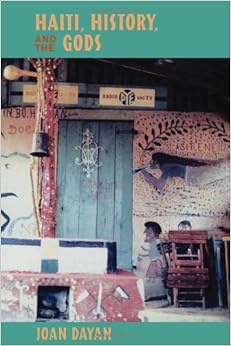

CD first began this kind of work in Haiti.  Haiti, History and the Gods is a seminal work for examining the kind of society in which we are currently living, that has declared open season on young, unarmed black men, and the bodies of all the rest of us as well.

Friday, August 8, 2014

Bezos vs. Writers

Steve Bezos owns the Washington Post.

After reading the latest updates in the Authors vs. Bezos/amazilla stand-off in this AM's NY Times article, it was interesting to search back to the start as to how the WaPo reports on the matter.


As to be expected, quislings like Alyssa Rosenberg -- who thinks Got is not degrading of women as characters or actresses -- in the WaPo, tells us right up front, right the start of the battle, that amazilla is doing good for writers by holding up authors' books, denying customer service fulfillment on their books, and taking a much larger chunk of writers' earning for itself to fund such things as purchasing the WaPo from where it can further shape public opinion in favor of amazilla -- while still providing no profits to stockholders and investors (other than Bezos, of course).

Some days back science fiction author, Walter Jon Williams, posted a well-thought out desciption of what is the actuality is of the relationship between amazilla and writers, and what amazilla is in reality doing to writers and creatives of all kinds, here.

The argument of Bezos that his exploitation of writers for the sake of his wealth is good for writers is eerily reminiscent of the argument of slaveowners that slavery is an excellent situation for the enslaved, and the only victims here are the slaveowners.


Patrick Henry's Red Hill home
Not to mention how reminiscent is the whining of those who cannot bear to have their convenience and low prices threatened to Patrick Henry's faux sigh that due to the general convenience of slavery, slavery cannot be abolished.


Monday, February 6, 2012

Labor, Class, Racism Struggle & Ideology

As well as the useful, thought-provoking How the Irish Became White, there are two other really fine studies that were published in the same period, which should be read, as content and slants of all three books illuminate and cite each other.

Alexander Saxton's The Rise and Fall of the White Republic: Class Politics and Mass Culture in Nineteenth-Century America (1990 - reprinted in 1996:

and

The Wages of Whiteness: Race and the Making of the American Working Class by David R. Roediger (1991). Originally it came out from Verson, like Saxton's, but Verso has made a pdf available at no cost online. This one includes an Introduction by Kathleen Cleaver.

Among what I personally am finding so useful for my own research and what I'm writing right now is that each work includes good sections on the Jacksonian era. Unlike The American Slave Coast though, these books are focused on the years after Reconstruction and the making of the labor struggle to organize for better working conditions as we've generally understood it into and through the 20th century.

Additionally, these are historians who reject entirely the Psychohistory view of history -- which is such a relief, particularily when working with issues such as the construction of "race." I hadn't even consciously realized how much I rejected Psychohistory until listening (as oppose to re-reading) Barbara Tuchman's A Distant Mirror and the way she built out huge portions of that book from a psychological diagnois of 14th century Europeans -- that these mothers and parents didn't love their infants and small children because they died so frequently, and based it the lack of art that showed such parental love except with the Virgin and Jesus -- and yikes! there wasn't secular art to speak of yet in the 14th century! particularly at the start of it!

Each of these works are now classics in the relationship in our nation among racism, class and labor. So why aren't these works and the many other useful studies that appeared in the 90's that focus on this cluster of issues by black and white authors not cited by those who insist that it is class that matters only these days, not racism? For these books make it very clear that the truth of the matter is quite otherwise.

There is enormous room for more work too, particularly now as the jobs that have so long been the springboard into the middle class for the working poor and labor, along with the artisan skills, have shrunk to nearly zero. How is this going to play out in the coming years in this cluster of intimately entwined categories?

The more I look into everything around slavery and racism in our national history the more I see how little things change, really. Which, as the author of The Wages of Whiteness says can create a sense of pessimism, at least in the readers and critics. What we see are the patterns of our own national folkways. But I'm wondering if we really aren't approaching the time when this will change. Because, folks, when it comes to those jobs and the future, there isn't even a social caste-status payoff for whiteness in the mix any longer.

Culturally, at least the musicians recognized this (well, not Charlie Daniels and his ilks, of course -- but then we're speaking of the really good stuff that you need a great deal of talent to play, compose, arrange, or jam on). All three of these books have sections on culture, particularly music.

Monday, March 21, 2011

Prosperity: Building the Home of the Brave and Land of the Free

Rockman, Seth. (2009). Scraping by: Wage labor, slavery, and survival in early Baltimore. Johns Hopkins University Press, Baltimore.
At a moment of great entrepreneurial energy and social mobility, prosperity came to Americans who could best assemble, deploy, and exploit the physical labor of others. The early republic’s economy opened up new possibilities for some Americans precisely because it closed down opportunities for others.
. . . the perpetuation of slavery in a place like Baltimore owed less to the actual labor compelled from enslaved workers and more to the fact that plantation purchasers in Charleston, Augusta, New Orleans, and throughout the South were willing to pay hundreds of dollars for Baltimore slaves. Under the “chattel principle” that facilitated the instantaneous conversion of a person into cash, Baltimore slaveholders reaped wealth from slavery that had little to do with urban labor itself.

Other historians have suggested that the “cultural work” of slavery should be considered alongside the actual work that enslaved men and women performed. What slaveholders obtained from their human property was not merely labor, but a way of conceptualizing themselves as “masters,” a vehicle for performing patriarchal obligations to one’s wife and children, a means of class differentiation relative to nonslaveholding whites, a mode of social discipline to keep impoverished European immigrants grateful for their low wages, and a tool for undermining interracial solidarity of working people in general. Slavery sustained, if not promoted, many of the values and practices associated with early republic capitalism, such as the performance of self, the attainment of middle-class standards of respectability, and the pursuit of upward mobility. Seen in this light, slavery appeared worth preserving as a system not merely for compelling labor and accumulating capital, but for its ability to shape the contours of a broader range of social and cultural relations.
Both a property regime and a system of cultural power, slavery was also a labor system that accelerated economic development. Payroll records and job advertisements from Baltimore reveal the ready assimilation of enslaved workers into a fluid labor market. Through the practice of hiring slaves, employers reconciled slavery with the most advantageous aspects of a “free-labor” economy, namely the ability to hire and fire workers at will and to jettison traditional responsibilities of providing laborers with room and board. However, they were not so committed to the free-labor ideal that they sought to abolish slavery or convert all labor relations to a wage basis. There was no need to choose between a labor force entirely of enslaved workers or one entirely of free, self-owned, and legally equal workers. Instead, the system that emerged in Baltimore blurred boundaries between categories of labor, assuring the interchangeability of different workers along a continuum of slaves-for-life to transient day laborers – with term slaves, rented slaves, self-hiring slaves, indentured servants, redemptioners, apprentices, prisoners, children, and paupers occupying the space in between.
Scraping By is an essential text for understanding the equation of labor = prosperity of the earlier decades of the U.S., and how this grew out of the laws and regulations of labor of the colonial eras previously.


Wednesday, April 7, 2010

An Account of Reconstruction, 1865 - 1866 by a British Imperialist

K -- you will find this fascinating, in light of the books you're currently reading. 

"Sir Charles Wentworth Dilke’s fascinatingly odd Greater Britain: A Record of Travel in English-Speaking Countries," (published 1868).

The heads-up for this from a blog I like, though some of the blogger's statements are, if not exactly wrong, not correct. For example the blogger states that the UK backed the Confederacy. The UK government never did back the Confederacy in any of the ways that mattered, and for which the Confederacy lobbyed until the end: financially (no loans), no weapons and no embargo of the Union, either diplomatic or mercantilist.

As for the blogger's conclusion, I have to agree wholeheartedly:

But the most telling passage for me, is this one — which occurred in the ellipsis above — in which we see most clearly how the problem of black free labor literally disappears under racism. When he asks the assembled whites about what kind of work the free blacks do, they literally cannot answer him. Though he has seen almost nothing in the entire town but black industrious labor, free black labor is so unthinkable to the ” poor trash” that when he points it out, they erase his very words with a spelling lesson on race hatred:

Strangers are scarce in Norfolk, and it was not long before I found an excuse for entering into conversation with the “citizens.” My first question was not received with much cordiality by my new acquaintance. “How do the negroes work? Wall, we spells nigger with two ‘g’s,’ I reckon.” Virginians, I must explain, are used to ” reckon” as much as are New Englanders to ” guess,” while Western men ” calculate ” as often as they cease to swear.) ” How does the niggers work? Wall, niggers is darned fools, certain, but they ain’t quite sich fools as to work while the Yanks will feed ‘em. No, sir, not quite sich fools as that.” Hardly deeming it wise to point to the negroes working in the sun-blaze within a hundred yards, while we sat rocking ourselves in the verandah of the inn, I changed my tack, and asked whether things were settling down in Norfolk.
That non-work ethic of the former confederacy? It’s alive and well among certain white southern populations still, as we learned while living in New Orleans.