LINES OF THE DAY

". . . But the past does not exist independently from the present. Indeed, the past is only past because there is a present, just as I can point to something over there only because I am here. But nothing is inherently over there or here. In that sense, the past has no content. The past -- or more accurately, pastness -- is a position. Thus, in no way can we identify the past as past." p. 15

". . . But we may want to keep in mind that deeds and words are not as distinguishable as often we presume. History does not belong only to its narrators, professional or amateur. While some of us debate what history is or was, others take it into their own hands." p. 153

Silencing the Past: Power and the Production of History (1995) by Michel-Rolph Trouillot

Showing posts with label religion. Show all posts

Saturday, March 25, 2023

Go Any Further and We Shall Fall Off

      . . . .  We are at the end of the world, or at least the end of Europe, in the oldest, continuously inhabited city in Europe, Gadir, established by the Phoenicians, now, finally, Cádiz.  Now we know that we can go further, and we won't fall off.  Cuba, Havana, is just over there.  (Though it is Jerez, la frontera de Jerez, that actually looks a lot like Havana (without the dilapidation -- and when we get to Sevilla, now that recalls Havana in every way, which as the treasure flotas arrived from Havana to Sevilla, la reina católica's city, and which she made the capital of her kingdom, would be expected, right?). The tap water in Jerez was safe to drink, but it tasted funky in the way New Orleans tap water does.  Here in Cadiz, it's still safe to drink, which as it turns out is true throughout Spain. We are so used to being Cuba, where one cannot drink the tap water. Potable water was and always is a problem there, just as it is in St. Augustine, FL.

We are in a 4-star hotel that was a convent.  The church is still consecrated and operating as a church, but the sisters have gone ... where? elsewhere? It is extremely quiet, which is good for sleeping. One feels to be in a fortress (of God?) or a prison (of God?).  But it is still cold, dark and convent-y, though with mod cons.

It's a good thing to be reminded, as one falls in love with Spain, that even when/where it was Muslim, it has always been a prodigiously Catholic country, about which history there is a lot to be said, and not much of it good.  At least as far as the history I know goes, and speaking relatively to most people, at least in the USA, I know whole lot.  It cannot be divorced from the Church's history, and the history of Spain (and Portugal) anywhere.

So much experienced -- cannot do anything except jot notes in Moleskine and take fotos with foney-fone.  In mine mind's eyes, I see endless processions of beautiful horses, Flamenco dancers and, yes, matadors and bulls. Watch certain Flamenco expressions and there is so much there from the arena, or did it flow from the dancers to the arena -- even from dancers much, much before Jesus, perhaps, even likely, from before the Romans? The bulls were in Iberia before the Romans and the arenas.  Africa is just a quick passage across the Mediterranean . . .  there are bull rings and arenas there too, on the southern side. 

[Originally posted on DW on 03/012/23]

~  ~  ~  ~  ~ ~ ~

Cádiz Cat Houses and the Atlantic

     . . . . Today was Phoenicians and Romans, mostly. 

After which I took fotos and video of cats, cat houses, and cat towns under the seawall that protects Cádiz from the tormentas of el atlántico as we sunset walked around the island where is situated the oldest, longest continually inhabited city in Europe. We did both Romans and Phoenicians today.... and cats.

Speaking of cats instead of horses, I have a nice foto of one of the cats that live in and around the remnant of the Umayyads' fortress wall on the site that became Madrid -- going back so far, but not yet as far as Charles Martel or Charlemagne -- time, time, time. It is impossible not to time travel in Cádiz.

    . . . Took fotos and video of cats. Cat houses, and cat towns under the seawall that protects Cádiz from the terrors of the Atlantic as we sunset walked around the island where is situated the oldest, longest continually inhabited city in Europe. So of course included are cat houses and communities.

The people of Cádiz care for the feral cats in the same way do those of Istanbul.  Places for them to shelter from the salty humdity and sea spray, to relax and hang out, and to eat.  These are cleverly constructed so the cats can get to the food but the always ravenous gulls and other birds cannot.  Wonder if rats can?  But I've yet to see a rat anywhere, but this is a city, moreover one so ancient as this, with constant grain shipments, surely there are rats.

We did both Romans and Phoenicians today.... and cats. Will have dinner at a Moroccan restaurant with a lovely woman from Finland we met on the train yesterday. Dancing Flamenco is her hobby and passion.  Otherwise she's festival organizer. One of her festivals is a Steampunk festival. 

Perhaps there is a way to transfer the short video I shot of one of the competitors and her horse in Jerez yesterday morning to here. I could do it via a long process of getting it to this wonky laptop's hard drive in Word video files.  But I don't have time for that before I get back to NYC, where I would do the work on my desktop, which is much more powerful and faster.  Trust me: this is equine poetry in motion.  Ever since I've gotten here, i.e. to Spain, my mind's eyes, are filled with horses and dancers as I try to sleep. I've never been in a country, not even England, not even Virginia or Kentucky, where horses are such an integral part of a national identity and history.  No wonder 4th grade Horse Girl me dreamed of coming here.

So little time to write, to transfer, etc.  It's all my notebook, and occasionally trying to put some of it up here via my fone.  Weird experience that.

But I am so afraid of missing, losing something, of these incredible experiences that just never stop, not for a second.

[Originally posted on DW on 03/13/23]

Sunday, August 14, 2016

What To Do When Unrelenting Hot & Humid

Last night, after midnight, it was still 88º.  Excessive Heat Warning still in effect.


It's been like this for over a week now, with no end in sight.  Thunderstorms forever predicted but they never appear.  We are hunkering in our a/c-ed and floor fanned cave.  If we don't move around too much we're OK.  But outside it just keeps getting hotter as the mid-90's sun keeps heating up even further the cement and pavement and the the high rises belch hot air from their massive cooling systems into the street and the vehicles pour out even more heat.  the humidity is indescribable.

What to do?  Taxes, is one thing we were able to do. Some home improvements. Meeting friends for dinner.  Going out to the freezer that is Subrosa to hear the best latin jazz, which is about the best music going in this era.

As for history -- something I hadn't previously considered encountered my radar, finally, this past week: the relationships among 16th and 17th century protestants and Islam.  Oddly, despite doing so much religious and political history of European powers the 16th and 17th centuries in the variety of our church's study programs, this never came up.

What made me think of this the other day was another of my many duh moments, the recognition of something staring one in the face all one's life: the first siege of Vienna was 1529 -- and by then Martin Luther had substantially contributed to political and military upheaval in many of the Germanic states that chafed equally at the domination of the Austrian Holy Roman Empire and the Pope in the Vatican.

A bit of digging ensued.

     It turns out that Martin Luther had quite a bit to say to the ruling elites of his time and place and quite a bit to say to them about the ruling elites and Islam. Well, of course he would, since he had so much to say about everything -- frequently in his favorite rhetorical scatology,

But more to the point there were political ramifications to this, from the Balkans across to England, Europe and into Spain.

The Ottoman rulers, such as Suleiman the Magnificent, were in dialog with protestants, as part of various strategies, describing how much more say, protestant Queen Elizabeth had then in common with Islam, than with the Pope and the European rulers who followed Rome.


Suleiman the Magnificent 1494 - 1566

Later, in the century, at the Battle of Lepanto, there were protestants, particularly from England and the Netherlands, fighting allied with the Muslim sea forces, for instance, against Spain.

However, one doesn't see anywhere, probably for what seem obvious reasons, any western European protestant rulers actually making a common cause with the Turk. Further east though, certain groups and their leaders probably didn't have a lot choice in the matter, if they wanted to survive. But Catholic rulers did make the choice, such as the long-standing Franco-Ottoman Alliance of 1535.

Divide and conquer, make allies and stand strong.  The Ottomans were major players in the European power rivalries of the 15th, 16th and 17th centuries, something we so often forget to factor into our thinking of the events of those centuries. It drove so much of Queen Isabella's policies during and after the conclusion of Spain's reconquista, which she herself accomplished.  The Ottomans had indeed penetrated into southern Italy during her reign.  It was the challenges presented by the Ottomans, the New World and Luther's Reformation that every European monarch had to navigate for a successful reign.  These rulers included, of course, whoever was currently seated in the Vatican's Chair of St. Peter's.

Jeremy Irons, as Pope Alexander VI.
The televisions series, The Borgias, included Ottoman politics in the series.

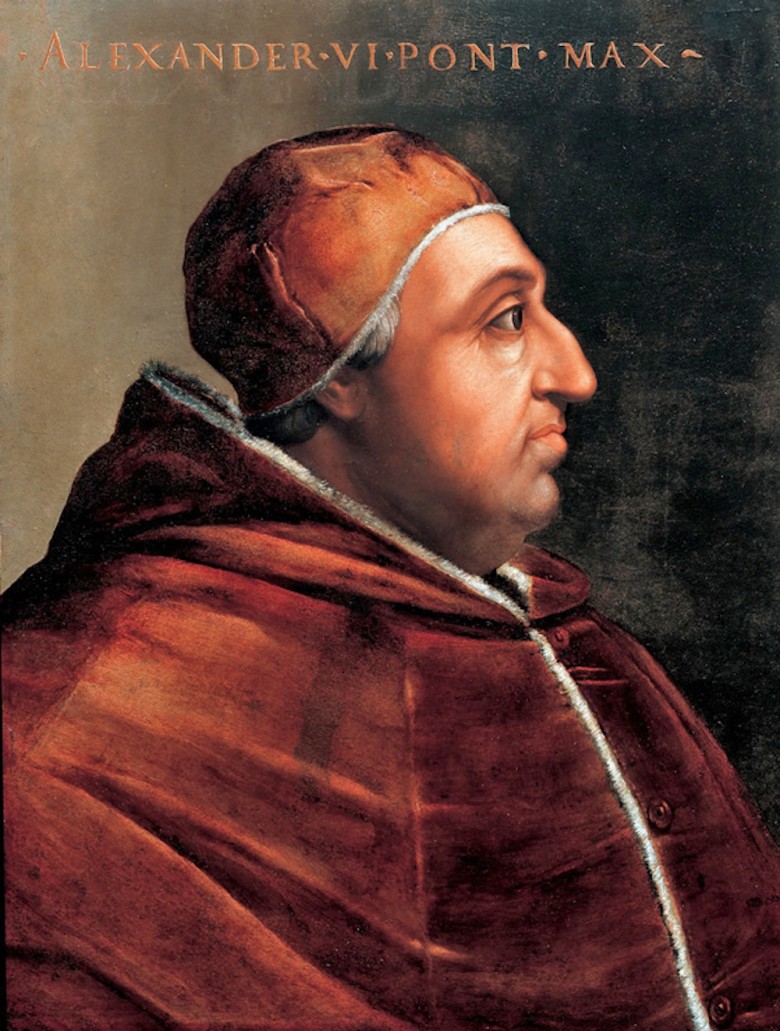
Rodrigo Borgia - Pope Alexander VI
For instance, here is this:
Overall, the military activism of the Ottoman Empire on the southern European front probably was the reason why Lutheranism was able to survive in spite of the opposition of Charles V and reach recognition at the Peace of Augsburg in September 1555:[15] "the consolidation, expansion and legitimization of Lutheranism in Germany by 1555 should be attributed to Ottoman imperialism more than to any other single factor.


  Currently, disturbingly, one sees the xtreme xtians, including so many politicians such as Ted Cruz, who are engaged in Spiritual Warfare with those inhabiting Satan's belt of the globe, mining Luther's writings for instruction as to how to defeat Islam, which in many places he did declare to be powered by Satan himself.

It is also disturbing that I hadn't thought of any of this myself until this last week.  I should have been connecting these dots all along.

Wednesday, May 18, 2016

Admiral (2015)

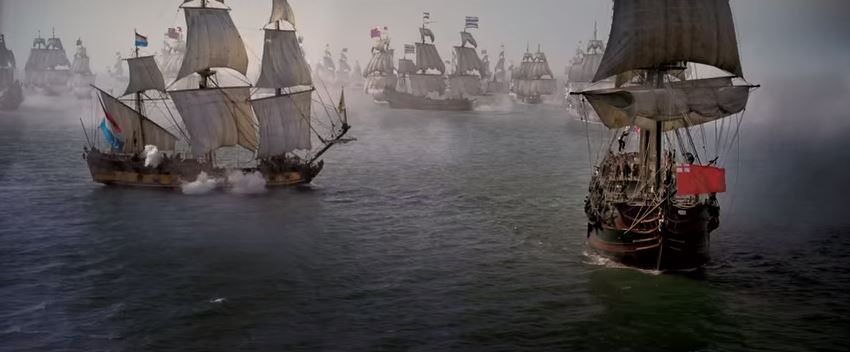
English title: Admiral - Dutch title: Michiel de Ruyter (2015) Dutch film about their great hero of the Anglo-Dutch naval wars of the 17th century, Michiel de Ruyter.  I watched this via netflix streaming.

Michiel de Ruyter painted by Ferdinand Bol in 1667
Admiral was an admirable distraction from my congestion and coughing last night. O, those ships were gorgeous. But it does seem the writers could have done a bit more to identify the causes for these conflicts beyond Charlie 2 being such another feckless Stuart of the fully feckless Stuart dynasty. It would have been nice if the English adversaries at sea, such General Monck (made Duke of Albemarle), had been identified. As Walter Jon observed, this isn’t a film that is likely to appeal to anyone who isn’t interested in the history of the matter or in pitched naval battles per se. 

That said, it was a terrific pleasure to watch de Ruyter's fleet's invasion via the Medway River, which concludes with the burning of the English fleet anchored off Kent at Chatham -- particularly if one recalls those entries in Pepys's diary, where he views the aftermath with the Duke of York and other notables.

This was the Embarrassment of Riches century for the Dutch. Global marine trade had made them even more wealthy than their previous control of Europe’s textiles trade and manufacture. They were also aggressive privateers, successfully taking the mercantile ships of the French, Spanish and English, all of whom had designs on protestant Netherlands’ territory on the Sea, and their global trade dominance. 


Beyond this, however, slavery in the new world and the Dutch slave trade out of Africa to supply slaves to Caribbean and North American colonies This is a huge economic resource over which the Dutch and the English are fighting now — control of the slave entrepots on the West African coast, above the Portuguese controlled Kongo. The Dutch first managed to push the Portugese out of the upper coasts pretty much all the way down to the equator by then. Now it was the Dutch and English fighting for control. Charlie II and his cronies had started the Royal African Company specifically to get into the African slave trade and thus Charlie could have some cash to jingle in his always cash-poor privy pockets.

The English ultimately won this one, initiating the gloriously wealthy-from-the-slave-trade-18th-century for Liverpool, Bristol, London and to a degree some other British cities, particularly in Scotland. Beyond the sale of bodies of Africans themselves, the African slave trade required so much out of which to get fabulously wealthy, from ships and financing, to insurance, to all those shackles and manacles, supply, etc.  There were no qualms in England for supplying these services to the British slave trade – though this was also the century in which the movement to abolish the African trade got started and the century in which slavery as a condition in the British Isles was abolished.

None of these matters concerning the African slave trade rivalry or any of the European powers, including the Dutch, are matters for this film.  This is just background information that I brought to the watching of it, and which made it work for me.  So did memories of reading about the aftermath the defeat of the conjoined French and English naval invasion in a volume of Dumas's Musketeers chronicles, and with the Spanish invasion in the Altriste novels,  1672 was called in Dutch history, "rampjaar" -- the Disaster Year.  Among other things the Dutch deliberately broke their dikes in the Spanish held territory and flooded out everyone, citizen and invader alike.  The Spanish soldier's point of view of the aftermath is admirably brought to life in the historical novel series, Las aventuras del capitán Alatriste by Arturo Pérez-Reverte via his novel (1968 in Spain; 2007 in U.S.), Sun Over Breda.  As this is about the Dutch, however, the rampjaar is dealth with via time lapse from an ever higher altitude camera so we see no details of that horrific period.

Nor is there any mention in this film that attempts to deal with the Anglo-Dutch wars how the Dutch traded the Nieuw Amsterdam colony to England. These are the sorts of things that only somebody like me though, would be thinking about while watching this lush action-adventure, that is mostly on the sea.


There was probably another reason why the English — or at least the Lords — were so hot to go to war with the Dutch during Charles II’s reign. So many of the protestants in the reigns of both the Catholic supporters, Kings James and Charles I were given refuge in the protestant Netherlands, from where they plotted to take down the crown and, from which others escaped their majesties’ pursuit to the New World — from where they returned in droves to support Cromwell and the execution of Charles I — and, of course, get places in the administrative structure and return of their properties.  Charles II and the other returned-to-power nobility had not forgotten any of this.

Like the slave trade which the Royal African Company was about (though he writes so often about going the Company’s house ‘on the king’s business”, this was something else that Pepys was too discreet to put details down on paper, even in his own most private diaries.

The Admiral film presumes its Dutch audience knows all these historical matters. Its focus is Dutch political conflicts between the Republic and the forces that want a king* like other European nations -- as well as on the several great battles that Michiel de Ruyter won for them.

Warning: there is a prolonged sequence of horrific violence that includes the torture and mob dismemberment of Michiel de Ruyter's patrons, Johan and Cornelius de Witt, brothers.  Johan had been the prime minister of the Dutch Republic for 20 years, and successfully brought them through the wars -- not least by backing commoner Michiel de Ruyter over his aristo rivals.

------------------

*  They got as their king, the Dutch stadtholder William III of Orange-Nassau (William of Orange), who had married James II's daughter, Mary Stuart. Not long after he invaded England, bloodlessly dethroned his father-in-law -- the final feckless Stuart, in what is known as "The Glorious Revolution" of 1688, and took the crown for himself. Along the way, William betrayed many, as royalty, would-be and otherwise, does.

Saturday, May 9, 2015

Film - Ex Machina - Spoiler Free

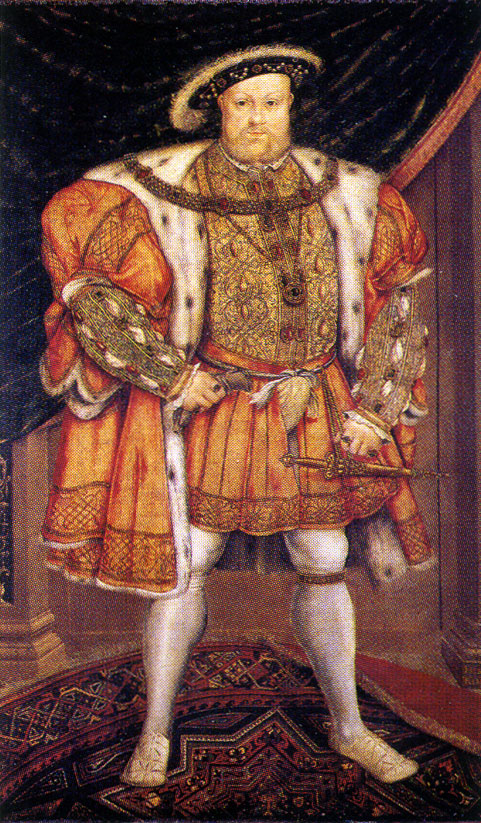
Ex Machina, an sf film that has been touted more than once as the best film to be released so far in 2015, opened here some weeks before last week's national roll-out. I saw it soon after PBS began airing Wolf Hall, with which Ex Machina has more than a little in common with Henry VIII's quest for the perfect woman/queen/wife, who all turn into disappointments, sooner, usually, than later, with the exception of Jane Seymour, who quickly provided the king with a son and then removes herself by selflessly dying.

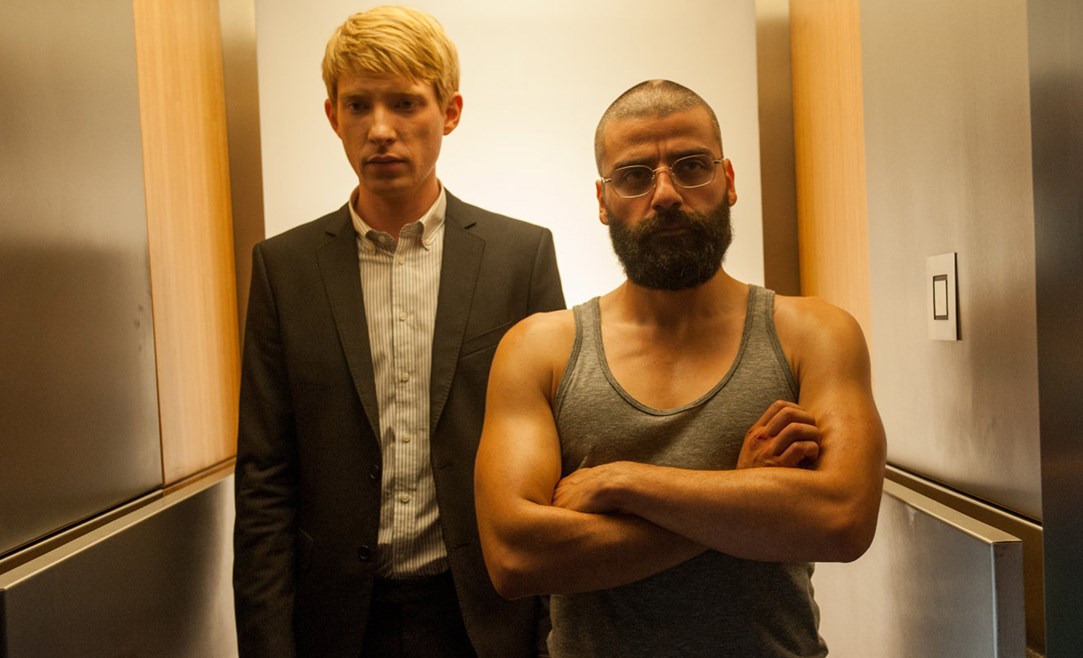
Though Ex Machina's Nathan, king of technology, has a different coloring, his build resembles Henry VIII
Caleb, with his employer, the genius god Nathan. Nathan partly constructed Ava the AI via Calebs porn preferences, which he suveilled and mined, in order to make Ava's Turing Test as complex as possible.
However, Ex Machina and Wolf Hall share another quality, which is male rivals who jostle and jar to prove themselves the smartest, most powerful guy in the room. Wolf Hall's King Henry VIII prided himself on his learning as well as his majesty, and Ex Machina's Nathan, who sets in motion all the action that is the film, as founder-coder of the most successful search engine, the most wealthy man in the world, is arguably much more powerful than a king, and as capricious, entitledly vicious and cruel as any king. Nathan wrote that code when he was 13, and now is obsessed with his AI project. Nathan's brought his younger employee, Caleb, to his Norwegian Fortress of Solitude to perform the Turing Test on Ava (Eve) his latest AI prototype. Is she the AI singularity or not?  Caleb is a different type than Nathan, but he too is very, very smart.

Nathan and Caleb are performing their nerds' version of this.
Part of the film is about the outsmarting game Nathan and Caleb play on each other.

It's also about being God. Nathan, who is an obnoxious though very smart egoist, is enthralled by Caleb calling him God, though Caleb repeatedly corrects his employer with what he actually said, which was that the ability to create actual artificial intelligence would be "like a god, not God." As Caleb is all about the semantics of everything, mechanical and human, this is an essential difference of definition, but Nathan is going with God being himself, thank you, because he's smarter than everyone else.

Which brings us to the title of the film, Ex Machina, from Deus ex Machina, drama's god from the machine . . . .

Does the capacity to create a fully, independently functional, self-aware, artificial consciousness of free will make the man God?  Then we must think, "God is dead," and has been dead a long time before the present of this film.  Our tech-obsessed society killed God, putting the mechanically built God in humanity's God's place.

It is a commonplace that (male) humanity kills its father-God.  But what have females done with fathers and God, other than serve?

Two AIs.  One talks, the other doesn't. One survives, the other doesn't.  It matters not whether the AI has the capacity to talk when they both are programmed to be female.  Like Lucifer, Eve will rebel.
Was it Nathan or Caleb who proved himself the smartest guy in the room?  The answer is irrelevant.  What matters is the next question: what happens now?

Beyond, or below, God, there are many question thrown up by Ex Machina, via the very smart scripting and photography, particularly about what makes up gender, at least of what qualifies as the feminine and the female -- and even, as we see by the still above, ethnicity. These are the questions most critics and reviewers have focused on, though a quick google-through will show they don't all agree on what those questions about men and women are, or what they signify.

Ex Machina, so say the critics, is a movie about ideas, in the best traditions of science fiction, as well as a magnificently constructed and photographed film. So it is, and thus  I went to see Ex Machina again this week. It was a sparsely attended late morning screening; all the audience with the exception of two elderly out-of-town hetero couples and me, were white men between the ages of 20-something and mid-30's.  In the meantime mothers and fathers of all colors and heritages and ages were streaming into the theater down the corridor, young kids in tow, to see Avengers: Age of Ultron.  If anyone were to ask,  I'd suggest instead of Ultron,  Ex Machina, anytime -- if the questioner is older than 11.

Friday, February 27, 2015

Interstitiality of Racism, Bigotry, Criminality, De-personification and Literature

What has helped provide this week's warmth, life's snap and crackle that keeps us keeping on, is our Vanderbilt amiga being here. She's so frackin' brilliant! It's a terrific mind-workout challenge being with her, so stimulating, so interesting and I always learn something, see things in new ways.

Her capacity for using the professional languages designed to exclude, designed, even, to identify, those who are designated as expendable, extraneous, less than "human," is superb. She exposes the interstitiality among the professional languages, where the boundaries between religion and literature dissolve into the languages of case law and incarceration.  Further, this is enabled by the formulized rituals of the legal system to debase the body, and remove it entirely from the person's own control. When a person cannot control even her own body for a movement or a moment (i.e. as with slavery), there is no more personhood.

Angola Prison Plantation work gang 2014
The complete control of the body means complete control of the mind. I saw all of this in operation in how Monticello's master, more than any other plantation I've visited, implemented physical control via surveillance, and even minute arrangements of situation and organization. This includes armed guards, no different in operation and effect than at the contemporary Angola Prison in Louisiana, which I've also visited. Angola is deliberately kept as an antebellum plantation, with the cotton and other crops planted, cultivated and harvested, mostly by hand.  I felt the same creepy, oppressive, desolate depression at Monticello as I did at Angola. The entire antebellum south was a gigantic prison complex of interlocking systems designed to keep the captives incarcerated.  It started all over again, then in the Jim Crow era, where armed white men rode the roads and guarded the train depots to keep the labor force from escape to Chicago, New York, California.

CD exposes the ritualistic racism that further allows while obscuring, how our legal system and the others deliberately create classes of those who are slotted for de-personification.  It begins with the body, and the body then takes care of the mind.  This is the judicial system, the prison system -- and I will, as will she, insist this is what the plantation - slavery system of the colonial America and the antebellum era was deliberately created to be. However, without a foundation for thinking of, manipulating other human beings, as less, as like animals, i.e. not human, founded in the languages of sacred texts and "national "literature", we could not get from the conception of God's creation to society's throw-aways .

I'll go further than this, and insist that without that de-personification there is no control of not only the "poor" and others designated as social waste, but no control by the elite over labor and the wealth labor's production creates. We see this taking place now, not only in prisons, immigration agencies and other apparatus of state control, but in work.  See: the wildly expanding use of "employee monitoring," that tracks every single move an employ makes.  Its at the point that the UPS truck drivers are even monitored as to how they get out of and into their trucks.  There is a right way, which doesn't waste seconds, and all the other ways are wrong because wasteful, getting the driver called into the office for a talking to and warning that if s/he doesn't shape up getting in and out of the truck they will be fired.  See:
 Esther Kaplan uncovers many of these disturbing and intrusive behaviors, which inform hiring and firing decisions, and can push employees to their limits, in her article for Harper's, "The Spy Who Fired Me."
Exploring / exposing these matters from this perspective is fundamental to understanding the horrors of the world we're in. We'll never be able to make a more humane world without understanding this monolith that is sitting upon ever more shoulders, oppressing, repressing, denying our worth, our right to even "be."

I sit during her lectures, breathless and scribbling..

Among other things she does, CD works with prisoners in Nashville State Prison. She repeats that the men she's working with know all this better than anyone. They have a language themselves, that addresses, describes and embodies the ritual of humiliation, denial of personhood and exclusion as social waste.

And there, if I'm understanding CD correctly, is the only opportunity for all the rest of us, who as a class is growing globally every day, to push back, by understanding, taking into ourselves, the conceptual language of those who have been ostracized from "society."  I.e. it's another place to dissolve boundaries between us and the rulers.


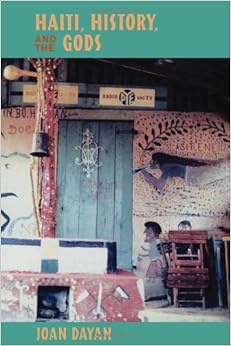
CD first began this kind of work in Haiti.  Haiti, History and the Gods is a seminal work for examining the kind of society in which we are currently living, that has declared open season on young, unarmed black men, and the bodies of all the rest of us as well.

Tuesday, February 10, 2015

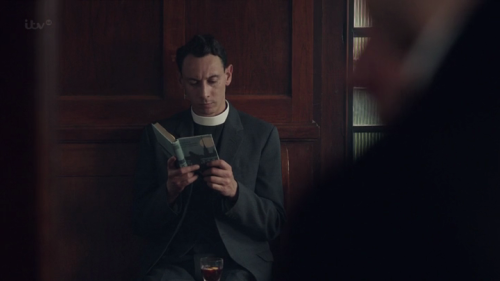
Grantchester -- Episode 4 - PBS / ITV

I liked this series from the first episode.

It's odd that I did, and even more odd that my liking has increased as season's episodes roll on PBS.  Grantchester is a quiet show, with a fairly superficial treatment of people's moral dilemmas and personal stumbling blocks to being good, the individual's obligation to strive, life-long, to become a better person, as part of, and within a social community.  I even think of its softly delivered lessons during the week. It's the sheer generosity of spirit that infuses this series, so different from just about anything else in current entertainments, that has grabbed me, I suppose.

Our attractive vicar, Sydney Chambers, and Dickens. 

 Like everyone else in this episode, Detective Geordie Keating learns lessons in Gross Indecency and Judge Not . . . .
This week's episode delved into dimensions of seriousness regarding being a gay man in semi-rural 1950's homophobic England. This theme has already been touched upon via continuing character, Leonard Finch, Our Attractive Vicar's curate, who is referred to as "the pansy" as a matter of course by Detective Keating.

Leonard Finch, who has hoped to find a refuge from his conflicted instincts within a quiet life of contemplation by serving the Church of England.  His situation, however, leaves little time for contemplation and his Vicar is teaching him that his calling is not to serve the Church per se, but people and a community.
So we have already seen a gay man's conflicts of living in way in which one must conceal who one really is. Even the Church of England that Leonard serves condemns him to damnation as a "sodomite."  But the focus this week is not on Leonard, but another young man, and an older, married man,.

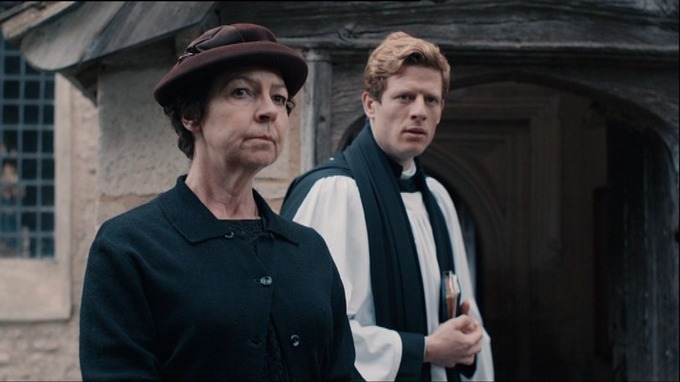
Mrs. McGuire, Vicar Sydney Chambers's housekeeper, who, he assures a German visitor, "hates everyone."  Mrs. McGuire does seem to learn her lessons in  Christian charity from Sydney, but tends to forget them from one episode to another.  But that means the viewer has the pleasure of her softening repeated from episode to episode.
The episode's message of how harmful and wrong it is, socially and morally, for both individuals and communities to shun and condemn those who are different from "us" then broadens in scope to include Germans. Recall, everyone in this community has been afflicted by Germany in both WWI and WWII.

To the sorrow of so many, the harm of such phobias remain in their lives, even after lessons are learned. What happened in this episode, it is clear, has permanently affected the lives of at least three men, a woman and two children.

The episode also depicts the casual sexism that is so common among almost all men that it continues even now. Did the episode connect homophobia, xernophobia and sexism?  If it did, it so merely by presence, not by preaching.


Next thing you all will hear is that I've joined an Episcopal congregation, the closest thing here to Church of England.

OTOH, if I was seeing it back-to-back instead of one episode a week, it might not be so appealing?

Monday, November 17, 2014

Reign - Season 2 - Episode 7 - Prince of the Blood

Writers of Reign, to play nicely with history, to the satisfaction of everyone who watches, you need to know your history.  When it comes to this era you really need to know the history of protestants everywhere, and France's protestants in particular, as well as the history of the RC Church -- because all of this period is opening the gates into the century we know as the Wars of Religion.

Which perhaps might be taken as a caution that perhaps pitching a show as "fun entertainment" in which all the primary figures are hip deep in the blood, torture and plunder that are the Wars of Religion is not a good idea after all.  Especially as one of the primaries at least shall soon be dead, and the other gone back to Scotland to tread her inevitable road to imprisonment and losing her head.  This is not fun.

So, for starters here's something you all needed to know before you began writing: the protestant movement in France, the converts to Calvin's version of protestantism and reform, known as the Huguenots, did not begin with "the people."  In fact, "the people," the peasants, were strongly anti protestant.  They wanted to keep their rituals, their feast days, their Virgin, their priests, their cathedrals and beautiful music and the theater of the mass.  They preferred their Church so much, that they were terrific auxiliaries to the throne's slaughter of  the Huguenots.

The second thing you needed to know before you began writing was that in France, as in England and Germany, the Huguenots were both a religious and political movement.  That the nobles aligned with the crown would find them a credible threat to their power and authority is precisely because so many of the one million plus converts in France were nobles and wealthy merchants.

So, Reign writers, you see  all that courtly handwringing that if "the people" who had converted to protestantism weren't put down and punished, conversion cantagion of the body politic might spread to the nobles is o so badly wrong, that the entire idea of fun entertainment goes up in the flames of the noble's burning chateaux.   This is why, ultimately, Catherine and Charles are for the pogroms -- to remove these dangerous elements, who have both wealth and power, from their kingdom.

As well, there are other deadly intra-conflicts and intrigues, as many of those aligned with the crown, scheme to take it for themselves, as Charles is so young and the Queen Mother is still a hated Medici Italian, with all her grasping relatives grabbing money, land and power.  This was already going on while Henri II still lived.

O, and Condé, Louis I, Prince of the Blood, military leader of the Huguenots?   He gets whacked by the Guises, fighting to save de Coligny (who also gets whacked) at the battle of Jarnac.

Condé was a hunchback and by the time we see him on Reign he looked like this.
Condé didn't look like this.
What you all needed to do, Reign writers, was read the definitive history, The Huguenots, by Geoffrey Treasure.  Or -- maybe you did, but you all just don't care because, hey, Wars of Religion, they are such fun entertainment!  Who cares how much the suffering and brutality mattered to the formation of the political and economic movements of the time, the effects of which did so much to create the Europe, North America, the Caribbean and South America, at least, in which we live today.

The thing about the 16th - 17th Wars of Religion is that they were not fun for anybody, including those wearing crowns, see: Mary Stuart losing her head, for instance. This did not take place in an historical sidebar to the reign of Glory the Virgin Queen. These events were all interconnected.  Without the wars of religion at this time, Mary wouldn't have been such a tempting figurehead around which the French and other Catholic powers to rally to replace Elizabeth on England's throne.

The response to that is, as has been seen before -- hardly anybody knows this so who cares?   Anybody who does know isn't our audience, so stop being such a huffer and puffer.  We've made a GREAT story here.

Well, I dunno about that. It sure does look like your reliance, such as it was, upon a few historical details instead of doing the work of entirely reimagining a historical era into a historical fantasy world, you all have written yourselves into a corner in the dungeon of non-renewal.


Saturday, February 2, 2013

*From the Holy Mountain: A Journey Among the Christians of the Middle East* by William Dalrymple


Taking a break for a bit from U.S. history to read about the early Christians in the Middle East. William Dalrymple is a writer, historian and journalist who I admire on all three planes. I'm much looking forward to the publication in this country of his latest book, Return of A King: The Battle for Afghanistan, the third in his trilogy of the India Company. Holy Mountain, published in 1997, is the fifth of his books I've read, as well as the first of his books I've read that isn't centered on India. It was his City of Djinns (1993) that introduced me to Dalrymple the historian.

Dalrymple's drivers for Holy Mountain is John Moschos and his pupil Sophrojnius, the Sophist, who journeyed across A.D. 587 Christianity of the Byzantine Empire. He is following as best he can the book of their journeys that Moschos completed shortly before he died, the book which became the book of the Christian world for centuries thereafter: The Spiritual Meadow of John Moschos. This book accompanies Dalrymple through his adventures as the Polish journalist, Ryszard Kapuściński describes in his Travels With Herodotus (2004) took with him everywhere the Histories of Herodotus. The Spiritual Meadow is one of the few sources we have as to what the varieties of this Christianity were like in the region. In a very few years Islam would explode out of the Arabian Peninsula, changing everything.

Dalrymple sees these years in which we who are presently alive, the conclusion of what began so soon after Moschos's death. Dalrymple visits the rapidly disappearances of what survived this far, the ancient churches, the monasteries, the communities, the villages, dismantled by the Levant's fequent earthquakes, by deliberate violence, whether political or relgious in impluse.
None of three major religions come out looking very good at one period or another, though less time is given in this book to Judaism than to Christianity, which is the subject of the book, and to Islam, which is the religion that has had the region as subject for so many eras.

What I find unusual in Dalrymple's work is the author's insights into how much the early era of Christianity -- particularly that of the Byzantine and Armenian Churches' Patriarchs influenced the formation of Islam.

What I've liked best so far is the case he makes of the foundational influences upon the earliest Christian-Celtic art by the Byzantine artists, and how that circuit of information worked. Every time I've looked at The Book of Kells and other art from the Celtic church of the time I was reminded of Byzantine art -- and there wasn't really any secular Byzantine art. There is, to my eyes, a significant difference from the very beginning between this art of the edge of the West and the East: the Celtic Church's art conveys warmth and a sense of dimensionality, emotionally as well as superficially. here are games the artists play with themselves and the viewers in their art -- sly humor even -- that you would have to work hard to find any of in the Church art of the East.

What remains unanswered for me is the why of so many of the behaviors of the saints of the early churches of the Levant. Where did the ideas come from that standing on a pillar for one's life made one closer to God? Or being buried in the ground up to one's head? Immuring oneself in a tiny space? All these werid things these saints did convinced people they were holy and saints, who, and their body parts after death, contained the power to heal whatever ailed you or your property -- saints here, as opposed to martyrs. These are voluntary sufferings. From where did the predecessors of these ideas come? Judaism did not do this, for example.

From the Holy Mountain is sad reading. The book was published in 1997. Dalrymple, still very young, young enough to take crazy risks with his life -- and also the lives of many others, which I'm not sure he's ever quite realized -- still thinking of himself as an art - architecture student-journalist -- feels so much more safe and free in Syria, in contrast to in Turkey, particularly the Kurdish parts of Turkey, where he was in constant danger, where the destruction of the ancient Christian communities was proceeding most rapidly.

Dalrymple references constantly the contemporary growth of militant Islam in the region, understanding in great detail the reasons why. He particularly cites the centuries' long failures of the European nations and the U.S. of every having been of any help of any use to anyone of any faith in this vast, variegated region. He references constantly the current atrocities committed in the Balkans, with the atrocities that have gone on seemingly forever in this region, particularly the terror of the Armenian genocide. In fact, this is one of the primary driving forces for destroying the remaining Christian sects and their communities, villages and buildings -- they aren't supposed to have ever existed, so thus, Turkey was never responsible for genocidal acts. Get rid of the proof of the existence of those you destroyed and you're home free. Where else have we seen this ....

And now, look at Syria, home to the most ancient of all the the varieties of early Christianity -- these sites, sects and communities are now being destroyed as much by the forces fighting as they are in Kurdish Turkey.

Desolation. It feels that everything that is the natural out of which we came is being erased, whether sea, forest, prairie, animals and -- well everything that gave us sustenance and joy for all our species' existence. And in exchange what do we get? Toxic synthetics, baby talk and zombies (and keyboards and digital devices on which you can't actually, you know, work!).

William Dalrymples books are all more than worth reading, but unlike his later books, this one makes me feel it's the end of the world. That's probably because I read it now and not before Syria. So many of the people he speaks to throughout his journeys in Anatolia and the Levant express their sense that things will be getting better soon. Reading the book first, now in 2013, we know they only got worse.

Thursday, November 22, 2012

Da List: *Hip Deep Angola Part Three: A Spiritual Journey to Mbanza-Kongo now online*


This summer I had the tremendous experience of going to Mbanza-Kongo, in the north of Angola, where I recorded material for an episode of Afropop Worldwide Hip Deep and a still unfinished piece of writing.

Today is the distribution day for the show. This very special radio program will air on Public Radio International stations around the country this week. In New York, it will be heard on WNYE 91.5 FM on Saturday (24) at 11 p.m. and Monday (26) at noon.

You can hear it on Soundcloud at http://soundcloud.com/afropop-worldwide/hip-deep-angola-part-3-a

Meanwhile, it's being broadcast against a background of turmoil in the neighboring Democratic Republic of Congo. See this and this.

HIP DEEP ANGOLA, PART THREE: A SPIRITUAL JOURNEY TO MBANZA-KONGO
Produced by Ned Sublette


HIP DEEP ANGOLA 3: A SPIRITUAL JOURNEY TO MBANZA-KONGO (distribution date November 22). Today Mbanza-Kongo (Kongo City) is part of Angola, in the north where the Congo River divides Angola from the Democratic Republic of Congo. When the first missionaries arrived there in 1491, it was the seat from which the Manikongo (king) ruled over a large area that reached to south of Luanda. It was a city of luxury, with perhaps as many as 60,000 people at its peak. To make this unprecedented program, producer Ned Sublette traveled to Mbanza-Kongo to rendezvous with Dr. Bárbaro Martínez Ruiz, professor of art and art history at Stanford.

We’ll learn about the simbi, the spirits that Martínez Ruiz describes as “the multiple power of god”; hear Antonio Madiata play the lungoyi-ngoyi, the two-stringed viola of the Kongo court; attend a session of the lumbu, the traditional tribunal of elders; listen to the voice of a deceased singer who took 500 years of genealogical knowledge with him when he departed; talk to traditional healer Pedro Lópes; and with the help of historian C. Daniel Dawson and with Angolan composer and musicologist Victor Gama, we’ll examine Kongo-Ngola culture in the diaspora – in Brasil, Haiti, Cuba, and more.