LINES OF THE DAY

". . . But the past does not exist independently from the present. Indeed, the past is only past because there is a present, just as I can point to something over there only because I am here. But nothing is inherently over there or here. In that sense, the past has no content. The past -- or more accurately, pastness -- is a position. Thus, in no way can we identify the past as past." p. 15

". . . But we may want to keep in mind that deeds and words are not as distinguishable as often we presume. History does not belong only to its narrators, professional or amateur. While some of us debate what history is or was, others take it into their own hands." p. 153

Silencing the Past: Power and the Production of History (1995) by Michel-Rolph Trouillot

Showing posts with label wars of religion. Show all posts

Saturday, November 12, 2016

The Magnificent Century -- Sulyeman Emperor of 16th Century Ottoman Empire

. . . .The Magnificent Century is extremely popular throughout Eastern Europe, the Balkans, Greece, Macedonia, Egypt and into Pakistan, as well as in the home country of Turkey.  Recall, that all or almost all these nations that watch the series avidly were under lengthy Ottoman rule. It has become popular along with many other Turkish television show in Chile.

[First post about The Magnificent Century here.]


    Finished watching the final episode of the 48 episodes of season one (2011) last night. 48 episodes or not, this was only the first season of four.  As far as I can tell, the entire series centers the trajectory of the survival in the murderous hothouse of the Ottoman Emperor's harem, of Hurrem, the captured, enslaved Ukrainian, Greek Orthodox concubine who becomes muslim and, eventually, Sulyeman's wife. So it is she who is the primary protagonist, though there are many plots and principal characters. The Magnificent Century is, above all, a soap opera. Thus, this 48th episode ends, of course, on a cliffhanger, as do many of the episodes within the season, for that matter.

Sulyeman's Valide Sultan

     Minutes earlier Hurrem and viewers learn she's pregnant with a fourth child from Emperor Sulyeman. She has immediately informed the Valide Sultan (Valide is the title of the queen mother who runs everything, and thinks this includes her son, the emperor), and his sister, Hatice, married to Grand Vizier, Pasha Ibrahim, of the anticipated fortunate event. 

Sadika/Victoria
   While guards, his mother and sister look on horrified in the garden, a knife is being held at Sulyeman's throat by Victoria, a Greek slave girl - spy, renamed by the Valide, Sadıka. Sadika was a princess who was married in a castle of the King of Bulgaria, who had stopped paying tribute to the Ottomans. While the wedding party is at the banquet table, Sulyeman and his army attack.  Sadika's groom was killed by Sulyeman in front of her eyes while they attempted to escape. The guards get the bride away.  Later, she takes on a secret mission to insinuate herself as a slave girl-concubine in the harem and assasinate Sulyeman. In the course of attempting to fulfill this mission she has murdered a couple of other harem concubines, gotten promoted to be the Valide Sultan's personal maid. 

Hatice Sultan, Sulyeman's sister
Later, the Valide gives Sadika to her daughter Hatice, when she marries the Grand Vizier, Pasha Ibrahim, who is also Sulyeman's beloved friend and adviser. They now live in their own palace, away from the Valide's oversight.

In the final episode very much goes on, which will, as seen from the description above, one will not have any comprehension, unless one has watched the whole thing.

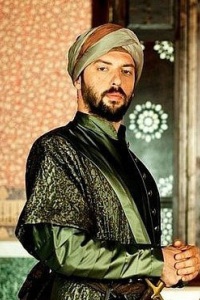
   Pasha Ibrahim took Leo prisoner.  He has beaten the Ruthven (Ukraine-Hungary) artist, who stupidly tracked his childhood sweetheart, then fiancée down to Istanbul after the Tatars left him for dead and sold her into slavery. he only stopped because the emperor has ordered the artist be brought into his presence. Ibrahim's attempting to torture* Leo into admitting he's been having an affair with Hurrem. On the contrary, from the moment Alex/Hurrem lays eyes on Leo she's been trying to make him get the hell outta Dodge. She's entirely in love with the emperor.  Beyond that, the slightest hint they know each other would be her death and that of her children.  But Leo, selfish and self-centered doesn't care about the terrible threat his existence in the palace is for the woman he claims to love.

Mahidevran Sultan

Ibrahim, Hurrem, proved to be a traitor to Sulyeman, is rid of her influence over the emperor and will have Mahidevran Sultan, the previous most favorite of the harem, mother of the oldest son and heir-designate, forever in his debt.  Don't forget, the Pasha's managed to marry Sulyman's favorite sister, and is a very ambitious fellow.  I'd identified with im in the earlier episodes, but no longer! Unfortunately the series hasn't made it clear to this non-Turkish expert just why Ibrahim took on such a hate for Hurrem.
Grand Vizier Ibrahim Pargali
So, while Sadıka is holding a knife to Sulyeman's throat, Hurrem is holding a bowl of poisoned candy shoved into her hands by Ibrahim, instructed to eat it and take her own life (while presumably the pasha heads for the harem to strangle her children), or else Leo must, and this would prove, I'm not sure what. She's weeping, Leo is howling, Ibrahim is seething with EviLe, Hurrem's fingers are about to take a candy -- The End.

     More has to come since we have not yet had the precedent-breaking wedding, the Ottoman emperor taking a legally wedded wife! Will netflix get the rousing following 3 seasons? I want to see Ibrahim Go Down. I know from history that he betrayed Sulyeman, went to war on him, and was either beheaded or garrotted or poisoned, though I don't know why he turned on Sulyman.  This being a soap opera, presumably this happens after Sulyman marries Hurrem, and she persuades the emperor to do or not do something that Ibrahim doesn't want or does want? 

Sulyeman riding to war
   With success of the series, later episodes were more lavishly budgeted, with some set pieces as the endless celebration of the Grand Vizier's wedding to Emperor Sulyeman's beloved sister, and more scenes set outside the claustrophobia of the Istanbul palace and harem.  It does remain primarily a talking heads format, with the eyes of every character broadcasting enormous information about themselves and what issue / person / event is centered in a scene.  The clothes remain breathtaking. 

Over such long sequence of episodes, the skills of the actors, particularly that of the actor who plays Sulyeman, become more evident.


When will the next season be available?  I feel bereft, after living with these characters for two months.

------------------------

*   Beating is standing in for serious torture, doubtless. But due to Turkey's standards and regulations for what can be seen on television, it couldn't be too graphic.

Leo the artist

Leo was surely tortured in real life -- if this happened in real life that is.  I have no idea -- this is a soap opera -- he would have been horribly tortured if taken by a Grand Vizier for his own nefarious purposes.  Nevertheless, the beating is bad enough to look at, though no skin is shown broken, despite the pounding of fists, cracking of head against stone cell wall, kicking in the gut and head as well. All we see then is a faintly bruised cheekbone and his velvet clothes are not dirty, torn or even disheveled. The most terrible part of this scene is the face of Ibrahim.  We've seen glimpses of this Mr Hyde face previously in the later episodes as he chokes with his hands the harem overseer, Nigar Kalfa (who for inexplicable reasons has been shown to be in love with him, upon which he learns, he spurns her in the most humiliating way), demanding she find evidence in Hurrem's rooms of adultery.

Evidently this is setting us up to see this character, with whom we have been so sympathetic, because of his love for the emperor's sister, which was impossible.  Hatice is so lovable herself and she was dying for love of him, so how could he be -- evil? As well, he writes beautiful poetry to her, and plays the violin and reads western literature and enjoys western culture of all kinds including art. I don't know enough about Turkey and its politics to know, but perhaps Ibrahim's affinity for western culture is supposed to signal the audience that he will turn evil and betray the empire?

I always keep in mind this is historical fiction and a soap opera to boot!

However, {NY TIMES PAY WALL} reading about this discovery of more than forty very well preserved ships in the shipping waters of Bulgaria spanning the 9th - 19th centuries in the Black Sea -- I was delighted for several reasons, including this frivolous one, since this is the route the ship carrying Hurrem / Alexandra to Turkey takes in the 16th century.

Wednesday, August 17, 2016

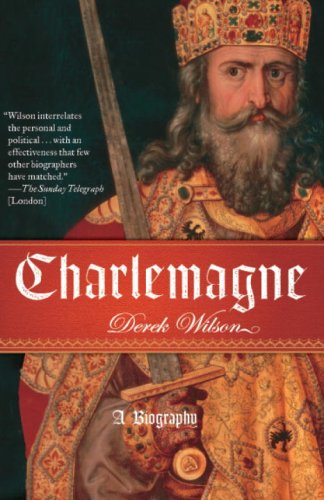
Reading Wednesday -- Charlemagne

It's not easy finding histories published in English about  the kaleidoscopic geopolitical  arrangements among religions  and regions, when the strong men of those we tend to call Merovingians took control of the old Gaulic Empire (5th - 8th centuries). We can glibly recite the names: Charles Martel, Clovis, Pepin, Charlemagne, but how little we know of what went on then -- or how large parts of Gaul became part of Charlemagne's Frankish Empire.

This summer seemed a good idea to fill in some details.

In possession of a gift certificate, off to the Strand I went, certain there would be shelves of books in the European section on these matters.  Well, no. Feudalism in France, there were many, many books, all of which began with a short introduction that explained what we already know: that structural roots of what is understood as pure feudalism began with Charlemagne's administrative organization of his own empire, for taxes, for defense and law-giving.  Feudalism is FRENCH in origin. Well, yah, we know that.


Derek Wilson's Charlemagne (2016)  was only book in the whole enormous place that had Charlemagne as the subject, front and center.  Charlemagne, by Brit popular historian, Derek Wilson, who specializes in biographies of colorful monarchs for trade - commercial publishing, not academic. The books are dense with information, though they are on the prestige end -- not quite coffee table books, but have full-color, beautiful art reproduced to illustrate. It was first published in England (Hutchinson Press). Doubleday reprinted here, but as I said, this isn't a subject of  interest to U.S. trade publishing. 

My reasons for reading Charlemagne  (2006) by Derek Wilson were many..  Most of them were not satisfied, for reasons of length (it's short) for reasons that the work was more geared to dealing with what seems to have been Charlemagne's character.  

However, Wilson's book did reveal something important to me, both personally and for the project in which I am currently engaged. Wilson, methodically, providing excellent sources throughout, debunked the mythology which is what almost all of us know about this first western Roman emperor.  In other words almost everything we think we know about him, no matter how little we know we know, is false -- phony history, deliberately constructed as PR both in his own time and later, for all sorts of reasons.  Best of all, Wilson describes how Charlemagne himself, his scribes and advisors, and those who followed them, employed minstrels / singers / poets to do this. 

Another way of putting it is that these powerful elites engaged in deliberate revision of history for the purpose of convincing those over whom they ruled that things that were not, were, and what had happened, didn't happen.


My copy, acquired for Senior Honors Comp. Lit course.


All of the purposes for which popular culture was deployed to change history find their nexus, naturally, in La Chanson de Roland.

For purposes of brevity, cut to the chase: 

Q: Why was Charlemagne in Spain and the borders of the Gaulish provinces in the first place?

A: To keep the Moors from invading Christian Gaul.

Well, no. 

At that time the Abbasid Caliphate had prevailed over much of the strict religious Umyyad Caliphate, Iberia -- Spain, the western edge of the Muslim world was much divided, with the Umyyads under siege by the Abbasid factions.  (There were other splinter groups as well within Islamic Spain, just as there were splinter groups among the precariously hanging on Christians in northwestern Spain.  One of the Umyyad groups invited (with money payment as a carrot) Charlemagne and his forces to come and help them against the largest Abbsid group. And he did.  That's what he and his forces were where they were -- not fight Saracens, but helping one group of Saracens against another group.

The interpenetration of Muslims in Charlemagne's kingdom was so common in terms of living, trade, marriage that everyone pretty much got along -- particularly for the sake of trade and taxes.

Bet this hadn't been heard by most of us before, who aren't actual scholars of the era and read the languages of the documents . . . .

But the rep of Charlemagne as Christ's Defender of the Faith, who held off the defeat of Europe's heart by the Spanish Saracens holds to this day.  As to a somewhat lesser degree, does Charlemagne's great efforts in taking Jerusalem from the Saracens.  Not true, he never went there, of course.

Mostly he fought other Christian warlords, while all fought with each other, and maneuvered, most often with military might, to overcome his warlord, rivals -- and not infrequently even the Pope himself (who wasn't in Rome at this period).  But Charlemagne had greater vision than all of them.  

This is where he and the western Church came together.  Charlemagne had more than glimmers of Christiandom -- which could be viewed as a spiritual version of the Eurozone.  However many bastards he sired, etc.,  Charlemagne's faith and belief in Christianity and the Church were as deep as his drive to power and control, and both were equally sincere.

He divided his kingdom for the sake of peace in his later years. None of his heirs had his faith, his talents or charisma, and what he built fell apart quickly (rather like what seems is happening with the Eurozone?)

Leo III crowns Charlemagne emperor.

Napoleon coerces the Pope to crown him emperor.. Though being Napoleon he places the crown upon his own head, and further crowns Josephine empress himself.  The creation of the portrait of this event, who was included and what action was depicted, was carefully overseen and dictated by Napoleon.
For his time and place, the scope of his vision of Christendom was exceptional.  It became a dream ideal, a foundation of the equally dream ideal of Chivalry,  that all of those west of the Adriatic were part of something that was unto itself -- special, under God's and Christ's particular, protection and affection. Which drove crusades and other incursions unto this very day.  Charlemagne's empire was the foundation of what later became the Holy Roman Empire, often more an idea or a claim than an empire at all.  But it lasted until WWI finally put it forever in its well-earned coffin.

I understand rather better now why Charlemagne is the patron saint of the very idea of Europe, even though much of his sainthood is founded in faux deeds and deliberately created romance.

I still am unable to outline all the steps along the way though, from the 5th century through that of the 11th.


Wednesday, May 18, 2016

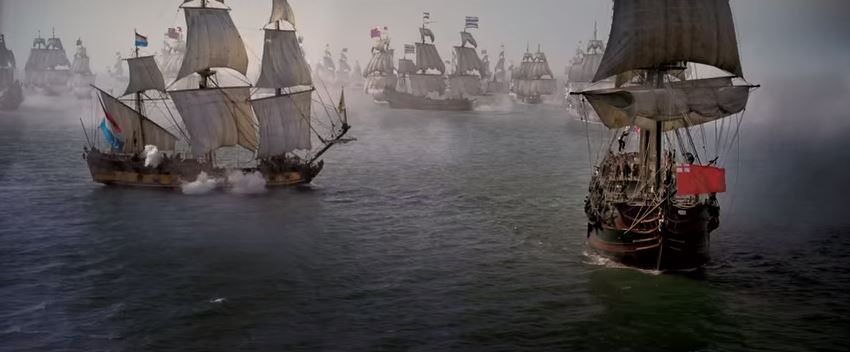
Admiral (2015)

English title: Admiral - Dutch title: Michiel de Ruyter (2015) Dutch film about their great hero of the Anglo-Dutch naval wars of the 17th century, Michiel de Ruyter.  I watched this via netflix streaming.

Michiel de Ruyter painted by Ferdinand Bol in 1667
Admiral was an admirable distraction from my congestion and coughing last night. O, those ships were gorgeous. But it does seem the writers could have done a bit more to identify the causes for these conflicts beyond Charlie 2 being such another feckless Stuart of the fully feckless Stuart dynasty. It would have been nice if the English adversaries at sea, such General Monck (made Duke of Albemarle), had been identified. As Walter Jon observed, this isn’t a film that is likely to appeal to anyone who isn’t interested in the history of the matter or in pitched naval battles per se. 

That said, it was a terrific pleasure to watch de Ruyter's fleet's invasion via the Medway River, which concludes with the burning of the English fleet anchored off Kent at Chatham -- particularly if one recalls those entries in Pepys's diary, where he views the aftermath with the Duke of York and other notables.

This was the Embarrassment of Riches century for the Dutch. Global marine trade had made them even more wealthy than their previous control of Europe’s textiles trade and manufacture. They were also aggressive privateers, successfully taking the mercantile ships of the French, Spanish and English, all of whom had designs on protestant Netherlands’ territory on the Sea, and their global trade dominance. 


Beyond this, however, slavery in the new world and the Dutch slave trade out of Africa to supply slaves to Caribbean and North American colonies This is a huge economic resource over which the Dutch and the English are fighting now — control of the slave entrepots on the West African coast, above the Portuguese controlled Kongo. The Dutch first managed to push the Portugese out of the upper coasts pretty much all the way down to the equator by then. Now it was the Dutch and English fighting for control. Charlie II and his cronies had started the Royal African Company specifically to get into the African slave trade and thus Charlie could have some cash to jingle in his always cash-poor privy pockets.

The English ultimately won this one, initiating the gloriously wealthy-from-the-slave-trade-18th-century for Liverpool, Bristol, London and to a degree some other British cities, particularly in Scotland. Beyond the sale of bodies of Africans themselves, the African slave trade required so much out of which to get fabulously wealthy, from ships and financing, to insurance, to all those shackles and manacles, supply, etc.  There were no qualms in England for supplying these services to the British slave trade – though this was also the century in which the movement to abolish the African trade got started and the century in which slavery as a condition in the British Isles was abolished.

None of these matters concerning the African slave trade rivalry or any of the European powers, including the Dutch, are matters for this film.  This is just background information that I brought to the watching of it, and which made it work for me.  So did memories of reading about the aftermath the defeat of the conjoined French and English naval invasion in a volume of Dumas's Musketeers chronicles, and with the Spanish invasion in the Altriste novels,  1672 was called in Dutch history, "rampjaar" -- the Disaster Year.  Among other things the Dutch deliberately broke their dikes in the Spanish held territory and flooded out everyone, citizen and invader alike.  The Spanish soldier's point of view of the aftermath is admirably brought to life in the historical novel series, Las aventuras del capitán Alatriste by Arturo Pérez-Reverte via his novel (1968 in Spain; 2007 in U.S.), Sun Over Breda.  As this is about the Dutch, however, the rampjaar is dealth with via time lapse from an ever higher altitude camera so we see no details of that horrific period.

Nor is there any mention in this film that attempts to deal with the Anglo-Dutch wars how the Dutch traded the Nieuw Amsterdam colony to England. These are the sorts of things that only somebody like me though, would be thinking about while watching this lush action-adventure, that is mostly on the sea.


There was probably another reason why the English — or at least the Lords — were so hot to go to war with the Dutch during Charles II’s reign. So many of the protestants in the reigns of both the Catholic supporters, Kings James and Charles I were given refuge in the protestant Netherlands, from where they plotted to take down the crown and, from which others escaped their majesties’ pursuit to the New World — from where they returned in droves to support Cromwell and the execution of Charles I — and, of course, get places in the administrative structure and return of their properties.  Charles II and the other returned-to-power nobility had not forgotten any of this.

Like the slave trade which the Royal African Company was about (though he writes so often about going the Company’s house ‘on the king’s business”, this was something else that Pepys was too discreet to put details down on paper, even in his own most private diaries.

The Admiral film presumes its Dutch audience knows all these historical matters. Its focus is Dutch political conflicts between the Republic and the forces that want a king* like other European nations -- as well as on the several great battles that Michiel de Ruyter won for them.

Warning: there is a prolonged sequence of horrific violence that includes the torture and mob dismemberment of Michiel de Ruyter's patrons, Johan and Cornelius de Witt, brothers.  Johan had been the prime minister of the Dutch Republic for 20 years, and successfully brought them through the wars -- not least by backing commoner Michiel de Ruyter over his aristo rivals.

------------------

*  They got as their king, the Dutch stadtholder William III of Orange-Nassau (William of Orange), who had married James II's daughter, Mary Stuart. Not long after he invaded England, bloodlessly dethroned his father-in-law -- the final feckless Stuart, in what is known as "The Glorious Revolution" of 1688, and took the crown for himself. Along the way, William betrayed many, as royalty, would-be and otherwise, does.

Sunday, May 26, 2013

I Am Going to See Fort Sumter. I am, I AM!

I AM going to see Fort Sumter or else I shall hold my breath until I turn blue and fall over and then you'll be sorry, el Vaquero, you just see if you ain't!   No, No, NO, Fort Moultrie is NOT just as good.

:)

Tomorrow.

Out of the Sea Islands now, which we loved. We felt at right at home, and made welcome. This is the region which has always been and still is predominately black in population.  And why yes, they know exactly why they are there.

Charleston is a different kind of place.  The historic district got renamed the French Quarter when they went for the history draw for tourist trade back in the 1970's.  Named by people who may know their own city's history very well, but don't know New Orleans history at all*.  It doesn't look in the least like NO's French Quarter because -- it's Georgian and Federal, and you won't ever have seen a sample of either form of architectural design in NO's French Quarter -- or anywhere else in NO either.

You will never see a structure like the Old Exchange /Customs House (1767) in New Orleans. Look at the facade and the pure Georgian pediment above the windows and doors, including cornice moulding and reference to columns.

What it does have in common with New Orleans and the French Quarter / historic district is that the courtyards, patios and gardens are hidden behind walls, and the gates and other ironwork are reminiscent of New Orleans's.  The vegetation is equally lush, but it's not the same vegetation.  Nor will you ever see palm trees in New Orleans other than those artificially transplanted there, and which need replacing all the time, as around the Harrah's casino.  Palm trees are here in Charleston though, all over the place.

I did learn though why it was decided by the Charleston's city council to name the historic district the French Quarter: it was because of the large number of French Huguenot immigrants at the end of the 17th and early 18th centuries (which is how el V's ancestors happened to move from France to the Americas back then, fleeing  Her Very Roman Catholic Highness, Marie d'Medici, and the purges she made of the protestants generally, and the Huguenots in particular.  They went three places in large numbers in the Americas: New York (New Rochelle is their town); Virginia (which is where el V's ancestors landed; and Charleston, which was staunchly protestant and anti-Catholic.

So Charleston doesn't remind me of New Orleans at all, lacking entirely that Mediterranean Catholic flavor.  It does remind me though of the English colonies such as Bermuda and  Barbados.  There were a large number of Barbadians who settled here, with their slaves, and in more than one wave, with the first one coming in very early.

Anyway, we did a lot today. We did good.  Tonight el V's off to a Spoleto concert, of a friend's group.  I shall stay in and download photos from my camera. In the meantime el V's napping.

* The young docents in the museums and the tour guides and the tourist literature are constantly prompting you to agree that Charleston reminds you so much of New Orleans's French Quarter ... but they haven't a clue that what is called the French Quarter isn't French in style at all, because it was built by the Spanish.  It was a shock to them to hear this, which one of them did, about the fifth time he burbled about how much this looks like New Orleans.  I flatly contradicted him.  On this trip neither of us have opened our mouths once other than to ask relevant but entirely non-controversial questions.  But this ... THIS! was too much!