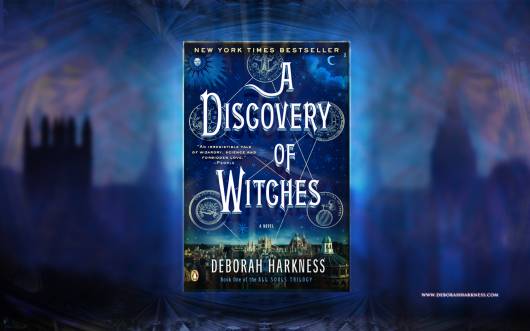
. . . Prior to the opening of The Iron King, the first novel in the series, Iron King Philip, so named for his iron fist implementing his iron will, has dissolved the Knights Templar on trumped charges of sorcery.
He has imprisoned and tortured as many Knights as could be caught by his forces. With the connivance of certain well-placed Archbishops and Cardinals inside and outside the Inquisition, both Church and King have appropriated the Templars' wealth, and incidentally, destroyed the records that could be found of their enormous debts to the Templars.
At the start of the narrative proper, the Iron King gets the cooperation of the Church to burn at the stake the Knights Templar Grand Master, Jacques de Molay. As the Grand Master burns with his closest and oldest friend, he lays a curse upon the king and his line. The night the Grand Master burns, concurrently, the Queen of France and her sister are committing adultery with two young men about-court, for which they too are soon arrested, thanks to the scheming of the Iron King's daughter, Isabella (the she-wolf), the Queen of England. From the arrest of the Templars and the royal adulteresses follow all of what happens in the series of seven novels, which end with the end of the line of the Capets.
This post is evidently provoked by the inability to escape the frantic bleating of media of every kind around the coming premiere of the final season of HBO's Game of Thrones. GRRM really did pull more inspiration from the novels of The Accursed Kings than he ever did from the Wars of the Roses.
This re-read of the the French historical fiction series revealed even more information of how much the first three volumes of ASOIAF took from the English language translation of Druon's retelling of the end of the Capetian dynasty. This dynasty, at the conclusion of the series, is replaced by the Valois (though, of course, the replacements were also related to the Capetians, just as the Capetians themselves were growths from the Merovingian and Carolingian families).
When I say ‘inspiration,’ I don't mean only such Westros governing administrative bodies such as 'the small council,' the names of characters such as Loris, Brienne, figures that certainly are prototypes of the Clegane brothers, twins, dwarfs, etc., as well as place names, but so much else, such as 'banner' and 'bannerman'.
'Bannermen' is not French per se.* In French this affiliate to various lords would probably be called something more like 'moyens' the middles, as they were of middling ranked status, with lands -- but not nobility, nor peasants, some of which also small lands.
In English,'bannerman' derives from Scotland with Edward I’s conquest, coming into Norman-French speaking England, and then brought to France via his combined English and Scots forces. These campaigns play out in The Accursed Kings by the two final volumes, which is why the final volume is titled King Without A Kingdom. Here are the roots of the 100 Years War between France and England, as the Capets are replaced by the Valois.
To my historian’s mind, the most significant inspiration GRRM took for his fantasy history Game of Thrones, was The Iron Bank of Braavos. There are no banks in Lord of the Rings, thus they have seldom been part of medievalist fantasy or historical fiction until the Iron Bank of Braavos.** Occasionally there are Jews in historical fiction who provide the funds and credit by which nobility and royalty can carry on their endless wars, as in Ivanhoe, by the creator of historical fiction. However, in The Accursed Kings, the historical consortium of 13th- 14th century Lombard money lenders, credit extenders, and investors are essential to not only to the expensive military and political events (not least marriages and coronations) that take place over the course of series, but also to individual characters who make the wars. Even Gucci, the very young nephew-scion of the most important Lombard banker in France, Tolemei – a continuing, significant character in his own right -- is an ancillary character,who becomes more a featured player in the books’ events as he matures, even as he has a private life, which the consequences are, at best, bittersweet. -- and with which The Accursed Kings concludes.
Among the historical cultural elements that The Accursed Kings does include that ASOIAF doesn’t, is the place of artists and poets within this elevated society of churchmen, royals, nobles and bankers. We meet the father of the poet Boccaccio, who wants to retire from the Bank and just write poetry; Dante and his work is invoked, particularly in an affecting scene in the tent of an exception to most of the lords running French army. The army’s bogged down under a summer’s relentless rain and mud, this lord keeps his men’s spirits up by having Dante’s Inferno recited, encouraging the discussion and hoots of appreciative laughter when particularly disliked figures – whose deeds are very familiar to the men, some of whom, or their families do, have actual skin in the game -- are described suffering in hell. Did we know the Inferno a/k/a The Divine Comedy had funny bits? These poets and writers also play a role as messengers, negotiators and information gatherers.
Inversely, partly via Sam Tarley and mageisturs, but primarily via crones’ folk tales, Game of Thrones does emphasize the importance of scholars and historians; the fabulous past is part and parcel of High Fantasy. Significantly, in this inversion of High Fantasy tropes, no one pays attention to them, or acts on what they learn, unlike Aragorn requesting information the herb athelas to heal Frodo and Eowyn, or Gandalf in the archives of Minas Tirith.
It is equally the case in The Accursed Kings that few learn anything from the past, beyond, occasionally the new king thinking over what his predecessor did for good or ill, so there are no historians or scholars as characters. What we do have is a large, fractious, rebellious faction of nobles who think everything will improve by returning to the ‘good old days of chivalry’ of Saint Louis IX in the 13th century. In those days the lords of the land weren’t obligated to follow rules decreed by a king. They behaved with impunity in their own lands and against each other. These short-sighted retrogressive nobles play an important role in bringing down the Capetian dynasty by demands that obligatory allegiance to the king’s central authority be voided. Thus the dissolution of Philippe IV’s first painful steps progressing to France as a nation state, not a state made of many individual feuding states and statelets. This too leads to the end of the Capetians.
I admire these books as perhaps the most honest historical fiction I’ve encountered that is focused solely on the figures who rule: royalty and nobles, popes and cardinals; and most of all, bankers. Druon does not glorify anyone and sticks as best he can to actually what happened. He dramatizes why the Salic Law was implemented, that the line of monarchy cannot go through the female/queen line.
I can't figure out why the series was so successful in France as these novels are set during one of the worst eras of French descent into dysfunction, anarchy, poverty and suffering -- and in the middle we have the Black Death --made even worse, the historians tells us, through the idiocy of the Capetian kings, the Church (the era of the papacy removing to Avignon from Italy) their nobles and their rivalries. When adapted for television, all of France watched, with enthusiasm. Here in the US there would be no market for novels or television series -- or even histories themselves -- that provide a narrative of the pile-up of stupidities that make a pile-up of failures on the national and international stage. Instead there would howls of outrage accusing the creators and historians of lying and tearing down the country.
~~~~~~~~~~~~~~~~~~~~
* Curiously, when one searches online for the French translation of 'bannerman', what one gets as examples are all from ASOIAF.
** Alas, then, allowing the conviction be imprinted among so many readers of this sort of fiction, who are so young they know no history, that there was no money in the European Middle Ages, just as there were no people of color in the European Middles Ages, and no women of power and agency in the European Middle Ages. This medieval historical fiction series would show them differently on all three fronts.
Showing posts with label historical fantasy. Show all posts
Wednesday, April 10, 2019
Friday, July 21, 2017
Ammunition -- Surely They Are Laughing All the Way to the Bank - HBO Confederates
. . . . Even on the ASOIAF forum HBO's announced next project with D&D alternate history in which the southern antebellum slaveocracy successfully seceded has set off a sh*t storm, on the order of "Bad Idea or Worst Idea?" with loads of people weighing in with all the cliched, stereotypical expected responses, which basically say --
For example, Eugene Genovese's thesis that slavery was feudal not capitalist, has been dismantled by vast scholarship in the last twenty - thirty years. Enormous amounts of scholarship has gone into the history of antebellum slavery in all its aspects since the Civil Rights Movement, and historians everywhere have been reaping the benefits of this in the last 2 - 3 decades. The same is true for the war effort itself.
Here is a very short list of books than anyone who wants to speak of the system of antebellum slavery and The War of the Rebellion should read:
And we must never forget that while the north for the most part, as well as the Union, when the time came, though deeply white supremacist, was also deeply antagonistic to slave labor, for it undercut wages across the board for everyone (as keeping the wages of Haitians at a few cents an hour is the benchmark for wages throughout the hemisphere currently)-- as well as threatening having work at all. With this half of the 19th century receiving boatloads of immigrants every day, the competition for jobs was fierce.
Having slavery forced upon free soil states was not in their interests -- just as the Fugitive Slave Act was antithetical to their interests, economically, politically, and socially. Anyone could point to your daughter and son, declare her, him a runaway slave and there was no legal recourse -- and you were supposed to help them.
Don't forget by now there was a large percentage of legally enslaved who had white skin, blue eyes and blonde hair, thanks to generations of white men raping African American women for both fun and profit -- every slave child born provided the slave owner with at least another $50 of credit, in a culture that didn't have money per se, only credit, vastly based in the bodies of their slaves.
So skin color was not a final defense by any means -- nor was an accused runaway allowed to have or speak a defense! People in the north did not like this. This brought more people into the anti-slavery factions than anything else, and did it so fast the south couldn't believe it was happening.
You have to know all this and much more besides, and know it inside and out, viscerally, before you can write successfully about anything to do with the history of the war, slavery, and what happened. And the more one knows -- seeing from the benefit of hindsight-- the more one knows it couldn't have happened any other way.
What cannot be white washed away in any kind of entertainment is that slavery = rape and every kind of violence perpetrated on people who have no legal right to object or fight back. Which is why so many can't seem to let it go (see above -- slavery's haut! How dare you object to what turns us on?). They want and revel in with all their being, the joy of feeling dominant, doing whatever they wish (or their fantasy surrogates do to women and others whatever they wish), to deliberately make people suffer both physical abuse and emotional abuse.
We see this particularly in the many stories or program that involves artificial intelligence / androids. There is no fun in hurting and degrading a sentience that doesn't feel abused and degraded, that in really has no free will or feeling. Thus all the plot lines is giving the androids a/is actual humanity or having them develop it -- so they can feel humiliated and degraded. (A rare exception to this is Ex Machina, an adroid who does feel outrage, but is also entirely sociopathic, lacking all the human feelings and values -- just like slave owner. She gets hers, and is now unleashed upon the world of poor unsuspecting male victims. O noes!)
We say, for the sake of the story, so people can have identification with the characters we have to give them human feelings. I.e. we need that dominance from built in abuse. Which is why this will not help and will make things worse. D&D have a track record, and that track record is out there for all to see and read.
Entertainments have civic, ethical, social, political and historical responsibilities too. To say "it's only for fun," -- just think about what that fun consists of.
Then there's this, that so many of us find the entire concept sickening on so many levels, delights the ilks that are D&D -- it means they won, which is supremely depressing.
To be able to combat these idiocies coolly and effectively, one needs to be armed -- and trust me, those thoughtlessly regurgitating these cliches are not. One must point out particularly what the slavocracy's objectives were (number 1: expansion of slavery) there are a few books one can read to make one competent. One should read them too, because what most people think they know about antebellum slavery, "the underground railroad," abolition and the roots of the War of Southern Aggression are at best out-dated (such as slavery was a feudal system), and at worst, just wrong (the north didn't give a damn about slavery).Woo! slavery's so haut!It's just entertainment what's your problem?How can you condemn something that hasn't even been written yet?The Civil War wasn't about slavery.Antebellum slavery couldn't industrialize because it was a feudal system not a capitalist system.The north didn't care about slavery.There were very few abolitionists (and evidently, judging by these comments, not a single person of color -- or white woman -- was in favor of abolition or against slavery, and this was wholly a white man's war).Why not just have let 'em have their part of the country and all would have been fine.Slavery would have just withered away.Blahblahblahblah.
For example, Eugene Genovese's thesis that slavery was feudal not capitalist, has been dismantled by vast scholarship in the last twenty - thirty years. Enormous amounts of scholarship has gone into the history of antebellum slavery in all its aspects since the Civil Rights Movement, and historians everywhere have been reaping the benefits of this in the last 2 - 3 decades. The same is true for the war effort itself.
Here is a very short list of books than anyone who wants to speak of the system of antebellum slavery and The War of the Rebellion should read:
Narrative of the Life of Frederick Douglass, an American Slave. Written by Himself;
Behind the Scenes: Or, Thirty Years a Slave and Four Years in the White House by Elizabeth Keckley (Keckley was the US's first African American
couturier -- right before secession she dressed both Mary Todd Lincoln and Varina Davis. She became socially isolated Mary Todd Lincoln's White House confidant. the book is a mixture of authentic memoir and fiction;
Crucible of Command: Ulysses S. Grant and Robert E. Lee--The War They Fought, the Peace They Forged by William C. Davis;
General Lee's Army: From Victory to Defeat by Joseph Glatthaar;
This Vast Southern Empire: Slaveholders at the Helm of American Foreign Policy by Matt Karp;
The American Slave Coast: A History of the Slave-Breeding Industry by Ned and Constance Sublette -- which runs down in a chronological, fast-reading narrative the latest scholarship about slavery in North America from the earlier colonial era to Emancipation, including the influence and effects the system within the larger European and hemispheric historical context, but the focus is on the economics of the enslaved bodies themselves -- without which the South had no wealth;
Bound for Canaan: The Epic Story of the Underground Railroad, America's First Civil Rights Movement by Fergus M. Bordewich;
Our Man in Charleston: Britain's Secret Agent in the Civil War South by Christopher Dickey -- an interesting contrast to how the Union State Department was seeing the situation with England in particular through the experiences of the US minister's mission to Saint James;
Mary Chesnut's Civil War; the carefully edited after-the-fact diary of a the wife of the South Carolina senator James Chestnut Jr., until secession, after which he served as an aide to Jeff Davis and a brigadier general in charge of South Carolina's reserves (though not seeing action, of course, being such a slavocracy nabob);
The Free State of Jones by by Sally Jenkins and John Stauffer -- Mississippians (the state with largest number of millionaires in the country prior to Emancipation) who were neither segregationists nor secessionist, nor were they nabobs -- they suffered and they resisted and fought back.
The Education of Henry Adams by Henry Adams. He writes of his first hand experiences at the highest levels of England's and France's government during the first years of the war, as private secretary to his father, Francis Adams, as minister to Saint James.Two things we must never forget about antebellum slavery and the War of Southern Aggression /K/ A it's official name in the records of the United States, The War of Rebellion: African Americans played an immense role in abolition and emancipation. Escaped slaves and free people of color founded newspapers, wrote books, spoke at endless meetings, organized a relief and assistance for those who managed to escape. They labored endlessly to keep the issues of the Fugitive Slave Act and Dred Scott in the forefront of progressive minds. Here we see the first nexus of authentic cooperative action -- not just words! -- of black and white, male and female. Never underestimate the power of people with god-given mission for moral improvement (look at how the evangelicals etc. have managed to just about disappear not only abortion, but any woman's reproductive health care from so many places in this nation, even though it is all legal).
And we must never forget that while the north for the most part, as well as the Union, when the time came, though deeply white supremacist, was also deeply antagonistic to slave labor, for it undercut wages across the board for everyone (as keeping the wages of Haitians at a few cents an hour is the benchmark for wages throughout the hemisphere currently)-- as well as threatening having work at all. With this half of the 19th century receiving boatloads of immigrants every day, the competition for jobs was fierce.
Having slavery forced upon free soil states was not in their interests -- just as the Fugitive Slave Act was antithetical to their interests, economically, politically, and socially. Anyone could point to your daughter and son, declare her, him a runaway slave and there was no legal recourse -- and you were supposed to help them.
Don't forget by now there was a large percentage of legally enslaved who had white skin, blue eyes and blonde hair, thanks to generations of white men raping African American women for both fun and profit -- every slave child born provided the slave owner with at least another $50 of credit, in a culture that didn't have money per se, only credit, vastly based in the bodies of their slaves.
So skin color was not a final defense by any means -- nor was an accused runaway allowed to have or speak a defense! People in the north did not like this. This brought more people into the anti-slavery factions than anything else, and did it so fast the south couldn't believe it was happening.
You have to know all this and much more besides, and know it inside and out, viscerally, before you can write successfully about anything to do with the history of the war, slavery, and what happened. And the more one knows -- seeing from the benefit of hindsight-- the more one knows it couldn't have happened any other way.
What cannot be white washed away in any kind of entertainment is that slavery = rape and every kind of violence perpetrated on people who have no legal right to object or fight back. Which is why so many can't seem to let it go (see above -- slavery's haut! How dare you object to what turns us on?). They want and revel in with all their being, the joy of feeling dominant, doing whatever they wish (or their fantasy surrogates do to women and others whatever they wish), to deliberately make people suffer both physical abuse and emotional abuse.
We see this particularly in the many stories or program that involves artificial intelligence / androids. There is no fun in hurting and degrading a sentience that doesn't feel abused and degraded, that in really has no free will or feeling. Thus all the plot lines is giving the androids a/is actual humanity or having them develop it -- so they can feel humiliated and degraded. (A rare exception to this is Ex Machina, an adroid who does feel outrage, but is also entirely sociopathic, lacking all the human feelings and values -- just like slave owner. She gets hers, and is now unleashed upon the world of poor unsuspecting male victims. O noes!)
We say, for the sake of the story, so people can have identification with the characters we have to give them human feelings. I.e. we need that dominance from built in abuse. Which is why this will not help and will make things worse. D&D have a track record, and that track record is out there for all to see and read.
Entertainments have civic, ethical, social, political and historical responsibilities too. To say "it's only for fun," -- just think about what that fun consists of.
Then there's this, that so many of us find the entire concept sickening on so many levels, delights the ilks that are D&D -- it means they won, which is supremely depressing.
Wednesday, June 17, 2015
Reading Wednesday - The Mystic Marriage by Heather Rose Jones - No Spoilers
I'm not going to say much about this novel because someone else already has, and done an excellent job, here.

I admired, enjoyed, admired and liked The Mystic Marriage (2015). It's a Ruritanian - alternate European history fantasy of alchemy and romance in what is either the period between Napoleón's escape from Elba and Waterloo, or right after it, since there don't seem to be any wars going on during the period of this novel. The reason I foreground the question of chronology is that my favorite part is the opening. Antuniet Chazillen, one of the four protagonists has escaped from Prague to Heidelburg, and needs to escape her pursuers again, which sends her back to the capitol of Alpennia, her family's home country. She is able to take a coach, it seems across boundaries, with little or no trouble, which, while not necessarily that troublesome in peace, would certainly be troublesome during the time of Napoleón's wars.
What I admired was the author's way with the names of people, families, and place. They were consistent throughout, and felt plausible to an imaginary language surrounded by the languages of what had been the Austro-Hungarian and the Polish empire as well, before the coalition of Russia, Prussia and Austria ate it up. Contributing to the admiration
What I enjoyed the most were those four protagonists, each on with agency, each one with a purpose in life, who do not necessarily begin as friends, but who all know each other due to this also being a novel of manners, thus family and social connections are not only plot points but help define characters strengths, weaknesses and growth. The only drawback to this sort of thing, if you, as I do, like this sort of thing, is that the novel plays out mostly within the elite classes, and that leaves out most of a society. This tends also to tend to sense of claustrophobia after a while. These four protagonists are pairs, or at least two of them are a pair-in-making. How these two become a pair is why the alchemical term, "Mystic Marriage" (or Sacred Marriage) makes for such a splendid title. On the mundane level too, this is a romance that goes beyond "romance." Via the process of becoming a pair, the 'coniunctio', the so-called social butterfly's own life-work is revealed through the heat and pain of true love's transformation, and the other becomes a fuller person with capacity for living -- meaning that the two become greater together than by themselves. I do like that sort of thing in a novel, in which true love is revealed to be something even more than the best sex that has ever taken place in the history of the world. But I also admire it greatly because one can't just decide to write this. It literally emerges out of the marriage of the writer's heat and pain in collaboration with the elements her talent has chosen to put into the crucible of the process of writing.
Nevertheless, the potential claustrophobia is kept to a minimum, due muchly to the character of Jeanne Vicomtesse de Cherdillac, who is what I liked the most in The Mystic Marriage. Interestingly Jeanne's classified as a social butterfly, while the other three have the status of women with a working profession: Antuniet is an alchemist, Margerit Sovitre is thaumaturgist to the Queen Regent, and Baronness Barbara Saveze is a weapons master. In the first novel, Barbara was an armin, i.e. a bodyguard.
So, in the course of reading The Mystic Marriage we realize this is a second novel in what is called the Alpennia series. I have not read the first one, Daughter of Mystery, thus I am in an excellent position to say that the reader does not need to have read it first in order to understand and thoroughly enjoy the second one.
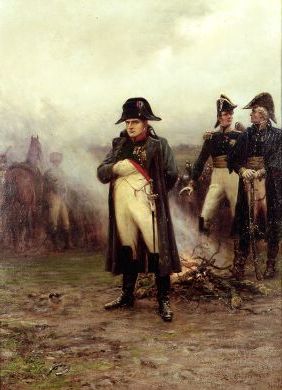
Yesterday I saw two copies of The Mystic Marriage on the New Books shelves in one of my local public library branches.
The author talks of her books here.

I admired, enjoyed, admired and liked The Mystic Marriage (2015). It's a Ruritanian - alternate European history fantasy of alchemy and romance in what is either the period between Napoleón's escape from Elba and Waterloo, or right after it, since there don't seem to be any wars going on during the period of this novel. The reason I foreground the question of chronology is that my favorite part is the opening. Antuniet Chazillen, one of the four protagonists has escaped from Prague to Heidelburg, and needs to escape her pursuers again, which sends her back to the capitol of Alpennia, her family's home country. She is able to take a coach, it seems across boundaries, with little or no trouble, which, while not necessarily that troublesome in peace, would certainly be troublesome during the time of Napoleón's wars.
What I admired was the author's way with the names of people, families, and place. They were consistent throughout, and felt plausible to an imaginary language surrounded by the languages of what had been the Austro-Hungarian and the Polish empire as well, before the coalition of Russia, Prussia and Austria ate it up. Contributing to the admiration
What I enjoyed the most were those four protagonists, each on with agency, each one with a purpose in life, who do not necessarily begin as friends, but who all know each other due to this also being a novel of manners, thus family and social connections are not only plot points but help define characters strengths, weaknesses and growth. The only drawback to this sort of thing, if you, as I do, like this sort of thing, is that the novel plays out mostly within the elite classes, and that leaves out most of a society. This tends also to tend to sense of claustrophobia after a while. These four protagonists are pairs, or at least two of them are a pair-in-making. How these two become a pair is why the alchemical term, "Mystic Marriage" (or Sacred Marriage) makes for such a splendid title. On the mundane level too, this is a romance that goes beyond "romance." Via the process of becoming a pair, the 'coniunctio', the so-called social butterfly's own life-work is revealed through the heat and pain of true love's transformation, and the other becomes a fuller person with capacity for living -- meaning that the two become greater together than by themselves. I do like that sort of thing in a novel, in which true love is revealed to be something even more than the best sex that has ever taken place in the history of the world. But I also admire it greatly because one can't just decide to write this. It literally emerges out of the marriage of the writer's heat and pain in collaboration with the elements her talent has chosen to put into the crucible of the process of writing.
Nevertheless, the potential claustrophobia is kept to a minimum, due muchly to the character of Jeanne Vicomtesse de Cherdillac, who is what I liked the most in The Mystic Marriage. Interestingly Jeanne's classified as a social butterfly, while the other three have the status of women with a working profession: Antuniet is an alchemist, Margerit Sovitre is thaumaturgist to the Queen Regent, and Baronness Barbara Saveze is a weapons master. In the first novel, Barbara was an armin, i.e. a bodyguard.
So, in the course of reading The Mystic Marriage we realize this is a second novel in what is called the Alpennia series. I have not read the first one, Daughter of Mystery, thus I am in an excellent position to say that the reader does not need to have read it first in order to understand and thoroughly enjoy the second one.Yesterday I saw two copies of The Mystic Marriage on the New Books shelves in one of my local public library branches.
The author talks of her books here.
Friday, April 17, 2015
Andrew Jackson, Talleyrand, Napoleón
I suppose Napoleón is a fascinating fellow. What he did, the havoc, game-changing, and bringing the changes around to, not even a monarchy embodied in the body of the divinely appointed sovereign, but an imperium, the closest model of which would have been the Roman Empire of the Caesars. Like Augustus, he re-wrote and remodeled every part of administration from jurisprudence to the military.
But Talleyrand now ... the fellow, once in Church orders, in the government of Louis XVI, run to American self-exile from the Revolution that had turned to the Terror, returned to France when the Directoire to become France's Foreign Minister, surfed successfully all the waves between that, the Consulate and throught the zenith of Napoleón's imperium, then falling out and again in exile, this time in England, to return again triumphantly as one of the four major players at the Congress of Vienna -- now that is a fascinating human being. Perhaps not a good one or an admirable one, but fascinating -- and more than a survivor, a success, until the end of his days.
And by all accounts, excellent company, which by most accounts, for any length of time, Napoleón most certainly was not. Charismatic he was for long periods, but not good company: he lacked manners and courtesy, he was cruel and impatient, and loved hurting people by pinching them violently for extended minutes, leaving bruises and on occasion, blood -- even when not angry.
Talleyrand was a remarkably clear-sighted pragmatic realist. An egoist too, no doubt, but he wasn't a megalomaniac. In the end, he was more successful than Napoleón, whose second coming transformed to defeat and ended his not that many more days in prison-exile.
Where on the scale between these two would fall Andrew Jackson? He sure was a megalomaniac in so many ways, see the Bank of the United States, hard money, the English, Indians, etc. He too was charismatic, and his manners with women at least, frequently were noticed as exquisite. Women flocked to Jackson, even those politically opposed to him, as they flocked to Talleyrand.
People like speculating how Jackson the military leader would have stepped to Wellington's game (another egoist! -- whose manners with women were anything but good), but what would have been more likely if San Domingue's revolution had not put a decided end to Napoleón's plans for the New World, is how Napoleón would have stepped to Jackson's, facing off as they'd have done in the Floridas and Louisiana territories.
Run-ons, are us today, as getting ready for a Harvard visit takes most of my attention!
But Talleyrand now ... the fellow, once in Church orders, in the government of Louis XVI, run to American self-exile from the Revolution that had turned to the Terror, returned to France when the Directoire to become France's Foreign Minister, surfed successfully all the waves between that, the Consulate and throught the zenith of Napoleón's imperium, then falling out and again in exile, this time in England, to return again triumphantly as one of the four major players at the Congress of Vienna -- now that is a fascinating human being. Perhaps not a good one or an admirable one, but fascinating -- and more than a survivor, a success, until the end of his days.
And by all accounts, excellent company, which by most accounts, for any length of time, Napoleón most certainly was not. Charismatic he was for long periods, but not good company: he lacked manners and courtesy, he was cruel and impatient, and loved hurting people by pinching them violently for extended minutes, leaving bruises and on occasion, blood -- even when not angry.
Talleyrand was a remarkably clear-sighted pragmatic realist. An egoist too, no doubt, but he wasn't a megalomaniac. In the end, he was more successful than Napoleón, whose second coming transformed to defeat and ended his not that many more days in prison-exile.
![]() |
| One of Andrew Jackson's duels historically imagined. This one was about a horse race. |
People like speculating how Jackson the military leader would have stepped to Wellington's game (another egoist! -- whose manners with women were anything but good), but what would have been more likely if San Domingue's revolution had not put a decided end to Napoleón's plans for the New World, is how Napoleón would have stepped to Jackson's, facing off as they'd have done in the Floridas and Louisiana territories.
Run-ons, are us today, as getting ready for a Harvard visit takes most of my attention!
Labels:
Andrew Jackson,
historical fantasy,
history,
men,
napoleon,
Talleyrand
Thursday, March 26, 2015
What To Do With Dragons
I was finally able to pick up The Widow's House, fourth volume in Daniel Abraham's Dagger and Coin series..
I've read the prior volumes, and quite liked the first two. The third one though, was fairly generic in ways the first two were not. However, The Widow's House is back to form and I stayed up later than I should have for two nights in a row, reading it to the end -- because I could not guess how it would end, which is not the case for this reader with most fiction at this point.
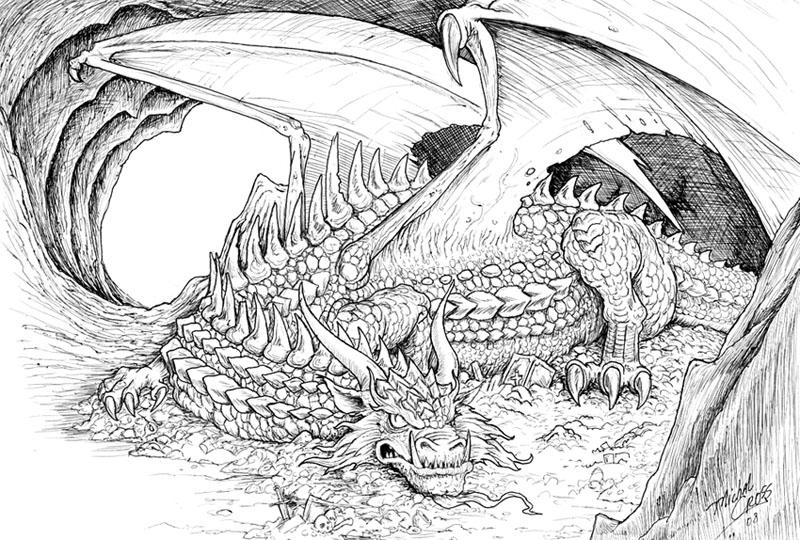
As Widow's House contains a dragon that held some promise of being an interesting character, I got to thinking about dragons in fiction. Actually, the most interesting thing Inys the dragon does is get drunk. That may be a first? I can't recall whether any of the dragons in the books of the alternate history/fantasy Tremaire series ever got drunk.
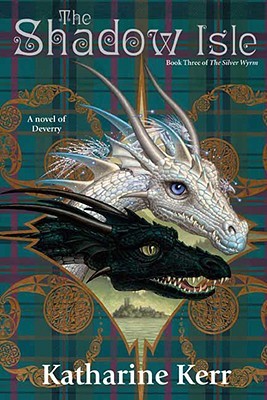
Writers like to have dragons, but few of them seem to know what to do with them when they get them. Among those who seem to understand their dragons are the
writers Katharine Kerr, whose Deverry dragons are essentially cats (which works very well), or McCaffrey's, in the first Pern novel, who are medieval heavy
cavalry chargers with super firepower. Another exception is McAvoy's Mayland
Long, the black dragon of Tea With the Black Dragon (1983) -- "black dragon" signifies my favorite oolong tea -- is a shape shifter. So, as a wise Mandarin, he possesses human-kind personality and physical characteristics. And Novak
knows how to create an Enlightenment - Age of Revolution philosophe with Tremaire. Others of her dragons also had differentiated characters and voices.*
However, Hobb's dragons seem nothing more than slabs of mountain in one series and, unintentionally on the part of the writer, never made any sense. Another couple of her series made dragons be everything from rotting toxic poisonous swimming serpents to mad things that made no sense. These dragons' real function is to become woods out of which are constructed ships, that communicate with the special persons. Then there was another series, which I confess I couldn't read which seemed to try to unify the mountain dragons of a Fitz series's world with the world of the Shippers. In that one the dragons' function was to give a very special young female a save the world mission.
Got's dragons' function -- so far, only expected function -- is to be WMD -- which so far at least can't seem to be imagined actually taking place in the narrative either. Wait! one of them burned up a bad guy once who spoke contemptible insults about Daenerys Stormborn of the House Targaryen, the First of Her Name, the Unburnt, Queen of Meereen, Queen of the Andals and the Rhoynar and the First Men, Khaleesi of the Great Grass Sea, Breaker of Chains, and Mother of Dragons in a language he mistakenly thought incomprehensible to the Mother of Dragons Who Is Always Threatening / Promising Something-or-Other Will Be Done to Something-o- Someone-or-Other. Or did that only happen on-screen and not on the page at all? It's all so long ago who remembers?
The exceptions to this would be the afore-mentioned Novak dragons, Kerr's, and now, Abraham's Inys, the world's last dragon, has personality / character. Still, for all his size, Inys inhabits only few pages of The Widow's House. He's referred to much more than he's on-stage, er, on page.
Which again seems that with dragons, when one has them, it's difficult to give them actions of active significance, beyond deus ex machina, or, as in Hobb, McGuffin roles. This seems so for Got's dragons. **
Well, in fact Abraham's Inys is instrumental to a significant action: as he falls to the weapons of the enemy, the inhabitants of the city that has never been successfully sieged other than by insiders opening the gates -- OPEN THE GATES to save the dragon that was thought to be saving them -- AND THE CITY FALLS TO THE ENEMY. Horribly.
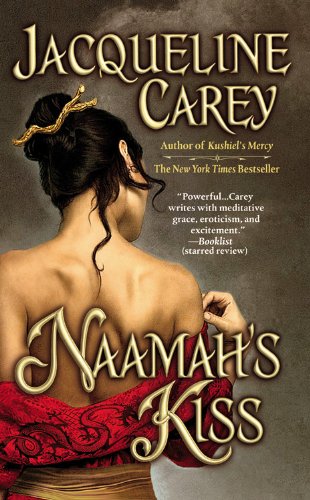
There is the Ch'in dragon in Carey's Namaah spin offs from the Phedré - Terre d'Ange series, featuring Moirin, whose voice is exactly like Phedré's, and whose
vagina is equally magical. In the second volume, Naamah's Kiss, Moirin goes to Ch'in and rescues Snow Tiger-- a celestial princess imprisoned by her uncontrollable dragon powers and appetites. Moirin saves and liberates Snow Tiger via her afore-mentioned divine vagina.** * It also employed the Westerner-goes-to-Asia-and-saves-the kingdom trope.
Maybe the best dragon is still Smaug from The Hobbit, though he too was onstage for a relatively short period? But he had a character and agency up the wazoo, and he sure did something. And when he fell, the story of what he wrought wasn't magically concluded. He was onstage as long as he needed to be.
-------------------------------------
* I haven't read the volumes released since Tremaire and Captain William Laurence went to Africa -- I've been so immersed in one way and another for the last few years with the Age of Revolution and Napoleón history and slavery)
** This seems equally so for dire wolves. Everyone talks endlessly about dragons and dire wolves, but they do very little, and in fact entire books go by and they don't even appear
* * * Please take note: I am neither criticizing the divinity of the vaginas of either Phedré or Moirin, nor the author for giving them these vaginas.
Their vaginas have as much right to possess magical power as do the bodies of the super-powered, super-attenuated male characters in every genre from mysteries (for example, James Lee Burke's Robicheaux and Clete, or Child's Jack Reacher) to sf/f, in which these aging Warrior - Heroes are still taking and giving punches and kicks more powerful than a mule's and getting up immediately, or at least recovering after a day or two in the hospital with no further problems until they again do something stupid.
No matter how old they are crowds of gorgeous lascivious and smart women throw themselves at these old, beat-up guys who continue to exhibit truly bad judgment and make terrible life choices. Additionally, their wives and lovers keep getting killed because of these guys' bad choices, even as they white-knight service even more gorgeous and / or deserving females.
So why shouldn't a Fantasy Female God-blessed heroine be the most beautiful and attractive woman in the intelligently and lovingly imagined author's world, the foundations of which are built on a spiritual belief in the worship of love and beauty, that these qualities are indeed divine? Carey's women live fully within their milieu of theology, philosophy and history that are inclusive, not exclusive (though of course the less special Special Terre d'Ange's take it for granted they are superior to all other peoples, which surely annoys the Others), so within this world building they are entirely plausible extra-special saviors.
As a reader, my real objections are the primary characters' non-differentiated voices, vocabulary and cadences. "Blessed Elihu" and "love as thou wilt" seem invoked in every gdded paragraph; by the fourth volume what had been fresh about the voice and invocations had crossed over into annoying and even snort-provoking. One was so tempted to do the drinking game with the endless repetitions, but -- you know? probably Phedré would agree and say, "as thou wilt, what makes you happy." :)
I've read the prior volumes, and quite liked the first two. The third one though, was fairly generic in ways the first two were not. However, The Widow's House is back to form and I stayed up later than I should have for two nights in a row, reading it to the end -- because I could not guess how it would end, which is not the case for this reader with most fiction at this point.
As Widow's House contains a dragon that held some promise of being an interesting character, I got to thinking about dragons in fiction. Actually, the most interesting thing Inys the dragon does is get drunk. That may be a first? I can't recall whether any of the dragons in the books of the alternate history/fantasy Tremaire series ever got drunk.
Writers like to have dragons, but few of them seem to know what to do with them when they get them. Among those who seem to understand their dragons are the
writers Katharine Kerr, whose Deverry dragons are essentially cats (which works very well), or McCaffrey's, in the first Pern novel, who are medieval heavy
cavalry chargers with super firepower. Another exception is McAvoy's Mayland
Long, the black dragon of Tea With the Black Dragon (1983) -- "black dragon" signifies my favorite oolong tea -- is a shape shifter. So, as a wise Mandarin, he possesses human-kind personality and physical characteristics. And Novak
knows how to create an Enlightenment - Age of Revolution philosophe with Tremaire. Others of her dragons also had differentiated characters and voices.*
However, Hobb's dragons seem nothing more than slabs of mountain in one series and, unintentionally on the part of the writer, never made any sense. Another couple of her series made dragons be everything from rotting toxic poisonous swimming serpents to mad things that made no sense. These dragons' real function is to become woods out of which are constructed ships, that communicate with the special persons. Then there was another series, which I confess I couldn't read which seemed to try to unify the mountain dragons of a Fitz series's world with the world of the Shippers. In that one the dragons' function was to give a very special young female a save the world mission.
Got's dragons' function -- so far, only expected function -- is to be WMD -- which so far at least can't seem to be imagined actually taking place in the narrative either. Wait! one of them burned up a bad guy once who spoke contemptible insults about Daenerys Stormborn of the House Targaryen, the First of Her Name, the Unburnt, Queen of Meereen, Queen of the Andals and the Rhoynar and the First Men, Khaleesi of the Great Grass Sea, Breaker of Chains, and Mother of Dragons in a language he mistakenly thought incomprehensible to the Mother of Dragons Who Is Always Threatening / Promising Something-or-Other Will Be Done to Something-o- Someone-or-Other. Or did that only happen on-screen and not on the page at all? It's all so long ago who remembers?
The exceptions to this would be the afore-mentioned Novak dragons, Kerr's, and now, Abraham's Inys, the world's last dragon, has personality / character. Still, for all his size, Inys inhabits only few pages of The Widow's House. He's referred to much more than he's on-stage, er, on page.
Which again seems that with dragons, when one has them, it's difficult to give them actions of active significance, beyond deus ex machina, or, as in Hobb, McGuffin roles. This seems so for Got's dragons. **
Well, in fact Abraham's Inys is instrumental to a significant action: as he falls to the weapons of the enemy, the inhabitants of the city that has never been successfully sieged other than by insiders opening the gates -- OPEN THE GATES to save the dragon that was thought to be saving them -- AND THE CITY FALLS TO THE ENEMY. Horribly.
There is the Ch'in dragon in Carey's Namaah spin offs from the Phedré - Terre d'Ange series, featuring Moirin, whose voice is exactly like Phedré's, and whose
vagina is equally magical. In the second volume, Naamah's Kiss, Moirin goes to Ch'in and rescues Snow Tiger-- a celestial princess imprisoned by her uncontrollable dragon powers and appetites. Moirin saves and liberates Snow Tiger via her afore-mentioned divine vagina.** * It also employed the Westerner-goes-to-Asia-and-saves-the kingdom trope.
Maybe the best dragon is still Smaug from The Hobbit, though he too was onstage for a relatively short period? But he had a character and agency up the wazoo, and he sure did something. And when he fell, the story of what he wrought wasn't magically concluded. He was onstage as long as he needed to be.
-------------------------------------
* I haven't read the volumes released since Tremaire and Captain William Laurence went to Africa -- I've been so immersed in one way and another for the last few years with the Age of Revolution and Napoleón history and slavery)
** This seems equally so for dire wolves. Everyone talks endlessly about dragons and dire wolves, but they do very little, and in fact entire books go by and they don't even appear
Their vaginas have as much right to possess magical power as do the bodies of the super-powered, super-attenuated male characters in every genre from mysteries (for example, James Lee Burke's Robicheaux and Clete, or Child's Jack Reacher) to sf/f, in which these aging Warrior - Heroes are still taking and giving punches and kicks more powerful than a mule's and getting up immediately, or at least recovering after a day or two in the hospital with no further problems until they again do something stupid.
No matter how old they are crowds of gorgeous lascivious and smart women throw themselves at these old, beat-up guys who continue to exhibit truly bad judgment and make terrible life choices. Additionally, their wives and lovers keep getting killed because of these guys' bad choices, even as they white-knight service even more gorgeous and / or deserving females.
So why shouldn't a Fantasy Female God-blessed heroine be the most beautiful and attractive woman in the intelligently and lovingly imagined author's world, the foundations of which are built on a spiritual belief in the worship of love and beauty, that these qualities are indeed divine? Carey's women live fully within their milieu of theology, philosophy and history that are inclusive, not exclusive (though of course the less special Special Terre d'Ange's take it for granted they are superior to all other peoples, which surely annoys the Others), so within this world building they are entirely plausible extra-special saviors.
As a reader, my real objections are the primary characters' non-differentiated voices, vocabulary and cadences. "Blessed Elihu" and "love as thou wilt" seem invoked in every gdded paragraph; by the fourth volume what had been fresh about the voice and invocations had crossed over into annoying and even snort-provoking. One was so tempted to do the drinking game with the endless repetitions, but -- you know? probably Phedré would agree and say, "as thou wilt, what makes you happy." :)
Friday, March 13, 2015
Monday, November 17, 2014
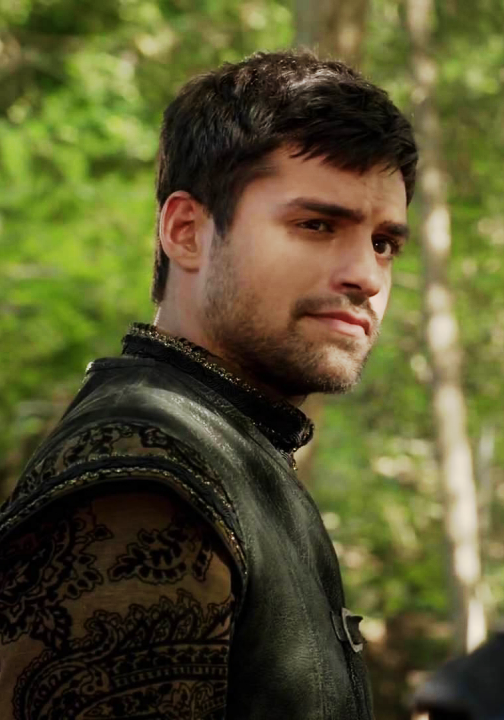
Reign - Season 2 - Episode 7 - Prince of the Blood
Which perhaps might be taken as a caution that perhaps pitching a show as "fun entertainment" in which all the primary figures are hip deep in the blood, torture and plunder that are the Wars of Religion is not a good idea after all. Especially as one of the primaries at least shall soon be dead, and the other gone back to Scotland to tread her inevitable road to imprisonment and losing her head. This is not fun.
So, for starters here's something you all needed to know before you began writing: the protestant movement in France, the converts to Calvin's version of protestantism and reform, known as the Huguenots, did not begin with "the people." In fact, "the people," the peasants, were strongly anti protestant. They wanted to keep their rituals, their feast days, their Virgin, their priests, their cathedrals and beautiful music and the theater of the mass. They preferred their Church so much, that they were terrific auxiliaries to the throne's slaughter of the Huguenots.
The second thing you needed to know before you began writing was that in France, as in England and Germany, the Huguenots were both a religious and political movement. That the nobles aligned with the crown would find them a credible threat to their power and authority is precisely because so many of the one million plus converts in France were nobles and wealthy merchants.
So, Reign writers, you see all that courtly handwringing that if "the people" who had converted to protestantism weren't put down and punished, conversion cantagion of the body politic might spread to the nobles is o so badly wrong, that the entire idea of fun entertainment goes up in the flames of the noble's burning chateaux. This is why, ultimately, Catherine and Charles are for the pogroms -- to remove these dangerous elements, who have both wealth and power, from their kingdom.
As well, there are other deadly intra-conflicts and intrigues, as many of those aligned with the crown, scheme to take it for themselves, as Charles is so young and the Queen Mother is still a hated Medici Italian, with all her grasping relatives grabbing money, land and power. This was already going on while Henri II still lived.
O, and Condé, Louis I, Prince of the Blood, military leader of the Huguenots? He gets whacked by the Guises, fighting to save de Coligny (who also gets whacked) at the battle of Jarnac.
![]() |
| Condé was a hunchback and by the time we see him on Reign he looked like this. |
![]() |
| Condé didn't look like this. |
The thing about the 16th - 17th Wars of Religion is that they were not fun for anybody, including those wearing crowns, see: Mary Stuart losing her head, for instance. This did not take place in an historical sidebar to the reign of Glory the Virgin Queen. These events were all interconnected. Without the wars of religion at this time, Mary wouldn't have been such a tempting figurehead around which the French and other Catholic powers to rally to replace Elizabeth on England's throne.
The response to that is, as has been seen before -- hardly anybody knows this so who cares? Anybody who does know isn't our audience, so stop being such a huffer and puffer. We've made a GREAT story here.
Well, I dunno about that. It sure does look like your reliance, such as it was, upon a few historical details instead of doing the work of entirely reimagining a historical era into a historical fantasy world, you all have written yourselves into a corner in the dungeon of non-renewal.
Labels:
historical fantasy,
historical fiction,
history,
politics,
religion,
Television
Thursday, October 9, 2014
One Might Think Reign Writers Channel Nostradamus
Season 2 of Reign opened October 2, with an episode titled "The Plague" -- following right where the first season's last episode left off.
Despite the pus and rot of plague, Reign still appears more a show of dresses and costumes (not historically accurate, of course, any more than anything else in the show is) paraded on a runway, that is fabricated out of a hodgepodge of Renaissance "architecture," decor and ornamentation."
The actresses -- and actors as well -- appear stand-ins for the producers' and writers' fantasies of power and romance as well as the fantasies of their intended audience -- with horses! swords! and castles! They are dressed like dolls, but like dolls they tend to look alike, while their acting is fairly non-existent, with the exception of Megan Follows and some others. However, Follows as Queen Catherine de Medici, isn't a girl like the others, and is an experienced actress of substance.

Mary
It is difficult at times to tell the girls apart, particularly when they aren't in the same scene. Mary and one of her ladies (her ladies, like her, historically, were all named Mary, which would never do in a television series -- not to mention England's Queen Mary Tudor), Lola -- really? Lola, from Scotland in the 16th century?* -- look so much alike that in the early episodes they are nearly identical. Soon the stylists had to give Lola extra-curly hair in every scene so we could distinguish her lady-in-waiting more easily from Mary Queen of Scots. The actresses' voices have the same pitch, and they deliver their lines in the same flat manner. Their acting range goes from standing there to talking head -- but then, neither do the male actors. Both young men and women indicate firmness of whatever by clenching their teeth, sort of.
A strange show, that is possessed of an extravagant budget that allows for Irish castles and even the veddy high class castle turned hotel, outdoor sequences, the wardrobes and all those jewels. It also was able to create enormous additional sets that stand in for the French royal castle, with ceilings even, that few shows can afford.
As well as plundering history, the writers plunder familiar fantasy fiction, presenting recognizable story lines from other sources. After the pilot was picked up, and at some point into the CW commissioned episode, CW asked for a full season of 23 episodes, thus the need to write very fast, with a principle plot that turned on little than will she or won't she end up with her true love, or will she be killed before she decides, it would be necessary to grab from somewhere. But this grabbing doesn't have the same non-self-conscious insouciant glee of not taking oneself seriously that gave the first seasons of Lost Girl such fun and verve.
As a tween and teen I'd have adored Reign -- horses! swords! castles! that mixes in monsters and other supernatural something-or-other. At that age I wouldn't have noticed writing weaknesses or poor acting.
But even at that age, with my schooling in costume via the period art illustrations in my piano lesson books of adaptations of classical composers works, and The Book of Knowledge spreads of Renaissance art and portraits, I would have noticed the clothes were not really period. With the comparative knowledge of Jewish, Catholic and Protestant religions, and their historical milieus, already drilled into me via our church's pastor, I would have been much annoyed by how the show attempts to make pagans some sort of magic stand-in for the French protestants, the Huguenots, by calling the pagans heretics. Then as now, that is wrong. A heretic is:
Pagans cannot be heretics for they were never baptised into the Church, or left the Church. However, as far as the Roman Church and French royals were concerned, the Huguenots were heretics.
But a show doesn't want to offend anyone, and nobody would want to speak in a Catholic country (much of the first season was shot in Ireland), probably, of how, in this very era, Queen Catherine de Medici and King Francis -- Mary Queen of Scots' husband -- and that following with Louis XIV, killed, burned, tortured and looted the Protestants -- a pogrom. Named enemies of France, thousands who were able fled the country -- which created serious financial troubles for Louis XIV.
Moreover, as King Francis participated in this, and he's the romantic lead, the writers wouldn't want to mention the historical actualities. Particularly the show wouldn't want to mention how much his Queen, Mary of Scots, Reign's female romantic lead, encouraged him in the prosecution.
History, the bathtub in which everybody's entitled to potch! Full speed ahead! Watch out for Abraham Lincoln hunting vampires who create the plague -- as well as African American slavery.
--------------------------
* Lola is the diminutive for the Spanish Dolores -- "sorrows" as in Nuestra Senora de los Dolores. Wiki helpfully informs that:
Despite the pus and rot of plague, Reign still appears more a show of dresses and costumes (not historically accurate, of course, any more than anything else in the show is) paraded on a runway, that is fabricated out of a hodgepodge of Renaissance "architecture," decor and ornamentation."
The actresses -- and actors as well -- appear stand-ins for the producers' and writers' fantasies of power and romance as well as the fantasies of their intended audience -- with horses! swords! and castles! They are dressed like dolls, but like dolls they tend to look alike, while their acting is fairly non-existent, with the exception of Megan Follows and some others. However, Follows as Queen Catherine de Medici, isn't a girl like the others, and is an experienced actress of substance.

Lola

Mary
It is difficult at times to tell the girls apart, particularly when they aren't in the same scene. Mary and one of her ladies (her ladies, like her, historically, were all named Mary, which would never do in a television series -- not to mention England's Queen Mary Tudor), Lola -- really? Lola, from Scotland in the 16th century?* -- look so much alike that in the early episodes they are nearly identical. Soon the stylists had to give Lola extra-curly hair in every scene so we could distinguish her lady-in-waiting more easily from Mary Queen of Scots. The actresses' voices have the same pitch, and they deliver their lines in the same flat manner. Their acting range goes from standing there to talking head -- but then, neither do the male actors. Both young men and women indicate firmness of whatever by clenching their teeth, sort of.
A strange show, that is possessed of an extravagant budget that allows for Irish castles and even the veddy high class castle turned hotel, outdoor sequences, the wardrobes and all those jewels. It also was able to create enormous additional sets that stand in for the French royal castle, with ceilings even, that few shows can afford.
As well as plundering history, the writers plunder familiar fantasy fiction, presenting recognizable story lines from other sources. After the pilot was picked up, and at some point into the CW commissioned episode, CW asked for a full season of 23 episodes, thus the need to write very fast, with a principle plot that turned on little than will she or won't she end up with her true love, or will she be killed before she decides, it would be necessary to grab from somewhere. But this grabbing doesn't have the same non-self-conscious insouciant glee of not taking oneself seriously that gave the first seasons of Lost Girl such fun and verve.
As a tween and teen I'd have adored Reign -- horses! swords! castles! that mixes in monsters and other supernatural something-or-other. At that age I wouldn't have noticed writing weaknesses or poor acting.
But even at that age, with my schooling in costume via the period art illustrations in my piano lesson books of adaptations of classical composers works, and The Book of Knowledge spreads of Renaissance art and portraits, I would have noticed the clothes were not really period. With the comparative knowledge of Jewish, Catholic and Protestant religions, and their historical milieus, already drilled into me via our church's pastor, I would have been much annoyed by how the show attempts to make pagans some sort of magic stand-in for the French protestants, the Huguenots, by calling the pagans heretics. Then as now, that is wrong. A heretic is:
1 : a dissenter from established religious dogma; especially : a baptized member of the Roman Catholic Church who disavows a revealed truth. 2 : one who dissents from an accepted belief or doctrine : nonconformist.
Pagans cannot be heretics for they were never baptised into the Church, or left the Church. However, as far as the Roman Church and French royals were concerned, the Huguenots were heretics.
But a show doesn't want to offend anyone, and nobody would want to speak in a Catholic country (much of the first season was shot in Ireland), probably, of how, in this very era, Queen Catherine de Medici and King Francis -- Mary Queen of Scots' husband -- and that following with Louis XIV, killed, burned, tortured and looted the Protestants -- a pogrom. Named enemies of France, thousands who were able fled the country -- which created serious financial troubles for Louis XIV.
Moreover, as King Francis participated in this, and he's the romantic lead, the writers wouldn't want to mention the historical actualities. Particularly the show wouldn't want to mention how much his Queen, Mary of Scots, Reign's female romantic lead, encouraged him in the prosecution.
History, the bathtub in which everybody's entitled to potch! Full speed ahead! Watch out for Abraham Lincoln hunting vampires who create the plague -- as well as African American slavery.
* Lola is the diminutive for the Spanish Dolores -- "sorrows" as in Nuestra Senora de los Dolores. Wiki helpfully informs that:
Lola may also be used as a short form of the unrelated German name Aloisia. The name Lola is also common in Africa; in Nigeria, many feminine names are shortened to Lola, such as Temilola or Damilola. Lola (Tajik for tulip) is also a feminine name in Uzbekistan, Tajikistan, and Afghanistan. It is derived from the Persian لاله or lâleh.
Wednesday, August 27, 2014
Reading Wednesday: Horne, Crane, Gabaldon, Harkness
This is an unusual week in that as well as a new study of slavery in colonial North America, I read two novels.
The Counter-Revolution of 1776: Slave Resistance and the Origins of the United States of America (2014) by Gerald Horne (New York University Press), covers in granular detail part of what we look at in The American Slave Coast -- that among the driving forces of the American War of Independence were fear of abolition on the part of the southern elite slave holding class, and lust for Native land on the part of both north and south.

El V's and my bedtime read-aloud book has been The Southern Frontier: 1670 - 1732 (1929), * by Vernor W. Crane (Ann Arbor Press, University of Michigan), a history of South Carolina's traders, who were instrumental in the enslavement of Natives. The Nativeswere mostly sold to the Caribbean, particularly Barbados, in the 17th and earlier 18th century. This accomplished three of the objectives of South Carolina as a colony: to make money, get labor and remove Indians via enslavement and war from the western lands. Hopefully, all of it to the eastern bank of the Mississippi would be South Carolina, filled with plantations worked by slaves. These slaves were far and away preferred to be Negro slaves -- Africans -- rather than Natives, because the Natives could escape too easily to friends and relatives in the wilderness -- even up to French Canada.
This aspect of colonial slavery is something not much looked at, as part of what the goals of South Carolinians were from the beginning of the colony, which was always envisioned as a slave-based feudal economy and society. Horne doesn't look at it (as being outside the scope of his own work? As Crane's work is cited in Horne's own). However, his arguments are sound around the fundamentals of the Seven Years War or the French and Indian War as it was called here, base the causes of it on 1) fear of Catholic interference with slavery (Spain and France) and, 2) demand to rid themselves of Natives, for their land and because they, like Spain and France -- and England too, often, (which is where his argument gets contradictory and fuzzy at times) -- allied with "Africans" for rebellion and to take the colonies from white Englishmen by conquest.
It had been years since I last re-read Diana Gabaldon's Outlander (1991). I was prompted to do so again by the Starz miniseries based on Gabaldon's novel -- which was a sensation when published. I wish I had been able to edit the ms. There are glaring inconsistencies that shouldn't be in there. I won't say what they are in case of spoilers, as the television miniseries is still in progress, with this one exception, which was "fixed" in the premiere episode of the television series: In the novel takes Frank to tell Claire that it is blood on the stoops of the houses in the village where Claire and Frank are staying -- Claire, a WWII field triage nurse doesn't recognize blood when it's there, and needs a non-medical fellow to tell her this? Why these crazy inconsistencies are in the published novel I cannot figure out. At the time of publication there were many interviews and stories about Outlander as a phenomenon, which both the agent and the purchasing editor recognized it would be. So it's not as though it was published as a throw-away. (I was working in publishing then, so I got, heard and read all the industry scuttlebutt in those days.) However, what probably matters most, is that the vitality of Claire's character, and her relationships with both her husbands, remain plausible, thus deeply interesting and satisfying.
Oddly enough though, Outlander's dealing with the deeper questions of time
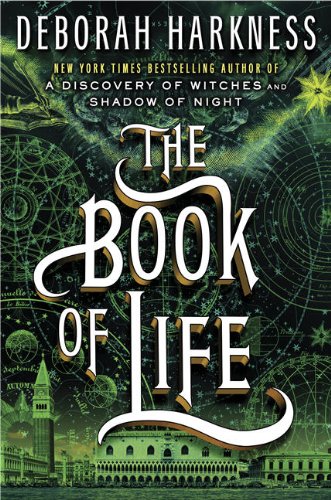
travel is more satisfying than is The Book of Life (2014), the conclusion of Deborah Harkness's All Soul's Trilogy. In the first two novels Harkness brought up so many deep questions between what makes life and the nature of time, and there is a great deal of time travel too. This is what lifted her series out of the commonality of most fantasy fiction, particularly fantasy fiction that features witches, demons and vampires. She was using fantasy tropes to delve into serious scientific questions. But she drops all these matters in The Book of Life in favor of the usual business of which alpha is the most alpha of all, and saving the world for supernaturals. Deeply disappointing -- and rather dull too. The saving grace for The Book of Life is, as in the previous books, the purely delightful witches' house. This is the most mysterious and wondrous element of the series.
This failure on the part of Harkness has to considered in light of her position, according to wiki:
Ah well, I'll contemplate these matters under my Colombian sun shade hat, while I walk in the 90 degree muggy noon heat up to Union Square's Farmer's Market for peaches (even the local peaches are fabulous this year) and whatever else catches my fancy. Then -- a chocolate dipped Dairy Queen. Fortunately, the only Dairy Queen in NYC, is on 14th Street too, a couple of blocks west of Union Square. This may be the last day of summer here ....
-----------------------
* Such magnificent work these earlier generations of professors and scholars accomplished in those days -- without internet, databases (just bibliographies!), google, any of the tools that has so transformed historical research in the last two decades. Among the many benefits these digital tools have bestowed is how much more possible it is to be an independent scholar, rather than on a faculty as a tenured professor. Which is fortunate too for scholarship, as there are fewer and fewer tenured faculty for history departments everywhere. On the other hand these former scholars didn't live through publish or perish, and had a much more leisurely academic round than the changes brought to faculty and scholarship that were wrought post WWII -- and now to the point that faculty are hardly thought to matter -- any more than the students are thought to matter, other than cash cows to be milked for the real business of the academy now -- real estate moghulship.
The Counter-Revolution of 1776: Slave Resistance and the Origins of the United States of America (2014) by Gerald Horne (New York University Press), covers in granular detail part of what we look at in The American Slave Coast -- that among the driving forces of the American War of Independence were fear of abolition on the part of the southern elite slave holding class, and lust for Native land on the part of both north and south.

El V's and my bedtime read-aloud book has been The Southern Frontier: 1670 - 1732 (1929), * by Vernor W. Crane (Ann Arbor Press, University of Michigan), a history of South Carolina's traders, who were instrumental in the enslavement of Natives. The Nativeswere mostly sold to the Caribbean, particularly Barbados, in the 17th and earlier 18th century. This accomplished three of the objectives of South Carolina as a colony: to make money, get labor and remove Indians via enslavement and war from the western lands. Hopefully, all of it to the eastern bank of the Mississippi would be South Carolina, filled with plantations worked by slaves. These slaves were far and away preferred to be Negro slaves -- Africans -- rather than Natives, because the Natives could escape too easily to friends and relatives in the wilderness -- even up to French Canada.
This aspect of colonial slavery is something not much looked at, as part of what the goals of South Carolinians were from the beginning of the colony, which was always envisioned as a slave-based feudal economy and society. Horne doesn't look at it (as being outside the scope of his own work? As Crane's work is cited in Horne's own). However, his arguments are sound around the fundamentals of the Seven Years War or the French and Indian War as it was called here, base the causes of it on 1) fear of Catholic interference with slavery (Spain and France) and, 2) demand to rid themselves of Natives, for their land and because they, like Spain and France -- and England too, often, (which is where his argument gets contradictory and fuzzy at times) -- allied with "Africans" for rebellion and to take the colonies from white Englishmen by conquest.
![]() |
| I still have this 1992 copy. |
Oddly enough though, Outlander's dealing with the deeper questions of time
travel is more satisfying than is The Book of Life (2014), the conclusion of Deborah Harkness's All Soul's Trilogy. In the first two novels Harkness brought up so many deep questions between what makes life and the nature of time, and there is a great deal of time travel too. This is what lifted her series out of the commonality of most fantasy fiction, particularly fantasy fiction that features witches, demons and vampires. She was using fantasy tropes to delve into serious scientific questions. But she drops all these matters in The Book of Life in favor of the usual business of which alpha is the most alpha of all, and saving the world for supernaturals. Deeply disappointing -- and rather dull too. The saving grace for The Book of Life is, as in the previous books, the purely delightful witches' house. This is the most mysterious and wondrous element of the series.
This failure on the part of Harkness has to considered in light of her position, according to wiki:
professor of history and teaches European history and the history of science[4]at the University of Southern California.[5] She has published two works of historical non-fiction, John Dee's Conversations with Angels: Cabala, Alchemy and the End of Nature (1999) and The Jewel House: Elizabethan London and the Scientific Revolution (2007).[5]Gabaldon is a scientist: her MS in Marine Biology, Ph.D. in ecology, and was a university professor also, before becoming a full-time writer.
Ah well, I'll contemplate these matters under my Colombian sun shade hat, while I walk in the 90 degree muggy noon heat up to Union Square's Farmer's Market for peaches (even the local peaches are fabulous this year) and whatever else catches my fancy. Then -- a chocolate dipped Dairy Queen. Fortunately, the only Dairy Queen in NYC, is on 14th Street too, a couple of blocks west of Union Square. This may be the last day of summer here ....
-----------------------
* Such magnificent work these earlier generations of professors and scholars accomplished in those days -- without internet, databases (just bibliographies!), google, any of the tools that has so transformed historical research in the last two decades. Among the many benefits these digital tools have bestowed is how much more possible it is to be an independent scholar, rather than on a faculty as a tenured professor. Which is fortunate too for scholarship, as there are fewer and fewer tenured faculty for history departments everywhere. On the other hand these former scholars didn't live through publish or perish, and had a much more leisurely academic round than the changes brought to faculty and scholarship that were wrought post WWII -- and now to the point that faculty are hardly thought to matter -- any more than the students are thought to matter, other than cash cows to be milked for the real business of the academy now -- real estate moghulship.
Tuesday, February 11, 2014
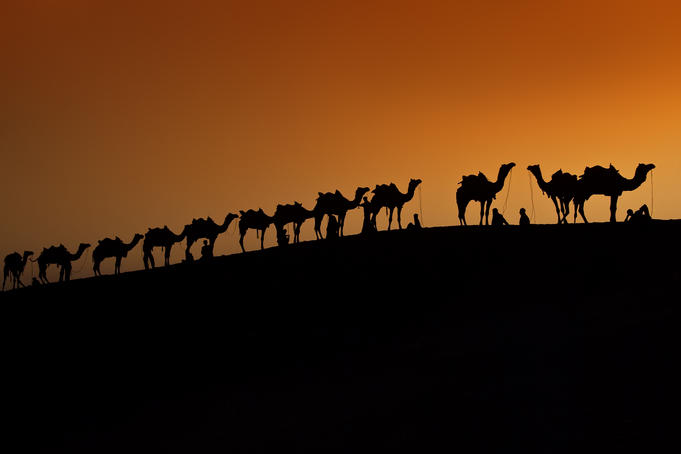
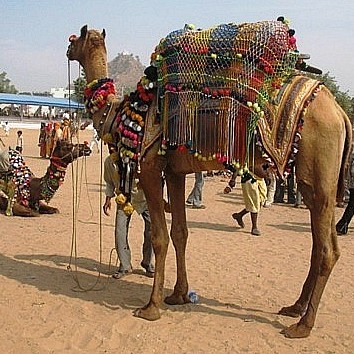
Camels Do Not Belong In Genesis
So little, so very little, contained in Genesis turns out to be true. Not Eve and the Apple, not the Jewish Captivity in Egypt, not, o all sorts of events. And, now, not this either:
Radiocarbon dating was used to pinpoint the earliest known domesticated camels in Israel to the 10th century B.C.— decades after the kingdom of David, according to the Bible. ....
Camels probably had little or no role in the lives of such early Jewish patriarchs as Abraham, Jacob and Joseph, who lived in the first half of the second millennium B.C., and yet stories about them mention these domesticated pack animals more than 20 times. Genesis 24, for example, tells of Abraham’s servant going by camel on a mission to find a wife for Isaac.
Labels:
books,
historical fantasy,
history,
mythology,
Writing
Wednesday, February 5, 2014
Reading Wednesday - The Marriage Plot's Future?
Ever since the cloning of Dolly the Sheep -- and even before -- a cluster of classic plots have occupied my own thinking about stories, whether (still) in old-fashioned print, on screen, in song lyrics and any other way.
I first thought about this when I was a young woman exploring my sexuality. So many stories I'd read hung breathlessly upon young women's virginity -- who was going to get it, and what will happen to her when that happens? I came to the age of sexual expression when virginity wasn't what determined the rest of one's life. If one were educated and / or determined, neither did having a child -- and raising that child oneself -- without a husband define one's social status. Rather than being Ruined and condemned to prostitution and an early, miserable death, a pregnant single woman family, these days many parents even are nearly pathetically grateful that their child has chosen to reproduce. Two plots gone right there! (Unless, of course, you are a poor, resourceless girl, raped and abused by whomever -- but we don't like those stories. We like stories of promiscuous, careless, lustful girls who fall by their own stupidity. We still do ....)
Married the wrong man? You can get divorced. There were even lawyers and law students who would handle your case pro bono! Anne Bronte Tenant of Wildfell Hall conditions no longer in place Neither would there have been an impediment between Rochester and Jane, for he is allowed to divorce his mad wife. (Sadly,for people without funds, this is not true in most cases. Extricating oneself from an unhappy -- and particularly from an abusive marriage -- isn't that straight forward, easy, and inexpensive, particularly when your abuser prefers to kill you and then himself rather than lose his power over you.)
Finally, there are all the historical fictions of the future, what happens with them? No desperate Queen Catherine of Aragon faking pregnancies in vain hope of extracting Henry VIII from his obsession with the younger and presumably fertile Ann Boleyn. Corporate power dynasties can clone themselves, as well as employ many other technologies to reproduce themselves -- perhaps, even digitize their consciousness -- literally making the legal fiction that corporations are persons reality.
Science fiction has been writing stories about these last matters for decades already; I edited Not of Woman Born, an anthology of such stories before the turn of the 21st century.
So, now what?
A novelist and film critic discuss the future of story-telling's ubiquitous marriage plot in The New York Times, here.
Dana Stevens describes it this way:
I first thought about this when I was a young woman exploring my sexuality. So many stories I'd read hung breathlessly upon young women's virginity -- who was going to get it, and what will happen to her when that happens? I came to the age of sexual expression when virginity wasn't what determined the rest of one's life. If one were educated and / or determined, neither did having a child -- and raising that child oneself -- without a husband define one's social status. Rather than being Ruined and condemned to prostitution and an early, miserable death, a pregnant single woman family, these days many parents even are nearly pathetically grateful that their child has chosen to reproduce. Two plots gone right there! (Unless, of course, you are a poor, resourceless girl, raped and abused by whomever -- but we don't like those stories. We like stories of promiscuous, careless, lustful girls who fall by their own stupidity. We still do ....)
Married the wrong man? You can get divorced. There were even lawyers and law students who would handle your case pro bono! Anne Bronte Tenant of Wildfell Hall conditions no longer in place Neither would there have been an impediment between Rochester and Jane, for he is allowed to divorce his mad wife. (Sadly,for people without funds, this is not true in most cases. Extricating oneself from an unhappy -- and particularly from an abusive marriage -- isn't that straight forward, easy, and inexpensive, particularly when your abuser prefers to kill you and then himself rather than lose his power over you.)
Finally, there are all the historical fictions of the future, what happens with them? No desperate Queen Catherine of Aragon faking pregnancies in vain hope of extracting Henry VIII from his obsession with the younger and presumably fertile Ann Boleyn. Corporate power dynasties can clone themselves, as well as employ many other technologies to reproduce themselves -- perhaps, even digitize their consciousness -- literally making the legal fiction that corporations are persons reality.
Science fiction has been writing stories about these last matters for decades already; I edited Not of Woman Born, an anthology of such stories before the turn of the 21st century.
So, now what?
A novelist and film critic discuss the future of story-telling's ubiquitous marriage plot in The New York Times, here.
Dana Stevens describes it this way:
This past year alone, in the world of film — which, as the dominant popular art form of the last century, can be said to have picked up the marriage-plot baton from narrative fiction — we’ve seen movies like Richard Linklater’s “Before Midnight,” the third installment of a two-decade-spanning trilogy that treats long-term romantic partnership (not marriage — significantly, the character played by Julie Delpy resists that step) as a permanent negotiation involving countless small compromises, disappointments and, often, self-deceptions. More radically, Spike Jonze’s man-meets-software romance “Her” imagines a very near future in which love breaks down not just traditional gender binaries but the line between human and nonhuman itself (and in which the familiar “love triangle” becomes a complex love polyhedron involving hundreds of simultaneous human and digital paramours).
Whatever form the marriage plot assumes as it continues to evolve, it seems clear that the richest and most ambitious love stories will be those that aren’t afraid to call into question what we mean both by “love” and by “story,” whether by opening up the closed temporal loop of “happily ever after” (in the style of Michel Gondry’s mind-bending, time-shifting sci-fi romance “Eternal Sunshine of the Spotless Mind”) or acknowledging the impermanence and imperfection of all relationships (like Woody Allen’s “Annie Hall,” which could be seen as an early turning point in the reinvention of the contemporary rom-com). The freeze-frame kiss that’s marked the end of so many Hollywood romances — the image of a man and a woman joined forever in changeless heterosexual bliss, the ultimate teleological goal of all love — is coming unfrozen, and what happens after those two pairs of lips separate is ours to decide.
Labels:
books,
historical fantasy,
historical fiction,
Movies,
SF/F,
Writing
Friday, January 10, 2014
The Book of Life - Deborah Harkness Concludes the All Souls Trilogy
Viking will release the conclusion to Deborah Harkness's All Souls Trilogy this summer, July 15, 2014, The Book of Life.
An exclusive teaser excerpt has been put up online by Lindsay Deutsch. It is available to be read here.
I am assuming that the book of the title is a physical book, the living properties of which were beginning to be explored by the principal characters, witch Diana Bishop and her vampire husband, Matthew Clairmont, as Shadow of Night concluded.
Like the previous novels' other many readers are doing, more or less patiently, I am greatly looking forward to the publication of The Book of Life. I'm particularly interested in which historical eras they will explore in The Book of Life. As an historian who has also written adult historical fantasy (though sexual attraction, romance and marriage -- and wine -- are very important in Harkness's novels, they are neither Romances nor Young Adult books), the historical geographies and cultures of the books are intensely appealing.
Beyond enjoyment in the historical and adventure aspects, I'm impatient for more of the philosophical and genetic mysteries of time and life that our characters are puzzling over, which for them are literally matters of life and death. Even better, it appears The Book of Life will be the conclusion of all these matters -- the whole story told in three volumes, an actual trilogy, as opposed to an open-ended series.
An extensive post discussing A Discovery of Witches can be read here. (Fair Warning: depending on taste for reading content on screen, this could be classified by those who don't have the taste to do so as TL;DR.)
Neda Ulaby, NPR's reporter on arts, entertainment and culture, did a feature on Shadow of Night in the summer of 2012. I had the privilege of contributing a few words. You can hear or read the piece here.
The publications of Harkness, professor of history at the University of Southern California, include two non-fiction studies in the history of science:
- John Dee's Conversations with Angels: Cabala, Alchemy, and the End of Nature. Cambridge, U.K.: Cambridge University Press. 1999.
- The Jewel House: Elizabethan London and the Scientific Revolution. New Haven, Conn.: Yale University Press. 2007
The Book of Life, the conclusion to Harkness's All Souls Trilogy will be available from Viking, July 15, 2014
I am assuming that the book of the title is a physical book, the living properties of which were beginning to be explored by the principal characters, witch Diana Bishop and her vampire husband, Matthew Clairmont, as Shadow of Night concluded.
Like the previous novels' other many readers are doing, more or less patiently, I am greatly looking forward to the publication of The Book of Life. I'm particularly interested in which historical eras they will explore in The Book of Life. As an historian who has also written adult historical fantasy (though sexual attraction, romance and marriage -- and wine -- are very important in Harkness's novels, they are neither Romances nor Young Adult books), the historical geographies and cultures of the books are intensely appealing.
Beyond enjoyment in the historical and adventure aspects, I'm impatient for more of the philosophical and genetic mysteries of time and life that our characters are puzzling over, which for them are literally matters of life and death. Even better, it appears The Book of Life will be the conclusion of all these matters -- the whole story told in three volumes, an actual trilogy, as opposed to an open-ended series.
A Discovery of Witches (2011)
An extensive post discussing A Discovery of Witches can be read here. (Fair Warning: depending on taste for reading content on screen, this could be classified by those who don't have the taste to do so as TL;DR.)
Shadow of Night (2012)
Neda Ulaby, NPR's reporter on arts, entertainment and culture, did a feature on Shadow of Night in the summer of 2012. I had the privilege of contributing a few words. You can hear or read the piece here.
Deborah Harkness
The publications of Harkness, professor of history at the University of Southern California, include two non-fiction studies in the history of science:
- John Dee's Conversations with Angels: Cabala, Alchemy, and the End of Nature. Cambridge, U.K.: Cambridge University Press. 1999.
- The Jewel House: Elizabethan London and the Scientific Revolution. New Haven, Conn.: Yale University Press. 2007
Labels:
evolutionary biology,
fantasy,
historical fantasy,
Science,
science fiction,
Women,
writers,
Writing
Tuesday, October 15, 2013
So, Reign: The Rise of Mary, Queen Of Scots + Nashville + Revolution
What sort of series will this be? Will there be dragons? Evidently there are going to enchanted forests ....
From the Reign site:
Judging only by the trailers, its another "historical" series that is entirely non-historical , from music, to costume,to design, to character, to event.
The central figure was one of the most stupid people to ascend to a throne -- and she lost her head, o yes she did -- and accomplished nothing useful for herself, her allies or her kingdom. The "Rise" of the Queen of Scots? Who do they think they are fooling? She never had any real power at all. No Elizabeth I was she. I have just asked a very stupid question, that doesn't even rise to the level of a rhetorical question. They are fooling the people from whom Barnum made a fortune.*
What kind of "legend" is that?
According to the series's people, it's supposed to be fun, not historic. That is perfectly fine. But then, why bother with principals who are named historical figures and pretending that this is historical anything?
It's not a-historicity that drives me out of delight in a creative work of entertainment, it's unproductive bs that declares a pretense to history. Make it all up? Absolutely a good thing! But hitching it to real figures who were pivots of events and actions that affected millions of real people (generally for the worse), throws viewers like me out of disbelief suspension and into a 20/20 vision that reveals all the holes and failures of imagination, plotting, story-telling and characterization.
So much going on Tuesdays, Wednesdays and Thursdays: Nashville, Revolution, Scandal, Dracula and now this. So far, the only ones that will bring me back every week are Nashville** and, perhaps the over-the-top- bonkers Scandal. Revolution is implausible, contains dudebro brutality beyond surfeit, and, withall, lacking fun of any kind.
Dracula-- will have to wait and see. And this thing called Reign will probably not even get me watching a single episode, as the trailers are reminiscent of Camelot, one of the very worst series ever attempted -- so bad, they, whoever they are, should still be ashamed.
-------------------------* For the record, the historical record informs us that Barnum never said either "There's a fool born every minute," or "You can fool all the people some of the time etc."** Nashville does posit at least one startling implausibility:
Juliette Barnes is supposed to be so wealthy she owns a jet, and can casually throw away a million here, a million there, etc. This is too hard to buy into for anybody who knows the music biz. (She might lease ....) The most popular group in their time of popularity, which meant they sold actual albums, not singles from iTunes like Juliette Barnes does (do you know what the royalty is for the artists from iTunes sales? it's nothing like what smart negotiators got their artists in the days of records and even cds), the Dixie Chicks, couldn't own their own jet. However, the ongoing story writing threads with the jet are entertaining. Further, they function by drawing in broad strokes to make instantly recognizable to the non-music business viewer of the series the vast changes in the business that have occurred between the Country Music breakout of very young star Juliette,
and that of the 'classic' Bonnie Raitt old school star of Rayna Jaymes.
From the Reign site:
As Mary learns for herself that fierce foes are conspiring to sabotage her marriage to Francis and even threaten her life, she becomes aware of other dark forces. There’s a mysterious presence in the castle; a shrouded figure who may become her unlikely ally. Villagers cope with the brutality of the times by trusting in magic and superstition. And in the dark woods surrounding the French Court lurk those who offer human sacrifice to a being who seems to require blood.
Judging only by the trailers, its another "historical" series that is entirely non-historical , from music, to costume,to design, to character, to event.
The central figure was one of the most stupid people to ascend to a throne -- and she lost her head, o yes she did -- and accomplished nothing useful for herself, her allies or her kingdom. The "Rise" of the Queen of Scots? Who do they think they are fooling? She never had any real power at all. No Elizabeth I was she. I have just asked a very stupid question, that doesn't even rise to the level of a rhetorical question. They are fooling the people from whom Barnum made a fortune.*
What kind of "legend" is that?
According to the series's people, it's supposed to be fun, not historic. That is perfectly fine. But then, why bother with principals who are named historical figures and pretending that this is historical anything?
It's not a-historicity that drives me out of delight in a creative work of entertainment, it's unproductive bs that declares a pretense to history. Make it all up? Absolutely a good thing! But hitching it to real figures who were pivots of events and actions that affected millions of real people (generally for the worse), throws viewers like me out of disbelief suspension and into a 20/20 vision that reveals all the holes and failures of imagination, plotting, story-telling and characterization.
So much going on Tuesdays, Wednesdays and Thursdays: Nashville, Revolution, Scandal, Dracula and now this. So far, the only ones that will bring me back every week are Nashville** and, perhaps the over-the-top- bonkers Scandal. Revolution is implausible, contains dudebro brutality beyond surfeit, and, withall, lacking fun of any kind.
Dracula-- will have to wait and see. And this thing called Reign will probably not even get me watching a single episode, as the trailers are reminiscent of Camelot, one of the very worst series ever attempted -- so bad, they, whoever they are, should still be ashamed.
-------------------------* For the record, the historical record informs us that Barnum never said either "There's a fool born every minute," or "You can fool all the people some of the time etc."** Nashville does posit at least one startling implausibility:
Juliette Barnes is supposed to be so wealthy she owns a jet, and can casually throw away a million here, a million there, etc. This is too hard to buy into for anybody who knows the music biz. (She might lease ....) The most popular group in their time of popularity, which meant they sold actual albums, not singles from iTunes like Juliette Barnes does (do you know what the royalty is for the artists from iTunes sales? it's nothing like what smart negotiators got their artists in the days of records and even cds), the Dixie Chicks, couldn't own their own jet. However, the ongoing story writing threads with the jet are entertaining. Further, they function by drawing in broad strokes to make instantly recognizable to the non-music business viewer of the series the vast changes in the business that have occurred between the Country Music breakout of very young star Juliette,
and that of the 'classic' Bonnie Raitt old school star of Rayna Jaymes.
Labels:
historical fantasy,
historical fiction,
Television
Sunday, March 24, 2013
*Blancanieves*
This black-and-white Spanish film, Blancanieves (2012) sets the Snow White fairy tale within the bullfighting milieu of 1920's Seville. Blancanieves is the matador. The film opens in NYC on March 29th. I am looking forward to this!
Warning: this trailer begins with a cosmetic commercial that contains a chameleon and brilliant colors.
There is flamenco, there are six (not seven) matador dwarves, and a ... dirigible.
Warning: this trailer begins with a cosmetic commercial that contains a chameleon and brilliant colors.
There is flamenco, there are six (not seven) matador dwarves, and a ... dirigible.
Saturday, October 13, 2012
Playing Ruritania
Vanished Kingdoms: The History of Half-Forgotten Europe by Norman Davies.
This large book (830 pp) was published by Allan Lane last year, and reviewed in the December 15, 2011 LRB. (Alas, the the entire review isn't available for view except for subscribers.)
If one is fascinated by places that carry allure in their very names -- Tolosa, Burgundia -(whose Burgundy, where and when?)! -- and, many a time, Poland but, and still, "Poland isn't finished yet," which can not be said for Ruthenia, or Tolosa.
Further, the LRB piece is a meditation in detail and depth on imperiums' inability to imagine their transience, and small, weak realms, who even more than comprehending how easily they can be disappeared, understand that their very languages are more than likely to disappear within another generation and a half.
It was reviewed again this week in the UK Guardian. Did come out in a paper edition? There's nothing to indicate why it was chosen to be reviewed in that publication now.
Another book that will be of great interest to fantasy writers who like to play Ruritania with European geography is the biography of travel writer, Patrick Fermor: Patrick Leigh Fermor: An Adventure by Artemis Cooper. Though the reviewer doesn't say this, Fermor's world has been as effectively disappeared by history as any invoked in Vanished Kingdoms. Fermor's time was a part of Merian C. Cooper's world, a world in which his explorations allowed him to imagine and create King Kong.
This large book (830 pp) was published by Allan Lane last year, and reviewed in the December 15, 2011 LRB. (Alas, the the entire review isn't available for view except for subscribers.)
If one is fascinated by places that carry allure in their very names -- Tolosa, Burgundia -(whose Burgundy, where and when?)! -- and, many a time, Poland but, and still, "Poland isn't finished yet," which can not be said for Ruthenia, or Tolosa.
Further, the LRB piece is a meditation in detail and depth on imperiums' inability to imagine their transience, and small, weak realms, who even more than comprehending how easily they can be disappeared, understand that their very languages are more than likely to disappear within another generation and a half.
It was reviewed again this week in the UK Guardian. Did come out in a paper edition? There's nothing to indicate why it was chosen to be reviewed in that publication now.
Another book that will be of great interest to fantasy writers who like to play Ruritania with European geography is the biography of travel writer, Patrick Fermor: Patrick Leigh Fermor: An Adventure by Artemis Cooper. Though the reviewer doesn't say this, Fermor's world has been as effectively disappeared by history as any invoked in Vanished Kingdoms. Fermor's time was a part of Merian C. Cooper's world, a world in which his explorations allowed him to imagine and create King Kong.
Subscribe to:
Posts (Atom)


.jpg)