LINES OF THE DAY

". . . But the past does not exist independently from the present. Indeed, the past is only past because there is a present, just as I can point to something over there only because I am here. But nothing is inherently over there or here. In that sense, the past has no content. The past -- or more accurately, pastness -- is a position. Thus, in no way can we identify the past as past." p. 15

". . . But we may want to keep in mind that deeds and words are not as distinguishable as often we presume. History does not belong only to its narrators, professional or amateur. While some of us debate what history is or was, others take it into their own hands." p. 153

Silencing the Past: Power and the Production of History (1995) by Michel-Rolph Trouillot

Showing posts with label science fiction. Show all posts

Tuesday, August 4, 2015

Sense8, Ex Machina and Prophet Gibson

Watching Sense8 has been such a slog that days, weeks, and now, over a month has gone by since watching an episode.  I don't recall which episode I viewed last but then netflix does that for me. :)

Part of the problem for this viewer is it looks like the sort of video loops that play at a rave, or a Burning Man event. The series is not located in the kind of world most people inhabit, but a pick-and-choose-your-own-adventure global picture post card world, with neither cause nor effect as to what shows up, other than it looks pretty and / or exotic.

It broadcasts the world-view of those for whom it seems climate change, loss of human work, etc. are never considered because they exist at the levels where they aren't affected by it. That little is left of the natural world doesn't much matter for these are the sorts that are most comfortable existing in an entirely constructed artificial space where the sensory comes through jacks and shunts of one sort or another directly to the brain, not through the senses of hands, eyes and ears, but highly elegant or gory simulacrum of experience:  games, television, graphic novels, fashion and so on. These are the sorts that populate William Gibson's novels, who are thoroughly at home in this post-natural world of pixels and constant, complete connection.  So are Sense8's creators and writers, the Wachowskis and J. Michael Straczynski.


Lately I've been thinking of Sense8 in this aspect of sensory and other experience, along with Ex Machina. The the local shops' windows are already becoming inhabited with a fantasy of autumn fashion (despite we have cooling shelters and so on practicing right now due to the heat, pollution and humidity).

More than  few of these windows are centering the new mannequins, fashioned after the unclothed, unfleshed AI constructs of Ex Machina.  Some of the windows have even left out the clothes the stores supposed are selling, leaving the space empty other than an artistically arranged collection of cyber limbs and a naked torso that reveals the inner working of the technology.

Fashion, like this almost present world of AIs, the internet of things and Sense8, is a world of infinite possibilities, a series of masques on the walls of an infinite series of halls.  Or, as the NY Times reported this weekend "Fashion Finds a More Perfect Model: The Robot." The title of the slide show is, "So Much Like Humans, Only Better."

However, cranky moi has never found a single the DJ music experience even remotely the splendid, transcendent, transformational experiences she's had from living, human musicians playing together. One uses what others make, and the musicians make it. With human musicians even the gods come down to dance with us.

This is essential to humans, but not to AI's or robots or androids.


Friday, January 10, 2014

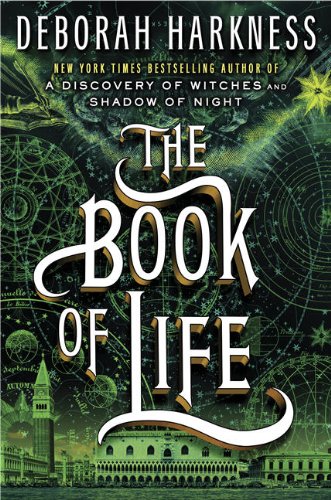
The Book of Life - Deborah Harkness Concludes the All Souls Trilogy

Viking will release the conclusion to Deborah Harkness's All Souls Trilogy this summer, July 15, 2014, The Book of Life.

The Book of Life, the conclusion to Harkness's All Souls Trilogy will be available from Viking, July 15, 2014

An exclusive teaser excerpt has been put up online by Lindsay Deutsch.  It is available to be read here.

I am assuming that the book of the title is a physical book, the living properties of which were beginning to be explored by the principal characters, witch Diana Bishop and her vampire husband, Matthew Clairmont, as Shadow of Night concluded.

Like the previous novels' other many readers are doing, more or less patiently, I am greatly looking forward to the publication of The Book of Life. I'm particularly interested in which historical eras they will explore in The Book of Life. As an historian who has also written adult historical fantasy (though sexual attraction, romance and marriage -- and wine -- are very important in Harkness's novels, they are neither Romances nor Young Adult books), the historical geographies and cultures of the books are intensely appealing.

Beyond enjoyment in the historical and adventure aspects, I'm impatient for more of the philosophical and genetic mysteries of time and life that our characters are puzzling over, which for them are literally matters of life and death. Even better, it appears The Book of Life will be the conclusion of all these matters -- the whole story told in three volumes, an actual trilogy, as opposed to an open-ended series.

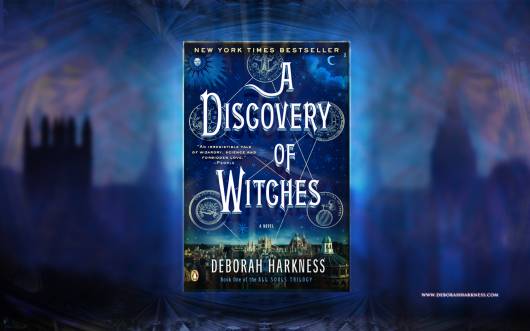
A Discovery of Witches (2011)

An extensive post discussing A Discovery of Witches can be read here. (Fair Warning: depending on taste for reading content on screen, this could be classified by those who don't have the taste to do so as TL;DR.)

Shadow of Night (2012)

Neda Ulaby, NPR's reporter on arts, entertainment and culture, did a feature on Shadow of Night in the summer of 2012.  I had the privilege of contributing a few words.  You can hear or read the piece here.

Deborah Harkness

The publications of Harkness, professor of history at the University of Southern California, include two non-fiction studies in the history of science:

 - John Dee's Conversations with Angels: Cabala, Alchemy, and the End of Nature. Cambridge, U.K.: Cambridge University Press. 1999.

- The Jewel House: Elizabethan London and the Scientific Revolution. New Haven, Conn.: Yale University Press. 2007

Monday, June 13, 2011

White Man's Country

The set of sf/f genre marketed as Urban Fantasy is not generally of reading interest to me personally, but that doesn't interfere with acknowledging the positive things it has brought to the SF/F Reading table. Diversity of characters and cultures in the genre is excellent news for the genre as a whole. You can start with the nomenclature of its marketing category --Urban Fantasy. In marketing other products, to employ 'urban' as a defining descriptor means 'black,' or African American.

You must first be able to imagine something other than what is before something other than what is can come into being.

My take is this: the Western, its revisionist historical, and, as well, its mythological space was exclusive to white people. There were some Indians (who are convenient antagonists who prove the protagonist's exceptional expertise) and occasionally Mexicans and even more occasionally Asians. Black people, like slavery, were disappeared from the history of the Western Territories. This entertainment / mythological paradigm of the historic west was, of course very different from the history. This applies particularly to the presence and influence of women and of African Americans, not to mention Asians and Mexicans and Indians.

With Civil Rights, Voting Rights, Feminism, the defeat of the American century in Vietnam, the Western's mythology was no longer functioning satisfactorily. In attempts to revive the Western, we saw then, finally, what some call the Civil Rights Western, with black protagonists. This was a long road in Hollywood, and there were signposts along the way in the Westerns that African Americans could be and someday would be full citizens in the west, in the nation, and we were trying to imagine that day, and what it would look like.

Successful Westerns, for instance the 1939 The Outlaw Jesse James, spawned over a dozen remakes. This did not happen with the Civil Rights Western, because it was antithetical the White Man's mythological vision of the west. Putting black male protagonists front and center spoiled the mythology. It forced consideration of the nation's actual history of the south and of the west, and its connections to slavery and the Civil War, which Hollywood and the audience did not like. As the great historian of the nation from colonial era to the present, Professor Richard Slotkin, states: "The Western is about white supremacy." When the white supremacy is taken out, the mythological space implodes.

Additionally, Slotkin says, when the politics of white supremacy and local time history elements are removed from the western, "...it becomes clear that it is about S-E-X, particularly if the protagonist is female." The place of the female in the Western is usually to inform the audience which of the men is good, is bad, who to sympathize with and so on. If she's the protagonist all those signals disappear.


So, then, it’s the 70′s and the Western is dead. But a new (mythological space) frontier emerges in our national imagination. This one had been until the 70's and Star Wars more the space of those who regarded themselves as outsiders rather than to the mainstream sort who used to make Westerns solid box office and publishing profits.

Still, mythologically, reaching back as far as Burroughs's John Carter of Mars — the Western has always spawned at least some sets of SF/F. Like the Western there were no female protagonists or females of agency, or so few as to not matter; the same for POC and gay or transgendered — and if they were there, they are either to be rescued, be rewards, be magically useful, be victims that are avenged by the (white, male) protagonist, or be the villains.

SF/F, and particularly, space opera, in those decades was still safe space for USian White Man's country, for only we USians had the wealth and the technology to go there in covered wagon shuttles (the space race with the Soviet Union was a convenient goad, foil and antagonist for getting more funding), go there in imagination via Dreamworks and the like, and the publishing industry to support the fiction. We controlled distribution space. Outer Space -- vast, empty, we could populate as we liked, even with non-human, non-flesh, robots and mechs.

But now it seems the Other is again crowding over the frontier and filling this once safe country — POC, Women, the gay, and even non USians, non-Europeans, are playing in space, both in imagination and in efforts to get there in shuttles, explorers, and other technologies, and claim it for themselves. And the Space Race competition died with the dissolution of the Soviet Union competition.

It’s not a coincidence, one thinks, that this borderland of urban fantasy in sf/f, that includes the steampunk, is ‘urban.’It is in the cities where diversity begins. New Orleans had the largest population of free people of color of any city in the U.S. when Jefferson bought it. Baltimore had the largest population of free people of color at the run-up to the Civil War. NYC was a close, close second. All three of these cities were magnets for immigrants as well. That’s just three examples.

We're imagining full citizenship for everybody in Urban Fantasy.

I’m most curious to see where White Man’s Country is next located.

Friday, June 11, 2010

Another Science Fiction

Megan Prelinger discusses aerospace industry ads from the golden age of science fiction—the 1950s and early 1960s—when the farthest reaches of imagination were fed by the technological breakthroughs of the postwar years. Her book Another Science Fiction presents nearly 200 entertaining, intriguing, and inspiring pieces of space-age eye candy.


The most interesting aspect of the interview-discussion is how the vision of the United States and its relationship to space exploration was an extension of the previous century's dogma of Manifest Destiny.  Also of interest is the designer of the Mad Men series blurbs the book, wishing it had been available to him in the first seasons.


See the Lenny Lopate Show showpage, WNYC for a series of these recruiting ads' illustrations, aimed at the industry.