LINES OF THE DAY

". . . But the past does not exist independently from the present. Indeed, the past is only past because there is a present, just as I can point to something over there only because I am here. But nothing is inherently over there or here. In that sense, the past has no content. The past -- or more accurately, pastness -- is a position. Thus, in no way can we identify the past as past." p. 15

". . . But we may want to keep in mind that deeds and words are not as distinguishable as often we presume. History does not belong only to its narrators, professional or amateur. While some of us debate what history is or was, others take it into their own hands." p. 153

Silencing the Past: Power and the Production of History (1995) by Michel-Rolph Trouillot

Showing posts with label Andrew Jackson. Show all posts

Friday, April 17, 2015

Andrew Jackson, Talleyrand, Napoleón

I suppose Napoleón is a fascinating fellow.  What he did, the havoc, game-changing, and bringing the changes around to, not even a monarchy embodied in the body of the divinely appointed sovereign, but an imperium, the closest model of which would have been the Roman Empire of the Caesars.  Like Augustus, he re-wrote and remodeled every part of administration from jurisprudence to the military.

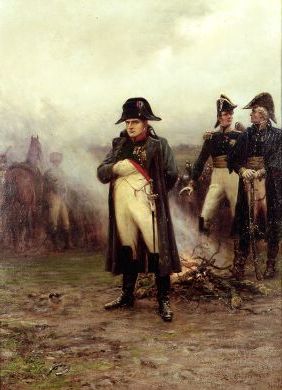
Why did Napoleón stick his hand inside his uniform?  Dang, every military fellow, and those who liked to ape pretensions to military background for over a century was painted and / or photographed with his hand inside his clothes -- fondling their manly chest hairs?
That he appointed  members of his family as monarchs of the territories surrounding France  -- not principally for la belle France's defense as declared in his public announcements of the appointments -- but in order to be recognized as a dynastic ruler equal to the ancient houses such as  Bourbon, Hapsburg and   Romanovs is interesting.  But it still, a megalomaniac is a megalomaniac, and inflated egoist narcissists  in the end are inflated egoist narcissists, and ugly dangerous people, whether their fields of operation are limited to one's family or are expansive as a continental theater.


But Talleyrand now ... the fellow, once in Church orders, in the government of Louis XVI, run to American self-exile from the Revolution that had turned to the Terror, returned to France when the Directoire to become France's Foreign Minister, surfed successfully all the waves between that, the Consulate and throught the zenith of Napoleón's imperium, then falling out and again in exile, this time in England, to return again triumphantly as one of the four major players at the Congress of Vienna -- now that is a fascinating human being. Perhaps not a good one or an admirable one, but fascinating -- and more than a survivor, a success, until the end of his days.

And by all accounts, excellent company, which by most accounts, for any length of time, Napoleón most certainly was not.  Charismatic he was for long periods, but not good company: he lacked manners and courtesy, he was cruel and impatient, and loved hurting people by pinching them violently for extended minutes, leaving bruises and on occasion, blood -- even when not angry.

Talleyrand was a remarkably clear-sighted pragmatic realist. An egoist too, no doubt, but he wasn't a megalomaniac.  In the end, he was more successful than Napoleón, whose second coming transformed to defeat and ended his not that many more days in prison-exile.

One of Andrew Jackson's duels historically imagined.  This one was about a horse race.
Where on the scale between these two would fall Andrew Jackson? He sure was a megalomaniac in so many ways, see the Bank of the United States, hard money, the English, Indians, etc. He too was charismatic, and his manners with women at least, frequently were noticed as exquisite. Women flocked to Jackson, even those politically opposed to him, as they flocked to Talleyrand.

People like speculating how Jackson the military leader would have stepped to Wellington's game (another egoist! -- whose manners with women were anything but good), but what would have been more likely if San Domingue's revolution had not put a decided end to Napoleón's plans for the New World, is how Napoleón would have stepped to Jackson's, facing off as they'd have done in the Floridas and Louisiana territories.

Run-ons, are us today, as getting ready for a Harvard visit takes most of my attention!

Thursday, July 31, 2014

The Fantasy of General Wellington's Invasion in the War of 1812

One of the persistent myths of alternate history fans is that Lord Wellington was asked by the British government to invade the United States from the Gulf Coast in order to defeat the upstart Americans in the War of 1812. [Example here.]

Whether or not there ever was a formal request made by the PM to Wellington, Duke Wellington supposedly declined, without grace or patience. Thus, it is a speculation without content.  It is so counter-factual, in fact, that there is not a single fact out of the period and location, to fuel such useless speculation.

Nevertheless the speculations continue apace, taking it as a given that this general, who was so good at his work that he defeated Napoleón himself in a battle -- a battle, let me haste to say, that didn't take place until after the first abdication of Napoleón, which concluded the Congress of Vienna, in which the surviving powers were wrangling over the division of the spoils of Bonaparte's empire, and Wellington was a primary player.*  With some level-headed dissenters, war gamers tend to believe that Wellington have quickly cut a swathe through the former colonies and returned them to British rule. This fuels ever more extreme counter-factual speculation as how would change the course of world history.

There is not a single fact upon which to build speculations.  In contrast, however,, there are ample facts that strongly suggest that Wellington showing up on the Gulf coast would have been as much a debacle as it turned out for British army general, Edward Pakenham, and British naval commander, Admiral Alexander Cocherane -- and very likely in the same way.

First he'd have had to defeat Andrew Jackson, who knew his territory, as he proved over and over, from the Floridas and the Gulf, all the way up the Natchez Trace and the Mississippi Corridor to Nashville, the water and land routes both, in this vast Louisiana Purchase territory. Whenever Jackson encountered the Brits in the Floridas and the Gulf, he'd defeated them (and hung some, even though it was illegal).  He'd been doing this long before the Battle of New Orleans.

This wasn't Wellington's geography, or the geography of any regular army, as the British learned in the War of Independence.  They occupied all the cities, but it did them no good (except to give contemporary Americans a silly idea of their own competence and exceptional capacity for success purely through the actions of single individuals, conveniently forgetting the essential roles of France in Spain in the ultimate outcome).

There were no places other than New Orleans to re-supply a Wellington army, and it was very far away from the hinterlands. There were no plantations to plunder yet, but those around New Orleans and Natchez. The land was covered in dense forest, swamps, bridgeless rivers and bayous. The American forces were skilled at living rough and at brigandage.  They'd have been at least as fierce a guerrilla third front as Wellington had encountered in Spain, except these would be working against him.

As intensely as Wellington had put himself through a military education he'd surely read the history of the War of American Independence.  As much time as he'd


spent in Spain, he'd surely have at recall the large role Spain's General Bernardo Galvez played in the Gulf Mississippi Valley in defeating the British back then and there, and how easy it was for him to do so, since the British military were not good on that ground. Moreover, now, in the present of the War of 1812, which in any case, as mentioned, was now over, Spain was Britain's ally.

So, yes, there are many facts that show Wellington, if, indeed he was formally asked to fight in North America, made the right decision to stay on this side of the Atlantic, while there is nary a single one to say he'd have met anything but disaster, whether by water, cavalry or infantry.  His artillery would have been as prone to incapacity by corrosion and mud as anyone else's, especially without roads along which to push them.  The horses would die from starvation, and the men as well.

----------------------

Which was a fortunate circumstances for Britain and the rest of Europe, since Wellington was already on the ground in central Europe, where war was resuming, not sitting around uselessly in the Americas, where that war was over. The Treaty of Ghent had been signed December 24, 1814.

Wellington, where he was,  was perfectly positioned to take immediate charge of the British forces and confer with the generals of the other powers' armies during Napoleón's 100 Days: 20 March to 8 July 1815.
Friday, February 11, 2011

Studying Andrew Jackson

Appositively, David O. Stewart writes about him in the Huff Po.  What Mr. Stewart is really doing in the article is running down the instances of violence committed by, and perpetuated upon, politicans.  This has never been much of a nation for civility in any of its national venues.

Andrew Jackson's great scholar is Robert V. Remini.  He's devoted his entire academic career to reading everything Jackson ever wrote, what has been written about him, what those around him wrote, and the eras in which Jackson not only lived (he was a British captive in the War of Independence when only 13; he was significantly mis-treated by his captors), but those that he shaped so much in his own character, which shaping endured long after the Jacksonian era concluded.

Jackson was there then, in the Era of Confederation, the Early Republic, the War of 1812 (which propelled him upon the national stage via the Creek and Seminole wars, not to mention the Battle of New Orleans), the so-called Era of Good Feeling, more accurately known, as Remini says, by Jackson and the country as the Era of Corruption, the Second Great Awakening (which Remini doesn't cover -- he's a political historian), Nullification, the Great Indian Removal; he died the year Texas entered the U.S. as a slave state, an issue very close to Jackson's heart.  He just missed the Mexican American War and the California Gold Rush which would have gratified his specie-loving, banks and soft money-hating, economic policies.

Back to Remini.  One of the pleasures of a scholar of that calibre devoting his energies to a very particular subject and period is that at a certain point he really knows it.  S/he knows it so well they can take complicated, subtle issues and synthesize their thinking in relatively few words, that are crystal clear to the rest of us.  Remini does this with three Jacksonian issues in a series of three lectures he gave in 1988 (the publication date for this slim volume -- 117 pages, including index -- published by the Louisiana State University Press).  The three issues are "Democracy," "Indian Removal" and "Slavery."

I learned something that I had no idea about previously.  It's easier to quote Remini describing it in the "Slavery" lecture than for me to try and describe it -- this is about the Nullification crisis during Jackson's presidency, which is connected to the southern imposed gag rule on any petition, report or discussion of slavery or abolition in Congress:
Although the abolitionist movement had long since been under way, it is interesting and important to note that Jackson and his spokesman regarded the introduction of the slavery question as a political issue in congress as having been conceived by the nullifiers to advance their efforts at disrupting the Union.  The position of the Jacksonians in 1833, therefore, was simply this: slavery was protected by the Consitution; only those intent on mischief seriously proposed that Congress could abolish slavery; and only nullifiers like Calhoun and his friends argued that there were irreconcilable differences between slave and nonslaveholding states, for the simple reason that they hoped eventually to establish a southern confederacy. (p. 92)
In other words, as Remini goes on to amplify, the stirring up of abolition controversy was manufactured by Calhoun and his ilk in hopes of so alarming the white men of the slaveholding states that they'd break away from the Union -- and make Calhoun their head. It was an imaginary movement, propelled by outright lies in the press Calhoun and his friends controlled and that supported them.

Now Jackson did see conspiracies in many places. It was a word he often employed, particularly in connection with those who opposed him.  But then, he had rather gotten sucked in by Burr back in the day during Burr's plotting to cut a personal domain for himself out of the Louisiana Territory.  Evidently that sort of power politic dreaming hadn't ended in 1806.

Now, there were indeed authentic abolitionist movements and organizations in play in the 1830's.  But for white men like Jackson -- and Calhoun -- they couldn't conceive there were any altruistic or humane ideals or concerns involved.  Any talk of abolition had to be for calculated political objective, because that is how they thought.  States rights, uselessness of central government except for national defense, no publicly funded projects even for infrastructure -- all of us are in this alone.  No one could actually give a damn about slaves and their condition within this democracy of rugged, self-sufficient individualists.

Slavery just was, and always would be. No problem. Except that for political and economic gain there were northern politicians who wanted to use them as an excuse to stirr up trouble for the south, just as there were southerners doing the same thing.

From my perspective here in the second decade of the 21st century this callousness about so many human beings, even among politicians, takes my breath away.