LINES OF THE DAY

". . . But the past does not exist independently from the present. Indeed, the past is only past because there is a present, just as I can point to something over there only because I am here. But nothing is inherently over there or here. In that sense, the past has no content. The past -- or more accurately, pastness -- is a position. Thus, in no way can we identify the past as past." p. 15

". . . But we may want to keep in mind that deeds and words are not as distinguishable as often we presume. History does not belong only to its narrators, professional or amateur. While some of us debate what history is or was, others take it into their own hands." p. 153

Silencing the Past: Power and the Production of History (1995) by Michel-Rolph Trouillot

Showing posts with label napoleon. Show all posts

Friday, April 17, 2015

Andrew Jackson, Talleyrand, Napoleón

I suppose Napoleón is a fascinating fellow.  What he did, the havoc, game-changing, and bringing the changes around to, not even a monarchy embodied in the body of the divinely appointed sovereign, but an imperium, the closest model of which would have been the Roman Empire of the Caesars.  Like Augustus, he re-wrote and remodeled every part of administration from jurisprudence to the military.

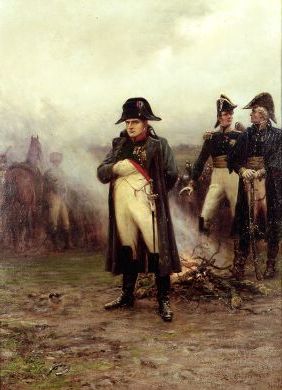
Why did Napoleón stick his hand inside his uniform?  Dang, every military fellow, and those who liked to ape pretensions to military background for over a century was painted and / or photographed with his hand inside his clothes -- fondling their manly chest hairs?
That he appointed  members of his family as monarchs of the territories surrounding France  -- not principally for la belle France's defense as declared in his public announcements of the appointments -- but in order to be recognized as a dynastic ruler equal to the ancient houses such as  Bourbon, Hapsburg and   Romanovs is interesting.  But it still, a megalomaniac is a megalomaniac, and inflated egoist narcissists  in the end are inflated egoist narcissists, and ugly dangerous people, whether their fields of operation are limited to one's family or are expansive as a continental theater.


But Talleyrand now ... the fellow, once in Church orders, in the government of Louis XVI, run to American self-exile from the Revolution that had turned to the Terror, returned to France when the Directoire to become France's Foreign Minister, surfed successfully all the waves between that, the Consulate and throught the zenith of Napoleón's imperium, then falling out and again in exile, this time in England, to return again triumphantly as one of the four major players at the Congress of Vienna -- now that is a fascinating human being. Perhaps not a good one or an admirable one, but fascinating -- and more than a survivor, a success, until the end of his days.

And by all accounts, excellent company, which by most accounts, for any length of time, Napoleón most certainly was not.  Charismatic he was for long periods, but not good company: he lacked manners and courtesy, he was cruel and impatient, and loved hurting people by pinching them violently for extended minutes, leaving bruises and on occasion, blood -- even when not angry.

Talleyrand was a remarkably clear-sighted pragmatic realist. An egoist too, no doubt, but he wasn't a megalomaniac.  In the end, he was more successful than Napoleón, whose second coming transformed to defeat and ended his not that many more days in prison-exile.

One of Andrew Jackson's duels historically imagined.  This one was about a horse race.
Where on the scale between these two would fall Andrew Jackson? He sure was a megalomaniac in so many ways, see the Bank of the United States, hard money, the English, Indians, etc. He too was charismatic, and his manners with women at least, frequently were noticed as exquisite. Women flocked to Jackson, even those politically opposed to him, as they flocked to Talleyrand.

People like speculating how Jackson the military leader would have stepped to Wellington's game (another egoist! -- whose manners with women were anything but good), but what would have been more likely if San Domingue's revolution had not put a decided end to Napoleón's plans for the New World, is how Napoleón would have stepped to Jackson's, facing off as they'd have done in the Floridas and Louisiana territories.

Run-ons, are us today, as getting ready for a Harvard visit takes most of my attention!

Tuesday, March 3, 2015

A Napoleonic Triumverate

That all three of the books with which I'm engaged this week feature Napoleón is accidental, not intentional, but I do enjoy such serendipitous occurrance.

The "recreational" book I'm reading is In These Times: Living In Britain Through Napoleon's Wars 1793 - 1815 (2014) by Jenny Uglow. This book is rather disappointing. I was expecting more content rather than unattached, unconnected extended anecdote (this criticism is also leveled by British history reviewers too, I see). Extended as these anecdotes are though, they frequently leave out what

British view of the XYZ Affair, notorious in the U.S., which here is portrayed as female. The line below reads: "Property Protected a la Francoise."

the reader needs to know. I expected learn specifics about the banking and financing of this era, which includes a British banker pulling the financing together for the U.S., for the Louisiana Purchase. But this momentous event gets a couple of words at most -- and those words are unattached to anything -- in fact one would have to use cogitation to understand the man she mentions is a banker -- and I never learn the name of his bank. I also hoped to learn much more about what it cost Britain to blockade the U.S. shipping not only to their own markets but everyone else's.


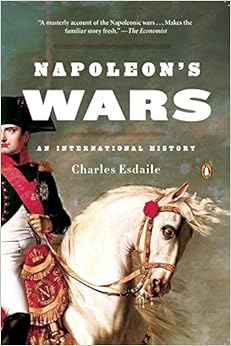
The audio book I'm working out with is Napoleon's Wars: An International History (2007) by Charles J. Esdaile. The focus isn't so much on the man and certainly not on his love affairs (yay), but on the why of the many wars he fought, and how they were won or lost and the consequences of the occurrence, the winning and / or losing, on the larger stage of Europe. Among the useful elements the author stresses is that it wasn't until the second coming of Napoleón during the Congress of Vienna in 1814 that all of Europe and Britain and were united against France. This was the only time during this entire era of warfare that happened. I hadn't quite realized that before.

The first edition (1938), from Secker & Warburg
The current research book is a re-read, for the third time: The Black Jacobins: Toussaint L'Ouverture and the San Domingo Revolution (1938), by Trinidadian scholar, C.L.R. James (1901 - 1989) which is about the French Revolution, Napoleon, England and the Haitian Revolution. The Black Jacobins is the seminal book on Haiti and the Haitian Revolution. Before this book, Haiti and its Revolution had fairly been written out of the history of the French Revolution and Napoleón's Empire. After this book it was no longer possible to discuss either of them without including Haiti and its Revolution. Or, to quote James from his own book, regarding the Haitian slave owners' claim to representational seats in the 1788 Estates-General:
. . . . Full of confidence these slave owners claimed 18 seats, but Mirabeau turned fiercely on them:  "You claim representation preportionate to the enumber of the inhabitants.  The free blacks are proprietors and tax-payers, and yet they have not been allowed to vote.  And as for the slaves, either they are men or they are not; if the colonists consider them to be men, let them free them and make them electors and eligible for seats; if the contrary is the case, have we, in apportioning deputies according to the population of France, taken into consideration the number of our horses and mules?"
In other words the Big Whites, the white slave owning class of San Domingo (as James refers to it, writer in English as he is), claimed population proportional representation for themselves in the Estates-General based on the number of slaves they owned (just as in the U.S. Constitution for the antebellum southern slave owning elite)  -- while denying other property owners seats in the Estates-General because they were "small whites," i.e. didn't own land and slaves, the rapidly growing class of mulattoes, whose wealth in cash, land and slaves was rapidly increasing, and the "black" free people, who were not wealthy and owned no land or slaves.

The upshot was that the San Domingo Big White slave owners were allowed only 6 deputies, while:
" . . . the great Liberal orator [Mirabeau] had places the case of the Friends other Negro squarely before the whole of France in unforgettable words.  The San Domingo representatives realized at last what they had done; They had tied the fortunes of San Domingo to the assembly of a people in revolution and thenceforth the history of liberty in France and of slave emancipation in San Domingo is one and indivisible."
Alas, such attitude lasted for a very short time, as emancipation was not to the taste of those who initially played such a role in France in making the Revolution, the great property owner class, referred to as the Great Bourgeoisie  and particularly the Maritime Bourgeoisie, whose entire fortunes were tied to every aspect of slavery in San Domingue.

This time around understand more clearly I had previously James's assertions that PM Pitt's demand to abolish the European African slave trade was high hypocrisy. By the time of the French Revolution, San Domingue was the most wealth-producing territory on the globe, financing almost all of France with its production of sugar, coffee, cotton and indigo, and the related industries including the slave trade. However, at this time as well, England's India colonies were beginning to be successful producing sugar and cotton, and the workers needed to be paid only a penny a day. San Domingue demanded more African slaves every year to put more of the island into cultivation -- devouring the captives' lives in less than ten years, from overwork, disease, starvation and abuse. By 1789 San Domingue was importing at least 40,000 Africans annually. Pitt's desire to abolish the European African trade was straight up protectionism for English products -- his definition of Adam Smith's "free market" meant eliminating the competition. Previously this had sailed right past me.

This latter, btw, is the book anyone must read before even thinking s/he's going to write anything about San Domingue, Haiti (especially if s/he's never been to Haiti, the Caribbean and doesn't know anyone from these parts of the world) or the French Revolution, whether journalism, history, literary fiction, genre fiction -- anything. For if s/he hasn't read this book s/he is going to make a huge fool of her/himself. This time around I'm reading the second edition (1963), to which James appended his seminal essay, "From Toussaint L'Overture to Fidel Castro."


Is it necessary to add that James was a Marxist in his politics and in his historical perspective? This is why U.S. history departments in the 50's and 60's didn't want him on the syllabus.

Would that all of our books would remain so foundational, so seminal, so necessary, 80 + years after initial publication as The Black Jacobins has.

Hmmm. The library says that Ancillary Sword is ready for pick-up. Will the pages of this novel contain as much excitement as the matters of these books, even though the events -- though not their consequences and effects -- took place so very long ago?. .
Friday, January 30, 2015

Reading History Haul For Frigid Weekend, Historical Fiction and Non Fiction

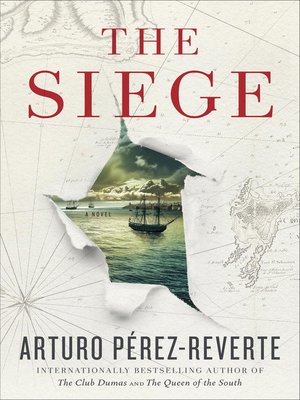
The historical novel first: The Siege (English trans. 2013; Random House) by Arturo Pérez-Reverte.  Pérez-Reverte is the author of the 17th century series featuring Spanish hidalgo swordsman nonpareil, Captain Alatriste.  The Alatriste books' actions are fairly contemporaneous with many of those in Dumas's The Three Musketeer series, during which France and Spain often clashed in battle, particularly in what will become the Netherlands. It's not inconceivable that the fictional musketeers and equally fictional Alatriste may have shared a desperate encounter in the flooded fields of Flanders . . . .

Note: among Pérez-Reverte's previous books is The Club Dumas, the action of which is provoked by " an original handwritten chapter from Alexander Dumas's The Three Musketeers . . ."


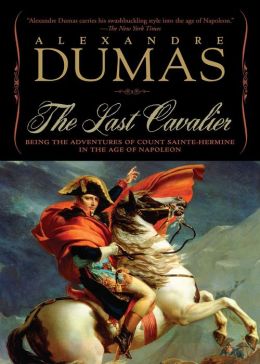
As we all know, Alexander Dumas, after Walter Scott, is the father and godfather of the historical novel, so that is illuminating that The Last Cavalier a/k/a The Knight of St. Hermine, Dumas's long overlooked valedictory novel, deals with Napoleón and his era,


The Siege is set in the Napoleónic era, when Spain and France are again at war. Cádiz has been sieged for year by the French when women turn up murdered. It's up to Police Comisario Rogelio Tizón to investigate. It seems from the cover copy that his investigation will turn up something more than a 'mere' serial killer. This is the first time I will be reading any historical fiction about the Napoleónic wars in Spain written by a Spanish novelist.


The Adams Family is back!  The Remarkable Education of John Quincy Adams (2015, Macmillon) by Phyllis Lee Levin. The title cleverly plays upon the famous Education of Henry Adams, the peculiar memoir-complaint penned by JQA's grandson.  The author drew heavily upon JQA's remarkable journal, which she agrees with us may be the most remarkable historic national document created by any of our Great Men -- or Great Women, for that matter.  Best of all, JQA's wife, Louisa Catherine is front and center.  That she managed to stay living with this impossible -- if brilliant and principled -- man all those years alone makes her deserving of her place in the book.


I also have Eyre Crowe's With Thackeray in America, which contains some of the more famous drawing of slave auctions and so on from the 1853 visit


(Thackeray (author of Vanity Fair -- in which, coincidentally, the Battle of Waterloo plays a significant role -- among other Victorian era bestselling novels) was not impressed with the U.S.).  The book isn't in print these days; the copy I have was published in 1893, however it can be seen online.

Did ever an artist have a more "artistic / romantic" name than Eyre Crowe?

Friday, August 15, 2014

Charlotte Bronte's Shirley -- End Of Summer Reading Historical Fiction

Last night I began to read Charlotte Bronte's second published novel, Shirley (1849).  It seems the perfect novel to carry me through the change of seasons from summer to autumn, both long enough while engaging enough, with several themes.  Not the least of Shirley's engagements is that it presents dilemmas and problems for all the readers -- and even scholars -- who are insistent upon presenting Charlotte Bronte and her protagonists as feminist and politically liberal.


Shirley, though classified as a social novel, is neither feminist nor liberal, particularly in its outlook of Yorkshire textile laborers particularly, or the lower classes in general.  This may explain why Shirley is so unpopular generally with not only Bronte-ists, but those who study the history of the novel in English -- so much so that a surprising number of those who are well educated in The Novel, are unaware that Charlotte Bronte wrote this novel.


The edition I chose to read was not my falling apart Penguin copy acquired a millennium ago while an undergrad, but a newer Penguin edition with an introductory essay (2006) by the excellent Bronte scholar, Lucasta Miller.

The other primary reason I chose Shirley is that as well as being classified as Bronte's only social novel, it is considered an historical novel.  The novel's chronological location is specifically told the reader on page 1 as, "eighteen-hundred-eleven-twelve." I.e., we're in my favorite war (speaking historically), the War of 1812.  Britain, like Napoleon, had levied an embargo upon trade with "America" (which included grabbing every U.S. ship they encountered -- if they could) thus the Yorkshire textile manufacturers, like so many other industrial employers, had closed their mills or greatly reduced activity and workforces.

The narrator so informs us, in a one-sided explanation, on page 25, second


chapter, as spoken by the half French-Antwerpian, Robert Moore, owner of the Hollow's mill:
"I am very rich in cloth, I cannot sell; you should step into my warehouse yonder, and observe how it is piled to the roof with pieces.  Roakes and Perason are in the same condition: America used to be their market, but the Orders in Council have cut that off."


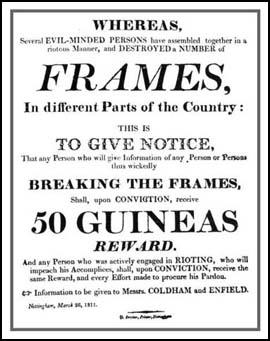
This is the period of the Luddite uprisings, as the manufacturers like Roger Moore, with the capital to do so, are installing more efficient machines that require fewer workers.

Bronte expands on the Orders in Council and unemployment on page 29-30:
"The 'Orders in Council,' provoked by Napoleon's Milan and Berlin decrees,* and the forbidding neutral powers to trade with France, had, by offending the Americans, cut off the principal market of the Yorkshire woollen trade, and brought it consequently to the verge of ruin. Minor foreign markets were glutted, and would receive no more: the Brazils, Portugal, Sicily,**were all overstocked by nearly two years' consumption. At this crisis, certain inventions of the north, which, greatly reducing the number of hands necessary to be employed, threw thousands out of work and left them without legitimate means of sustaining life.  A bad harvest supervened.  Distress reached its climax....
This is the first time I've undertaken a Shirley re-read since having lived in New Orleans and on the Chesapeake, major grounds and objectives for the Brits in the War of 1812.

As for the plan that was to be a reading transition from one season to another -- well, Climate Change evidently made another plan.  When I left for the libary before 10 AM the temperature was 64 degrees.  Big brown leaves were being blown off the plane trees in droves.  This is like no August I've experience here ever.  The long term weather forecasts are saying we're going to continue with temperatures generally lower than usual, November is going to be wet, and winter will began early and be close to the brutal thing is was last go-round.  I'm going to be extra-careful not to catch a sinus infection in November or break my elbow in January as I did last time.

----------------------

*  Napoleon's monstrous egomania and British arrogance were equally responsible for the embargo. All nations' trade was caught between the hammer and tongs of the British and French navies.  Indeed, when Denmark insisted on her right to continue trading as she wished, and an ally with Britain against the French, the British navy shelled Copenhagen, burning much of it to the ground, in 1807.

 ** Not to mention being under siege in one way or another, as with Sicily to where the King of Naples had fled, and Portugal, as part of the very long and brutal Peninsular campaign -- Bronte is frequently hazy, to put it generously, with her information about many aspects that she mentions regarding trade, the military and politics, despite her passion when younger for heroes such as Wellingon and Napoleon. Her forte is the personal, always.

Additionally she was writing this some decades after it took place; she was born when it was all over, in 1816.  Thus Shirley gets classified by some as an historical novel.  I'm not sure I agree, however, any more than I can think of Middlemarch as an historical novel.  Though set in the 1830's of the Reform Movement bills, Eliot, born in 1819, was more than old enough, particularly with her father profession and their common interest in public issues and politics, to remember the time well.  As well, the Reformist movement returned to the public stage in 1860.


Thursday, July 31, 2014

The Fantasy of General Wellington's Invasion in the War of 1812

One of the persistent myths of alternate history fans is that Lord Wellington was asked by the British government to invade the United States from the Gulf Coast in order to defeat the upstart Americans in the War of 1812. [Example here.]

Whether or not there ever was a formal request made by the PM to Wellington, Duke Wellington supposedly declined, without grace or patience. Thus, it is a speculation without content.  It is so counter-factual, in fact, that there is not a single fact out of the period and location, to fuel such useless speculation.

Nevertheless the speculations continue apace, taking it as a given that this general, who was so good at his work that he defeated Napoleón himself in a battle -- a battle, let me haste to say, that didn't take place until after the first abdication of Napoleón, which concluded the Congress of Vienna, in which the surviving powers were wrangling over the division of the spoils of Bonaparte's empire, and Wellington was a primary player.*  With some level-headed dissenters, war gamers tend to believe that Wellington have quickly cut a swathe through the former colonies and returned them to British rule. This fuels ever more extreme counter-factual speculation as how would change the course of world history.

There is not a single fact upon which to build speculations.  In contrast, however,, there are ample facts that strongly suggest that Wellington showing up on the Gulf coast would have been as much a debacle as it turned out for British army general, Edward Pakenham, and British naval commander, Admiral Alexander Cocherane -- and very likely in the same way.

First he'd have had to defeat Andrew Jackson, who knew his territory, as he proved over and over, from the Floridas and the Gulf, all the way up the Natchez Trace and the Mississippi Corridor to Nashville, the water and land routes both, in this vast Louisiana Purchase territory. Whenever Jackson encountered the Brits in the Floridas and the Gulf, he'd defeated them (and hung some, even though it was illegal).  He'd been doing this long before the Battle of New Orleans.

This wasn't Wellington's geography, or the geography of any regular army, as the British learned in the War of Independence.  They occupied all the cities, but it did them no good (except to give contemporary Americans a silly idea of their own competence and exceptional capacity for success purely through the actions of single individuals, conveniently forgetting the essential roles of France in Spain in the ultimate outcome).

There were no places other than New Orleans to re-supply a Wellington army, and it was very far away from the hinterlands. There were no plantations to plunder yet, but those around New Orleans and Natchez. The land was covered in dense forest, swamps, bridgeless rivers and bayous. The American forces were skilled at living rough and at brigandage.  They'd have been at least as fierce a guerrilla third front as Wellington had encountered in Spain, except these would be working against him.

As intensely as Wellington had put himself through a military education he'd surely read the history of the War of American Independence.  As much time as he'd


spent in Spain, he'd surely have at recall the large role Spain's General Bernardo Galvez played in the Gulf Mississippi Valley in defeating the British back then and there, and how easy it was for him to do so, since the British military were not good on that ground. Moreover, now, in the present of the War of 1812, which in any case, as mentioned, was now over, Spain was Britain's ally.

So, yes, there are many facts that show Wellington, if, indeed he was formally asked to fight in North America, made the right decision to stay on this side of the Atlantic, while there is nary a single one to say he'd have met anything but disaster, whether by water, cavalry or infantry.  His artillery would have been as prone to incapacity by corrosion and mud as anyone else's, especially without roads along which to push them.  The horses would die from starvation, and the men as well.

----------------------

Which was a fortunate circumstances for Britain and the rest of Europe, since Wellington was already on the ground in central Europe, where war was resuming, not sitting around uselessly in the Americas, where that war was over. The Treaty of Ghent had been signed December 24, 1814.

Wellington, where he was,  was perfectly positioned to take immediate charge of the British forces and confer with the generals of the other powers' armies during Napoleón's 100 Days: 20 March to 8 July 1815.

Thursday, January 30, 2014

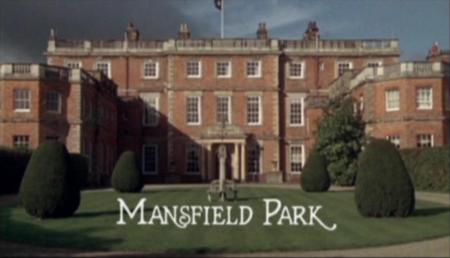
Mansfield Park - The War of 1812 - Louisa Catherine Adams

I had been thinking that while we USians are fascinated with all things Jane Austen, it appears Miss Austen hadn't a particle of interest in the U.S.  The only mentions of the New World, I thought, were in Mansfield Park.


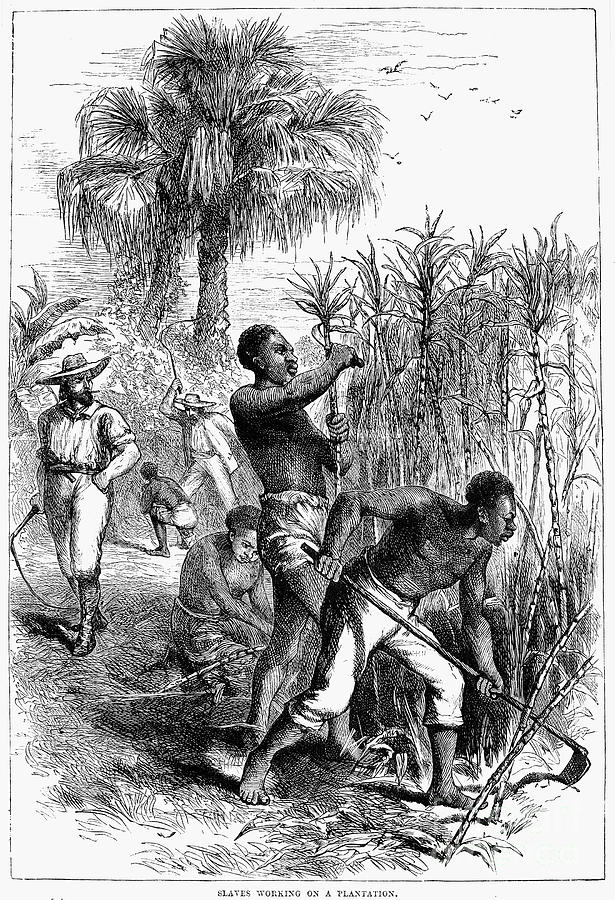
The absentee Baronet Bertram goes, with his heir, Tom, to sort out his plantations in Antigua, which seem to have been badly mismanaged -- which happened with West Indies absentee ownership.


It turns out Mansfield Park also includes a mention of America, meaning the U.S. It occurs after Sir Bertram returns, the amateur theatricals and all its accompanying dramas are put a stop to, and the unwelcome guests prudently depart:

From Chapter XII:
Fanny could listen no farther. Listening and wondering were all suspended for a time, for Mr. Bertram was in the room again; and though feeling it would be a great honour to be asked by him, she thought it must happen. He came towards their little circle; but instead of asking her to dance, drew a chair near her, and gave her an account of the present state of a sick horse, and the opinion of the groom, from whom he had just parted. Fanny found that it was not to be, and in the modesty of her nature immediately felt that she had been unreasonable in expecting it. When he had told of his horse, he took a newspaper from the table, and looking over it, said in a languid way, "If you want to dance, Fanny, I will stand up with you." With more than equal civility the offer was declined; she did not wish to dance. "I am glad of it," said he, in a much brisker tone, and throwing down the newspaper again, "for I am tired to death. I only wonder how the good people can keep it up so long. They had need be all in love, to find any amusement in such folly; and so they are, I fancy. If you look at them you may see they are so many couple of lovers—all but Yates and Mrs. Grant—and, between ourselves, she, poor woman, must want a lover as much as any one of them. A desperate dull life hers must be with the doctor," making a sly face as he spoke towards the chair of the latter, who proving, however, to be close at his elbow, made so instantaneous a change of expression and subject necessary, as Fanny, in spite of everything, could hardly help laughing at. "A strange business this in America, Dr. Grant! What is your opinion? I always come to you to know what I am to think of public matters."
As there are so many Royal Navy figures in Austen's family and her novels this might be thought about a bit. It is generally believed that Mansfield Park was begun in 1811 and completed in the summer of 1813, with a publication in 1814. The U.S. officially declared a state of war with Britain in 1812. *

However, the conditions of war provocation had been place long before 1811, among them the many hostile encounters on the sea between the U.S. and Britain, as part of Britain's high-handed treatment of U.S. merchant ships. The U.S. had no navy, thanks to President Jefferson, who thought without a navy chances for war with Europe were less. Jefferson's administration basically bowed to France -- the U.S. people saw it that way. He embargoes all European trade for the U.S. plunging the U.S. into deep economic depression, particularly outraging the New England mercantile-shipping-banking elite. Ultimately this provoked New England (for the first time, not the last) to attempts organizing secession from the U.S. In the meantime, the west wanted War!  Impressment of sailors from U.S. ships was only a single goad. In most ways the U.S. was in an impossible situation, caught between England and France as both nations demanded the U.S. alliance and support, forbidding U.S. traders to deal with the other or any nation supposedly allied with the other.

The Brits were blockading U.S. ports, as well as those of European nations who wished to trade with the U.S. or France. One consequence as the burning of Copenhagen for trading with the U.S. One of the few nations with whom we could still trade was Russia, where was John Quincy Adams as our minister, who was entrusted to keep that trade open and obtain, hopefully, other assistance as well against England and France. Both France and England felt they needed friendly relations with Russia -- until Napoleon screwed the pooch on that, that is.

In 1812, Madison's administration was pushed by the South and the newer western states into declaring war on Britain: with an empty treasury, thanks to Jefferson's Embargo, no navy, thanks again to Jefferson, no army, thanks to the states' determination to finance their individual militias only and refusal of a draft to make a national army.

So, even before the War began, the U.S. turned to privateering. -- smuggling, of course, went on as it always had.

To the chagrin and shocked disbelief of the Brits, U.S. privateers took numbers of Brit vessels -- even at the entry roads of the Thames and in the English Channel!  (The exact, astonishing large number is enumerated Henry Adams's history of Madison's administrations.)


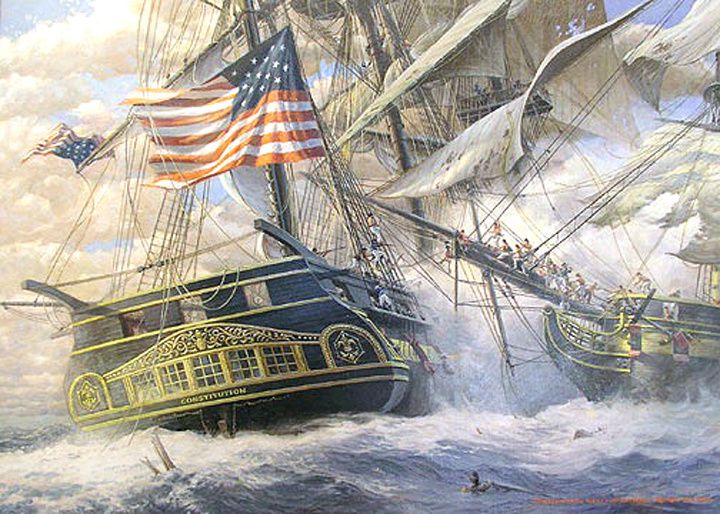
The U.S. ship yards began re-building a navy at a pace the Brits didn't suspect was possible. With the news that the USS Constitution had defeated the His Majesty's Guerriere, there was disbelieving wailing and gnashing of teeth throughout England.


On the shores of the Chesapeake, things were generally better for the Brits (until the Star Spangled Fort McHenry engagement). In August 1814, the Brits fired the government buildings when they took Washington, D.C. (thereby turning the President's Palace into the White House, as the thick white paint of repairs concealed the soot-covered walls) and the destruction of a whole Brit invading army at New Orleans -- which invasion arrives from Jamaica via the navy.

As did France, thus United States filled the English papers while Jane Austen wrote Mansfield Park. a novel that glancingly mentions the War to illustrate another characteristic about Tom Bertram.

In the meantime, Louisa Catherine Johnson Adams was in St. Petersburg, bearing and losing a child, a favorite of both the czar and czarina, while her husband negotiated fishing and trading treaties with Russia. Then in the winter of 1815 she traveled by coach from Russia to Paris, and Napoleon escaped from Elba.

------------------------------

* For a timeline of novel's chronology and that of its composition, go here.

Sunday, January 5, 2014

Louisa Catherine Adams In Winter

Louisa Catherine Adams met John Quincy Adams first in Nantes, when she was four-year-old Louisa Catherine Johnson, and he was twelve.


They met again in London, when he was thirty and she was twenty-two.  She married him, he who had already been a name in diplomacy from D.C. to Russia to Amsterdam and London, who had already experienced multiple perils and adventures.  Now Louisa's perils and adventures began -- starting with her father's bankruptcy and abscondence back to America while she and John Quincy were honeymooning in Scotland.  Her father's bankruptcy not only lost the couple the dowry-allowance Johnson had settled upon his daughter, but the creditors demanded that John Quincy be responsible for Johnson's debts.

In the meantime the couple had spent $2500 -- a very large amount in the currency of the time, and a substantial portion of their bank account -- to send their clothes and belongings to Portugal, where he was posted as minister, only to be told the American government changed its mind and was instead sending him to Prussia. What, what to do.  Somehow they did and become particularly beloved by the Prussian king and queen. Louisa miscarred more than once, which deeply concerned the queen. The queen gifted Louisa with a cosmetic set including rouge, which the Queen insisted she wear, as Louisa was pale from blood loss.  John Quincy scrubbed it off her face himself, her first encounter with the impossible John Quincy, rather than the passionate, poetic, tender JQ she'd heretofore known.  It was only the beginning of the impossibilities.


Perhaps the most impossible thing John Quincy did, while safely ensconced in himself, in France and the Netherlands, negotiating the Treaty of Ghent that settled the War of 1812, was to order his wife off to Paris from St. Petersburg, in the dead of winter, across the smoking ruin that was Europe in the tail end of the Napoleonic wars: hostile, conflicting armies, starvation, disease, desperation, bandits and criminals. Louisa was accompanied by her seven-year-old son, Charles Francis (Henry Adams's father), a man-servant, John Fulling, Madame Babet, a nursemaid hired the day before she departed from St. Petersburg, and Baptiste, a low-ranked prisoner of war who agreed to accompany them in exchange for his freedom. What the EFF was JQA THINKING???????  No wonder within the Adams family Louisa's journey became a thing of growing admiration and legend.  Even she began to see it that way, and was persuaded to commit the experience to paper.

The tale of her perils and her brilliance in extracting her tiny company from them is told by Michael O'Brien in Mrs. Adams in Winter:A Journey in the Last Days of Napoleon (2010).  Like her husband's 14,000 word diary, kept from the time he was twelve, Louisa's travelogue from St. Petersburg to Paris in the winter of  1815 is a unique document in American history. Her family and Louisa were correct,deeming this is one splendid tale.  Most of all, it is a tale of women, and how they do, not only Louisa, but all sorts of women she encounters along the journey.

Serendipitiously that O'Brien's book came as a gift this Christmas.  Like Nicola Griffith's Hild, this is another story centering women that feels so right to read in the dark days of the year, particularly this year that has brought the U.S. and the UK such terrible weather of cold and snow, ice and flood.

Wednesday, October 23, 2013

Book Reading Wednesday - Fanny by Edmund White

Edmund White has written some of my most satisfactory reading experiences of both fiction and non-fiction. Published in 2003, I missed Fanny, doubtless because I had begun the classwork for acquiring my MLS for Information and Library Sciences. I was doing no recreational reading in those years which included a leave of absence from the program to move to New Orleans for the Rockefeller Foundation Award at the Stone Center at Tulane University. There I read for a long research project conducted as an independent study with one my MLS professors, and after that I read nothing but materials connected to both The World That Made New Orleans andThe Year Before the Flood. So, yes, I missed even the news this novel had been published.

Yet, Fanny is filled with all 'my stuff,' so to speak: English Victorian fiction and history; biography; a New Orleans just recently possessed by the Americans; Lafayette's final triumphant tour of a U.S. initiating Jacksonian democracy; a visit to Point Breeze, the estate of of Napoleon's brother, Joseph, who retired himself and very large fortune from France and Europe to New Jersey*; the conditions of slavery through the eyes of someone not of the U.S. -- and how very quickly she adapts to the convenience. This is a fictional biography, narrated in first person, by Frances Trollope, who wrote one of the classic works of earlier America, referred to by all and sundry, English or American, who wishes to write of early America, 


Domestic Manners of the Americans (1832).  It contained some quite unattractive truths about us, highliighting particularly the obsessive masculine habit of spitting tobacco anywhere, everywhere, all the time.**
Frances Trollope wrote other works of non-fiction and well as many novels.  Among her children was the novelist,Anthony Trollope. She is at least partly the model of the novelist forever seeking 'puffs' for her books in Anthony Trollope's novel, The Way We Live Now, considered among his best works. 

However, the real focus of White's Fanny, is not Fanny Trollope, but her friend,


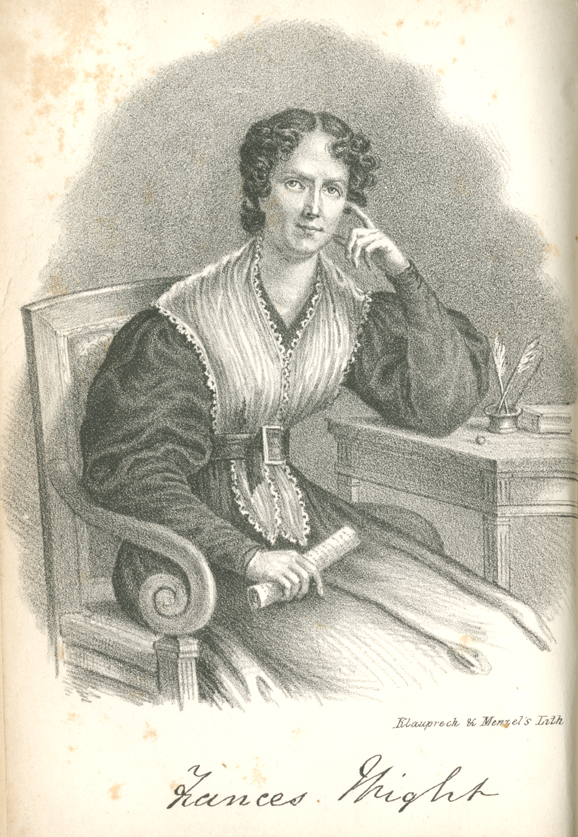
Fanny Wright. Wright's career as a public intellectual - social reformer -- to be such as a woman was a rare thing in those days -- was made initially with her book,


Views of Society and Manners in America (1821). Wright was the one who got Francis Trollope to America to participate in the preposterous utopian Nashoba Commune in Tennessee, from which Mrs Trollope and the children she'd taken with her (Anthony was left at home to starve with his mentally incompent father) was fortunate to escape finally, still alive, but barely.

White's Frances Trollope is revealed as a keen observer of very much, while remaining extraordinarily blind about certain matters most personally close to her.  It's a tour de force of a novel in the sense of observation, sensibility and voice. I enjoyed this very much.  But then, as mentioned above -- this is all my stuff.  

-------------------------------------
*   Joseph financed his move to Breezy Point with the sale of the works of art he plundered from Spanish palaces, castles, monasteries and town halls; his wife, Julie Clary, by marriage with Napoleon's brother, was named Queen consort of Spain and the Indies, Queen consort of Naples and Sicily, and the Comtesse de Survilliers. Her sister, Désirée Clary, six years younger, became Queen of Sweden and Norway when her husband, Marshal Bernadotte, was crowned King Charles XIV John of Sweden (Charles III John of Norway). Their brother, Nicholas Joseph Clary, was created 1st Comte Clary and married Anne Jeanne Rouyer. It paid off very well to marry a Bonaparte.

**  Other Europeans remarked particularly on this habit as well, including famously Charles Dickens in hisAmerican Notes concerning his 1841 visit to the U.S., and his consequent novel, Martin Chuzzlewit, which took on particularly U.S. copyright violations of writers like himself.