LINES OF THE DAY

". . . But the past does not exist independently from the present. Indeed, the past is only past because there is a present, just as I can point to something over there only because I am here. But nothing is inherently over there or here. In that sense, the past has no content. The past -- or more accurately, pastness -- is a position. Thus, in no way can we identify the past as past." p. 15

". . . But we may want to keep in mind that deeds and words are not as distinguishable as often we presume. History does not belong only to its narrators, professional or amateur. While some of us debate what history is or was, others take it into their own hands." p. 153

Silencing the Past: Power and the Production of History (1995) by Michel-Rolph Trouillot

Showing posts with label U.S. Colonial history. Show all posts

Saturday, January 24, 2015

Sons of Liberty - 3 part History Channel Scripted Series

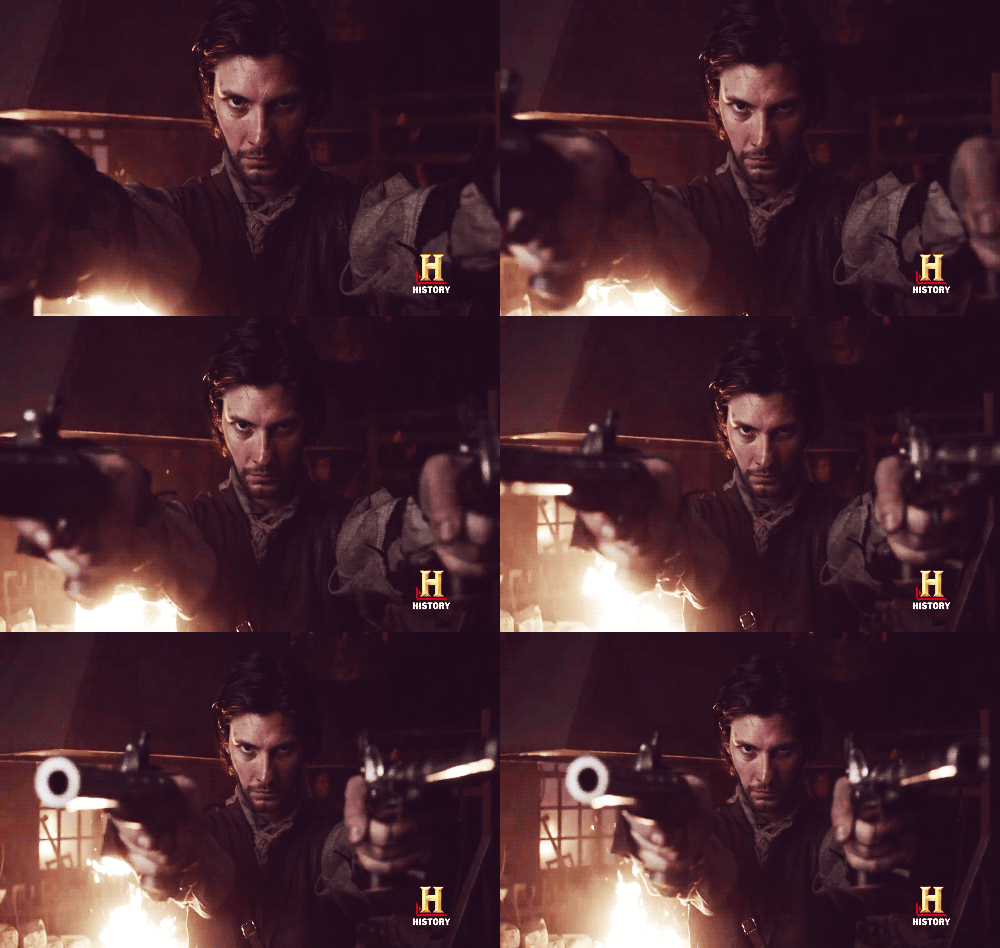
Sons of Liberty is a three-part History Channel scripted series that dramatizes the lead up to the Declaration of Independence; it premieres Sunday night, January 25th.


Well shot, staged and scripted, the sneak peeks look promising for the whole. The primary location is Boston, so there's lots of mob violence, which is more than accurate for Boston and the push to get the Colonies to secede from English Crown rule. This also ensures that Sons of Liberty will be more generally entertaining than was AMC's attempt last year, to make small screen period drama out of our history, the earnestly dull and misfortunately titled Turn: Washington's Spies. (Nevertheless, Turn returns for season 2 on April 13.)

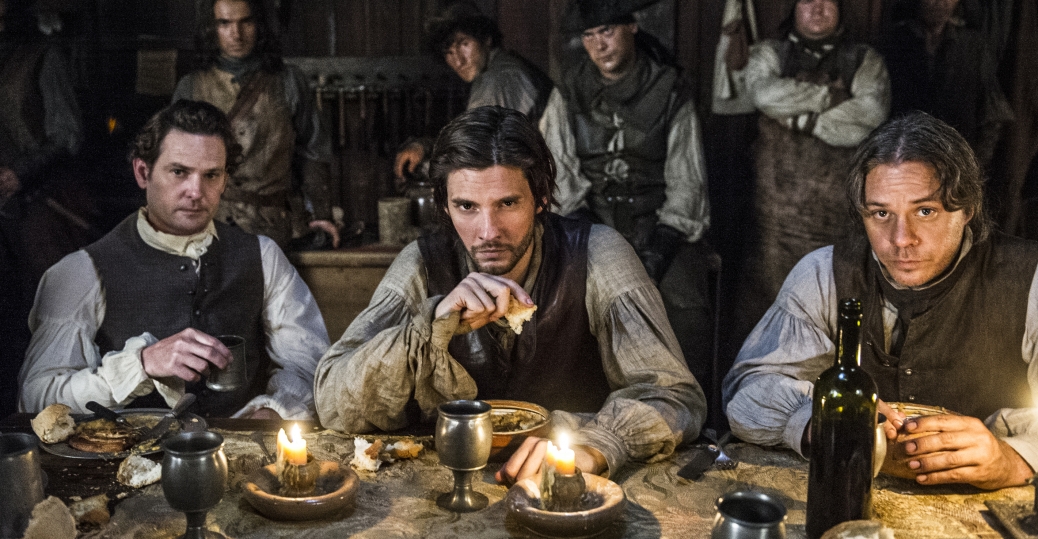
John Adams, Sam Adams, Paul Revere plot secession in a tavern. Though  John Adams didn't do that much plotting, personally, but in other ways he was in, not least since his cousin was one of the multiple-headed plotting hydra, if not the head of the heads.
The central figure in Sons of Liberty, as indeed he should be, is Sam Adams -- John Adams's cousin. With the focus on Boston and Adams's crew, we probably won't see the accompanying agitprop strategies for the South worked out with figures from Virginia and South Carolina -- which included organizing their own tea parties -- to galvanize the citizens generally to raise the cry for secession. Or, maybe we will, since George Washington is among the cast of characters, though Jefferson seems not to be.

George Washington, History Channel's Sons of Liberty
Sons of Liberty seems not to be entirely factually accurate, but at least the historical consultants for the series present the facts in their own video bits, for instance, emphasizing why the Crown put the tax and other regulation on tea, such as only tea from the East India Company and their agents could be sold in the Colonies, in order to bail out the bankrupt Company.  I don't know, however, if the series will also tell us how much every agent in the Colonies depended on selling the lower priced smuggled tea to the financially stressed, always cash-strapped Colonies' women who found the non-taxed smuggled tea to be more than compatible with their household accounts.

It does look from the sneak videos that we will see how little the English Crown and parliamentarians knew about their North Atlantic colonies.  For instance, when reading the documents from the period -- as independent historian Nick Bunker did in his recent study, An Empire on the Edge: How Britain Came to Fight America (2014), many of them seemed not to understand that the mid-Atlantic colonies such as New York, and the New England colonies, were populated mainly by white people with small farms -- completely unlike conditions in their Caribbean sugar colonies.


Sons of Liberty has been criticized in some quarters for casting so many English actors in the leading roles. However, then, one wonders: how much of the history of the Independence movement in the Colonies is understood in those quarters, since, you know, all those personages were citizens of England.  It wasn't until around the Tea Party era that the Colonies's citizens began to refer to themselves as American rather than English.

Appropriately, Sons of Liberty is underwritten at least in part by Sam Adams beer, and it seems, also appropriately, by Rums of Puerto Rico.  It wasn't only tea the North American colonists smuggled at astounding rates, but rum.  There were also the illegal distilleries, particularly in Rhode Island, the English officials were supposed to shut down. And where did Sam Adams et al. plot?  In taverns, of course.  :)

I'm pulling hard that Sons of Liberty be as good as it suggests it can be.  The History Channel's first redeemed itself with The Hatfields and McCoys. It's won famously with Vikings, which is currently my favorite television.  But I know far less about that era, the geography and the figures than I do about the matters of Sons of Liberty, which can make a big difference in how much one enjoys a period series, as shown by the comments by Scandinavian historians who watch Vikings.

So, I'm keeping my fingers crossed.


Tuesday, November 18, 2014

The House of Stuart -- Europe's Most Hapless Monarchs

A new history of England has been published by Allan Lane -- England, as opposed to Britain -- The English and Their History, by the Professor of French


history at Cambridge, Robert Tombs.  It's reviewed in the Guardian - Observer.

From the review, this was particularly striking, studying as we do, so much about the House of Stuart, because of the colonial history section of The American Slave Coast. I must agree with Tombs's assessment of the Stuarts, from Mary Stuart through to


the last Stuart, the popular Queen Anne, who dies from to the complications of bearing 17 pregnancies, without issue, after a short reign (1702 - 1707):
In Tombs’s depiction, the succession of King James VI of Scotland as England’s monarch after Queen Elizabeth’s death in 1603 proved “disastrous” for the English, for in the House of Stuart “the country acquired Europe’s most hapless dynasty”.
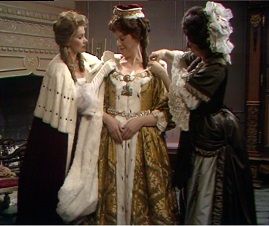
My positive introduction to Queen Anne, as with so many probably, was as royal patron to Sarah Churchill, Duchess of Marlborough, in The First Churchills (1969),


played to such enchanting effect by the enchanting Susan Hampshire.

Queen Anne was played by Margaret Tyzack in The First Churchills.
though, perhaps some put up the Spanish Hapsburgs in competition with that rank, because they fell from the greatest glory, wealth and empire into madness, poverty and backwater isolation.

However, the Stuarts never had any glory, they never had an empire, or even any wealth.  Indeed, they weren't able to even keep their own thrones and countries, most of them. Most of them lived as pensioners upon the largesse of French monarchs, as they begged, gambled and borrowed their way around Europe.


Wednesday, October 29, 2014

Three Reading Wednesdays At Least!

A splendid trio of titles this week: two historical novels and one a studied account of a famous event in literary history.


These are the current trade paper reprint editions from Houghton Mifflin / Mariner imprint that I acquired.
The two historical novels are both by Anya Seton, and both of them are among first historical fiction I read written by women, read in that boundary year between 12 and turning 13, certainly the ones I remember, along with Gone With the Wind.


The Winthrop Woman I read at the lake during the periods I wasn't allowed in the water.  It was among the Book of the Month Club offerings that my mother brought to the annual July sojourns at the Lake. in the vain hope that she'd have so much time on her hands she'd be able to catch up with her reading.


I had already read Gone With the Wind, at the end of spring, just when school let out.  This was from my grandmother's shelves, from where I'd previously appropriated Ben-Hur and Ivanhoe, both of which I'd re-read several times already.

When school resumed in the fall, that year I was bused everyday to Town, where the county public library was located, and for which my mom saw to it I'd gotten my library card as soon as first grade was completed. The library was divided into the juvenile side and the adult side.  It may have been me, but it seemed the division was so strictly observed that surely a lightening bolt would strike -- or expulsion from the library at least -- would ensue if I stepped over that invisible line.  But now I was a freshman (rather early but I'd been skipped a grade), maybe I could sneak across that line and browse among the mysteries those adult shelves held.

Sure enough, on one of those first explorations I discovered Seton's Katherine.  I no longer recall whether I was aware that the same writer was responsible for both novels -- it's quite likely that I was not.  But I do recall in detail that book -- a dull green library binding, with darker letters spelling out the title.  It was a fat book too, and I'd already associated a fat book with an exciting read back in time. Why this particular book with dull covers (only the latest books acquired possessed the colorful dust jackets, preserved in see-through plastic) got my attention, I no longer remember.  It's not as though Katherine was even a girl's name I liked, surrounded at that time by a number of bullying Kathys, and attracted as I was to exotic women's names such as Deirdre and Charlotte.

But devour I did Seton's imaginative creation out of the few facts known about Katherine de Roet - Swynford, and finally Duchess of Lancaster and ancestress of English Kings.  This is where I first encountered the existence of John of Gaunt, Duke of Lancaster, Geoffrey Chaucer, England's alliance with Portugal and her national fortune founded in wool, and a great deal more about the middle ages in England that have interested me every since.  I puzzled over the differences between this Middle Ages and that of Sir Walter Scott's Ivanhoe.

So, I  learned there were chronological, i.e. historical differences -- periods -- even within a the demarcation of the Middle Ages of my history classes. I also noticed -- vaguely! --  there seemed differences in stories of a woman as the eponymous title of a novel, from those of an eponymous novel written by a man with male hero.

Oddly, I did know the meaning of "eponymous" at that age, another of the random bits of information gleaned from omnivorous reading and The Book of Knowledge volumes'  literature sections.  Yet, while had noticed the author of Ivanhoe was a man, I'm still not sure I actually noticed that Seton was a female -- partly because I was distracted by the "Anya" -- what kind of name was that?) I did not notice however, that I thought of both Ben-Hur and Ivanhoe as heroes, but I did not think of Katherine as a heroine.  She was "just" a woman, though fascinating.  unlike, any women I knew, in a milieu I did not understand, but which glowed with the colors of the frequent jewels described the narrative. By comparison, Elizabeth Winthrop and her colonial Puritan world were close and familiar.

Yet Katherine wasn't entirely unlike women I knew, or at least knew of, during her poverty stricken years, as depicted in Seton's imagination, married to the knight Hugh Swynford.  She was left alone to manage on a poor country estate, to make do with little, while trapped in marriage with a man she did not like, forced to have his children. That was my take-away from the novel from the reading back then.

However, I'm not certain that's what Seton actually wrote in Katherine. I began reading Katherine last night, and so far, I'm still very impressed with the book, though perhaps in a different way than the 12 year-going-on 13 me was.  Yet, in the end, Seton's writing is creating the same effect -- constant page turning to follow the journey of this most sympathetic and interesting of heroines.  The novel opens when Katherine's 15;  as far as I got last night, though married, she's still only 15. I can't wait to learn what comes next, and how it compares -- and / or contrast -- with what I remember.

There isn't anything more satisfying to read than a good historical novel.


The non-fiction title among the three books this week is The Immortal Evening: A Legendary Dinner with Keats, Wordsworth and Lamb by Stanley Plumly. This is one of the events in the history of English Romantic Literature that profs of our graduate seminars liked to refer to.  Now a whole book has been published about it.  It looks good, because in that company, how not?

Tuesday, September 16, 2014

Buckskin Breeches

My only claim to productivity today is I have learned about the deer skin trade of colonial Carolina and territories, where it went, and the market for it.

It was indeed huge.

Partly it was driven by the crash in beaver furs -- which happened in the New World as it did in the 16th century in Europe, due to over-hunting.  So something  had to come to take the place of beaver to signify rank and fashion,


Cocked hats were buckskin -- if I'd thought of them at all as to materials I would have assumed wool ....
especially in (men's) hats.  Deer skins, i.e. buckskins, played that part.  Not to mention his breeches, his gloves, the bindings of his books, and many other items of clothing and personal use signifying "gentleman."

Do I need to say that by 1750 the deer trade also collapsed to the regional scarcity of the animal by then?  As had, not coincidentally, the trade in slaving Native Americans to the Caribbean, as the population of many of the tribes that had extensive contact with the Europeans in the territory collapsed.

Wednesday, September 10, 2014

Reading Wednesday: Baronet, Robert Mountgomery, Scotts Traders, Colonial Carolina + Dreams of Azilia

I feel fairly safe in assuming that no one else on this Reading Wednesday will be


commenting on a work even vaguely resembling this one, what these days we'd call a prospectus for real estate development:

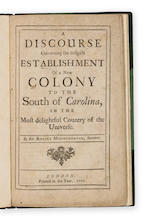
Robert Mountgomery.  London, 1717. A discourse concerning the design’d establishment of a new colony to the south of Carolina.  "A plan representing the form of settling the districts, or county divisioins [sic] in the Margravate of Azilia.”


Needless to say, the entire discourse is a crazy quilt of fantasy and outright lies, written by a person who had never been to the New World, much less this territory:

Nor is it probably necessary to mention that the Margravate of Azilla never existed -- just one more of the many feudal fantasies of of those who thought they could create entire kingdoms for themselves in this territory.  What is even more interesting however, is this may be the first of the very many southern fantasies that have their inspiration in imaginary Caledonian history, from Sir Walter Scott's medieval romances, to the invented discovery of the verses of Ossian, written by a James Macpherson


(President Buchanan's lover, the wealthy Alabama planter - slaveowner, William Rufus Devane King, 13th Vice President, read him Ossian's lines during their domestic evenings together in D.C.; his plantation was located near Selma, AL, named for Ossian's Songs of Selma), to the fantasy origin


story of the Ku Klux Klan in the novels such as The Clansman: An Historical Romance of the Ku Klux Klan, by Thomas F. Dixon

Instead of noble settlers peacefully overseeing laboring forces of Africans forced out of their homes to the New World, what was gotten in these territories during the 17th century and well into the 18th, were many, often Scots, traders, who worked closely with the native tribes of what now are the Carolinas, Georgia, Alabama and even into Mississippi.

Their first main product was deer skins -- for which, as far as I've been able to determine, the British army had constant use, though for what, I'm not sure.  I've read things that hint one of the uses was perhaps as the inner trouser legs and seats for the cavalry, but am not about to swear to that.

Quickly, their second primary product, and far more lucrative, was Native Americans, sold into slavery, mostly to the Caribbean, particularly to Barbados -- Carolina's "mother" homeland colony (as Georgia became Carolina's colony, finally -- the buffer between variously the French or Spanish Floridas, to where the enslaved Africans hied themselves from the coastal Carolina plantations, as soon as the Carolina settlers of Charles Town found out they could grow rice along the coast and the islands -- once they brought Africans who knew how to do it, to do it. There the escaped prisoners built free villages (called marronage villages), intermarried with natives, were sustained by the Spanish in particular as buffers against South Carolinian invasion from the north, and often taken into the military, given rank, arms and training.  (Quite a few already had the training, being pows sold by their African enemies into slavery.)  The very idea of African armed soldiers sent Carolinians into a frenzy of outrage, terror and hate from the very first days.

Their terror and hate did not prevent them however, from continuing to do with the Native tribes exactly what the Europeans were doing in Africa: pushing constantly at divide and conquer, provoking wars, in order to easily acquire coffels to sell off at Charles Town to ships that would the prisoners to the Caribbean or Mexico -- even, occasionally to South America.

This accomplished several missions for the traders and the Charles Town factors simultaneously: made money -- good money, in fact -- and was part of the process of the long term goal which was depopulate these extensive regions entirely of Natives all together.

Thus this long history of South Carolina's Indian Wars, which until recently, with the post modern re-examination of our nation's history with the First Peoples has been fairly ignored outside of South Carolina. One can speculate this is so because Calhoun and his South Carolina's political heirs' fundamental role in secession and making the Civil War has overshadowed her history with the Indian trade as national historical interest.

In fact, there were only two reasons South Carolina ever ratified the Constitution.  First, because it felt it needed help with wiping out the Indians -- it needed the U.S. Army, as her militia's job was to keep the African labor on the plantation and guard against uprising.  The second was getting the 3/5ths clause inserted into the Constitution, which allowed them to vote their wealth, which was valued in slaves -- and because there were no words about slavery in the Constution itself.

Once Andrew Jackson had crushed the tribes for once and for all, South Carolina no longer had any use for the federal government and began agitation for, what, in South Carolina's history, would be thought of as her second secession, or second Independence.

The first secession or independence was dumping the Lords Proprietors's authority decisively back in in 1719.  (Let us not forget these Lords were useless, impractical and supremely ignorant of the lands that they supposedly governed. Thomas Miller, overthrown by the coastal elite was the last appointee the Lords ever made.)

There were many, and even contradicting, reasons for ridding themselves the Proprietors, of course,  However, the Carolinian elite, from the beginning, with so many Scots and Irish among the traders and factors of Charles Town (it didn't become Charleston until after Independence) never had any use for government for anything -- except for war, and only a war that was conducted on the behalf of their own interests.

Naturally the Native tribes changed sides constantly among three colonial powers vying for control of North America, control of the Indian trade, and control of Indian lands. England's protection of the Indian lands for sake of the furs put the the North American colonists' demand for the Indian lands at loggerheads with England, even before the French and Indian Wars of the 1754 - 63.  In the meantime, from as far as our digging has been able to determine, the tribes were always ready to betray each other, and sell each other off to the traders, for the sake of guns and powder and European consumer goods. At times, when they went to war on the colonists, they were as vicious in the torture of the white prisoners as they were to each other.

Thus, the terror of Indians that haunted the Carolinians until after the days of Jackson, just as Haiti and armed Negroes did, and still do, for that matter.

Simms's home near Barnwell, SC -- Barnwell is a name all over the early history of South Carolina, as well, of course in the history of SC and Secession.


An illustration to Simms's The Yemassee.
See: The Yemassee. A Romance of Carolina (1835) by William Gilmore Simms. This is an historical novel of the Yemassee War of 1715-17, when the Yemassee, supposedly allied with the Spanish and other Native tribes -- and supposedly, African marroons, attacked South Carolina's colonial settlements.  It could only be written partly during the tragedy of Indian removal was in progress that today is known as the Trail of Tears.

The reading of this astonishing document from the colonial past, A discourse concerning the design’d establishment of a new colony to the south of Carolina, is because it's part of the documentation for the South Carolina history in The American Slave Coast. For some reason the colonial history of South Carolina prior to the rise of the great rice plantations on the coast and lowlands has been little noticed in the narrative of our nation's colonial development -- unlike Virginia's and Massachusetts's.  Of course South Carolina's own state historians know all this and have been documenting it carefully, even in those days, but an historian is going to have do a long, laborious manual search among the myriad of South Carolina's historical magazines and journals to find the sources for it.*

However, the story of these traders, who were the real reason Charles Town managed to exist for so long, is very long and fascinating all in their own right. It does give me shivers to know these men were covering all this region even before New Orleans was founded. They were very, very, very tough -- imagine, all this vast region was mostly covered in forest, through which they traveled thousands of miles, by foot mostly, by pirogue or horse when possible --  and as greedy and immoral as frackers are in our day.

-------------------------

*  The longer I'm at this history game the more impressed I am by the local historians of anywhere and any era, who are by-and-large, unknown, unsung. They have performed the most valuable, fundamental work for any sort of history.

Of course, until perhaps well into the 20th century, these men -- and yes indeed they were almost ALL men -- were people of leisure, due to either or both class and fortune -- as well as gender.  They possessed the education for this work. They could afford materially to do this work. They could afford to travel to see documents and to buy them. They could even afford to pay someone to perform some of the most tedious parts, such collating gathered information, do endless copying of drafts, and even pay to have the finished product published. No one else were so privileged, not even the mothers, daughters and wives of their own class and means -- women had other work to do, and generally did not have the education.

Wednesday, August 27, 2014

Reading Wednesday: Horne, Crane, Gabaldon, Harkness

This is an unusual week in that as well as a new study of slavery in colonial North America, I read two novels.


The Counter-Revolution of 1776: Slave Resistance and the Origins of the United States of America (2014) by Gerald Horne (New York University Press), covers in granular detail part of what we look at in The American Slave Coast -- that among the driving forces of the American War of Independence were fear of abolition on the part of the southern elite slave holding class, and lust for Native land on the part of both north and south.


El V's and my bedtime read-aloud book has been  The Southern Frontier: 1670 - 1732 (1929), * by Vernor W. Crane (Ann Arbor Press, University of Michigan), a history of South Carolina's traders, who were instrumental in the enslavement of Natives. The Nativeswere mostly sold to the Caribbean, particularly Barbados, in the 17th and earlier 18th century. This accomplished three of the objectives of South Carolina as a colony: to make money, get labor and remove Indians via enslavement and war from the western lands.  Hopefully, all of it to the eastern bank of the Mississippi would be South Carolina, filled with plantations worked by slaves.  These slaves were far and away preferred to be Negro slaves -- Africans -- rather than Natives, because the Natives could escape too easily to friends and relatives in the wilderness -- even up to French Canada.

This aspect of colonial slavery is something not much looked at, as part of what the goals of South Carolinians were from the beginning of the colony, which was always envisioned as a slave-based feudal economy and society. Horne doesn't look at it (as being outside the scope of his own work?  As Crane's work is cited in Horne's own).  However, his arguments are sound around the fundamentals of the Seven Years War or the French and Indian War as it was called here, base the causes of it on 1) fear of Catholic interference with slavery (Spain and France) and, 2) demand to rid themselves of Natives, for their land and because they, like Spain and France -- and England too, often, (which is where his argument gets contradictory and fuzzy at times) -- allied with "Africans" for rebellion and to take the colonies from white Englishmen by conquest.

I still have this 1992 copy.
It had been years since I last re-read Diana Gabaldon's Outlander (1991).  I was prompted to do so again by the Starz miniseries based on Gabaldon's novel -- which was a sensation when published. I wish I had been able to edit the ms. There are glaring inconsistencies that shouldn't be in there.  I won't say what they are in case of spoilers, as the television miniseries is still in progress, with this one exception, which was "fixed" in the premiere episode of the television series:  In the novel takes Frank to tell Claire that it is blood on the stoops of the houses in the village where Claire and Frank are staying -- Claire, a WWII field triage nurse doesn't recognize blood when it's there, and needs a non-medical fellow to tell her this?  Why these crazy inconsistencies are in the published novel I cannot figure out.  At the time of publication there were many interviews and stories about Outlander as a phenomenon, which both the agent and the purchasing editor recognized it would be.  So it's not as though it was published as a throw-away.  (I was working in publishing then, so I got, heard and read all the industry scuttlebutt in those days.)  However, what probably matters most, is that the vitality of Claire's character, and her relationships with both her husbands, remain plausible, thus deeply interesting and satisfying.

Oddly enough though, Outlander's dealing with the deeper questions of time


travel is more satisfying than is The Book of Life (2014), the conclusion of Deborah Harkness's All Soul's Trilogy. In the first two novels Harkness brought up so many deep questions between what makes life and the nature of time, and there is a great deal of time travel too. This is what lifted her series out of the commonality of most fantasy fiction, particularly fantasy fiction that features witches, demons and vampires.  She was using fantasy tropes to delve into serious scientific questions.  But she drops all these matters in The Book of Life in favor of the usual business of which alpha is the most alpha of all, and saving the world for supernaturals.  Deeply disappointing -- and rather dull too.  The saving grace for The Book of Life is, as in the previous books, the purely delightful witches' house.  This is the most mysterious and wondrous element of the series.

This failure on the part of Harkness has to considered in light of her position, according to wiki:
professor of history and teaches European history and the history of science[4]at the University of Southern California.[5] She has published two works of historical non-fiction, John Dee's Conversations with Angels: Cabala, Alchemy and the End of Nature (1999) and The Jewel House: Elizabethan London and the Scientific Revolution (2007).[5]
Gabaldon is a scientist: her MS in Marine Biology, Ph.D. in ecology, and was a university professor also, before becoming a full-time writer.

Ah well, I'll contemplate these matters under my Colombian sun shade hat, while I walk in the 90 degree muggy noon heat up to Union Square's Farmer's Market for peaches (even the local peaches are fabulous this year) and whatever else catches my fancy.  Then -- a chocolate dipped Dairy Queen. Fortunately, the only Dairy Queen in NYC, is on 14th Street too, a couple of blocks west of Union Square. This may be the last day of summer here ....

-----------------------

 *   Such magnificent work these earlier generations of professors and scholars accomplished in those days -- without internet, databases (just bibliographies!), google, any of the tools that has so transformed historical research in the last two decades. Among the many benefits these digital tools have bestowed is how much more possible it is to be an independent scholar, rather than on a faculty as a tenured professor. Which is fortunate too for scholarship, as there are fewer and fewer tenured faculty for history departments everywhere.  On the other hand these former scholars didn't live through publish or perish, and had a much more leisurely academic round than the changes brought to faculty and scholarship that were wrought post WWII -- and now to the point that faculty are hardly thought to matter -- any more than the students are thought to matter, other than cash cows to be milked for the real business of the academy now -- real estate moghulship.