These identical, white, elongated, three-bladed turbines give the impression of aliens, perhaps out of the imagination of H.G. Wells. Studded throughout field after field of perfectly identical GMO-ed corn rows of exactly the same height, with off in the distance the occasional farmstead turned resolutely from the interstate, wrapped in protective stands of trees, I swore this was a mm sf novel cover from the mid-1960's.
Showing posts with label sf. Show all posts
Wednesday, October 5, 2016
Meadow Lake Wind Farm - Chalmers, Indiana
. . . During our drive from Chicago to Columbus, IN, we drove through the Meadow Lake Wind Farm.
These identical, white, elongated, three-bladed turbines give the impression of aliens, perhaps out of the imagination of H.G. Wells. Studded throughout field after field of perfectly identical GMO-ed corn rows of exactly the same height, with off in the distance the occasional farmstead turned resolutely from the interstate, wrapped in protective stands of trees, I swore this was a mm sf novel cover from the mid-1960's.
Thursday, August 4, 2016
Orphan Black - Season 4 - No Spoilers
Orphan Black's 4th season is just available from Netflix DVD. Yes, I binge watched the whole thing. That was that tense and suspenseful -- and interesting.
It was an excellent season, and way darker in some ways than the others. Alison's dire straits weren't dark or otherwise comic relief, though Donny did his best to sub for that, and in an odd way, so did Helena as she subbed as Alison when the cops come to the Hendricks'. There were no Klone Klub Kumbya scenes of eating, dancing, drinking and / or reunion.
![]() |
| One way MK makes sure nobody sees her face. Appropriately this summer was also Dolly the Sheep's birthday, though she died early of complications that turn out not to have anything to do with being cloned. Her own clone daughter-sibs are doing fine. |
The new Leda clone, MK's still out in the cold and evidently dying.
![]() |
| Helena, eating for two and three. |
Helena's still out there in the wild. But though it may be cold she's not out in the cold, so to speak.
![]() |
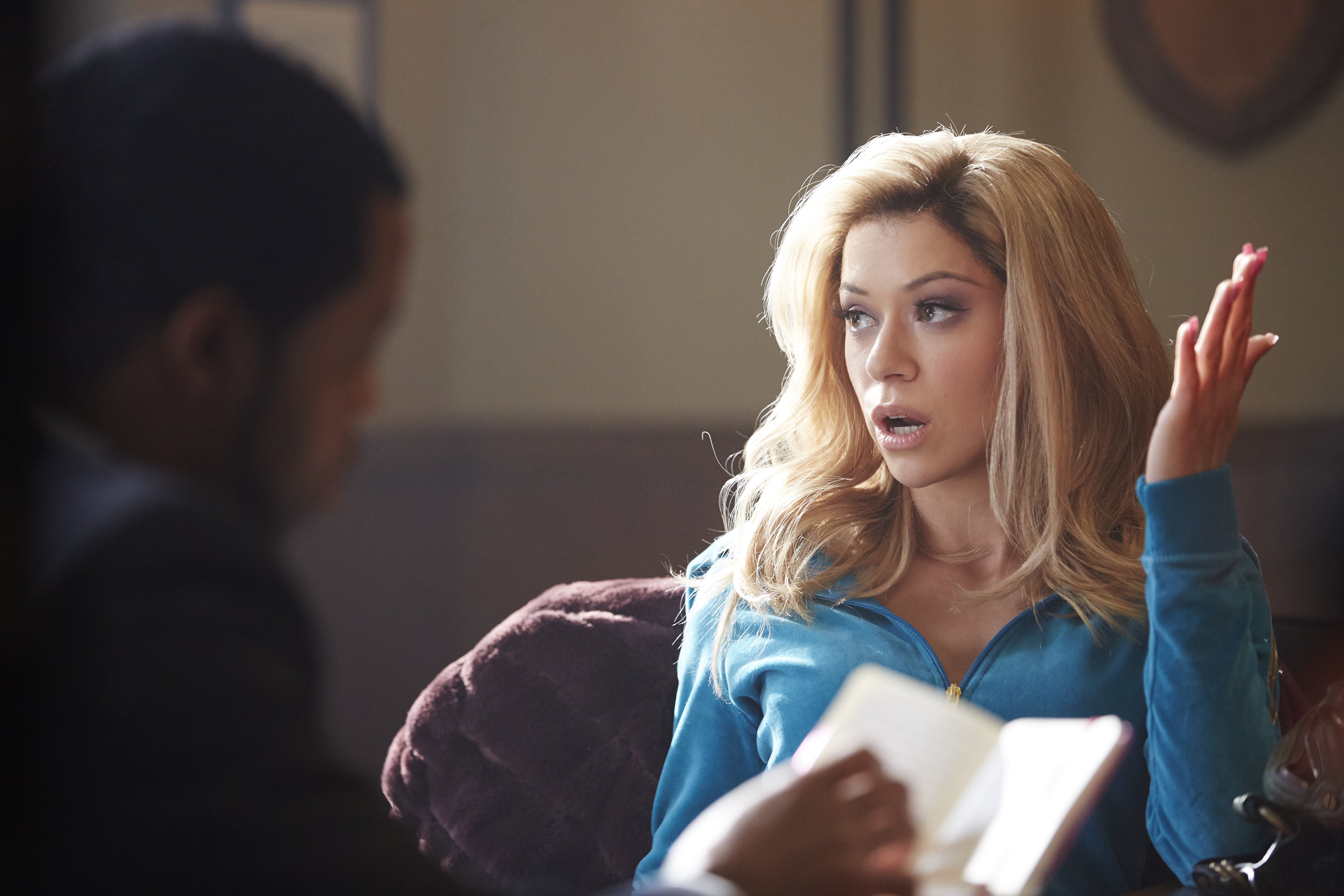
| Krystal explains what's going on. |
Krystal, introduced in season 3, flatly dismisses she's related in any way to Sarah. Instead of Kumbya / reunion, the season finale ended on a bloody cliff hanger.
There was so much to appreciate. Among my particular appreciations is how the writers redeemed sticking in the seemingly useless (innocent, Neolution calls the unaware cloines) and dim Krystal, who isn't really dim at all. Or useless. Takeaway here: don't ever think women who work in the beauty industry not bright! Krystal provided the comic relief in this season, while authentically a Leda. She's a spectacularly successful character, i.e. yet another unique Leda, herself and herself only, entirely different from the others, yet a Leda like the others. She's even voluptuous in figure in the classic va va voom manner (and mannerisms) that Sarah isn't, just as Cosima is ill-thin, as Sarah isn't.
This season Maslany, particularly as Sarah, Alison and Krystal, looked stretched, i.e. exhausted, as well she might be after 4 full seasons of doing what she does. I'm so glad the producers et. al are being smart and cutting it off after 5 seasons. It is enough. Any more will ruin what they made, the very best Science Fiction ever to hit the screen, filled with meaningful content while vastly entertaining, and with a great actor.
And let us not forget Maria Doyle Kennedy. Has there ever been an actor who is so convincing carrying a rifle, threatening torture -- and doing it -- and being the nurturing, caring and even strict mom, all at the same time? Gads, she's good. The show would be so much less without her. Also less without the actress who plays Sarah's daughter, Kira.
I do hope the final season will provide an explanation for Kira's visions, clarivoyance and her particular connection with the clone sistrahs and their whereabouts and feelings. And that season 5 finds more to do for Felix instead of side-lining him via a went nowhere subplot of his biological sister -- who naturally found herself veddy outside Fe's real family . . . .
I read a lot of commentary and recaps online while season 4 was broadcast on BBC America, to which I have not access. After seeing it myself now, what's interesting to me, in terms of the writing, is that while I'd seen all the previous season, nothing commented on, discussed and recapped about Season 4 made any sense until I was able to watch it myself. Then, watching it, it all made sense (mostly :) ).
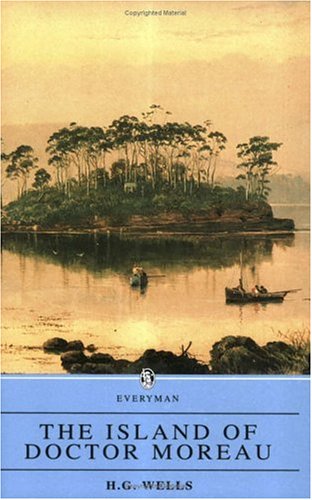
There was a bit -- a very bitty bit -- in one of the last episodes, when Cosima arrives at Dr. Susan's Duncan's house, where she's on a sofa, a glass of red wine in hand. "Welcome," she says, "to the Island of Dr. Moreau." Or something like that -- I don't recall the exact words other the "welcome," "island," and "Dr. Moreau" ones.
Is this telling us what and where will be centered the action of the final season, season 5?
If so, that's pretty darned cool. Actually, if Dr. Duncan's Island of Dr. Moreau reference doesn't mean anything more than what it signifies in that brief bit, it's also very cool.
There was a bit -- a very bitty bit -- in one of the last episodes, when Cosima arrives at Dr. Susan's Duncan's house, where she's on a sofa, a glass of red wine in hand. "Welcome," she says, "to the Island of Dr. Moreau." Or something like that -- I don't recall the exact words other the "welcome," "island," and "Dr. Moreau" ones.
Is this telling us what and where will be centered the action of the final season, season 5?
If so, that's pretty darned cool. Actually, if Dr. Duncan's Island of Dr. Moreau reference doesn't mean anything more than what it signifies in that brief bit, it's also very cool.
Good writing, writers of Orphan Black. You get to do it one more time. Imma lookin' forward.
Tatiana Maslany -- get some r 'n r, plus zzzzzz's, OK?
Wednesday, April 22, 2015
By Way of Reading Wednesday and Earth Day - Jan Morris
Jan Morris has long been one of my favorite writers who explores time and spirit within ancient, rooted places. She has had a long career as a novelist, journalist and 'place' writer; Morris tends to object to the catch-all term, 'travel writer' applied to what she does, which is staying in a place, not moving from place-to-place. If there is any writer who appreciates this planet and the vast cultural variety that earth's places have produced, it's Jan Morris.
Fortuitously there's a new interview with her up on the Guardian, that provides a verbal portrait of this very sharp, penetrating, sympathetic, observant human being. It can be found here.
I first discovered her when reading as many histories of Venice as I could find and had time for prior to my first visit there -- not el V's first visit, of course.
In certain circles her novel located the imaginary small country and its same-named capital, and Last Letters from Hav (1985) and the sequel section, Hav of the Myrmidons of the 2006 reprint, is her most admired book. When asked here about Venice's influence on these two books she says:
Do you see your novel Hav as a fictionalisation of your experiences in Venice?
As to the flavor of that insignificant but most important place on earth to those who live in Hav, here's a bit from a Guardian review by Ursula K. Le Guin of the 2006 imprint:
This capsulates the admiration of this work of Morris's I felt from the moment I encountered it in the 1980's (when, perhaps not coincidentally I also discovered Fernand Braudel magnificent, ground-breaking histories of the Mediterranean regions and their hinterlands). This also explains why it feels on Earth Day, as we admit slowly to ourselves that our efforts on our planetary home may well have made it unhabitable in the not at all distant future, Hav is a read for today.
Fortuitously there's a new interview with her up on the Guardian, that provides a verbal portrait of this very sharp, penetrating, sympathetic, observant human being. It can be found here.
I first discovered her when reading as many histories of Venice as I could find and had time for prior to my first visit there -- not el V's first visit, of course.
![]() |
| This 2006 edition of Last Letters from Hav has an introduction by Ursula K. Le Guin. |
In certain circles her novel located the imaginary small country and its same-named capital, and Last Letters from Hav (1985) and the sequel section, Hav of the Myrmidons of the 2006 reprint, is her most admired book. When asked here about Venice's influence on these two books she says:
Do you see your novel Hav as a fictionalisation of your experiences in Venice?
"No, unless subconsciously. I think places like Trieste, Beirut or Danzig were probably more in my mind when I threw myself into that fantasy, but most of it was, as far as I know, pure invention – ooh, but now I do distinctly remember plucking an electric ferry-boat directly and shamelessly from the harbour of Bergen, in Norway, and depositing it in Hav … Forgive me!"
As to the flavor of that insignificant but most important place on earth to those who live in Hav, here's a bit from a Guardian review by Ursula K. Le Guin of the 2006 imprint:
When Last Letters from Hav was published (and shortlisted for the Booker prize) in 1985, Jan Morris's well-deserved fame as a travel writer, and the unfamiliarity of many modern readers with the nature of fiction, caused unexpected dismay among travel agents. Their clients demanded to know why they couldn't book a cheap flight to Hav. The problem, of course, was not the destination but the place of origin. You couldn't get there, in fact, from London or Moscow; but from Ruritania, or Orsinia, or the Invisible Cities, it was simply a matter of finding the right train.However, Le Guin's recognition that Hav inhabits the imagined geography of Ruritania, doesn't prevent her from understanding where else, and perhaps more importantly, Hav is located -- including within time, within history:
Probably Morris, certainly her publisher, will not thank me for saying that Hav is in fact science fiction, of a perfectly recognisable type and superb quality. The "sciences" or areas of expertise involved are social - ethnology, sociology, political science, and above all, history. Hav exists as a mirror held up to several millennia of pan-Mediterranean history, customs and politics. It is a focusing mirror; its intensified reflection sharply concentrates both observation and speculation. Where have we been, where are we going? Those are the questions the book asks. It poses them through the invention of a place not recognised in the atlas or the histories, but which, introduced plausibly and without violence into the existing world, gives us a distanced, ironic and revelatory view of everything around it. The mode is not satiric fantasy, as in the islands Gulliver visited; it is exuberantly realistic, firmly observant, and genuinely knowledgeable about how things have been, and are now, in Saudi Arabia, or Turkey, or Downing Street. Serious science fiction is a mode of realism, not of fantasy; and Hav is a splendid example of the uses of an alternate geography. If, swayed by the silly snobbery of pundits as contemptuous of science fiction as they are ignorant of it, you should turn away from Hav, that would be a shame and a loss.
This capsulates the admiration of this work of Morris's I felt from the moment I encountered it in the 1980's (when, perhaps not coincidentally I also discovered Fernand Braudel magnificent, ground-breaking histories of the Mediterranean regions and their hinterlands). This also explains why it feels on Earth Day, as we admit slowly to ourselves that our efforts on our planetary home may well have made it unhabitable in the not at all distant future, Hav is a read for today.
Tuesday, August 12, 2014
Continuum - Season 3
As of last night's dinner-preparation hour I'm nearly half way through watching Continuum's third season.
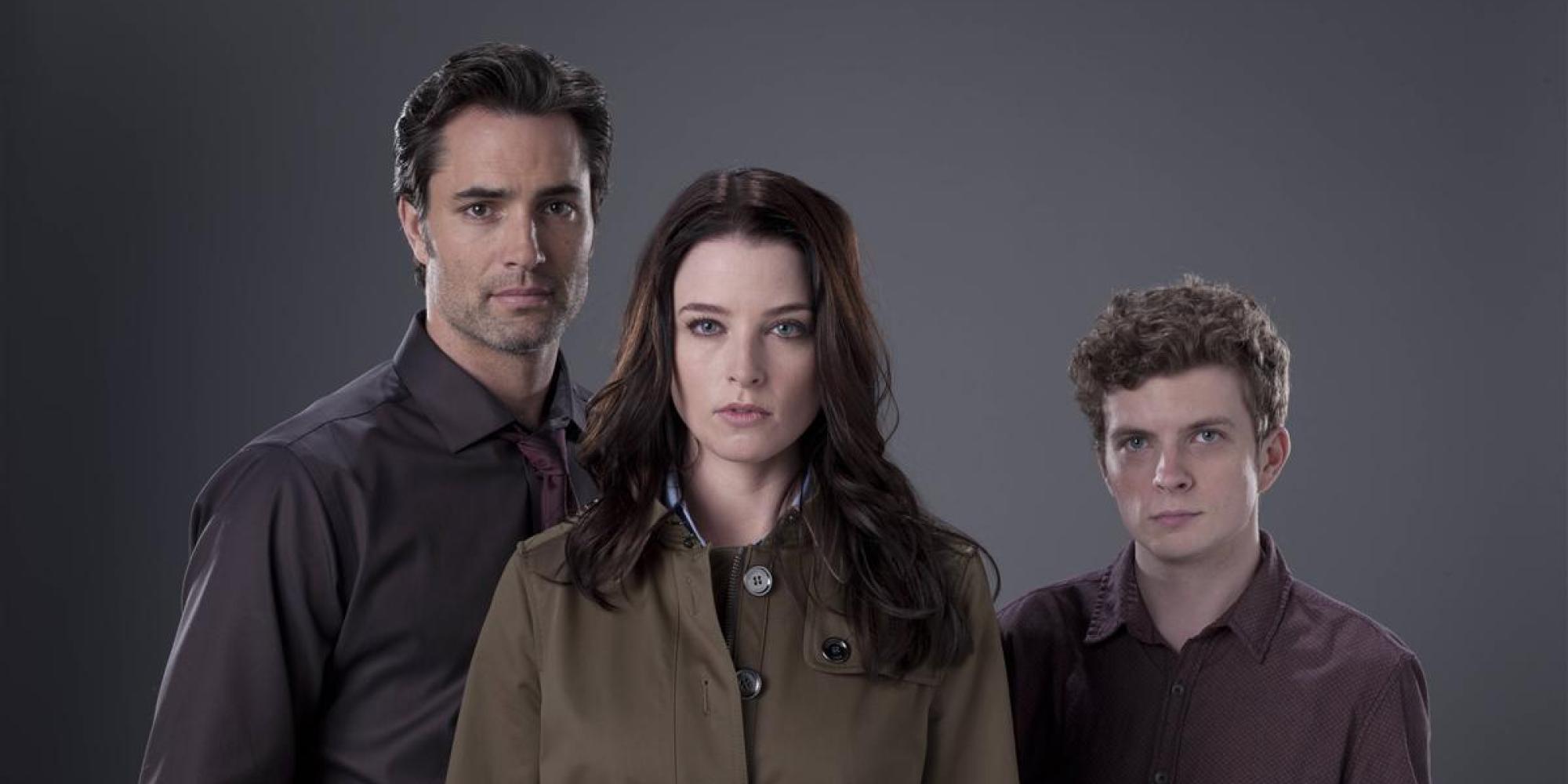
Season 3's plot lines and the characters themselves are complicated. Part of the complication involves Alec Sadler, one of the three principal characters, being present as two; i.e. one from the timeline (I think ...) we've been in since the beginning of the show, and the other from another timeline branch, and they're existing simultaneously in the same timeline -- though I'm not entirely clear whether this timeline is the series' original timeline. I may have forgotten some essentials from watching seasosn 2 last year at this time.
This season also began with two of the protagonist-protector from 2077, Kiera Cameron, but immediately one of them is shot dead. The killed Kiera was the "original" Kiera known from the series's start by her contemporary Vancouver
police force partner and friend, Carlos Fonnegra. That there are / were two Kieras is known to him almost immediately. He sees this Kiera as different the first one, and isn't sure he either likes or trusts the second one.
Second Kiera doesn't like First Alec or trust him, but seems to like and trust the second one. Further complications are created by First Alec learning that his first love, Emily, wasn't what he thought she was, while Second Alec, who was the first Alec, traveled back in time a week to save Emily's life, after she's killed in the first timeline. First, now Second Alec, still loves Emily, no matter what.
If others can follow all this with no difficulties they are much better viewers than I am. In the meantime, as the two Alecs and the Second Kiera dash about, the timelines are getting ever more muddled and history in the past and the future is changing. This further complicates the plots because it's not always easy to distinguish what seem volte faces of characters and their relationships with each other as they seemed previously.
Further we're presented with Kiera's past -- which is still in our future -- beginning when she's still a young girl, and not yet a Protector. But -- is her time traveling changing her past as well?
Tonight I'll watch the seventh episode (there are thirteen), and will perhaps understand things better.
As well, I am hoping that Alec Sadler, who the series isn't about --
it's Kiera's show -- isn't edging the focus from her to himself. The show couldn't handle two Kieras -- i.e. two supercompetent females leads -- but we have two Alecs, and the Alecs are supergenius-nerds, who are getting at least twice the amount of screen time than previously.
What I'm like most about Continuum, is how well the writers are connecting labor, capitalism, and the corporate state with the police state, in both our present and the future. Indeed, in Kiera's future, the state has gone full circle in which every person owes a life debt to the state -- which is connected to one's economic status -- which debt gets adjusted in various ways up and down, including execution when the debt is greater than one's economic value. This value is assessed by many criteria: treason is of course a debt that merits execution. This sort of conceptualization seems to indicate the writers have carefully read at least the first
sections of David Graeber's Debt: The First 5,000 Years (2011).
So far though, Continuum's writers haven't overtly connected these conditions to so many jobs being performed by robots and other automation,* though it is implied, whenever there are scenes set in a college or university, and the many public protests included throughout the seasons' episodes. It's this that makes the over-arching time lines of both "present" and future so plausible in Continuum.
Continuum does seem to be asking the important questions, and further inquires, what are the answers, and how can we get to them?
Alas, so far, there's been no hard announcement there's going to be a season 4 of Continuum, though it was scheduled to be made "early in August."
----------------
* Just this week: room service and check-in desk will be robots:
the Aloft Hotel in Cupertino, Calif, ... will begin using an R2D2-esque robot for such trips. Fittingly, Aloft’s parent company, Starwood Hotels, tests the latest technology at the Silicon Valley hotel. Guests can enter their rooms with a smartphone app and bypass the traditional check-in process at the front desk.
So very soon now, not even turning your city, your region into an extractive, toxic tourist playground will provide even the most menial of jobs, that are always touted as "jobs creation," and o so good for the economy.
Season 3's plot lines and the characters themselves are complicated. Part of the complication involves Alec Sadler, one of the three principal characters, being present as two; i.e. one from the timeline (I think ...) we've been in since the beginning of the show, and the other from another timeline branch, and they're existing simultaneously in the same timeline -- though I'm not entirely clear whether this timeline is the series' original timeline. I may have forgotten some essentials from watching seasosn 2 last year at this time.
This season also began with two of the protagonist-protector from 2077, Kiera Cameron, but immediately one of them is shot dead. The killed Kiera was the "original" Kiera known from the series's start by her contemporary Vancouver
police force partner and friend, Carlos Fonnegra. That there are / were two Kieras is known to him almost immediately. He sees this Kiera as different the first one, and isn't sure he either likes or trusts the second one.
Second Kiera doesn't like First Alec or trust him, but seems to like and trust the second one. Further complications are created by First Alec learning that his first love, Emily, wasn't what he thought she was, while Second Alec, who was the first Alec, traveled back in time a week to save Emily's life, after she's killed in the first timeline. First, now Second Alec, still loves Emily, no matter what.
If others can follow all this with no difficulties they are much better viewers than I am. In the meantime, as the two Alecs and the Second Kiera dash about, the timelines are getting ever more muddled and history in the past and the future is changing. This further complicates the plots because it's not always easy to distinguish what seem volte faces of characters and their relationships with each other as they seemed previously.
Further we're presented with Kiera's past -- which is still in our future -- beginning when she's still a young girl, and not yet a Protector. But -- is her time traveling changing her past as well?
Tonight I'll watch the seventh episode (there are thirteen), and will perhaps understand things better.
As well, I am hoping that Alec Sadler, who the series isn't about --
![]() |
| Note: the captions says "the future is in her hands." |
What I'm like most about Continuum, is how well the writers are connecting labor, capitalism, and the corporate state with the police state, in both our present and the future. Indeed, in Kiera's future, the state has gone full circle in which every person owes a life debt to the state -- which is connected to one's economic status -- which debt gets adjusted in various ways up and down, including execution when the debt is greater than one's economic value. This value is assessed by many criteria: treason is of course a debt that merits execution. This sort of conceptualization seems to indicate the writers have carefully read at least the first
sections of David Graeber's Debt: The First 5,000 Years (2011).
So far though, Continuum's writers haven't overtly connected these conditions to so many jobs being performed by robots and other automation,* though it is implied, whenever there are scenes set in a college or university, and the many public protests included throughout the seasons' episodes. It's this that makes the over-arching time lines of both "present" and future so plausible in Continuum.
Continuum does seem to be asking the important questions, and further inquires, what are the answers, and how can we get to them?
Alas, so far, there's been no hard announcement there's going to be a season 4 of Continuum, though it was scheduled to be made "early in August."
----------------
* Just this week: room service and check-in desk will be robots:
the Aloft Hotel in Cupertino, Calif, ... will begin using an R2D2-esque robot for such trips. Fittingly, Aloft’s parent company, Starwood Hotels, tests the latest technology at the Silicon Valley hotel. Guests can enter their rooms with a smartphone app and bypass the traditional check-in process at the front desk.
So very soon now, not even turning your city, your region into an extractive, toxic tourist playground will provide even the most menial of jobs, that are always touted as "jobs creation," and o so good for the economy.
Labels:
capitalism,
economy,
police state,
politika,
sf,
superheroes,
Television,
Women
Subscribe to:
Posts (Atom)