LINES OF THE DAY

". . . But the past does not exist independently from the present. Indeed, the past is only past because there is a present, just as I can point to something over there only because I am here. But nothing is inherently over there or here. In that sense, the past has no content. The past -- or more accurately, pastness -- is a position. Thus, in no way can we identify the past as past." p. 15

". . . But we may want to keep in mind that deeds and words are not as distinguishable as often we presume. History does not belong only to its narrators, professional or amateur. While some of us debate what history is or was, others take it into their own hands." p. 153

Silencing the Past: Power and the Production of History (1995) by Michel-Rolph Trouillot

Showing posts with label domestic slave trade. Show all posts

Monday, September 15, 2014

The Economist's Anonymous Historians Mean To Slavers Whine Continues to Give

This time from Greg Grandin, whose latest book, Empire of Necessity, Freedom and Necessity in the New World, which looks at the relationship of slavery and the trade in all the Americas with 18th and 19th century global capitalism. It too got bitch-slapped in the Economist when it came out. *


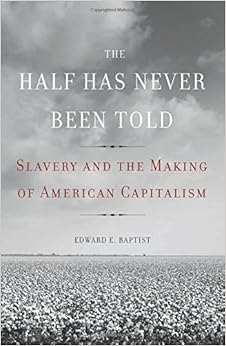
Edward Baptist, author of The Half Has Never Been Told, the study of U.S. Cotton Kingdom slavery and the global capitalist revolution. The snarky, ignorant review in The Economist ignited a fire storm so great the magazine pulled the review and apologized.  The firestorm, however, continues -- here, and many other sites.
From Greg's article in The Nation:
Quote:The Empire of Necessity tries to establish the dependent relationship of slavery to the capitalist revolution of the eighteenth and nineteenth centuries in all of the Americas, north and south, and presumes to use Herman Melville as embodying the moral complexities of that relationship. In other words, there’s a lot going on in the book. But the reviewer seemed only excited to find a few instances confirming that the trans-Atlantic slave system was not universally, 100 percent, absolutely, totally, categorically, “a matter of white villains and black victims.” “As is commonly supposed.” “Blacks,” he or she was happy to report, “profited from the Atlantic slave trade.”

The reviewer then complained about the book’s gloominess: “Unfortunately, the horrors in Mr Grandin’s history are unrelenting. His is a book without heroes. The brave battlers against the gruesome slave business hardly get a look in, although it was they who eventually prevailed.”One might think that “brave battlers” would be a good description of the group of West Africans who led the slave-ship revolt that is the book’s set piece. Having endured horrific captivity and transport, forced not just across the Atlantic but the whole American continent into the Pacific, the deception they managed to pull off under extremely hostile conditions was, I’d say, heroic. 
Slavery might not be black or white, but bravery and morality apparently are: whites possess those qualities, a possession that merits historical consideration; blacks don’t, at least according to The Economist. The Empire of Necessity didn’t “credit” William Wilberforce, the white reformist MP, or white abolitionist evangelicals and Quakers, for ending slavery. Nor, the reviewer points out, did I make mention of the British Royal Navy freeing “at least 150,000 west Africans from slave ships during the 19th century.” The book isn’t about abolition, or, for that matter, the British Royal Navy. No matter. “The British historians,” wrote the great historian of slavery, Eric Williams, “wrote as if Britain had introduced Negro slavery solely for the satisfaction of abolishing it.” So too, apparently, anonymous Economist reviewers.
This bit, quoting from The Atlantic Monthly's pundit, the British James Fallows, is fun:
Quote:
The review itself was written in that smarmy style that makes US corporate managers and hedge funders swoon, identified some time ago by James Fallows as “colonial cringe.” Readers on this side of the Atlantic assign an Oxbridge accent to the text, which “involves a stance so cocksure of its rightness and superiority that it would be a shame to freight it with mere fact.”
Greg further informs us how far back and how deep are the roots of The Economist's pro-slavery and racist biases. In the U.S. Civil War The Economist was just about the only British publication that bellowed in favor of British support of the CSA and slavery.  I recall Henry Adams and his father's profound disgust for this at the time, so much so they could barely bring themselves to mention the publication at all, even to criticize its lies. 

--------------------

* Full disclosure, el V's is referenced, and is among the acknowledgments for Empire of Necessity.

Friday, January 31, 2014

"The Faces of Young White Slavery" - 1864; Harper's

Today's NY Times Disunion column, which runs throughout the current observances of the lead-up, duration and aftermath of the U.S. Civil War highlights one of the strongest incentives in the North for abolition and emancipation prior to the primary shooting war *. White slaves -- the unease, discomfort and nervousness they caused northerners is something that I have been tracking for the last few years as well.  If these white people are considered 'negro' and therefore slaves, what about my daughter?  What about my husband? What about me?


In the south the white slaves also provoked anxiety -- who is in truth actually white and free, and fit to associate with me?  It was getting more difficult to tell with each generation, to where court cases were proliferating in attempts to declare this person and another a non-person, in fact, but black.  The courts -- judges, attorneys, witnesses and jurors -- were having such difficulty in deciding that cases would be tried and re-tried, and finally end, again, inconclusively.


Such an end-point of race-based slavery is inevitable, since the very condition of slavery means no control over one's body, one's very self, so the right to rape is embedded in slave ownership.  Additionally the lighter-skinned the white offspring of the rape -- particularly for the female child -- the more valuable the child in the marketplace.


At the same time, these white-skinned slaves bore public witness in their very existence that directly contradicted the slave power's own propaganda of the morality of slavery and its beneficence for both owner and slave.  Their existence wrote public volumes about the morality and behavior of the individual slaveholder, what he did, when others were politely averting their eyes -- or while they were raping their own slaves.

Thus arose the lie of the intrinsic immorality of the slave woman: lascivious and immoral -- it was her fault that she and successive generations of her daughters, before and after her, were repeatedly impregnated by white men -- she and they -- who had no basis by which to refuse, who were imprisoned by a system that coerced sexual submission as well as submission in all other ways.
... Harper’s Weekly wrote: “to all appearance, she is perfectly white. Her complexion, hair, and features show not the slightest trace of negro blood.” With their fair skin and elegant dress, Rebecca and Rosa evoked for most viewers the “fancy girls” sold in the New Orleans slave market. The fate that awaited these girls as concubines to white men was clear to most viewers at the time. Their tender youth compelled Northerners to renew their commitment to the war and rescue girls like these.
The column on the propaganda campaign that used white slave children to rally a war-weary northern population can be linked to here.

Some of the photographs used in the campaign were included in their original format in the recently past exhibit at the Metropolitan Museum of Art in "Photography and the American Civil War."  This exhibit has moved now to the New Orleans Museum of Art, opening today, January 31.

--------------------------
 We were shooting each other about the expansion of slavery for quite some time already, notably Bloody Kansas and the Kansas-Nebraska battles.  Another instance was John Brown's quixotic incursion into Virginia. As well, the many attacks and even killings of anyone in the south who might speak against slavery, as well as the constant imprisonment, torture and even killing of any slave who objected to anything, much less being a slave.

Friday, January 10, 2014

12 Years A Slave - Northup's Book, Not McQueen's Film

There's a carefully researched article on the UK Guardian that deals with Northup's life, his book, other slave narratives and the times in which he was enslaved.


When slave narratives were rediscovered in the 20th century, the fact that most had been ghosted or edited by white people once again raised the question of their authenticity: many historians repeated the century-old charge that the narratives were exaggerated or fabricated by abolitionists. Unfortunately, much of the US coverage of McQueen's film has rehearsed these invidious questions, but the underlying truths of the atrocities of slavery are beyond dispute, and not altered by the fact that any narrative is, by definition, constructed.
In the case of Northup, his account was verified by the historian who recovered his story, a woman named Sue Eakin. Twelve years old when she discovered a copy of Northup's narrative in a local plantation in 1930, Eakin was intrigued to find it described the area in which she lived. Six years later, as a student at Louisiana State University, she found a copy of the book in a local bookstore. The owner sold it to her for 25 cents, telling her it was worthless: "There ain't nothing to that old book. Pure fiction." Eakin would devote her life, she later said, to proving him wrong.
 Eakin set about discovering everything she could about Northup's life, tracking down its details, using the legal and financial records of the men who owned him to corroborate his account of his enslavement. (Northup himself quotes more than once from such records: "The deed of myself from Freeman to Ford, as I ascertained from the public records in New-Orleans on my return, was dated June 23d 1841.")
Unlike many slave narratives, Northup's named names: the people who mistreated him were still alive, and their own records substantiate the facts of his story. Eakin died in 2009; three years later amateur historian David Fiske published Solomon Northup: His Life Before and After Slavery. Between them, Eakin and Fiske established that Northup played a significant role in his book's composition, working closely with Wilson over the three months they wrote it. Fiske even found reports of corroboration made by Edwin Epps himself, from union soldiers who met him in Louisiana during the civil war: "Old Mr Epps yet lives, and told us that a greater part of the book was truth," they reported in 1866.

Thursday, August 1, 2013

N.B. F. -- Slave Trader, Butcher of Fort Pillow, KKK Grand Wizard

Yesterday, the FB Papers yielded a folder of correspondence between FB and a Memphis lawyer, a close, personal, life-long friend of Forrest, since they were five-year-old boys.

FB asked his correspondent many questions about Forrest the slave trader.  It went fine for a few exchanges, though from the beginning the lawyer objected to FB's interest in Forrest's slave trading.  It was unfair and ungentlemanly to bring up what this man had overcome by his own bootstraps (nevermind that his bootstraps was getting rich by selling human beings -- and by all accounts, perhaps due to his horrid temper, cruelty to his possessions).  Morever this man was in every respect an excellent citizen and valued member of his community.  But soon the correspondence closed acrimoniously on the lawyer's side and snarkily on FB's, over the KKK and Fort Pillow. The lawyer, however, did, no matter how reluctantly, confirm that FB was correct in the details of Forrest the slave trader, right down to the description of where, and how and why he lynched African Americans who earned his fiery ire.

Interesting, that PBS's Antique's Road Show doesn't see slave trading as a stain upon the man's character.* It's not even mentioned. However, Antiques Road Show decrees:
The reputation of General Forrest, under whom Ellen's great-grandfather served during the latter half of the war, has come to be defined by two infamous, yet brief, chapters in his life: his controversial assault on the Union-held Fort Pillow in 1864; and his post-war involvement with the first incarnation of the Ku Klux Klan. So closely is Forrest's name associated with the Klan, in fact, that he is sometimes incorrectly referred to as its founder. If not for these two black marks on his reputation, the ribbons and regalia appraised by Christopher Mitchell at around $10,000 would undoubtedly be quite a bit more valuable. 
It was fairly exciting to run into this sequence of letters.  The whole folder is filled with FB's research correspondence with southerners who were there for it all: the trade, the auctions, the owners, the overseers, the emancipated and participants in the Civil War.

Bruin's Slave Jail
The letter that perhaps most spoke to me, wasn't a letter at all, but an interview FB conducted with a now elderly gentleman in New Orleans, who gave an account of his progressive sales, first from his original Virginia plantation owner, sold again in Richmond, the journey by sea around the Gulf to New Orleans, sale to the jail on Esplanade, to a brick yard owner, and from the owner to his brother-in-law, the whippings, the treatment and all of it, until Emancipation.  There was not a single ray of golden glow to be found in this terrible tale, repeated countless times by numberless people.

But then -- that's what Frederick Bancroft was doing: he was putting numbers to the centuries of this economic system, the numbers of human beings, not the number of sacks of cotton their hands could fill in a single hour.

--------

*  Another instance that demonstrates television, like movies, is absolutely unreliable when it comes to historical truth, accuracy or facts.  Or as el V's put it in The Year Before the Flood: "Movies told me lies, music told me the truth."

Monday, July 22, 2013

Independence -- What Did It Mean?

We spent most of the weekend reviewing and revising and editing the latest printout of The American Slave Coast (which we'll be doing for many more months, one revision after another, each time the various themes more focused and clear, hopefully).  Among the variety of discussions we had was this one: What were the most important changes and effects upon the former North American Atlantic colonies as a consequence of Independence from Britain?  How much emphasis should we give those in The American Slave Coast as our primary focus is the slave economy of the American South?  Some need more emphasis than others, since aspects that created the slave economy would only have happened with Independence -- and those in turn created huge strands of American culture in general, particularly music.

Separation of Church and State:


The most significant change was the disestablishment of the Anglican church, the separation of church and state, making for religious tolerance as the law of the land.  Disestablishment affected the North and South in different ways.

In the South it closed the Church as a path to political power and riches. In the South younger sons needed to become lawyers and / or slave dealers / breeders, as the quickest way to wealth and significance.  In New England there were colleges, a proliferation of schools, and professional enterprises beyond the law. In the North, as a non-slave trade based economy, there were mercantile, banking and shipping opportunities they lost no time in taking advantage of, not the least returning to the West Indies carrying trade to and from, with particular attention given to bringing back rum to slake the bottomless thirst of both the North and South. Too bad Jefferson screwed the pooch on that one, all over again, with his hated embargo, which brought all trade to an end, and had New England screaming to secede, and sent the newly solvent U.S.'s economy into full depression.

In the North, Methodists and Baptists and many others were no longer repressed by Quakers (in Pennsylvania), the Puritans' Congregationalists in New England, and Presbyterians and Anglicans in South Carolina and Virginia. Maryland was officially tolerant before the War of Independence, with the ruling elite generally Catholic, but before Independence Maryland still had to support Anglican bishops, priests, etc.  Church attendance was mandatory for everyone who wasn't excused by membership in another faith's congregation. Obviously this could not be enforced outside the small settled coastal enclaves. Already, before Independence, beyond the pale it was a lawless free-for-all, particularly as the 'west' attracted the very poor Scots-Irish imigrants and run-away indentures, as well as run-away slaves (slaves particularly ran to the Floridas, which under Spanish rule and non-slave, provided a haven of maronage). After disestablishment church attendence and membership soon stopped being mandatory.

Needless to say mandatory church membership and attendence did not apply to the enslaved, but long before Independence, the African American communities were enthusiastic attendees of Sunday church, both in white folks' churches and in their own services. Baptist and Methodist forms, and the Awakening's evangelical passions, provided African Americans a more traditional way into religious joy, with call and response preaching, singing, dancing aiding them to transcend their bleak daily existence and merge with the other world. Their traditional spiritual practices were unacceptable to whites, but this was allowed. (Still no drums though.)

In Virginia both the enslaved and free African Americans soon became Protestant, spoke English and had merged their various African folkways with those of their English owners for at least three generations before Independence (you find 'fetish' bundles secreted inside the sophisticated architecture of houses build in 18th century Annapolis, built by slaves who'd been sent to England for training in architecture, carpentry, cabinetry and other valuable building skills -- slaves who were Christian). They were gifted players of the fiddle (and the violin if their owners so pleased). Drums were strictly forbidden them, but they were allowed wind instruments.  The Maryland and Virginian aristocrats were fox hunters already in the early 18th century -- the houndsmen who blew the horn signals were their slaves. It was the same in Maryland, except that with its tolerance, Methodist and Baptist pastors had already converted large numbers of the both the enslaved and free African Americans.  But it wasn't until a few years after Independence that African Americans were able to build their own first AME churches, at about about the same time in Philadelphia and Baltimore.

It's out of these churches we get the musical traditions, much later labeled Gospel, that fed directly into what even later would be rock 'n roll. However, that's not all that is going on in the various African American religious and cultural communities, either before or after Independence

The African-Atlantic Slave Trade Abolished 1808; Domestic Slave Breeders and Traders Become Very Wealthy -- Which Was Already in Effect Before Independence -- the War Created An Abrupt Halt: It Returned the Moment the Brits Left the South:

But in the meantime, between the Constitutional Convention (1787), its ratification (1788) and 1808, the largest number of Africans in the shortest period of time were imported into the U.S., almost all of them to South Carolina's Sea Islands -- with a natural spill over to the same barrier island coast and money crops of  rice and long staple cotton in the Savannah region.

The consequence is that along this thin coastal line the white population was far outnumbered by its slave population. This population not only created the most massively wealthy Americans from rice and long staple, it also created an African American culture different in folkways, language and religion from the established African American cultures of upper south of Virginia and Maryland.


The English culture of the slaves bought from the Upper South's traders collided with that of the new imports, who (as did many of the ancestors of the upper South's African Americans) came primarily from the Sene-Gambian region -- though with many Ibos, Asantes and others as well. With them came what we come to call the banjo -- which also was already in Virginia. This helped give us the Blues when the domestic slave trade carried the players into the later Cotton Kingdom of the Mississippi Valley. The significant numbers of Islamist slaves among them brought the vocal style of melisma, currently way over-used, but also a defining characteristic of African American vocalization in both Gospel and popular music.  Religious traditions and other practices became known in the Gulf states as HooDoo. All these varieties, everywhere, were affected --  as everywhere in the New World -- by the fundamental culture of Kongo, which also poured into both the Blues and rock 'n roll.  All this  mixed and collided first in South Carolina.  Then in the Mississippi Valley via the following century and a half of the domestic slave trade.

They all mixed, including the San Domingue African American cultures that immigrated from the Revolution, in Louisiana.  In New Orleans, the biggest and most flashy slave market of them all, they brought a Frenchified culture and language, and some elements of the Vodou religion from San Domingue. As most of the slaves brought from their short stay in Cuba by their planter owners were women and children, very large parts of Vodou practice, particularly the rhythms, dances and songs, were left behind in Haiti. But in New Orleans they fraternized with the already established African-Indian religions created by the imports from Africa during the French and Spanish eras. They also met South Carolinian HooDoo practice (as South Carolina itself became a slave exporting state) and Virginian Protestant belief.  Always these religions, musics and beliefs mixed in evangelical church, churches from Roman to Baptist and everything in-between.

They also assimilated with each other at the shipping wharves and docks, particularly with music. The much later southern Italian immigration to New Orleans, with its cultural tradition of funeral parades with brass band, contributed, beyond organized crime, to the deep culture of New Orleans with second line parades. At the end of the Spanish-American war, the military bands (mainly composed of African Americans) left Cuba and re-entered the U.S. at New Orleans. They sold - pawned their brass instruments to finance their way back to their homes further away. The local musicians were able to buy these expensive instrument cheaply.  This was the essential step to the creation of jazz.  Jazz is syncopated, it swings.  You don't find that in Afro-latin music, any more than you will find melisma -- because the Senegambian slave trade did not go to the Caribbean, South America or Brasil, where the vast majority of the Africans were taken. (The number that came to what will be the U.S. directly from Africa was a tiny sliver of the Atlantic slave trade; most of them had arrived already by 1750 -- and New Orleans (1718) had barely been founded then.)

Primogeniture and Entail Abolished:

This is connected to the end of proprietary possession of the previous colonies of Pennsylvania, Maryland, South Carolina, and the most recent one, Georgia. There were still legal suits against the U.S. government by both the Penn descendants and the Delaware tribe pending in 2004 about the dissolution of the Pennsylvania Lords' Proprietor lands affected by this. There may still be -- I haven't checked since 2011.

The French Revolution, The Revolution in San Domingue and the Louisiana Purchase, i.e. Napoleon:

It was not just New Orleans that Napoleon coerced Spain into selling the U.S. -- but the entire vast Mississippi Valley, populated by Indians. These tribes communicated and traveled along their traditional migratory routes along the Mississippi River, from above the St. Lawrence Valley in Canada, down through Louisiana. During the colonial era, after defeating the French in Canada, their lands were protected by the British against North American expansion for the sake of the Indian trade -- from which the Crown took much revenue. Napoleon's strategy was to give New Orleans and this vast territory to the Americans, to force the Brits out. Anyone should have it, rather than the Brits.

Andrew Jackson, member of a Scots-Irish family from the borderlands of South and North Carolina, due to the treatment by the Brits of his family during the War for Independence when he was a small child, hated the British with a biblical fury. Andrew Jackson hated the Brits even more than Napoleon hated the Brits. He hated them the way the Irish hated the Brits.*  He finished Napoleon's task. He delivered all the new territory purchased from Spain from the Indians. Then he took more than the U.S. had bought, which it had wanted all along and far more than New Orleans, while Jefferson and Madison  pretended they'd bought it with New Orleans -- the Floridas, which were both British and Spanish possessions. Andrew Jackson: he made the Gulf and the Mississippi Valley safe for slavery, the domestic slave trade and  King Cotton. He pointed the way for the Mexican War to get Texas too.  Finally, what he did, making King Cotton safe, significantly fueled the Industrial Revolution in  northern U.S. and Britain.

All of this happened because of the domestic slave trade that made so many people so very very rich -- on paper anyway -- all at the expense of African Americans -- that took place after Independence.

Therefore it isn't a surprise that both before and after the Civil War African American communities were united in their refusal of that favorite "Solution of the Negro Problem" -- what was called euphemistically, colonization.** 

Jackson imposed a coerced colonization with the Mississippi Valley tribes. African Americans, slave and free, knew first hand what coerced colonization implied: more death, more suffering. Those other lands belonged to other peoples, people who spoke a different language, had different cultures and economies. They weren't welcome. They might well be re-enslaved -- which did happen in Africa and the Caribbean, when supposedly free people of color removed there, whether voluntarily or not.

African Americans earned this American land with generation upon generation of blood, sweat, suffering and skills. Why the hell should they go somewhere else -- with nothing -- after already having been brought here forcibly, with nothing, not even their names?  Haiti was a favorite place whites thought African Americans should go, even before the San Domingue Revolution, but who would want to go there, even after the Revolution, with the U.S. blockading it from trade, filled with people who spoke a different language, had a different religion and culture?  South America? Vastly outnumbered by those whites and Africans speaking Spanish,  Portuguese and African languages, practicing Roman Catholic and Afro-Catholic syncretic religions and others as well, the multiple cultures of Indians, Spanish and Africans?  Everything already owned? And resented as outsiders that no one invited in?***

Then there was that all-time favorite for colonization, i.e., Removal, like Indian Removal, to Africa. African Americans were not interested in re-locating to the mother country for all the same reasons they weren't interested in going to Latin America or Haiti. There were a few exceptions, that tiny sliver of African American missionaries (who by and large had horrible experiences, and, if they didn't die, often turned into slave traders themselves, supplying slave cargo for Latin America and Brasil). What mother country? Many didn't even have an oral memory from where came their ancestors, thanks to the domestic slave trade that constantly broke up families generation upon generation.

Even Marcus Garvey could not persuade African Americans to "go back to Africa," not even during the height of the Jim Crow era, the revived KKK and lynching.****

In other words, the domestic slave trade that blew up upon the end of the War for Independence and the end of the War of 1812, is what created so much of what we consider American culture, the American Century -- and even further -- the Modern.  It was that explosion of pent up African American creativity into the public sphere of the U.S. a generation after slavery that created so much for which this nation takes great cultural pride -- just for starters, its era's significator, Jazz.

--------------------

Which explains the large number of Irish names found fighting on the side of the Spanish, in South America and the Caribbean. Alejandro O'Reilly is merely one of the better known of these.  He was  Inspector-General of Infantry for the Spanish Empire in the second half of the 18th century. O'Reilly served as the second Spanish governor of colonial Louisiana (1769), being the first Spanish official to actually exercise power in the Louisiana territory after France ceded it to Spain. He was the creator (after a a great fire of New Orleans) of New Orleans' so-called French Quarter (called that because the San Domingue refugees settled there). The now named Jackson Square is a reflection in miniature of Habana Vieja's Plaza de Armas.


*Colonization was mostly a sop of public conscience on the part of influential slave owners like Henry Clay and Thomas Jefferson, who had no intention to do anything about abolition or emancipation.  Colonization put dealing with slavery off to the hazy someday -- and moreover, made it the responsibility of the victim rather than the victimizer, as we see from an excerpt of an 1887 letter in the Bancroft archive, in which the writer expresses his anger that the negroes have not gone there (meaning Haiti):

Theo D. Jervey
Attorney At Law
No. 23 Broad Street
Charleston, S. C.

“The constant claim of their tremendous progress wearies. Some 9,000,000 new, with half a century of freedom behind them and not apparently the least desire to cross over to the land where half the number of their race has been struggling with anarchy after a century of freedom and redeem it, by taking possession by peaceful force of numbers.  But, if I do not hold myself in, I may inflict upon you what I subjected T. Thomas Forten to, some 15 years ago. .... "
*** Brasil, despite England and Portugal having been political and trade partners for centuries, would have been equally outlandish to African Americans -- indeed, many parts of Brasil were as African as Africa -- with less European modification than in Liberia, as in el Salvador.

***The only times African Americans would leave the United States voluntarily was when they were slaves and slavery was in full effect, as during the War of Independence, the War of 1812, and running away to Canada after Dred Scott and the Fugitive Slave Act of 1850 (free people of color also moved in numbers to Canada during that period due to kidnappers taking them down South and selling them). Antebellum free people of color and African Americans after Emancipation wanted to left alone right here to make their homes and care for their families where they were born. Who can't understand that? They'd damned well earned that right.

Thursday, May 16, 2013

Headin' South


Chestertown! Friends!

The Flag Of Hampton Roads

Charlottesville - Monticello + Friends!

Historic Richmond - Tredegar Iron Works

William and Mary + Friends! + Williamsburg

Historic Charleston - Beaufort

Sea Islands

Historic Savannah

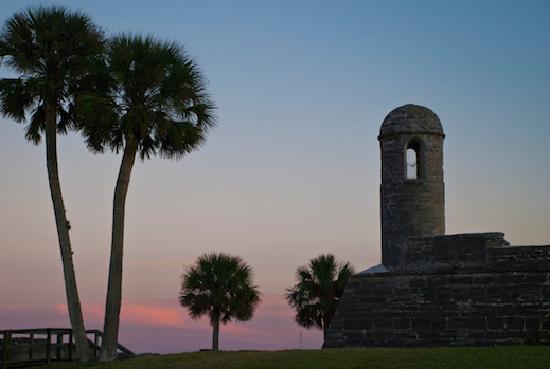
The castillo de san marcos, in the old town of St. Augustine, the oldest continuous settlement in the United States, founded by the Spanish, desired by the French and the English, but no one wanted the Spanish Floridas as much as Andrew Jackson and President Madison.  Jackson got it. It then became a bustling slave market port for product coming down from the Upper South, coffle-walked to the Black Belt, and even to Natchez, the second largest slave market after New Orleans

Thursday, September 20, 2012

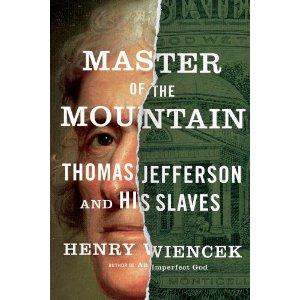
The Dark Side of Thomas Jefferson's Moon - *Master of the Mountain*

The current issue of Smithsonian Magazine features an article by Henry Wiencek offering new insights into the life of Thomas Jefferson. Wiencek, a former Fellow at Washington College’s C.V. Starr Center for the American Experience, offers a thematic overview of his research in the Smithsonian article “The Little Known Dark Side of Thomas Jefferson.” His new book, Master of the Mountain, has stunned historians with well researched material dealing with Thomas Jefferson and his slaves.

The full Smithsonian article is here.

Full disclosure: we know Henry Wiencek, and have read Master of the Mountain, as well Henry's other books.

Tuesday, August 7, 2012

1850 and Subsequent National Crises


I'm half way transcribing and writing up my notes for that focus on the decade preceding the official break out of the U.S. Civil War.  Though the more you learn about this period it becomes inescapable that we were already at war.  The defining moment for the war's inevitability was Texas's recognition as a state.  Those f*ckers were from the gitgo bugf*ck insane -- so naturally the South Carolinian slaveholding power elite loved them and egged them on.  In the meantime Limbaugh, Fox News, Bachman, Beck, et al. Calhoun had successfully dispersed his toxic slave society pride and hatred for the New Englanders throughout what would become the confederacy.  He had done so, so successfully, that on his deathbed in 1850, his last words predicted correctly, with specific detail, when and how Secession would come about, even calling it over a presidential election. Even before that, Nashville, TN hosted conventions that discussed Secession.


I cannot express how much everything that we've been experiencing in the last ten years looks so much like 1850 -- the year the elected politicians gridlocked for good, the constant rhetoric -- and even actions -- of violence employed on constant basis by the southerners against what they saw as trespasses against their rights -- which was the right to trample on everyone else, and curtail everyone's freedom for the sake of them keeping their slaves and spreading slavery everywhere, and what follows. With the Fugitive Slave Act in action, people in the free states were not only digusted by what they were seeing, but by what they were told  they, by law, had to do to aid the slave owners.  Their inevitable conclusion, based on this, and what the slave owners actually said, was that ultimately even white men could be enslaved by the same slave owners who were forcing them to recover slaves.


After I finish this task, I'm going to go backwards, to the 1830's, specifically Washington D.C.  The one part of the Little Compromise that Stephen Douglas got through at the end of the longest legislative session ever, by lobbying incessantly that "the non-slave states had to be given a mite (while the slave states got the Fugitive Slave Act, which did more to turn the non-slave states abolitionist than anything else)," was the end of the slave trade in D.C.  It was a national disgrace, that all other nations regarded with shaken horror and bewilderment that this could go on within the capital of the nation that so trumpeted freedom and liberty.  Of course by the time of 1850, most of the actual trade had been removed, due to this disgrace and embarrassment, to outside of D.C., to Alexandria, which part had been retroceded to Virginia, so it was no longer in the District of Columbia's precincts.

I've read quite a few accounts, if only in passing, by first hand witnesses of the slave trade and the treatment of slaves in Washington D.C.  Now I'm going to concentrate on it for a while.