LINES OF THE DAY

". . . But the past does not exist independently from the present. Indeed, the past is only past because there is a present, just as I can point to something over there only because I am here. But nothing is inherently over there or here. In that sense, the past has no content. The past -- or more accurately, pastness -- is a position. Thus, in no way can we identify the past as past." p. 15

". . . But we may want to keep in mind that deeds and words are not as distinguishable as often we presume. History does not belong only to its narrators, professional or amateur. While some of us debate what history is or was, others take it into their own hands." p. 153

Silencing the Past: Power and the Production of History (1995) by Michel-Rolph Trouillot

Showing posts with label Imperialism. Show all posts

Wednesday, December 23, 2020

Gilded Age Adventure Fiction: Allan Quatermain

     . . . . Haggard, H.R. (1887) Allan Quatermain, second volume, sequel to King Solomon’s Mines (1885). I’ve read King Solomon’s Mines, of course, and She, and maybe another Haggard novel, but if I had read Allan Quatermain it was long enough go that I have recalled nothing.

The series of narratives that are Quatermain’s memoir cover 50 years of the life of a fictional representative of those imperial stalwarts the Empire hatched in their thousands for a couple of centuries out via the English public school system, to fill the needs of the East India Company, the British army and the douty UK middle class. They were as much glorified by Kipling, as the grunt in his writing, and writers in the same mode as Haggard. 

This universal admiration for this dream ideal alpha (white) male, has Quatermain resembling Kipling in a way that at the time, Kipling couldn't imagine. Quartermain's  loss of his dearly beloved only son, Harry, is the motive for this novel. Harry died in a smallpox hospital where he was a physician. Quatermain blames himself, because though very well off financially, he wanted his son to stand on his two feet without dad’s financial support, to toughen up, be a real man, which Harry did, refusing to go home to daddy when the smallpox epidemic raged. Quite like Kipling's pushing of his son inexorably to join up to fight in WWI, and who, to Kipling's shock and grief was killed.

Colonial Brit Imperium superiority is on display on nearly every page of Quatermain, with long lectures on what makes an admirable man and the general inferiority of non-whites, unless exceptions out of a warrior 'race' such as the Zulu. 

It’s also broadly accepted that ‘white’ ultimately means British, only. Other Europeans, whether German, French etc.(Alphonse in Allan Quatermain is nothing but a list of ticked off boxes of French coward, fool and ignorance), included to show their inferiority as buffoonish figures of diversion and exploitation, at best, as well as targets of physically brutal abuse, as well as verbal contempt. This mode was eagerly displayed by other adventure genre writers, from Edgar Rice Burroughs, and continued to proliferate within the sf/f fields, including the buffoon as alpha male writer, John Norman and many others, even now. 

What makes Haggard exceptional among many genre adventure writers though, is his inclusion and featuring, women of agency who are strong enough to rescue themselves -- though not even their courage, proven ability and his admiration can stop Quartermain from mansplaining to them what a real woman is, and how to be/come that.  Worse, in Allan Quartermain, the girl child who rescued herself with tremendous courage and presence of mind, the reader is carefully informed that for the rest of her life, she was 'nervous' and subject to great starts and frights 

Theodore Roosevelt admired Haggard the writer enormously, writing him a letter saying so. He wished very much they could meet. They did have friends in common. The adventures and hardships of our heroes in Allan Quatermain are astonishingly similar to what’s in River of Doubt: Theodore Roosevelt's Darkest Journey (2005), which I read earlier this year. It seems a miracle that Roosevelt did not die – many times – on that terrible journey in the Amazon. Nor was it entertainment, not a novel for boys (which books TR loved), but what really happened, to real people.

Original British P-1885 Martini-Henry MkIV Rifle Pattern A


By the by, the Allan Quatermain narrative mentions several times the Martini-Henry rifle which came in, in 1871. Could the martini cocktail, supposedly invented in 1887, have gotten its name from the Martini Henry rifle, an brought into the British Army then? Martini–Henry rifles were used throughout the British Empire for 47 years.

The Martini-Rossi vermouth was created earlier, in the mid-1800’s, from which some think the cocktail derived its name.  It's not far from the favored gin-and-tonic of the Raj and African colonies to a martini, stirred, not shaken.


Thursday, January 24, 2019

I Am Not An Expert But I Am A Privileged White Male, So Watch Me Bloviate Anyway Because, You Know, White Man = Expert

     . . . .Too long, don't read this rant following ☭  ☭  : but Kristof made me do it.

Imagine oneself Cuban, reading Nicholas Kristof's latest excrescence in the NY Times. The colonial, imperialist, white supremacist mindset permeates him, and he doesn't even know it. He actually thinks he's being nice and progressive about Cuba.

https://www.nytimes.com/2019/01/23/opinion/cuba-embargo.html?

This is why the United States (and England too) is a lurching, dysfunctional, chaotic, violent monster of gigantic destruction to itself and everything else. 

"I'm Not An Expert (nor does he even speak Spanish) BUT Listen to ME!!!!!!!! Tell Everybody All About Cuba." Bloviates Nicolas Kristof: 

  Quote
"....It’s simply a tired little country ..."
This, right at the top of his blowharding in the prestigious New York Times, reveals Kristof's profound ignorance of what is going on in Cuba -- he's never have written that if he went dancing Cubans, of any and all ages, or listened to Cubans making music, or spent time with them getting up every day to dress their kids as nicely as possible, figure out how to solve yet more shortage or invent yet another work-around, exchange tech expertise for pay, providing goods and services, doing a cattle round-up, make chocolate -- organic chocolate on organic, diversified beautiful farms, by hand, as well as raising, organically, the other two crops that naturally occur together, coffee and coconuts, as well as poultry, pigs, cattle, horses -- and, further run by a consortium of women, of all ages and colors, who love their machetes -- they give their machetes names -- and use them with great expertise -- and they don't look in the least like a cliche of what a farm woman or agriculture worker looks like.

If Kristof had any meaningful contact with Cuba beyond a service situation he would NEVER have called Cuba "a tired little country." Cubans have more energy than anybody in the USA, other than immigrants like the Haitians, and certainly a lot more than anybody currently in the White House or trying to be POTUS. 

It's not merely an ignorant observation, it's insulting, in the way one would expect from a privileged, comfortable old white guy who isn't an expert but is gonna tell people anyway -- even when the people he's telling know profoundly more about it than he does. 

 Quote
"Let’s make room for nuance: Cuba impoverishes its citizens and denies them political rights, but it does a good job providing basic education and keeping people healthy. As I noted in my last column, on Cuba’s health care system, Cuba’s official infant mortality rate is lower than America’s (its real rate may or may not be).
 
I’m not a Cuba expert, but ... "
However, Kristof is a privileged white male in very comfortable circumstances so he's gonna tell the USA what is what about what he doesn't know anything about, and all will read  his awesome brilliance and be in awe of of his awesomeness who went to Havana that one time -- and he shall be well paid. Don't bother looking out for somebody who does know and could tell us what we might want or even need to know. And who speaks Spanish.

Moreover, Kristof proves to have never met a cliche he won't seize on without thinking about it or investigating what is behind the cliche -- one that everybody invokes who is not an expert either, the cliche that everybody includes in every repetitive same-samey piece they all write about the subject of Cuba. (Who will bet against me that when Kristof writes or talks about New Orleans, he uses the dreaded hoary 'gumbo' cliche?) 

  Quote
"Plus, extra credit goes to a country that so lovingly preserves old American cars. I rode in from the airport in a pink 1954 Cadillac."
He has no idea that this pink Cadillac's body (all the rest of it was pillaged to get something else running for a little while) has rusted for decades without an engine, but is now running because the state fairly recently imported a large number of diesel fuel burning engines that those with these useless cars rushed to install in order to drive around ignorant old white guys who boast of riding in a pink Cadillac and further pollute beautiful Havana. It wasn't lovingly preserved, but created, with parts and paint the owner somehow managed to wangle recently from outside of Cuba.

People visiting their Cuban friends and family commonly bring in shock absorbers, fuel pumps and all sorts of parts even for vehicles much more recently manufactured than a 1954 pink Cadillac, such as Toyotas.  But he doesn't know that  Why?  If he'd asked, you know, he would have known. Responsible journalism, hello?

The following is the most infuriating bit, the most insulting bit. Kristof literally cannot imagine Cuba and Cubans existing in any way in the future except as in its previous relationship to the US when the US corporations and the mafia owned the whole damned island -- as a servant class to rich white old white Americans. Caregivers. Servants. Cooks, Cleaners. Gads, this is disgusting. He hasn't met any of the dynamic, innovative Cuban professionals. Just for one example of what he can't imagine is just at the end of this last year, a Hollywood production team came to Havana where they met with all sorts of agencies and people who work in television and film there. The Hollywood people were agreeably impressed with their knowledge, experience, record and creativity. But great economics white US guy can't think that there could be fine investment opportunity in film and tv production facilities in Cuba.  Nope. Cubans must clean up the vomit and shyte of tourists and elderly retired people. Who are rich, white USians.

  Quote
".... Some American seniors who now winter in Florida could become snowbirds in Cuba instead, relying on its health care, low prices, great beaches and cheap labor. You can hire a home health care aide for a month in Havana for the cost of one for a day in Florida...."

Cheap labor yay! That's what we can do with Cuba!  

Additionally this will help keep immigrants out who traditionally are supposed to be doing this work since we'll be outsourcing to Cuba our rich elderly family without the voting crisis of letting in to the USA people, who aren't, you know, white -- people, who work harder than privileged white men like Kristof can begin to imagine, to improve their families' futures and become US citizens -- and voters! which is the ruling class of the USA's worst nightmare. Total win-win for us, YAY!

You know Cubans are not thrilled about returning to their historic status as servant class to clean up the incontinent messes of rich old white guys of the USA. Additionally, they are already doing this for the elderly members of their families -- who live with them, not in retirement homes, where US prosperous ilks foist off the care for their elderly upon immigrants and others they assume are too stupid to do anything else, and should be GRATEFUL for this really low-paying, really difficult and exhausting work, while facing imprisonment and deportation any old time. But he, as an old white guy of privilege, demonstrates he literally cannot think of Cubans as deserving or capable of being anything more than  'servant' and providing 'service.' 

Has he noticed how much of the island's population is not white? Who does he think made the Cuban Revolution? Who does he think the Revolution served? Does he believe they have put up with everything the Cubans have had to put up with throughout their history and struggled to overcome throughout their history in order to -- raise their kids for the opportunity of cleaning his white bottom when he's old and drooling? What does he know about the great Cuban Revolutionary leaders such as Lt. General José Antonio de la Caridad Maceo y Grajales in Cuba's history of fighting for the abolition of slavery and independence, and the position of the US in those struggles? Clue, here:

The US was NOT in favor of the abolition of slavery in Cuba -- and opposed over the 19th century to various of Cuba's struggles for independence from Spain, because independent from Spain, Cuba would abolish slavery -- so the USA intervened with its big stick.  Can't have free black people by golly. Our slaves would run away to Cuba instead of us being able to sell our overpopulation of slaves to Cuba where the sugar industry would kill them in 10 years -- very profitable for us, that, yessirree bob! 

In the meantime, while Kristof mourns that the orange nazi (and the mummies of Florida like Rubio) want to roll back the baseball players deal, he hasn't noticed that the orange nazi and his mafia have sold Cuba to Putin and his mafia. The Russians are everywhere in Cuba again, providing building materials, industrial products from elevators to tractors, while the Russian oligarchs anchor their yachts in Cuba's Caribbean ports. Orange nazi feels right at home with yachts of course (or does he get seasick?) while giving not a ripe fart for baseball. 

My gawd, everything clown Kistof did not notice, that was right in front of his face, but he didn't see, blissing out on pink Cadillacs and cheap servants. 


Wednesday, December 30, 2015

The Imperious Drive


This last week Antipope's Charlie's Diary examined "Fantasy Shibbolths" here.

Earlier this month Charlie's Diary took on "Science Fiction Shibboliths" here.

In the course of both of these articles and the discussions of the subject matters that follow, empire, imperialism and colonialism were unavoidable topics.

Yet we get this silly article about SF/F in the LA Book Review here, that complains the person from part of the former UK empire is not employing the correct terms to talk about SF/F.  Both writers, the subject of the criticism and the critic, miss the really important points that writers of sf/f  such as Charlies don't.


Empire, above.

Empire, below.


Fantasizing that sf/f -- or any pop culture -- saves the world is alike to living in an imperialist theme park because the default of the field is always empire one way and another. It's impossible to argue that steampunk isn't about class and empire, though the field is to be applauded in fact on how many diversities of empire it can envision.

Which is why even an article about the #1 UK television baking show speaks of it in terms of the yearning for empire even in desserts and faux competition here (NY Times article so use one's paywall work-around of choice).

Quote:
It’s astonishing to think that not even a century ago, Britain was the largest, most effective and arguably the most brutal empire the world had ever seen — one of the fundamental political institutions that structured the entire world. This might explain why British national identity, such as it is, continues to manifest itself in signifiers left over from the days of Empire: gin, tea, cricket, flags, those wretched “Keep Calm and Carry On” posters, all of them now zombified and divorced from their material basis. Their appeal is the dream of an endless summer of Pimm’s, bowls and thwarted romantic expectations on the lawn of a great country estate, as if this lifestyle could ever be made possible without the violent exploitation of around one-third of the population of the earth. Ten years ago, adorning oneself with these signifiers might have been considered a somewhat alternative statement. Since then, though, they’ve gained a great deal of popularity, to the point where they’re firmly established in the mainstream of middle-class culture in the British Isles.
For sf/f, telling doncha think, the author's use above of "zombified?

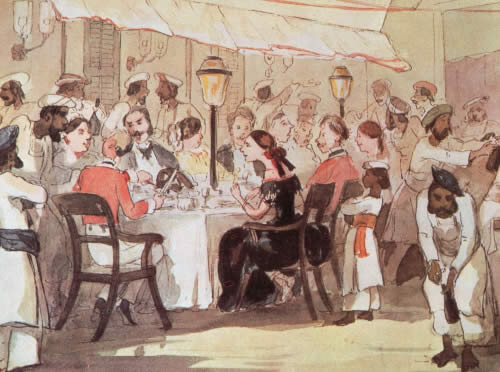
Which brings one to another new restaurant that has opened in the neighborhood, that largely and loudly beckons the truly non-historic consciousness of the young tourists in their deluded fantasy of finding NYC's historical golden past of of a hip and happening underground -- a cultural rebellion of the above ground fortunate --proclaims itself as serving up an authentic colonial Indian food experience (owned by recent immigrants from either Pakistan* or -- India). Is this a sign of the desperate times in which the underground, the vast majority of the world live, that the formerly colonialized too feel it necessary to mine the hip hip hooray above ground colonial golden past of empire, in order to survive in a new world.  Will we be seeing the Native populations of North America open theme park restaurants celebrating the fun and delicious era of the Trail of Tears?

------------------------

*  Here it has been noticed that often restaurants owned by people of Pakistani origin bill themselves as "Indian" because this designation is understood more easily by the young and the tourists who are honestly ignorant of both history and geography.

Friday, March 6, 2015

Corporate Pillage and Power Supported By the State: The East India Company

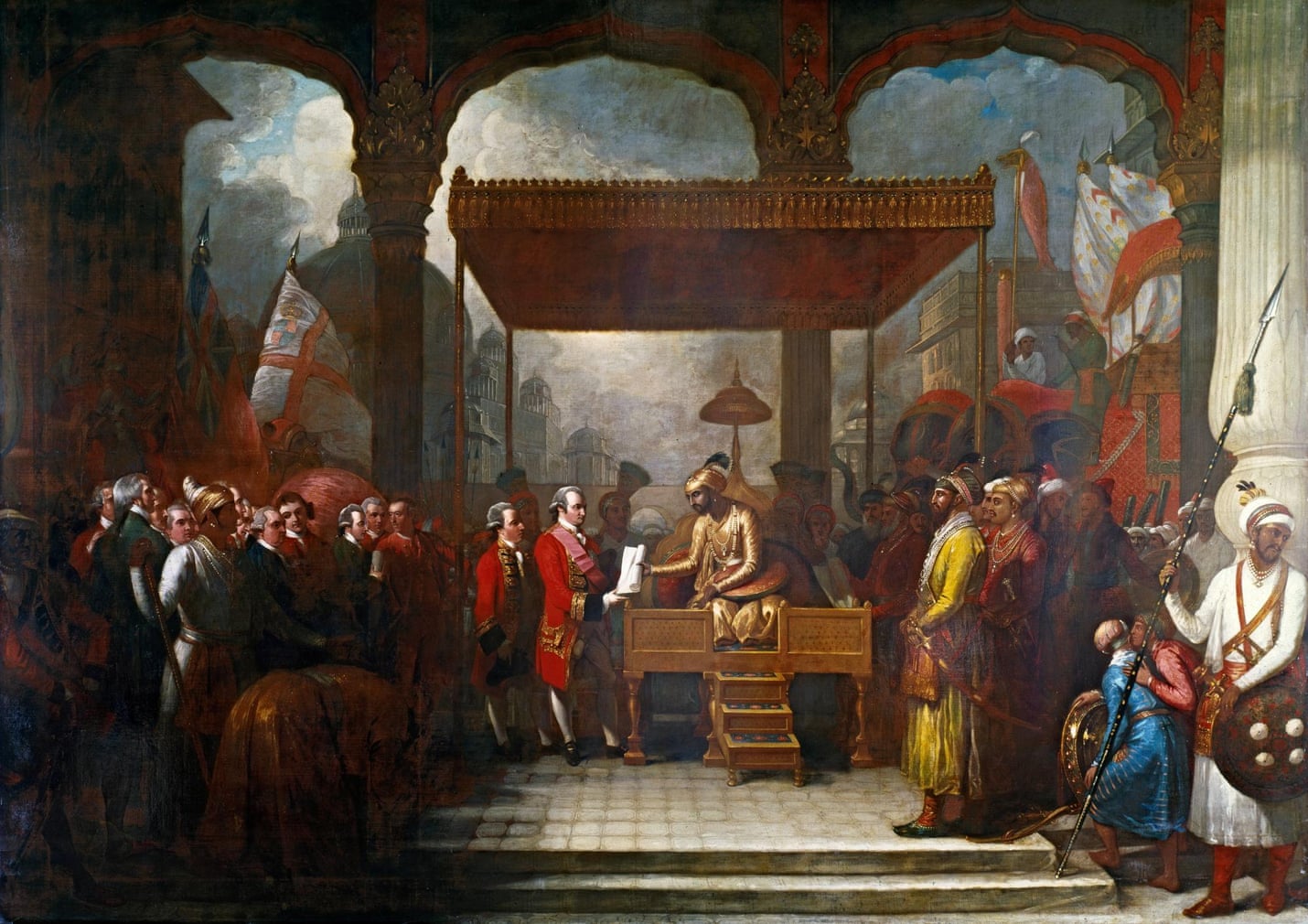
In the Guardian's Long Read series, "The East India Company: The original corporate raiders," is excerpted from William Dalrymple's forthcoming book, The Anarchy: How a Corporation Replaced the Mughal Empire, 1756-1803, to be published next year.


One cannot but help recalling the English government, its enthusiasm to help fill the East India Company's empty coffers from the glut of India tea on the market, gave some big pushes to the North American colonies' rebellion and secession. (For a good description of this series of unfortunate events, particularly for New England, and especially Boston - Massachusetts, see Nick Bunker's An Empire on the Edge (2014).*

The pull from Dalrymple's The Anarchy concludes:
The 300-year-old question of how to cope with the power and perils of large multinational corporations remains today without a clear answer: it is not clear how a nation state can adequately protect itself and its citizens from corporate excess. As the international subprime bubble and bank collapses of 2007-2009 have so recently demonstrated, just as corporations can shape the destiny of nations, they can also drag down their economies. In all, US and European banks lost more than $1tn on toxic assets from January 2007 to September 2009. What Burke feared the East India Company would do to England in 1772 actually happened to Iceland in 2008-11, when the systemic collapse of all three of the country’s major privately owned commercial banks brought the country to the brink of complete bankruptcy. A powerful corporation can still overwhelm or subvert a state every bit as effectively as the East India Company did in Bengal in 1765. 
Corporate influence, with its fatal mix of power, money and unaccountability, is particularly potent and dangerous in frail states where corporations are insufficiently or ineffectually regulated, and where the purchasing power of a large company can outbid or overwhelm an underfunded government. This would seem to have been the case under the Congress government that ruled India until last year. Yet as we have seen in London, media organisations can still bend under the influence of corporations such as HSBC – while Sir Malcolm Rifkind’s boast about opening British embassies for the benefit of Chinese firms shows that the nexus between business and politics is as tight as it has ever been. 
The East India Company no longer exists, and it has, thankfully, no exact modern equivalent. Walmart, which is the world’s largest corporation in revenue terms, does not number among its assets a fleet of nuclear submarines; neither Facebook nor Shell possesses regiments of infantry. Yet the East India Company – the first great multinational corporation, and the first to run amok – was the ultimate model for many of today’s joint-stock corporations. The most powerful among them do not need their own armies: they can rely on governments to protect their interests and bail them out. The East India Company remains history’s most terrifying warning about the potential for the abuse of corporate power – and the insidious means by which the interests of shareholders become those of the state. Three hundred and fifteen years after its founding, its story has never been more current. 
I'm guessing (i.e.I do not know!) this first serial from Dalrymple's book was run so far ahead of publication due to the Guardian centering for weeks the HSBC scandal. It's also not a chunk just pulled from the book; it was edited and revised,


as the pulls in various publications from Kim Gordon's Girl in a Band: A Memoir aren't chunks of self-enclosed text, but revised as well.  First Serial excerpts often need a revision specifically for the specific publication in play, as most books aren't composed as stand-alone sections, and the length and focus for each publication is different.

----------------------------------

*  William Dalrymple  and Nick Bunker are two of my most admired and favorite independent scholar-writers -- meaning they both do splendid research, but they are also good writers as writers, which makes all the difference. 

Sunday, May 27, 2012

The Horse: From Arabia to Royal Ascot – British Museum Exhibit

Full article here, plus illo, plus links to other illos. It may not tell you anything you don't already know, but it's always a pleasure to see horses!


This is the sort of illo the article links to, though you have to scroll down the wiki site to find it, Moghul ruler, Akbar, hunting deer from horseback:


[ " John Curtis, one of the curators, explains that there has been much advance interest in the show. Horses, magnificently wordless in themselves, excite passionate differences of opinion in their admirers and the museum has been petitioned, urging that certain breeds be championed. But the museum has faced a challenge: "Most of our exhibitions are monocultural, whereas the horse exists in all cultures." And so partly to avoid a bewildering miscellany, the decision has been taken to put Arab horses in charge of the narrative.The domestication of the horse is thought to have taken place on the western Euraisan steppes, probably in Kazakhstan, around 3,500BC (the exhibition includes what may be the earliest depiction of a horse and rider, a terracotta mound from Mesopotamia). But the narrative then advances through Islamic history and showcases the emergence of the Arab horseIt reveals that the bloodlines of modern thoroughbreds can be traced back to three Arabian stallions imported into England in the 18th century (the Darley Arabian, the Byerley Turk and the Godolphin Arabian). The journey we take includes astounding Arab rock paintings of horses and then fetches up in Victorian England to consider the horse's influence on society (the horse traffic jams were terrible), before a racy finish at Ascot and in the modern world." ]

Additionally, something we may wish to consider, which information is not included within the article, but provided by a commentator to it: this is the second exhibit at the British Museum this year sponsored by the House of Saud, i.e. see concentration on the Arab horse in history.

In the modern era museums became, among other things, the supreme expression of who holds power, and how much power is held. This has been always the case with the horse, a signature of class, rank, wealth and power.

Wednesday, April 7, 2010

An Account of Reconstruction, 1865 - 1866 by a British Imperialist

K -- you will find this fascinating, in light of the books you're currently reading. 

"Sir Charles Wentworth Dilke’s fascinatingly odd Greater Britain: A Record of Travel in English-Speaking Countries," (published 1868).

The heads-up for this from a blog I like, though some of the blogger's statements are, if not exactly wrong, not correct. For example the blogger states that the UK backed the Confederacy. The UK government never did back the Confederacy in any of the ways that mattered, and for which the Confederacy lobbyed until the end: financially (no loans), no weapons and no embargo of the Union, either diplomatic or mercantilist.

As for the blogger's conclusion, I have to agree wholeheartedly:

But the most telling passage for me, is this one — which occurred in the ellipsis above — in which we see most clearly how the problem of black free labor literally disappears under racism. When he asks the assembled whites about what kind of work the free blacks do, they literally cannot answer him. Though he has seen almost nothing in the entire town but black industrious labor, free black labor is so unthinkable to the ” poor trash” that when he points it out, they erase his very words with a spelling lesson on race hatred:

Strangers are scarce in Norfolk, and it was not long before I found an excuse for entering into conversation with the “citizens.” My first question was not received with much cordiality by my new acquaintance. “How do the negroes work? Wall, we spells nigger with two ‘g’s,’ I reckon.” Virginians, I must explain, are used to ” reckon” as much as are New Englanders to ” guess,” while Western men ” calculate ” as often as they cease to swear.) ” How does the niggers work? Wall, niggers is darned fools, certain, but they ain’t quite sich fools as to work while the Yanks will feed ‘em. No, sir, not quite sich fools as that.” Hardly deeming it wise to point to the negroes working in the sun-blaze within a hundred yards, while we sat rocking ourselves in the verandah of the inn, I changed my tack, and asked whether things were settling down in Norfolk.
That non-work ethic of the former confederacy? It’s alive and well among certain white southern populations still, as we learned while living in New Orleans.