LINES OF THE DAY

". . . But the past does not exist independently from the present. Indeed, the past is only past because there is a present, just as I can point to something over there only because I am here. But nothing is inherently over there or here. In that sense, the past has no content. The past -- or more accurately, pastness -- is a position. Thus, in no way can we identify the past as past." p. 15

". . . But we may want to keep in mind that deeds and words are not as distinguishable as often we presume. History does not belong only to its narrators, professional or amateur. While some of us debate what history is or was, others take it into their own hands." p. 153

Silencing the Past: Power and the Production of History (1995) by Michel-Rolph Trouillot

Tuesday, September 9, 2014

Sophia Tolstoy + Leo Tolstoy's 186th Birthday Google Doodle

This was a non-dimensional tribute to Tolstoy's fiction -- sanitized of the terrors within his works, without any connection to the life the writer led, particularly of the terrible life he led Sophia, his wife, and their deeply troubled marriage, which was well known even then.


She was 18 when the 34-year old Leo Tolstoy married her.


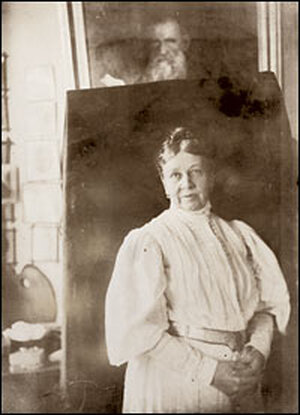
A self portrait
Sophia Tolstoy was a photographer and diarist of significance, dealing with both tsarist Russia and Tolstoy and their lives; she copied and edited Tolstoy's work; eight of her 13 children survived childhood -- there were miscarriages as well.  Tolstoy himself found pregnancy and childbirth and babies disgusting, while she was overwhelmed with caring for the surviving children and everything else from keeping the accounts to overseeing running his estates, his serfs and the animals. Yet, people will wonder why their marriage became so troubled.

Sunday, September 7, 2014

Bill Gates Discovers Big History

Bill Gates discovered Big History via dvds he watched while on the treadmill in his private gym.  He's decided to put Big History courses into all the country's high schools.

There are questions anyone should ask about Bill Gates dictating a nation's high curriculum.  He's responsible for the Common Core and other initiatives such as


Microsoft Encarta* that don't seem to have worked any better than anything else in creating an authentically educated population. By now these Big History courses are being taught all over the U.S. and Gates plans to get his plans added to thousands more schools within the next year or so.  However, anecdotally, the students in the university courses that we teach now and again, when asked, can't point to a map and show where a place is, whether in the U.S. or anywhere else, never heard of the Emancipation Proclamation or any of the Presidents, the Mexican War, the War of 1812, etc.

In other words, reading about these courses, students aren't learning actual history: there is no methodology for evaluation of historical actualities.  It's an undisciplined hodgepodge of unproven, if exciting, theories without supporting, discriminating documentation -- rather the way within genres, so much so-called alternate history is written.

Myself, am quite fond of Big History. It's a constant feedback loop, delving into the history of any where, any time and any place -- the local feeding into the larger picture and the larger world's affect upon the ever smaller and more local.  For instance, if one wants to understand the history of cotton's drive of the global economy and how it got to be a part -- and such a huge part -- of the global economy in the nineteenth century, a study of the history of a single Mississippi plantation is where to begin.  This moves one on to transport back and forth between Mississippi and Europe, European capital instruments, and how they flow to Mississippi and so on.  But without looking at both the larger and the smaller, the historian will have a process and a system that's incomplete.

In any case,  el V's books, and now our The American Slave Coast, are Big Histories of their subjects, because that's how I've always rolled -- the interconnections and influences among subjects and events within various time frames. Thus The American Slave Coast begins with Europe's first conscious voyages into what they called the New World.  Africans were on all those voyages, in a spectrum of positions from skilled seamen to those whose condition was that of being enslaved, from the time of Colombo's very first sail.

It is fun reading the description of Bill Gates discovery of Our Favorites: the Annales School of historians.

It's also fun to read how his advisor in these matters, Australian David Christian, began realizing his concepts.

He went through the same process I witnessed el V go through, in his first


attempts to write what became Cuba and Its Music: From the First Drums to the Mambo, which became that book that people are still reading and teaching, precisely because it is a Big History.  It begins with the Phoenicians, and, indeed, that first section remains the most popular part of the book with those who aren't reading for the music only.

Back then El V didn't know what Big History was. He was so frustrated in his attempts to find his way into writing the book.  He kept going further and further back in time. (Though he'd done a great deal of very high quality, professional writing, until then he hadn't written book.)  I gave him a bunch of books from my shelves that he'd never looked at, including Braudel.  That was his eureka time -- a subject's story could be told from before the subject, i.e. Cuban music, existed -- it could and, for full understanding, should be told from the existence of the forces that made the crucible which brought the subject into being.  Fortunately with his Spanish language skills, he was able to dig into Spanish resources that most music writers don't have, and brought those early days of Phoenician traders in Iberia, and the era of the Peninsula's Roman dominance, into -- appropriately for the subject -- throbbing life.

The NY Times Magazine article about Gates and his new philanthropic education mission here.
---------------------

*  Link here to description of Microsoft Encarta at Wiki, which supposedly destroyed Microsoft Encarta. I never found it useful -- too clumsy, and too difficult to extract any useful scope of information.  The same reason e-books are not useful for me: too much time wallowing around swiping, ticking, clicking, going from one place to another, rather than absorbing information, much less knowledge.

Saturday, September 6, 2014

So Under The Gun I Can Hardly Think

Yet, thinking is exactly what I am under the gun to be doing, supposedly because I can think, and fact check and do all those things.


To make everything more complicated in the 90 degree heat and the stupendous humidity, when I settle in to do today's quota of pages, the primary library I use, for no reason, locked out my log-in, declaring either i.d. or password was fraudulent, or maybe both.  Reset password, still I am not a user the system recognizes as legitimate.

I phone and am told stupid stuff by someone who doesn't know how things work. I go to two different places (it's a huge research facility with special collections in different locations) -- the first one is closed on Saturdays, though it was open on Saturdays last month --  and am instantly re-legitimized manually, thereby learn that I have materials from ILL waiting -- but at another library elsewhere.

The upshot is, I spent over three hours out in the sun and humidity that I should have used for fact checking and so on and so forth.  Plus another hour + prior to noon, doing the usual Saturday errands, hoping to be finished before it hit 90, though it was already 90, but I didn't know that.


And -- it's Fall Fashion Week! Every female college student with the least pretension to a career in Fashion is in the City.  (So then, how come all the bar - restaurants are packed and nobody's in the designers' stores -- yes, I live where every designer has a loss leader flagship store.)  Bumper to bumper traffic for some reason -- even at 10 AM -- on Houston.  And many tourists with melting down screaming children who are not enjoying their MILFs shopping til they drop for themselves.

I came home, soaked from head to toe -- mentioned, didn't I, the humidity? Drank over a quart of water at one go. Then I gave thanks to the Great Air Conditioner for our reliable, sturdy little unit which keeps our (small) place a cool cave.

All of us sometimes have days like this.  It really could be worse.  O yes, easily, a whole lot worse.

Friday, September 5, 2014

Economist Magazine's Reviewer's Feelings Hurt By Book About Slavery and Capitalism

White slave owners and traders are pictured as victimizers and enslaved people as victimized!  This is advocacy not history, shrills anonymous reviewer of The Half Has Never Been Told: Slavery and the Making of American Capitalism by Edward Baptist.


I have read the book. The title is perfect
because the whole story is still not told.
Though most of what is in his book is in
The American Slave Coast, there's a
great deal more in TASC -- but then
TASC is much longer and covers the
entire period of legal slavery in the U.S.
Each book focuses on different aspects of 
of slavery and capitalism in the U.S.

In the wake of Ta-Nehisi Coates tweets about it, The Economist felt it necessary to apologize and withdraw the review:

Apology: In our review of “The Half Has Never Been Told: Slavery and the Making of American Capitalism” by Edward Baptist, we said: “Mr Baptist has not written an objective history of slavery. Almost all the blacks in his book are victims, almost all the whites villains.” There has been widespread criticism of this, and rightly so. Slavery was an evil system, in which the great majority of victims were blacks, and the great majority of whites involved in slavery were willing participants and beneficiaries of that evil. We regret having published this and apologise for having done so. We have therefore withdrawn the review, but in the interests of transparency the text remains available only on this special page and appears below.

And here it is, and how typically ignorant it is. This anonymous person even drags up that very disproved "fact" that slaves were not badly treated because they were too valuable to be mistreated. That this is mendacious is proved with every account of slavery one reads.  More important than a slave's value were two other parts of a slave society: profit, and in the case of U.S. southern slavery in particular, white supremacy of the "black" body -- though as the generations rolled on the general lightening of the enslaved population became ever more noticeable.


[ " “FOR sale: a coloured girl, of very superior qualifications…a bright mulatto, fine figure, straight, black hair, and very black eyes; very neat and cleanly in her dress and person.” Such accounts of people being marketed like livestock punctuate Edward Baptist’s grim history of the business of slavery.

Although the import of African slaves into the United States was stopped in 1807, the country’s internal slave trade continued to prosper and expand for a long time afterwards. Right up until the outbreak of the civil war in 1861, the American-born children and grandchildren of enslaved Africans were bought cheap in Virginia and Maryland to be sold dear in private deals and public auctions to cotton planters in the deep South.

Tall men commanded higher prices than short ones. Women went for less than men. The best bids were for men aged 18 to 25 and for women aged 15 to 22. One slave recalled buyers passing up and down the lines at a Virginia slave auction, asking, “What can you do? Are you a good cook? Seamstress? Dairy maid?” and to the men, “Can you plough? Are you a blacksmith?” Slaves who gave surly answers risked a whipping from their masters

Raw cotton was America’s most valuable export. It was grown and picked by black slaves. So Mr Baptist, an historian at Cornell University, is not being especially contentious when he says that America owed much of its early growth to the foreign exchange, cheaper raw materials and expanding markets provided by a slave-produced commodity. But he overstates his case when he dismisses “the traditional explanations” for America’s success: its individualistic culture, Puritanism, the lure of open land and high wages, Yankee ingenuity and government policies. 

ake, for example, the astonishing increases he cites in both cotton productivity and cotton production. In 1860 a typical slave picked at least three times as much cotton a day as in 1800. In the 1850s cotton production in the southern states doubled to 4m bales and satisfied two-thirds of world consumption. By 1860 the four wealthiest states in the United States, ranked in terms of wealth per white person, were all southern: South Carolina, Mississippi, Louisiana and Georgia.

Mr Baptist cites the testimony of a few slaves to support his view that these rises in productivity were achieved by pickers being driven to work ever harder by a system of “calibrated pain”. The complication here was noted by Hugh Thomas in 1997 in his definitive history, “The Slave Trade”; an historian cannot know whether these few spokesmen adequately speak for all. 

Another unexamined factor may also have contributed to rises in productivity. Slaves were valuable property, and much harder and, thanks to the decline in supply from Africa, costlier to replace than, say, the Irish peasants that the iron-masters imported into south Wales in the 19th century. Slave owners surely had a vested interest in keeping their “hands” ever fitter and stronger to pick more cotton. Some of the rise in productivity could have come from better treatment. Unlike Mr Thomas, Mr Baptist has not written an objective history of slavery. Almost all the blacks in his book are victims, almost all the whites villains. This is not history; it is advocacy. " ]

By the way, Lord Thomas concentrates his studies on colonial Caribbean and South American slavery, which are his areas and eras of expertise.  He is by no means an expert on the history of the southern U.S. slave society, which differed so much in so many ways from that further south of us, and particularly from the colonies with French and Spanish imperiums' legal systems and codes.

What I can't figure out though, is why The Economist even allowed this review to run at all? Surely they're brighter than this and better informed than this? Except, surely, they knew something like this would appear in the review since they chose whoever-it-was to review it.  It's so convenient for The Economist and its writers to not have by-lines, and not to have ever allowed them, as far as I know.

Wednesday, September 3, 2014

The Many Battles of Atlanta

Thanks to AH and his blog, which provided the link to The Bitter Southerner blog and this story, "The Many Battles of Atlanta."


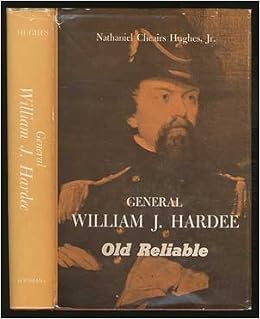
On July 21st, 2012 the author, Fletcher Moore, and a photographer, Brett Falcon, hiked the 20 mile route taken by General Hardee 148 years ago -- to make this story:
One-hundred-fifty years ago next month, some 25,000 ill-fed, ill-dressed men issued from wood and earth fortifications around the perimeter of what is now downtown Atlanta. Their aim was to sneak around the edge of a sizable Federal army and slay them all from behind. The effort entailed a 15-mile march through the dark of night, in the smothering July heat, down dusty paths and through a trackless wilderness.
General Johnston was replaced by General Hood as defender of Atlanta against Sherman. The objective was this:
After a failed attack on the Federals as they crossed Peachtree Creek north of Atlanta, Hood drew his troops into the city's inner defensive lines, in the hopes of getting Sherman to stick his neck out. Sherman arguably did just that, sending McPherson due west from the Decatur area along a route roughly corresponding to I-20. At nightfall on July 21, McPherson's 35,000 men were arrayed in a north-south line, from somewhere near the intersection of I-20 and Moreland Avenue to the vicinity of Little Five Points, with a reserve division (around 12,000 men) encamped in modern Candler Park.
Major General James B. McPherson, killed at the Battle of Atlanta on July 22nd, 1864.
Seeing his opportunity, Hood ordered one of his corps commanders, Gen. William J. Hardee, to march his men along a hook-shaped route, south, then east, then back north, seeking to fall undetected upon the left flank and rear of McPherson's army. The march was to be performed under cover of night, aiming to recreate Confederate Gen. Stonewall Jackson’s similar maneuver at Chancellorsville the year before, which had produced a stunning victory. Audacious as Hood’s idea may have been, however, Hardee’s march was beset with unexpected obstacles, and the troops were not in a position to attack until past noon the following day, by which time McPherson had sniffed out the plan and sent his reserve to meet them. While the Confederates enjoyed some initial success, the offensive ultimately failed, and subsequently the Confederate position in Atlanta began to slowly unravel, culminating in a fiery retreat some six weeks later.
It was Hardee's route I aimed to duplicate.
Yesterday was the 150th anniversary of the arrival of Sherman's columns in Atlanta.

The stories told by Fletcher Moore of General Hardee and Hood are not those of Gone With the Wind. The final paragraph telling the final fate of this Atlanta is chilling for the same reason that are those of Columbia and Richmond chilling, when the CSA falls, and the armies and government desert:
As I trudge through East Atlanta and drop myself on a bus bench to await my ride home, I can't help but think of the one detail of the battle that seems to escape the attention of those who identify with the “lost cause”: When Hood finally gave up the ghost and fled the city, it was he who lit the first match that burned Atlanta to the ground.
General Sherman
Yet, to this day, the "sons-of-bitches invading Yankees who wouldn't leave us alone" are blamed for the burning of these cities.

The photos that go with this "Bitter Southerner" piece are fascinating and one wishes for more of them.

Reading Wednesday: The American Slave Coast + Memoirs of A Fox-Hunting Man, Tuchman, Faulkner & Willam Alexander Percy

This is the week of the final read-through, revisions, fact-checking, etc. of The American Slave Coast: A History of the Slave-Breeding Industry.  This is adding to the current seasonal dissonance created first by the hottest weather of the entire summer, because, while this week is the start of everything new for so many as classes resume here in NYC in every level from pre-K to university, we are finishing a multi-year project. Or, at least, finishing this aspect of the project -- we're working on a presentation of some of the material complete with musicians, singers and other readers ....

Yesterday was the first real scorcher of this year, with temps in the high 90's as well as very high humidity. The copy shop to which I took the thumb drive to print out, yet again, the first chapters of TASC, had a line out into the street of anxious NYU kids, purchasing the spiral bound class packets that their professors had put together and the copy center had xeroxed and assembled, to be paid for with NYU's own cash card, which each student presumably is issued (NYU has its own currency, i.e. on that card).

I was so glad to not be a student, teaching or, worst of all -- a freshman!

It was very hot and stuffy in that little Asian-owned copy shop, the only one left in the neighborhood, staffed by brilliant young Asian girls -- who, by now, must as sick of seeing me come in with that thumb drive to have these pages once again printed out, as I am about doing it. It will be interesting to see, when we add up all the expenses for doing this book, how much we've spent on copying the drafts over the years.  The first year, of course, we didn't spend any money ourselves, since we could copy at the Center in C'town.

This was in every way a very expensive book to write,* even if we don't add in the cost of the extensive travel research we did, including going to England. Still, though some of the travel costs were off-set by paying gigs, this was no small sum. There is also the payment for permission to use certain illustrations -- as well as having again to re-purchase Photo Shop (though now Photo Shop no longer sells the program at all -- it only rents) to process our own photos and to restore the very poor quality of period newspaper advertisements and other illustrations.

Just the cost of living while doing this book, which has increased every few months -- well, that's why it's taken so long. There wasn't much time to just work on the book. There was all the other work taken on to support ourselves in the meantime.


All the while, even now, we keep learning more history instrumental to the founding causes as to why the Southern United States, of all the New World economies that included slavery, was the only one to be a slave society, its economy based on womb enslaved into perpetuity. It wasn't an accident by any means.The intention and the perspective which allow such an inhumane blindness to humanity and civil rights was embedded in the founding fathers of the Southern states even before the first settlements of Virginia and Carolina were founded.

As back home in Britain, their thinking was formed so much by their handling of their Irish plantations, so they expanded this immediately to enslavement for profit (as opposed to labor per se) of the natives. The native tribes, of course, as the African peoples in Africa, were in perpetual rivalry and conflict with each other, so they were ready at all times to betray each other and sell each other to the Carolinians, who were assiduous and methodical in collecting slaves from the natives and selling to the Caribbean colonies.

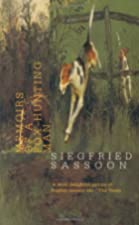
As always, reading of the brutality of our nation's founding centuries, it's quite a dissonance to switch the heart of British civility, as with Siegfried Sassoon's first volume of changed-names memoir of growing up into and out of World War I.  I began reading Memoirs of A Fox-Hunting Man, in the fall of 2011. I'd had the book on my shelves for years already. I was provoked finally into reading it by my experiences with the Eastern Shore fox hunting clubs.  However, the sheer uselessness of the narrator, Sassoon's fictionalized Sherston-self, as a callow, blind and selfish boy and youth (his own characterization of his younger self), and his entire class-ridden culture on the threshold of WWI, provoked


impatience, while the tiny font and skinny trim of my Faber and Faber paperback, and my worsening vision, provoked annoyance -- so, I put it down. Over the years I would read a chapter every few months, but never making any real progress with the work. However, re-reading / listening to audio versions of Barbara Tuckman's The Proud Tower and The Guns of August, made the last half of the Memoir so interesting -- or maybe he was old enough now? children and adolescents aren't generally very interesting reading for me -- I finished it over the weekend.

As well, I kept thinking of  Sassoon's Memoirs while this spring reading the history of Faulkner's and William Alexander Percy's Mississippi -- Mississippi with which I found myself so involved this year, historically, geographically, politically and culturally.  Both Americans, Faulker and Percy, both aristos in their worlds as much as Sassoon was in his, had very different wars than Sassoon -- yet, for all three of them, their wars were shaped by their being embedded in their world's ruling classes, where everyone knows everyone or at least their uncles and aunts, and make the path clear for these nephews, cousins, school friends' sons. So there are many parallels. While Faulkner never wrote a memoir of his war, he did return to it constantly in his fiction and his (fictionalized) presentations of himself.  Percy did as well, in his poetry, though not so much, and more so in his own memoir,


Lanterns on the Levee.

Picking up Memoirs of A Fox-Hunting Man last week, this time I found it fascinating and finished it in a few nights reading.  The war looms every more largely in the second half, until finally, slowly, o so slowly, the real thing comes, and finally, Sassoon is taken by war, months after he joins up. He loses the men whom he loves, who may well have been his lovers. Whether or not they were physical lovers doesn't matter to us. In any case, the various loves in their various way, were were profound and complete. Finally, the war devours him, ending, for him at least, forever, the very England of the golden days of following the hounds in comaraderie of class, prosperity and family.  The blinders of class and comfort through which Sherston had so happily seen nothing of the world but his own very narrow matters, have been shattered forever, with the shattering of his health and his youth.

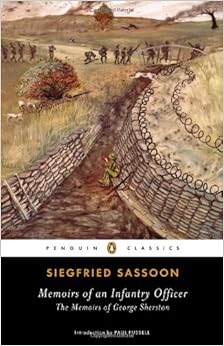
The second volume in The Complete Memoirs of George Sherston is Memoirs of 


An Infantry Officer, the third, when he's in hospital and treatment for shell shock,


is titled Sherston's Progress.

---------------------

* During the course of the years (beginning in September, 2010) working to create The American Slave Coast, el V and I both used up two computers. We're finishing it, both us on computer 3 -- though yes, both of us initially, began with machines that were unstable in the way computers warn you that necessary replacement looms.

Monday, September 1, 2014

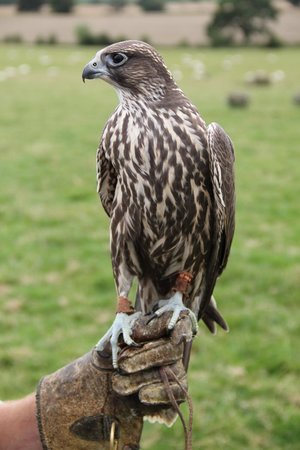
Proposal: Fairy Tale or Potter? Walworth Castle Birds of Prey Center, County Durham

In Northeast Yorkshire, County Durham, is the Walworth Castle.

[ "Walworth’s an honest-to-God castle, dating back 800 years, with a huge Norman tower. You can spend the night in that tower: Walworth is a Best Western hotel, the most atmospheric Best Western you’ve ever seen, with suits of armor and a dungeon. The rooms are, however, aggressively modern, with WiFi and flat-screen TVs." ]


The castle dates back to the 16th century (according to wiki, while the Castle's promotional materials says it dates back 800 years, so I am confused; the castle's architecture does say "older than the 1500's").  These days its marketed as a wedding center. However, Walworth is a place that bird lovers and historians will also enjoy visiting, as it is home to the


Walworth Castle Birds of Prey Center.  The visitor can watch the trained birds in flying displays, go hawking herself or, if in love, combine birds and romance:

[  " . . . the falconers will take you out for a day of hunting rabbits up on the moors. Or they can stage a once-in-a-lifetime experience: A few days before my visit, Tori got one of her trained owls to fly down carrying a diamond in a fancy little bag while a guy proposed to his girlfriend beneath an oak tree." ]


When reading that it's difficult not to visualize Harry Potter's Hedwig (who was a Great Snowy).

Full story about the Birds of Prey Center here.  The 16 photos of the slide show at the top of the article are worth viewing; some are magnificent.