LINES OF THE DAY

". . . But the past does not exist independently from the present. Indeed, the past is only past because there is a present, just as I can point to something over there only because I am here. But nothing is inherently over there or here. In that sense, the past has no content. The past -- or more accurately, pastness -- is a position. Thus, in no way can we identify the past as past." p. 15

". . . But we may want to keep in mind that deeds and words are not as distinguishable as often we presume. History does not belong only to its narrators, professional or amateur. While some of us debate what history is or was, others take it into their own hands." p. 153

Silencing the Past: Power and the Production of History (1995) by Michel-Rolph Trouillot

Showing posts with label Cuba And Its Music. Show all posts

Friday, May 22, 2020

Breathing Lilacs: Tragedy Is Personal

     . . . . The memory of yesterday's scent of lilacs at Washington Square Park lingers. Which brought to mind, then, Walt Whitman's, "When Lilacs Last In the Dooryard Bloom'd", his elegy for the assassinated Abraham Lincoln.  Washington Square Park, though not yet a park* -- all of what was to be known as Greenwich Village -- was Whitman stomping grounds too.


I buried my masked face in them, heedless of the bees -- at least until I noticed them, so entranced I'd been by the strong come hither the blossoms broadcast. That I could smell them so vividly, even through the mask shows 1) the difference in air quality here due to virus; 2) how little the mask prevents air born from coming through. Well yes, the mask is to protect others; it doesn't protect us. O the perfume was heady!  The bees' presence also made me happy.

Did three different class guest spots this last week, including one around The Year Before the Flood: A Story of New Orleans, for a Tulane class.

El V is incredible. His SooperDooperPooter for processing, editing and producing video and film and audio got delivered yesterday, and he had it up and functional before bed! So's he able now to send quickly these enormous files of content to the VIMEO website for sharing with the film maker in New Orleans, with whom he's  working on the Cuban content, among other things. It's so great to have decent tools. To render (this word has a special meaning within this Adobe PremierePro program, which I won't clutter this post with)  his work loads and then send them along used to take something 24 hours, and even the slightest burp in internet service or speed would stop it, and then it would have to start all over from zero, including all the edits, tweeks, synching, volume control, color saturation, etc. Now he can do it in minutes!

Seems last night I got mildly high from the amount of Erica’s THC Soothing Salve, and her Freeze lotion, which I vigorously and lengthily rubbed into both of us last night as both of us have screaming neck and back pain. Felt happy and peaceful, giggled a lot together during Reading Aloud. John Quincy Adams just gets to be more fascinating and enjoyable the older he gets.  

And, just before lights out a friend emailed this Yo-Yo-Ma Book Section link:

https://www.nytimes.com/2020/05/21/books/review/yo-yo-ma-by-the-book-interview.html
Q: What books are on your nightstand?
“The World That Made New Orleans,” by Ned Sublette.
“Barracoon: The Story of the Last ‘Black Cargo,’” the oral history of one of the last known African survivors of the Middle Passage, by Zora Neale Hurston.
The memoirs of Alexandre Dumas, the first volume of which I am struggling through in French.
“Spirit Rising,” by the unparalleled Angelique Kidjo, who recommended the first three titles. She and I are working on a new project that explores some of the less-known intersections between what we think of as Western classical and African music.
What great book company to be in -- Alexandre Dumas! even.  So big shout outs this week from both Rhiannan Giddens (Cuba and its Music) and Yo-Yo-Ma (The World That Made New Orleans) -- and Angélique Kidjo too -- who back when it came out had herself photographed holding up The American Slave Coast!  for Ned's books!

Of course I am ignoring just about everything that isn't part of our own little world -- all too easy to do, when in quarantine.  But mentally ill neighbor across the hall helps keep me grounded in the awareness of other realities, with one request after another: opening cartons, bottles, etc. that she can't because she took much of her medication, fell and hurt her arm and shoulder; cooking for her; providing ear plugs and three phone calls of how to use them >?< in one day; a wash cloth because she doesn't have any; toothbrush and toothpaste, etc. 

That we're having nice days is certainly having an effect upon our mood this week. We're just generally more relaxed and peaceful. For now.

All I can say is, "Thank you lordessa, for B and his weekly supply of cornbread!"

Even the absentee ballot requests for both of us arrived -- finally! -- in yesterday's mail, so I will be able to vote in next month's Dem Pres Nom primary -- from which ballot the Dem party bigwigs including Cuomo have done everything they can to 1) not hold; 2) remove Bernie Sanders.

Also, for a variety of reasons, some of our friends are moving back to NYC . . . .

~~~~~~~~~~~~

*  Fort Green Park was Whitman's park of the heart, from at least the 1840's on.


Thursday, April 6, 2017

Reading Wednesday -

     . . . . Yah I know it's Thursday now, but I did scrabble these notes yesterday, Wednesday.

Reading, I am reading, but very slowly. Still coming back from the Cuba Expedition, and I am spending a lot of time out of the apt. in company of people of all sorts for various projects.


                                               Clovis I

We continue in our Great Merovingian Escape from our own world's political horrors. It really settles us down before sleep to read about all these figures about which we know so little beyond the dimensions of their brutality wielded upon each other.

I have been struggling with Greg Iles's third and concluding volume of the white supremacist evils perpetrated in Natchez and environs during the age of Kennedy, the Vietnam War and the Civil Rights era, Mississippi Blood (2017). But the icky dimensions of Iles's own psyche are back on view large and overwhelming in this third volume, meaning his sexual fantasy that deals with race and age in ways that, honestly, make his central fantasy stand-in of self, so yucky.  But Iles and his character Penn Cage see themselves only as good guys, so it's even more difficult to deal with.  Iles and Penn are outright creepy, which might seem an odd judgment when he's also created some of the most truly evil villains to be found on the page. But then, the villains are comic book villains, really, whereas we're take to Penn Cage seriously as both a man and white hat hero.  Why haven't Iles's friends told him . . . .


Instead I'll be reading Claire Tomalin's Samuel Pepys: The Unequalled Self (2003).  I've read other of her biographies, notably the work that deals with Charles Dickens' and his very young actress mistress for whom he cruelly discarded his wife, The Invisible Woman, from which a film was made.  Last year or was it the year before? I listened to three volumes of Pepys Diaries, which was a wonderful experience.  So I expect to enjoy this biography too. Unlike Iles, Pepys, despite his flagrant sexual / gender transactions (so judged even by himself, at least at times) is a likable guy.  He doesn't lie to himself about himself. In so many ways he embodied the spirit of his age. Combine that with his capacity for diligent work and his winning personality, no wonder he got on.

Sunday, September 7, 2014

Bill Gates Discovers Big History

Bill Gates discovered Big History via dvds he watched while on the treadmill in his private gym.  He's decided to put Big History courses into all the country's high schools.

There are questions anyone should ask about Bill Gates dictating a nation's high curriculum.  He's responsible for the Common Core and other initiatives such as


Microsoft Encarta* that don't seem to have worked any better than anything else in creating an authentically educated population. By now these Big History courses are being taught all over the U.S. and Gates plans to get his plans added to thousands more schools within the next year or so.  However, anecdotally, the students in the university courses that we teach now and again, when asked, can't point to a map and show where a place is, whether in the U.S. or anywhere else, never heard of the Emancipation Proclamation or any of the Presidents, the Mexican War, the War of 1812, etc.

In other words, reading about these courses, students aren't learning actual history: there is no methodology for evaluation of historical actualities.  It's an undisciplined hodgepodge of unproven, if exciting, theories without supporting, discriminating documentation -- rather the way within genres, so much so-called alternate history is written.

Myself, am quite fond of Big History. It's a constant feedback loop, delving into the history of any where, any time and any place -- the local feeding into the larger picture and the larger world's affect upon the ever smaller and more local.  For instance, if one wants to understand the history of cotton's drive of the global economy and how it got to be a part -- and such a huge part -- of the global economy in the nineteenth century, a study of the history of a single Mississippi plantation is where to begin.  This moves one on to transport back and forth between Mississippi and Europe, European capital instruments, and how they flow to Mississippi and so on.  But without looking at both the larger and the smaller, the historian will have a process and a system that's incomplete.

In any case,  el V's books, and now our The American Slave Coast, are Big Histories of their subjects, because that's how I've always rolled -- the interconnections and influences among subjects and events within various time frames. Thus The American Slave Coast begins with Europe's first conscious voyages into what they called the New World.  Africans were on all those voyages, in a spectrum of positions from skilled seamen to those whose condition was that of being enslaved, from the time of Colombo's very first sail.

It is fun reading the description of Bill Gates discovery of Our Favorites: the Annales School of historians.

It's also fun to read how his advisor in these matters, Australian David Christian, began realizing his concepts.

He went through the same process I witnessed el V go through, in his first


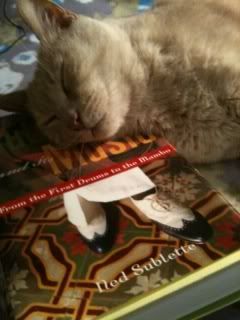
attempts to write what became Cuba and Its Music: From the First Drums to the Mambo, which became that book that people are still reading and teaching, precisely because it is a Big History.  It begins with the Phoenicians, and, indeed, that first section remains the most popular part of the book with those who aren't reading for the music only.

Back then El V didn't know what Big History was. He was so frustrated in his attempts to find his way into writing the book.  He kept going further and further back in time. (Though he'd done a great deal of very high quality, professional writing, until then he hadn't written book.)  I gave him a bunch of books from my shelves that he'd never looked at, including Braudel.  That was his eureka time -- a subject's story could be told from before the subject, i.e. Cuban music, existed -- it could and, for full understanding, should be told from the existence of the forces that made the crucible which brought the subject into being.  Fortunately with his Spanish language skills, he was able to dig into Spanish resources that most music writers don't have, and brought those early days of Phoenician traders in Iberia, and the era of the Peninsula's Roman dominance, into -- appropriately for the subject -- throbbing life.

The NY Times Magazine article about Gates and his new philanthropic education mission here.
---------------------

*  Link here to description of Microsoft Encarta at Wiki, which supposedly destroyed Microsoft Encarta. I never found it useful -- too clumsy, and too difficult to extract any useful scope of information.  The same reason e-books are not useful for me: too much time wallowing around swiping, ticking, clicking, going from one place to another, rather than absorbing information, much less knowledge.

Tuesday, February 15, 2011

New Orleans, *Abraham Lincoln: Vampire Hunter* & el V's Books

There was this book, Abraham Lincoln: Vampire Hunter, which, in the natural course of events, is now a movie-in-production.

A while back some of the people working in the flick contacted el V for musical advice.  They ordered two copies of The World That Made New Orleans, a copy of Cuba and Its Music:From the First Drums to the Mambo, and a copy of The Year Before the Flood. Though the mail person has complete access to the gate that opens to the path that leads to the mailbox, the mail person just threw the boxes across the fence.  The others are OK, but The Year Before the Flood landed in a pool of water.  It is now being dried out and hopefully can be read soon, says the e-mail report.

Monday, October 4, 2010

*OFFBEAT* Does Postmamboism -- and His Nness Too, Of Course

Canal Street Gets the Postmamboist Treatment by Zachary Young.

“Postmamboism” is a word you’re probably not familiar with. For writer and historian Ned Sublette, it’s a way of looking at the world.

“It’s a term that I made up to describe what I had done in my three books (Cuba and Its Music, The World That Made New Orleans, The Year Before the Flood),” Sublette says. “I used music to read history.” He describes postmamboism as a “portable theory that places music at the center of understanding and uses music to interrogate other fields of study.” The practice treats music as a lens through which to view other aspects of human society.

This Monday, Sublette will give a talk at UNO in which he will apply his analytical methods to the cultural history of New Orleans – or more accurately, to one specific part of it. The title of the talk is “Uptown and Downtown New Orleans as Musical Plate Tectonics,” and in this metaphor, Canal Street is the fault line.