LINES OF THE DAY

". . . But the past does not exist independently from the present. Indeed, the past is only past because there is a present, just as I can point to something over there only because I am here. But nothing is inherently over there or here. In that sense, the past has no content. The past -- or more accurately, pastness -- is a position. Thus, in no way can we identify the past as past." p. 15

". . . But we may want to keep in mind that deeds and words are not as distinguishable as often we presume. History does not belong only to its narrators, professional or amateur. While some of us debate what history is or was, others take it into their own hands." p. 153

Silencing the Past: Power and the Production of History (1995) by Michel-Rolph Trouillot

Showing posts with label writers U.S. History. Show all posts

Sunday, August 23, 2020

As He Said: "The Past Isn't Even Past"

     . . . . Most of our current crises are connected to this nation's founding history in genocide and African slavery -- economically, politically and socially, even down to emergency natural disaster crews. 

As we all know, the vast majority of our vast incarcerated populations are of color -- and poor. Now many local California politicos and pundits -- and the state fire fighting agency --  are bitterly criticizing the state for giving prisoners early release due to the hotspotting prisons are for outbreaks of covid-19.  Guess what?  The state's fire fighting agency, underfunded by the taxpayers and the politicians, depend instead on what is essentially slave labor -- which for the moment at least it does not have so our homes burn.  How much you want to bet California doesn't make this mistake again?

We all benefited, we benefit even now, from this nation's history of  slavery and perennial racial injustice to African Americans and Native Americans, even if we are more recent immigrants, whether we are white or not. 

We are seeing it so clearly with our dependence upon the poor and of color as the real line of disaster fighting -- and just to get groceries, to get medical care.* Because, you know, we believe don't need to pay them even a living wage.


Really, who believes in their heart that $1 - $2 a day for fighting these wildfires is pay?  particularly for those whose lives and health are at such a high level of risk? Plus, we all know too, these firefighting prisoners are legally prohibited from getting jobs as professional fire fighters because that means paying salaries and benefits. It's so much more practical and tax saving to just refresh the prison population constantly.  Keeping people who have served their sentence from getting real jobs is an effective method of ensuring that constant refreshment.

We all benefit, then and now, who aren't African American, who aren't Native American.

The brilliant light of 19th Century literature in this country couldn't have happened without the resources of slavery.  Longfellow's wife, recall, was vastly wealthy, like all those Boston cultural luminaries were -- allowing them to dedicate their lives to art and culture. There were so many who had that wealth resource that within 3 centuries of first colonization the US there were enough heirs of such wealth to support a leisure class that supports the arts and literature.

Where did much of that wealth of New England and the North, like NY, come from?

As with Longfellow's wife, her father owned the vast wealth creating textile factory complexes such as his Lowell, MA.  Those textiles were produced from the slave-grown cotton.  Much shipping and insurance and banking in so many ways out of slavery -- even after the African slave trade to the the US was abolished, even after slavery itself supposedly was abolished.  

Immediately after the war those wealthy northern and New England movers and shakers headed south** and allied with the great pioneers of neo-slavery, sharecropping, such as the Percys of Greenville, Mississippi (Walker Percy's family -- which was why he could live and write without a job.)


It is nearly impossible to look at even the brilliant light elements of our past and not see it rooted in and shadowed by slavery and genocide -- including the massive removal out of "Dixie" to make that vast territory safe for slavery. 

This morning there's a Marine Dem retweeted on Bill Gibson's Twitter feed, who warns us from where he lives within a huge maga country enclave, that 'they' hate 'us' with almighty passion, they are voting.... it's all about white vs everyone else -- and women. If you can only get it by giving over all power to the insane, and destroying what's left, and dying too, so be it. Long rage the covid-19 hoax! as proclaimed by a relative undergoing chemo for cancer in a rally in a waiting room of fellow unmasked cancer victims.

It merges well with Jon Meacham on the history of the revisionist Glorious Lost Cause history of the War of the Rebellion -- which began immediately.*** 

https://www.nytimes.com/2020/08/23/books/review/lost-cause-meacham.html?

[....]Here, then, was the ur-text of the Lost Cause, of the mythology of a South that believed its pro-slavery war aims were just, its fate tragic and its white-supremacist worldview worth defending. In our own time, the debates over Confederate memorials and the resistance in many quarters of white America, especially in the South, to address slavery, segregation and systemic racism can in part be understood by encounters with the literature of the Lost Cause and the history of the way many white Americans have chosen to see the Civil War and its aftermath.

To Pollard, the Southern side had fought nobly for noble ends. “The war has left the South its own memories, its own heroes, its own tears, its own dead,” he wrote. “Under these traditions, sons will grow to manhood, and lessons sink deep that are learned from the lips of widowed mothers.” Pollard declared that a “‘war of ideas,’” a new war that “the South wants and insists upon perpetrating,” was now unfolding.

And in many ways it unfolds still. The defiance of federal will from Reconstruction to our own day, the insistence on states’ rights in the face of the quest for racial justice and the revanchist reverence for Confederate emblems and figures are illuminated by engaging with the ethos of which Pollard so effectively wrote. He enlarged on his thesis in “The Lost Cause Regained,” published in 1868. Pollard wrote that he was “profoundly convinced that the true cause fought for in the late war has not been ‘lost’ immeasurably or irrevocably, but is yet in a condition to be ‘regained’ by the South on ultimate issues of the political contest.” The issue was no longer slavery, but white supremacy, which Pollard described as the “true cause of the war” and the “true hope of the South.”

The Civil War, then, was to be fought perennially....

We're already fighting our second civil war -- but while they are using their guns and everything else already, we insist on pretending it hasn't happened yet and it won't happen because we are going to win (one) election.  Which latter is in NO WAY assured of happening either. They certainly are doing everything, including shooting, to make sure it doesn't happen.

~~~~~~~~

*  For a breathtaking account of earlier dependence on coerced African American labor  even when slavery supposedly was over, see John M. Barry's Rising Tide (1997) for how the Walkers did it in their Yazoo Delta Kingdom in the Great Mississippi Flood of 1927.

*One of the most well recognized among those even now, is J.P. Morgan.  Not to mention all the racial injustice placating D.C. and presidents such as Theodore Roosevelt did for them, helping make labor laws and court cases go away, as he did for the Walkers with whom he happily went hunting.

***  In truth, though Meacham doesn't mention it, the revisionism began at least as soon as Vicksburg fell, with Davis and others suddenly dropping 'slavery' from their cause for fighting -- though it was top and center in their constitution as a 'nation' and the secessionist state constitutions, and in their many other printed works before and after secession.

Wednesday, April 19, 2017

Reading Wednesday: The Underground Railroad + White Tears

     . . . .  During a recent get-together with friends Colson Whitehead's The Underground Railroad, having recently won the Pulitzer for fiction, was part of the discussion.


The speculative fictional central narrative device chosen by the author, is a physical, industrial railroad, that literally runs underground, was questioned. The reasons for questioning the wisdom of this choice were reasonable: "white people's kids are going to believe it and there are too many phony ideas about the underground railroad already." By this are meant the quilts with special designs, secret maps, white people ran the escape routes, by the means of a secret organization were able to whisk thousands of people from the Deep South's Cotton Kingdom states to free soil states in the north, and many more phony ideas of what the means of escape from antebellum slavery were.*


Whitehead's novel has joined the talking points in the African American community concerning the depictions of slavery being made in popular culture / entertainment, including the controversy that sunk the fortunes of Nate Parker's (2016) film, Birth of A Nation, which seemed poised at the BAFTAs for Oscar recognition until social media revealed to the mass audience that he'd been accused of rape back in college, found not guilty but the woman had committed suicide later. Then of course, there are the Tarantino's massive violence revenge fantasies in which a black slave shoots up evil white slave owners and their henchmen.

I've had long conversations with people, black and white, about the films, but until this occasion hadn't discussed The Underground Railroad. Thinking as both an historian and a fiction writer, the reason the book is called The Underground Railroad and that the author creates a speculative fiction device that is a literal (within the terms of fiction, the novel itself) railroad that runs underground, is that this allows him to recounts all the stations of the African American Passion (it was Easter dinner after all), which history has literally been kept underground, but yet has continued to run in legal and financial documents and in memory.

There is another reason too, which is that the author could then employ the device as form, structure and even to a degree style, all three of which are armors for the novelist's psyche, as well as part of the tool kit for making a coherent story (which often as we know real life is not -- a coherent story).

Beyond that too, the author was allowing himself some sardonic play with white people's -- and black too -- capacity to romanticize the idea of escape route, and generally get so very wrong. He pushed that anti-historical determination to the very limit. In many ways I thought this was brilliant, particularly in aspiration.

Whitehead is not alone among younger novelists who recently have published work that aspires to bring the penetration of the history of US slavery into the present.  But White Tears (2017) by transplanted from England to hipster Brooklyn, Hari Kunzru is not successful in his execution.


Like Colson's novel, White Tears has a spec fic aspect also -- or magical realism as so many love to call that kind of thing (I don't). Though in a sense possession of a so-white guy by a long dead (fictional) blues man who suffers horrendous abuse in prison after murdering with a knife his girlfriend -- and then somehow gets the white boy to murder people with a knife too and suffer terrible abuse in prison -- is perhaps more horror than spec fic?

Maybe Kunzru was attempting to make fun of white guys grasping for personal authenticity by going for 'authentic' black stuff? (Want something good, steal if from black people . . . .)  The author further attempted to mate these white boys' quest for cool authentic identity with our carcel state which historically and currently specifically targets black men by giving one of the boys a fabulously wealthy family, whose current wealth comes from private prisons as with Eric Prince and his ilks. Then he tries to hook up young white guys' putting on black identity to make themselves 'real' with the colonial - imperial war machine too. This doesn't work, particularly as almost all the book is focused on two souless white boy geeks, one rich the other not, about whom honestly who gives a shyte?

If Kunzru wanted to show that white people have no culture of their own, this book doesn't do it. Well, it does it, by the conscious choice to center specifically USian contemporary brand of socially and emotionally incapacitated white geek guys.
The Guardian recently ran a piece on Black writers engaging with both lit and spec fic here. **

Supposedly The Underground Railroad is going to be an amazilla television series.


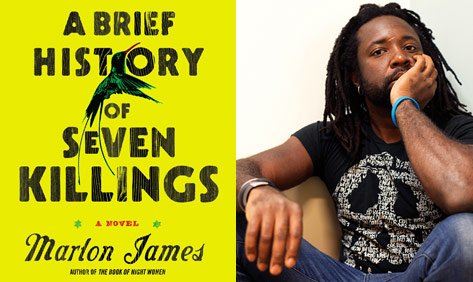
Marlon James (his A Brief History of Seven Killings (2014) got the Booker Prize) is currently engaged in an epic African fantasy project, titled Dark StarSeven Killings was optioned for an HBO series.


Junot Díaz's Brief Wondrous Life of Oscar Wao (2007) might be considered the gate opener for this successful combination of literary and genre fiction.  It won both the Pulitzer and National Book Awards, as well as other prizes. It was optioned for a film, if I am recalling correctly, back then, but there doesn't seem to be any recent news about that.

--------------------------------------------


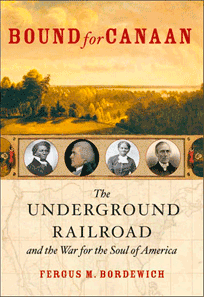
*  For the most complete and factual account of the means of who and how and to where slaves escaped their condition, from the earliest colonial era to the end of the Civil War, one cannot do better than read Fergus Bordewich's Bound for Canaan.

**   The brilliant fiction work that African American women are doing, with or without the inclusion of speculative fiction / genre tropes, seemingly is mostly ignored when it comes to the prestige prizes. The women who are first generation African immigrants, or from the Caribbean, seem to do somewhat better though, when it comes to the Big Validations, particularly in the UK. I'm not sure of this though, since I haven't gathered numbers and stats.  Somebody must have though!

Have any of their works been optioned for prestige television?