Presumably this season is only the first of the PBS's Civil War era, original,scripted drama.
Mercy Street's six episodes began airing on PBS last month and concluded last night, February 21st, 2016. Ridley Scott (
The Good Wife, Man in the High Castle, etc.) executive produced this first PBS historical drama in 20 years.
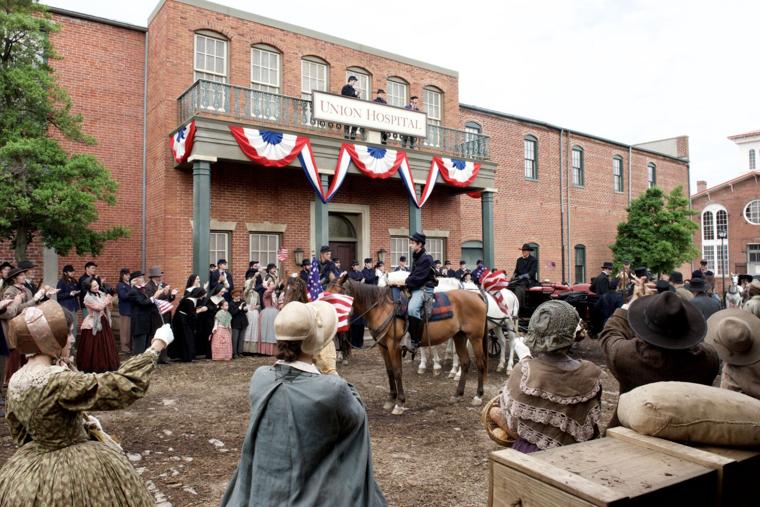
The time is 1862, the central location a Union confiscated hotel, converted into a hospital owned by the very wealthy Green family (existed, historically) of Alexandria, Virginia -- a rebel state. Alexandria is right across a short bridge from Washington D.C., thus the immediate Union occupation. Additionally the Green family mansion has Union military officers billeted in it.
 |
| Mrs. James Green of Mercy Street, played by Donna Murphy |
Mrs. Jane Green (Donna Murphy), her husband, James Green, Sr., son James, and two daughters, Emma the eldest, and Alice her younger sister, continue to live in their mansion nevertheless, served by their slave staff.
For Historical Background: Alexandria is where the slave dealers and markets moved, when, as part of the deal finally struck in 1850 to allow California into the Union as a free state, the slave trade itself -- not slavery -- was abolished in the city limits of D.C. This open buying and selling of slaves in the capital of the United States, land of the free, was a national disgrace that everyone who visited from anywhere in the world commented on -- a slave market right in front of the White House! In exchange the slave power got the Fugitive Slave Act.
According the extra features included on the second
Mercy Street dvd
*, the
Mercy Street season was five years in production, writing and shooting. One of the team interviewed for that segment said that they had been researching the entire five years and the researching and fact checking continued all the way through the shooting. If there is another season lined up, which would only make sense for a project that already has been five years in the making, the researching continues. As the co-author of
The American Slave Coast, that it would take that much time before one could feel confident enough to begin shooting a Civil War history drama is more than believable. It took us five years to write and publish
Slave Coast, and between the two of us, before we began we already knew -- in one way and another -- a whole lot of what we wrote about. Like slavery itself, the years of the War of Southern Rebellion is easily a life-time project.
The following are from jottings made while watching "The Diabolical Plot," the final episode, which conveniently features -- John Wilkes Booth. See episode title . . . .
~ ~ ~ ~ ~ ~ ~
All things conveniently tied up in the sixth, and final episode. Emphasis on
convenient . Necessary, likely, since one hasn't seen any announcement as to a second season of
Mercy Street yet.
The drama of the struggle to manage a Civil War hospital, perform good nursing and good medicine, deal with the eager predators who regard plundering government funded institutions as their right as northern government haters, and duty as southerners works. It like this very much.
 |
| Samuel Diggs, a free man of color from Philadelphia where before the war he assisted a white doctor. |
What also, thankfully works, is dramatizing without sentimentality, what it is like to be black -- free, contracband or enslaved in D.C. and Union occupied Alexandria.
Historically, the Knights of the Golden Circle existed. It was a secret society, much like Skull and Bones, or the Free Masons, formed in the secession years in Richmond. John Wilkes Booth did become a member, of which he was very proud. It was never effective in anything it proposed however, In early 1862, Booth was arrested and taken before a provost marshal in St. Louis for making anti-government remarks. Though he was wildly plotting -- all of them failed conspiracies, there's no documentary source for blowing up a hospital. Beyond that any viewer knew this plot would be aborted for the very reason it was aborted by the fellow who was executing the Booth's orders.
 |
| Union Hospital, once the Green family's Mansion House Hotel |
I'm not liking those storylines as much as I might -- at least the way they are presented. One of the reasons is it felt as though the writers felt self-congratulatory that they'd gotten themselves a 2-fer with it, The episode achieved suspense by the threat, not only to President Lincoln, but to most of the cast, not to mention all those innocent, faceless patients (as this old-school tv, the primary characters won't go, we know, and we know also that Lincoln's not going either, not then). Second, it was a convenient way to remove the Bullen obstacle -- no more for fear of spoilage -- to proper management of the Mansion House Hotel, now officially renamed the Union Hospital.
The writing of Nurse Hastings and Dr. Hale got worse with each episode -- no subtlety, no roundness, no backstory. Their story lines and characters are written with sledge hammers not pen and ink nib, and scream they are present because -- must have antagonists! and then, further flattened because the writers thought making these characters also double as comic relief was a good idea. Comic villains aren't impossible in a Civil War drama, but it takes very good writing. But this is particularly hard to swallow as its such a travesty of the historical nurse, Anne Reading, who was trained by Florence Nightingale in the Crimea.
As well, the tying up was too neat, and o so standard -- mustn't let PBS viewers' comfort zones get scratchy -- we've already done that with the surgery scenes (they are indeed bloody and horrid in a way that surely does evoke the real thing).
 |
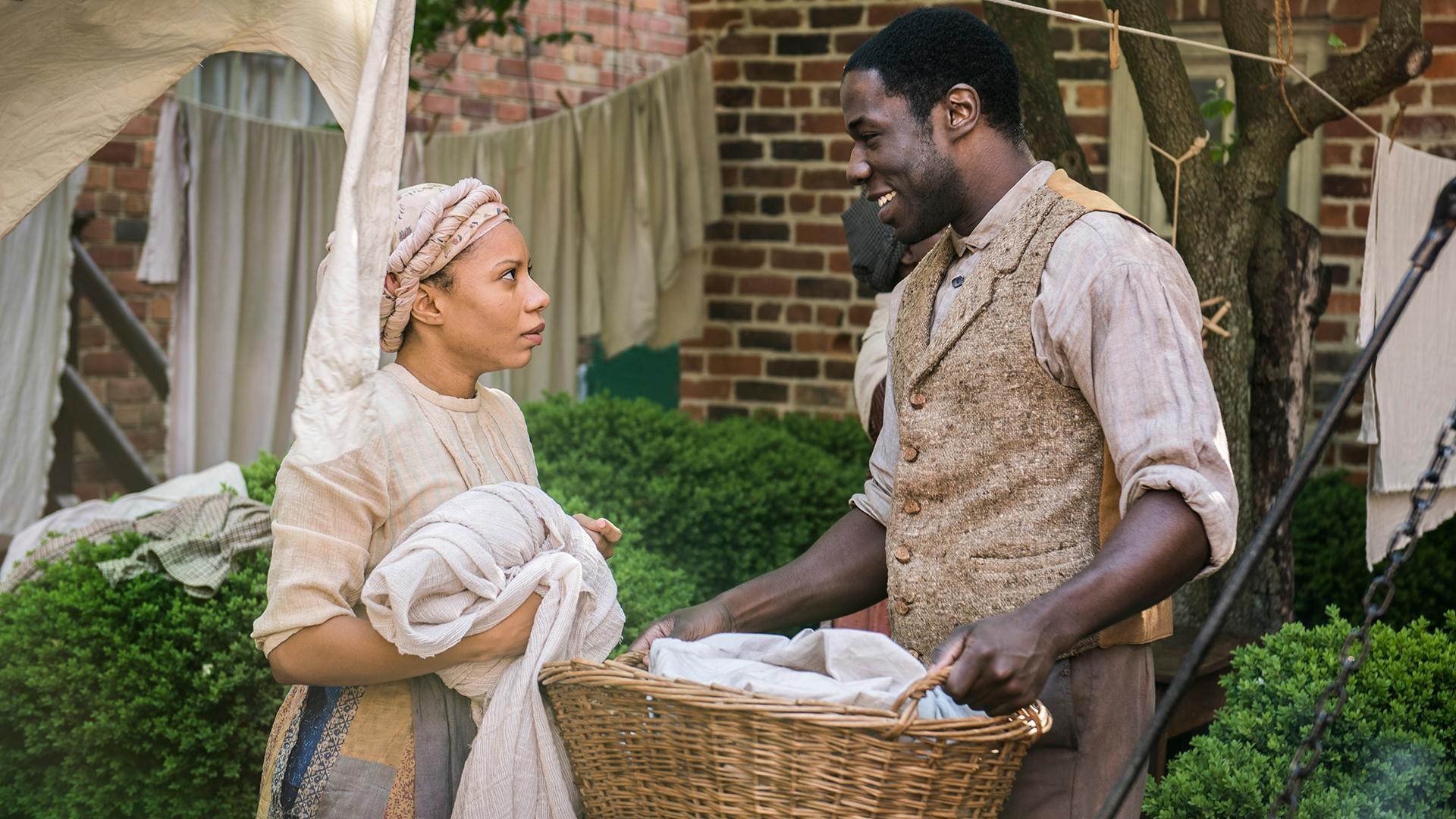
| Aurelia and Samuel |
Still that at the very last moment Samuel Diggs returns -- from North Carolina? in that amount of time? Without any explanation of how he could get from D.C. to North Carolina in those few days, find this family, get them out and return. There isn't enough back story for these characters. Though -- both Aurelia the escaped slave, and Samuel the black man born free, have a story arc that I really liked. By and large this series has done much better with the black characters than most of the white ones, which is not how it usually works.
Generally speaking, it felt as though the series improved to a degree over the six episodes as the characters found their way more deeply into themselves. All the black characters are interesting. After them it is Mrs. Green I enjoyed watching most. Donna Murphy is such a good actress that the viewer can see into her heart and must admire Jane Green even though this viewer at least is passionate about how wrong she is about the war and slavery.
 |
| The Geen Sisters: Alice the younger, Emma the elder |
Her daughters are dull southern belle cliches. One feels this is the fault of the actors. Alice, the youngest, is a pita, and that is the actress, who did delcare in the dvd extra how much she just worships Gone With the Wind, so this is a dream come true part for her. The actress clearly doesn't know about GWTW and slavery and the Glorious Lost Causers and the rest -- or -- believes all that guff herself. Feh. The others are generally OK, and probably will improve if there's another season..
 |
| Aurelia and Belinda |
I appreciated the historical accuracy that James Green was imprisoned in the Alexandria slave dealer prison of Price, Birch & Co. This repurposing of the slave prison to hold confederates happened. I really liked how Belinda their enslaved housekeeper / cook, while bringing food to Green in this former slave prison has flashback memories to the place as a slave prison, where the 'stock' was held before being shipped further south for re-sale.
For Historical Background: Back in the 1820 and 1830's and into the 40's the site had belonged to the largest slave dealers in the history of the U.S., (Isaac) Franklin and Armfield. (There's a great deal about this slave prison, its history, Franklin and Armfield and Franklin particularly, in The American Slaves Coast.)
Franklin left two monuments to himself that aptly illustrate the meaning of slavery in the U.S.: his Gallatin, Tennessee showplace of Fairfield plantation** where thoroughbreds, not cotton, was raised, and the notorious Angola in Louisiana, still, deliberately, a cotton plantation prison in which the cotton is still picked by hand.
This sort of thing, all of which is in
The American Slave Coast, is one of the many reasons this viewer was interested enough to watch all the episodes of
Mercy Street, despite the fairly poor-to-stock standard story telling and characterization. Also, with the public broadcasting determination to 'play fair and offend NOBODY' constrictions the southerners' expressions are way too noble and the northerners are rather too mean -- to the rebels, whose objectives were to burn northern labor out and replace their free labor with slave labor. The North knew that because the South said so.
 |
| The Ballroom at Green House: Emma Green, Nurse Anne, Head Nurse Mary -- who, of course, is a widowed baroness, from Boston, just like, you know, Louisa May Alcott -- Alice Green. |
In the dvd extra features mentioned at the top, in the one entitled, "Historical Reconstruction," the talking head stated that PBS watchers weren't like any other audience: they care about careful writing, good storytelling, and accurate historical facts. Judging again by the statements in the dvd extra features, as with so many on-screen 'historicals' -- most of that focus on accuracy goes on the details of decoration, clothes, dance steps, As far as set dressing and costumes go, it is spectacular.
In other ways, however, PBS has a ways to go with historical accuracy, judging by
Mercy Street and many of its other productions, dramatic or non-fiction, not at much on how people thought, talked and behaved -- which is far more difficult to reconstruct accurately. For -- how can anyone know for sure?
------------------------
* Why
Mercy Street was available on dvd from netflix before the series concluded airing on PBS is not a question I am able to answer.
** There are illustrations of the Franklin, Franklin and Armfield slave prison in Alexandria, and photographs, which we took ourselves, of Franklin's showplace of Fairfield and his slave breeding prison plantation of Angola in
The American Slave Coast.