LINES OF THE DAY

". . . But the past does not exist independently from the present. Indeed, the past is only past because there is a present, just as I can point to something over there only because I am here. But nothing is inherently over there or here. In that sense, the past has no content. The past -- or more accurately, pastness -- is a position. Thus, in no way can we identify the past as past." p. 15

". . . But we may want to keep in mind that deeds and words are not as distinguishable as often we presume. History does not belong only to its narrators, professional or amateur. While some of us debate what history is or was, others take it into their own hands." p. 153

Silencing the Past: Power and the Production of History (1995) by Michel-Rolph Trouillot

Monday, July 18, 2022

Postmambo Colombia Music Seminar - Trailer. And HORSES!

      . . . .  I keep forgetting to put up the trailer for the Postmambo Colombia Music Seminar, which is coming right up.


People are so looking forward to this trip, for a multiple of reasons.  As activities are outdoors, the restaurants are open sites, travel within the area will be open to air, and the group is small enough that people can can move --masked -- in separate vehicles -- people feel secure.  The weather is terrific now too.

~~~~~~~~~~~

     . . . . It's been non-stop busy here.  Even this weekend of splendid weather -- about to break for the more usual July of 90+ temperature and humidity -- it was a small, local arts community in New Jersey, with its own gorgeous theater, where the organization provided a showing of Tierra Sagrada to its community.  Trying to decide whether to go to Lisbon in the fall, for the annual WOMEX conference, where Tierra Sagrada will be part of the film festival.  Plus there was the 4th of July uptown in our friends courtyard garden, el V's bd at the Metropolitan Museum of Art where we got to view the just opened exhibit, Chroma: Ancient Sculpture in Color.  These were reconstructions of pieces that we've always seen a white and bare of any color at all.  On occasion, the original, as we have it, was shown next to the reconstructed color pieces.  I took this occasion to use the Android's camera for the first time.


Northern Bowman, Persian or Scythian

The city's exploding with music events, with musicians coming in from Latin America, particularly.  Last night it was Brasil, at Central Park's Summer Stage.  It was the most successful event the series has had so far this summer.

~~~~~~~~~~~

     . . . . Non stop anxiety here due to the raging covid numbers, and the fool of a mayor who succeeded the previous fool of a mayor.  All the officials gravely intone -- finally forced to admit that the numbers in the hospitals alone has us in extreme high risk category for infection -- we should maybe consider wearing masks indoors.  We are surrounded by people having to deal with this, while their beloved relatives are in hospital with other conditions and then contract covid from the staff, and they are not allowed, then, to see their relatives.  Which means they can't keep monitoring how their relatives are being treated.  In one case, there is a doctor who insists on giving the patient an epilepsy med.  She doesn't have epilepsy, and it turns her into a zombie -- and thus incapable of protesting anything they do or don't do for her.  Why yes, we just received two new boxes of high quality masks from amazilla.

~~~~~~~~~~~~~

      . . . . Non stop rage and despair on most other fronts.  What fools -- when not just outright evil, which there is no doubt most of them are  -- these jerkwaddies who have counted coup on the country, and what greater fools are us, who have allowed it and done nothing.
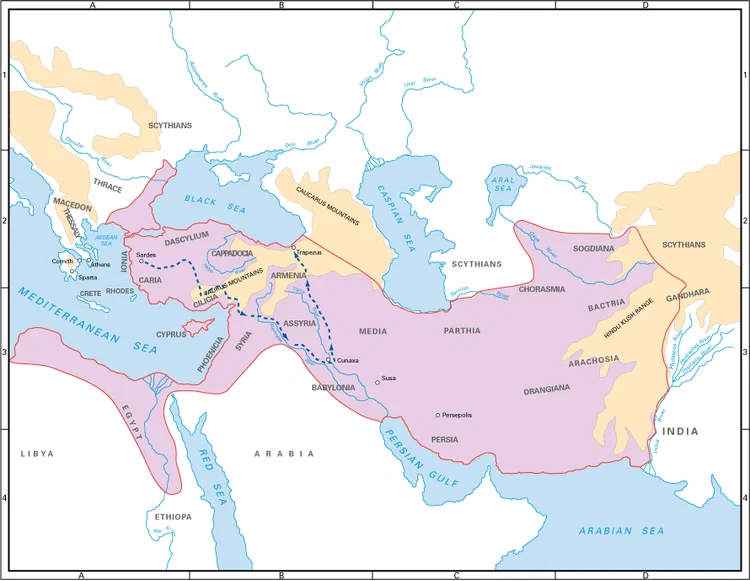


A map of Persia, indicating major settlements, regions, and mountain ranges, as well as the march of the Ten Thousand (dotted line).


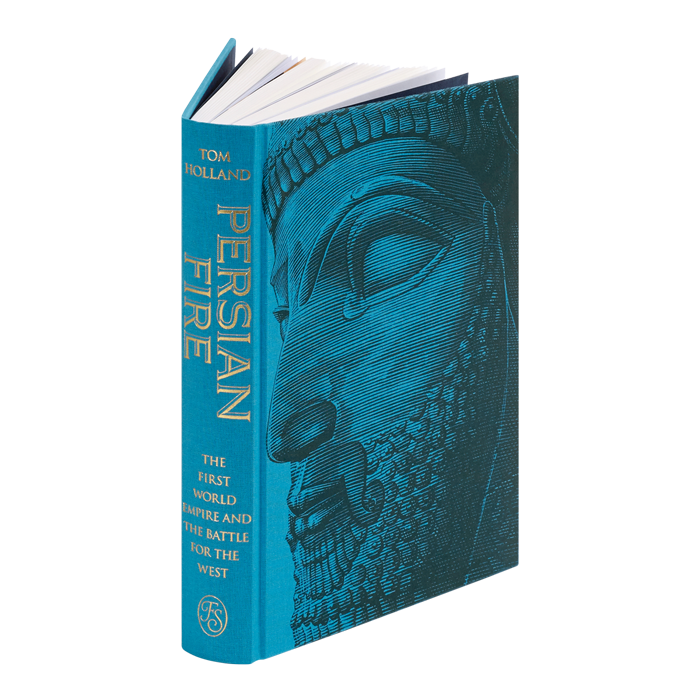
     . . . . I take consolation from Xenophon's Anabasis -- the March of the 10,000 -- and Tom Holland's Persian Fire: The First World Empire and the Battle for the West (2005 -- so author's filled with 9/11 Clash of Empires interpretation of everything).
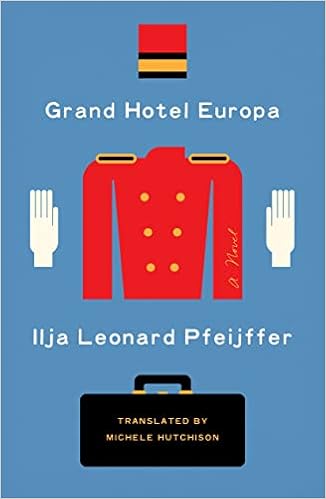


Additionally, I have become immersed in the splendid novel, Grand Hotel Europa, from Dutch author, Ilja Leonard Pfeijffer, originally published in Europe in 2018, and translated and published here this last month. The presiding genius of Grand Hotel Europa is Clio, as the lost lover, muse of European history, particularly Italy and Central Europe's. Though not exactly historical fiction, it's difficult to imagine someone who takes historical fiction seriously not being at the very least intrigued by the novel.  It's very long, so I fear its beguiling aspects may begin to pale at a certain point, but if this is the case, I have not yet reached that point.  Michele Hutchisson's translation fulfills the shimmering, yet transparent beauty of the prose, which wins as much admiration as the reader can provide.


~~~~~~~~~~~~~~~~~

     . . . . Watching Indian historical epics, during long hot nights, which not only sends me constantly looking at my World Atlas -- such a huge book, it is fortunate the bed is near my screen -- while marveling at the integration of elephants as not only known and usual, but essential elements of the societies in such a variety of ways -- but teaching me about a whole new breed of horse, the curly-eared Marwari warhorse.


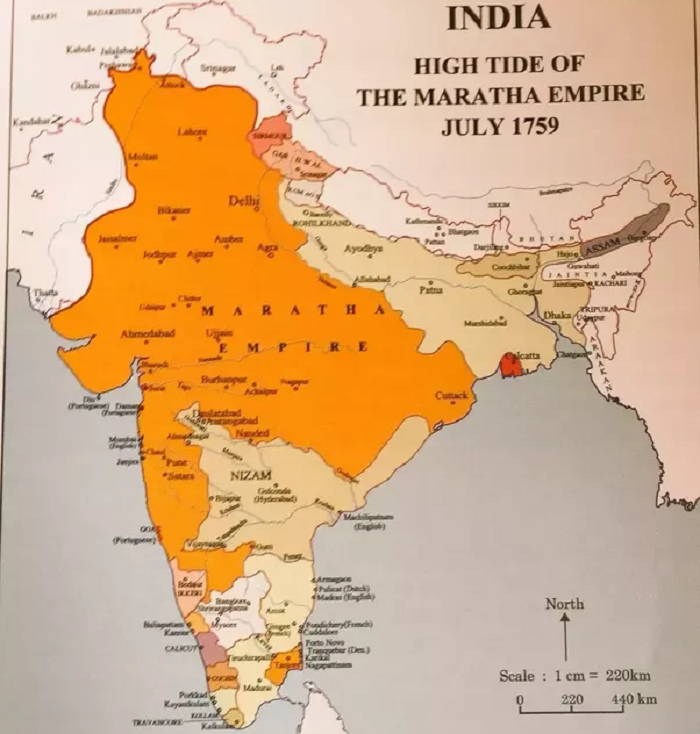
These horses appear to have been bred originally -- perhaps starting in the 13th-4th centuries, post the Mongolian-Turcic conquests of Central Eurasia -- in northwestern India, crossing some Arab stock with 'native' equines and the horses of the Mughuls and the  Khanates.  They became signature horses of the various northern kingdoms such as Jodhpur (Marwar) region of Rajasthan, and by the 17th century then, the horse of the kingdoms of Maratha Empire, which at its zenith covered all of Central India, most of the western seacoast, the Doab, that fertile land between the Ganges and its greatest tributary, the Yamuna.  I think it was the Brits who called it "Hindustan."


These horses, while large and powerful, thus warhorse, also need far less water and forage than most horses.  This is more than useful for an empire that encompasses extensive desert and rough infertile ground. The mares typically are larger than the stallions.  They have loyal and courageous natures, are said they would not leave their rider even when he was killed in battle.  It is also said that when engaging an army that used war elephants, fake elephant trunks would be fastened to their bridles, which confused the elephants into thinking the horses were baby elephants, allowing the riders to attack the elephant unexpectedly. The favorite coat for the cavalry warhorse is said to have been 'pinto', as we see in the painting above.

So it is again, when all else fails, horses still give me delight.

~~~~~~~~~~~~~~

     . . . . Listening via streaming to a Cali, Colombia radio station.  It is all over the music festival Postmambo will be attending, among other activities.  The things we can do these days ....

Wednesday, July 6, 2022

Got There; Returned Spiritually Energized, To Crash Yet Again

      . . . . Got home about 8 PM mid-last week, later than expected, since the transfer flight back to JFK from Havana, got delayed in Fort Lauderdale, while passengers sat enplaned on the runway for an hour.  But otherwise things were fine.

So interesting: in Cuba nobody among the multitudes with whom interaction was inevitable, had even heard of anyone who had covid in the last year +.  It was quite different in the first year and a half, which also had a strict curfew all that time.  By now everybody has been vaccinated, though supposedly their own vaccine isn't as good as 'ours' -- but Cuba wasn't allowed to get 'our' vaccines.  Shoot, the previous made certain Cuba wasn't even allowed to purchase syringes.  Also all interaction was outdoors.  All of it, except the occasional restaurant meal (with very little available -- forget 'choice' -- and in the room to sleep.

Everyone was more than pleasantly surprised -- and so pleased -- to see Tierra Sagrada -- which they, no more than el Vaquero -- had any idea was going to happen out of those spiritual events of January, 2020.

Though things are tougher than one can even begin to imagine there, it was also energizing, despite the determination of every Cuban to get out of dodge however and whenever they can.

~~~~~~~~~~~~~

     . . . . Something else that happened due to Cuba, is that I finally found it impossible not to retire forever and completely from the flip fone universe and enter that of the smart phone.  El V's had his iphone forever -- but it was second hand -- gifted -- in the first place, so he way, way upgraded, despite his dislike of Apple ... but he's had one long enough he's now comfy with it, at least as iphone ios universe.  At the same time he was doing that he got me a Samsung Android, so we both could communicate via whatsapp from Cooba, which is the only way.  Surprising to me, I liked the phone a lot -- intuitive in a way I never could parse the Tablet, which is still sitting here doing nothing for a year.  Maybe I'll give the Tablet another shot.  But ultimately, if I have now gone so far down the constant surveillance and sale of my personal data to have a smart phone, I see no reason for the Tablet, which is a whole lot more awkward to hold and handle than the phone is.  I dunno.

~~~~~~~~~~~~~

     . . . . The 4th we went uptown to mourn the End of Democracy USA and welcome in our SCOTUS 6 Opus Dei  Oligarchy.  It's official.  We are Russia.  Mourning together in company, with delicious food and terrific company, was better than cowering at home.  The young white cadres have made all public life a risk, to put it mildly, whether on the subway, at a theater, in school, a nightclub, a park, in church, a parade, just walking on the sidewalk, sitting on one's stoop.  It's worked so well in tandem with weaponizing covid to keep us all terrified and hiding.  Easy to take over now, right-o.

~~~~~~~~~~~~~~

Best solo reading this last week: Tom Holland's Persian Empire: The First World Empire and the Battle for the West (2005).  It's going so well with our recently completed read aloud to each other Landmark edition of Histories of Herodotus, and the embarkation of the Landmark Xenophon Anabasis. Kind of getting a handle on these eras.  This is when Greece, particularly Athens, was embarking on the new thinking for which it has been lauded ever since, from philosophy, to history, to science, to art, poetry and theater. 

Maybe ... it was that of Persia into Greek settlements along Lydia, the islands and even excursion into hinterland, that did this? Along the other hardly to be comprehended Persian conquest of Egypt, seldom occupied by a foreign power, and never held held by one.

Well, in the end, in not many centuries Egypt will be ruled by the Hellenes themselves, in some form, the successors of Alexander -- even if the Athenians considered the Macedonians as much barbarians as the Persians -- and everyone else who wasn't a Hellene. Why yes, in Hellene eyes, the Latins were at least as much barbarians as everyone else. Even if they occupied Greece.


Wednesday, June 15, 2022

Postmambo Seminars Presents

June 16, 8 pm Eastern, Postmambo Movie Night presents:


Elder's Corner, directed by Adesiji Awoyinka, who will join us on Zoom for conversation afterward. From the press kit:
    From the colorful, celebratory sounds of Juju to the politicized urgency of Afrobeat, Nigerian musicians have spearheaded some of Africa's most prominent musical movements. Oftentimes, their work formed the backdrop against which the nation blossomed. So what happened to the pioneering artists who rose to prominence during the country's halcyon years - and continued to endure when it faltered?
If you haven't been to a Postmambo Movie Night before, here's how we do it. It's easier to do than it is to describe. 

    1) We assemble on Zoom, then migrate as a group to Vimeo to watch the movie.  (I'll give you the Vimeo link in the Zoom chat.)

    2) Once we're on Vimeo, I give the 5-4-3-2-1 countdown, and we all start watching in sync. When it's over, we migrate back to Zoom.

==>Please be on time. (It's hard to sync you in if you don't start with us.) Log in before 8 pm Eastern, please.

This is really easy, but occasionally people who don't have experience with these platforms encounter problems. We don't want anyone excluded! If you don't think you have the tech savvy, or want to do a tech check beforehand, e-mail me and we'll get together privately and talk you through it. 

**************** HOW TO DONATE ***************
You don't have to pay to attend. Don't feel bad if you can't. But we can only continue if we are supported, so we very much appreciate your donation of any size. We're self-funding, so your participation is crucial. I suggest a contribution of $15 for this one event, or $150 to express ongoing support for the series, but we'll happily accept whatever amount you can donate.  Payment options:
1) Zelle. This is our preferred way to receive money, if your bank offers it. Tell them to send it to postmambo@gmail.com.  (It will ask you to confirm by showing you the name PLEAS.)

2) Paypal (be sure to check "sending to a friend" or else they charge a commission): ned@qbadisc.com

3) cashapp $nedsublette

4) Venmo @Postmambo-Studies

4) Paper check via USPS.  E-mail me and I'll send the info. 
Thank you if you have donated, y'all know who you are, and once again -- thank y'all for making our sessions possible.

* * *

July 14: Postmambo Sessions presents a conversation with Dr. Gerald Horne, Moores Professor of History at the University of Houston and author of more than three dozen books, including Jazz and Justice: Racism and the Political Economy of the Music (Monthly Review Press, 2019). I might also have to ask him about his new one, The Counter Revolution of 1836: Texas slavery & Jim Crow and the roots of U.S. Fascism (International Publishers, 2022).

August 11: Postmambo Sessions presents a conversation with T.J. English, historian of organized crime and devoted music fan who co-led our beyond-splendid 2019 Havana Nocturne Postmambo Cuban Music Seminar based on his best-selling book of the same name. We'll talk about his brand-new title (pub date Aug. 2) Dangerous Rhythms: Jazz and the Underworld.

* * *
Come with us!  There's still time to join us, but it's coming up soon.  August 15-22: Postmambo is off to the Pacific region of Colombia for the Postmambo Colombian Music Seminar with co-host Dr. Michael Birenbaum Quintero. It's time to register and book that flight.  Trailer here: https://www.youtube.com/watch?v=K-Xk-CQGtMA

Feb. 1-6, 2023: For the Funk Of It, live in New Orleans. Registration is open now. Write me . . .

* * *

Monday, June 13, 2022

Balzac: Fiction Needs Facts, Fiction Needs History, All Fiction Does

      . . . . The 19th C French novelists are a primary resource for thinking about writing/composing both fiction and history.  Balzac and Dumas are both particularly useful. But Dumas was nearly entirely concerned with the history of France provided in the pages of overt fiction. Balzac, however, thought constantly of the relationship of not just historical fiction to history, but the necessity of historical facts and verisimilitude to other fictional forms, particularly those forms we in the US, in this time, loosely call the realist novel, the novel of manners, and, the fiction of the fantastic.

Balzac came up a ‘system’ novel for the literature of realism – which term didn’t yet exist in his time – but was called by the 1820’s French Romantic painters, la couleur locale, and Balzac expanded to la couleur historique.

In describing that attempt, Balzac speaks of local color; in relation to the fiction of the period, his la couleur historique — is indeed more precise. For Balzac as for his contemporaries, truth could most easily be found in the history and expressed in literature with an historical setting: 

"Lit le roman historiques sont l'expression de la France et de la lit au XIXe siecle" (review of H. de Latouche, Fragoletta, 1829). He was to foreshadow Augustin Thierry's opinion, that history would impact nineteenth century fiction, as the young Romantics had experienced a violent reintegration into history, as a result of the French Revolution and the Napoleonic Wars. The example of Sir Walter Scott merely gave a specifically literary dimension to an already intense fascination with history and historical change; and Scott would of course be Balzac's ideal for the whole of his mature literary career. His early aim was that of Scott and of Scott's other disciples, to reconstruct "l'esprit d'une epoque et d'un fait," to make popular the study of history through a form less boring perhaps than the scholarly essays inspired by la Clio classique. 

Even at this early stage, however, Balzac seems to call for a greater degree of truth than do many of his contemporaries. For him, historical fact was to serve as more than a mere springboard for the poetic imagination. He could say that the historical novel should not aspire to the rigorous veracity of scholarly history, that historical figures should have a peripheral role in what is after all a work of fiction. He criticized Vigny for having used history to his own ends:

avait vu quelques scenes poetiques, et il les avait Verite, pour nous convaincre que les artistes viven qu'il s'agit bien moins de mettre le vrai dans le fau le vrai" (review of M. James, Richelieu, 1830).

 Balzac, as he expressed it ten years later, was the exact opposite of literary truth which Vigny developed in his preface to Reflexions sur la verite dans l'art: "L'art du roman vrai dans tous les details, quand son personnage es la litterature, I, 1840).

Even Balzac's excursions into fantastique practiced by Ε. T. A. Hoffmann are dose of reality. The authenticity of details is a point many times in the articles and prefaces he wrote. A realist may deal in fiction, but he must never relinquish fact, "l'immense verite des details." Balzac's rapid abandonment of the historical and fantastique may well be explained by his judgment of  Indiana (1832)*:

 "Ce livre-la est une reaction de la verite contre le fantastique, du temps present contre le moyen-äge, du drame intime contre la bizarrerie des incidents ä la mode, de l'actualite simple contre l'exageration du genre historique."

What had originally been a quest for truth, an imitation of nature, had rapidly become the vehicle for the greatest excesses of the literary imagination. The public had grown tired, Balzac wrote in the preface to La Peau de chagrin (1831), his first important work with a contemporary setting, of "l'histoire de France." Les Chouans appeared in 1829, which also saw the publication of Merimee's Chronique du regne de Charles IX; only two years later Balzac followed his elder, Stendhal, in writing a chronique du XIXe siecle. ....

... the matter might change; the method had not.  The recreation of the past which is the task of the historian would  always remain for Balzac the most adequate analogy to the novelist's undertaking. He intended to write "l'histoire oubliee par tant  toriens, celle des moeurs." Charles Nodier had defined the novelist as historien de moeurs as early as 1817; for Balzac the term became a constant point of reference. He repeatedly proclaimed himself an historian of manners and morals, "plus historien que romancier"; he referrs to his work as "cette longue histoire des moeurs modernes mises en act. He claimed merely to be an humble copyist, the secretary of his society as he said novelists had always been. The gift he prized above addition to the ability to give artistic form to what one had to say, was the accurate observation of reality, which made the roman de mores a more difficult genre than the historical novel. The Balzacian notion of contemporary mores demands "des connaissances presque techniq tandis qu'un roman historique ne veut que la science, des recher et de la lecture". ....

- - - - Balzac's Theory of the Novel / Maurice Z. Shroder / L'Esprit Créateur / Vol. 7, No. 1, Honoré de Balzac (Spring 1967), pp. 3-10 (8 pages) / Published by: The Johns Hopkins University Press / https://www-jstor-org.i.ezproxy.nypl.org/stable/26277449?

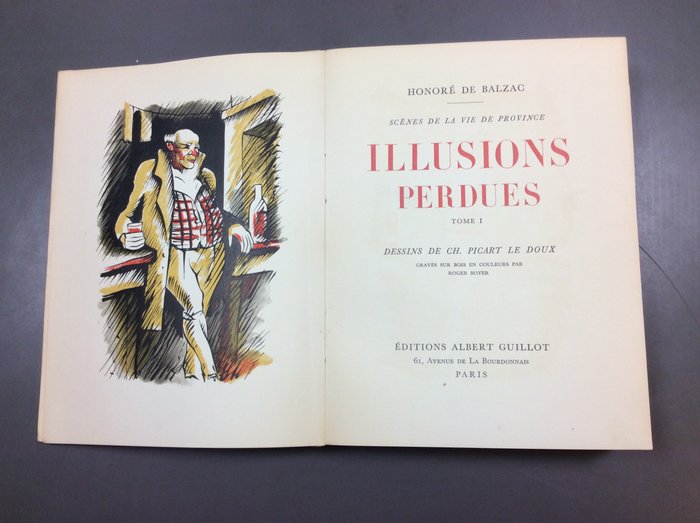
To see why Balzac believed it was more difficult to give artistic form to novels which are histoire des moeurs modernes mises en act -- the novels of contemporary manners -- one of his own works will provide an example. The subject of Illusians perdues (Lost Illusions) is a young man who burns to write literature, who has a decent gift, and the business of writing and publishing.


For those of us in the US, thinking of our own history and fiction that is inspired by our history, our own locale couleur and  locale historique, our National Archives (much available via online portal)  is and excellent resource.

When I'm asked what are the most important tools for writing good historical fiction, I always respond there are five.

1) voracious reading of the respected historians and fiction writers too -- and particularly those who wrote contemporary history of the period in which one's tale and characters are made;

2) Read the newspapers of the period -- that is, if your period had newspapers, but it will have some source of news, if only the local gossips. Indeed, George Eliot made brilliant use of these in Middlemarch, set several decades before she wrote it, though newspapers not only proliferated in that period already, and, indeed, a fictional newspaper is part of the fiction too; [Indeed, Laidislaw goes from his ambition to be a fine artist to working in newspapers and politics -- another case of literature's Illusions perdues!]

3) Look at the arts created in the period -- this includes listening to the music of the time, even though recording wasn't yet invented, probably, one may still learn something important, since making music played a role in so many lives, that speaks to class, and even to politics of those alive at the time;

4) Spend a lot of time with and the National Archives, and with JSTOR, generally now, since pandemic, available to you at home instead of needing to be at your local library, haunt the historical societies and museums of the place;

5) Go to the places one's characters go (which, as we see above, George Sand had not done).

A novel by George Sand, published in 1832:

Indiana is a novel about love and marriage written by Amantine Aurore Dupin; it was the first work she published under her pseudonym George Sand. Published in April 1832, the novel blends the conventions of romanticism, realism and idealism. As the novel is set partly in France and partly in the French colony of Réunion, Sand had to base her descriptions of the colony, where she had never been, on the travel writing of her friend Jules Néraud.

If one has slogged through Indiana, as I have, one sees indeed how Balzac came to the conclusion that it was far more difficult to write fiction as convincing art for a novel of manners than for historical fiction

~~~~~~~~~~~

In the meantime, things continue to roll along.  So much to do, so many places to go in the service of the doing -- please, please, please let neither of us contract covid.

The Heat Storm is reaching us today.  My concern goes out to our family and friends in West and the Southwest, and now the Middle West too.


Thursday, June 9, 2022

Postmambo Thursday Will Not Be Tonight

      . . . . Since covid, two Thursdays of every month are Postmambo events via Zoom.  The first monthly event is discussion and interaction led by a special guest with expertise and achievement in some area of Afro-latin, African. African American, etc. history, culture, music, spirituality.  The second Thursday is Postmambo Movie Night*, with a film connected to these matters as well, in some way or other.  Our most recent film was the recently remastered, remixed, etc.


Deep Blues, (originally released in 1991; remastered 2021) a deep dive into the Blues, led by the great late, lamented Bob Palmer, presenting the music made by names that everybody doesn't know. **

This week we canceled the First Thursday, because, at 8 PM there will be live television coverage of the first January 6th Investigation Committee's hearings.  This first one begins at our usual start time of 8 PM eastern time USA, the others will be daytime events.  Knowing the people are who attend Postmambo Zoom Thursdays, we know that like us, they want to tune in to the hearings.  You all probably are the sort who want to tune into the hearings as well.

The hearings can be watched on most major TV news stations, at least this Thursday’s, on ABC, NBC, CBS, MSNBC and CNN.  I suppose C-Span too?  The usual suspect will not be covering the hearings at all, much less broadcasting them, it says.

* Postmambo Movie Night will e back next week, on June 16, 8  PM, 


with Elder's Corner, directed by Siji Awoyinka, who will join us on Zoom for conversation afterward.

 **   Bob was in many ways el V's inadvertent mentor into ethnomusicology.  We drove over Cuba in a Lada together, twice, in the summer of 1990, el V and Bob never stopping their dialogue which covered everything from Bob's early life to 1950's horror films, and music, music, music. Bob also introduced el V into infinite variety of worlds that are New Orleans.


Later, when Bob's daughter made a documentary about her father, The Hand of Fatima (2009), she cast el V to be the voice-over, to be the Voice of Bob, speaking words Bob had written.

~~~~~~~~~~

Ooooo, lovely el V -- he just returned bringing me sausage, eggplant, squash and egg pappardelle for dinner, and! -- 


Tom Holland's Persian Fire: The First World Empire and the Battle for the West (2005).  I have been wanting to read this for a long time.  Now having Herodotus's say regarding the Persians, and working on getting Xenophon's account of the March, so recently into my sieve mind, I should be well prepared for Holland's take.

Wednesday, June 8, 2022

La Lucha

     . . . . Oyez, Oyez. Breaking News: Essential information for persons wishing lives of success and satisfaction, that this is so is so announced by The Media --  lip gloss is back.  As it is written, so let it be done.

~~~~~~~~~

READING so far this month, begins with finishing off Guy Gavriel Kay's All the Seas of the World (2022). This is an inert, monotonal narrative, content to lie page flat. There is no differentiation in voices of characters, or the pacing. The pages, however, are stuffed with  ponderous ponders about random acts changing lives and events and characters, as well as the female protag’s constant pondering on her past as a slave, which involved sexual violation from a master she quite liked – but she killed him, by the means he trained her to do and the weapons he gave her. This all happens before the book opens. She never tells us why she killed him, or why she killed him when she did, until almost the end, which is pretty anticlimactic.  Also because he dissed her by ordering her have sex with somebody beneath her.  A stable hand, I think, who smelled like shit.  That pissed her off so much, that then she killed him. This all has already happened, as mentioned.  We begin our journeys with people who are very successful and rich due to their abilities to plot and scheme, to kill or have others kill on one's behalf, which killings change or move along each others’ lives as they interact. Their, then, interconnecting circles of wealth, agency and power, expand to intersect and ally with other rich, powerful, successful characters, which make them ever more wealthy and powerful.  Plus we are led to believe they deserve this because they worthy wielders of power and choosers of life and death for others. The author's vaunted ‘quarter turn’ from history and real locations is frustrating because one is always thinking of the real places and history. The author’s pretense at fantasizing by quarter turns the Romance languages, which turn the places and words into mush and meaningless – when the real thing has meaning -- has only become more intolerable as the books grind on. Everything irritating in this author's works from the gitgo was foregrounded and dominant in this one. This is particularly the case for a reader who has read the same popular histories for the 15th and 16th century Mediterranean, the Turks and the Ottoman Empire as the author has read.

Jennifer Haigh's Mercy Street (2022) is first contemporary set novel I can stand in a long time. Something as counter to the smug sorts such as Julian May Jonas's Vladímír (2022) or Victor LaValle's The Changeling (2017) as one get.  Haigh has no trouble finding ‘something to write about, unlike Jonas's novelist stand-in protagonist laments. Haigh's narrative is straight forward, no tricks, no structuralist maneuvers, no up author’s own ass interiority solipcist ponderous ponderings. Just a range of characters, particularly female characters born in poverty, who stay in poverty – often due to early pregnancy, set mostly in Boston around winter 2015 i (we were in Boston  several times that winter, and recall the endless snow and storm vividly) and New England. An abortion clinic is the connection among the characters who are clinic staff, their lives, the people they know who aren’t the patients -- their all important weed dealers, the patients, the antiabortionists.  It's real w/o being in the least misery porn or hopeless. It is the most realist, realistic, realism contemporary novel with a lot of women I've encountered since maybe the 70's and 80's.

As far as the ongoing READING ALOUD TOGETHER BEFORE LIGHTS OUT, after nearly 10 weeks, this past Monday, we finished The Landmark Herodotus: The Histories. (2007) Edited by Robert B. Strassler. A New Translation by Rosalind Thomas. “The most densely annotated, richly illustrated and most user-friendly edition of the Histories ever to appear.”  So user friendly is this edition that not only did we read aloud all the appendices, we also read aloud the glossary. We are currently following the Landmark Herodotus, with The Landmark Xenophon's Anabasis (2021), dited by Shane Brennan and David Thomas.  "... the definitive edition of the ancient classic--also known as The March of the Ten Thousand or The March Up-Country--which chronicles one of the greatest true-life adventures ever recorded."


For engrossing non-fiction READ ALONE, I'm treating myself to another Roger Crowley title, Conquerers: How Portugal Forged the First Global Empire (2015).  Anyone with an interest in the history of the "Christians" confronting the realities of Muslim empires, Crowley is essential.  His 1453: The Holy War for Constantinople and the Clash of Islam and the West (2005) is the best depiction of the Fall of the Red Apple to the Ottomans.

~~~~~~~~~~~

CURRENTLY WATCHING the Netflix continuation reboot of Borgen (2022), the popular here, and in the UK, former Danish series, featuring Danish politician, Birgitte Nyborg.  Perhaps what interests this viewer the most is how the Russians in this series are already bad guys due to Ukraine, though obviously, when the series was being written and shot, the invasion hadn't happened yet.  I see this awareness of Russia's intentions toward Ukraine, as well as what thugs they are everywhere, thus are made villains earlier in many television programs, particularly in British crime series.  Here also, in, for instance, the Amazon Prime Bosch.  Quite a change from the days of The American, where Russians protagonist spies here in the US are overtly working to destroy the US, were lauded as The Best Evah!  It's about family!   (But the Russians never evah fooled John le Carré.)

PREMIERE - CRITICS SCREENING of the Afro-futurist sf musical set in Rwanda, Neptune Frost.  It's not like anything else.


~~~~~~~~~~

GENERAL DAILY WORK ACTIVITY  tends to revolve around the now, nearly completed, complete with the 5:1 professional movie theater sound technology, Tierra Sagrada.  So far, in various stages of production and editing, it has been viewed on one of our Postmambo Movie Nights, at the Big Ears Film Festival in Knoxville back at the end of March, at the King Juan Carlos theater at NYU.  It is now scheduled for some churches and colleges in New Jersey and Connecticut.  El V's taking it to Cuba later this month to show it to the people who are in it.

Activity also around going to New Orleans next month, to prospect for next winter's Postmambo Travelers trip, and in August to Colombia -- Cali and environs -- the Pacific coast, which may be the most African spot in the Western Hemisphere, though certainly Haiti and Bahia can give that designation a run for the title.

Speaking of Brasil (Bahia), the country's largest publishing house, which also owns a chain of bookstores, has acquired the rights to translate all our books into Portuguese and publish them there.  

Speaking of the UK, an old radio piece that el V created for public radio back in the day, got picked up for a program on the BBC-- it was wild listening to it via BBC on line.

Speaking of New Orleans, el V's working out how to manage Cornell University's orchestra getting there, staying there, eating there, working with NO musicians, and getting home again, for the spring semester.

~~~~~~~~~~~

Memorial Day was a great get-away, company, food and weather had us spending from 3 PM - to nearly midnight in friends' courtyard garden -- with nary a mosquito bite!  That was the longest span of hours away from our apartment since covid (yes, everyday more people we know have it, people who are vaxxed, generally careful, some of them have gotten break through covid three times already)  unless we were out of NYC all together.

Knowing our work matters, our friends, keep us going despite the weight of fury, bitterness, depression, despair. 


Monday, February 28, 2022

Ukraine Isn't Tuning Into New Orleans Right Now, But Russia Hangs In Cuba


     . . . . February ends. Another el sucko de dicko day – with the negative add of it being Monday.  However, here it is nearly the middle of the afternoon and the temperature is 27°, the highest it's been all day.  Russia supposedly in talks but beginning to reduce Ukranian residential areas to rubble, for all that world and his own nation’s opinion have almost moved Putin from a guy you can deal with, a guy you can live with, good for business, into the columns titled Monsters of History, providing moral and other sorts of support to Ukraine's resistance. 

Do any of soch media's newly minted Ukraine experts remember how not so long ago they hoorahrahrawed The Americans as the best thing that ever happened on television and how much they loved, admired, and sympathized with its two primary protagonists, who were planted Russian spies here in the USA to aid, assist and abet in any way they could devise, the downfall of the United States government?  Like a Russian yacht, from the gitgo it seemed more than likely that under the layers of production financing there was a deep connect to Russian money.  If that were suggested though, being in the realm of tinfoil hat delusion, well, one didn't, did one?  

Beyond that, it is still something nearly impossible to understand, why such middle-of- the-road, white, prosperous folks, particularly young males, enjoyed so much identification with these protagonists.  Well, one thing the 2016 campaign and elections and faux noose, and red caps and gerrymandering and hate campaigns against everyone who wasn't white, male and rich, outrage for public health and education and equality and justice and tolerance for all taught us -- why yes Russia has been meddling in everything, including the so-called US government head-up-Putin's ass giving Cuba back to Russia.

Which is taking a dreadful toll on Cubans and Cuba, by the way.  Which if  here was any fabric to spare and accessible on Cuba, we could well be seeing Ukraine flags there too.  But as the Cubans don't even have food, well -- and don't have a Fidel to tell the Russia "Go Fuck Yourself" now, and more porkalotetzy Russian oligarchs and their yachts are arriving every day as more ports close to them -- which means what little food available will be gobbled by the Russians.

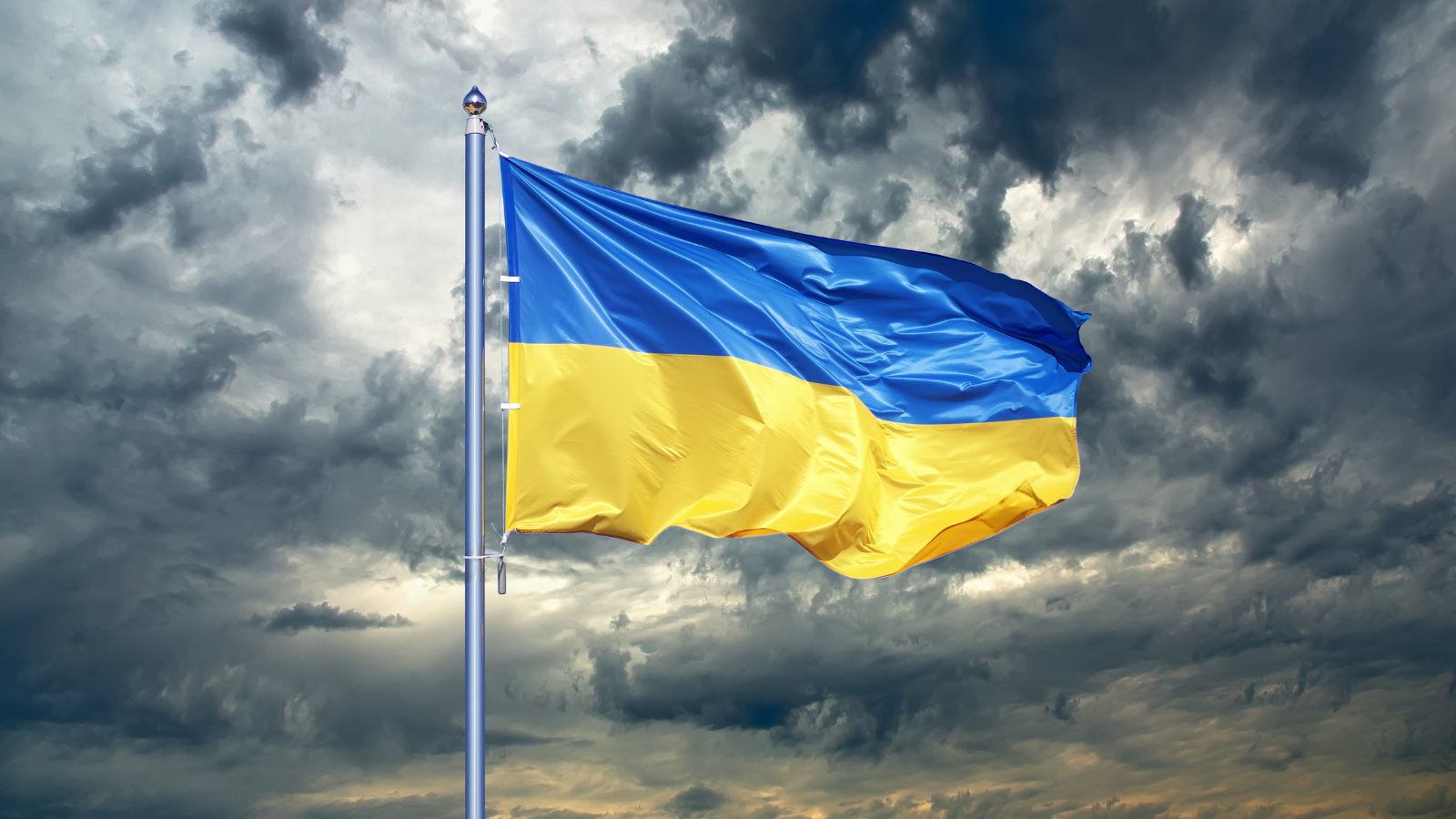
We are in awe too, of the acts of courage being taken by Russians against this war, as well as having so much for that of the Ukrainians.  Doubtless one of the most common searches on internet images these days is this.


In the meantime, from From North Dakota's Fargo-Moorhead's InForum -- access to stories by subscription only.

"North Dakota tax dollars are financing Putin's regime in Russia

North Dakota's Legacy Fund is invested in bonds to the Russian government, and that needs to stop immediately."

 Dayem, now whose bright idea was it to do this, hmm? and now much did they get paid? 

~~~~~~~~~~~~~~~~~~~

     . . . . Easy to forget but, hey today is Lundi Gras -- and tomorrow's Mardi Gras.  Eat some damned King Cake you all.


The great New Orleans radio station WWOZ that streams and broadcasts specifically New Orleans music, had about 100 Ukrainians tuning in daily.  As of this afternoon there are only 8 tuning in . . . .

Update:  O my, here it is evening, and those same 8 listeners are still able to tune it – for a half hour at a time, but somehow, they keep returning to hear New Orleans music!

Yes, we tune in streaming from here as well.