LINES OF THE DAY

". . . But the past does not exist independently from the present. Indeed, the past is only past because there is a present, just as I can point to something over there only because I am here. But nothing is inherently over there or here. In that sense, the past has no content. The past -- or more accurately, pastness -- is a position. Thus, in no way can we identify the past as past." p. 15

". . . But we may want to keep in mind that deeds and words are not as distinguishable as often we presume. History does not belong only to its narrators, professional or amateur. While some of us debate what history is or was, others take it into their own hands." p. 153

Silencing the Past: Power and the Production of History (1995) by Michel-Rolph Trouillot

Showing posts with label spirituality. Show all posts

Thursday, November 2, 2017

Still Feeling Xalapa: ¡Gatos!

     . . . . I introduced The Young of Xalapa to the concept of "herding cats."

El Azuzul Jaguar Statue. Museum of Anthropology, Museo de Antropologia, Xalapa.

Jaguar statue, Oaxaca.
Olmec Twins & Jaguar: the twins are divinities also. Here they are facing off to the Jaguar God, in the posture of respect, which, we note, is one of the postures common to cats of all kinds.


Due to loss of habitat, jaguars are endangered species throughout Mexico, Central America, South America and Brasil.  It is revered by the cultures in all these regions.

As all of my young friends are more than fond of cats, appropriately as they are descended from people for whom the Jaguar is a divinity, they immediately got it.

In Xalapa they term such a concept as "Xalapeñear."

Thursday, November 24, 2016

Cuba -- Spiritual Renewal

     . . .  Currently el V is leading a tour of intrepid Travelers on an intense cultural, religious and music tour of Western Cuba -- a Tobacco and Sugar Counterpoint.  It's only the second Thanksgiving since we've met that we aren't spending it together, and the only one we're not together since we've been married.

Two Muñequitos performing rumba guagancó in their home town of Matanzas. Their kids are now performing in the group. One of them is the daughter Vivian (above), who performs the child Eleggua, just as did when we first met her. The audience adore her child as much audiences had adored Vivian at that age.
The theme for this trip is "Spiritual Renewal."  If any people understand the need for spiritual renewal its the people with whom the Travelers are meeting on this trip. By all accounts, for the Travelers, what they're experiencing is so far beyond their hopes or expectations they can hardly find expression for it. However, maybe the words were found yesterday, and they were few and short.

Yesterday, among the activities was the finale of an initiation, seating of Changó, in the head of a santería initiate (the activities for the initiation have been going on for a couple of weeks already -- this is the conclusion), at the the home of a member of Los Muñequitos de Matanzas, the foremost rumba group in the world, founded way back in the early 50's.  Our relationship with the group and the members, many of whom now are 4th generation, reaches back to 1990. This was the real thing, not made up for tourists. The reason the Travelers were invited is because el V's a member of the family, and his friends and family members are welcome everywhere.

 This experience has not been provided for the other travel groups el V's taken to Cuba, for various reasons. But this group is special, because it's the first group el V's brought to Matanzas since the election.  Cubans understand hurting and their compassion for USians who are hurting is deep and broad, as a citizenry and as individuals, is deep and broad, as I learned personally, after 9/11, and after being very ill.

Two of one of the founders' sons, Barbaro and Figurine, dance in NYC.

While all are hurting badly right now, some are hurting very much more.  A significant number of the Travelers in this group are African American women, some traveling with their daughters.

A Changó altar -- el día de Changó -- the feast day, is December 4.  El V will be participating. The orisha is syncretized with the Roman Catholic saint of Santa Barbara for many reasons including that she, like the orisha, is associated with lightning and the axe. His colors are gold and red.  He is one of what I call the Magnificent Seven of the orishas.  Like Eleggua,  Ogún, and Oyá, Changó's a warrior.

A beautiful rooster was ritually sacrificed.

The conclusion of the rituals and ceremonies is the meal of beans, rice, the chicken etc.* The Travelers needed to partake for ritualistic reasons. But a big dinner was scheduled right after this event. So -- Anna ensured that it was just a taste of each of the required dishes for each of them. 


As they were eating, one of the Travelers said, "I think this is our Thanksgiving."

You can imagine what was all in those words. As soon as el V repeated them to me, my heart thumped in resonance, and I started to tear up.

Spiritual renewal includes reaching back and up and down to the Ancestors.  We know how to do this.


     . . . Giving thanks is one of the caminos to spiritual renewal.

-------------------

*  For those who think is terrible, think Christian communion . . .  and how much violence has been unleashed for centuries over the argument whether or not it is truly the body and blood of Christ's sacrifice or merely a representation of the sacrifice.


Tuesday, February 10, 2015

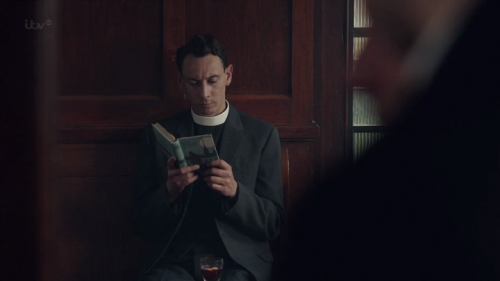
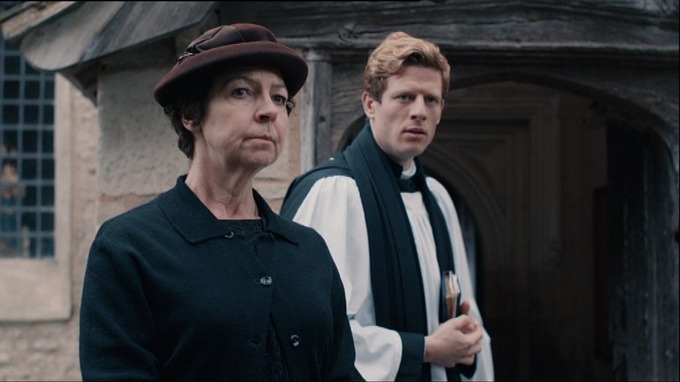
Grantchester -- Episode 4 - PBS / ITV

I liked this series from the first episode.

It's odd that I did, and even more odd that my liking has increased as season's episodes roll on PBS.  Grantchester is a quiet show, with a fairly superficial treatment of people's moral dilemmas and personal stumbling blocks to being good, the individual's obligation to strive, life-long, to become a better person, as part of, and within a social community.  I even think of its softly delivered lessons during the week. It's the sheer generosity of spirit that infuses this series, so different from just about anything else in current entertainments, that has grabbed me, I suppose.

Our attractive vicar, Sydney Chambers, and Dickens. 

 Like everyone else in this episode, Detective Geordie Keating learns lessons in Gross Indecency and Judge Not . . . .
This week's episode delved into dimensions of seriousness regarding being a gay man in semi-rural 1950's homophobic England. This theme has already been touched upon via continuing character, Leonard Finch, Our Attractive Vicar's curate, who is referred to as "the pansy" as a matter of course by Detective Keating.

Leonard Finch, who has hoped to find a refuge from his conflicted instincts within a quiet life of contemplation by serving the Church of England.  His situation, however, leaves little time for contemplation and his Vicar is teaching him that his calling is not to serve the Church per se, but people and a community.
So we have already seen a gay man's conflicts of living in way in which one must conceal who one really is. Even the Church of England that Leonard serves condemns him to damnation as a "sodomite."  But the focus this week is not on Leonard, but another young man, and an older, married man,.

Mrs. McGuire, Vicar Sydney Chambers's housekeeper, who, he assures a German visitor, "hates everyone."  Mrs. McGuire does seem to learn her lessons in  Christian charity from Sydney, but tends to forget them from one episode to another.  But that means the viewer has the pleasure of her softening repeated from episode to episode.
The episode's message of how harmful and wrong it is, socially and morally, for both individuals and communities to shun and condemn those who are different from "us" then broadens in scope to include Germans. Recall, everyone in this community has been afflicted by Germany in both WWI and WWII.

To the sorrow of so many, the harm of such phobias remain in their lives, even after lessons are learned. What happened in this episode, it is clear, has permanently affected the lives of at least three men, a woman and two children.

The episode also depicts the casual sexism that is so common among almost all men that it continues even now. Did the episode connect homophobia, xernophobia and sexism?  If it did, it so merely by presence, not by preaching.


Next thing you all will hear is that I've joined an Episcopal congregation, the closest thing here to Church of England.

OTOH, if I was seeing it back-to-back instead of one episode a week, it might not be so appealing?

Wednesday, April 2, 2014

Reading Wednesday, Mostly Dragons, Some Africa

A fantasy series* set within a secondary world much modeled on Victorian England and Europe, featuring a lady explorer-natural philosopher, recently had its second installment published. Having read the first volume in the series with mild enjoyment, I rather looked forward to volume two, as often, once an author has established her character(s) and world is a large improvement over the first book.


The second novel wasn't as well-written as the first one though.  It's flatly written in a self-conscious attempt to ape what the author believes is a Victorian lady's style of writing. The narrative is a dull mash-up of African cultures rendered in the single-dimension cliches of Africa and Africans, despite the author's claiming to having qualified as an anthropologist.

Despite what the author seems to think, what she mashed up are not dead museum cultures and places, nor are they quaint museum spiritual practices. These are people, families and communities who still have their cultures and languages, and still believe in their spiritual practices, despite the very well-funded fundies of several outside religions actively demonizing them.

Then the actively missing music ....  When reading anything that is taking place in Africa, whether fiction or non, and there is no music, that is a sure sign the author never got a toehold into what was / is going on. O wait -- this is fantasy, so how do I know this is Africa?  After all, the word is never used.  But a whole of words that come from some particular African languages are used -- though not always correctly.

For a novel, though, worse than mashed up geographies and vocabulary challenges, is that the narrative is static and the plot is unsurprising from start to finish. The characters, including the narrator and first person point of view, are equally flat and predictable.

With no reason to finish this book, I did not do so.

Think the Temeraire series by Naomi Novik; however, instead of a Napoleonic era secondary world, this is Victorian. There is authentic passion contained the early Temeraire volumes, as the dragon Temeraire and his beloved Captain William Laurence discover each other, and, together, the Whole Wide World. With Temeraire, Lawrence, other dragons and characters, the readers feel how enormous are the stakes of their choices: personal, military, political and social. Perhaps this is a large part of the problem with the Victorian series, that it is too much an imitation -- and an imitation of materials that the author doesn't understand herself well enough to spark and fizz a reader's sense of shock and awe?

 This one follows the well-patented arc of feisty lady against her social strictures, presented in a single voice flat as the notes in a creaky piano whose strings have been tuned one too many times. The perils are expected perils while the reader knows, via the First Person Herself that more books are coming, thus Our Heroine is not in peril. Then there is the problem that despite what we expect, Our Heroine is dull, or at least her voice is.

 Perhaps the ur fault is Author's choice to plagiarize emulate Mary Kingsley's mode -- and even trajectory -- in her novel?

The opening paragraph to Kingsley's
PREFACE TO THE ABRIDGED EDITION OF TRAVELS IN WEST AFRICA.
   When on my return to England from my second sojourn in West Africa, I discovered, to my alarm, that I was, by a freak of fate, the sea-serpent of the season, I published, in order to escape from this reputation, a very condensed, much abridged version of my experiences in Lower Guinea; and I thought that I need never explain about myself or Lower Guinea again. This was one of my errors. I have been explaining ever since; and, though not reconciled to so doing, I am more or less resigned to it, because it gives me pleasure to see that English people can take an interest in that land they have neglected. Nevertheless, it was a shock to me when the publishers said more explanation was required. I am thankful to say the explanation they required was merely on what plan the abridgment of my first account had been made. I can manage that explanation easily. It has been done by removing from it certain sections whole, and leaving the rest very much as it first stood. Of course it would have been better if I had totally reformed and rewritten the book in pellucid English; but that is beyond me, and I feel at any rate this book must be better than it was, for there is less of it; and I dimly hope critics will now see that there is a saving grace in disconnectedness, for owing to that disconnectedness whole chapters have come out without leaving holes.
 Almost word-for-word ....


Think the Temeraire series by Naomi Novik; however, instead of a Napoleonic era secondary world, this is Victorian. There is authentic passion contained the early Temeraire volumes, as the dragon Temeraire and his beloved Captain William Laurence discover each other, and, together, the Whole Wide World. With Temeraire, Lawrence, other dragons and characters, the readers feel how enormous are the stakes of their choices: personal, military, political and social.

This other series follows the well-patented arc of feisty lady against her social strictures, presented in a single voice flat as the notes in a creaky piano whose strings have been tuned one too many times. The perils are expected perils while the reader knows, via the First Person Herself that more books are coming, thus Our Heroine is not in peril. Then there is the problem that despite what we expect, Our Heroine is dull, or at least her voice is.

Perhaps this is a large part of the problem with the Victorian series, that it is too much an imitation -- and partly an imitation of materials that the author doesn't understand herself well enough to spark and fizz a reader's sense of shock and awe?

The Temeraire series itself is a secondary world fantasy inspired by Patrick O'Brien's Captain Aubrey - Stephen Maturin novels of the Napoleonic era -- Maturin a noted biologist. It has been much commented upon that the O'Brian series was an inspired Napoleonic era modeled upon the Jane Austen regency mode.

Perhaps there are so many layers of inspirations and influences upon this Author's mashup that the consequence is by the second volume already her literary efforts have been mashed flatter than an alluvial plain?

Instead, I picked up a collection of papers from 1978 by and also edited by Brit historians, P. Hair and Anthony J. Barker on the African slave trade, when all the scholarship in the field was starting new approaches, partially sparked by what had been going on in the USA with the Civil Rights Movement.  It was an exciting collection of papers; the historians' excitement came through their academic structures, and that they were aware they were just crossing a threshold not previously gone over.


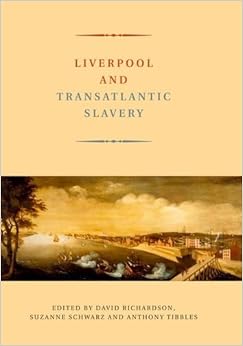
Additionally, it was exciting to compare and contrast that collection of papers with another collection on the same subject: Liverpool and  Transatlantic Slavery (2010) a collection of papers presented at a recent conference in Liverpool.  How far we've come since 1976!

-------------------

*  Title / author deliberately omitted because my response to the work is negative and thus, for Author's sake, do not wish it to influence others doing a casual web search.

Friday, March 14, 2014

The Whitney Plantation Museum

Today we visited the wonderful work in progress, the Whitney Plantation Museum.  The Whitney's proprietor, who educated seven of his eight children at Metairie Park Country Day School, invited us to visit after Wednesday evening's presentation there from The American Slave Coast. Thus, we had the privilege of personal guidance within what is now there now on the Whitney, and what further the proprietor is dreaming into existence via the application of very much very hard work, very much expense, a very discerning eye and a fine sensibility. Mr. JC  thinks he has disdain for dreaming and is interested only doing -- but what's he doing, he's doing because he thought of it, dreamed it, first.  He sees what will be and works with his whole soul to make be now. (He's a retired, notable trial counsel.)

This isn't a plantation museum like any other one already existing or in the process of being resurrected as a tourist destination.

Mr. JC is creating a memorial to all the slaves who worked and died in Louisiana, and to the slaves on the Whitney in particular.  It’s not difficult for perceive the entire entity as an enormous altar, composed of many interlocking moving parts. An historical slave labor plantation was a factory-prison of many interlocking moving parts, the most important of the parts, the laborers.

The plantation chapel is filled with sculpture replicas of the Whitney’s children – whom John knows all by name.  The sculptures are filled with life and presence. The children see you. They are judging, though neither cruel nor kind, just present. The sculptor who has called them back from the past is Rod Moorhead.  Behind the chapel is the Field of Angels, dedicated slave children. Presiding over this Memorial is a beautiful black angel, wings sweeping out, protectively receiving a tiny infant in her arms. One of the Field of Angels memorial plaques reads:
The Field of Angels is in honor of the 2200 slave infants born in St. John the Baptist parish who perished prior to the second birthday.  They were deposited in earthen holes on the plantations and occasionally at the catholic church cemetery.
Behind this memorial surrounded by willows weeping veils of spring green gauze are other commemorative art, which, so far is represented by a classic columned octogonal gazebo. Like the chapel this extensive area too is a deeply spiritual space. Because the children are called by name these are places of power, that contain both peace and sorrow. Sorrow for this terrible world human beings dreamed into existence for the sake of selfish, greedy convenience. Peace because John is a magician who has created a world to come, a world of healing for the world of evil passed away far too late.

After the tour we were guided back to the present by a cajun lunch at the B & C Seafood Restaurant on Highway 18.

Our second guide into Whitney's past is Ibrahima Seck. He drove us to the plantation and back again (el V and Ibahima had met more than once previously, but this was my first opportunity to spend time with this brilliant historian and scholar). What he has to say when talking about American blues is informative and exciting, as is everything else he thinks about. (Blues ultimately has its roots in the music Ibrahima grew up on, among other things that makes him so well educated in the elements of the form.)

On the way back, filled with gratitude for the riches of this day, I was able to be peacefully silent, able to witness the beakneck speed the swamp world's spring time renewal. We drove out from New Orleans between 10 and 11 AM and back from the Whitney between 4 and 5 PM.  In that time the trees all along the highway had burst into bloom. The female of the current twenty-some generation of a bald eagle family that has held that huge nest visible from the highway, had gone into brood mode -- or maybe egg laying? She wasn't in the nest in the morning, but flapping and perching alternately as we drove along the highway.  While we went and returned she decided to get to her business.

Spring is here, if not there ....

And, our faces are fairly finely sunburned.

Friday, December 13, 2013

Prayers & Taxi Drivers In NYC

NYC Muslim taxi drivers praying at the BP gas station on Houston I mentioned yesterday is part of a longer story of Muslim taxi drivers and where they can pray on PRI's The World today.


The website has a photo of the devout and their beautiful rugs.

This is one of the reasons for the Cordoba House community center to be built at Park51 (formerly a Burlington Coat Factory) – that drove t-party ijiots into frothing hysterics. It was planned to be a place anyone can go to, to do some things you need to do, like breast feeding, that one would rather not do in public, on dirty cement.