LINES OF THE DAY

". . . But the past does not exist independently from the present. Indeed, the past is only past because there is a present, just as I can point to something over there only because I am here. But nothing is inherently over there or here. In that sense, the past has no content. The past -- or more accurately, pastness -- is a position. Thus, in no way can we identify the past as past." p. 15

". . . But we may want to keep in mind that deeds and words are not as distinguishable as often we presume. History does not belong only to its narrators, professional or amateur. While some of us debate what history is or was, others take it into their own hands." p. 153

Silencing the Past: Power and the Production of History (1995) by Michel-Rolph Trouillot

Showing posts with label south america. Show all posts

Sunday, February 2, 2020

What I Saw This Weekend

     . . . . I am again a partnered person.

Vaquero returned, his Jet Blue flight took off just 20 minutes ahead of the Jamaican-Cuban-Miami earthquake. We made a date, then, for Friday night, to celebrate reunion. We both were enthusiastically looking forward to viewing two exhibits that had just concurrently opened at the Metropolitan Museum of Art.


. . . The Arte del mar: Artistic Exchange in the Caribbean exhibit was one of those, immediately upon entering the exhibit space, the area right behind one's eyebrows enlarges, engorges with a sense of wonder, surprise, and expectation.
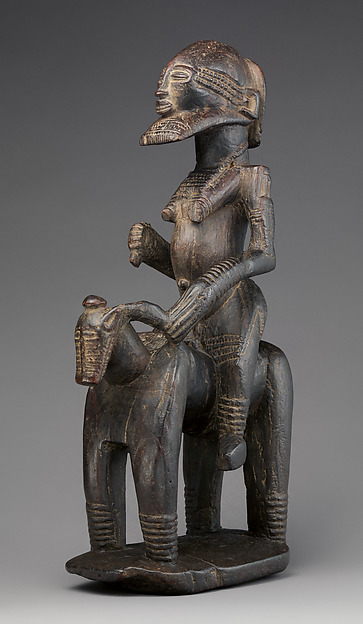
So many of the figures in this exhibit presented to our, NYC 2020, eyes as prominently hermaphroditic -- whether that was intentional was unknown to us, however.

The Sahel: Art and Empires on the Shores of the Sahara exhibit was also spectacular, but we're fairly familiar with these sorts of objects and the history -- not to mention the music.  Also, for me the relationship and history of the horse within these cultures, is an element I've been looking at for decades.

Whereas, in the Caribbean Exchange, the surviving artifacts are few and, apart from Carib and Taino, peoples we've never heard of before. Some of these may well have disappeared even prior to the Colombian Exchange's diseases, enslavement and genocides.  These items presented as mysterious and strange in a way the Malian, Dogan, Niger, Fulani, etc. cultures of the Sahell and West Africa are not.  Due to the literacy of Islam, these are 'historic' cultures. Whereas the items from the Caribbean Exchange cultures are forever unknown to literate history.
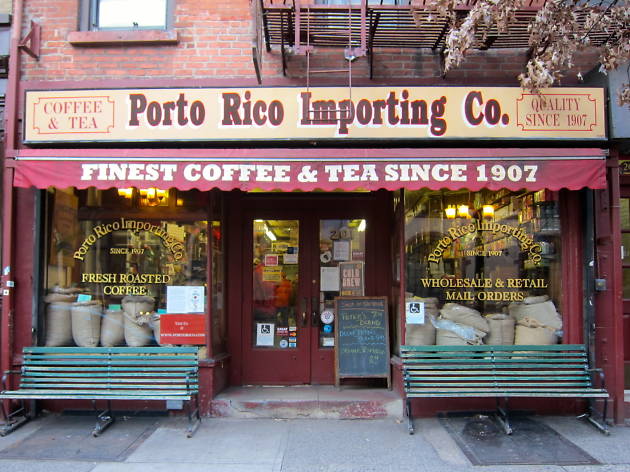


     . . . . Yesterday afternoon’s errands took me around my neighborhood, east and west. Approaching to the place on Bleecker Street where I've been buying our loose tea and coffee, since the branch on my block got rent priced out, I passed one of those tourist souvenir-smoke shops. Just there, a man burst out the shop door, throwing the stand of NYC post cards across the threshold. At first I thought it was an accident, and an asshole who didn't have the social grace to even say he was sorry, to the counter person who was at the other side of the door.  Then I saw the man's  face and the rest of his body. This was someone who was violently out of control, lashing out.  He yelled, “He threatened me! he said he was going to attack me!" he screamed into the faces of the rest of we pedestrians there, our faces and body language registering censure of what he'd done.  He raced down the block, where he met up two others like him, in appearance. If they weren’t exactly homeless, they lived rough lives focused on over consumption of booze and drugs. The took protective formation and ran back to the store, while the first guy continued to shout, “He said he was going to attack me, dirty m-word.”  I didn’t believe him the first time I heard him yell the store person threatened him.  Now I certainly didn’t.  I don’t known how it turned out, for all was quiet ten minutes later. The revolving post card stand was upright in its place, where I've seen it standing, for years and years of walking this block.

Yesterday had been very pleasant. I enjoyed having so many errands to do in the overcast, damp, a little foggy weather.  It felt like April, not February 1. I was shopping again, for food and supplies for two, not just myself, i.e. I was savoring having Vaquero home again.

Then, that.  I chatted with a few others who had witnessed this event.  We began to realize this white guy who caused this ruckus, that not only I reacted so negatively toward, had been trying to get the street on his side, to attack someone, by using a racial slur.  That was depressing as hell, that he thought he could do that.  OTOH, nobody on the street responded the way he wanted.  He only had his two (white) boys at his back.  Nobody else joined in. 

Tuesday, September 1, 2015

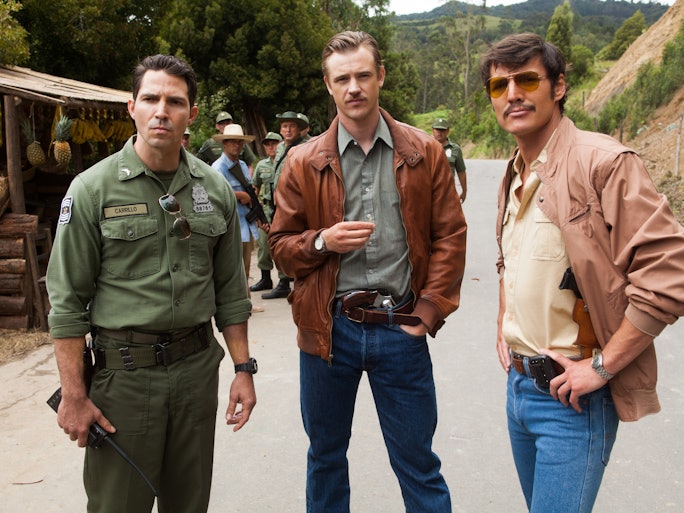
Narcos -- After Finishing

I finished watching Narcos last night.

Excellent, all around.


One of the elements I liked most about the series is what the creators did not do: show any of the figures, whether they were criminals or DEA, as particularly sympathetic, with whom one does heroic self-identification.  All around, this is a show about a grubby world, particularly that of the preposterous, over-the-top indulgences of criminals without much education or imagination beyond doing business.

Luis Carlos Galán. who was gunned down by Escobar's orders (1989), while he was running for the presidency of Colombia, because he would not repudiate extradition to the U.S. of Colombian criminals exporting drugs to the U.S.

Gaviria ran and won Colombia's presidency after Galán was killed; Escobar so escalated his bombing and murders that finally Gavira had to accede to Escobar's demands.  He's presently still doing well, as can be seen here.
There are some authentic heroes, and martyrs:  the first of the two men who campaigned for the country's presidency, centering drug trafficking to the U.S. as an extraditable offense to the U.S.; some of the national court's judges; and one Colombiano cop and the incorruptibles he recruited to fight the narcos' cartells. When have we seen any politician, judge or cop as an authentic hero lately, unless in fantasy series such as Elementary and White Collar?

I also appreciated that the series allowed us some eye-witness reminders how great is the suffering of the nation and its people when criminals overtly war upon all of the legal and political institutions, from the local cops to national courts and the judges.

It also shows how one cannot be immersed in that kind of violence and money, even as the right-thinking, right-motivated force, without it ratcheting up one's own capacity for violence and will to ignore humanitarian and legal systems, because one believes that obeying the laws will let the bad guys operate freely forever.  Catch 22 of law enforcement and bad guys. Not to mention if one is the CIA and believes the only problem is commies.

Take-away: a narco state is a very bad thing.  The amount of money is unbelievably great -- at one point Forbes Magazine classified Escobar as the 7th richest man in the world -- so there will always be war to control the drug supply and its market.  And there always will be large numbers of the innocent who will be sucked into the war, one way or another -- falling in love with the wrong guy, and even just by standing in the wrong place at the right time,

Tuesday, June 9, 2015

Maturín, Venezuela - Location

When the bloody wars of South American independence from Spain were waged, these countries, per se, did not exist.  Mosr of the regional colonies that would become nation-states certainly didn't have their nation-state names then, either.

However, the cities and so on had their names.  So here is the city that shares the name of Patrick O'Brian's admired naturalist and ship's doctor, Stephen Maturin.


Saturday, September 20, 2014

1635 Decima

El V's decided how to open his performance bit tonight at Danny Rivera's concert: with a decima, from La vida es sueño, by Pedro Calderón de la Barca, widely regarded as the greatest playwright ofSpain's el siglo de oro.  Decimas are still sung in Puerto Rico. 


He's accompanying his performance by playing his classical Ramírez, the same guitar he bought as a young classical guitar and vihuela student in Spain, with the help of Segovia.


The guitar was already a recognizable instrument in Spain by this time of the 17th century, via the vihuela and the gittern.