LINES OF THE DAY

". . . But the past does not exist independently from the present. Indeed, the past is only past because there is a present, just as I can point to something over there only because I am here. But nothing is inherently over there or here. In that sense, the past has no content. The past -- or more accurately, pastness -- is a position. Thus, in no way can we identify the past as past." p. 15

". . . But we may want to keep in mind that deeds and words are not as distinguishable as often we presume. History does not belong only to its narrators, professional or amateur. While some of us debate what history is or was, others take it into their own hands." p. 153

Silencing the Past: Power and the Production of History (1995) by Michel-Rolph Trouillot

Showing posts with label War of 1812. Show all posts

Friday, September 12, 2014

The War of 1812 and the Terrapins

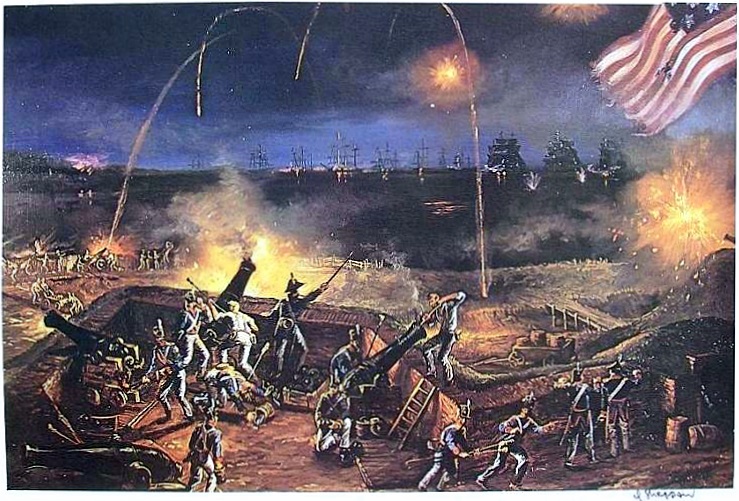
The University of Maryland's football team is named the Terrapins.  They have changed their uniforms for tomorrow's game against West Virginia as commemoration of the Battle of Baltimore at Ft. McHenry's anniversary, which is tomorrow, September 13th.

Among other elements, the uniform will incorporate lines of "The Star Spangled Banner."  Usually the Terrapins' uniforms incorporate elements of Maryland's state flag.  Photos of Maryland state flag photos here.


Football and war go together like misogyny and racism.  Or, something-or-other ....

At least it seems the lines from the third verse of the "Star-Spangled Banner" glorifying slavery:
“No refuge could save the hireling and slave / From the terror of flight, or the gloom of the grave” ....
are not among those included on the uniforms.

Sunday, August 24, 2014

'Tis the Bicentennial of the Battle of Bladensburg and the Burning of D.C.

August 24, 1814, a day of national infamy.

Which blundering event on the part of the nation and its leaders was merely one more blundering failure in this war that New England merchants agitated to secede over -- which is the likely explanation that so few remember and even fewer even know about the War of 1812. This, despite it being the hinge point in the towering career of Andrew Jackson, and his shaping of our subsequent national history up to and including the Civil War.  The Brits may have been having their successes against (mostly) very tiny, undefended towns and plantations along the Chesapeake in these years.  But Jackson was winning one engagement after another in the south and west, against Indians, against the Brits, against whatever he set himself against, including the wilderness itself.

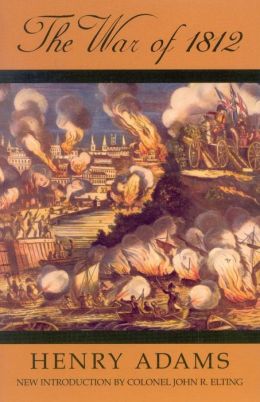
Again, for the best description and analysis of this "forgotten war," the best source is Henry Adams's account in the volumes that cover the Madison administrations in his History of the United States of America.

Canada remembers the War of 1812 much better -- the northern conflict that is, not the Chesapeake conflicts and those further south.  This is because that war, in which they turned back the U.S. invasions has become a part of Canada's founding history as herself a nation.


Fortunately, in September came the Battle of Baltimore - Ft. McHenry, which not only stopped the Brits but redeemed American military reputation.

For a look at today's Bladensburg, go here.  With about 10,000 residents, it looks a very pleasant place to live -- as do so many small communities in Maryland's counties.

Friday, August 15, 2014

Charlotte Bronte's Shirley -- End Of Summer Reading Historical Fiction

Last night I began to read Charlotte Bronte's second published novel, Shirley (1849).  It seems the perfect novel to carry me through the change of seasons from summer to autumn, both long enough while engaging enough, with several themes.  Not the least of Shirley's engagements is that it presents dilemmas and problems for all the readers -- and even scholars -- who are insistent upon presenting Charlotte Bronte and her protagonists as feminist and politically liberal.


Shirley, though classified as a social novel, is neither feminist nor liberal, particularly in its outlook of Yorkshire textile laborers particularly, or the lower classes in general.  This may explain why Shirley is so unpopular generally with not only Bronte-ists, but those who study the history of the novel in English -- so much so that a surprising number of those who are well educated in The Novel, are unaware that Charlotte Bronte wrote this novel.


The edition I chose to read was not my falling apart Penguin copy acquired a millennium ago while an undergrad, but a newer Penguin edition with an introductory essay (2006) by the excellent Bronte scholar, Lucasta Miller.

The other primary reason I chose Shirley is that as well as being classified as Bronte's only social novel, it is considered an historical novel.  The novel's chronological location is specifically told the reader on page 1 as, "eighteen-hundred-eleven-twelve." I.e., we're in my favorite war (speaking historically), the War of 1812.  Britain, like Napoleon, had levied an embargo upon trade with "America" (which included grabbing every U.S. ship they encountered -- if they could) thus the Yorkshire textile manufacturers, like so many other industrial employers, had closed their mills or greatly reduced activity and workforces.

The narrator so informs us, in a one-sided explanation, on page 25, second


chapter, as spoken by the half French-Antwerpian, Robert Moore, owner of the Hollow's mill:
"I am very rich in cloth, I cannot sell; you should step into my warehouse yonder, and observe how it is piled to the roof with pieces.  Roakes and Perason are in the same condition: America used to be their market, but the Orders in Council have cut that off."


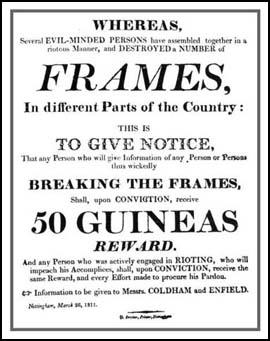
This is the period of the Luddite uprisings, as the manufacturers like Roger Moore, with the capital to do so, are installing more efficient machines that require fewer workers.

Bronte expands on the Orders in Council and unemployment on page 29-30:
"The 'Orders in Council,' provoked by Napoleon's Milan and Berlin decrees,* and the forbidding neutral powers to trade with France, had, by offending the Americans, cut off the principal market of the Yorkshire woollen trade, and brought it consequently to the verge of ruin. Minor foreign markets were glutted, and would receive no more: the Brazils, Portugal, Sicily,**were all overstocked by nearly two years' consumption. At this crisis, certain inventions of the north, which, greatly reducing the number of hands necessary to be employed, threw thousands out of work and left them without legitimate means of sustaining life.  A bad harvest supervened.  Distress reached its climax....
This is the first time I've undertaken a Shirley re-read since having lived in New Orleans and on the Chesapeake, major grounds and objectives for the Brits in the War of 1812.

As for the plan that was to be a reading transition from one season to another -- well, Climate Change evidently made another plan.  When I left for the libary before 10 AM the temperature was 64 degrees.  Big brown leaves were being blown off the plane trees in droves.  This is like no August I've experience here ever.  The long term weather forecasts are saying we're going to continue with temperatures generally lower than usual, November is going to be wet, and winter will began early and be close to the brutal thing is was last go-round.  I'm going to be extra-careful not to catch a sinus infection in November or break my elbow in January as I did last time.

----------------------

*  Napoleon's monstrous egomania and British arrogance were equally responsible for the embargo. All nations' trade was caught between the hammer and tongs of the British and French navies.  Indeed, when Denmark insisted on her right to continue trading as she wished, and an ally with Britain against the French, the British navy shelled Copenhagen, burning much of it to the ground, in 1807.

 ** Not to mention being under siege in one way or another, as with Sicily to where the King of Naples had fled, and Portugal, as part of the very long and brutal Peninsular campaign -- Bronte is frequently hazy, to put it generously, with her information about many aspects that she mentions regarding trade, the military and politics, despite her passion when younger for heroes such as Wellingon and Napoleon. Her forte is the personal, always.

Additionally she was writing this some decades after it took place; she was born when it was all over, in 1816.  Thus Shirley gets classified by some as an historical novel.  I'm not sure I agree, however, any more than I can think of Middlemarch as an historical novel.  Though set in the 1830's of the Reform Movement bills, Eliot, born in 1819, was more than old enough, particularly with her father profession and their common interest in public issues and politics, to remember the time well.  As well, the Reformist movement returned to the public stage in 1860.


Thursday, July 31, 2014

The Fantasy of General Wellington's Invasion in the War of 1812

One of the persistent myths of alternate history fans is that Lord Wellington was asked by the British government to invade the United States from the Gulf Coast in order to defeat the upstart Americans in the War of 1812. [Example here.]

Whether or not there ever was a formal request made by the PM to Wellington, Duke Wellington supposedly declined, without grace or patience. Thus, it is a speculation without content.  It is so counter-factual, in fact, that there is not a single fact out of the period and location, to fuel such useless speculation.

Nevertheless the speculations continue apace, taking it as a given that this general, who was so good at his work that he defeated Napoleón himself in a battle -- a battle, let me haste to say, that didn't take place until after the first abdication of Napoleón, which concluded the Congress of Vienna, in which the surviving powers were wrangling over the division of the spoils of Bonaparte's empire, and Wellington was a primary player.*  With some level-headed dissenters, war gamers tend to believe that Wellington have quickly cut a swathe through the former colonies and returned them to British rule. This fuels ever more extreme counter-factual speculation as how would change the course of world history.

There is not a single fact upon which to build speculations.  In contrast, however,, there are ample facts that strongly suggest that Wellington showing up on the Gulf coast would have been as much a debacle as it turned out for British army general, Edward Pakenham, and British naval commander, Admiral Alexander Cocherane -- and very likely in the same way.

First he'd have had to defeat Andrew Jackson, who knew his territory, as he proved over and over, from the Floridas and the Gulf, all the way up the Natchez Trace and the Mississippi Corridor to Nashville, the water and land routes both, in this vast Louisiana Purchase territory. Whenever Jackson encountered the Brits in the Floridas and the Gulf, he'd defeated them (and hung some, even though it was illegal).  He'd been doing this long before the Battle of New Orleans.

This wasn't Wellington's geography, or the geography of any regular army, as the British learned in the War of Independence.  They occupied all the cities, but it did them no good (except to give contemporary Americans a silly idea of their own competence and exceptional capacity for success purely through the actions of single individuals, conveniently forgetting the essential roles of France in Spain in the ultimate outcome).

There were no places other than New Orleans to re-supply a Wellington army, and it was very far away from the hinterlands. There were no plantations to plunder yet, but those around New Orleans and Natchez. The land was covered in dense forest, swamps, bridgeless rivers and bayous. The American forces were skilled at living rough and at brigandage.  They'd have been at least as fierce a guerrilla third front as Wellington had encountered in Spain, except these would be working against him.

As intensely as Wellington had put himself through a military education he'd surely read the history of the War of American Independence.  As much time as he'd


spent in Spain, he'd surely have at recall the large role Spain's General Bernardo Galvez played in the Gulf Mississippi Valley in defeating the British back then and there, and how easy it was for him to do so, since the British military were not good on that ground. Moreover, now, in the present of the War of 1812, which in any case, as mentioned, was now over, Spain was Britain's ally.

So, yes, there are many facts that show Wellington, if, indeed he was formally asked to fight in North America, made the right decision to stay on this side of the Atlantic, while there is nary a single one to say he'd have met anything but disaster, whether by water, cavalry or infantry.  His artillery would have been as prone to incapacity by corrosion and mud as anyone else's, especially without roads along which to push them.  The horses would die from starvation, and the men as well.

----------------------

* Which was a fortunate circumstances for Britain and the rest of Europe, since Wellington was already on the ground in central Europe, where war was resuming, not sitting around uselessly in the Americas, where that war was over. The Treaty of Ghent had been signed December 24, 1814.

Wellington, where he was,  was perfectly positioned to take immediate charge of the British forces and confer with the generals of the other powers' armies during Napoleón's 100 Days: 20 March to 8 July 1815.

Wednesday, December 18, 2013

Lost Girl 2 - season 3 - Why It Delights Us + The War of 1812

"Fox," some near and dear inquire, "explain again why you take such delight in such an absurd show."

OK, por ejemplo ....

Tamsin's Game Face
Q: When was the last time the War of 1812 was discussed in a supernatural series?

A: In Lost Girl's season 3, episode 10,  “Delinquents.”

Two valkyries, Tamsin and Acacia, reminisce about good times on the battlefield in times past. Up pops the War of 1812. Acacia, the elder valkyrie, chortles as she describes the mess the U.S. Brigadier General William Hull made in Michigan territory (the two battles of River Raisin, January, 1813, a/k/a Battle of Frenchtown ) in the U.S.’s vain attempt to conquer Canada. (Recall, this is a Canadian show.)  She contrasts Hull with great general of the Shawnee Confederacy– and all man -- Tecumseh. However, she did not include the fate of Tecumseh at the Battle of the Thames (October 14, 1813), though presumably he is a more than worthy addition to the Valhalha ranks.

Acacia, Tamsin's Valkyrie Mentor
This is one of the few references made in this series by the plethora of very ancient figures -- light or dark fae --  to what are human events. Granted most of them are not much concerned with humans at all, beyond keeping humans from interfering with the fae, and using them for their own criteria of legitimate feeding and amusement. However, as these two are valkyries, whose purpose is to harvest the deserving dead from human battlefields to Valhalla for the Last War, they would naturally chitchat about human battles past. Beyond that, however, without spoiling, there are surely reasons that valkyries showed up in season 3.  This means the writers are making what they do look more simple than what they are actually doing, at least for the sorts of viewers who notice such elements.


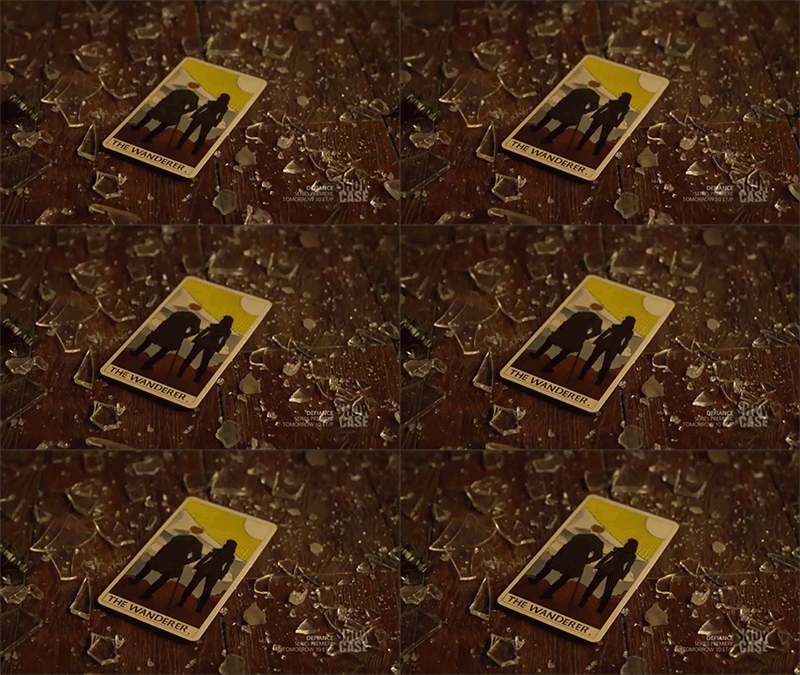
Which means further, that I'm looking forward all the more to season 4, which if the writing wasn't as good, as smart, as efficient, as it is, I wouldn't be.  Among the delightfully clever things they do is include Dion's "The Wanderer" (1961 - 1962) as source music in appropriate scenes.  Very cool. I just hope that the writers manage to keep their touch as light as they've done all along.

Tamsin Reborn Season 4, SyFy Channel, Premieres January 2014


Saturday, September 28, 2013

Henry Adams: The Myth of Failure by William Dusinberre

In this fascinating, slender volume, Dusinberre tells us something which anyone interested in naval and military history of the United States should know:

The chapters on the War of 1812, separately reprinted in 1944 for use in educating United States Army officers, remain the basis for most secondary works on the military history of the period.

This separate reprint is titled Henry Adams: The War of 1812, edited by Major H.A.  De Weerd (Washington, D. C.) 1944).


Wednesday, April 3, 2013

War of 1812 -- Andrew Jackson's Intelligence Network

Jackson had a highly effective intelligence network, particularly considering how little he had to work with, in terms of funds and man-power, and how far away he was from even small towns from 1813 until going to New Orleans at the end of 1815. He must have had a lot of messengers, and very effective ones.  I'm sitting here with the volumes of his correspondence from these years, so I can see Jackson wrote  constantly, despite being so ill for so much of the time. He also seems to have had access to large numbers of newspapers from the Caribbean.  When he gets to Mobile and the Gulf in 1814, there is that route of information, which he combs assiduously to his and the nation's profit.


But his letters don't give clues as to who is sending him info.  It has nothing to do with the mission of The American Slave Coast, but my curiosity as to his spy network has been growing.  Finally, appears a book that carries some information on this subject, Struggle for the Gulf Borderlands: The Creek War and The Battle of  New Orleans 1812 - 1815 (1981), by Frank Lawrence Owsley, Jr. University of Florida, Gainesville. The info comes from the papers of two of Jackson's correspondents, who, as even in this little book of scholarship, are ignored by history other than as cites and footnotes.

With this warning constantly being brought to the general's attention, he moved his headquarters to Mobile, closer to the source of his espionage reports.  The names and addresses of most of Jackson's informants indicate that they were located either in Pensacola or New Orleans .... Since Pensacola was a neutral Spanish port, it was not under the regular British blockade and received a constant supply of letters and newspapers from the islands of the Gulf and the Caribbean.

One of the best sources were the papers out of Havana, and out of Jamaica.

This is how Jackson, his governor and all the other interested parties came to the consensus that the target was going to be either Mobile or New Orleans.  Jackson decided it would be New Orleans with just barely enough time to leave Mobile and get to New Orleans and organize the defense.

Monday, June 18, 2012

Today - Official Start of the War of 1812


It was on June 18, 1812, that Pres. Madison officially signed into law the declaration of war against Britain.

The outcome? Something of a draw for both the U.S. and Britain. The winners were the Canadians, who consider the War of 1812 with a great deal more seriousness than either the U.S. or the UK. They were the ones the U.S. invaded, as the Brits invaded the Chesapeake region here. At one point we burned York, which is what Toronto was called then. Nevertheless we failed, and failed miserable to even get a toehold of conquest in Canada. Some slaves won too, meaning they got their freedom, though almost all of them were embarked on a journey that was anything but easy or short, filled with pain and uncertainty and poverty, and for many ultimately death, due to disease or other reasons. The really big losers, of course, were the Native Americans.

hip hip you all ....

Sunday, February 6, 2011

A Beautiful Day, Plus The War of 1812, Andrew Jackson & *The Black Swan*

On the Eastern Shore! 46 degrees. The sun is shining. The wind is not blowing. Most of the snow has been washed and melted away, though the mounds from clearance of parking lots for instance, were so large, they are still significant. The birds are wicked active and vocal. Outdoors smells like April.

Upon arising I went to work, attempting to compose coherent take away on the War of 1812 and Andrew Jackson. What a land grab!  Most of what was soon to be known as the Cotton Kingdom.  Additionally he ridded his natal state of South Carolina of any need to further regard anything coming out of the U.S.A.  How differently things might have turned out for this country if Andrew Jackson hadn't been where he was when he was.  So much happened because of him, the person he was. Part of what he was, was that he, like Julius Caesar, was possessed of extraordinary battle luck.

About an hour into this a neighbor calls. She and another friend are determined to catch The Black Swan; today's the last chance to do so around here, over in Easton. Would I like to go with them? I hemmed for a minute. I decided it would be healthy to play hooky.

el V says it's nice in NYC too, and the rain of yesterday significantly reduced their snow mountains, which are considerably larger than ours! He's in a better state of mind after hanging out with our friends uptown last night.  He was so miserable Friday night and yesterday.

Tuesday, December 14, 2010

Maryland Gazette - Annapolis

The entire years' issue runs, from 1810 - 1815 has had its microfilm digitized and there they are, week by week, month by month, year by year, thanks to the Maryland Historical Society. All accessible from this chair right here in which my ass is planted.

Everytime I go there I fill with awe and gratitude.  With luck, meaning particularly no flu, I might have a good 15,000 words on the Era of Good Feeling by the end of January.  BTW, the front page of every issue contains either an advert to buy slaves for cash or a reward for a runaway slave.

On another subject, but one to which I am very close: Dayem! it's cold! The wind, she's gusting like 40 50 mph.

Thursday, November 4, 2010

Privateers and Steam Brigs

The rains that appears to be pouring down along all the Atlantic coast is keeping me inside today. I'd planned to spend it at the Kent County News transcribing from issues published during the War of 1812 and stories about the first steam brigs taking slaves from here down to New Orleans. The biggest professional slave trader, Isaac Franklin and his partner, had built steam brigs for specifically built for them and this trade. I'm trying to find out who the builder was (Franklin's traders came into the C'town port). Thursday is good for this, since this is the day the weekly issue comes out, thus things are a bit less hectic in the offices.


Then I'd planned to finish up the day in the library to transcribe material from reference books on the Letters of Marque in the War of 1812. There's an excellent history of this published in 1930 by a local Baltimore history publisher, and later by Norton, with the best definitiions of the differences between piracy and privateers, and the history of privateers -- going back to the 13th century! I didn't know. But the real point is the Brits and how they dealt with all those Eastern Shore slaves running away and converging upon their ships in promise for transport to elsewhere and freedom. As well, the slave population provided many services to the British navy from navigation to food to spying out information -- to the bewildered outrage of their owners, of course. I'm trying to get some real numbers. Also find out what really happened to those who were transported to the West Indies, as promised -- where slavery was still in effect. This one's kind of a replay of the Brits - slave relationships during the War of Independence.

But I don't want to take my laptop out for a walk in the rain. My umbrella is small. Nor do I have the right rain footgear here yet.

Fortunately I can continue with other areas here at home.

Tuesday, November 2, 2010

The Stillness, The Beauty, The Solitude, The Work

Yesterday el V drove off, first to C. College upstate NY, to do an annual presentation for a Media class taught by a friend and colleague.  He's been doing this since she began teaching there.  Usually it's the second week of the semester, but due to our own academic and other schedules this year, it was yesterday.  He's leaving the car at their home upstate while he then trained it to NYC and our apt., and the three gigs he's got in town this week.  As well as starting the rounds of medical visits etc., now that the WC health insurance is operational.

I'm here still.  Alone.  In the House.  In this town, this county, this region. Reveling in the beauty.  Doing my War of 1812 thing.  Finding out more about the steamboat manufacture on the Chesapeake. Tracking down citations out of primary dox and sources to back up assertions I've made during our constant conversations, updates, etc. about our project.

Night hunting, multiple-barrel guns and huge punt guns had been been used in the Chesapeake around the turn of the 20th century to take down the geese in their tens of thousands.  I knew this -- from where? But I can't just go and say this without backup.  For something like that factoid, the backup is easy to find in all the local sources, including transcribed oral interviews.  This kind of hunting, which wiped out the grand riches of the migrated Canadian geese early in the 20th C, became in the regional lore something like the moonshiners and the -- hunters and their guns vs. the local authorities trying to get hold of those guns, and spike or otherwise take them out of commission.  Thus, this is easy to find multiple reputable sourcing cites for, unlike some other assertions I make, that "I just know." (It seems that even into the eras of wide-spread ecological awareness of overhunting and overfishing, even now yeye olde guyz still don't think they were doing anything wrong, while bemoaning the loss of that harvest.)  Just knowing does not writing reputable history make.

In any case, the War of 1812 has been given not only short, but little, shrift in the h.s. and undergraduate courses in U.S. history. I can understand that, but it leads to the lamentable contemporary situation of 'libertarians' and other such ilks, quoting their god Robert Heinlein, from the Heinlein Bible, Starship Troopers, in which a fictional character (so, can you certainly know that RH believed that himself?) declares the War of 1812 "one of the bush-fire wars on the sidelines of the Napoleonic Conflict.” Which is not only inaccurate but dumb. If anything, it was a continuation of the War of Independence. There was so much crowing in England that this was the new campaign, and at its conclusion the 'colonies' would be back under the Crown's rulership and administration.

Another reason this war has been rather lost in the teaching and awareness of U.S. history, is, as one of the privateer replica captains observed in the course of Downrigging Weekend's Captain's Forum: "It was fought here. Most of the United States weren't yet states. California was still New Spain. The War of 1812, the Chesapeake - Baltimore privateers don't mean anything to them. They've got their own historical boats and traditions."

These captains are very smart, well-informed, personable people. But when they get the opportunity to get down to knots and sails and masts and wind -- they may as well be Captain Aubrey with his own naval colleagues. I say this in all admiration. However, it seemed to me, that it would have been the height of bad form to have brought up Captain Aubrey and Patrick O'Brian's books to any of them this weekend. They have read those books, and loved the film of Master and Commander. But just imagine, how constantly they must run into lubber passengers who think we can sail one of these ships because we have read and digested O'Brian's novels thoroughly. How tiresome for them we must be after a point.  "You cannot learn to sail a boat like this from books!" thundered one captain.

In the meantime the three-year anniversary observance of the War of 1812 is just about upon us.  Thus it has been decided to keep Lynx and Pride of Baltimore 2 over here for most of this time.  Such a decision is provoked as well by the current economic catastrophic conditions which has pulled so much state and local community monies from what had been the constantly expanding historic ship inclusions in local observances of this and that.

This war -- was it three years?  Was it actually four, as many of us think?  See?  Three years or four years, that is not a small war for those who were in the thick of it, as were all the people here.

Monday, November 1, 2010

Starr Center Director Debuts His Civil War Column in NYT Today

Disunion will follow the Civil War as it unfolds; today's, the first installment, is Nov. 1, 1860, "The Last Ordinary Day." The subject concerns how some of the principle players of the Civil War were occupied on November 1 in 1860.

Is this cool-io or what?

Though myself, I'm totally occupied with the War of 1812.  With V away for the week, hopefully I'll get the the first draft of this matter and slavery finished.

Friday, October 15, 2010

The War of 1812, Sometimes called the Privateers' War

This is why.

I'm absurdly excited about going on a sail down the Chester into the Chesapeake on the Lynx, part of the College's participation in the long "Downrigging Weekend," a week from Saturday afternoon. It's a 'private' sail, meaning the Board of Trustees, staff, patrons, benefactors etc. and their families from the Starr Center and selected Washington College people. I have never done anything remotely like this before -- and this is a replica of a period 1812 U.S. privateer out of a Maryland boatyard.  This week I've been reading period accounts published in the local paper about the local burnings, pillagings, killings by the British navy in our area -- and the death of British Captain Parker.  This war, which when taught at all, is taught faintly as a joke in U.S. History, feels personal and terrible.

It's as if I'm ten or 11 again; it's the kind of thing that you dream about and anticipate for weeks when that age, and this is what I've been like  ever since we got the invitation last month.


Our passenger experience will probably be a little different, as we disembark for a reception, followed by a sit-down dinner at the Customs House.

This happens right after el V does The Year Before the Flood and Fats Domino at the Rock 'n Roll Hall of Fame in Cleveland.*  I flat out told him that I wouldn't miss this even for Fats Domino.

How 'bout us and American history, huh?

* The organizer of these events is so knocked out by The Year Before the Flood in general, and the R&B chapters, that's why they determined El V was the right person for this.  That has made him so very happy!