This weekend I read fairly non-stop Katharine Graham: Personal History (1997) the memoir of the publisher, president and chairman, eventually, of The Washington Post. The book reads very fast, and never flags in interest. Reading through hers and the Post's experiences during the
years of Johnson and Nixon - Vietnam era -- the Pentagon Papers and Watergate, and impeachment -- was fascinating. Reading Graham's memoirs intensified my viewing involvement with China Beach.
Graham was born (1917) very wealthy, and raised in an emotionally dysfunctional family with materially austere upbringing in terms of regimens, possessions and clothes, though there were lessons, art, literature and a great deal of other intellectual enrichment, that included the high achieving friends of her parents (among her mother's life-long closest friends were the Steichens). Dysfunctional as it all was, Graham herself managed to have very close relationships with both her parents and all her siblings.
Surrounded all her life by servants, even after marrying a (relatively) poor fellow, she barely learned to cook, never ironed a piece of clothing, or even knew how to shop for clothes. She lived through all of the changes the 20th century was fated to experience -- including a very slow coming to consciousness of women's systemic subordination as unfair. She overcame a great deal, and in her memoir at least, comes through as person who doesn't aggrandize herself at all -- in extreme contrast with her narcissist mother. However, she may not have realized just how much she still was viewing the world from the perspective of the truly powerful and privileged. She was a centerist in everything, which her position provided the privilege to be.
It was her plutocrat father (who, among other accomplishments organized setting up the World Bank) who initially bought the small circulation, struggling
Washington Post at an auction (1933). By then both Isaac Eugene Meyer and his wife, the poor German Lutheran Agnes Ernst, daughter of a bankrupt alcoholic feckless fellow, both preferred the political life in more tolerant D.C. to living in New York, where antisemitism was intense.
Eventually Graham's husband, Philip Graham, who was one of her father's best friends, was not only publisher, but given the controlling shares of the family owned Washington Post. When Philip, after severe mental illness, committed suicide (1963), Katharine Graham took on the paper that both her beloved father and husband had given so much of their lives.
I finished the book (625 pp.) last night. Woke this morning to the even more hair raising sense of déjàvu.
OMG! Bush46's debacle of Iraq, Blackwater, CIA, torture and lies, committed under cover of the waving bloody shirt of 9/11. What was going on during the Iraq invasion - rendition era -- lying about it, keeping it secret -- is part what Nixon and Co.'s men believed they had the right to do. Breaking laws was their right, and they despised the laws and the people who believed in them.
If this Senate Intelligence Investigative report of CIA torture came out next year, when the new r-Senate conveys, one doubts strongly this would have gone public. It took an independent publication -- The New York Times, for the Pentagon Papers*,
and the Washington Post for all the president's men, the Watergate and Ellesberg break-ins, funded by private campaign contributions, lied about by Nixon and his cronies from first to last -- to inform the public.
With the publication of the Pentagon Papers in the media, Nixon's lawsuits to stop, halt and desist repeated all the same tired lines we've been hearing for decades whenever the gummit, the intelligence community (and the civil police forces), Homeland Security, etc. etc. -- that none of this can be made public because of national security. And this applies to content about matters and actions taken place long before the present administrations, content already published, etc.
The Washington Post is now owned by the eviLe fellow who owns amazilla. This is the ultimate consequence, which surely she had never suspected, of taking that privately held family media company public.
I admit to have been thinking about this even before reading Graham's Personal History.
UPDATE: The Supreme Court ruling on amazilla employees overtime standing in lines to be searched for theft -- it did not escape this reader's notice that Katharine Graham had no sympathy at all for labor unions -- except way back in the day when she was f*cking a labor guy in SF when she was just a kid, with her first journalism job gotten for her by her daddy.
PLUS: The surveillance choppers are flying again, now that the rain from whatever storm has slackened, because the Eric Gavin protests have not quit. On the subway to and from medical appointment, many a group of young were observed chattering with exhileration, carrying fresh packages of baby wipes -- presumably as remedy from tear gas? Moreover, which hasn't been mentioned as far as I know in the media, here at least, many of these groups of the young are not English speakers, but clearly here from Europe in solidarity ....
---------------------
* The official title is United States – Vietnam Relations, 1945–1967: A Study Prepared by the Department of Defense, is a United States Department of Defense history of the United States' political-military involvement in Vietnam from 1945 to 1967.
Showing posts with label Vietnam war. Show all posts
Tuesday, December 9, 2014
Monday, December 8, 2014
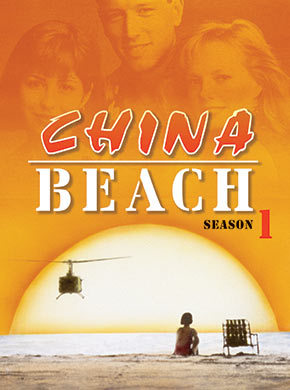
China Beach, Season 1 (1988) ABC
China Beach had four seasons. Only season one (1988), composed only of six episodes including the pilot, seems available from netflix.*
It stars Dana Delany.
The location of the series is the Da Nang evacuation hospital and R&R center, at My Khe, nicknamed by the occupying forces, "China Beach." However, the locations for the video shoots were in California and Hawaii.
Inevitably, China Beach got associated with with the eternally beloved series, Mash (1972 - 1983) -- which was transferred for television from the original setting Altman's 1970 Mash, which was intended to be read by all as Vietnam, not Korea. It was savage, and most savage of all to women.
China Beach is dark, less satirical, very cynical and, while sharp and witty, unlike Mash, this series is not a comedy. Nor is it a "war" series. The fighting, the consequences of which the hospital and the shipment center of dead bodies deal with most days and nights happens off screen.
Most of the focus is on the women at the hospital base, who are there to clean up the messes made by and of men, whether of their bodies, their lives, their quarters, and war – while also providing all emotional support, nurture and healing -- and of course, entertainment and recreation. Who thinks of doing any of this for them? Generally speaking, tentatively and experimentally, only each other.
These experiences of the women who worked the bases as nurses, administrators, services personnel, such as the young Vietnamese woman at the community center which the Red Cross My Khe director, Lila, is attempting to build, are based on the book Home Before Morning (1983) written by former U.S. Army Nurse Lynda Van Devante. They too have PTSD. Lynda Van Devante died in 2002.
While anti-war in Vietnam protest is full blown, and both protest and the war are highly criticized at the hospital, on the base, and among the men as irrational, useless and terrible waste, feminism has not yet raised its terrible head in the military.
This dark cynicism about war and the top-bottom military organization made this series, while popular with critics, unpopular with viewers ....
The episodes are written with the multiple characters in the traditional manner of network television, following each character's various fracas, conflicts and problems, as well as their shifting relationships with each other. However, there is arc in the telling over the season, as well as nuance and dimension in the conflicts that weren't as expected from a television series then. So, like Homicide, Xena and Babylon-5, China Beach too, might be one of the early indicators that a new golden age of television was dawning.
The penultimate episode of China Beach is titled "Brothers." It principally creates a denoument of two of the characters' through-lines of the season.
Beckett is the African American grunt in charge of the base's GRU -- Graves Registration Unit. His job, dealing hands on with the dead, makes him a pariah among those who go in country. Even his shadow falling on them might put them next in the body bag shipment home. Isolated mostly by the other soldiers, he has come to commune with "my men," the dead. The other principal arc is that of Cherry, the wide-eyed, blonde from Iowa, a Red Cross volunteer, who serves doughnuts in the canteen and talks to the men back from in country -- the young women who have volunteered for such jobs are called "Dolly Girls." She came to Vietnam to find her missing older brother, whom she has hero-worshipped all her life.
Through Beckett we can figure out how humanity gets religion from death and the dead, transmitted from those who live with them, who take on the dead's terror and taboo. Beckett walks through worlds. When some of his "brothers" attempt to recruit his dead as transport for heroin, he won't do it, no matter how much he's appealed to in the name of brotherhood. "My men don't want this." They aren't going to participate in the killing of other brothers, in the burned over ghettos of back home.
Cherry's wide innocent eyes see the the truth, faces it with courage, that her beloved brother has become a criminal, preying on everyone, via violence and his enterprise of guns, drugs and whores. The episode is powerful, not sy sll sentimental. There's not closure. Nor is there redemption for dealers or for Cherry's brother. There's no punishment either, other than the hell of their own heads. Both of these men, who don't know each other, have made by the corrupt enterprise that this war is, but they also made their choices to wallow in the filth, as much as Beckett and Cherry have made their other kinds of choices..
The vast amount of the series’s budget spent on music permissions.
Worth it though, particularly for the title cut – “Reflections,” the first single released as Diana Ross and the Supremes, in the Summer of Love, July 24th, 1967. "Reflections" is also notable for being the first time Motown incorporated a bit of the psychedelic touch, as heard in the opening bars. Highly effective – every time the opener comes on my screen, I get a lump in my throat. But the series, like the song, never ever overdoes psychedelia, slang or any of the 60's, or uses them in a cliched manner. The reality everyone is in, there in one of the armpits of the world, is already sufficiently irrational.
The audio values of the China Beach production are brilliant -- loudness of the insect and amphibian life after dark, the churn and thud of choppers, screech, wail and thunder of various weaponry, the constant thump of fans, dehumidifiers, generators, and if, a character is lucky, a whistle of an air conditioner, are as omnipresent source audio as are the hit songs of the day spontaneously sung acapela, out of radios, on tapes, by cover entertainers, and, when the troops are lucky, the actual performers, such as Nancy Sinatra.
This season one of 6 episodes, including the pilot, make for a coherent and satisfying arc themselves, and are more than worth watching. I sure wish I could see the rest of the other seasons.
It stars Dana Delany.
The location of the series is the Da Nang evacuation hospital and R&R center, at My Khe, nicknamed by the occupying forces, "China Beach." However, the locations for the video shoots were in California and Hawaii.
Inevitably, China Beach got associated with with the eternally beloved series, Mash (1972 - 1983) -- which was transferred for television from the original setting Altman's 1970 Mash, which was intended to be read by all as Vietnam, not Korea. It was savage, and most savage of all to women.
China Beach is dark, less satirical, very cynical and, while sharp and witty, unlike Mash, this series is not a comedy. Nor is it a "war" series. The fighting, the consequences of which the hospital and the shipment center of dead bodies deal with most days and nights happens off screen.
Most of the focus is on the women at the hospital base, who are there to clean up the messes made by and of men, whether of their bodies, their lives, their quarters, and war – while also providing all emotional support, nurture and healing -- and of course, entertainment and recreation. Who thinks of doing any of this for them? Generally speaking, tentatively and experimentally, only each other.
These experiences of the women who worked the bases as nurses, administrators, services personnel, such as the young Vietnamese woman at the community center which the Red Cross My Khe director, Lila, is attempting to build, are based on the book Home Before Morning (1983) written by former U.S. Army Nurse Lynda Van Devante. They too have PTSD. Lynda Van Devante died in 2002.
While anti-war in Vietnam protest is full blown, and both protest and the war are highly criticized at the hospital, on the base, and among the men as irrational, useless and terrible waste, feminism has not yet raised its terrible head in the military.
This dark cynicism about war and the top-bottom military organization made this series, while popular with critics, unpopular with viewers ....
The episodes are written with the multiple characters in the traditional manner of network television, following each character's various fracas, conflicts and problems, as well as their shifting relationships with each other. However, there is arc in the telling over the season, as well as nuance and dimension in the conflicts that weren't as expected from a television series then. So, like Homicide, Xena and Babylon-5, China Beach too, might be one of the early indicators that a new golden age of television was dawning.
The penultimate episode of China Beach is titled "Brothers." It principally creates a denoument of two of the characters' through-lines of the season.
| Michael Boatman plays Beckett on China Beach |
Through Beckett we can figure out how humanity gets religion from death and the dead, transmitted from those who live with them, who take on the dead's terror and taboo. Beckett walks through worlds. When some of his "brothers" attempt to recruit his dead as transport for heroin, he won't do it, no matter how much he's appealed to in the name of brotherhood. "My men don't want this." They aren't going to participate in the killing of other brothers, in the burned over ghettos of back home.
Cherry's wide innocent eyes see the the truth, faces it with courage, that her beloved brother has become a criminal, preying on everyone, via violence and his enterprise of guns, drugs and whores. The episode is powerful, not sy sll sentimental. There's not closure. Nor is there redemption for dealers or for Cherry's brother. There's no punishment either, other than the hell of their own heads. Both of these men, who don't know each other, have made by the corrupt enterprise that this war is, but they also made their choices to wallow in the filth, as much as Beckett and Cherry have made their other kinds of choices..
The vast amount of the series’s budget spent on music permissions.
Worth it though, particularly for the title cut – “Reflections,” the first single released as Diana Ross and the Supremes, in the Summer of Love, July 24th, 1967. "Reflections" is also notable for being the first time Motown incorporated a bit of the psychedelic touch, as heard in the opening bars. Highly effective – every time the opener comes on my screen, I get a lump in my throat. But the series, like the song, never ever overdoes psychedelia, slang or any of the 60's, or uses them in a cliched manner. The reality everyone is in, there in one of the armpits of the world, is already sufficiently irrational.
The audio values of the China Beach production are brilliant -- loudness of the insect and amphibian life after dark, the churn and thud of choppers, screech, wail and thunder of various weaponry, the constant thump of fans, dehumidifiers, generators, and if, a character is lucky, a whistle of an air conditioner, are as omnipresent source audio as are the hit songs of the day spontaneously sung acapela, out of radios, on tapes, by cover entertainers, and, when the troops are lucky, the actual performers, such as Nancy Sinatra.
This season one of 6 episodes, including the pilot, make for a coherent and satisfying arc themselves, and are more than worth watching. I sure wish I could see the rest of the other seasons.
----------------------------
* Might this have something to do with Time-Life having issued the entire run of China Beach, thus locking up the rights?
Labels:
feminism,
pop culture,
Television,
U.S. culture,
Vietnam war,
violence. U.S. history,
Women
Subscribe to:
Posts (Atom)