LINES OF THE DAY

". . . But the past does not exist independently from the present. Indeed, the past is only past because there is a present, just as I can point to something over there only because I am here. But nothing is inherently over there or here. In that sense, the past has no content. The past -- or more accurately, pastness -- is a position. Thus, in no way can we identify the past as past." p. 15

". . . But we may want to keep in mind that deeds and words are not as distinguishable as often we presume. History does not belong only to its narrators, professional or amateur. While some of us debate what history is or was, others take it into their own hands." p. 153

Silencing the Past: Power and the Production of History (1995) by Michel-Rolph Trouillot

Showing posts with label U.S. Military. Show all posts

Wednesday, December 23, 2015

Reading Wednesday -- Robert E. Lee

Off and on this fall I've been reading accounts of Robert E. Lee, particularly in the context of where, in hindsight's 20/20 vision, he decisively lost the war of southern aggression, Gettysburg.

Michael Korda's The Life and Legend of Robert E. Lee (2014) is a curious work within this context.  He fairly closed the book with the loss of Gettysburg, however, he doesn't go all the way through the battle.  Korda spends nearly 100 pages as a single chapter on the lead-up to the battle itself, and the first two days, and then, just stops. There's no description in the course of these pages of what his starveling army did in Maryland and Pennsylvania, though Korda carefully makes clear that in Lee's own mind his army wasn't plundering, because they paid for everything with the valueless CSA currency and the worthless CSA "government" vouchers that were redeemable when the war was over. There is no mention of the African Americans, many of the born free in both MD and PA, that the army's officers in particular grabbed randomly in order to sell back in VA, or the just grabbing of people's possessions such as women's clothing and other furnishings.


He does, however, describe in a few admiring words the crossing of flooded rivers in torrential downpours as "epic" -- but with no mention of how much the retreating army was slowed down and balked by the weight of its booty, or that many of the kidnapped captive African Americans drowned.

This is followed by a long chapter's  loving descriptions in detail of the long series of battles and siege of Richmond by Grant two years later, in 1965 titled Lee and Grant -- how much each respected the other.  Then "Appomattox" in which we get far more attention paid to the gorgeousness of Lee's dress uniform, contrasted with Grant's mud-bespattered "private's" field outfit -- an outside observer, not knowing the identities of the men involved, would have assumed the handsome, tall immaculately groomed and poised Lee to be the victor of a long war, not the short and swordless Grant.  Much, much attention is lavished upon Grant's supposed shame at not having a sword of his own hanging by his side and his yearning glances at the gorgeous gold-plated family heirloom sword worn by Lee.

As often as Korda assures the reader that he is a writer who hasn't bought into the apotheosis of Lee that both south and north had rolling even before the war was over, he halts repeatedly to admire Lee's saintly, refined, aristocratic superiority to all other men, who, unlike lesser military generals is utterly unconcerned with fame or other worldly matters beyond  his brilliance at engineering entrenching and other defenses when not actually fighting and winning battles (though evidently not enough to go to war with the CSA government to get his men fed, shod and clothed and given tents and blankets -- how unlike General Washington, Lee's model in all things).  Coarse drunken Grant knows little beyond the capacity for butchery -- which, when it came down to it, Lee shared the capacity to tolerate equally.  Lee simply didn't have the same numbers to spend that Grant did.

There are many places in this Korda biography of Lee that leave the reader scratching her head, some places where he even gets things wrong, which is not understandable with all the facts that we know about the war by the time of 2014.

What might be useful, except the book doesn't have footnotes -- only endnotes -- or a proper bibliography -- and often cites wiki! and movies! and fiction! and not often cites primary dox -- are the descriptions of the variety of officers in both armies who had been in Mexico in 1845, and who shared the West Point experience -- and how differently they regarded the secession and rebellion when it arrived.  These go far beyond the unexamined favorite platitude so many roll out about how important this was in terms of the war of southern aggression.  Ultimately, Korda shows us, this shared past experience mattered not much at all -- partly because, for one instance, Lee had no recollection of Grant in Mexico -- moving as Lee did in the aristocratic circles of that army -- while Grant remembered Lee's exploits and character very well.

As mentioned above, Korda's book was published in 2014, a year ago. None of us in 2014 could have imagined that in 2015 the New Orleans city council would vote to bring down the Lee monument of New Orleans primary traffic intersection, Lee Circle.

By the way, Lee never set foot at any time in his life in New Orleans, and New Orleans and Louisiana became Union controlled at the same time as Lee given the command of what then was renamed the Army of Northern Virginia in the spring of 1862.  Lee had no interest in the western war.  All his energy was devoted to the defense of "my own country," Virginia. Or, to put it another way, states rights is the best way to lose a war.

Wednesday, October 22, 2014

Robert O'Connell's biography of W.T. Sherman

This summer Random House published a new biography of President Grant's general (and President Lincoln's too, of course): Fierce Patriot: The Tangled Lives of William Tecumseh Sherman, by Robert L. O'Connell.


O'Connell, with his history Ph.D. from the University of Virginia, has spent his


professional career within the National Ground Intelligence Agency, much information about which is not easily come by, as when one clicks on the url for the NGIA, one is barred as unsafe. However, there is this: and this, and many other sites, since, it seems, the agency is huge, with so many employees there are housing / real estate offices dedicated to helping them find somewhere to live within the Charlottesville area. Monticello is also in the area, illustrating once again how much Virigina -- and Maryland -- have profited since the federal capital was moved from Philadelphia to a situation carved from what was their state land. 


These days O'Connell's a visiting professor at the Naval Postgraduate School, was formerly a contributing editor to MHQ: The Quarterly Journal of Military History. Over the course of his career he's written six books of military history, and a novel, Fast Eddy: A Novel in many Voices, a fictional biography of Captain Eddie Rickenbacker. PW review here.

This favorable review of the novel opens by characterizing the author as
". . . an iconoclastic military historian . . ."
so one cannot be surprised by O'Connell's leaving the material of about Sherman the small child who loses his father, is separated from his mother and siblings to be raised in a foster family, not at the front of his biography, but at the end. The first interest O'Connell has in these matters is that Sherman's stepfather is wealthy and influential, thus an appointment to West Point, and rapid, early preferment - promotion in Sherman's career after graduation. These effects, O'Connell believes, part of the complex power struggle between Sherman and his foster father, who becomes his father-in-law, for possession of his foster-sister, then wife, Ellen, who is described as "Daddy's Girl."

Divided into "Part I: The Military Strategist"; "Part II: The General and His Army"; "Part III: The Man and His Families" the narrative moves as rapidly as "Sherman's Bummers" the foragers who fed the Union army as it burned slavery to the ground during Sherman's March to the Sea.

A short book, written in a rather annoying slangy style that one feels the author's editor imposed, this isn't the biography of a whole man in his times, in the way David McCullough's John Adams attempts. This is the biography of man who interests military men written by a military historian. Thus it opens with West Point, and concludes with Sherman's mistress. The first chapter provides the information that Sherman was very fond of women.  Later O'Connell describes Sherman as possessing the healthy sex drive of a warrior.

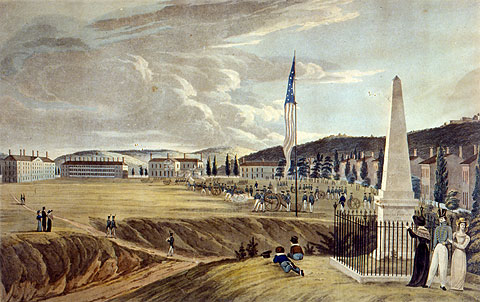
The Plain of West Point (1828); little if any of pre-20th century West Point remains.


Most of the emphasis of the West Point period -- gotten through briefly -- is what it meant to all these future officers of the Civil War that they shared the West Point experience, even that this was more important to all of them than their experience in the Mexican War.  It was West Point that instilled into them all what to expect from each other, no matter which side they were on.  Yet, when it was necessary, in order to win and finish the war, both Grant and Sherman behaved in unexpected ways, which shored them both up when necessary. The south's in-fighting -- every man king of his own plantation -- made this kind of  effective outside-the-box behaviors impossible.

It's an interesting slant through which to view General Sherman's mind, and the military mind in general, or, which, perhaps, provides some unasked for information about mind of the author. One of the elements O'Connell's book keeps to the fore throughout is the political and personal jockeying within the army itself, before, during and after the war, for the sake of favor, promotion and fame. As most historians should learn early on, whether or not military matters are their area, is that war provides great opportunity to generals with dreams of political office, officers dreaming of general's stars, and even those who are considered in peace times of little account -- as with, General Grant, who would never have become General Grant or President Grant without the War of Southern Rebellion.

There is new information in this book for me, who is neither a military historian nor a specialist in the War of Rebellion itself and the battles, but who knows well the lead-up to secession and the war, and what happened to the country -- and the African Americans -- after Appomattox. This reader was taken very early by


O'Connell's account of Sherman in the second Seminole War, which began in 1835, and lasted just long enough for the new West Point graduate to get a bit of a baptism as to battle and campaign. However, O'Connell doesn't mention -- isn't interested? -- that the Seminoles was a 'new' tribe, created out of self-emancipated slaves and survivors of Mississippian tribes who suffered genocide during the colonial South Carolina era, and finished off by Jackson as consequence of the War of 1812.

This is why we always need to read more than a single biography -- or even four or five -- of significant figures in history -- there's always something new to learn, and something the writers don't know.