The best parts:
--The locations, the vistas, the action, the people -- none of them are digital. This is all location and real people riding real horses. It does look different, and so much better, I do say.--The landscape is, as one expects, has the leading role in Mongol. You will not be disappointed. Vistas of snow, of arid slopes, green rolling spring grass, doesn't seem foreign to someone who grew up on the Great Plains, though, no we didn't have mountains where I grew up. But I did visit the Black Hills, which are really mountains, often on family summer vacations, and the Badlands, in both South Dakota and North Dakota. The Missouri-Platt system meanders through parts of both these states on their way to the Mississippi, so I saw those too on summer vacations. These are true vistas and landscapes, from my own life, and the lives of these characters in Mongol.
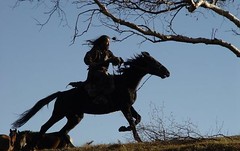
--The riders' skill is as much a pleasure to look at as the vistas. Mongols ride like no one else who has not been almost literally born in the saddle. That's not to say there are not other forms of good ridership, but there's nothing like this one. You probably saw this kind of riding with the Lakota tribes, for instance, when they achieved horses and horseback, and became powerful, post being kicked out of their eastern territories by more powerful tribes who had gotten weapons from the Europeans. Indeed, there are so many commonalities among any hunter-herder-warrior, animist, nomadic culture, no matter what their continent of habitation, and you see all these commonalities in Mongol, including the shamanist practices. The special pleasure of watching the riders' skills is in the children who play the principals when they are young. The deep seat, the natural use of quirt and heel, all that shows someone literally brought up in the saddle.
--They drink, they sing, they laugh, they have fun, tell jokes. Sometimes they are very funny. The men getting drunk, singing in the Mongolian throat singing style, in the bonding celebration post a successful battle. At times they sang horse neighing, other times belches and soundsless polite, while getting drunker and drunker.
--The horseback attack with the double swords against a much larger mounted warrior line. The warriors used those sabres like the chariots used razors on their wheel hubs to take out the competition in the Coliseum races in Ben Hur. It was shot from inside the charge, and inside those the tactic was decimating (yes, I'm using decimate as it should be used), and it was shot from a ground distance, and from above. The viewer saw how a suicide cohort of those riders could devastate, then break up the charge of a much greater force of mounted warriors. This was particularly interesting in that Saturday's remedy for attempting to hide from the pain meant I'd been reading the section of Sherwood Smith's King's Shield in which mounted cohorts, fighiting from horseback play their essential role (goddessa, she writes these scenes so very well!). Thus I couldn't help but layer this extensive filmic sequence on to Sherwood's book, and vice versa.
Why I was disappointed:
-- It was a lot more like what I saw of this conquerer's bio on the History channel when I was in New Orleans than a real tale. The broken chronology was unnecessary, and unintentionally dislocating -- when it must have been intended to be just the opposite, to make the audience feel at home in the sequences of GK's life arc. The film did not achieve a connected and developed narrative, i.e. a story, much less developed characters. Things happen, and unless you are capable of reading between the lines because of what you already know about the history and / or mythology of Genghis Khan, you really wonder how we get from here to there. You will wonder anyway. There are many versions of his story out there. This one was rather different than any I'd seen before, in terms of his relationships, at least. Nor have I ever read that he was a slave exhibit in a far off northern city, though yes, he was enslaved by enemies as a child, when his father was killed.
If you start without characters' motivation and relationships, they create story gaps, gaps that affect later action to greater degree the longer the work continues. This is even more so if you began with unnecesary chronological dislocation. This movie is much worth looking at, though you have seen all this in other movies. But it isn't that good in terms of what matters most to me, and what matters most to me is not battle scenes, though one needs them in this movie, and I certainly want them to be good. And they are. They are better than the story that is told
Also, think about this, here where I live a movie ticket at any time of day, night, week in and weekend, cost 12 dollars. There are no discounts, except for seniors, at certain showtimes. This is why netflix does so well. You cannot afford to take your family of four to the movies, especially if they want to eat movie popcorn (I don't, but then I'm not a family of four either). Then, if you count in travel costs -- you could so easily end up spending $100 for a family of four to go to a movie here.