A boutique town now, once its population was as large 100,000, once as small as 100, now it's 2,316.

Ranching is one of the primary businesses here, and always has been. One of my

favorite films, Giant (1956), was shot all around here. We had dinner in the very pricey Hotel Paisano restaurant last night, which is where

Elizabeth Taylor, James Dean and Rock Hudson stayed for the entire shoot. It's a splendid building, as are many others, such as the court house. When I'm feeling better, I'll do some exploring.
We're in a lovely house, owned by a gay couple in Chicago. Two bedrooms, two baths -- one of them to die for, which opens out to a small, walled in patio-courtyard, a kitchen to die for, hallways, dining room, living room, with a detached garage and detached laundry house. The front yard is screened from the street and sun with local trees and other vegetation, all of which smell wonderful. Though still an arid climate, it's not as dry here as more northwest where they're undergoing the third year of no rain. We drove twice through rain getting here.
The town is a terrific place for a few days away from it all. We were able to make our usual breakfast this morning before the MP, i.e. Marfa People, came to take Himself away. I made sure he had the sunblock -- but both of us forgot he should have taken his hat. They're shooting outdoors this morning.
In News From Back In Time (yesterday), we achieved Tony Lamas for me at a Tony Lamas factory outlet on the way out of El Paso. It was the fourth place we tried. It was a neverbefore experience, for I haave never before gone shopping with two men. I never shops with anybody, with the exception at times of going with el V and forcing him to get something wear.
PG drove with us -- in fact did the driving -- to Marfa. He got a terrific hat in the same Tony Lamas store. El V restrained himself from getting yet another hat. However, in El Paso, he did buy a pair of fiiiiiiiiiine navy and white spectators, perfect for salsa dancing, and in Juárez, the ugliest, most impractical pair of cowboy boots -- a caricature of cowboy boots one might say. He says they're for one of his Las Vidas costumes; he did wear them at the Museo de la Revolutión performance. PG, as did E, also bought boots in Juárez.
These are stores that men enjoy being in, plus I was very quick, having good idea of what I wanted. I walked into Justin's, Luchese (which two brands I've never liked anyway), see these extravagantly tooled and colored boots for rodeo queens and country star singers, but not for me. The huge store that sold southwestern Indian jewelry, hats, saddles, belts, serapes, blankets, and you name it. The other Las Vidas members bought lots of other stuff there. It was good quality too, but there were no boots, oddly.
We spied the Tony Lamas outlet as we were living the city limits, and PG swerved to the frontage road exit. I have tended to like Tony Lama. I asked for the ladies' section. At first I thought this was going to be another bust. But the lady of the store showed me how to look for what I was looking for, which is PLAIN. I found something in black with a black on black design right away and tried them on. They seemed OK, if a bit large, but then, these are the extreme needle toe design -- i.e. stirrup boots, along with that higher, slanted heel, which, when I find the right pair of these, are the most comfortable foot gear for my back condition.
Walking in such boots isn't the game, but it works for me. The lady of the store returned, and found me another pair a little smaller, very much like the other, only ten dollars more in price. I put on and off both pairs several times, walking around in them. Picked the second pair after much consideration. I also chose four pairs of boot sox.
I asked if the boots could be shipped home instead of me taking them. She brightened right up and said if they went out of state they count as an out of state sale, and thus Texas sales tax isn't charged. 17 dollars shipping UPS. She's not going to send them out until Wednesday, so I'll be sure to be home when they arrive. Seventeen dollars shipping, losing the sales tax, the packing headache, and the extra baggage fee -- I came out way ahead with that.

We celebrated my boots and P's hat at Rudy's. P spied it, and it was gooooooooooood. Rudy's loves and respects meat and all the associated dishes that go with barbequed carne. The music was fine. The women working there were smart, competent, bouncy and darned good looking too. About then I realized I was experienced everything I really love about Texas all at the same time.
This was followed by a chilling experience much worse than returning as citizens to the U.S. from a border city.
On I-10, driving west to east, we were stopped by a check point of Border Patrol - Homeland Security. The highway was shut down, and the truck weigh station, that still functions as a truck weigh station, is now a Border Patrol checkpoint. They stop every damned car pretty much to 1) determine whether or not you are U.S. citizen, whether you are carrying contraband, which presumably means human beings as well as botanicals and who knows what else. They look inside your car, under your car, your car is sniffed by big dogs. This time we got waved through fairly quickly, and instead of handing over our passports asked if we were U.S. citizens, and didn't bother to listen to P's response.
But what if a passenger doesn't happen to have her passport with her? How many people never leave their homes without their passports? I happen to, because I don't drive, and this is my non-controversial I.D. for entering university buildings and libraries. el V and PG had theirs because we're traveling. But what if you LIVE in that county? Would you have your passport? Well, probably by now you do, because that's how the U.S. rolls now. That checkpoint announced among many other things that Border Patrol has the right to check any and every vehicle and person within 100 miles of any border. That's a police state if I ever heard of one.
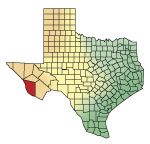
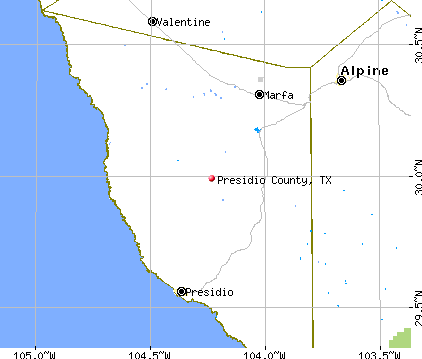
Presidio County
Presidio (derived from the latin presidium) - a fortress established in the southwestern United States by the Spanish in order to protect their missions and other holdings; "Tucson was first settled as a walled presidio" It also can mean a penal settlement or colony.
Marfa is the county seat for Presidio County, which is located in the stretch of territory that was the disputed boundary of Texas, after the U.S. annexed all the New Mexico, California etc. territory from Mexico in the treaty that concluded the Mexican-American War (1846 1848).
Texas insisted it all belonged to Texas. The slave power states, including all slavery all the time Texas as Mexico -- Mexico abolished slavery so Texas seceded from Mexico -- Texas a Republic, Texas as a state, insisted it all should be slave territory. In the meantime the New Mexico Territory, which then included what is now Arizona, California, etc. were determined to be free soil. Thus the Great Debate that went on for four years, until the Great Compromise of 1850, brokered first by Henry Clay and concluded by Stephen Douglas.
Among other key issues somewhat settled by the years of the debate was the admission of the independent Republic of Texas as a state, in 1848, with its southwestern boundary defined partly along here, this stretch known during the Debate as the Trans-Pecos, which separates Texas from Arizona and New Mexico.
For this the United States paid Texas 10 million dollars, or rather, we paid off Texas's international debt piled up while a Republic, which it was unable to pay back. Texas was, of course admitted as a slave state, and voted with the slave power in all things. Thus free soil New Mexico and Arizona . further paid by their statehood being delayed until 1912, in order to keep the slave power states, who all seceded in the end anyway, placated.
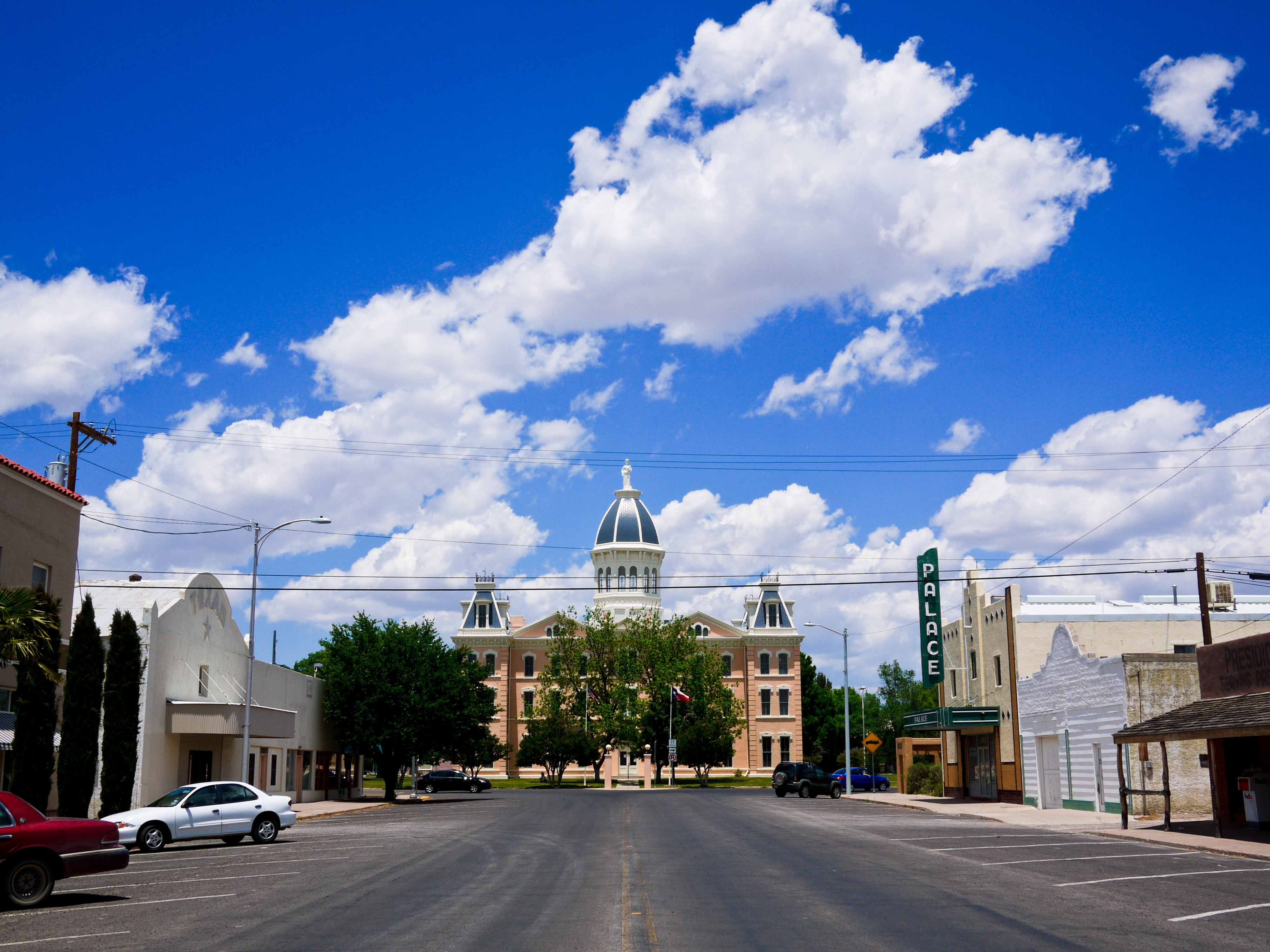
Some of this history is referred to on plaques posted on the Presidio County Courthouse (built 1886).
 |
| Marfa Bank |
I am very excited to be spending some days here, in the territory that was fought over with so much oratory in the House, for so many years, the object of Henry Clay the Great Debator's last gunfight.