LINES OF THE DAY

". . . But the past does not exist independently from the present. Indeed, the past is only past because there is a present, just as I can point to something over there only because I am here. But nothing is inherently over there or here. In that sense, the past has no content. The past -- or more accurately, pastness -- is a position. Thus, in no way can we identify the past as past." p. 15

". . . But we may want to keep in mind that deeds and words are not as distinguishable as often we presume. History does not belong only to its narrators, professional or amateur. While some of us debate what history is or was, others take it into their own hands." p. 153

Silencing the Past: Power and the Production of History (1995) by Michel-Rolph Trouillot

Showing posts with label Holiday Inn. Show all posts

Wednesday, December 11, 2013

White Christmas - 'Tis the Season

White Christmas (1954) opens at the European war front on Christmas Eve, 1944, with Danny Kaye’s character’s first team-up with the Bing Crosby character, who was already big star-vocalist before the war. They are putting on a show, at which they are expecting to also provide an surprise tribute to their General Waverley, who is being transferred from command of their division.

This opening is a reminder to we later generations the huge footprint WWII made for everyone who lived through it. However, here in the U.S. we would be letting go of World War II very soon, at least as a serious matter in that new media of television. Whereas, in Britain where so many of those who didn 't serve at the front served at home, suffered at worst lost loved ones, homes and livings, and at best serious shortages and deprivations, WWII is still a dramatic matter common in BBC series and other networks. *

From the front, where Corporal Danny Kay rescues Captain Bing Crosby just in time from getting killed by  a bombed building wall's toppling upon him, we move to the 1954 Christmas season in Florida. Kay is now Crosby's partner in show business success piled upon success. Then it's up to Vermont, where via serious story contrivances we manage to have two romance plots running concurrently with the plot to save retired General Waverly's ski lodge, where this year, there is no snow, so no customers.

When watching that opening scene at the WWII European front, I had no idea I’d never before watched this classic.  No wonder, because because my mind merged it with Holiday Inn (1942), which I did watch, finally, 2008, also starring Bing Crosby, running roughly the same story line and Bing singing Ira Berlin's "White Christmas." The significant differences are that this earlier film is in black-and-white,  covers all the annual holidays, not just Christmas, and Bing's side-kick, is played by Fred Astaire as a drunk, with Bing trying to keep Fred and the Girl apart.

Unfortunately both films have minstrel numbers.


In Holiday Inn the "Abraham" number on Lincoln’s Birthday is further performed in blackface.  We also see the characters 'blacking up.'

Perhaps by 1954 some Hollywood people were more sensitive -- or else this restored and released in 2004 White Christmas as streamed from netflix significantly lightened the blackface.


Whether or not the White Christmas minstrel medley -- “I'd Rather See a Minstrel Show"/"Mister Bones"/"Mandy" --  was or was not performed in blackface, all the performance gestures are straight out of the blackface minstrel performance tradition, which is equally jarring to us these days.


What White Christmas doesn’t get credit for is the quality of the dance numbers with Danny Kay partnered with Vera Ellen.


Also Kay’s*  serious camping up in the duet he and Crosby reprise from the


Haynes Sisters’ (Rosemary Clooney and Vera Ellen) nightclub act, “Me and My Sister.”
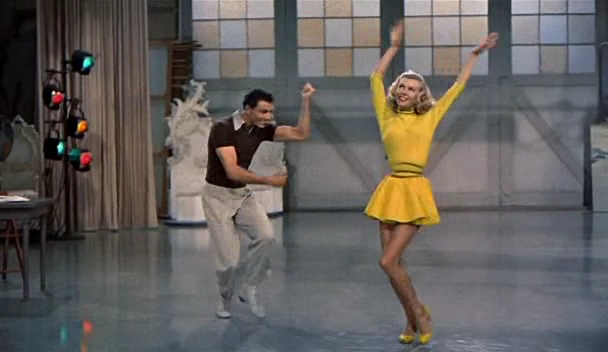

Vera Ellen may also have the tiniest waist you will ever see – putting Scarlett O’Hara’s 17 inches to shame.

White Christmas is not a great musical or a great film, but it is filled with good will for all, is enjoyable and entertaining, good-natured in a way that Holiday Inn is not.  It's a lovely thing to watch on a cold, snainy (snow and rain together) dark December evening while the house fills with the rich warm aromas of dinner getting made.

-------------------

* Think England's Foyle's War (2000 - present), Island At War (2004), The Hour (2011) and The Bletchley Circle (20012).  In contrast what can we think of on U.S. television (as opposed to triumphist commemorative documentary) beyond such comedies as McHale's Navy 1962 - 66) or the prison camp sit com, Hogan's Heroes (1965 - 71)?

** To the great distress at the time, after Kay's death it was publicly revealed he was gay.

Monday, December 15, 2008

Holiday Inn -- Christmas Movie

Holiday Inn (1942), black & white. This is the predecessor to White Christmas, (1954 - color), for which the Christmas song classic "White Christmas" was originally written. It stars the Bingster and Fred Astaire -- Danny Kaye takes Astaire's spot in the White Christmas remake of Holiday Inn.

Holiday Inn is essentially a music & dance revue of American holidays, bracketed by 3 – maybe 4 -- Christmases. The plot, such as it is, is the crooner vs the hoofer -- which one gets the girl(s)? Astaire swipes both girls, but one of them, the second one, comes back to Bing. This is a decidedly odd little movie, particularly since includes three Irving Berlin classics, "White Christmas," "Happy Holidays" and "Easter Parade," recycled from the Astaire / Garland vehicle Easter Parade (1948) – which is sung with all those specific references in the lyrics to Manhattan and Fifth Avenue – in the country. That there are two girls creates more confusion, hopefully of the venerable dramatic slapstick or comedy of manners kind, though neither mode plays that successfully. It's also a Support Our Troops WWII movie, but they keep forgetting that part. You really can't tell there's a war on, with the exception of one terrific solo Astaire tap number.

My personal favorite number is for Valentine's Day. Bing sings to 'Linda' (Marjory Reynolds), a song he wrote about her, he says, though he loses himself in his own voice and performance in the piano and doesn't even look at Linda. Behind his back, instead of having to stare goo-goo at the guy singing while the girl has nothing to do, Linda starts dancing with herself. Then Fred shows up, sweeps her off her feet into a classically Astaire courtship dance of high Romance. This is the second time they dance together, a reversal of the first, during which Fred is deeply inebriated and always threatening to go off his feet. We haven't seen Astaire pretend to drunk dancing before, unless drunk on love. It isn't funny or comfortable – he seems to have no heart in it, it feels cold as it supposedly is outside the Inn, it feels wrong. Reynolds isn't a dancer skilled enough to partner with the brilliant Astaire.

My other favorite revue number is again with Fred and Linda, dressed in 18th century court clothes and wigs, for Washington's birthday. The jealous Bing keeps changing the music from faux minuet style to hot jazz and swing styles whenever Fred is about to close The Kiss.

The problematic revue number is for Lincoln's birthday. "Abraham" provokes discomfort in today's audience. This number early got cut for television broadcast, except on Turner Classics. In this number both the Bingster and Linda put on blackface and the style of a minstrel show, supposedly because Bing doesn't want Linda to be recognized by Fred. They enthusiastically sing of how Lincoln freed "us darkies," while in the kitchen the black Jemima cook and her two black pickaninnies sing along of the good Lincoln who "who freed us darkies."

Then we get to the Hollywood section, in which a movie is made within a movie of this very movie, which is ostensibly a story about a Connecticut farm turned into a nightclub. Comes the second go-round of "White Christmas," which brings the escaped Linda back to the Bingster on the farm for Christmas because she hates the phony Hollywood so much. But all is well, as Astaire ends up with the first girl, 'Lila' (Virginia Dale), whom he already had swiped from Bing to be his dance partner when Bing wanted to quit show business so he could have holidays off. But Lila didn't want to quit performing and farm, so she broke off the engagement and ran off with Fred. Bing found that farming is even harder than performing – so hard he had a nervous breakdown and went to a sanitarium. Since a farmer still has to work on holidays, he decided to turn the farmhouse into a nightclub that is only open on holidays, so he can have the days in-between off. Or something like that.

During the course of the movie several years pass, and it feels that way watching it. This quality of endlessness could make Holiday Inn the perfect movie to have running on Christmas Day, when everyone has eaten too much and there is too much running around by children, teenagers and fussing grandmothers, while you are waiting for that very special phone call or text message from the one you really want to be with, but who is far, far away.