LINES OF THE DAY

". . . But the past does not exist independently from the present. Indeed, the past is only past because there is a present, just as I can point to something over there only because I am here. But nothing is inherently over there or here. In that sense, the past has no content. The past -- or more accurately, pastness -- is a position. Thus, in no way can we identify the past as past." p. 15

". . . But we may want to keep in mind that deeds and words are not as distinguishable as often we presume. History does not belong only to its narrators, professional or amateur. While some of us debate what history is or was, others take it into their own hands." p. 153

Silencing the Past: Power and the Production of History (1995) by Michel-Rolph Trouillot

Monday, September 22, 2014

For the First Day of Fall, A Little Sleepy Hollow

Sleepy Hollow (2013) Fox, first season, first four episodes.  I dunno about this show.


New Berne, North Carolina
Would that be because it’s obvious that instead of New York this is North Carolina?  Spanish Moss in the cemetery’s a dead give-away.


Maybe because at this point it looks a like a Monster of the Week show? Those MOW’s were detraction and distraction from the elements for which I, at least, re-watched BtVS multiple times.

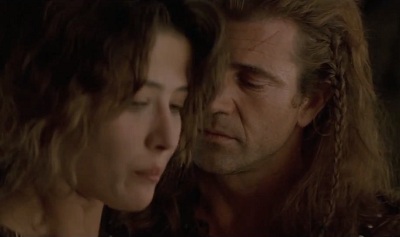
Princess Isabella of France was 3 years old during Wallace's actions. No, they were never married, much less had children.
Or is it because it takes such liberties with historical reality? At this point Sleepy Hollow may as well be Abraham Lincoln Vampire Hunter – in which vampires are responsible for slavery, rather than human greed and power drive. However, for someone like me who is an historian I see the consequences of pretending history is different than it was, “just for fun” – for example: Scotland’s voters invoking secession based on watching Braveheart – which lacks even a shred of historical fact or reality, including the wardrobe, geographical distance and who is who and who is married to whom in Edward I’s reign.* To make things even more ridiculous, the so-called serious news media, like NPR's "All Things Considered," interviewed the script writer and director of this fantasy film for insights into how the vote might go.  That's the best you guys could come up with?  It's not only them, of course -- in the run-up to the vote, lines from Braveheart were quoted all over the internet by those who were supporters of secession.

What I do like about Sleepy Hollow is its anti-Whedonish racial diversity that was present in these first episodes. In that sense it’s a little reminiscent of the first two seasons of Lost Girl, which were a lot of fun.  So far, though, Sleepy Hollow feels more predicatable than fun.  If, however, the relationship between Crane and Abbie develops into a nuanced professional, shared mission loyalty and friendship, that would be promising.  If, however, the writers start pushing it into sexual romance tension – ho-frackin’-hum.

Should I keep watching this?

------------

*  It’s hilarious that many of those who insist women in had no roles of consequence in medieval centuries, thus most women in the middle ages are whores, invoke a (fictitious, at least in chronology, marriage and galloping alone around the country-side to meet her rebel lover, while wearing not even a shawl for modesty or protection against the damp chill) princess from Braveheart to prove the reality of another equally fictitious, non-historical fantasy.

Saturday, September 20, 2014

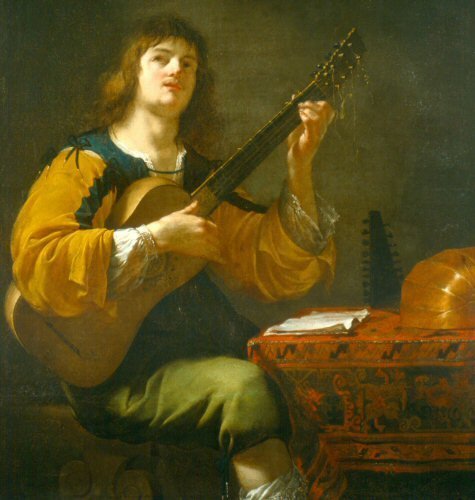
1635 Decima

El V's decided how to open his performance bit tonight at Danny Rivera's concert: with a decima, from La vida es sueño, by Pedro Calderón de la Barca, widely regarded as the greatest playwright ofSpain's el siglo de oro.  Decimas are still sung in Puerto Rico. 


He's accompanying his performance by playing his classical Ramírez, the same guitar he bought as a young classical guitar and vihuela student in Spain, with the help of Segovia.


The guitar was already a recognizable instrument in Spain by this time of the 17th century, via the vihuela and the gittern.

Tuesday, September 16, 2014

Buckskin Breeches

My only claim to productivity today is I have learned about the deer skin trade of colonial Carolina and territories, where it went, and the market for it.

It was indeed huge.

Partly it was driven by the crash in beaver furs -- which happened in the New World as it did in the 16th century in Europe, due to over-hunting.  So something  had to come to take the place of beaver to signify rank and fashion,


Cocked hats were buckskin -- if I'd thought of them at all as to materials I would have assumed wool ....
especially in (men's) hats.  Deer skins, i.e. buckskins, played that part.  Not to mention his breeches, his gloves, the bindings of his books, and many other items of clothing and personal use signifying "gentleman."

Do I need to say that by 1750 the deer trade also collapsed to the regional scarcity of the animal by then?  As had, not coincidentally, the trade in slaving Native Americans to the Caribbean, as the population of many of the tribes that had extensive contact with the Europeans in the territory collapsed.

Monday, September 15, 2014

The Economist's Anonymous Historians Mean To Slavers Whine Continues to Give

This time from Greg Grandin, whose latest book, Empire of Necessity, Freedom and Necessity in the New World, which looks at the relationship of slavery and the trade in all the Americas with 18th and 19th century global capitalism. It too got bitch-slapped in the Economist when it came out. *


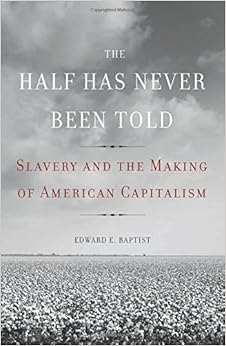
Edward Baptist, author of The Half Has Never Been Told, the study of U.S. Cotton Kingdom slavery and the global capitalist revolution. The snarky, ignorant review in The Economist ignited a fire storm so great the magazine pulled the review and apologized.  The firestorm, however, continues -- here, and many other sites.
From Greg's article in The Nation:
Quote:The Empire of Necessity tries to establish the dependent relationship of slavery to the capitalist revolution of the eighteenth and nineteenth centuries in all of the Americas, north and south, and presumes to use Herman Melville as embodying the moral complexities of that relationship. In other words, there’s a lot going on in the book. But the reviewer seemed only excited to find a few instances confirming that the trans-Atlantic slave system was not universally, 100 percent, absolutely, totally, categorically, “a matter of white villains and black victims.” “As is commonly supposed.” “Blacks,” he or she was happy to report, “profited from the Atlantic slave trade.”

The reviewer then complained about the book’s gloominess: “Unfortunately, the horrors in Mr Grandin’s history are unrelenting. His is a book without heroes. The brave battlers against the gruesome slave business hardly get a look in, although it was they who eventually prevailed.”One might think that “brave battlers” would be a good description of the group of West Africans who led the slave-ship revolt that is the book’s set piece. Having endured horrific captivity and transport, forced not just across the Atlantic but the whole American continent into the Pacific, the deception they managed to pull off under extremely hostile conditions was, I’d say, heroic. 
Slavery might not be black or white, but bravery and morality apparently are: whites possess those qualities, a possession that merits historical consideration; blacks don’t, at least according to The Economist. The Empire of Necessity didn’t “credit” William Wilberforce, the white reformist MP, or white abolitionist evangelicals and Quakers, for ending slavery. Nor, the reviewer points out, did I make mention of the British Royal Navy freeing “at least 150,000 west Africans from slave ships during the 19th century.” The book isn’t about abolition, or, for that matter, the British Royal Navy. No matter. “The British historians,” wrote the great historian of slavery, Eric Williams, “wrote as if Britain had introduced Negro slavery solely for the satisfaction of abolishing it.” So too, apparently, anonymous Economist reviewers.
This bit, quoting from The Atlantic Monthly's pundit, the British James Fallows, is fun:
Quote:
The review itself was written in that smarmy style that makes US corporate managers and hedge funders swoon, identified some time ago by James Fallows as “colonial cringe.” Readers on this side of the Atlantic assign an Oxbridge accent to the text, which “involves a stance so cocksure of its rightness and superiority that it would be a shame to freight it with mere fact.”
Greg further informs us how far back and how deep are the roots of The Economist's pro-slavery and racist biases. In the U.S. Civil War The Economist was just about the only British publication that bellowed in favor of British support of the CSA and slavery.  I recall Henry Adams and his father's profound disgust for this at the time, so much so they could barely bring themselves to mention the publication at all, even to criticize its lies. 

--------------------

* Full disclosure, el V's is referenced, and is among the acknowledgments for Empire of Necessity.

Friday, September 12, 2014

The War of 1812 and the Terrapins

The University of Maryland's football team is named the Terrapins.  They have changed their uniforms for tomorrow's game against West Virginia as commemoration of the Battle of Baltimore at Ft. McHenry's anniversary, which is tomorrow, September 13th.

Among other elements, the uniform will incorporate lines of "The Star Spangled Banner."  Usually the Terrapins' uniforms incorporate elements of Maryland's state flag.  Photos of Maryland state flag photos here.


Football and war go together like misogyny and racism.  Or, something-or-other ....

At least it seems the lines from the third verse of the "Star-Spangled Banner" glorifying slavery:
“No refuge could save the hireling and slave / From the terror of flight, or the gloom of the grave” ....
are not among those included on the uniforms.

Thursday, September 11, 2014

Thirteen Years Ago

This year too, the closer this day came, the more skittery and anxious we became.

So many personal, national and international catastrophes since.  They are, mostly, connected, at the very least by the greed that makes for climate change.


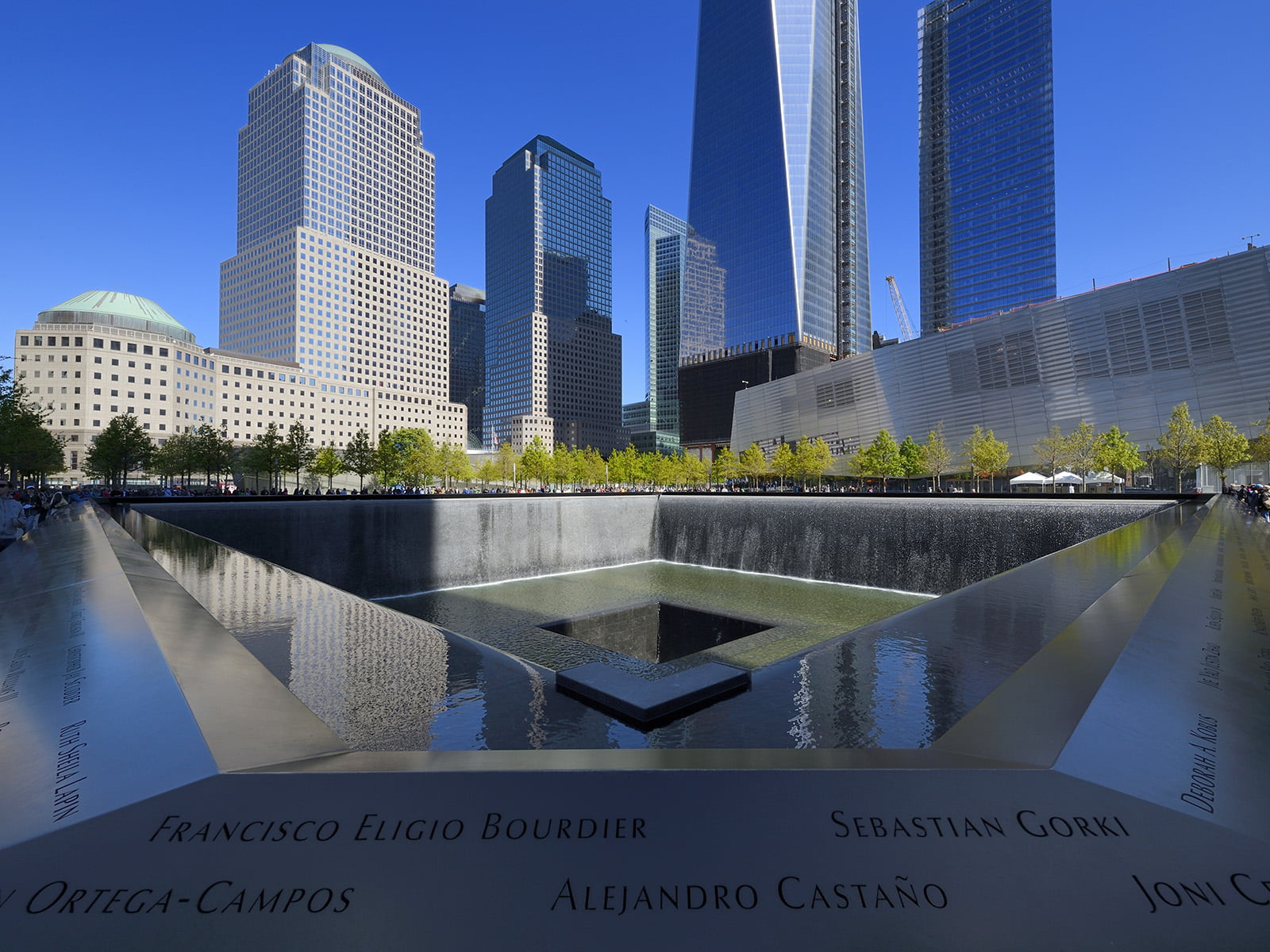
NYC has changed enormously in these thirteen years, including its skyline.  


This is what I see now, to the south, every time I leave our apartment.

Wednesday, September 10, 2014

Reading Wednesday: Baronet, Robert Mountgomery, Scotts Traders, Colonial Carolina + Dreams of Azilia

I feel fairly safe in assuming that no one else on this Reading Wednesday will be


commenting on a work even vaguely resembling this one, what these days we'd call a prospectus for real estate development:

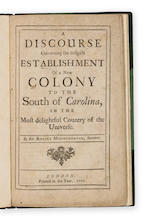
Robert Mountgomery.  London, 1717. A discourse concerning the design’d establishment of a new colony to the south of Carolina.  "A plan representing the form of settling the districts, or county divisioins [sic] in the Margravate of Azilia.”


Needless to say, the entire discourse is a crazy quilt of fantasy and outright lies, written by a person who had never been to the New World, much less this territory:

Nor is it probably necessary to mention that the Margravate of Azilla never existed -- just one more of the many feudal fantasies of of those who thought they could create entire kingdoms for themselves in this territory.  What is even more interesting however, is this may be the first of the very many southern fantasies that have their inspiration in imaginary Caledonian history, from Sir Walter Scott's medieval romances, to the invented discovery of the verses of Ossian, written by a James Macpherson


(President Buchanan's lover, the wealthy Alabama planter - slaveowner, William Rufus Devane King, 13th Vice President, read him Ossian's lines during their domestic evenings together in D.C.; his plantation was located near Selma, AL, named for Ossian's Songs of Selma), to the fantasy origin


story of the Ku Klux Klan in the novels such as The Clansman: An Historical Romance of the Ku Klux Klan, by Thomas F. Dixon

Instead of noble settlers peacefully overseeing laboring forces of Africans forced out of their homes to the New World, what was gotten in these territories during the 17th century and well into the 18th, were many, often Scots, traders, who worked closely with the native tribes of what now are the Carolinas, Georgia, Alabama and even into Mississippi.

Their first main product was deer skins -- for which, as far as I've been able to determine, the British army had constant use, though for what, I'm not sure.  I've read things that hint one of the uses was perhaps as the inner trouser legs and seats for the cavalry, but am not about to swear to that.

Quickly, their second primary product, and far more lucrative, was Native Americans, sold into slavery, mostly to the Caribbean, particularly to Barbados -- Carolina's "mother" homeland colony (as Georgia became Carolina's colony, finally -- the buffer between variously the French or Spanish Floridas, to where the enslaved Africans hied themselves from the coastal Carolina plantations, as soon as the Carolina settlers of Charles Town found out they could grow rice along the coast and the islands -- once they brought Africans who knew how to do it, to do it. There the escaped prisoners built free villages (called marronage villages), intermarried with natives, were sustained by the Spanish in particular as buffers against South Carolinian invasion from the north, and often taken into the military, given rank, arms and training.  (Quite a few already had the training, being pows sold by their African enemies into slavery.)  The very idea of African armed soldiers sent Carolinians into a frenzy of outrage, terror and hate from the very first days.

Their terror and hate did not prevent them however, from continuing to do with the Native tribes exactly what the Europeans were doing in Africa: pushing constantly at divide and conquer, provoking wars, in order to easily acquire coffels to sell off at Charles Town to ships that would the prisoners to the Caribbean or Mexico -- even, occasionally to South America.

This accomplished several missions for the traders and the Charles Town factors simultaneously: made money -- good money, in fact -- and was part of the process of the long term goal which was depopulate these extensive regions entirely of Natives all together.

Thus this long history of South Carolina's Indian Wars, which until recently, with the post modern re-examination of our nation's history with the First Peoples has been fairly ignored outside of South Carolina. One can speculate this is so because Calhoun and his South Carolina's political heirs' fundamental role in secession and making the Civil War has overshadowed her history with the Indian trade as national historical interest.

In fact, there were only two reasons South Carolina ever ratified the Constitution.  First, because it felt it needed help with wiping out the Indians -- it needed the U.S. Army, as her militia's job was to keep the African labor on the plantation and guard against uprising.  The second was getting the 3/5ths clause inserted into the Constitution, which allowed them to vote their wealth, which was valued in slaves -- and because there were no words about slavery in the Constution itself.

Once Andrew Jackson had crushed the tribes for once and for all, South Carolina no longer had any use for the federal government and began agitation for, what, in South Carolina's history, would be thought of as her second secession, or second Independence.

The first secession or independence was dumping the Lords Proprietors's authority decisively back in in 1719.  (Let us not forget these Lords were useless, impractical and supremely ignorant of the lands that they supposedly governed. Thomas Miller, overthrown by the coastal elite was the last appointee the Lords ever made.)

There were many, and even contradicting, reasons for ridding themselves the Proprietors, of course,  However, the Carolinian elite, from the beginning, with so many Scots and Irish among the traders and factors of Charles Town (it didn't become Charleston until after Independence) never had any use for government for anything -- except for war, and only a war that was conducted on the behalf of their own interests.

Naturally the Native tribes changed sides constantly among three colonial powers vying for control of North America, control of the Indian trade, and control of Indian lands. England's protection of the Indian lands for sake of the furs put the the North American colonists' demand for the Indian lands at loggerheads with England, even before the French and Indian Wars of the 1754 - 63.  In the meantime, from as far as our digging has been able to determine, the tribes were always ready to betray each other, and sell each other off to the traders, for the sake of guns and powder and European consumer goods. At times, when they went to war on the colonists, they were as vicious in the torture of the white prisoners as they were to each other.

Thus, the terror of Indians that haunted the Carolinians until after the days of Jackson, just as Haiti and armed Negroes did, and still do, for that matter.

Simms's home near Barnwell, SC -- Barnwell is a name all over the early history of South Carolina, as well, of course in the history of SC and Secession.


An illustration to Simms's The Yemassee.
See: The Yemassee. A Romance of Carolina (1835) by William Gilmore Simms. This is an historical novel of the Yemassee War of 1715-17, when the Yemassee, supposedly allied with the Spanish and other Native tribes -- and supposedly, African marroons, attacked South Carolina's colonial settlements.  It could only be written partly during the tragedy of Indian removal was in progress that today is known as the Trail of Tears.

The reading of this astonishing document from the colonial past, A discourse concerning the design’d establishment of a new colony to the south of Carolina, is because it's part of the documentation for the South Carolina history in The American Slave Coast. For some reason the colonial history of South Carolina prior to the rise of the great rice plantations on the coast and lowlands has been little noticed in the narrative of our nation's colonial development -- unlike Virginia's and Massachusetts's.  Of course South Carolina's own state historians know all this and have been documenting it carefully, even in those days, but an historian is going to have do a long, laborious manual search among the myriad of South Carolina's historical magazines and journals to find the sources for it.*

However, the story of these traders, who were the real reason Charles Town managed to exist for so long, is very long and fascinating all in their own right. It does give me shivers to know these men were covering all this region even before New Orleans was founded. They were very, very, very tough -- imagine, all this vast region was mostly covered in forest, through which they traveled thousands of miles, by foot mostly, by pirogue or horse when possible --  and as greedy and immoral as frackers are in our day.

-------------------------

*  The longer I'm at this history game the more impressed I am by the local historians of anywhere and any era, who are by-and-large, unknown, unsung. They have performed the most valuable, fundamental work for any sort of history.

Of course, until perhaps well into the 20th century, these men -- and yes indeed they were almost ALL men -- were people of leisure, due to either or both class and fortune -- as well as gender.  They possessed the education for this work. They could afford materially to do this work. They could afford to travel to see documents and to buy them. They could even afford to pay someone to perform some of the most tedious parts, such collating gathered information, do endless copying of drafts, and even pay to have the finished product published. No one else were so privileged, not even the mothers, daughters and wives of their own class and means -- women had other work to do, and generally did not have the education.