LINES OF THE DAY

". . . But the past does not exist independently from the present. Indeed, the past is only past because there is a present, just as I can point to something over there only because I am here. But nothing is inherently over there or here. In that sense, the past has no content. The past -- or more accurately, pastness -- is a position. Thus, in no way can we identify the past as past." p. 15

". . . But we may want to keep in mind that deeds and words are not as distinguishable as often we presume. History does not belong only to its narrators, professional or amateur. While some of us debate what history is or was, others take it into their own hands." p. 153

Silencing the Past: Power and the Production of History (1995) by Michel-Rolph Trouillot

Showing posts with label agriculture. Show all posts

Wednesday, January 4, 2017

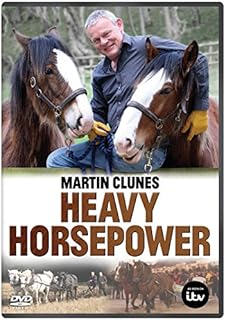
Heavy Horsepower - Martin Clunes

     . . . . Heavy Horsepower (2013) is a


Martin Clunes (principal of the long-running Brit television series, Doc Martin)  one-off narrative documentary kicked off by the need for his adolescent Clydesdales (two-year olds, Bruce and Ronnie)  to begin their training to do what they're bred to do -- work.  We begin with some scenes of his own lovely farm in Devon where his "boys" live, then their transport to Hoof Camp, to begin their training.

Harvesting shrimp
From there Clunes goes traveling to Europe and the U.S. to check out the work currently performed by these various heavy breeds of horsepower.  These horse professions include providing transport and pulling power for an all-organic winery *, working in public timber lands pulling out culls and dead trees, pulling heavy trawling nets in the water to gather shellfish, providing all the power for all the work on an Amish farm in Indiana, which is done with huge, expensive, polluting machines everywhere else.  And that's part of the point, isn't it?

I learned a great deal from this seemingly casual, off-the cuff delivery and locations, things about working horses that I never knew, including foot reins, employed by mounted drummers in the Queen's Guard.

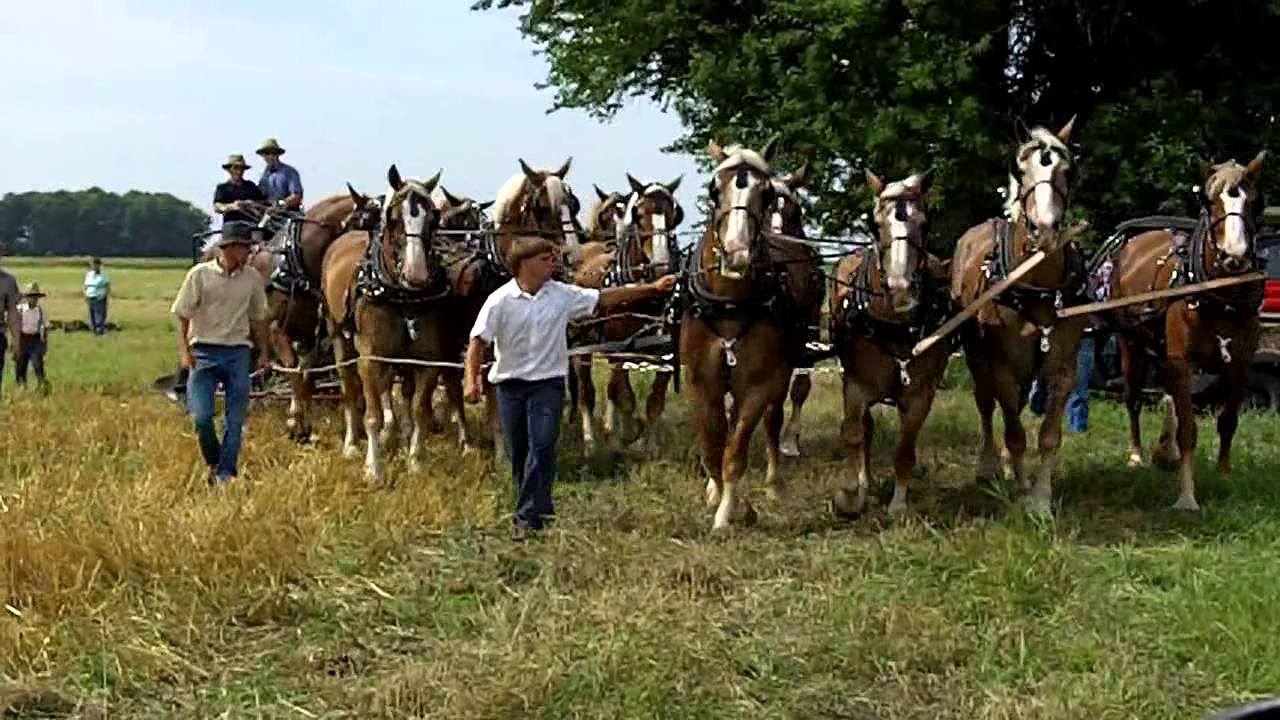
An Amish 12-hitch team pulling a bottom plow.
The best bit for me though was the Amish Schmucker family's farm in Indiana.  We stopped at one of their highway outlets back in September to have a lunch.  At their farm we get to see two teams of four mares each, pulling a plow -- 8 horses in all, followed by yet another two-teamed plow.  The skills of both horses and those who drive them are always on display throughout the program, but never more than here -- except perhaps with the logging team, and their very delicate dancing -- while in harness, seemingly all on their own -- over various endlessly long trunks of felled timber to position themselves to pull them out of the woods.

In between Clunes takes us back to his "boys" Hoof Camp to check in on their progress.  By the end of the program they are ready to begin their work to keep his own farm operating on organic principles.

This was a complete joy to watch.

---------------------------

*  The horse was a French breed, trained in France, thus the commands had to be given in French. This is the kind of thing I just love about horses and dogs -- they know their languages as much as humans do.  Other horses help teach the new horse who doesn't know the language too.

Friday, July 3, 2015

Cherries - The Hermione - The Shepherd's Life

I'm currently eating cherries.


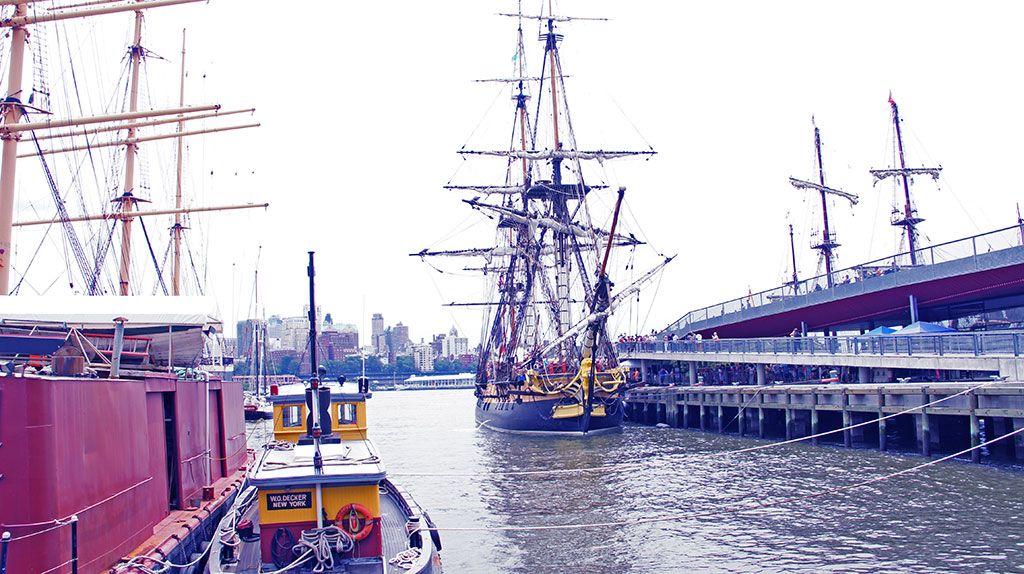
Going down to the South Street Seaport and try to tour the Hermione this afternoon.


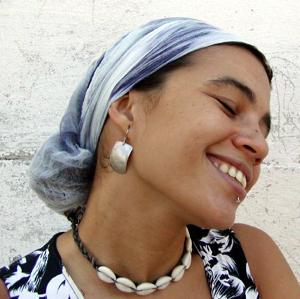
Tonight will hear Telmary, "Queen of Cuban Rap" -- there are many Afro-latin elements in her music, including jazz --  at Subrosa


A British title I've wanted since reading about it on the Guardian has recently appeared in the U.S. and I have it: The Shepherd's Life -- the subtitle is different from the British edition's A Tale of the Lake District -- here it's Modern Dispatches From An Ancient Landscape, by James Rebanks.

The author and his family have farmed and raised sheep in the Lake District since the days of the Viking takeover of the region. Despite certain modern equipment, they are still doing basically what their distant ancestors have done. Nor do deep-rooted people want to do anything else. Rebanks found school a complete waste of his time as a kid and left as soon he legally could leave.

But -- at some point he went to Oxford and got a degree and became a writer -- though he's still a farmer and sheep raiser, and identifies himself to himself and everyone else as that. To a great extent publishing his writing and his other activities are driven by his passion to keep farming, retaining his land and remaining on it, and his books, twitter account, directorship of various agencies are the means to do that.


Having grown up in an isolated rural world myself, these matters are of great interest to me, and much of it is entirely familiar and recognizable.

What is vastly different is the place where he, his family and the other families that are farming in the Lake District, who arrived when his did, are farming in a place that is flooded with millions of strangers -- tourists -- who carry on a relationship with the topography entirely divorced from that of the farmers.  This is fascinating material, as he describes and discusses what it means to the future of retaining any ownership themselves of their ancestral homelands. Our part of the world was of no interest to anybody elsewhere, except, perhaps, a few hunters, as we're a principle flyway for migrating birds including geese, and a great producer of ground game birds such as pheasant and grouse.

However, here, where I've been living my adult life, I've seen first hand the deleterious affects of having millions of people flooding into the place where you are struggling to stay and continue the work you love. I've observed it in the Caribbean and all over the U.S., as on the Gulf Coast and in the Mississippi Delta, where conglomerate gambling corporations' casino and development complexes destroy all the local business from fishing and farming to hotels to cafes and restaurants and even live music venues, and obscenely wealthy outsiders gobble up the houses and real estate as in New Orleans. None of these people coming in have any relationship to the place or the people who live there. They don't even see the residents, and they sure as hell don't give a damn about them or their homes, where their interlocking family and community roots descend deep into the mud of the place going back to almost the beginning.

What's odd is in the last ten years I've slowly been changing my opinion about sheep, including understanding that the long held idea that sheep are stupid is not only wrong, but propaganda from this country's cattlemen. Where I grew up bought into this mythology of the Western entirely. Cows good / raised by real men / beef is real food. Sheep bad stupid dirty / raised by dirty foreigners / lamb mutton not real food.

Elkhorn, on the Missouri River, in the North Dakota Badlands
This attitude can be seen, for instance in Theodore Roosevelt's Ranch Life and the Hunting Trail, written about the state in which I was born, where he bought a spread he called Elkhorn, and was a cattleman for some time. He was vehement about the distinction between a cattleman, or stockman, and the run-of-the mill fellow attempting to make a living out of the ground: In Ranch Life he stated that for the sheer, intense pleasure and satisfaction of being the boss of many and much, the king of all he surveys, the only life to rival that of a cattleman's, was that of the plantation owner in the antebellum south. Indeed, he could say that the modern cattle ranching spreads were the new plantations.


This is about as far from the satisfactions and passion of Rebanks and his people as one can get.
Saturday, June 15, 2013

The Art of Seeds

"The Hudson Valley Seed Library commissioned artists to create imagery for their seed packets."

Nine years ago, Ken Greene was the children’s librarian in an archetypal small town in the Hudson Valley.
He still lives in the vicinity of Accord, N.Y., but in recent years Greene’s life has taken twists and turns that even this onetime acrobat could not have imagined. His day job these days is as a farmer of heirloom vegetable and flower seed but along the way, and almost by accident, he has become a patron of modern American botanical art. So far, he has commissioned more than 80 artists to create paintings to illustrate his seed packets. ....
The tradition of picturing plump tomatoes, glowing sunflowers or mouth-watering sweet corn has a long history in American farming and home gardening, but Greene has brought a unique contemporary twist to the genre.

His brief to his painters: reveal your assigned variety of flower, herb or vegetable in your own way.
“Botanical illustration was the last thing I was looking for,” said Greene, whose enterprise is called Hudson Valley Seed Library.
These are 'real' seeds, for 'real' food plants.*
Heirloom seeds are distinguished from modern hybrids by replicating themselves faithfully. Thus, if you save the seeds of an heirloom tomato or melon (or a radish or lettuce left to seed) one year, you can grow it the next. No one owns the seed, so it can be passed freely among gardeners. Such open access to a crop is the antithesis of the agribusiness biotech profit model, and heirloom seed saving is tied in to the local food movement and all its attendant aspects: environmental sustainability, food security and social justice.
---------------------------------------

*Have you all heard about the fake egg manufacturing biz that hip, hot young entrepreneurs are flogging -- as better for us and the environment than actual eggs --- and cheaper too? made from peas and sorghum, plus other un-named ingredients, at least not named in the hotcchachacha interview with them on some NPR financial program.  I.e. more sugar = faux food, more empty calories and less flavor and pleasure.  Let's all eat bugs! is another faux food thing being flogged more frequently every year.  As we know Bhub, this faux food isn't for us wealthy hotchachacha types, but for the rest of this over-populated with excess people planet.

Sunday, June 9, 2013

Travel Is Educational

The things we saw and learned in the Gullah Country, which we did not previously know, but now we do, and much more:

... the sea island lineage has contributed to the development of the modern extra-long staple cottons, via the Egyptian cottons developed in Africa. The Egyptian cottons presumably are based on a cross between a wild Peruvian G. barbadense accession (Jumal’s tree cotton) and sea island cotton.  . . . 


Most of all it was interesting to learn that cotton agriculture could not get going until after Independence, due to England's protectionism of its woolens industry.  Then it was slowed significantly due to England's refusal to allow U.S. goods and ships most of the time, until in until sometime after the War of 1812.  I knew about this, but not the protectionism of England's woolens industry.

I have never seen so many huge, multistory and wing mansions concentrated in such a small region anywhere else,  neighborhood after neighborhood of them in Charleston, each massive pile larger than the one next door,  in every small town of the Sea Islands and coastal lands, each town a port town (and sometimes also a resort town, like Beaufort), that not only shipped out cotton and brought in necessary supplies and goods, but brought and shipped out slaves too.  The amount of wealth generated for all those generations is mind-boggling, all out of slavery.

Not all of it was from cotton though -- rice was a huge staple cash crop also.  But rice cultivation mostly disappeared after the Civil War, with the slavery on which it depended.  The rice planters had refused to mechanize, and thus when the war was over, they had nothing with which to get going again.

What I can't figure out is how so many of them kept going bankrupt, when they were generating such huge amounts of wealth for so many decades. Gambling was a big part of it.  But then Thomas Jefferson also was an indebted bankrupt most of his life, and certainly so when he died. Slaves were the collateral.  As long as you had slaves you could credit for everything from gambling debts to land. But the beast bit your family -- and the slaves, most of all -- when everything including the slaves were sold to pay for the patriarch's lifestyle -- even the patriarch's own children were sold. This went on for nearly three centuries.  No wonder everyone in the Gullah Country can say without the least bit of irony, "We are all related."


Thursday, May 16, 2013

This is a story of farming in Vermont with Fjord horses as your field power.


The farmer featured is a former Benedictine monk and artist. He, his partner and their daughter are described as:

... part of the 60-member Cobb Hill co-housing community incorporated in 1998. It was the brainchild of Donella Meadows, the late environmental scientist and an author of “The Limits to Growth,” an influential 1972 book that used computer modeling to predict the future of the earth if the population continued to expand and consume limited resources.
It's a lot easier to farm this way when you don't need to depend solely on horse power, and it is your choice, not imposed because there is no other way. You can't farm this way on an agri-biz cash crop size operation, which is either good or bad, depending on your outlook on these matters.  But from my own hands-on farming background and the study of what happens to the land and all region where cash mono-cropping is the economic system, this kind of smaller, mixed use, mixed power kind of agriculture is better. It's sustainable, which cash mono-cropping is not.

It's sustainable because it doesn't destroy the regional environment which cotton and the steamboats did. Cotton demanded deforestation, and fueling the steamboats demanded the same. This deforestation, which sent mountains of silt into the Mississippi River is why the great flood for which the Mississippi is notable begin in the 1800's. This kind of flooding coincides with the Mississippi Valley's transformation into the Cotton Kingdom by deforesting the entire length of the MIssissippi and its vast tributary systems.

As Stephen Leslie put it:
"I wanted to be an organic farmer because I had this sense, even back in the early ’90s, that our society was hurtling toward a cliff in terms of the unsustainability of systems we’ve put in place,” Mr. Leslie said. “I wasn’t really an activist, but I’m an artist. I like to do things. There’s not that big a disjuncture between wanting to paint a canvas and wanting to work a piece of land."

We will be having dinner tomorrow night with a passel of people in Kent County, Maryland, who are also doing their own versions of what Leslie's cooperative is doing in Vermont.  They are all artists too.


The link is to the single 'page' version; it includes an informative slide show of the horses, the land, the place.  As Leslie is the first to say, this way of life isn't for everyone.  That isn't confined only to people who don't like, fear or can't handle horses either.

Saturday, July 21, 2007

Sober North Dakotans Hope to Legalize Hemp

[ OSNABROCK, N.D. — David C. Monson seems an improbable soul to find at the leading edge of a national movement to legalize growing hemp, a plant that shares a species name, a genus type and, in many circles, a reputation, with marijuana.

As Mr. Monson rolls past his wheat, barley and shimmering yellow fields of canola, he listens to Rush Limbaugh in his tractor. When he is not farming, he is the high school principal in nearby Edinburg, population 252. When he is not teaching, he is a Republican representative in Bismarck, the state capital, where his party dominates both houses of the legislature and the governor is a Republican.

“Look at me — do I look shady?” Mr. Monson, 56, asked, as he stood in work boots and a ball cap in the rocky, black dirt that spans mile after mile of North Dakota’s nearly empty northern edge. “This is not any subversive thing like trying to legalize marijuana or whatever. This is just practical agriculture. We’re desperate for something that can make us some money.”
The rocks, the dirt, the cool, wet climate and a devastating crop fungus known as scab are part of what has landed North Dakota, of all states, at the forefront of a political battle more likely to have emerged somewhere “a little more rebellious,” as one farmer here put it, like California or Massachusetts.

Though federal authorities ban the growing of hemp, saying it contains tetrahydrocannabinol, the psychoactive substance better known as THC in marijuana, six states this year considered legislation to allow farmers to grow industrial hemp, and Representative Ron Paul, Republican of Texas, introduced a bill in Washington that would let states allow such crops. In state legislatures, the advocates of hemp note that it contains mere traces of THC, and that hemp (grown in other countries) is already found here in clothes, lotions, snack bars, car door panels, insulation and more.

But no place has challenged the government as fiercely as North Dakota. Its legislature has passed a bill allowing farmers to grow industrial hemp and created an official licensing process to fingerprint such farmers and a global positioning system to track their fields. This year, Mr. Monson and another North Dakota farmer, with the support of the state’s agriculture commissioner, applied to the Drug Enforcement Administration for permission to plant fields of hemp immediately.

“North Dakota is really pushing the envelope on this one,” said Doug Farquhar, the program director for agriculture and rural development at the National Conference of State Legislatures. Legislatures in Maine, Montana, West Virginia and other states have passed bills allowing farmers to grow industrial hemp, said Alexis Baden-Mayer, the director of government relations for Vote Hemp, a group that presses for legalization, but those laws have not been carried out given federal drug law. ]

There is much more to this article -- hit the link above.