LINES OF THE DAY

". . . But the past does not exist independently from the present. Indeed, the past is only past because there is a present, just as I can point to something over there only because I am here. But nothing is inherently over there or here. In that sense, the past has no content. The past -- or more accurately, pastness -- is a position. Thus, in no way can we identify the past as past." p. 15

". . . But we may want to keep in mind that deeds and words are not as distinguishable as often we presume. History does not belong only to its narrators, professional or amateur. While some of us debate what history is or was, others take it into their own hands." p. 153

Silencing the Past: Power and the Production of History (1995) by Michel-Rolph Trouillot

Showing posts with label farming. Show all posts

Wednesday, January 4, 2017

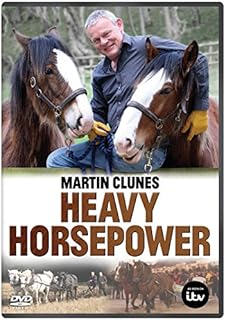
Heavy Horsepower - Martin Clunes

     . . . . Heavy Horsepower (2013) is a


Martin Clunes (principal of the long-running Brit television series, Doc Martin)  one-off narrative documentary kicked off by the need for his adolescent Clydesdales (two-year olds, Bruce and Ronnie)  to begin their training to do what they're bred to do -- work.  We begin with some scenes of his own lovely farm in Devon where his "boys" live, then their transport to Hoof Camp, to begin their training.

Harvesting shrimp
From there Clunes goes traveling to Europe and the U.S. to check out the work currently performed by these various heavy breeds of horsepower.  These horse professions include providing transport and pulling power for an all-organic winery *, working in public timber lands pulling out culls and dead trees, pulling heavy trawling nets in the water to gather shellfish, providing all the power for all the work on an Amish farm in Indiana, which is done with huge, expensive, polluting machines everywhere else.  And that's part of the point, isn't it?

I learned a great deal from this seemingly casual, off-the cuff delivery and locations, things about working horses that I never knew, including foot reins, employed by mounted drummers in the Queen's Guard.
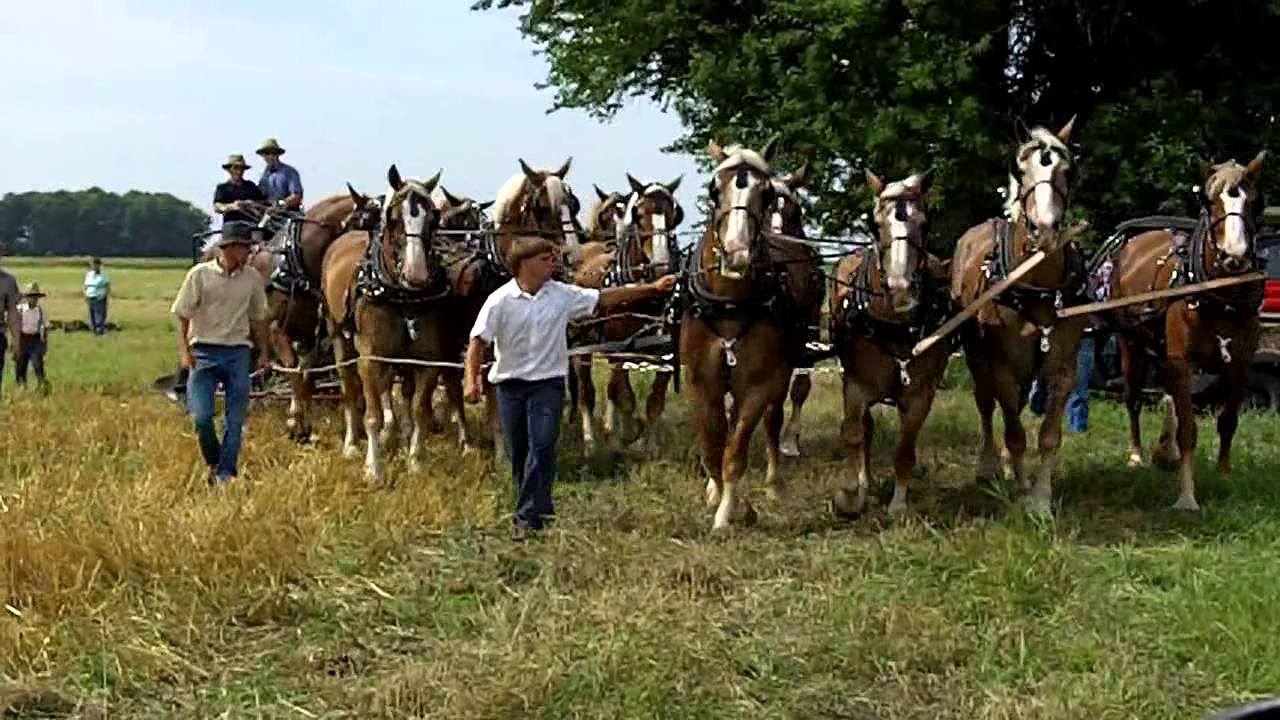
An Amish 12-hitch team pulling a bottom plow.
The best bit for me though was the Amish Schmucker family's farm in Indiana.  We stopped at one of their highway outlets back in September to have a lunch.  At their farm we get to see two teams of four mares each, pulling a plow -- 8 horses in all, followed by yet another two-teamed plow.  The skills of both horses and those who drive them are always on display throughout the program, but never more than here -- except perhaps with the logging team, and their very delicate dancing -- while in harness, seemingly all on their own -- over various endlessly long trunks of felled timber to position themselves to pull them out of the woods.

In between Clunes takes us back to his "boys" Hoof Camp to check in on their progress.  By the end of the program they are ready to begin their work to keep his own farm operating on organic principles.

This was a complete joy to watch.

---------------------------

*  The horse was a French breed, trained in France, thus the commands had to be given in French. This is the kind of thing I just love about horses and dogs -- they know their languages as much as humans do.  Other horses help teach the new horse who doesn't know the language too.
Thursday, May 16, 2013

This is a story of farming in Vermont with Fjord horses as your field power.


The farmer featured is a former Benedictine monk and artist. He, his partner and their daughter are described as:

... part of the 60-member Cobb Hill co-housing community incorporated in 1998. It was the brainchild of Donella Meadows, the late environmental scientist and an author of “The Limits to Growth,” an influential 1972 book that used computer modeling to predict the future of the earth if the population continued to expand and consume limited resources.
It's a lot easier to farm this way when you don't need to depend solely on horse power, and it is your choice, not imposed because there is no other way. You can't farm this way on an agri-biz cash crop size operation, which is either good or bad, depending on your outlook on these matters.  But from my own hands-on farming background and the study of what happens to the land and all region where cash mono-cropping is the economic system, this kind of smaller, mixed use, mixed power kind of agriculture is better. It's sustainable, which cash mono-cropping is not.

It's sustainable because it doesn't destroy the regional environment which cotton and the steamboats did. Cotton demanded deforestation, and fueling the steamboats demanded the same. This deforestation, which sent mountains of silt into the Mississippi River is why the great flood for which the Mississippi is notable begin in the 1800's. This kind of flooding coincides with the Mississippi Valley's transformation into the Cotton Kingdom by deforesting the entire length of the MIssissippi and its vast tributary systems.

As Stephen Leslie put it:
"I wanted to be an organic farmer because I had this sense, even back in the early ’90s, that our society was hurtling toward a cliff in terms of the unsustainability of systems we’ve put in place,” Mr. Leslie said. “I wasn’t really an activist, but I’m an artist. I like to do things. There’s not that big a disjuncture between wanting to paint a canvas and wanting to work a piece of land."

We will be having dinner tomorrow night with a passel of people in Kent County, Maryland, who are also doing their own versions of what Leslie's cooperative is doing in Vermont.  They are all artists too.


The link is to the single 'page' version; it includes an informative slide show of the horses, the land, the place.  As Leslie is the first to say, this way of life isn't for everyone.  That isn't confined only to people who don't like, fear or can't handle horses either.