The narrator of Nicola Griffith’s Hild (2013, FSG) is its subject, the English St. Hilda of Whitby, one of the Church’s patron saints of learning and culture.
The tale of her life begins when she’s barely three years old, and concludes while she’s still a young woman, about to marry the warrior with whom she grew up. By then, she’s only recently baptised, not yet an abbess, and certainly not a canonized saint. (It's a pleasure to encounter a female saint canonized for something other than being subjected to protracted torture and death.) But already she's an advisor and counselor to kings -- a precarious position in the early years of the Christian conversion of multitudes of cut-throat, treacherous, ambitious Anglo-Saxon kings striving to become overking of all the rival domains, one of whom is Hild’s uncle, King Edwin.
Despite some gruesome scenes of battle and torture, it’s a lovely novel, because it’s a book about seeing. Through the eyes of Hild, who, in early childhood, becomes seer for Edwin, we see a beautiful land still touched only lightly by the effect of human transformation. She has the capacity, perhaps inherited from her mother, to notice and recall what most eyes slide over.
Though her relationship with her mother is often uneasy and uncomfortable, whenever they are together she drills Hild in honing her capacity to see and remember. Equally important, her mother shows Hild how to shape what she sees into word-stories that will sway a king’s thinking, thereby keeping herself and those she cares for safe from a capricious ruler perpetually suspicious of conspiracy. Pondering everything she sees, she seeks to find the significance in the behaviors of weather and seasons, trade and agriculture, and people and animals from the smallest to the largest.
In the way that women who are married to unite kingdoms are called peace weavers, Hild is a pattern weaver. She creates original patterns on her loom in the weaving house, which not every woman can do -- i.e. not everyone has her imaginative power to re-create materially what she sees first in her mind. The place of weaving in seventh-century women's lives is part of Hild’s thematic matrix, as it describes how the women of this time and place weave relationships among each other, for themselves as individuals and within the larger weaving patterns that include family alliances -- at least for women who are of high enough status to have places at the fortress-courts from which powerful men exert dominance, extract tribute and launch their wars.
In the society this novel describes, a woman’s female relatives are her primary security. Even if they dislike each other, mothers, daughters, sisters, aunts, and cousins will never repudiate each other, because they don’t dare. When posted as a stranger to another court, if a lady's retinue contained a member of an ally's weave, she would find a place ready-made for her within that member's weave.
Of nearly equal importance in this social system is a formally recognized companionship between two young girls called gemæcce (pronounced something like yem-ATCH-ee). This pair bond is decided upon, or consented to, by mother, lady, queen, or other influential woman. Typically, this pair bond will be with someone the girl grew up with, whose own female relatives have ties to her relatives. The gemæcce partnership is for life, is nearly as important as who is chosen to marry the girls, and sometimes supersedes their relationships with the men. Hild's gemæcce is a charming young person named Begu, who is her polar opposite, with different valuable qualities; for instance, Begu gets Hild to play, she can make her laugh.
Though they cannot enter into a gemæcce pairing with women of the higher ranks, the weave of female allies in this seventh-century world can include women of lower status and even an enslaved woman. For a seer, to whom information is essential, these women are invaluable sources as well as a web through which the seer can transmit ideas and information she wishes to be widely spread.
Women are not warriors in this time, but are permitted to learn how to fight if they want to. For some women, knowing how to fight is necessary because a king going to war wants his seer at his side. If a battle goes against the king, the seer needs to be able to defend herself.
The book's research is meticulous. More to the point, the author understood her research so well that she weaves a fine, taut pattern of the past in the form of an historical novel. It's beautifully written, sentence by sentence. It's also skillfully composed: tension where it's needed; action that rises and falls in appropriately timed phrases; at times suffering, disease and death; other times women get giggling drunk together; in another phrase a vision is dreamed into water rippling over leaves. Though the characters are like all human beings who have ever lived and who live now -- they compete for power, they fall in love, they enjoy their food and drink -- it's a world very different from this one.
Hild is a splendid way to submerge, particularly in the season of the Winter Solstice and the Yule log.
Wednesday, December 4, 2013
Tuesday, December 3, 2013
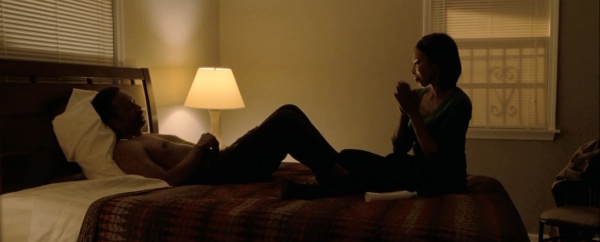
Treme - Season 4 - Yes We Can (ep. 32)
When too long away, returning to an intensely love place, filled with friends and family, it's homecoming. But there's this disorientation, as though everything's just out of focus. That's because, as much as they are the same, the place, the people and yourself have changed. It takes a bit of time to re-adjust, re-orient and bring it all back together.
It's Election Day,New Orleans, 2008. People are fired up. The musicians, including our friend John Boutté, are donating their talents to entertain the long lines of voters thrilled to cast their vote for the first black president of the United States and against the party that screwed New Orleans so royally in 2005
2008 was a long time ago from now, 5 years later, the end of 2013, arguably the worst year for President Obama of either administration. 2005 was a long time ago from 2008, but New Orleans remembers 2005, as they will for all their lives.
2008 was when everything changed again, as change has come for everybody in the series. This appears to be signaled by the change in the opening title sequence -- which are terrific!
It is unbelievable how much got into this episode. This is meant in the very best way. Back when el V and I were young and first married, living here in NYC, there was a weekly public radio station program that charted the history of black music and civil rights. We would shut off the lights, snuggle up in bed and listen. The program was only 60 minutes long, but every week's program took us on a journey that spun us through decades, cities and history -- political as well as cultural -- that took us so far from ourselves and where we were, into places new, marvelous and terrible, and, because of the music all it so familiar at the same time. By the time the program concluded we been very far away for a very long time, a journey that continued as we dropped into dream.
That's what it was like, watching the first episode of Season 4 in Treme. I'm so glad to be home again.
It's Election Day,New Orleans, 2008. People are fired up. The musicians, including our friend John Boutté, are donating their talents to entertain the long lines of voters thrilled to cast their vote for the first black president of the United States and against the party that screwed New Orleans so royally in 2005
| Kermit Ruffins Stokes the Crowd |
![]() |
| Big Chief Albert Lambreauax and LaDonna Batiste-Williams; Albert Being Albert Did Not Vote; LaDonna Did Divorce Larry |
![]() |
| Sonny Is Still Happily Married to His Vietnamese Wife; Even Playing a Few Gigs Again |
![]() |
| Davis is Uncharacteristically Subdued; Antoine, Despite A Bit of Bucking is More Responsible |
It is unbelievable how much got into this episode. This is meant in the very best way. Back when el V and I were young and first married, living here in NYC, there was a weekly public radio station program that charted the history of black music and civil rights. We would shut off the lights, snuggle up in bed and listen. The program was only 60 minutes long, but every week's program took us on a journey that spun us through decades, cities and history -- political as well as cultural -- that took us so far from ourselves and where we were, into places new, marvelous and terrible, and, because of the music all it so familiar at the same time. By the time the program concluded we been very far away for a very long time, a journey that continued as we dropped into dream.
That's what it was like, watching the first episode of Season 4 in Treme. I'm so glad to be home again.
Labels:
Cultural Identity,
culture,
HBO Treme season 4,
music,
New Orleans
Sunday, December 1, 2013
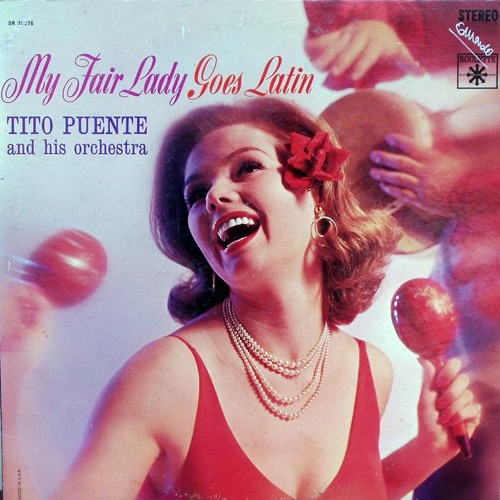
My Fair Lady Goes Latin -- Tito Puente 1964 Album
I had never seen the film version of My Fair Lady until, on one of my last Thanksgivings in Albuquerque, it seemed to run for hours on television. I was transfixed. Ever since I've associated My Fair Lady with this holiday weekend.
But I don't like to watch it any longer, though I still adore the costumes and sets. But you can't look at the clothes and sets without Audrey Hepburn. Some time ago the wide eyed innocent-but-O-so-sophisticated persona of Hepburn's became progressively less tolerable, until watching her on screen in anything made my teeth hurt from the faux sugar. Odd this happening, since I adored Hepburn's persona for years -- but now, I don't.
I mentioned this the other day to el V. So now there's something else that is equally wonderful to whatever My Fair Lady was: Tito Puente's 1964 album, My Fair Lady Goes Latin.
It is really good, but then is Tito Puente and his big band ever anything but really good? Some of the My Fair Lady songs were originally composed with a latin tinge (which I now can recognize when I hear them, but back then -- no), but he makes the songs even more latin, with quite a bit more than a soupçon of jazz arrangement, yet they are always the songs you have known and loved.
A Puerto Rican adaption production of My Fair Lady could compete with no trouble in the production, setting and costume sweepstakes, and certainly vocalists (Audrey Hepburn lipsynched). I'd love to see one. Imagine: Danny Rivera playing Professor Higgins! This would be so great.
But I don't like to watch it any longer, though I still adore the costumes and sets. But you can't look at the clothes and sets without Audrey Hepburn. Some time ago the wide eyed innocent-but-O-so-sophisticated persona of Hepburn's became progressively less tolerable, until watching her on screen in anything made my teeth hurt from the faux sugar. Odd this happening, since I adored Hepburn's persona for years -- but now, I don't.
I mentioned this the other day to el V. So now there's something else that is equally wonderful to whatever My Fair Lady was: Tito Puente's 1964 album, My Fair Lady Goes Latin.
It is really good, but then is Tito Puente and his big band ever anything but really good? Some of the My Fair Lady songs were originally composed with a latin tinge (which I now can recognize when I hear them, but back then -- no), but he makes the songs even more latin, with quite a bit more than a soupçon of jazz arrangement, yet they are always the songs you have known and loved.
A Puerto Rican adaption production of My Fair Lady could compete with no trouble in the production, setting and costume sweepstakes, and certainly vocalists (Audrey Hepburn lipsynched). I'd love to see one. Imagine: Danny Rivera playing Professor Higgins! This would be so great.
Labels:
Afro latin music,
culture,
Puerto Rico,
U.S. culture
Friday, November 29, 2013
Ebony and Ivy: The Secret History of How Slavery Helped Build America’s Elite Colleges
Amy Goodman of Democracy Now interviews Craig Stevens Wilder, the author of Ebony and Ivy: The Secret History of How Slavery Helped Build America’s Elite Colleges (2013).
It's a brilliant work of scholarship, delving into deep historical detail the close relationship between the most highly ranked of the institutions of higher learning in the U.S., slavery and the African-Atlantic slave trade. It also shows how institutions such as Harvard, Yale, Columbia and Princeton deliberately formed a 'science' of eugenics to help forge closer bonds between southern and West Indian planters, who had money to endow chairs and legacies, but who by-and-large had no universities of their own. This is pretty rough stuff.
There is no aspect of the U.S. before the Civil War that wasn't infected with slavery and the slave trade, starting in the colonial era. New England's Indian wars tended to conclude with the captives being shipped to West Indian slave markets and sold. There is no institution after the Civil War that wasn't tainted with white supremacy and Jim Crow. That's depressing.
However, Wilder makes clear there were always members of these institutions too, who throughout this sad history, pushed back against slavery, against white supremacy, eugenics, colonization and the slave trade. Often they suffered for it, but the antagonists persevered.
![]() |
| Craig Steven Wilder, professor, MIT, author of Ebony and Ivy |
There is no aspect of the U.S. before the Civil War that wasn't infected with slavery and the slave trade, starting in the colonial era. New England's Indian wars tended to conclude with the captives being shipped to West Indian slave markets and sold. There is no institution after the Civil War that wasn't tainted with white supremacy and Jim Crow. That's depressing.
However, Wilder makes clear there were always members of these institutions too, who throughout this sad history, pushed back against slavery, against white supremacy, eugenics, colonization and the slave trade. Often they suffered for it, but the antagonists persevered.
AMY GOODMAN: So, talk about America’s most elite universities. What relation do they have to slavery?
CRAIG STEVEN WILDER: I think there are multiple relationships. The first and probably most poignant, most provocative, is the relationship to the slave trade itself. In the middle of the 18th century, from 1746 to 1769—fewer than 25 years, less than a quarter century—the number of colleges in the British colonies triples from three to nine. The original three were Harvard, Yale and William & Mary, and all of a sudden there were nine by 1769. And it triples in that 25-year period. That 25-year period actually coincides with the height of the slave trade. It’s precisely the rise and the elaboration of the Atlantic economy, based on the African slave trade, that allows for this sort of fantastic articulation of new growth of the institutional infrastructure of the colonies.
Thursday, November 28, 2013
Happy Eating Holiday! Plus - Authors!
Has anyone else played this game?
I played Authors constantly, right up until leaving home, taking a deck with me much in the way others brought their tarot decks to college. But I never encountered anyone who had even heard of the game, much less played it, and have not since. Even before leaving home, Authors seems to have become somewhat of an esoteric game. None of my cousins ever played it, and had no interest in learning to, when I'd suggest it on holidays held at our house. So I never played Authors with anyone except my brother and sister, a few people at school -- and in high school my best friend, who was as much a book-and-reading fool as I was.
Today it's deep freeze here, perfect context for me still being sick -- since November 7, fer pete's sake! Every time I feel better and then go out, the next day I feel as miserable as I ever did. That happened yesterday after getting to see clips of Treme's new season on Wednesday night. Nevertheless we are having Thanksgiving and we both have enormous amounts for which to be thankful, thank goodness! :)
As I leisurely begin preparations for dinner I have been thinking of Thanksgivings past.
Some still particularly stand out in memory, several of them in New Mexico.
One of the very best was with a collection of amigos / amigas at a cabin without plumbing or electricity in the Organ Mountains.* The turkeys were wild turkeys, and cooked in an outdoor adobe oven, while everything else was done on a wood burning stove. We were grateful for that stove, particularly after the sun went down. The sky at night! It looked like those over saturated color Sunday School lesson front page of the sky above Palestine at the Nativity. More stars brilliantly sparkling up there than in a jewelry store's diamond case. Knocking back tequila, reciting poetry, dancing to the portable radio, stumbling to the outhouse.
Fine memories.
--------------------------
* Had not yet encountered the mighty and gracious el V -- but I have a splendid New Mexico Thanksgiving memory with him included too! Then it was on to creating NYC Thanksgiving memories, as after we met, I didn't stay much longer in NM -- though I did return for a year at one point, which was a tremendous error in judgment on my part. Or -- maybe not. It turned out to get me what I wanted. But there was no way for me to know that would happen, or even to expect it would.
I played Authors constantly, right up until leaving home, taking a deck with me much in the way others brought their tarot decks to college. But I never encountered anyone who had even heard of the game, much less played it, and have not since. Even before leaving home, Authors seems to have become somewhat of an esoteric game. None of my cousins ever played it, and had no interest in learning to, when I'd suggest it on holidays held at our house. So I never played Authors with anyone except my brother and sister, a few people at school -- and in high school my best friend, who was as much a book-and-reading fool as I was.
Today it's deep freeze here, perfect context for me still being sick -- since November 7, fer pete's sake! Every time I feel better and then go out, the next day I feel as miserable as I ever did. That happened yesterday after getting to see clips of Treme's new season on Wednesday night. Nevertheless we are having Thanksgiving and we both have enormous amounts for which to be thankful, thank goodness! :)
As I leisurely begin preparations for dinner I have been thinking of Thanksgivings past.
Some still particularly stand out in memory, several of them in New Mexico.
One of the very best was with a collection of amigos / amigas at a cabin without plumbing or electricity in the Organ Mountains.* The turkeys were wild turkeys, and cooked in an outdoor adobe oven, while everything else was done on a wood burning stove. We were grateful for that stove, particularly after the sun went down. The sky at night! It looked like those over saturated color Sunday School lesson front page of the sky above Palestine at the Nativity. More stars brilliantly sparkling up there than in a jewelry store's diamond case. Knocking back tequila, reciting poetry, dancing to the portable radio, stumbling to the outhouse.
Fine memories.
--------------------------
* Had not yet encountered the mighty and gracious el V -- but I have a splendid New Mexico Thanksgiving memory with him included too! Then it was on to creating NYC Thanksgiving memories, as after we met, I didn't stay much longer in NM -- though I did return for a year at one point, which was a tremendous error in judgment on my part. Or -- maybe not. It turned out to get me what I wanted. But there was no way for me to know that would happen, or even to expect it would.
Wednesday, November 27, 2013
Reading Wednesday: The Love Affairs of Nathaniel P; The Pursuit of Love; Longbourn
I read two whole novels!
The Love Affairs of Nathaniel P is a new novel (2013), while The Pursuit of Love (1945) is older than I am. I've also read Pursuit more than once before. I'll say it right here at the top that I enjoyed very much reading the older novel again, while feeling rather bored by the new one, despite how self-consciously Adelle Waldman is heiress to narrative techniques refined by that contemporary of Nancy Mitford, Virginia Woolf.
I'll begin with the new one.
One of the primary differences is that while the characters of Natty P are mediocrities who strive mightily to believe in their genius and uniqueness, the incestuous communities of Mitford's Pursuit are fascinating and entertaining (at least, at a safe distance). Monsters some of them are in the habituation of their generationally inherited comfortable complacency about their class privilege. But their steely determination to do what they mean to do, damn the torpedoes, the public opinion of their peers, or the Nazis, are figures who lead lives larger than the average. Compared to the Natty P pipsqueak generation, there were giants walking the earth in the days of the Mitfords.
Making up an untitled trilogy, The Pursuit of Love was followed by Love in a Cold Climate (1949) and Don't tell Alfred (1960). All three novels are narrated by Fanny, a cousin of the semi-fictional Alconleigh Radlett family. The first two are set after WWI, and run into WWII. Don't Tell Alfred is set mostly in France, after the war. Mitford's splendid at committing in print what some of her contemporary writers called the "posh aesthetic" -- a cold cruelty of which the era's Bright Young Things were enamored. It's the sort of thing the Natty P literary lights so aspire to toss off, but they fall so short as to not be on the playing field.
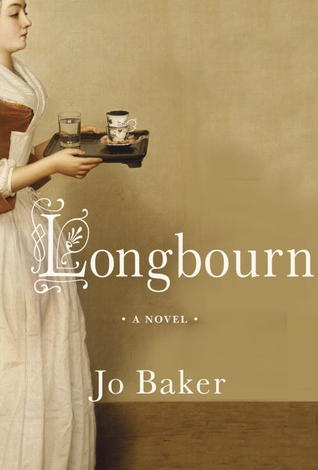
Current novel reading-in-progress is yet another Jane Austen - Pride and Prejudice spin-off, Longbourn (2013).*
This one is a cut above of the usual attempts that bite Jane Austen's superlative works. It focuses the working class, particularly the female servants who empty the Bennets' chamber pots, launder their menstrual napkins, scrub their mud-caked petticoats and skirts. They do this in winter, with chilblained hands, in thee summer in sweat soaked bodices. They cook, clean, listen to the whines, cater to the tantrums, and serve, twenty-four hours a day, seven days a week. They cannot expect better either, not in this world of too many women (due to the wars), few jobs and less opportunity for upward mobility.
There is a melodramatic secret in the center of the book, which the reader sees coming from very early on. Since I've identified the looming secret, know its solution too, there isn't much incentive to keep reading. I already know what it would be like living below stairs in the Bennet household, having read many histories of the condition. Indeed, I thought of it even before reading such works, a farm girl imagining that house filled with women having their periods at the same time, and what this would mean for laundry .... Language usages and ways of seeing and thinking from our own era creep into the text more often than the author seems to have noticed too.
-----------------
* Earlier this month I tried to read Joanna Trollope's Sense and Sensibility (2013), the first in the series by famous authors to write contemporary versions of Jane Austen's works.
It was a ridiculous effort -- yet I have read many of this author's own novels with pleasure. It's just not possible to recreate in contemporary terms the dilemmas facing women of the English class-based early 19th century. I wish They wouldn't do this. But Jane Austen makes money, so let us come up with every permutation to wring dollars / lbs out of her, since few contemporary novels sell as well as Austen's do.
There's a reason for that. Austen wrote novels out of her own mind, creation and experience. Most writers now are biting what came before or what someone else is currently doing. Imitation of a novel does not a novel make.
The Love Affairs of Nathaniel P is a new novel (2013), while The Pursuit of Love (1945) is older than I am. I've also read Pursuit more than once before. I'll say it right here at the top that I enjoyed very much reading the older novel again, while feeling rather bored by the new one, despite how self-consciously Adelle Waldman is heiress to narrative techniques refined by that contemporary of Nancy Mitford, Virginia Woolf.
I'll begin with the new one.
Natty P is the narrator of this description of a group of New Yorkers maybe three of four years ahead of Lena Denham's cohort. Natty P's people rotate in various degrees of intimacy within the larger constellation of the intersecting publishing vectors: reviewers for online zines like Gawker, editorial assistants for magazine like Vogue, novelists with first contracts. All of them intend to be published authors.
One and all they have graduated from programs at no lesser institution than George Washington University (though Harvard is by far the top of the list to name-drop as alma mater, and is name dropped on every page; Natty P graduated Harvard). Often they were recipients of prestigious literary prizes awarded by a program at that institution like this one. Yet even the poet of the novel, winner of a Stanford undergrad poetry prize, cannot find a job in NYC's publishing world worthy of her. The job market into which they graduated is unfair. Whether there were ample entry level jobs out there or not, these individuals do not think they should have to be in them. Those positions are for those who didn't go to Harvard.
One and all name check Italo Svevo (James Joyce who?) as their benchmark when assessing the brilliance of new acquaintance, or deciding someone might be worthy to have sex with. As well as quantifying the endless varieties of their brilliance, they minutely categorize everything else about themselves and each other -- including the toilet paper, and, toothpaste they buy and why. (Fascinated by them yet?) They hold in solidarity the conviction of personal exceptionalism, yet they are consumer driven lemmings, dashing in waves here and there according to what the media market orders them. They don't seem to have any fun other than on occasion feeling they've out-mot juste-ed a friend.
Described in detail as it may be, they aren't interested much in sex either, other than as score-keeping. This is the saddest part. No matter how well suited a woman might be for Natty P, he will soon see her physical flaws, and that's it. No one is physically perfect enough in their eyes for sex and love, including themselves. They are dreary, predictable and dull, hypnotized by the surperficial markers corporations have told them are identities.
Note: not a single character of color or anyone of any other class (such as those who don't go to Harvard) inhabit this world or enters their consciousness. Occasionally they see a poor person or a hardworking immigrant in the cold and they examine their vague feeling of guilt, and that takes care of that by providing them a sense of themselves as sensitive and compassionate. All of them have families well-heeled enough they can always go back home. Nevertheless they carry with them a sense of being victimized by society. For example one of them carries a chip that he doesn't like to examine much, but does like the tongue going to an infected tooth -- that he wasn't born a WASP. Yet he feels he is infinitely superior because WASPS are shallow and boring.
It's a beautifully written novel. However I cannot tell whether the author's intended take-away of these people is what I did take away: useless creatures, who are neither provocative or entertaining, with whom I'd never want to have a beer or a flute of champagne. I may be out-of-step generationlly though. Perhaps like Lena Dunham's writer character Hannah in Girls, who thinks she might be "the voice her generation, or a voice of a generation," Adelle Waldman is the voice of her generation. Waldman's generation thinks so, having declared this the greatest novel so far of the 21st century, and the shoe in for the fiction Pulitzer and National Book Awards.
After that meticulous assault in granular detail by the most minutely trivial of the terminally predictable it was a joy to sail upon the astringent waters of the old book's characters forthright self-regard. They came up in a hard, hard school.
Making up an untitled trilogy, The Pursuit of Love was followed by Love in a Cold Climate (1949) and Don't tell Alfred (1960). All three novels are narrated by Fanny, a cousin of the semi-fictional Alconleigh Radlett family. The first two are set after WWI, and run into WWII. Don't Tell Alfred is set mostly in France, after the war. Mitford's splendid at committing in print what some of her contemporary writers called the "posh aesthetic" -- a cold cruelty of which the era's Bright Young Things were enamored. It's the sort of thing the Natty P literary lights so aspire to toss off, but they fall so short as to not be on the playing field.
Current novel reading-in-progress is yet another Jane Austen - Pride and Prejudice spin-off, Longbourn (2013).*
This one is a cut above of the usual attempts that bite Jane Austen's superlative works. It focuses the working class, particularly the female servants who empty the Bennets' chamber pots, launder their menstrual napkins, scrub their mud-caked petticoats and skirts. They do this in winter, with chilblained hands, in thee summer in sweat soaked bodices. They cook, clean, listen to the whines, cater to the tantrums, and serve, twenty-four hours a day, seven days a week. They cannot expect better either, not in this world of too many women (due to the wars), few jobs and less opportunity for upward mobility.
There is a melodramatic secret in the center of the book, which the reader sees coming from very early on. Since I've identified the looming secret, know its solution too, there isn't much incentive to keep reading. I already know what it would be like living below stairs in the Bennet household, having read many histories of the condition. Indeed, I thought of it even before reading such works, a farm girl imagining that house filled with women having their periods at the same time, and what this would mean for laundry .... Language usages and ways of seeing and thinking from our own era creep into the text more often than the author seems to have noticed too.
-----------------
* Earlier this month I tried to read Joanna Trollope's Sense and Sensibility (2013), the first in the series by famous authors to write contemporary versions of Jane Austen's works.
It was a ridiculous effort -- yet I have read many of this author's own novels with pleasure. It's just not possible to recreate in contemporary terms the dilemmas facing women of the English class-based early 19th century. I wish They wouldn't do this. But Jane Austen makes money, so let us come up with every permutation to wring dollars / lbs out of her, since few contemporary novels sell as well as Austen's do.
There's a reason for that. Austen wrote novels out of her own mind, creation and experience. Most writers now are biting what came before or what someone else is currently doing. Imitation of a novel does not a novel make.
Tuesday, November 26, 2013
Tonight - Tuning Into Treme With Special Guest Eric Overmyer
The final, truncated season of Treme opens (HBO) this comming Sunday, December 1.
I hope the frightful weather advisory doesn't keep us or anyone else away.
Here are the details of the event, held at the National Jazz Museum in Harlem.
I hope the frightful weather advisory doesn't keep us or anyone else away.
Here are the details of the event, held at the National Jazz Museum in Harlem.
Labels:
African American culture,
HBO Treme,
Jazz,
New Orleans
Subscribe to:
Posts (Atom)